
Educational Planning Planning Adesina 1990 defines planning as

- Slides: 20
Educational Planning
Planning • Adesina (1990) defines planning as ‘ a way of projecting our intentions, that is, a method of deciding what we want to accomplish’. • Ejiogu (1990) holds that ‘to plan, means to project, forecast, design or make or chart our a course’. • From these views, it can be summarized that ‘planning refers to the act of deciding in advance what is to be done, how and when to do it, where and who is to do it in order to achieve the goals or objectives of the system’.
Cont … • A plan is a detailed scheme, programme or method worked out before hand for the purpose of achieving a set objective. There are three basic elements in a plan, it deals with the future involves action and identifies who is to implement the future action. • Planning bridges the gap between where we are and where we want to be.
Definition of Educational Planning • The process of setting out in advance, strategies, policies, procedures, programmes and standards through which an educational objective can be achieved. • Educational planning is a preparation phase in the decision making process. It helps to determine the optimal decision.
Educational Planning • Educational planning is a detailed and systematic process: it just does not happen by chance. • It is goal-oriented: it is directed at achieving a set of educational objectives.
THE EDUCATIONAL PLANNING PROCESS • Plan survey and deliberations • Definition of goals and objectives • Programs design and specification • Program provision • Implementation and control • Plan Evaluation and plan regeneration (Peretomode, 1991).
Characteristics of Educational. Planning • Primacy of Planning is the first step in management. It takes precedence over all the other managerial functions. Everybody plans even though not everybody plans well. As a teacher, you plan your lessons before you go to teach them. • Planning is pervasive: By this, we mean that planning cuts across all levels of management and all the other managerial functions. Whether at the primary, secondary or university level of education, planning is done. For example the managerial functions of organizing, staffing, etc involve some planning.
Cont • Planning is Mission - Oriented: Planning involves the mapping out or charting of activities in such a way that it helps to satisfy human wants. Thus, planning is goal-directed i. e planning is directed at achieving a specified goal or a set of goals. • Planning is Future-Oriented. Planning as said earlier on, is a process of deciding in advance what should be done in future, how it is to be done, who will do it, when and where to do it. This process takes into consideration past trends and present experiences in order to project into the future.
Educational Planning Process(Braod) • Statement of educational objectives: • The educational objectives must be identified and clearly stated. This will ensure that there is no confusion about the objectives. • Identification of various activities: Various activities which are needed to achieve the stated objectives must be clearly identified. • Evaluation of results: Evaluation should be related to the stated objectives.
USES OF EDUCATIONAL PLANNING • Identification of Objectives and strategies: By this we mean that educational planning helps in identifying and defining the objectives and the strategies, programmes, procedures, policies and standards which education needs to be more effective and efficient. • Proper Distribution of Scarce Resources: By scarce resources, we mean the limited resources which are available to satisfy our wants (needs). • Educational Planning aids decision making: Educational Planning helps decision makers at all levels to reach a better and well informed decision.
THE NEED OF EDUCATIONAL PLANNING • Resources are limited: Thus the need to determine in advance a programme of action for the attainment of the goal within a given time. • To achieve maximum effectiveness, efficiency: Adequate plans help to direct and co-ordinate the actions of employees in order to achieve maximum effectiveness, efficiency and productivity. • Help in administrative decisions: Planning is necessary for administrative decisions in education, for it aims at putting into action what educators deems to achieve.
Cont • Clear choices: Planning enables a nation to make its choices clear in terms of the aim and objectives. • Optimum Utilization of Resources: Educational plans are designed to avoid imbalances and enormous wastes and replenish the steadily aggravated shortage of teachers.
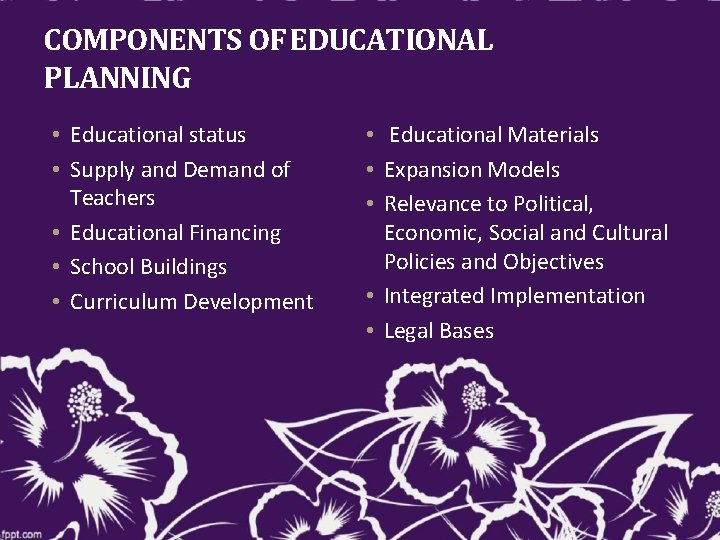
COMPONENTS OF EDUCATIONAL PLANNING • Educational status • Supply and Demand of Teachers • Educational Financing • School Buildings • Curriculum Development • Educational Materials • Expansion Models • Relevance to Political, Economic, Social and Cultural Policies and Objectives • Integrated Implementation • Legal Bases
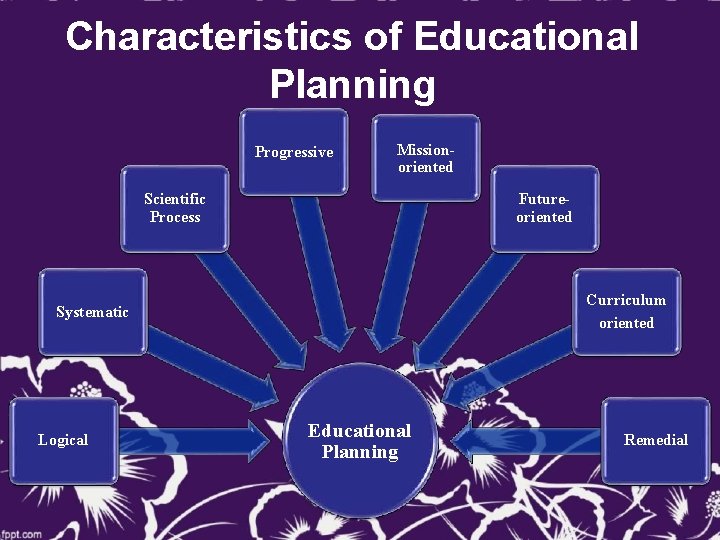
Characteristics of Educational Planning Progressive Missionoriented Scientific Process Futureoriented Curriculum oriented Systematic Logical Educational Planning Remedial
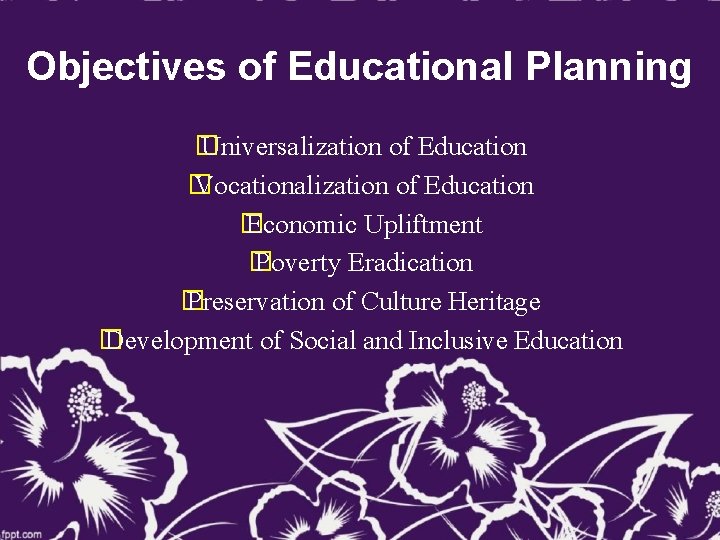
Objectives of Educational Planning � Universalization of Education � Vocationalization of Education � Economic Upliftment � Poverty Eradication � Preservation of Culture Heritage � Development of Social and Inclusive Education
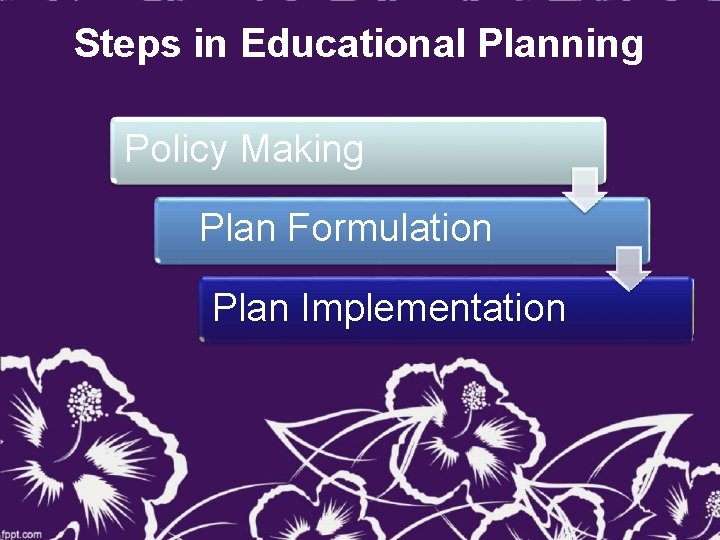
Steps in Educational Planning Policy Making Plan Formulation Plan Implementation
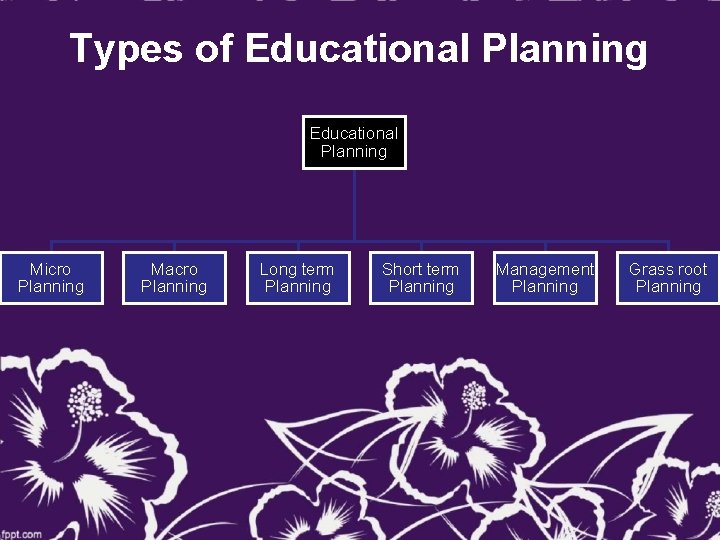
Types of Educational Planning Micro Planning Macro Planning Long term Planning Short term Planning Management Planning Grass root Planning
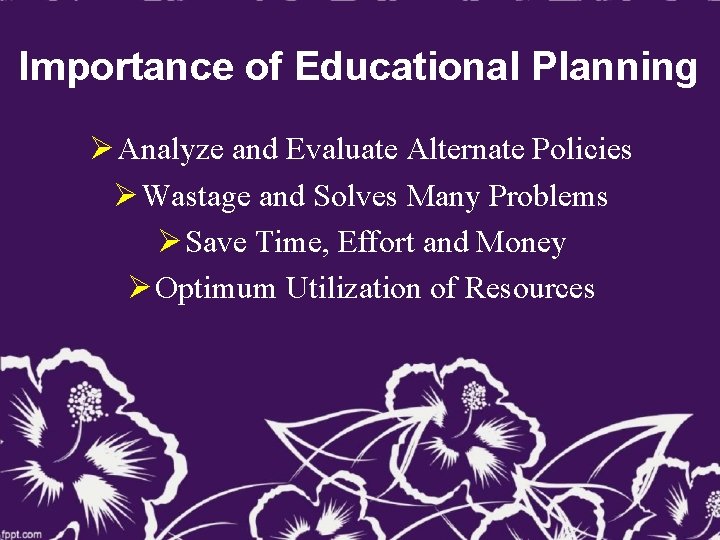
Importance of Educational Planning Analyze and Evaluate Alternate Policies Wastage and Solves Many Problems Save Time, Effort and Money Optimum Utilization of Resources
References • http: //www. shareyouressays. com/100974/6 -reasons-whyeducational-planning-is-important-for-academic-institutions • Adesina S. Educational Management, FDP Education Series, Enugu: Fourth Dimension Publishing Co. Ltd. , 1990. • Peretomode, V. A (1991): Introduction to Educational Administration, Planning and supervision. Lagos’ Joja publishers ltd. • Advanced
THANK YOU