
Educational expectations How they differ around the world

![Excerpt 3 • “[In a global society, R]ecognizing societal culture and cross-cultural similarities and](https://slidetodoc.com/presentation_image_h2/b8360390983810cf033d5798aa1b8954/image-12.jpg "Excerpt 3 • “[In a global society, R]ecognizing societal culture and cross-cultural similarities and")
- Slides: 13
Educational expectations: How they differ around the world: Implications for teaching ESL college students Presented by Tonya Kaushik February 22, 2012 ESL 5320
Article summary • Commonalities and differences in educational practices around the world • Varying models of teacher-student interactions and teaching methodologies • Ways Western ESL teachers can become more culturally sensitive to their ESL students’ needs
Excerpt 1 • “Reviewing the literature about educational approache around the world reveals certain commonalities and also some striking differences. It is essential when learning about these various approaches that our own orientation and value system be suspended (at least temporarily), so that each educational system can be understood in terms of the sociopolitical culture in which it is embedded” (p. 433).
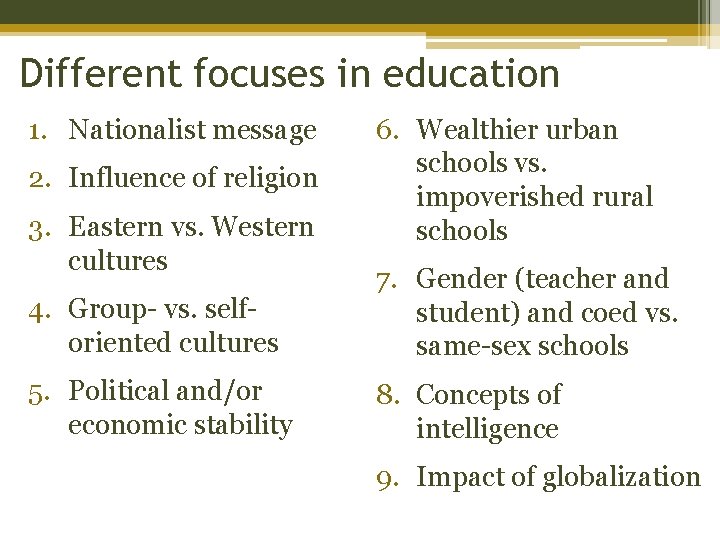
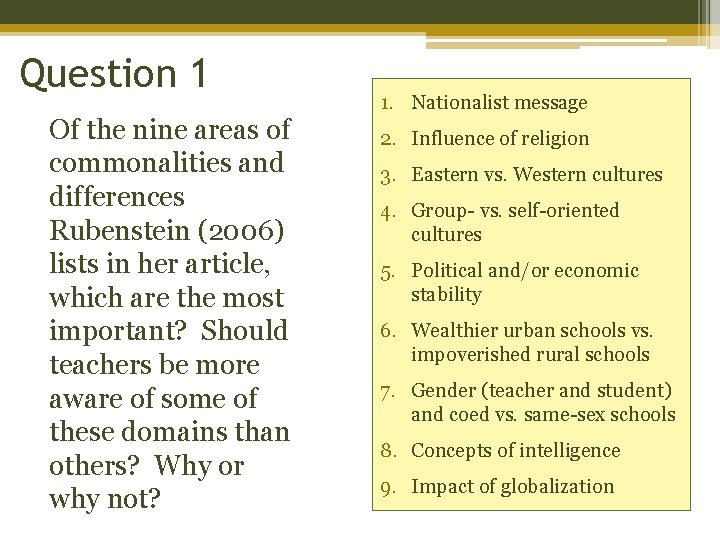
Different focuses in education 1. Nationalist message 2. Influence of religion 3. Eastern vs. Western cultures 6. Wealthier urban schools vs. impoverished rural schools 4. Group- vs. selforiented cultures 7. Gender (teacher and student) and coed vs. same-sex schools 5. Political and/or economic stability 8. Concepts of intelligence 9. Impact of globalization
Question 1 Of the nine areas of commonalities and differences Rubenstein (2006) lists in her article, which are the most important? Should teachers be more aware of some of these domains than others? Why or why not? 1. Nationalist message 2. Influence of religion 3. Eastern vs. Western cultures 4. Group- vs. self-oriented cultures 5. Political and/or economic stability 6. Wealthier urban schools vs. impoverished rural schools 7. Gender (teacher and student) and coed vs. same-sex schools 8. Concepts of intelligence 9. Impact of globalization
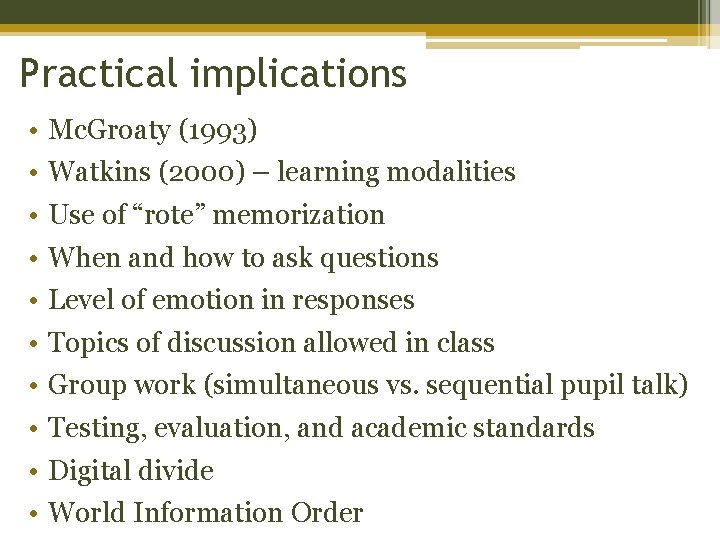
Practical implications • • • Mc. Groaty (1993) Watkins (2000) – learning modalities Use of “rote” memorization When and how to ask questions Level of emotion in responses Topics of discussion allowed in class Group work (simultaneous vs. sequential pupil talk) Testing, evaluation, and academic standards Digital divide World Information Order
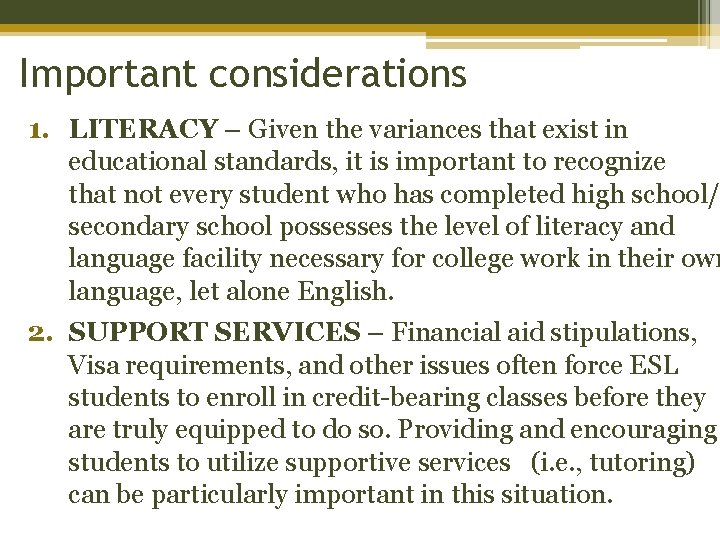
Important considerations 1. LITERACY – Given the variances that exist in educational standards, it is important to recognize that not every student who has completed high school/ secondary school possesses the level of literacy and language facility necessary for college work in their own language, let alone English. 2. SUPPORT SERVICES – Financial aid stipulations, Visa requirements, and other issues often force ESL students to enroll in credit-bearing classes before they are truly equipped to do so. Providing and encouraging students to utilize supportive services (i. e. , tutoring) can be particularly important in this situation.
Important considerations, continued 3. DISCUSSIONS – Discussion topics should be assigned judiciously. Teachers might want to be alert to indications that a particular topic may have inadvertently hit a nerve. Such signs would include verbal reticence or writer’s block in an otherwise involved and cooperative student. 4. CULTURE SHOCK – Continuing lack of engagement may be symptomatic of the depression that often accompanies various stages of the immigration and acculturation process (Brilliant, 2000; Brilliant et al. , 1995). Consulting an ESL counselor and encouraging the student to do the same may be helpful.
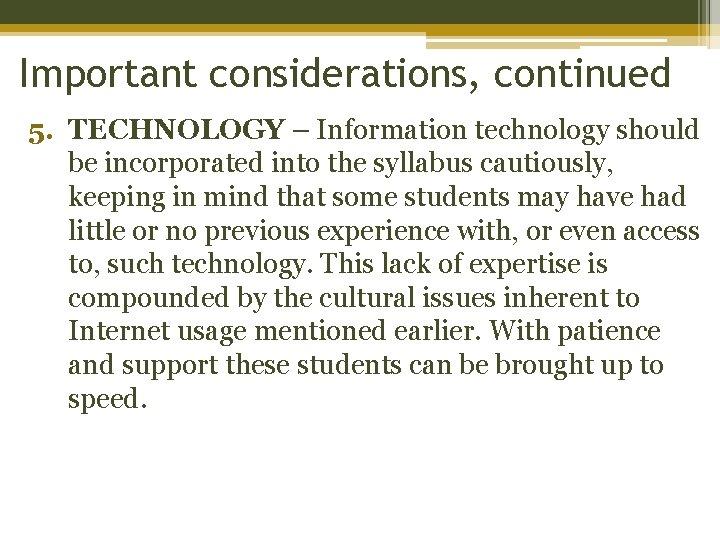
Important considerations, continued 5. TECHNOLOGY – Information technology should be incorporated into the syllabus cautiously, keeping in mind that some students may have had little or no previous experience with, or even access to, such technology. This lack of expertise is compounded by the cultural issues inherent to Internet usage mentioned earlier. With patience and support these students can be brought up to speed.
Important considerations, continued 6. INTERVENTIONS – Asking for help is difficult for many students, particularly those from cultures where this is seen as a sign of weakness or failure. If it appears that a student is struggling, rather than waiting for them to seek help, it may be advisable to request, even insist, that he or she schedule a private consultation to discuss the situation. Depending on the circumstances, appropriate interventions might include providing academic assistance or appropriate referrals for counseling and/or tutoring, or other services.
Excerpt 2 • “Continuing lack of engagement may be symptomatic of the depression that often accompanies various stages of the immigration and acculturation process (Brilliant, 2000 ; Brilliant et al. , 1995). Consulting an ESL counselor and encouraging the student to do the same may be helpful” (p. 439 -440).
Excerpt 3 • “[In a global society, R]ecognizing societal culture and cross-cultural similarities and differences becomes more, not less important. . [W]e need to avail ourselves of the knowledge our students can impart to us as we seek to guide and mentor them towards the deeper learning that is always more gratifying for the student and teacher alike” (p. 440).
Conclusion • Examine other cultures’ educational models in order to gain insight into students’ needs. • Realize that every student’s situation is different. • “What works in one setting may be disastrous in another” (p. 440).