
Education Quotes Education is the most powerful weapon



![] List of banks in Ethiopia Year Est. 2010 2011 1994 1996 2010 2009](https://slidetodoc.com/presentation_image_h2/67124eea5d04cbe73830999d486e2e0c/image-17.jpg "] List of banks in Ethiopia Year Est. 2010 2011 1994 1996 2010 2009")




- Slides: 49
Education Quotes Education is the most powerful weapon which you can use to change the world. . Education is the passport to the future, for tomorrow belongs to those who prepare for it today. . Education is An investment in knowledge pays the best interest. Dr. Krishna Gadasandula
Welcome to all 2 nd Year MBA. Students Dr. Krishna Gadasandula M. B. A. , M. Com. M. Phil. and Ph. D. With more than ten years of experience in Accounting and Finance Teaching, Research, Training & Education Management. Mail: krishnagadasandula@gmail. com, # +91 9866349726 -, 0904565415(Local Phone No. ) Hyderabad. India.
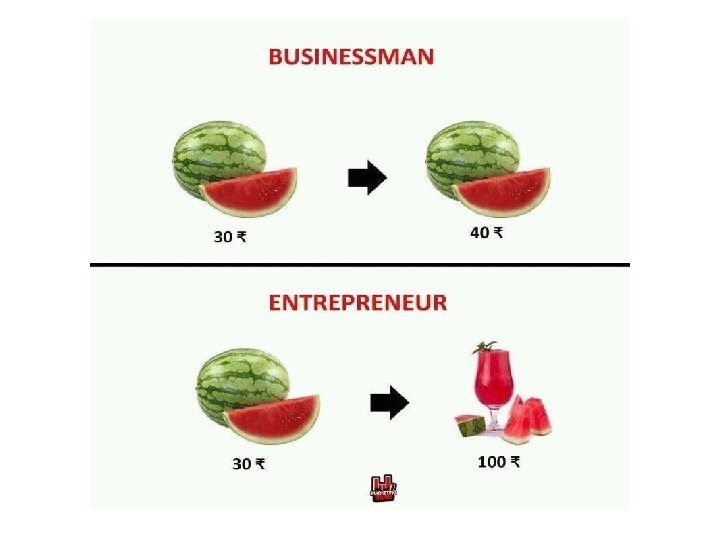
What is the Difference between Businessman and Entrepreneur?
Activity-Based Costing System Dr. G. Krishna
Course Title: Financial Markets & Institutions : MBA 5052 Instructor: Dr. Krishna Gadasandula Course Code current batch cr ph no. +251 91870 7232 +251 911998132 ok Advanced Management Accounting: 5
Financial Markets and Institutions: Syllabus Advanced Management Accounting: 6
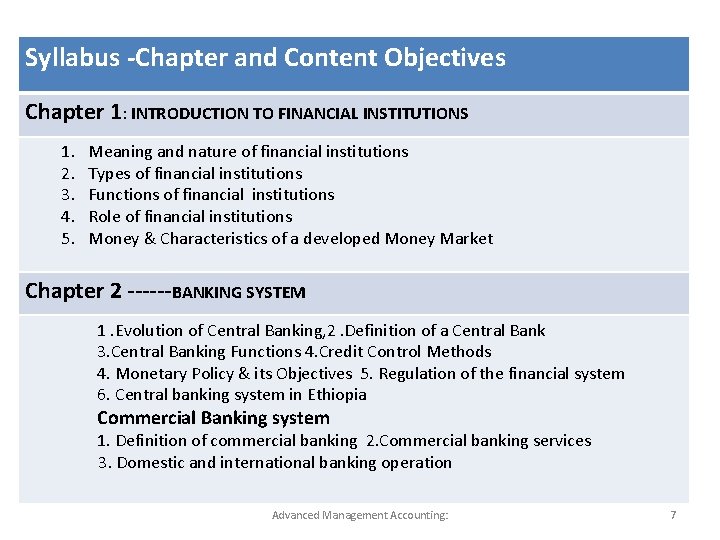
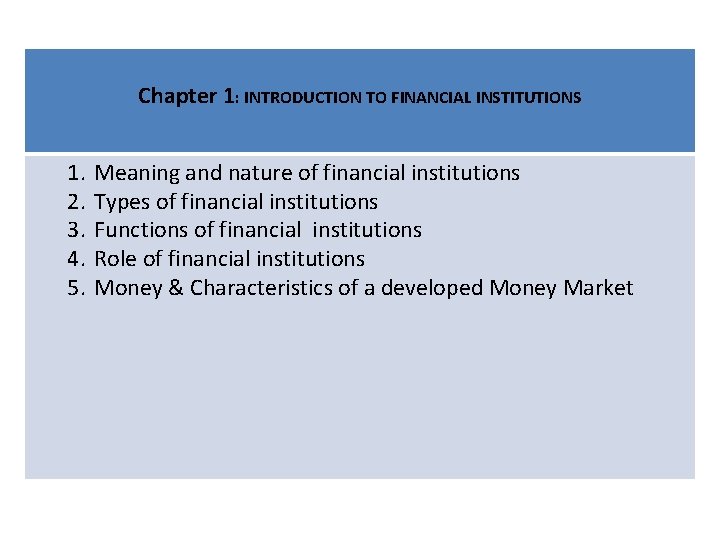
Syllabus -Chapter and Content Objectives Chapter 1: INTRODUCTION TO FINANCIAL INSTITUTIONS 1. 2. 3. 4. 5. Meaning and nature of financial institutions Types of financial institutions Functions of financial institutions Role of financial institutions Money & Characteristics of a developed Money Market Chapter 2 ------BANKING SYSTEM 1. Evolution of Central Banking, 2. Definition of a Central Bank 3. Central Banking Functions 4. Credit Control Methods 4. Monetary Policy & its Objectives 5. Regulation of the financial system 6. Central banking system in Ethiopia Commercial Banking system 1. Definition of commercial banking 2. Commercial banking services 3. Domestic and international banking operation Advanced Management Accounting: 7
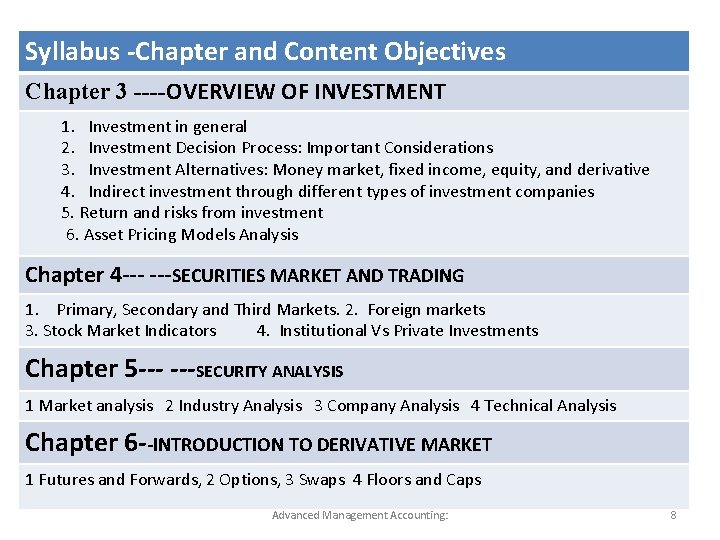
Syllabus -Chapter and Content Objectives Chapter 3 ----OVERVIEW OF INVESTMENT 1. Investment in general 2. Investment Decision Process: Important Considerations 3. Investment Alternatives: Money market, fixed income, equity, and derivative 4. Indirect investment through different types of investment companies 5. Return and risks from investment 6. Asset Pricing Models Analysis Chapter 4 --- ---SECURITIES MARKET AND TRADING 1. Primary, Secondary and Third Markets. 2. Foreign markets 3. Stock Market Indicators 4. Institutional Vs Private Investments Chapter 5 --- ---SECURITY ANALYSIS 1 Market analysis 2 Industry Analysis 3 Company Analysis 4 Technical Analysis Chapter 6 --INTRODUCTION TO DERIVATIVE MARKET 1 Futures and Forwards, 2 Options, 3 Swaps 4 Floors and Caps Advanced Management Accounting: 8
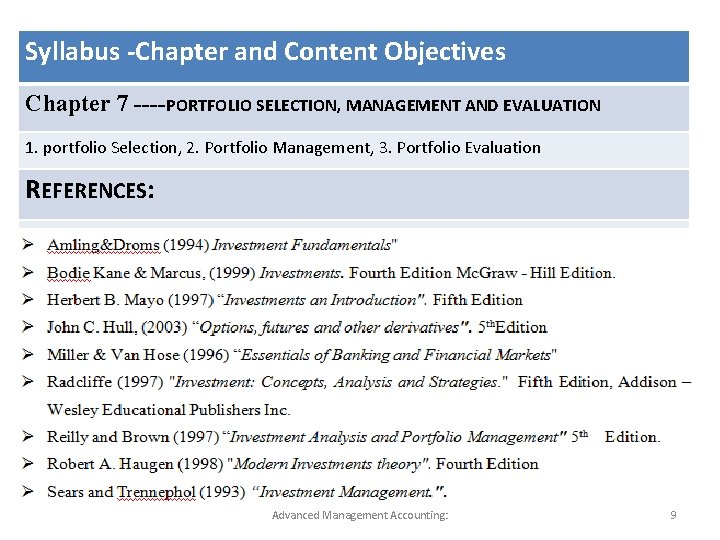
Syllabus -Chapter and Content Objectives Chapter 7 ----PORTFOLIO SELECTION, MANAGEMENT AND EVALUATION 1. portfolio Selection, 2. Portfolio Management, 3. Portfolio Evaluation REFERENCES: Advanced Management Accounting: 9
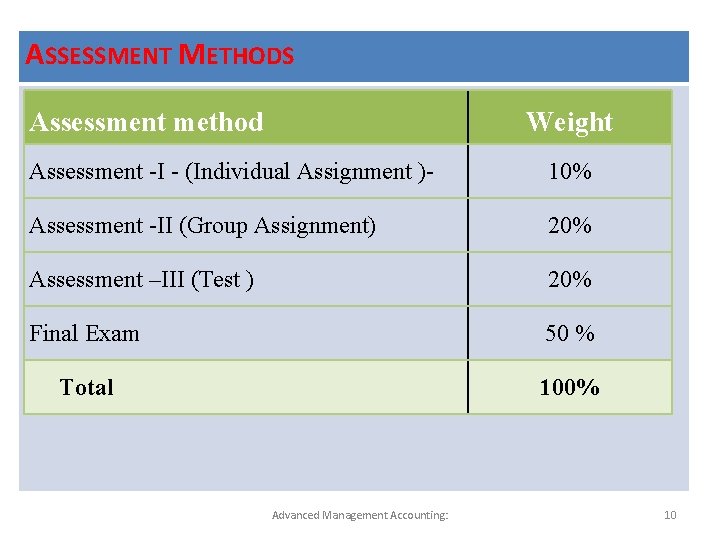
ASSESSMENT METHODS Assessment method Weight Assessment -I - (Individual Assignment )- 10% Assessment -II (Group Assignment) 20% Assessment –III (Test ) 20% Final Exam 50 % Total 100% Advanced Management Accounting: 10
Chapter 1: INTRODUCTION TO FINANCIAL INSTITUTIONS 1. 2. 3. 4. 5. Meaning and nature of financial institutions Types of financial institutions Functions of financial institutions Role of financial institutions Money & Characteristics of a developed Money Market ?
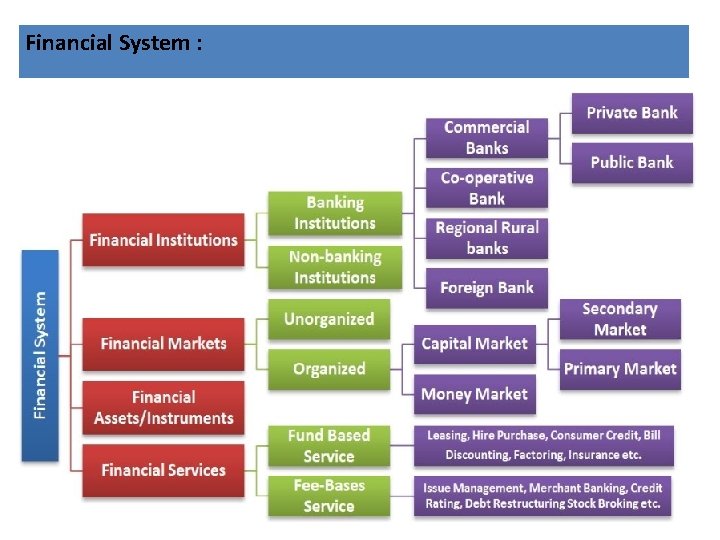
Financial System : 1. 2. 3. 4. 5. Meaning and nature of financial institutions Types of financial institutions Functions of financial institutions Role of financial institutions Money & Characteristics of a developed Money Market ?
Meaning and nature of financial institutions
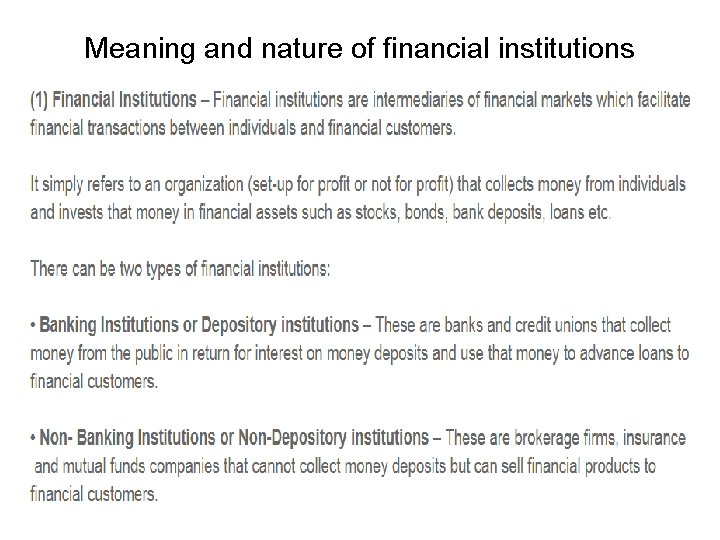
Meaning and nature of financial institutions
Types Of Financial Institutions, functions And Their Roles
How many banks are there in Ethiopia?
] List of banks in Ethiopia Year Est. 2010 2011 1994 1996 2010 2009 1963 No of Branches 159[2] 54[4] 191 233[6] 46 72 1192[8] 2005 190 9 10 Bank Name Abay Bank S. C. Addis International Bank Awash International Bank of Abyssinia Berhan International Bank Bunna International Bank Commercial Bank of Ethiopia Cooperative Bank of Oromia(s. c. ) Dashen Bank Debub Global Bank 2003 2012 146[10] 32 11 12 13 Development Bank of Ethiopia Enat Bank Lion International Bank 1909 2013 2006 43 7 67 14 Nib International Bank 1999 98 15 16 17 18 Oromia International Bank United Bank Wegagen Bank Zemen Bank Total 2008 1997 2009 115 108[11] 211[12] 1 2357 1 2 3 4 5 6 7 8
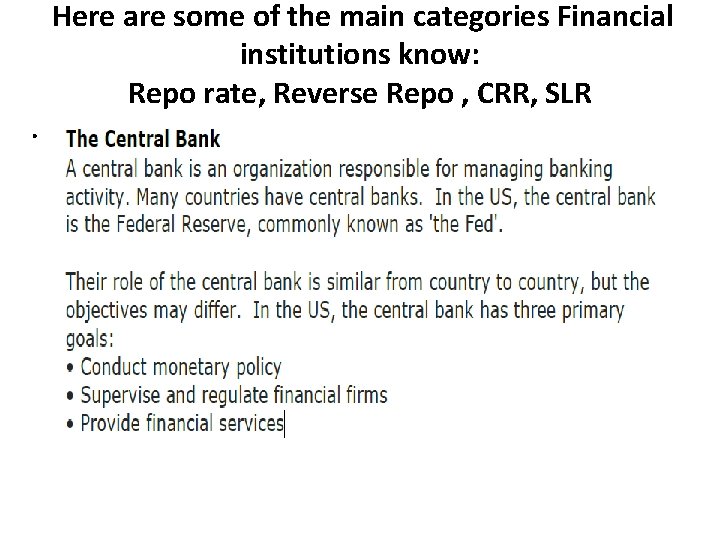
Here are some of the main categories Financial institutions know: Repo rate, Reverse Repo , CRR, SLR.
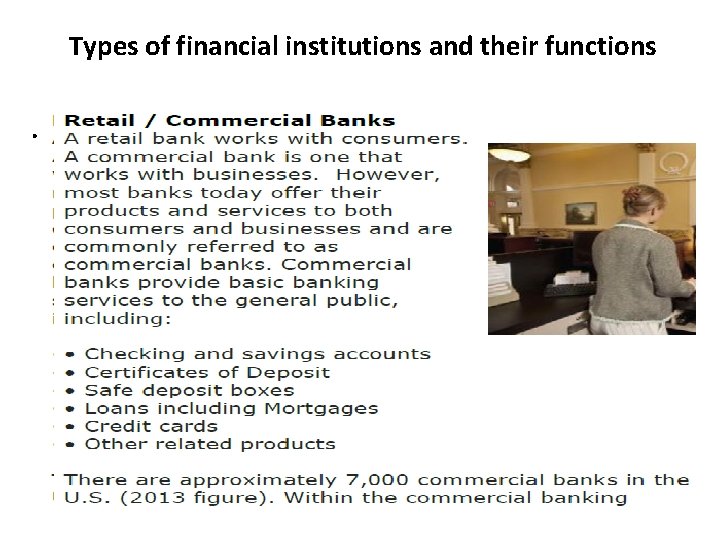
Types of financial institutions and their functions.
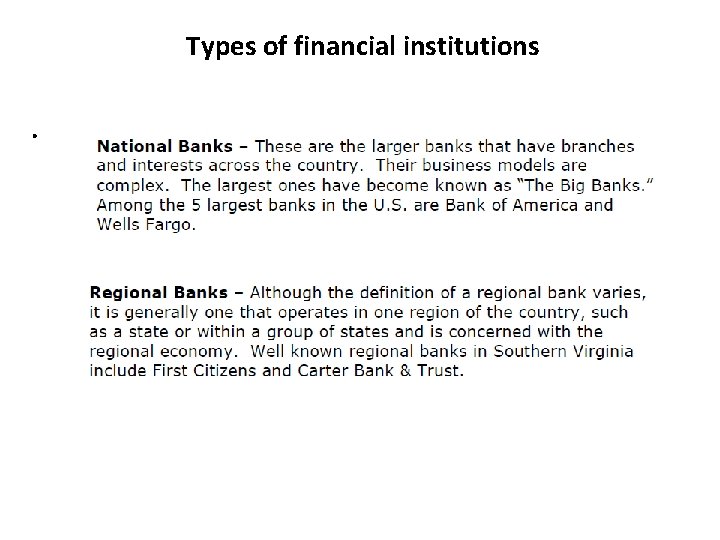
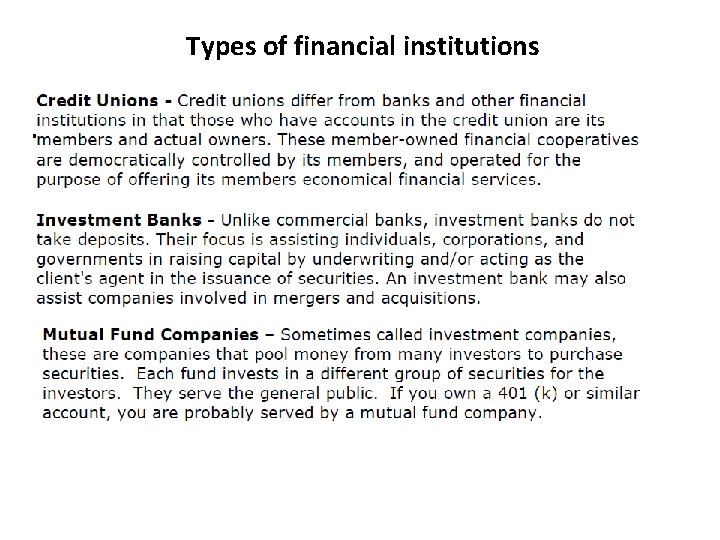
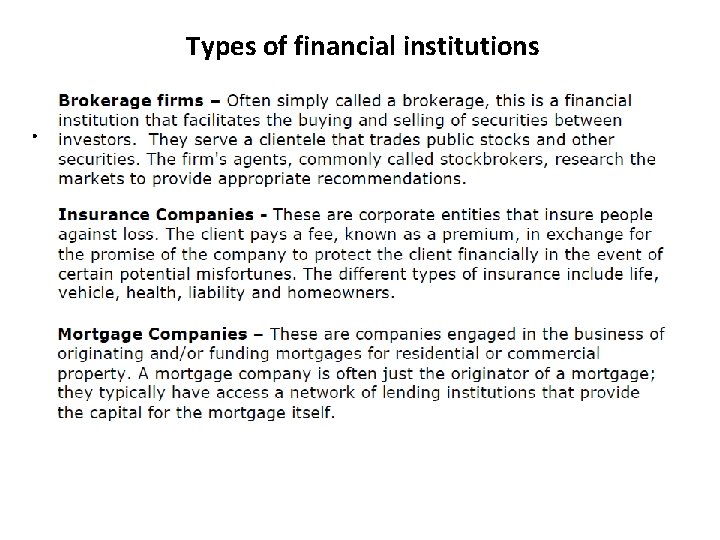
Types of financial institutions.
Types of financial institutions.
Types of financial institutions.
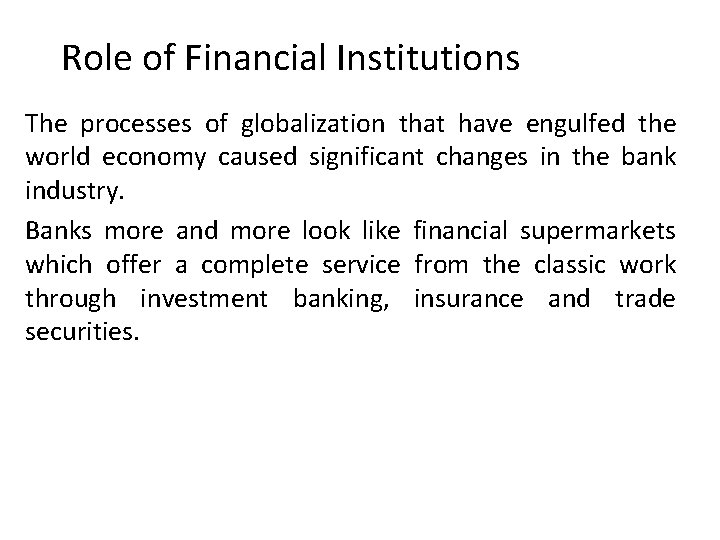
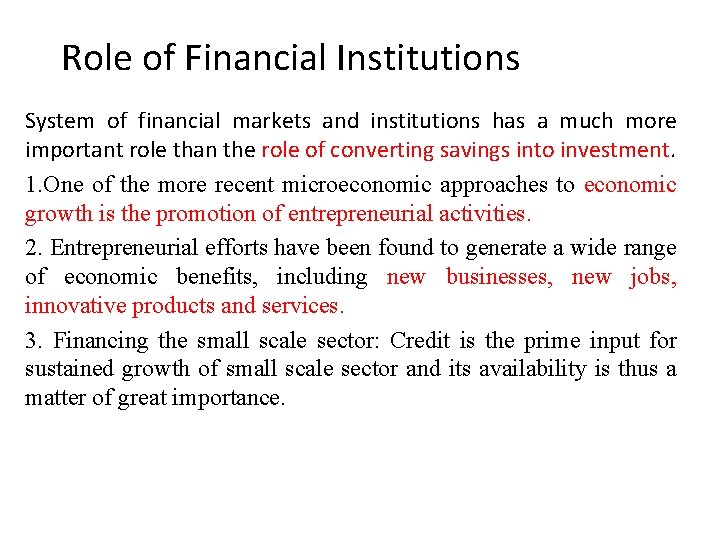
Role of Financial Institutions The processes of globalization that have engulfed the world economy caused significant changes in the bank industry. Banks more and more look like financial supermarkets which offer a complete service from the classic work through investment banking, insurance and trade securities.
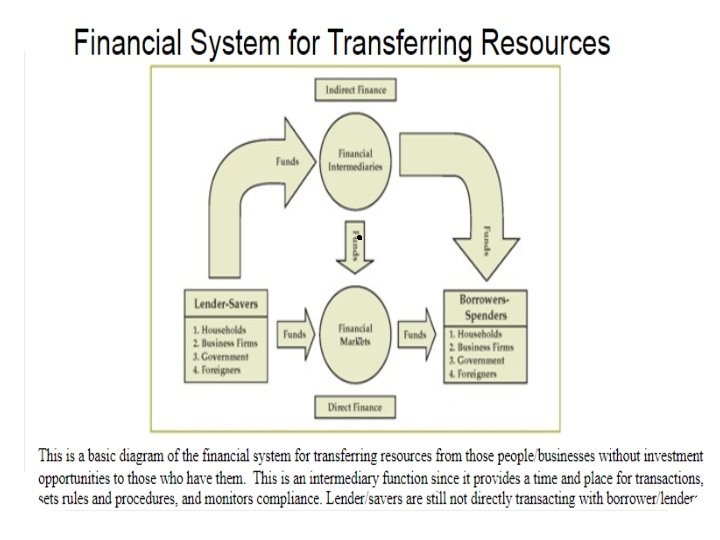
Role of Financial Institutions System of financial markets and institutions has a much more important role than the role of converting savings into investment. 1. One of the more recent microeconomic approaches to economic growth is the promotion of entrepreneurial activities. 2. Entrepreneurial efforts have been found to generate a wide range of economic benefits, including new businesses, new jobs, innovative products and services. 3. Financing the small scale sector: Credit is the prime input for sustained growth of small scale sector and its availability is thus a matter of great importance.
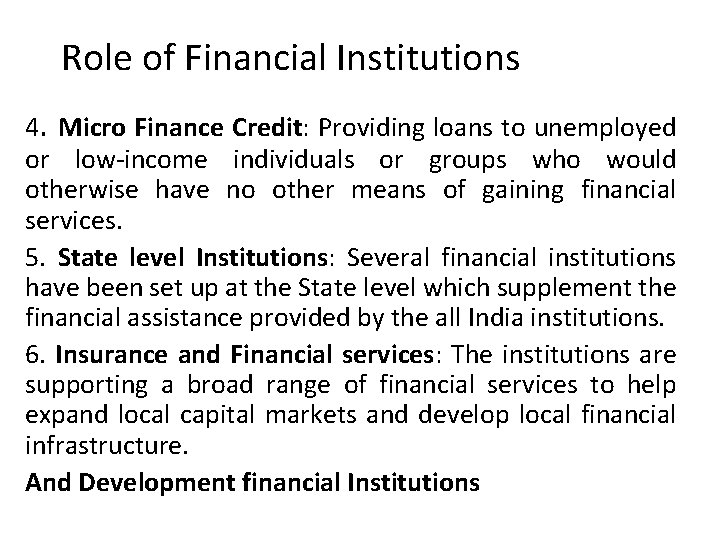
Role of Financial Institutions 4. Micro Finance Credit: Providing loans to unemployed or low-income individuals or groups who would otherwise have no other means of gaining financial services. 5. State level Institutions: Several financial institutions have been set up at the State level which supplement the financial assistance provided by the all India institutions. 6. Insurance and Financial services: The institutions are supporting a broad range of financial services to help expand local capital markets and develop local financial infrastructure. And Development financial Institutions
Home Assignment Write a Note on Development financial Institutions in Ethiopia.
Financial Market
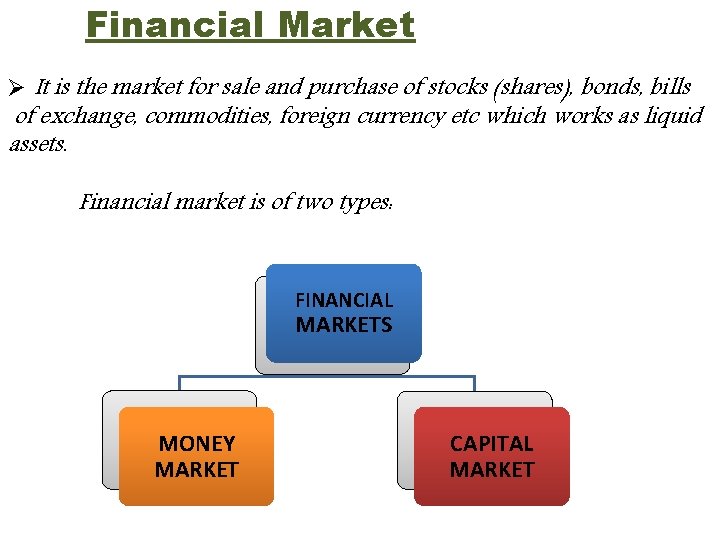
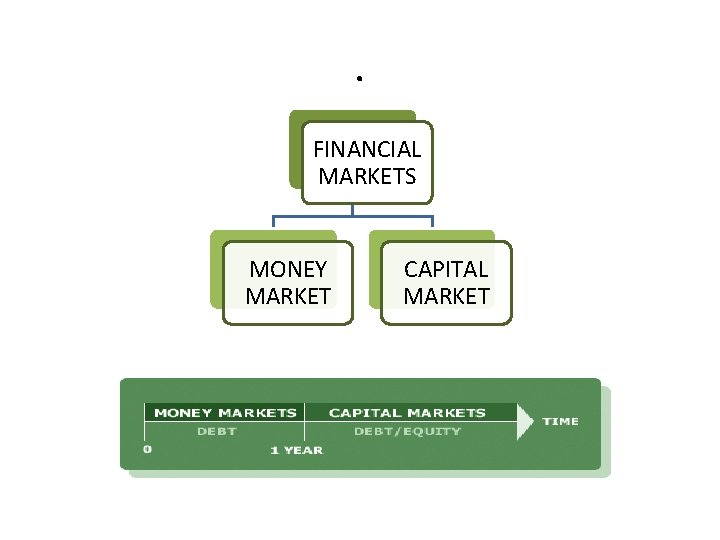
Financial Market Ø It is the market for sale and purchase of stocks (shares), bonds, bills of exchange, commodities, foreign currency etc which works as liquid assets. Financial market is of two types: FINANCIAL MARKETS MONEY MARKET CAPITAL MARKET
. FINANCIAL MARKETS MONEY MARKET CAPITAL MARKET
MONEY MARKET
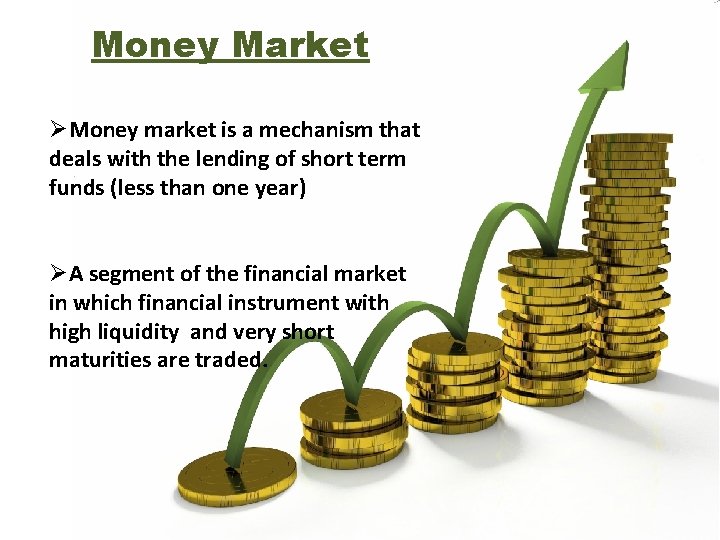
Money Market ØMoney market is a mechanism that deals with the lending of short term funds (less than one year) ØA segment of the financial market in which financial instrument with high liquidity and very short maturities are traded.
Features of money market Ø Constituents of Money Market ØHeterogeneous (diverse) Market ØDealers of Money Market ØShort-term Loans ØDifferent from Capital Market ØAssociation with Big Cities
Characteristics of A Developed Money Market ØExistence of Central Bank Ø Highly organized commercial Banking System Ø Availability of proper credit instruments Ø International attraction Ø Uniformity of interest rates ØStability of prices and Ø Highly developed Industrial system
Importance of Money Market ØFinancing Industry ØFinancing trade ØSelf sufficiency of banks ØEffective implementation of monetary policy ØEncourages economic growth ØHelp to government
Instruments of Money Market
Instrument of Money Market ØTreasury bills(T’Bills) ØShort-term (usually less than one year, typically three months) maturity promissory note issued by a national (federal) government as a primary instrument for regulating money supply and raising funds via open market operations ØCommercial bills(CB or CP) short-term unsecured promissory notes issued by companies. Commercial paper is an unsecured, short-term debt instrument issued by a corporation, typically for the financing of accounts payable and inventories, and meeting short-term liabilities. Maturities on commercial paper rarely range longer than 270 days Call Money market: An interbank call money market is a short-term money market which allows for large financial institutions, such as banks, mutual funds and corporations, to borrow and lend money at interbank rates.
Instrument of Money Market. ØPromissory notes (PN) A signed document containing a written promise to pay a stated sum to a specified person or the bearer at a specified date or on demand. A promissory note is a financial instrument that contains a written promise by one party (the note's issuer or maker) to pay another party (the note's payee) a definite sum of money, either on demand or at a specified future date ØCertificate of Deposits(CD or COD) A certificate issued by a bank to a person depositing money for a specified length of time at a specified rate of interest. A certificate of deposit (CD) is a savings certificate with a fixed maturity date, specified fixed interest rate and can be issued in any denomination aside from minimum investment requirements. A CD restricts access to the funds until the maturity date of the investment
Instrument of Money Market A repurchase agreement (repo) is a form of short-term borrowing for dealers in government securities. The dealer sells the government securities to investors, usually on an overnight basis, and buys them back the following day. A dealer or other holder of government securities (usually T-bills) sells the securities to a lender and agrees to repurchase them at an agreed future date at an agreed price.
Instrument of Money Market Real interest rates are largely negative in Ethiopia. • The minimum bank deposit rate of 7. 00%, bond yield of 3. 67%, • Treasury bill yield of 3. 67% and • Inflation rate is 16% Return is lower than the inflation rate.
CAPITAL MARKET
CAPITAL MARKET ØThe market where investment instruments like bonds and equities are traded is known as the capital market. ØThe primal role of this market is to make investment from investors who have surplus funds to the ones who are running a deficit Ø The capital market offers both long term and overnight funds. Ø The different types of financial instruments that are traded in the capital markets are: > Equity and Debt instruments > Insurance instruments, > Foreign exchange instruments, and > Hybrid instruments
Nature of capital market The nature of capital market is brought out by the following facts: ØIt Has Two Segments(Primary and secondary) ØIt Deals In Long-Term Securities ØIt Performs Trade-off Function ØIt Creates Dispersion In Business Ownership ØIt Helps In Capital Formation ØIt Helps In Creating Liquidity
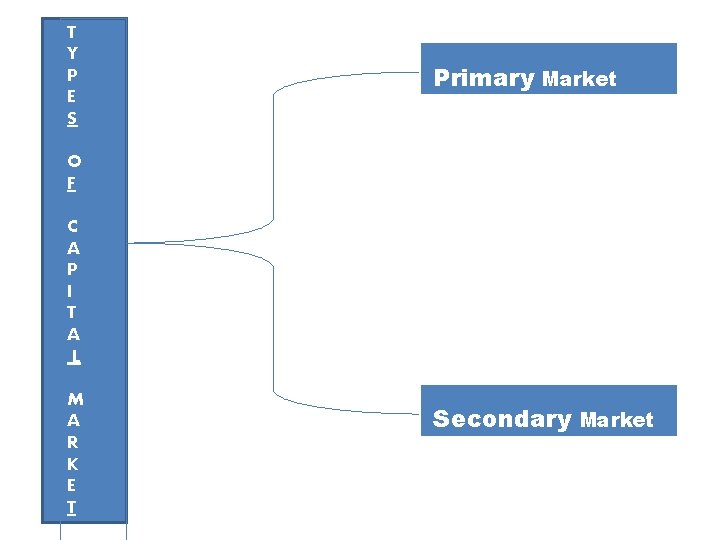
T Y P E S Primary Market O F C A P I T A L M A R K E T Secondary Market
Primary Market Ø It is that market in which shares, debentures and other securities are sold for the first time for collecting long-term capital. Ø This market is concerned with new issues. Therefore, the primary market is also called NEW ISSUE MARKET. ØIn this market, the flow of funds is from savers to borrowers (industries), hence, it helps directly in the capital formation of the country. ØThe money collected from this market is generally used by the companies to modernize the plant, machinery and buildings, for extending business, and for setting up new business unit.
Features of Primary Market Ø It Is Related With New Issues Ø It Has No Particular Place Ø It Has Various Methods Of Float Capital: Following are the methods of raising capital in the primary market: i) Public Issue (IPO) Learn About Methods of issue in ii) Offer For Sale IPO iii) Private Placement iv) Right Issue v) Electronic-Initial Public Offer Ø It comes before Secondary Market
Secondary Market ØThe secondary market is that market in which the buying and selling of the previously issued securities is done. ØThe transactions of the secondary market are generally done through the medium of stock exchange. ØThe chief purpose of the secondary market is to create liquidity in securities. ØIf an individual has bought some security and he now wants to sell it, he can do so through the medium of stock exchange to sell or purchase through the medium of stock exchange requires the services of the broker presently.
Features of Secondary Market ØIt Creates Liquidity ØIt Comes After Primary Market ØIt Has A Particular Place ØIt Encourage New Investments There is no Secondary market in Ethiopian stock market Why?
Thank you.