
Education management Perception of TQM and Its Effect





- Slides: 22
Education management: Perception of TQM and Its Effect on Attractiveness of Place of Study Feng Jie University of Malaya Graduate School of Business Kuala Lumpur. Malaysia Aida Idris Faculty of Business and Accountancy, University of Malaya Kuala Lumpur, Malaysia
PRESENTATION OUTLINE Introduction Significance of the Study Research Methodology Theoretical Framework& Items measurement Research Findings Conclusion
INTRODUCTION Total quality management (TQM) has been adopted as a management paradigm by many organizations worldwide In the last decade, TQM was introduced in the service industry Quality management models practiced by the business world have also been adapted and applied to the education sector
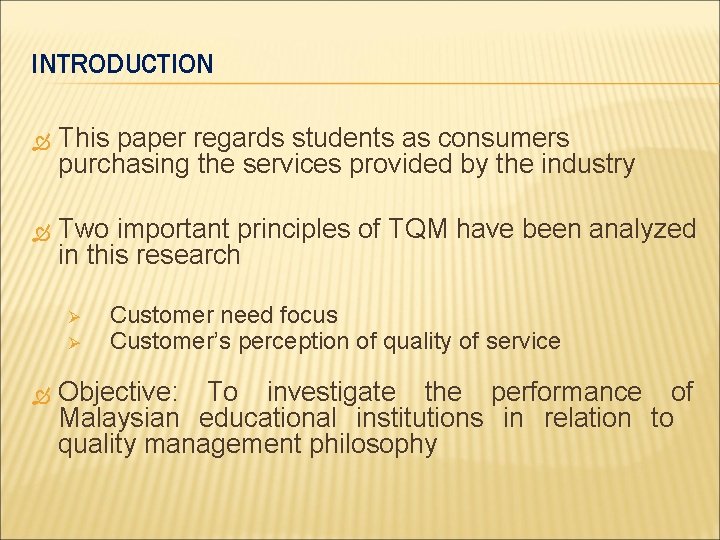
INTRODUCTION This paper regards students as consumers purchasing the services provided by the industry Two important principles of TQM have been analyzed in this research Ø Ø Customer need focus Customer’s perception of quality of service Objective: To investigate the performance of Malaysian educational institutions in relation to quality management philosophy
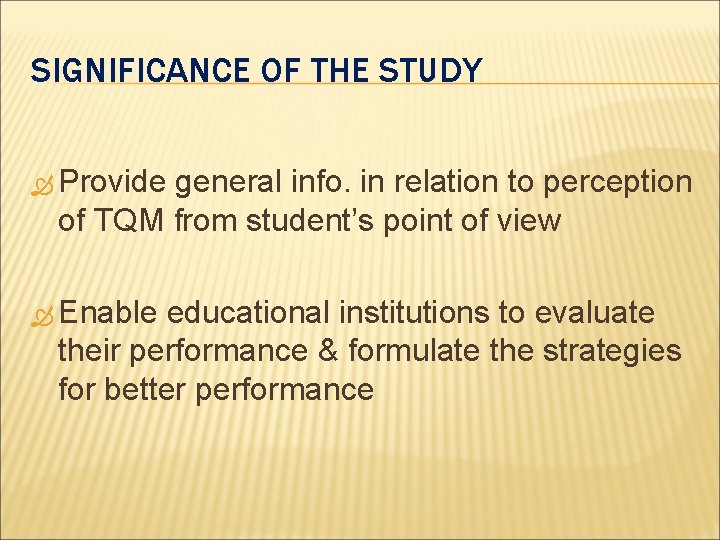
SIGNIFICANCE OF THE STUDY Provide general info. in relation to perception of TQM from student’s point of view Enable educational institutions to evaluate their performance & formulate the strategies for better performance
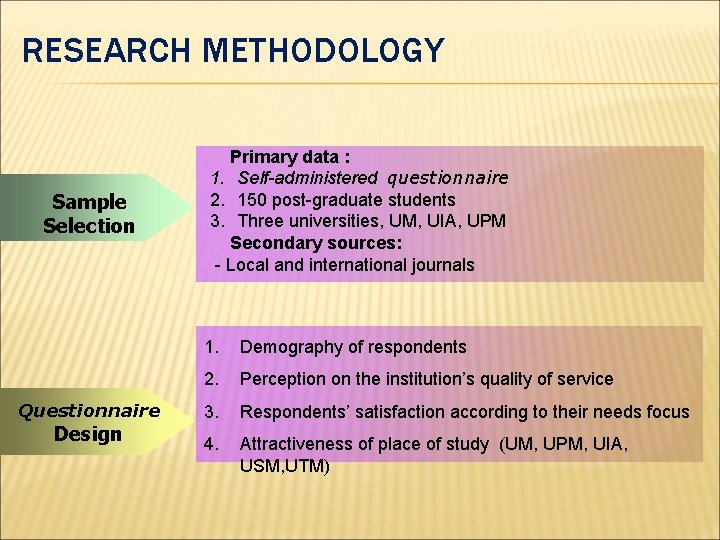
RESEARCH METHODOLOGY Sample Selection Questionnaire Design Primary data : 1. Self-administered questionnaire 2. 150 post-graduate students 3. Three universities, UM, UIA, UPM Secondary sources: - Local and international journals 1. Demography of respondents 2. Perception on the institution’s quality of service 3. Respondents’ satisfaction according to their needs focus 4. Attractiveness of place of study (UM, UPM, UIA, USM, UTM)
THEORETICAL FRAMEWORK& ITEMS MEASUREMENT H 1: The higher the focus on students’ needs, the more attractive the place of study Student Needs Focus Attractiveness of Place of Study H 2: The better the quality of service, the more attractive the place of study Quality of Service Items measurement are developed based on the works of Kwan (1996) and Lagrosen (1997), as well as separate interviews with a group of students and academicians.
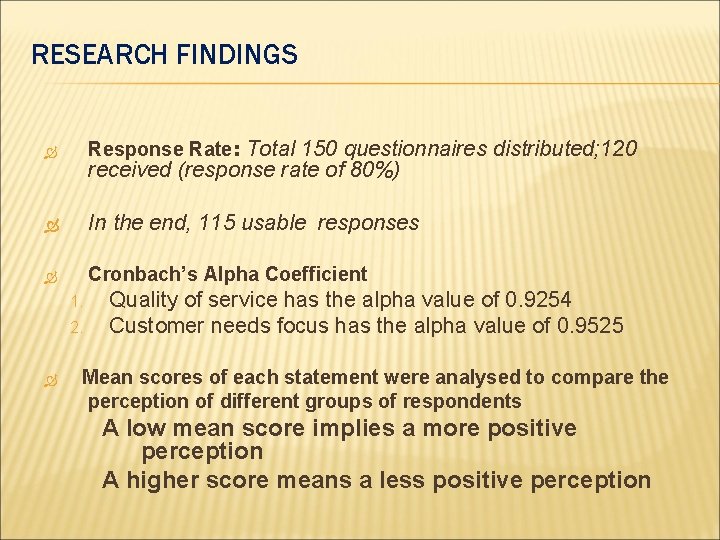
RESEARCH FINDINGS Response Rate: Total 150 questionnaires distributed; 120 In the end, 115 usable responses Cronbach’s Alpha Coefficient received (response rate of 80%) 1. 2. Quality of service has the alpha value of 0. 9254 Customer needs focus has the alpha value of 0. 9525 Mean scores of each statement were analysed to compare the perception of different groups of respondents A low mean score implies a more positive perception A higher score means a less positive perception
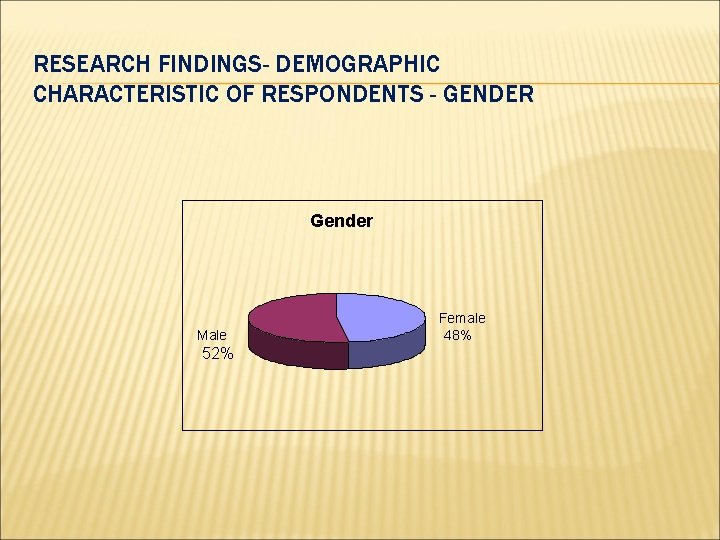
RESEARCH FINDINGS- DEMOGRAPHIC CHARACTERISTIC OF RESPONDENTS - GENDER Gender Male 52% Female 48%
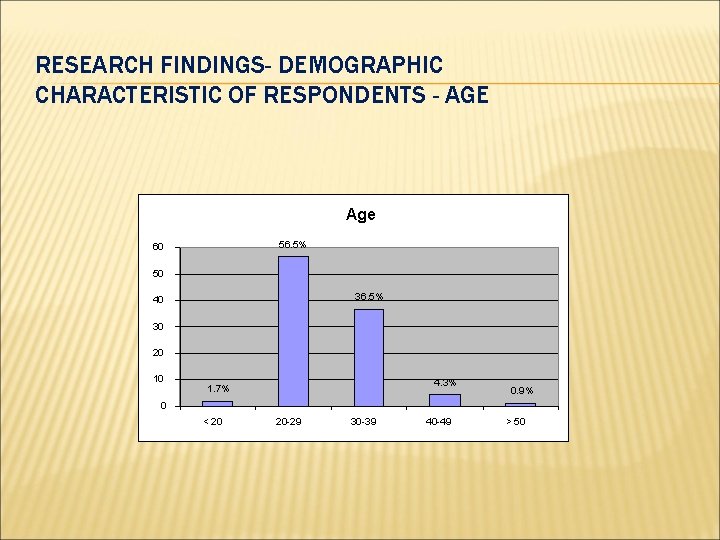
RESEARCH FINDINGS- DEMOGRAPHIC CHARACTERISTIC OF RESPONDENTS - AGE Age 56. 5% 60 50 36. 5% 40 30 20 10 4. 3% 1. 7% 0. 9% 0 < 20 20 -29 30 -39 40 -49 > 50
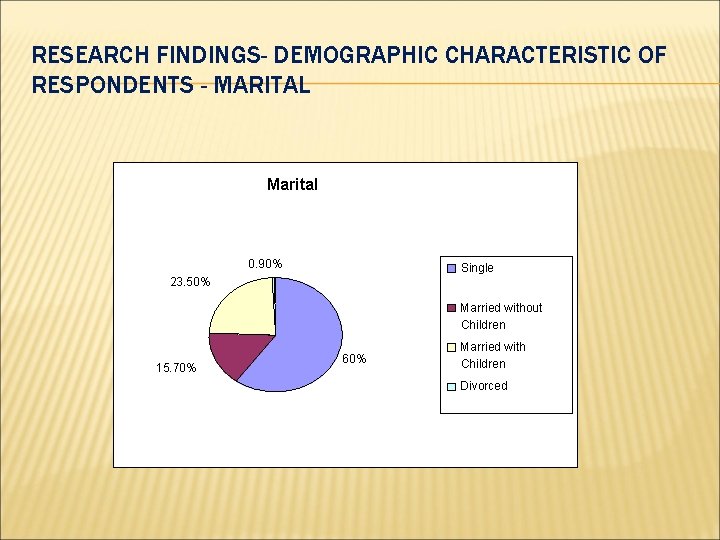
RESEARCH FINDINGS- DEMOGRAPHIC CHARACTERISTIC OF RESPONDENTS - MARITAL Marital 0. 90% Single 23. 50% Married without Children 15. 70% 60% Married with Children Divorced
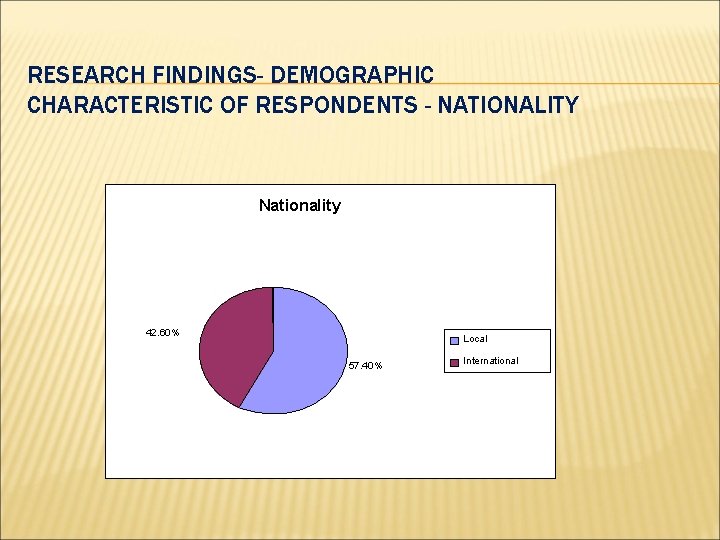
RESEARCH FINDINGS- DEMOGRAPHIC CHARACTERISTIC OF RESPONDENTS - NATIONALITY Nationality 42. 60% Local 57. 40% International
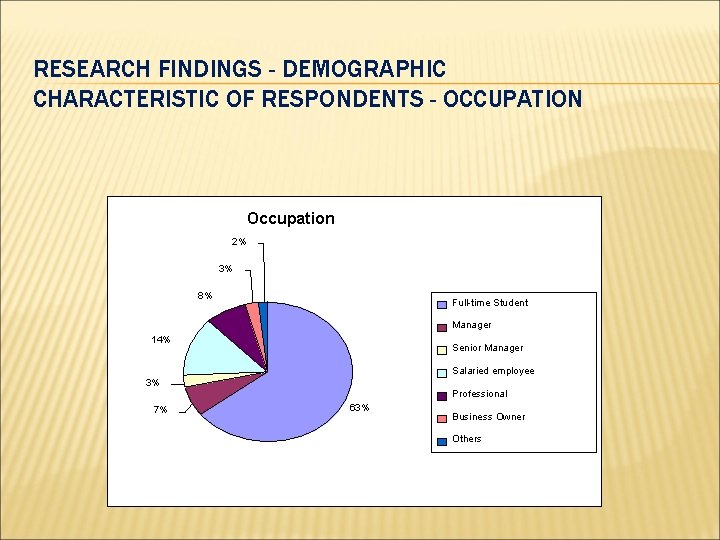
RESEARCH FINDINGS - DEMOGRAPHIC CHARACTERISTIC OF RESPONDENTS - OCCUPATION Occupation 2% 3% 8% Full-time Student Manager 14% Senior Manager Salaried employee 3% 7% Professional 63% Business Owner Others
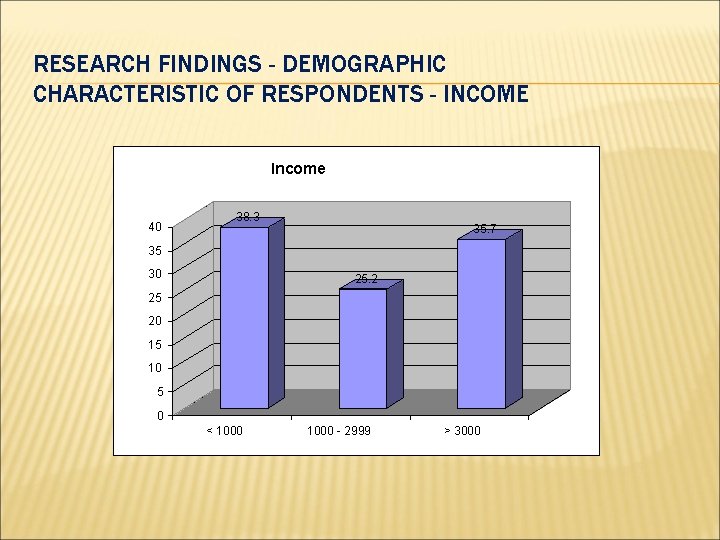
RESEARCH FINDINGS - DEMOGRAPHIC CHARACTERISTIC OF RESPONDENTS - INCOME Income 40 38. 3 35. 7 35 30 25. 2 25 20 15 10 5 0 < 1000 - 2999 > 3000
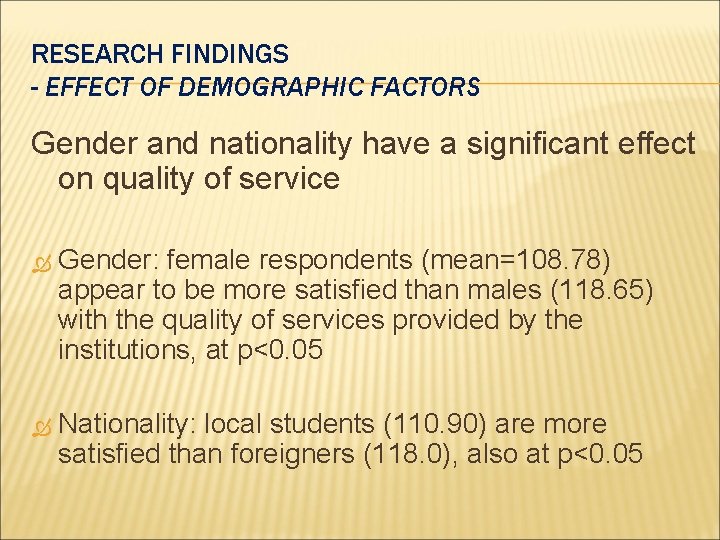
RESEARCH FINDINGS - EFFECT OF DEMOGRAPHIC FACTORS Gender and nationality have a significant effect on quality of service Gender: female respondents (mean=108. 78) appear to be more satisfied than males (118. 65) with the quality of services provided by the institutions, at p<0. 05 Nationality: local students (110. 90) are more satisfied than foreigners (118. 0), also at p<0. 05
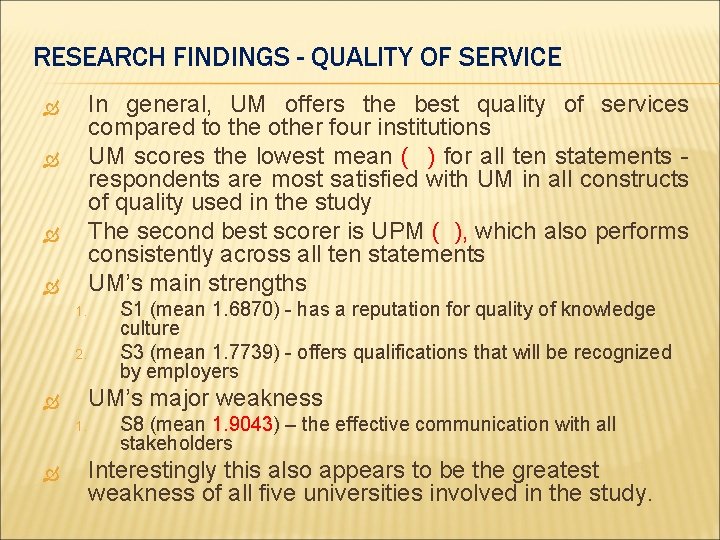
RESEARCH FINDINGS - QUALITY OF SERVICE In general, UM offers the best quality of services compared to the other four institutions UM scores the lowest mean ( ) for all ten statements respondents are most satisfied with UM in all constructs of quality used in the study The second best scorer is UPM ( ), which also performs consistently across all ten statements UM’s main strengths 1. 2. UM’s major weakness 1. S 1 (mean 1. 6870) - has a reputation for quality of knowledge culture S 3 (mean 1. 7739) - offers qualifications that will be recognized by employers S 8 (mean 1. 9043) – the effective communication with all stakeholders Interestingly this also appears to be the greatest weakness of all five universities involved in the study.
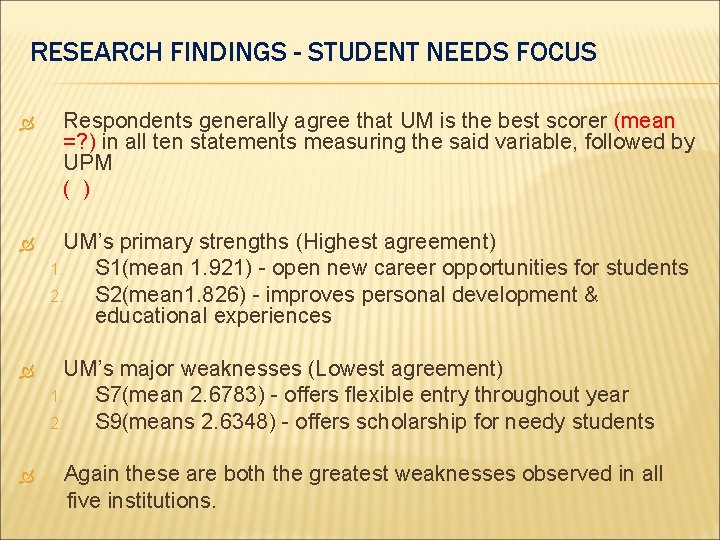
RESEARCH FINDINGS - STUDENT NEEDS FOCUS Respondents generally agree that UM is the best scorer (mean =? ) in all ten statements measuring the said variable, followed by UPM ( ) UM’s primary strengths (Highest agreement) 1. S 1(mean 1. 921) - open new career opportunities for students 2. S 2(mean 1. 826) - improves personal development & educational experiences UM’s major weaknesses (Lowest agreement) 1. S 7(mean 2. 6783) - offers flexible entry throughout year 2. S 9(means 2. 6348) - offers scholarship for needy students Again these are both the greatest weaknesses observed in all five institutions.
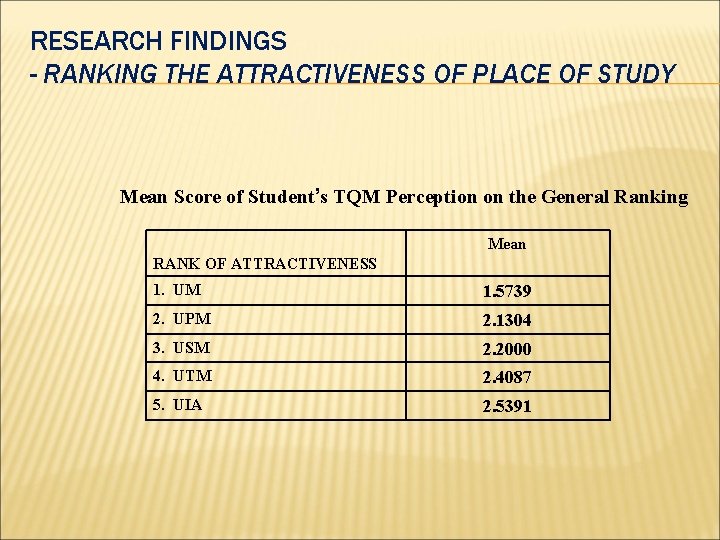
RESEARCH FINDINGS - RANKING THE ATTRACTIVENESS OF PLACE OF STUDY Mean Score of Student’s TQM Perception on the General Ranking Mean RANK OF ATTRACTIVENESS 1. UM 1. 5739 2. UPM 2. 1304 3. USM 2. 2000 4. UTM 2. 4087 5. UIA 2. 5391
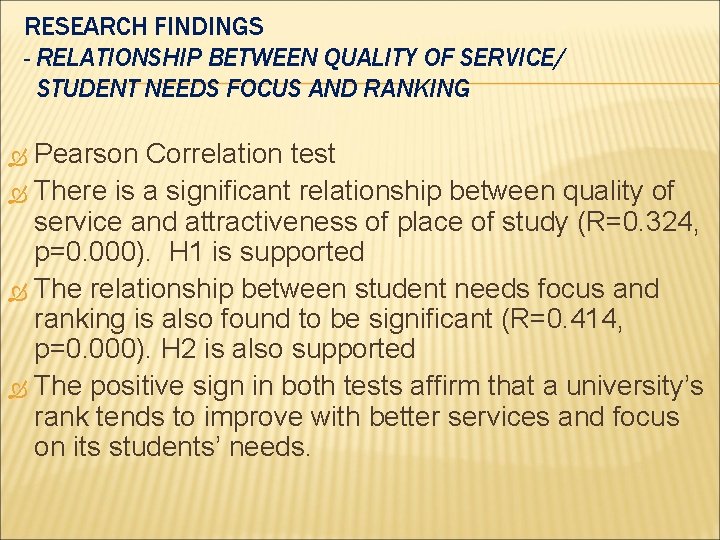
RESEARCH FINDINGS - RELATIONSHIP BETWEEN QUALITY OF SERVICE/ STUDENT NEEDS FOCUS AND RANKING Pearson Correlation test There is a significant relationship between quality of service and attractiveness of place of study (R=0. 324, p=0. 000). H 1 is supported The relationship between student needs focus and ranking is also found to be significant (R=0. 414, p=0. 000). H 2 is also supported The positive sign in both tests affirm that a university’s rank tends to improve with better services and focus on its students’ needs.
CONCLUSION - FINDINGS Results show that there is a positive relationship between the quality of service /student need focus and attractiveness of place of study The study provides empirical evidence that can help institutions to better understand the need of TQM and how TQM can improve institutional performance The findings show that students place a high importance on an institution’s quality management. Thus more effort should be taken to enhance the practice of TQM in every component of the institution, and embed it as an organizational culture
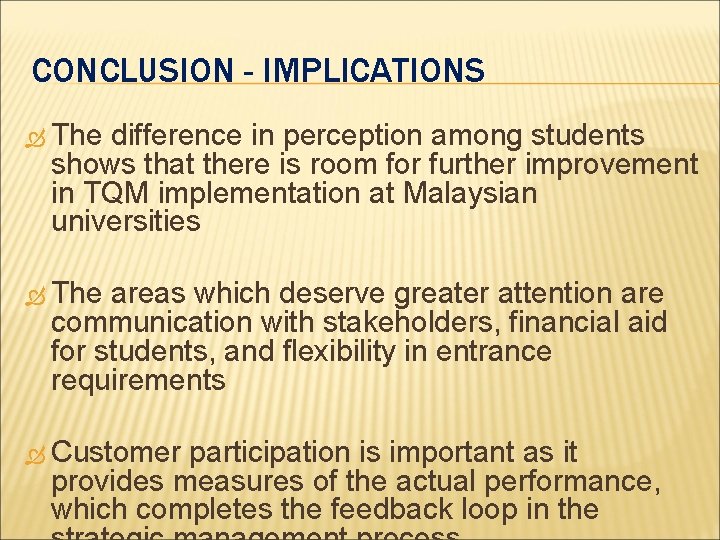
CONCLUSION - IMPLICATIONS The difference in perception among students shows that there is room for further improvement in TQM implementation at Malaysian universities The areas which deserve greater attention are communication with stakeholders, financial aid for students, and flexibility in entrance requirements Customer participation is important as it provides measures of the actual performance, which completes the feedback loop in the
THANK YOU