
Education in Universal Human Values A Programme for










- Slides: 60
Education in Universal Human Values: A Programme for Institutions of Higher Learning Initiated by the Bahá'í Academy to foster social progress Module 1: Moral Capabilities Unit 1: Introduction
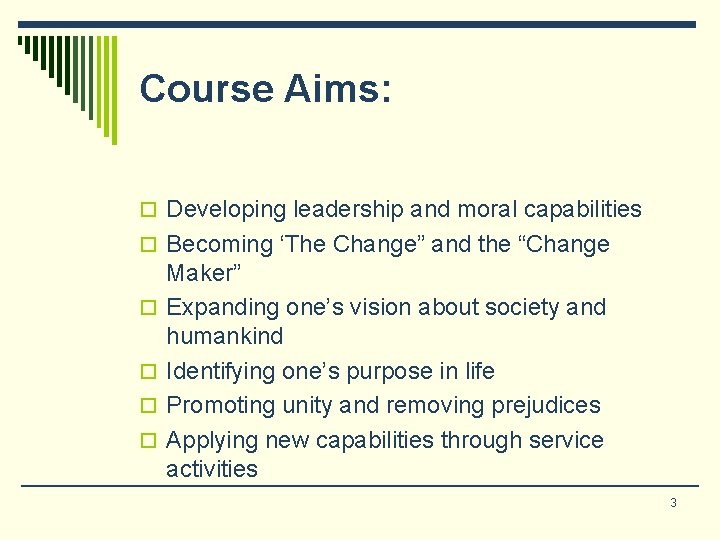
Course Aims: o Developing leadership and moral capabilities o Becoming ‘The Change” and the “Change o o Maker” Expanding one’s vision about society and humankind Identifying one’s purpose in life Promoting unity and removing prejudices Applying new capabilities through service activities 3
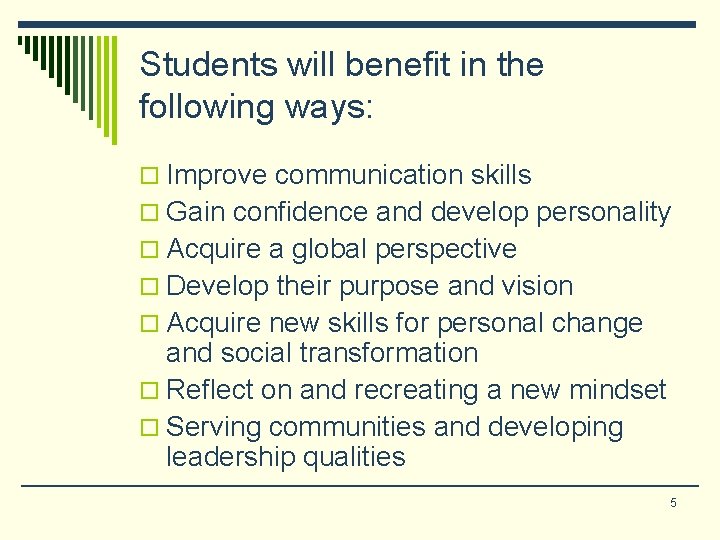
Students will benefit in the following ways: o Improve communication skills o Gain confidence and develop personality o Acquire a global perspective o Develop their purpose and vision o Acquire new skills for personal change and social transformation o Reflect on and recreating a new mindset o Serving communities and developing leadership qualities 5
Methodology: o Interactive, participatory, cooperative and experiential such as: Large and small group discussions and activities, presentations, performing arts (Happy Hippo Show), educational games, service learning activities 7
Other important features: o Course is broadly based and universal o Does not seek to promote any particular school of thought, tradition or religion o Students meet with mentors regularly and access online support 9
Unit 1: Introduction 11
Introduction Two parallel processes are at work in the world: o disintegration of old world n signs of destruction of old world everywhere o crystallization of a world civilization n construction is a subtle process, but moving forward with force 13
o Placing fault on various components of the world’s systems is pointless o Eventually we must stop using simplistic answers and focus on viable solutions to humanity’s growing problems 15
o Looking for viable solutions leads to fundamental questions: n n Who will bring about the changes that must occur in the lives of people and in the system? Who are the supporters of such a change? 17
o A very common answer is: every human being has the responsibility to contribute to such a great transformation 19
Many questions arise relating to this transformation: n n n Are we ready for such a change? Can we guarantee that people’s collective power will not be misguided? What principles should guide this process? 21
One important question is about leadership n Necessary for society to function p Difficult to accept as leadership is often abused p Difficult to trust some leaders 23
So we need to redefining leadership n True leadership is to inspire and assist others to undertake noble acts 25
o True leadership is achieved through moral development 27
Reflection o Think about some words that are linked to the leadership we all find inadequate for humanity today. A few examples are: control, lead, impose. What are some others? 29
o Some examples of words that describe moral behavior are: assist, unify, facilitate. What are some others? 31
Reflection o Write one or two paragraphs about the kind of leadership that in inappropriate for to mobilize mankind to build a new civilization. 33
o Now, write a paragraph about the moral standards that enable humanity to arise and create a new and better society. 35
o“ Capability”? 37
“Capability” Component 1: Skills What are some of the skills and abilities related to producing a certain rotation of crops successfully? 39
“Capability” Component 2: Understanding Concepts What a are a few concepts, the understanding of which are essential in crop production? 41
“Capability” Component 3: Attitudes What are some of the attitudes required of a good farmer? 43
“Capability” Component 4: Spiritual Qualities Think of some qualities that would contribute to your ability of successfully producing a rotation of crops. 45
“Capability” Component 5: Information Can you give some examples of the categories of information needed to ensure farming success? 47
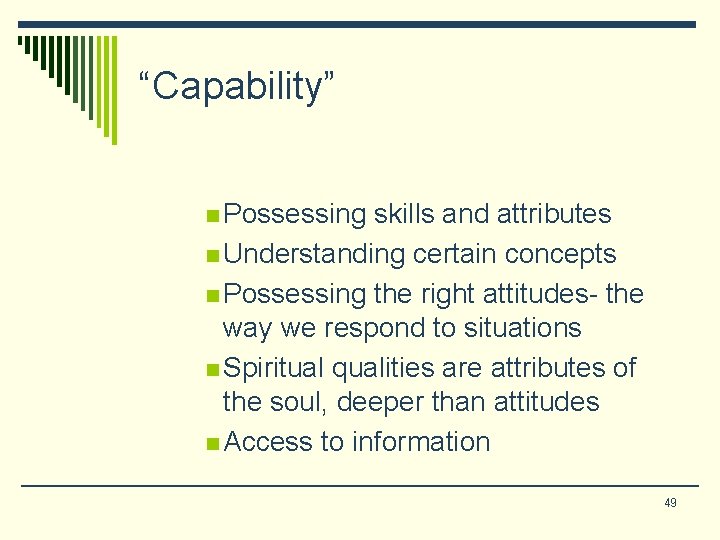
“Capability” n Possessing skills and attributes n Understanding certain concepts n Possessing the right attitudes- the way we respond to situations n Spiritual qualities are attributes of the soul, deeper than attitudes n Access to information 49
Discussion 1. The extended family: where moral capabilities are developed 2. The local community: the arena of service 3. Society: in dire need of moral standards 51
Discussion Discus the validly of this statement: “Moral influence can only be exerted through consistent practice of service to humanity. ” 53
����� ����� ���. “���������� ����� ����. Moral influence can only be exerted through consistent practice of service to humanity ”. 54
Review and Connect Review the unit and identify the connections in the unit to the needs of society and service learning activities 55
o Carry out the “Poster Sharing Activity” 57
End of Unit 1 59