
Education in South Korea Challenges and Reforms Taejong



- Slides: 31
Education in South Korea: Challenges and Reforms Taejong Kim (KDI School of Public Policy and Management)
School System in South Korea
Per student expenditure: primary and secondary
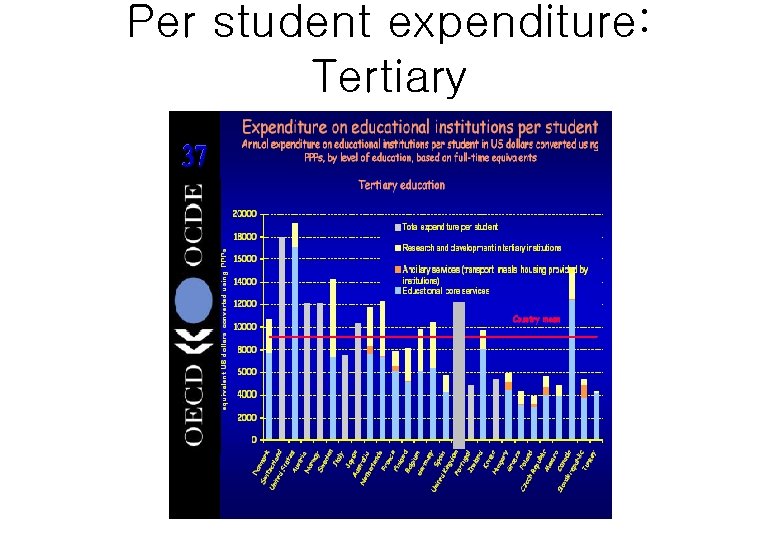
Per student expenditure: Tertiary
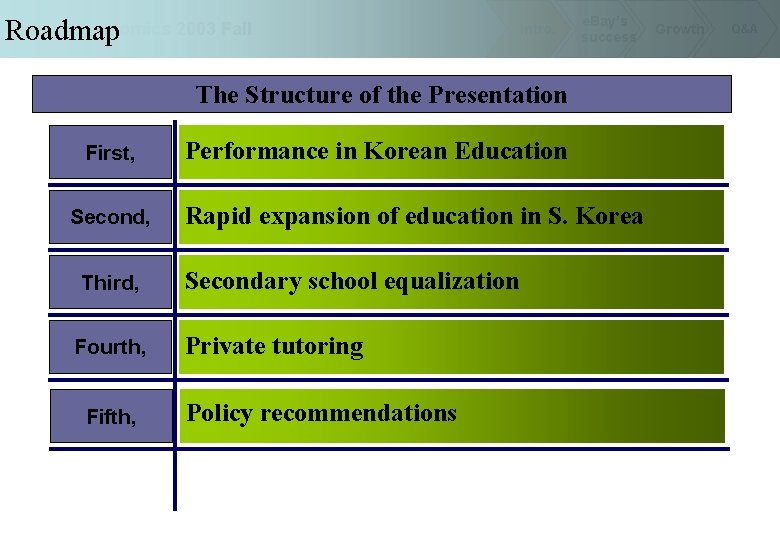
Labor Economics 2003 Fall Roadmap Intro. e. Bay’s success The Structure of the Presentation First, Second, Third, Fourth, Fifth, Performance in Korean Education Rapid expansion of education in S. Korea Secondary school equalization Private tutoring Policy recommendations Growth Q&A
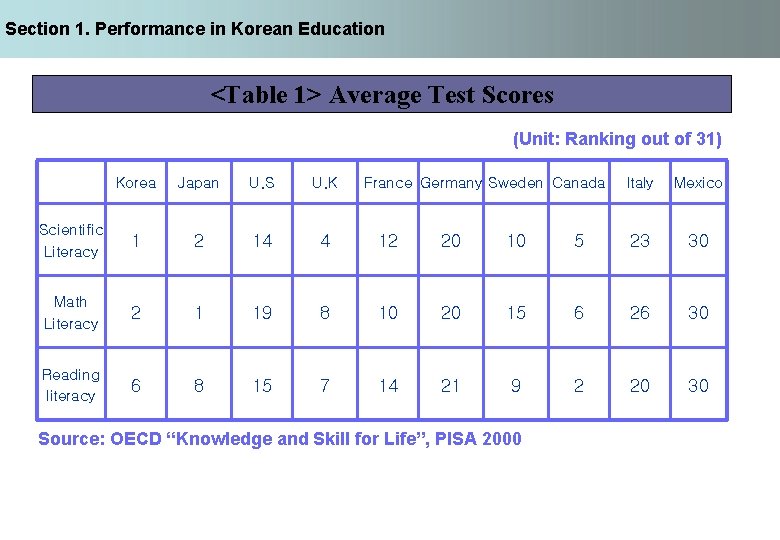
Section 1. Performance in Korean Education <Table 1> Average Test Scores (Unit: Ranking out of 31) Korea Japan U. S U. K France Germany Sweden Canada Italy Mexico Scientific Literacy 1 2 14 4 12 20 10 5 23 30 Math Literacy 2 1 19 8 10 20 15 6 26 30 Reading literacy 6 8 15 7 14 21 9 2 20 30 Source: OECD “Knowledge and Skill for Life”, PISA 2000
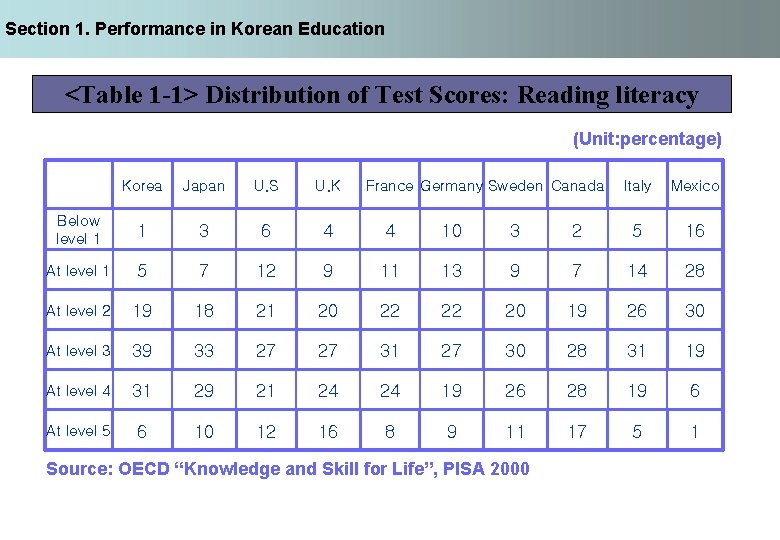
Section 1. Performance in Korean Education <Table 1 -1> Distribution of Test Scores: Reading literacy (Unit: percentage) Korea Japan U. S U. K France Germany Sweden Canada Italy Mexico Below level 1 1 3 6 4 4 10 3 2 5 16 At level 1 5 7 12 9 11 13 9 7 14 28 At level 2 19 18 21 20 22 22 20 19 26 30 At level 3 39 33 27 27 31 27 30 28 31 19 At level 4 31 29 21 24 24 19 26 28 19 6 At level 5 6 10 12 16 8 9 11 17 5 1 Source: OECD “Knowledge and Skill for Life”, PISA 2000
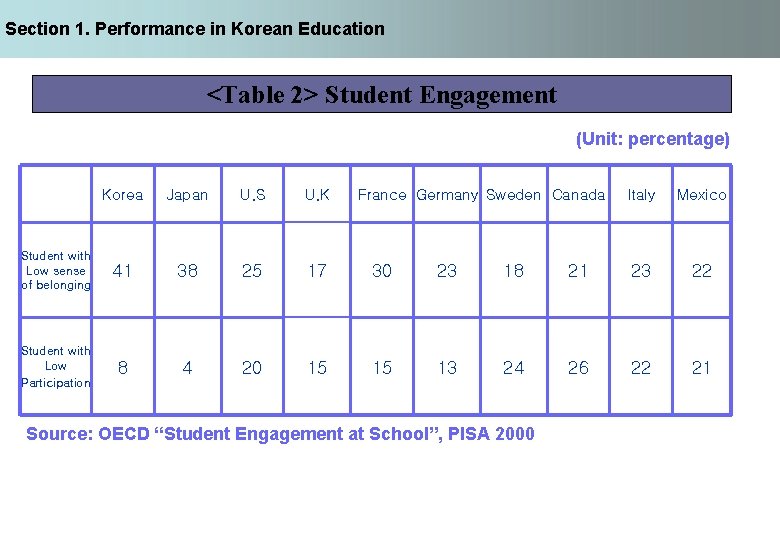
Section 1. Performance in Korean Education <Table 2> Student Engagement (Unit: percentage) Korea Japan U. S U. K France Germany Sweden Canada Student with Low sense of belonging 41 38 25 17 30 23 18 Student with Low Participation 8 4 20 15 15 13 24 Source: OECD “Student Engagement at School”, PISA 2000 Italy Mexico 21 23 22 26 22 21
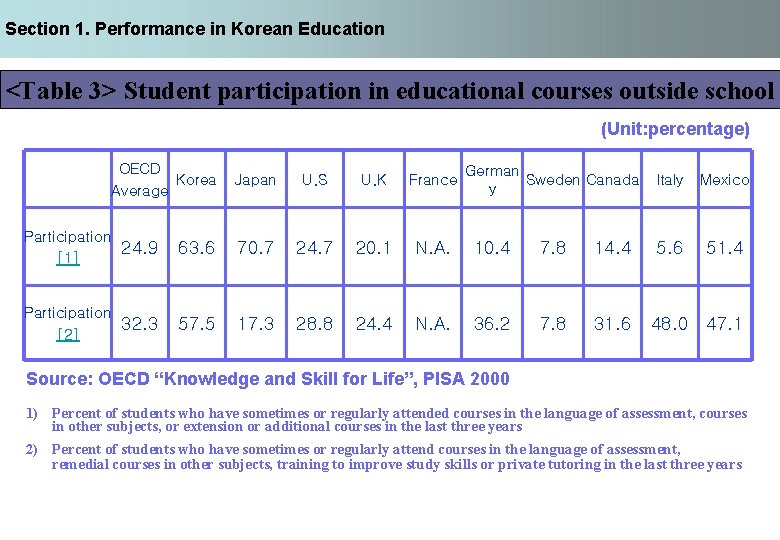
Section 1. Performance in Korean Education <Table 3> Student participation in educational courses outside school (Unit: percentage) OECD Korea Average Japan U. S U. K France German Sweden Canada y Italy Mexico Participation [1] 24. 9 63. 6 70. 7 24. 7 20. 1 N. A. 10. 4 7. 8 14. 4 5. 6 51. 4 Participation [2] 32. 3 57. 5 17. 3 28. 8 24. 4 N. A. 36. 2 7. 8 31. 6 48. 0 47. 1 Source: OECD “Knowledge and Skill for Life”, PISA 2000 1) Percent of students who have sometimes or regularly attended courses in the language of assessment, courses in other subjects, or extension or additional courses in the last three years 2) Percent of students who have sometimes or regularly attend courses in the language of assessment, remedial courses in other subjects, training to improve study skills or private tutoring in the last three years
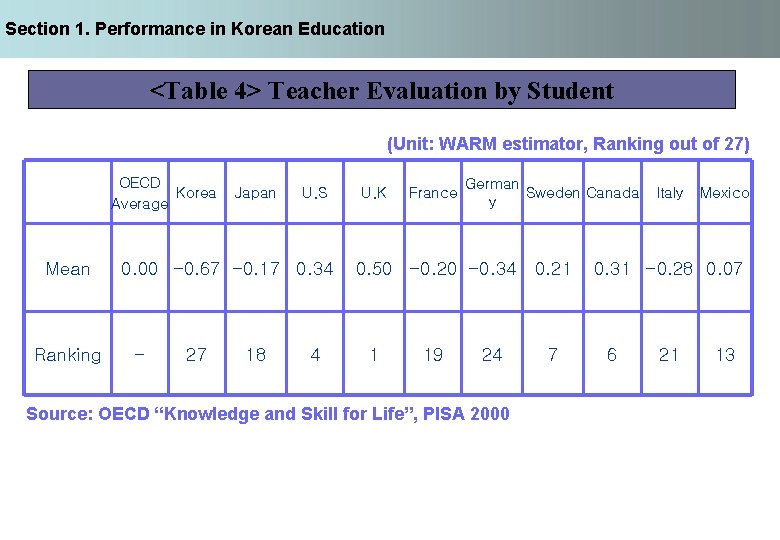
Section 1. Performance in Korean Education <Table 4> Teacher Evaluation by Student (Unit: WARM estimator, Ranking out of 27) OECD Korea Average Mean Ranking Japan U. S 0. 00 -0. 67 -0. 17 0. 34 - 27 18 4 U. K France German Sweden Canada y 0. 50 -0. 20 -0. 34 1 19 24 Source: OECD “Knowledge and Skill for Life”, PISA 2000 0. 21 7 Italy Mexico 0. 31 -0. 28 0. 07 6 21 13
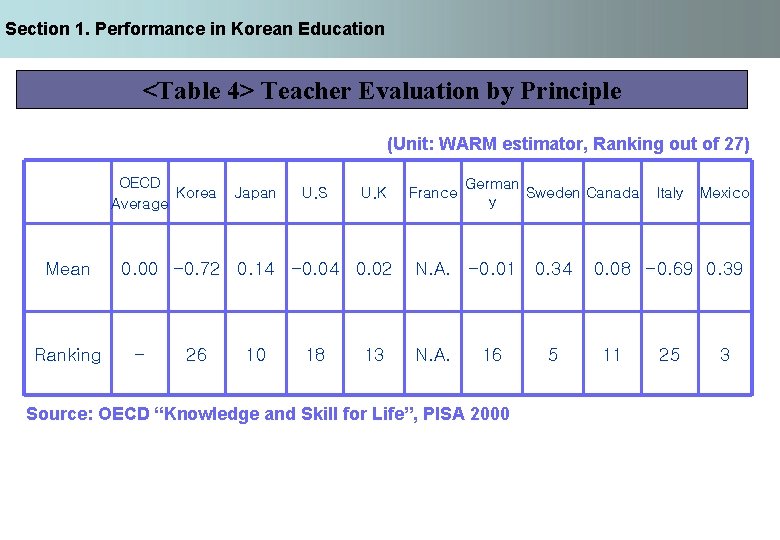
Section 1. Performance in Korean Education <Table 4> Teacher Evaluation by Principle (Unit: WARM estimator, Ranking out of 27) OECD Korea Average Mean Ranking Japan U. S U. K 0. 00 -0. 72 0. 14 -0. 04 0. 02 - 26 10 18 13 France German Sweden Canada y N. A. -0. 01 N. A. 16 Source: OECD “Knowledge and Skill for Life”, PISA 2000 0. 34 5 Italy Mexico 0. 08 -0. 69 0. 39 11 25 3
Section 1. Performance in Korean Education <Table 5> Test Scores and Other Skills at age 9 (1992) Korea Taiwan Israel Spain Canada U. S. A Average Percent Correct in Math Test 75 68 64 62 60 58 Average Percent Correct in Science Test 66 67 61 62 63 65 Percent of Students Who Read for Fun Almost Every Day 25 29 57 55 48 45 Percentage of Students Who Do Math Exercises by Themselves Every Day 23 47 42 60 48 58 Percentage of Students Who Work with Math Tools at least Once at Week 11 30 21 23 13 19 Source: IAEP/ETS. Learning Math. 1992/ IAEP/ETS. Learning Science 1992
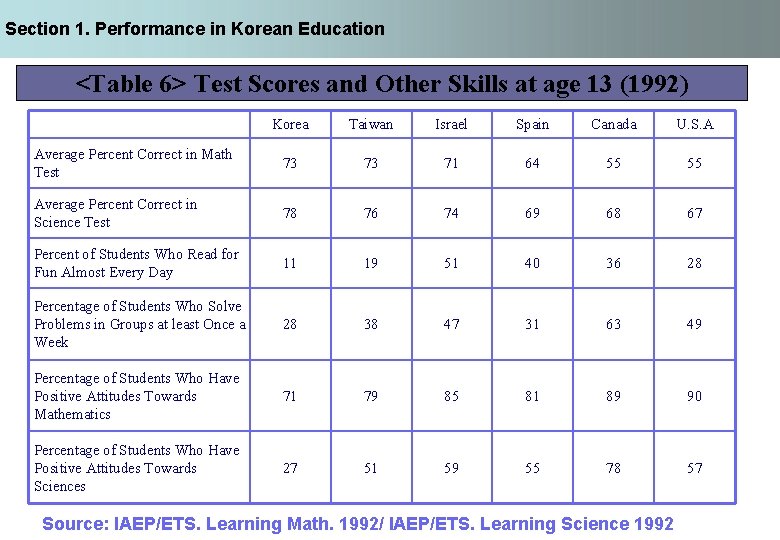
Section 1. Performance in Korean Education <Table 6> Test Scores and Other Skills at age 13 (1992) Korea Taiwan Israel Spain Canada U. S. A Average Percent Correct in Math Test 73 73 71 64 55 55 Average Percent Correct in Science Test 78 76 74 69 68 67 Percent of Students Who Read for Fun Almost Every Day 11 19 51 40 36 28 Percentage of Students Who Solve Problems in Groups at least Once a Week 28 38 47 31 63 49 Percentage of Students Who Have Positive Attitudes Towards Mathematics 71 79 85 81 89 90 Percentage of Students Who Have Positive Attitudes Towards Sciences 27 51 59 55 78 57 Source: IAEP/ETS. Learning Math. 1992/ IAEP/ETS. Learning Science 1992
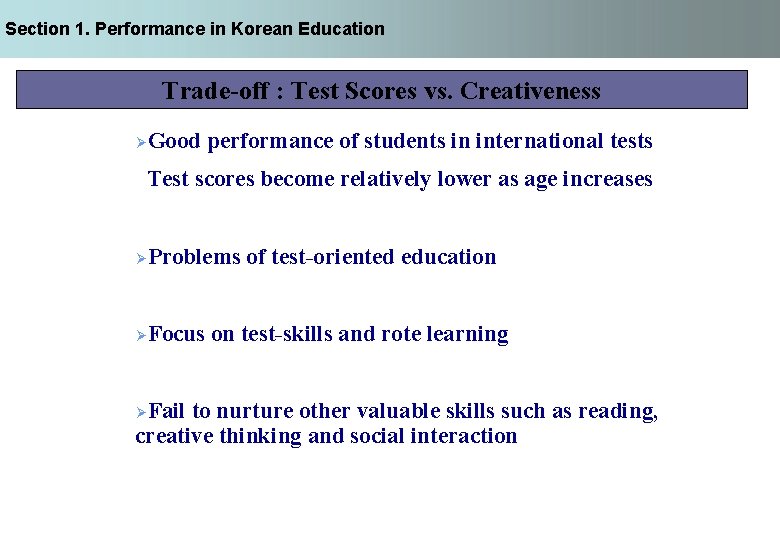
Section 1. Performance in Korean Education Trade-off : Test Scores vs. Creativeness ØGood performance of students in international tests Test scores become relatively lower as age increases ØProblems ØFocus ØFail of test-oriented education on test-skills and rote learning to nurture other valuable skills such as reading, creative thinking and social interaction
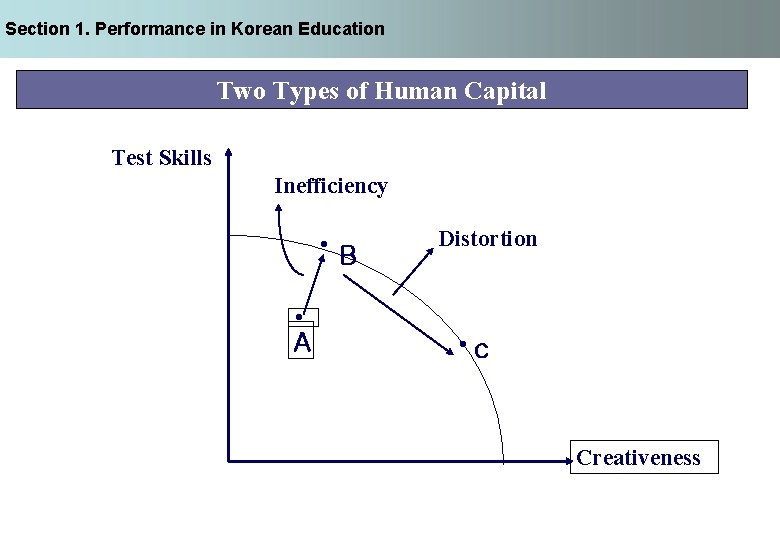
Section 1. Performance in Korean Education Two Types of Human Capital Test Skills Inefficiency B Distortion A c Creativeness
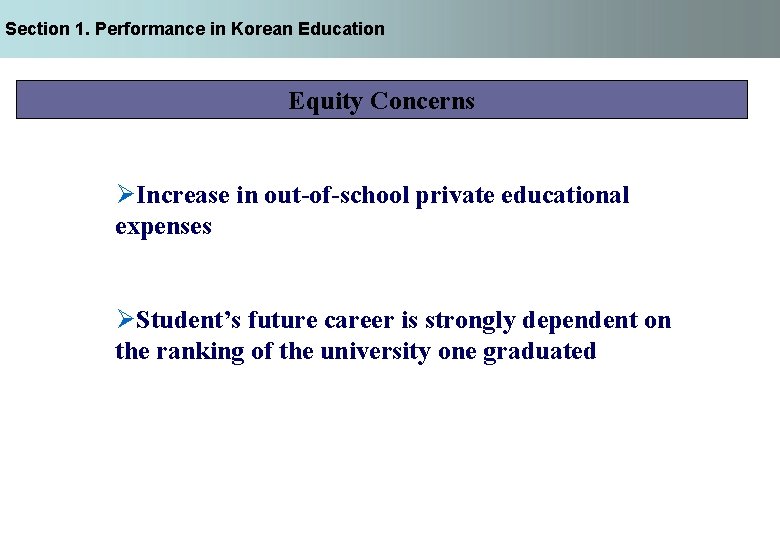
Section 1. Performance in Korean Education Equity Concerns ØIncrease in out-of-school private educational expenses ØStudent’s future career is strongly dependent on the ranking of the university one graduated
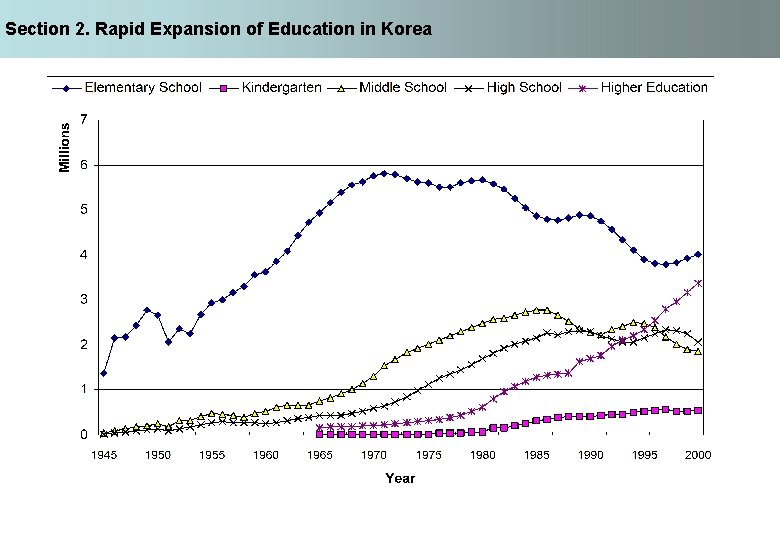
Section 2. Rapid Expansion of Education in Korea
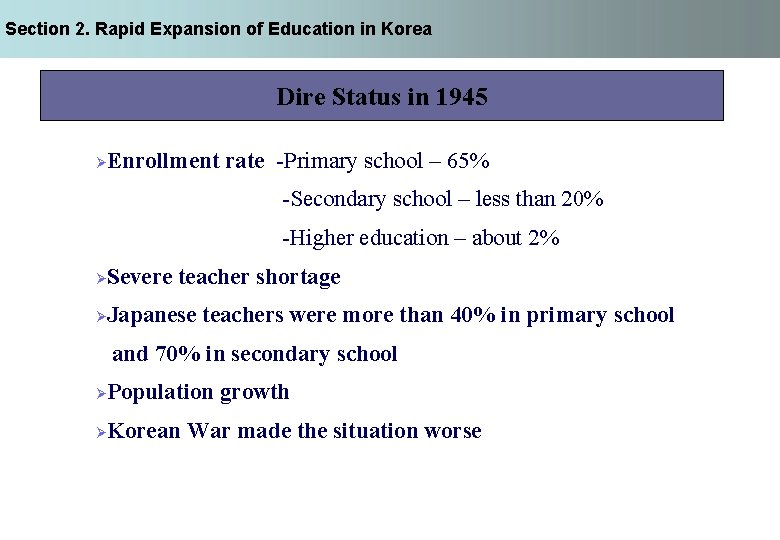
Section 2. Rapid Expansion of Education in Korea Dire Status in 1945 ØEnrollment rate -Primary school – 65% -Secondary school – less than 20% -Higher education – about 2% ØSevere teacher shortage ØJapanese teachers were more than 40% in primary school and 70% in secondary school ØPopulation ØKorean growth War made the situation worse
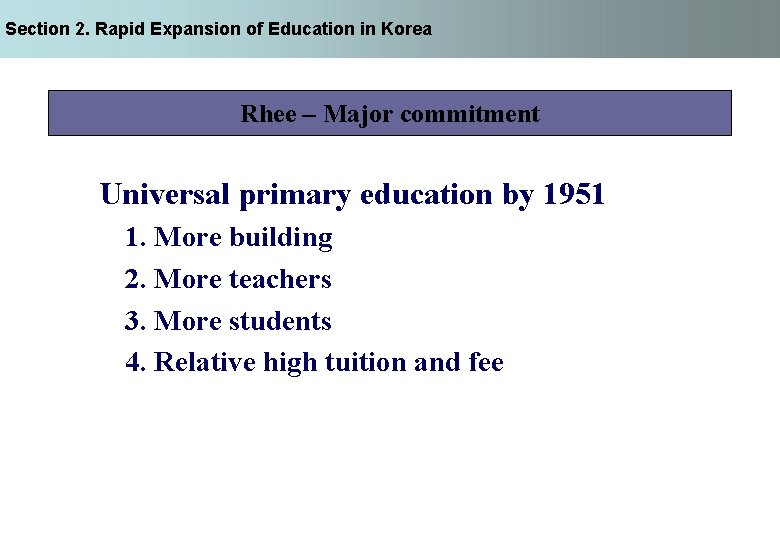
Section 2. Rapid Expansion of Education in Korea Rhee – Major commitment Universal primary education by 1951 1. More building 2. More teachers 3. More students 4. Relative high tuition and fee
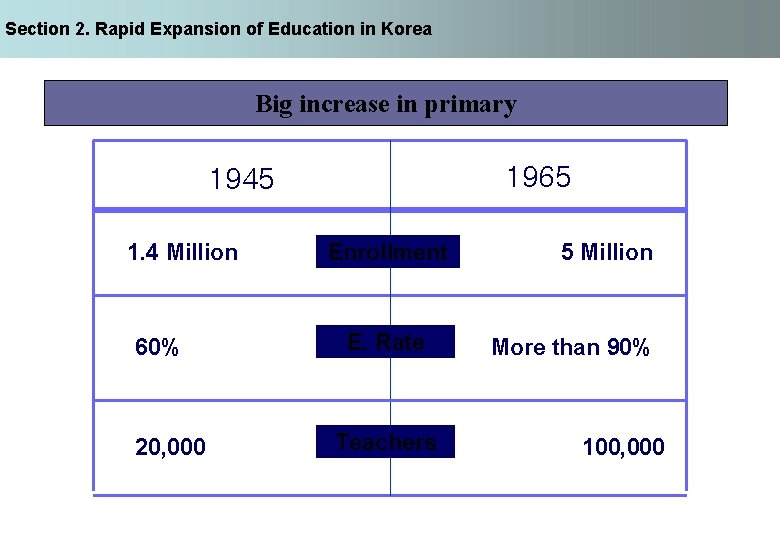
Section 2. Rapid Expansion of Education in Korea Big increase in primary 1965 1945 1. 4 Million 60% 20, 000 Enrollment E. Rate Teachers 5 Million More than 90% 100, 000
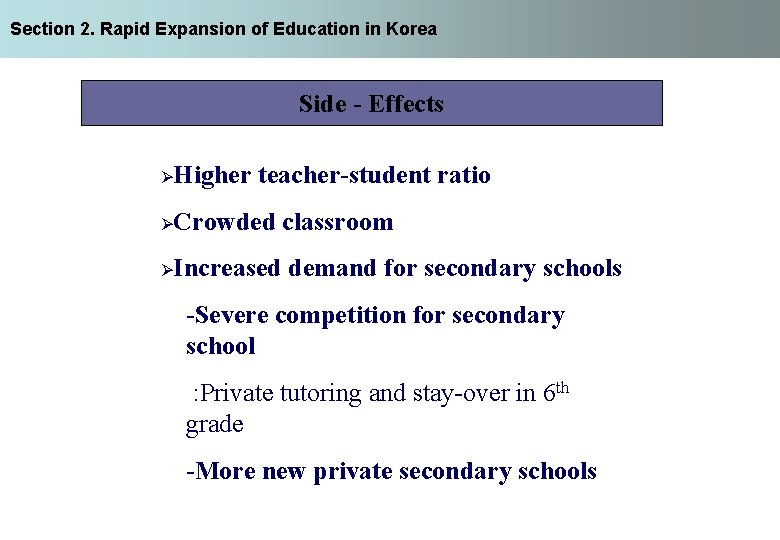
Section 2. Rapid Expansion of Education in Korea Side - Effects ØHigher teacher-student ratio ØCrowded ØIncreased classroom demand for secondary schools -Severe competition for secondary school : Private tutoring and stay-over in 6 th grade -More new private secondary schools
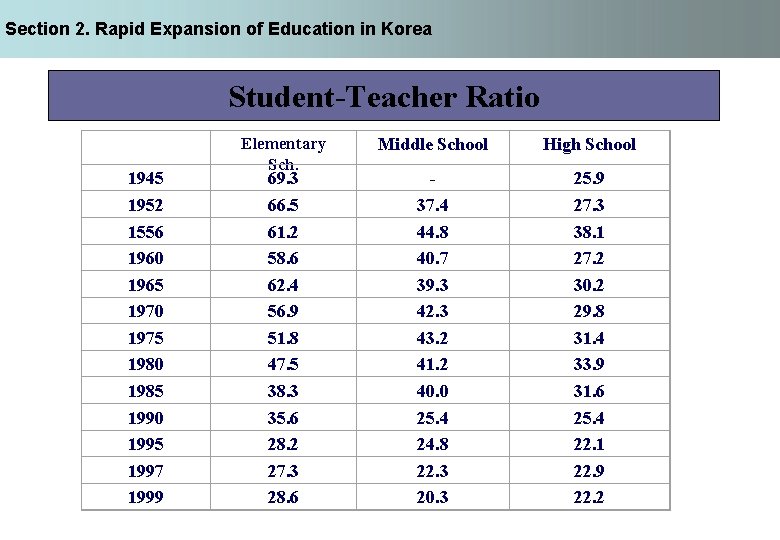
Section 2. Rapid Expansion of Education in Korea Student-Teacher Ratio 1945 1952 1556 1960 1965 1970 1975 1980 1985 1990 1995 1997 1999 Elementary Sch. 69. 3 66. 5 61. 2 58. 6 62. 4 56. 9 51. 8 47. 5 38. 3 35. 6 28. 2 27. 3 28. 6 Middle School High School 37. 4 44. 8 40. 7 39. 3 42. 3 43. 2 41. 2 40. 0 25. 4 24. 8 22. 3 20. 3 25. 9 27. 3 38. 1 27. 2 30. 2 29. 8 31. 4 33. 9 31. 6 25. 4 22. 1 22. 9 22. 2
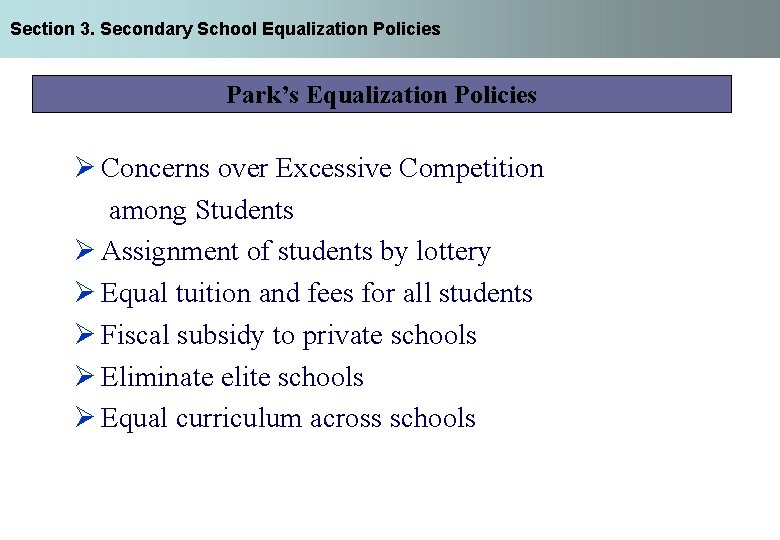
Section 3. Secondary School Equalization Policies Park’s Equalization Policies Ø Concerns over Excessive Competition among Students Ø Assignment of students by lottery Ø Equal tuition and fees for all students Ø Fiscal subsidy to private schools Ø Eliminate elite schools Ø Equal curriculum across schools
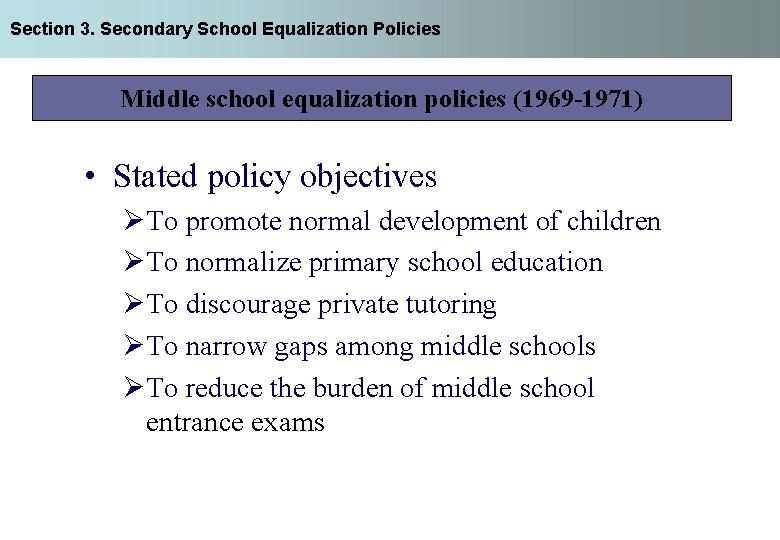
Section 3. Secondary School Equalization Policies Middle school equalization policies (1969 -1971) • Stated policy objectives ØTo promote normal development of children ØTo normalize primary school education ØTo discourage private tutoring ØTo narrow gaps among middle schools ØTo reduce the burden of middle school entrance exams
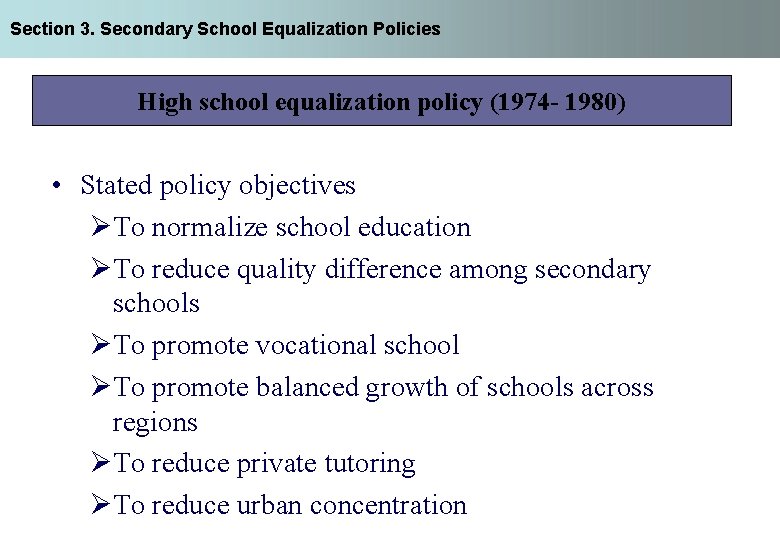
Section 3. Secondary School Equalization Policies High school equalization policy (1974 - 1980) • Stated policy objectives ØTo normalize school education ØTo reduce quality difference among secondary schools ØTo promote vocational school ØTo promote balanced growth of schools across regions ØTo reduce private tutoring ØTo reduce urban concentration
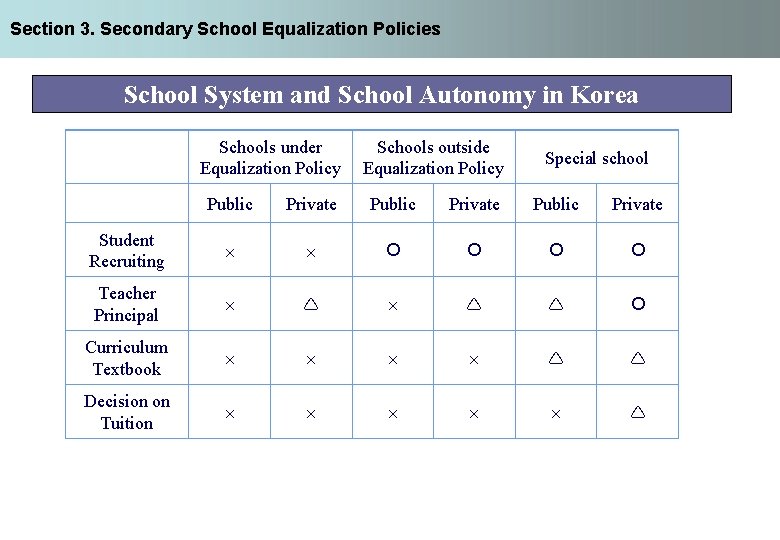
Section 3. Secondary School Equalization Policies School System and School Autonomy in Korea Schools under Equalization Policy Schools outside Equalization Policy Special school Public Private Student Recruiting Teacher Principal Curriculum Textbook Decision on Tuition
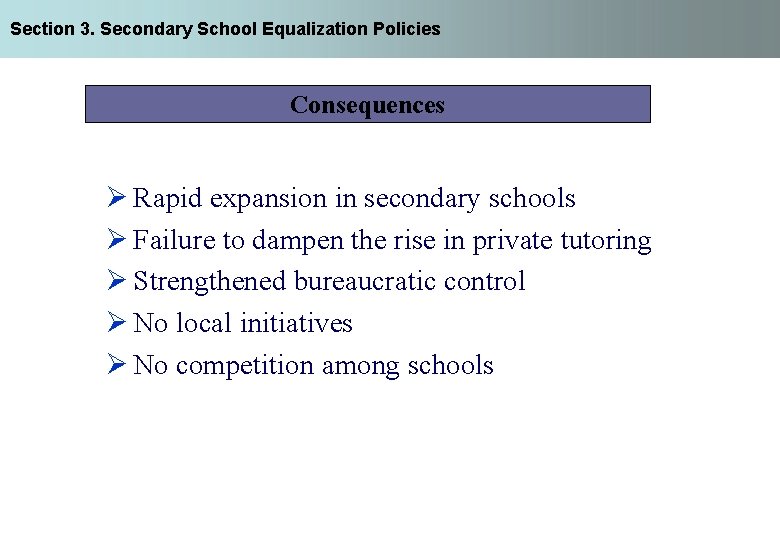
Section 3. Secondary School Equalization Policies Consequences Ø Rapid expansion in secondary schools Ø Failure to dampen the rise in private tutoring Ø Strengthened bureaucratic control Ø No local initiatives Ø No competition among schools
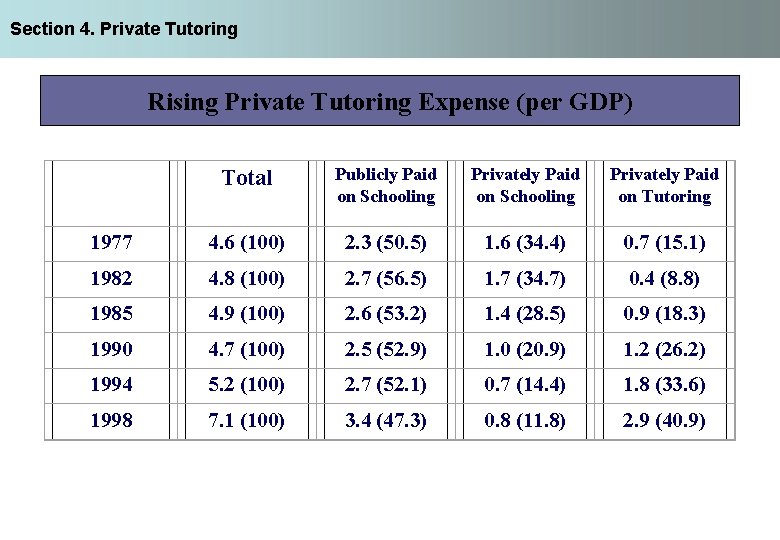
Section 4. Private Tutoring Rising Private Tutoring Expense (per GDP) Total Publicly Paid on Schooling Privately Paid on Tutoring 1977 4. 6 (100) 2. 3 (50. 5) 1. 6 (34. 4) 0. 7 (15. 1) 1982 4. 8 (100) 2. 7 (56. 5) 1. 7 (34. 7) 0. 4 (8. 8) 1985 4. 9 (100) 2. 6 (53. 2) 1. 4 (28. 5) 0. 9 (18. 3) 1990 4. 7 (100) 2. 5 (52. 9) 1. 0 (20. 9) 1. 2 (26. 2) 1994 5. 2 (100) 2. 7 (52. 1) 0. 7 (14. 4) 1. 8 (33. 6) 1998 7. 1 (100) 3. 4 (47. 3) 0. 8 (11. 8) 2. 9 (40. 9)
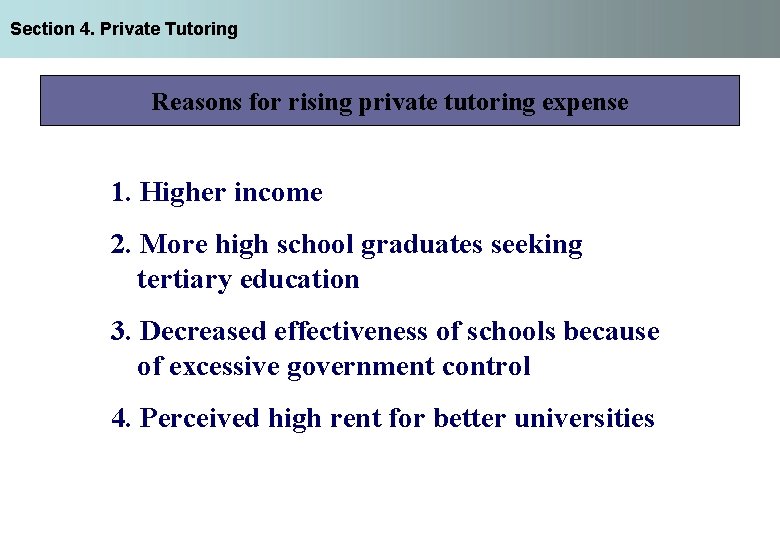
Section 4. Private Tutoring Reasons for rising private tutoring expense 1. Higher income 2. More high school graduates seeking tertiary education 3. Decreased effectiveness of schools because of excessive government control 4. Perceived high rent for better universities
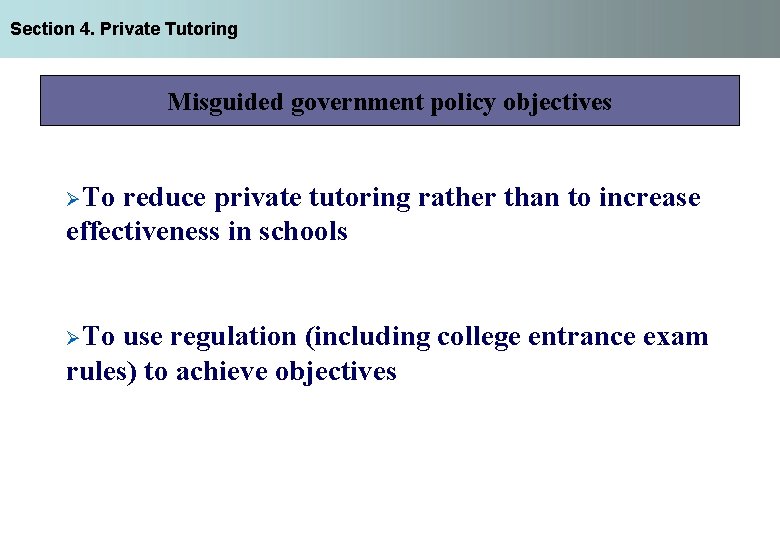
Section 4. Private Tutoring Misguided government policy objectives ØTo reduce private tutoring rather than to increase effectiveness in schools ØTo use regulation (including college entrance exam rules) to achieve objectives
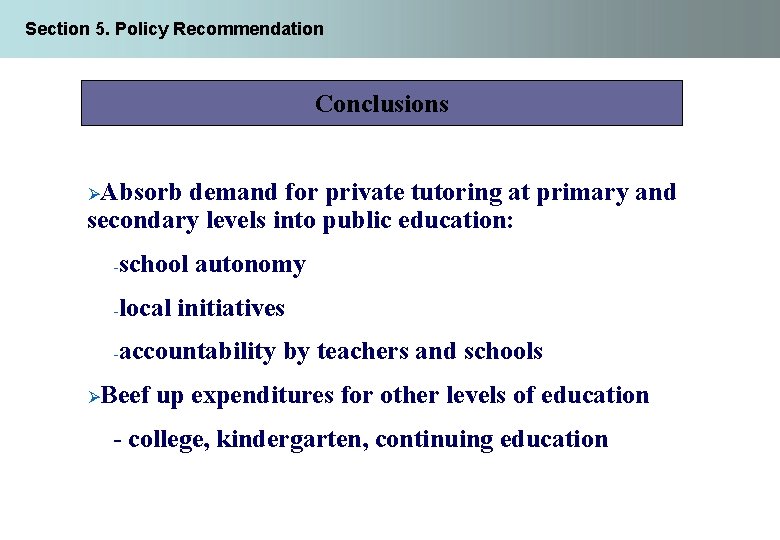
Section 5. Policy Recommendation Conclusions ØAbsorb demand for private tutoring at primary and secondary levels into public education: -school -local autonomy initiatives -accountability ØBeef by teachers and schools up expenditures for other levels of education - college, kindergarten, continuing education