
Education human development and mental health Opening new

- Slides: 18
Education, human development and mental health: Opening new paths on cultural-historical approach Daniel Magalhães Goulart University of Brasília/CAPES Brazil Fernando González Rey University Center of Brasília University of Brasília Brazil
Objective • To present some challenges that our team in Brazil is facing to advance a theoretical proposition of subjectivity. • To discuss the articulation between the spheres of education, human development and mental health.
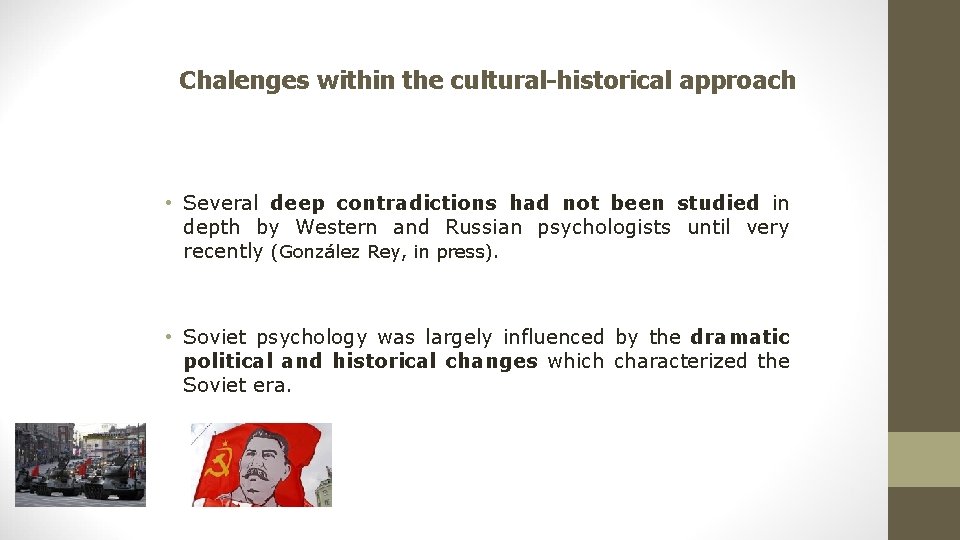
Chalenges within the cultural-historical approach • Several deep contradictions had not been studied in depth by Western and Russian psychologists until very recently (González Rey, in press). • Soviet psychology was largely influenced by the dramatic political and historical changes which characterized the Soviet era.
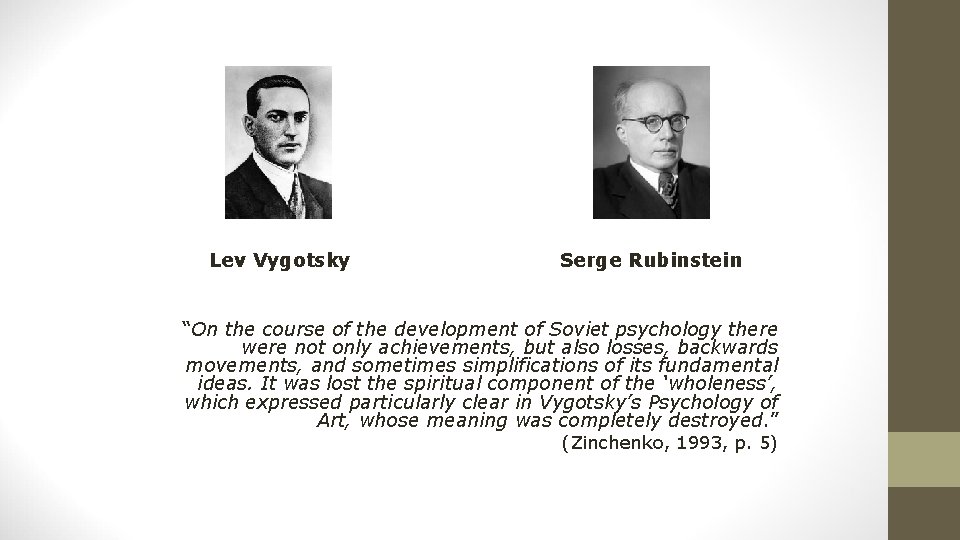
Lev Vygotsky Serge Rubinstein “On the course of the development of Soviet psychology there were not only achievements, but also losses, backwards movements, and sometimes simplifications of its fundamental ideas. It was lost the spiritual component of the ‘wholeness’, which expressed particularly clear in Vygotsky’s Psychology of Art, whose meaning was completely destroyed. ” (Zinchenko, 1993, p. 5)
• Rubinstein’s and Vygotsky’s work: transit from a element-based representation of psyche to a representation based on process principles and psychological units. • Rubinstein (1964): principle of the unity between consciousness and activity.
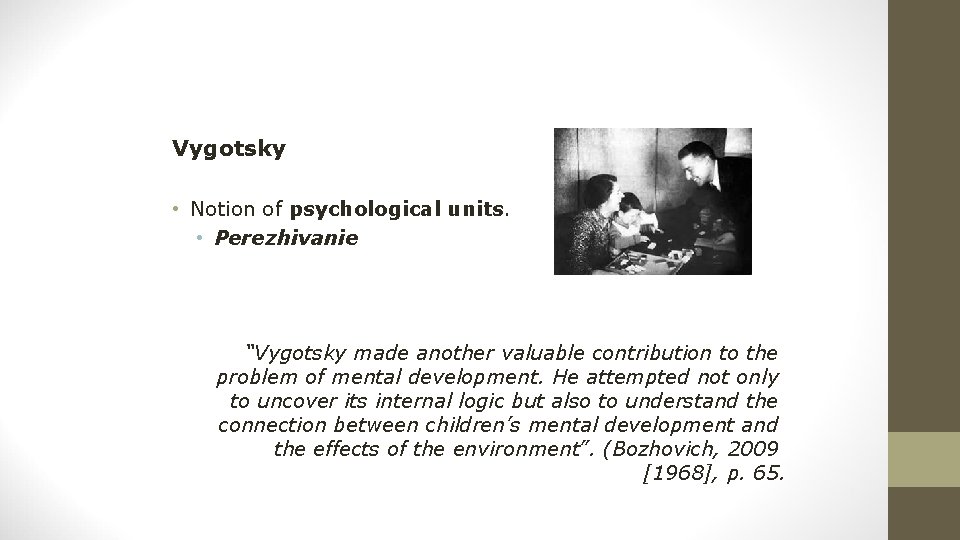
Vygotsky • Notion of psychological units. • Perezhivanie “Vygotsky made another valuable contribution to the problem of mental development. He attempted not only to uncover its internal logic but also to understand the connection between children’s mental development and the effects of the environment”. (Bozhovich, 2009 [1968], p. 65.
• Nevertheless, Vygotsky’s pioneer idea of units as part of a psychological system was never successfully developed by him. “If Vygotsky had lived only a few more years, he would surely have concentrated his effort on the analysis of this system [the author is referring to the system of sense]. And this would inevitably have led to that of which he already dreamt in his “Historical Sense of the Psychological Crisis, (. . . ) a complete overhaul of the whole conceptual apparatus of modern psychology. (. . . ) No simple continuing movement, but a complicated dynamic of senses. He never got a chance to do it, however. ” (A. A. Leontiev, 1992, p. 43)
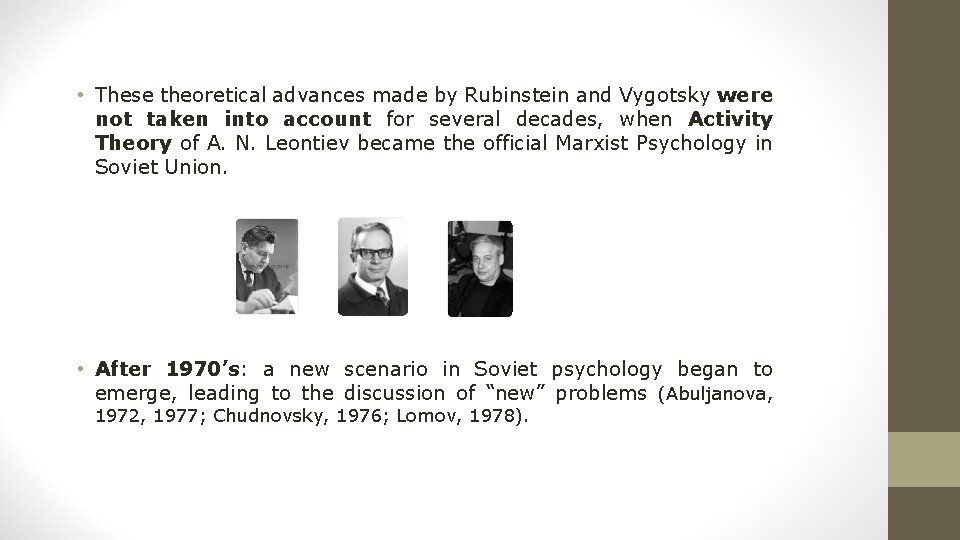
• These theoretical advances made by Rubinstein and Vygotsky were not taken into account for several decades, when Activity Theory of A. N. Leontiev became the official Marxist Psychology in Soviet Union. • After 1970’s: a new scenario in Soviet psychology began to emerge, leading to the discussion of “new” problems (Abuljanova, 1972, 1977; Chudnovsky, 1976; Lomov, 1978).
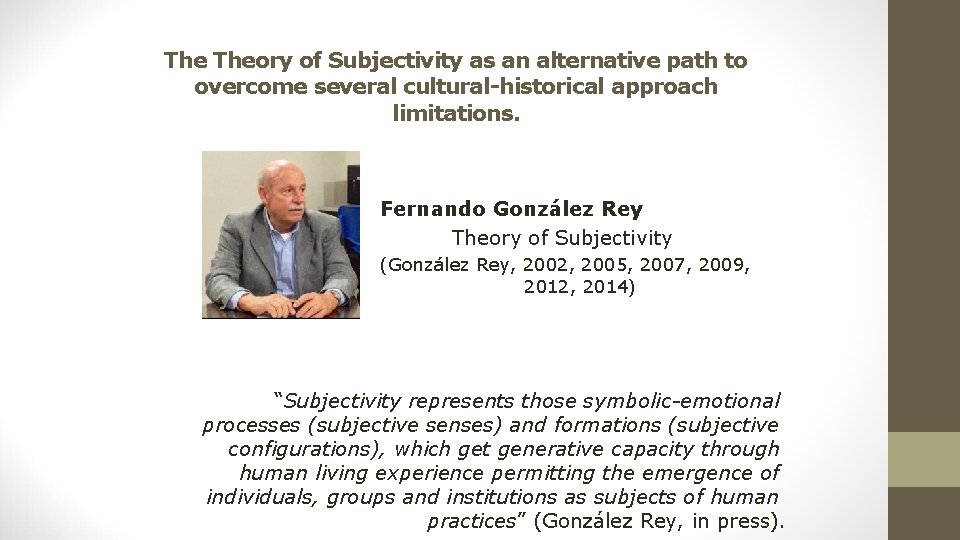
The Theory of Subjectivity as an alternative path to overcome several cultural-historical approach limitations. Fernando González Rey Theory of Subjectivity (González Rey, 2002, 2005, 2007, 2009, 2012, 2014) “Subjectivity represents those symbolic-emotional processes (subjective senses) and formations (subjective configurations), which get generative capacity through human living experience permitting the emergence of individuals, groups and institutions as subjects of human practices” (González Rey, in press).
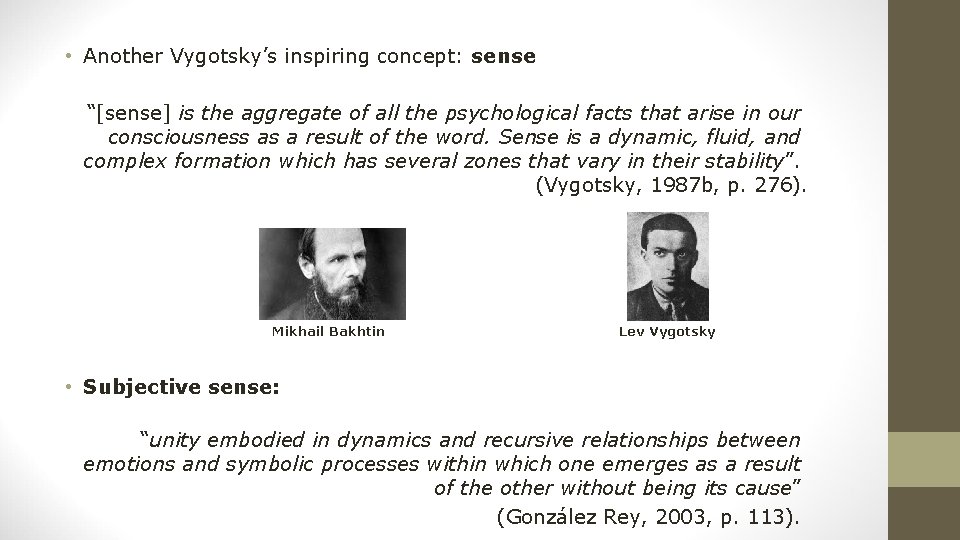
• Another Vygotsky’s inspiring concept: sense “[sense] is the aggregate of all the psychological facts that arise in our consciousness as a result of the word. Sense is a dynamic, fluid, and complex formation which has several zones that vary in their stability”. (Vygotsky, 1987 b, p. 276). Mikhail Bakhtin Lev Vygotsky • Subjective sense: “unity embodied in dynamics and recursive relationships between emotions and symbolic processes within which one emerges as a result of the other without being its cause” (González Rey, 2003, p. 113).
• Subjective configurations: “The subjective configuration of human actions and performances embodies the metaphorical unity between consciousness and activity enunciated by Rubinstein; more relevant human actions are subjectively configured, at the same time any psychological function that emerges as a motivation for the person is subjectively configured” (González Rey, in press). • Flexible concept, which helps us articulate dimensions of life which are artificially separated, such as education, mental health and human development.
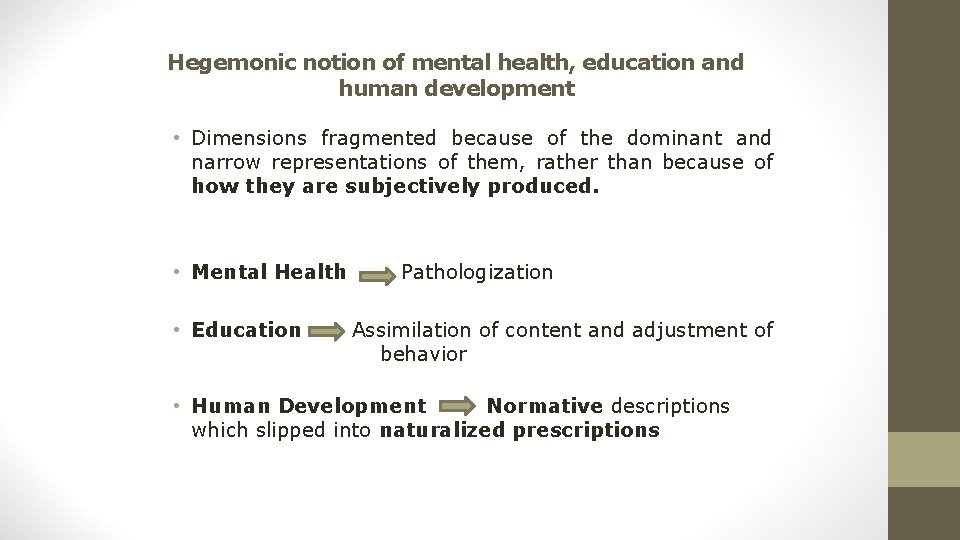
Hegemonic notion of mental health, education and human development • Dimensions fragmented because of the dominant and narrow representations of them, rather than because of how they are subjectively produced. • Mental Health • Education Pathologization Assimilation of content and adjustment of behavior • Human Development Normative descriptions which slipped into naturalized prescriptions
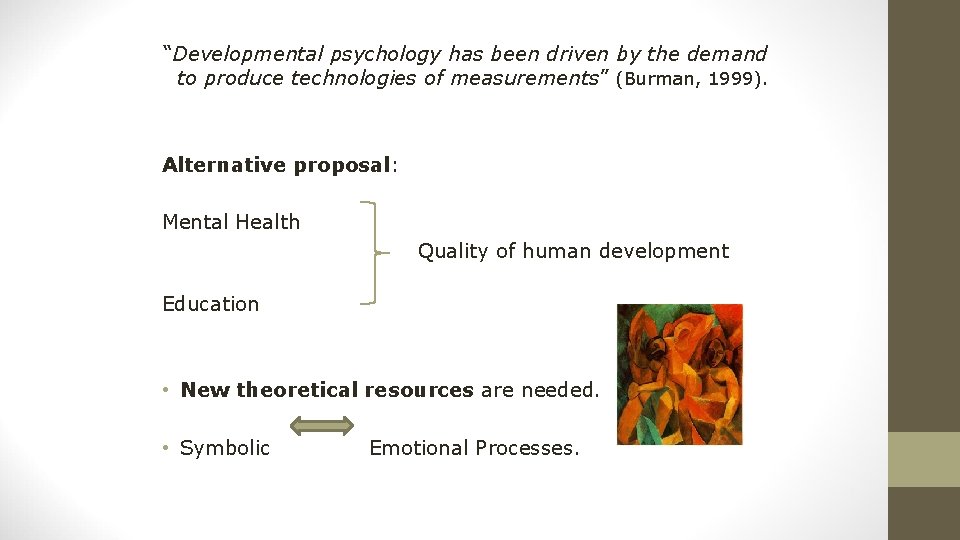
“Developmental psychology has been driven by the demand to produce technologies of measurements” (Burman, 1999). Alternative proposal: Mental Health Quality of human development Education • New theoretical resources are needed. • Symbolic Emotional Processes.
Implications of the Theory of Subjectivity: the articulation of mental health, education and human development. • Masters Dissertation and Ph. D studies. 1. Subjective processes related to the process of institutionalization of Brazilian mental health care services. 2. The “treatment” still emphasizes the elimination of symptoms from a semiologic point of view; 3. Production of assisted individuals as objects of technical procedures; 4. The institution seems to conceal the educational role to be played by the service; 5. Remaining “mental asylum model”.
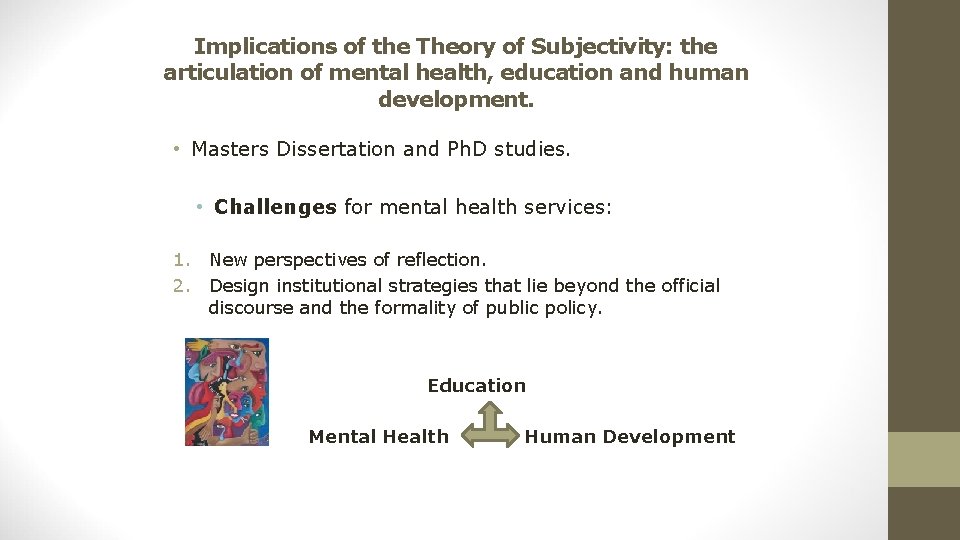
Implications of the Theory of Subjectivity: the articulation of mental health, education and human development. • Masters Dissertation and Ph. D studies. • Challenges for mental health services: 1. New perspectives of reflection. 2. Design institutional strategies that lie beyond the official discourse and the formality of public policy. Education Mental Health Human Development
Thank you very much! danielgoulartbr@yahoo. com. br danielgoulartbr@gmail. com
References • Abuljanova, K. (1980). El sujeito de la actividad psíquica [The psychic activity’s subject]. Roca, Cidade do México. • Bozhovich, L. I. (1968). La personalidad y su formación en la edad infantile [The personality and its formation in the childhood]. Habana, Cuba: Pueblo y Educación. • Canguilhem, G. (2004). Escritos sobre la medicina. Buenos Aires: Amorroru. • Chudnovsky, V. E. (1988). “Problema subjectivnosti v svete sobremennyx zadach psikjologii vospitaniya. [The problem of subjectivity from the standpoint of educational psychology]. Vorpocy psikjologii [Psychologic Issues], 4: 15 -24. • Burman, E. (1994) Deconstructing Developmental Psychology. London: Routledge. • González Rey, F. (2002). Sujeto y Subjetividad: Una aproximación histórico-cultural [Subject and subjectivity: An historical cultural approach]. México, D. F. : Thomson. • González Rey, F. L. (2005). Pesquisa qualitativa e subjetividade: os processos de construção da informação. [Qualitativa research and subjectivity: the processes of construction of information]. (2 a. Ed. ). São Paulo: Cengage Learning. • González Rey, F. L. (2007). Psicoterapia, subjetividade e pós-modernidade: uma aproximação histórico-cultural. [Psychotherapy, subjectivity and post modernity: a cultural-historical approach]. São Paulo: Pioneira Thomson Learning. • González Rey, F. L. (2009). Epistemología y Ontología: un debate necessário para la Psicología hoy. [Epistemology and Ontology: a necessary debate to actual psychology]. Diversitas [online]. 5(2), 205 -224. Retirado de: http: //ojs. usta. edu. co/index. php/diversitas/article/view. File/6/pdf. • González Rey, F. (2011). A Re-examination of Defining Moments in Vygotsky’s Work and Their Implications for His Continuing Legacy. Mind, culture and activity. 18, 257 -275.
References • González Rey, F. (2013). O pensamento de Vigotsky: contribuições, desdobramentos e desenvolvimento. [Vygotsky’s though: contributions, unfolds and development]. São Paulo: Hucitec. • González Rey, F. (2014). Advancing further the history of soviet psychology: moving forward from dominant representations in Western and Soviet Psychology. History of Psychology. 17(1), 60 -78. • González Rey, F. (in press) Avancing on the topics of the social and subjectivity from a cultural-historical approach: moments, paths and contradictions. Journal of the Theoretical and Philosophical Psychology. • Holzman, L. and Mendez, R. (Eds. ). (2003). Psychological investigations: a clinician's guide to social therapy. New York: Brunner-Routledge • Leontiev, A. A. (1992). Ecce Homo. Methodological problems of the activity– theoretical approach. Multidisciplinary Newsletter for Activity Theory, 11/12, 41– 44. • Lomov, B. F. (1978). Kategorii obtscheniya i deyatelnosti v psykjologii [The categories of communication and activity in psychology]. Voprocy Filosofii, 8, 34– 47. • Lomov, B. F. (1984). Metodologicheskie problemy socialnoi psikjologii [Metodological issues of social psychology]. Nauta, Moscou. • Rubinstein, S. L. (1964). El desarrollo de la psicología. Principios y métodos [The development of psychology: Principles and methods]. Habana, Cuba: Editora del Consejo Nacional de Universidades. • Vygotsky, L. S. (1987). Thinking and speech. In R. Rieber & A. Carton (Eds. ), The collected works of L. S. Vygotsky. Vol. 1 (pp. 43– 287). New York, NY: Plenum. • Zinchenko, V. P. (1993). Kulturno-Istorisheskaya Psykjologia: Onyt amplifikatsii. Voprocy Psykjologii, 4, 5– 19.