
Education Health and Care plans understanding how social
- Slides: 35
Education Health and Care plans: understanding how social care fits in. Chris Mullen: Social Care Policy Advisor, NDCS.
Aims for the session • Understand legal requirements on adult social care • Understand broad aims of Care Act and its provisions • How Care Act assessment fit into EHC plans
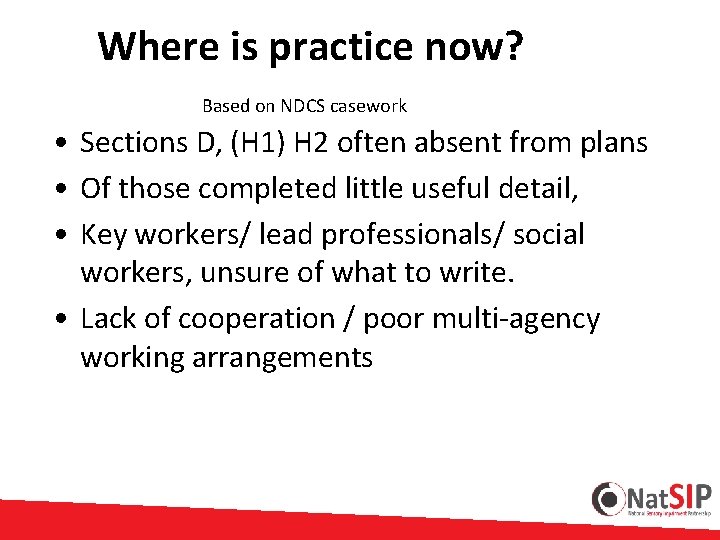
Where is practice now? Based on NDCS casework • Sections D, (H 1) H 2 often absent from plans • Of those completed little useful detail, • Key workers/ lead professionals/ social workers, unsure of what to write. • Lack of cooperation / poor multi-agency working arrangements
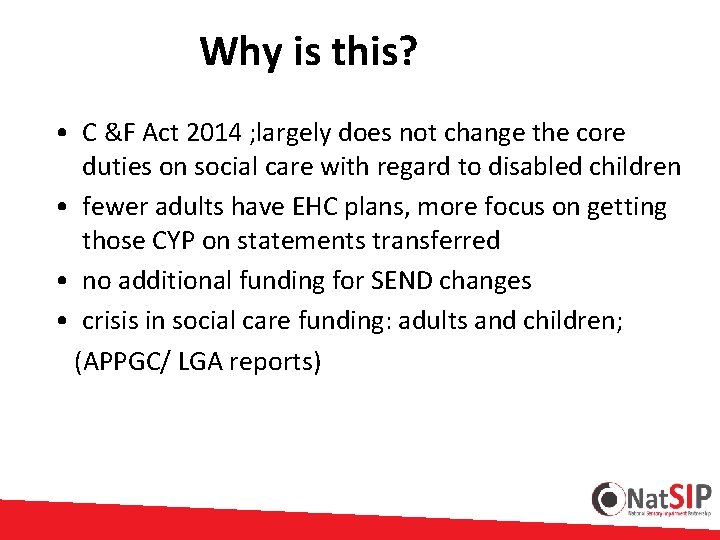
Why is this? • C &F Act 2014 ; largely does not change the core duties on social care with regard to disabled children • fewer adults have EHC plans, more focus on getting those CYP on statements transferred • no additional funding for SEND changes • crisis in social care funding: adults and children; (APPGC/ LGA reports)
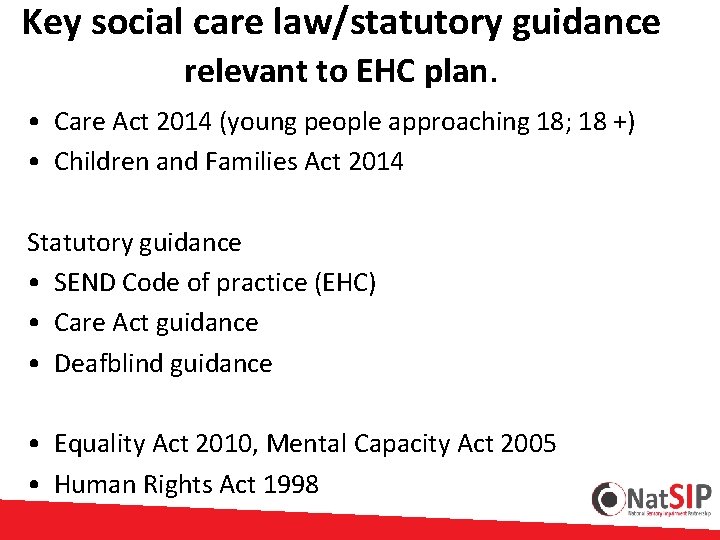
Key social care law/statutory guidance relevant to EHC plan. • Care Act 2014 (young people approaching 18; 18 +) • Children and Families Act 2014 Statutory guidance • SEND Code of practice (EHC) • Care Act guidance • Deafblind guidance • Equality Act 2010, Mental Capacity Act 2005 • Human Rights Act 1998
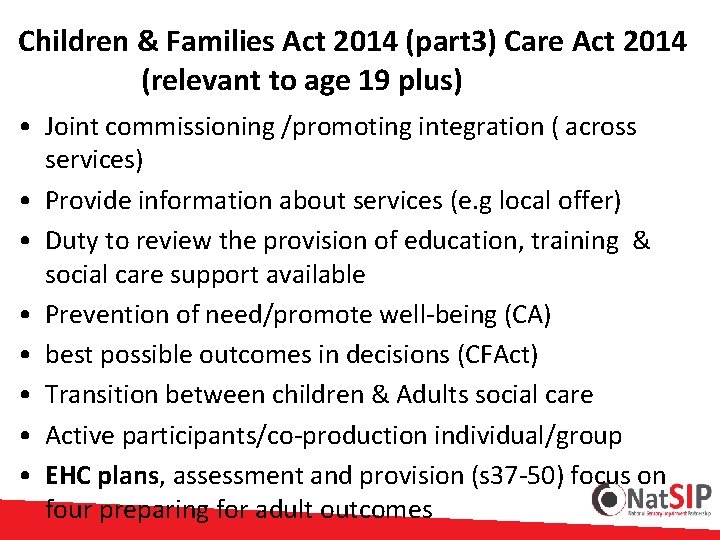
Children & Families Act 2014 (part 3) Care Act 2014 (relevant to age 19 plus) • Joint commissioning /promoting integration ( across services) • Provide information about services (e. g local offer) • Duty to review the provision of education, training & social care support available • Prevention of need/promote well-being (CA) • best possible outcomes in decisions (CFAct) • Transition between children & Adults social care • Active participants/co-production individual/group • EHC plans, assessment and provision (s 37 -50) focus on four preparing for adult outcomes
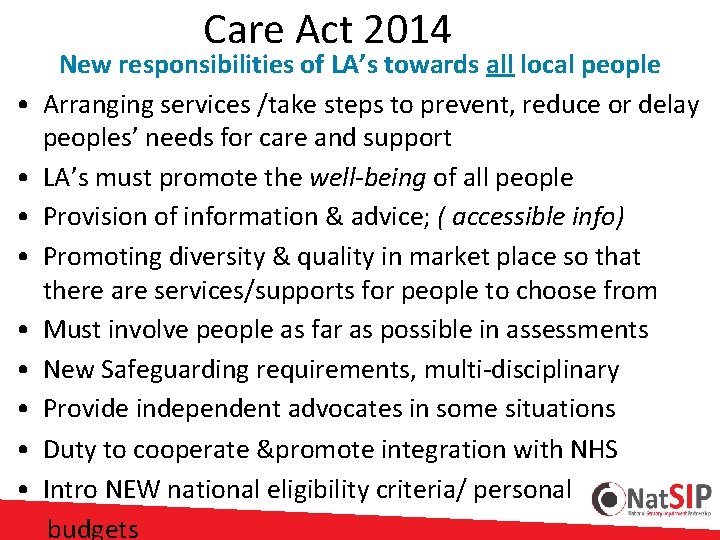
Care Act 2014 New responsibilities of LA’s towards all local people • Arranging services /take steps to prevent, reduce or delay peoples’ needs for care and support • LA’s must promote the well-being of all people • Provision of information & advice; ( accessible info) • Promoting diversity & quality in market place so that there are services/supports for people to choose from • Must involve people as far as possible in assessments • New Safeguarding requirements, multi-disciplinary • Provide independent advocates in some situations • Duty to cooperate &promote integration with NHS • Intro NEW national eligibility criteria/ personal budgets
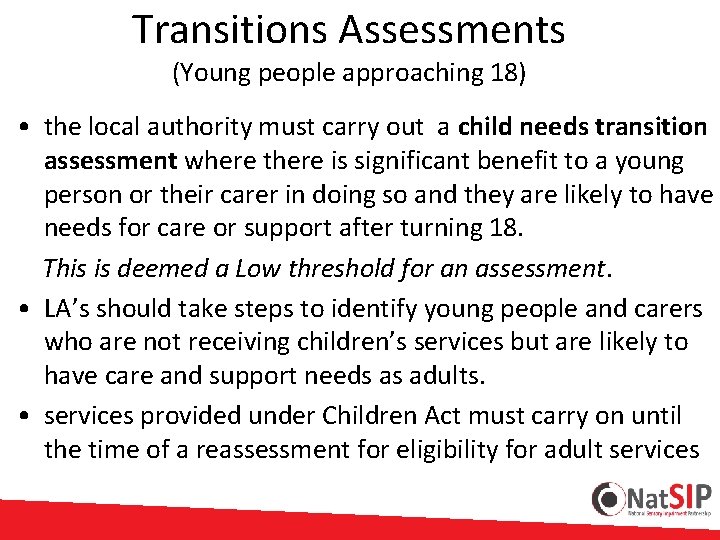
Transitions Assessments (Young people approaching 18) • the local authority must carry out a child needs transition assessment where there is significant benefit to a young person or their carer in doing so and they are likely to have needs for care or support after turning 18. This is deemed a Low threshold for an assessment. • LA’s should take steps to identify young people and carers who are not receiving children’s services but are likely to have care and support needs as adults. • services provided under Children Act must carry on until the time of a reassessment for eligibility for adult services
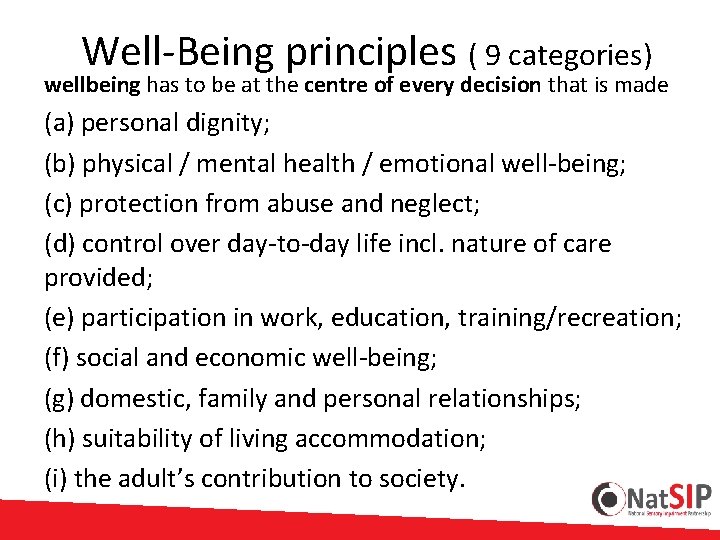
Well-Being principles ( 9 categories) wellbeing has to be at the centre of every decision that is made (a) personal dignity; (b) physical / mental health / emotional well-being; (c) protection from abuse and neglect; (d) control over day-to-day life incl. nature of care provided; (e) participation in work, education, training/recreation; (f) social and economic well-being; (g) domestic, family and personal relationships; (h) suitability of living accommodation; (i) the adult’s contribution to society.
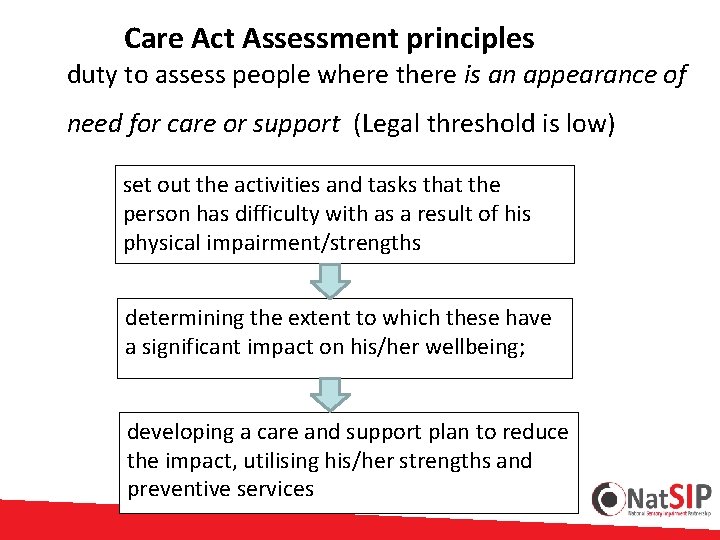
Care Act Assessment principles duty to assess people where there is an appearance of need for care or support (Legal threshold is low) set out the activities and tasks that the person has difficulty with as a result of his physical impairment/strengths determining the extent to which these have a significant impact on his/her wellbeing; developing a care and support plan to reduce the impact, utilising his/her strengths and preventive services
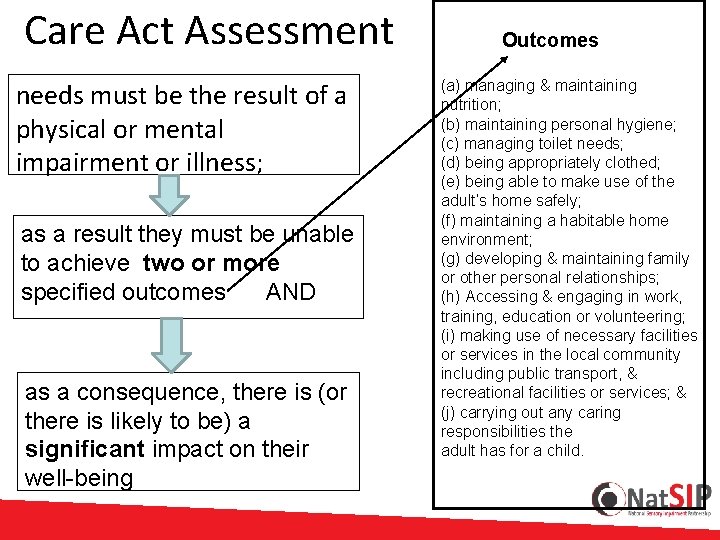
Care Act Assessment needs must be the result of a physical or mental impairment or illness; as a result they must be unable to achieve two or more specified outcomes AND as a consequence, there is (or there is likely to be) a significant impact on their well-being Outcomes (a) managing & maintaining nutrition; (b) maintaining personal hygiene; (c) managing toilet needs; (d) being appropriately clothed; (e) being able to make use of the adult’s home safely; (f) maintaining a habitable home environment; (g) developing & maintaining family or other personal relationships; (h) Accessing & engaging in work, training, education or volunteering; (i) making use of necessary facilities or services in the local community including public transport, & recreational facilities or services; & (j) carrying out any caring responsibilities the adult has for a child.
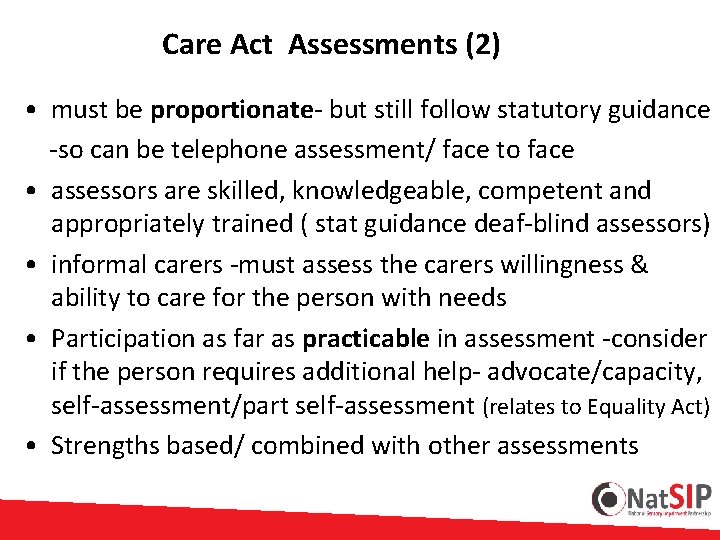
Care Act Assessments (2) • must be proportionate- but still follow statutory guidance -so can be telephone assessment/ face to face • assessors are skilled, knowledgeable, competent and appropriately trained ( stat guidance deaf-blind assessors) • informal carers -must assess the carers willingness & ability to care for the person with needs • Participation as far as practicable in assessment -consider if the person requires additional help- advocate/capacity, self-assessment/part self-assessment (relates to Equality Act) • Strengths based/ combined with other assessments
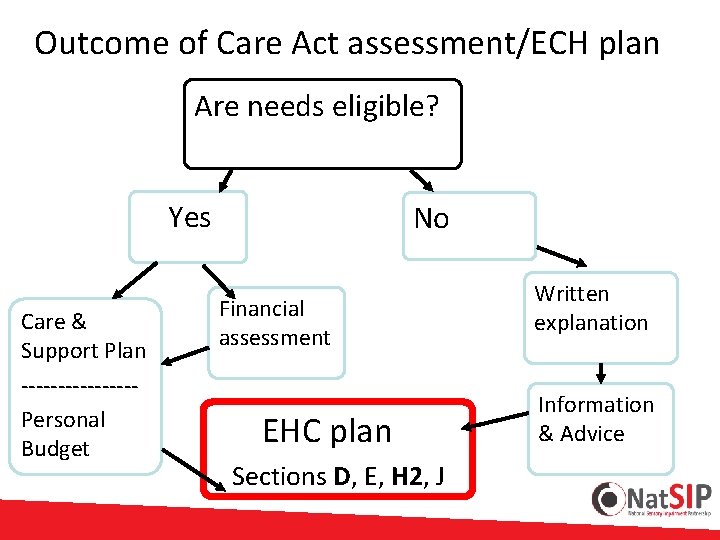
Outcome of Care Act assessment/ECH plan Are needs eligible? Yes Care & Support Plan --------Personal Budget No Financial assessment EHC plan Sections D, E, H 2, J Written explanation Information & Advice
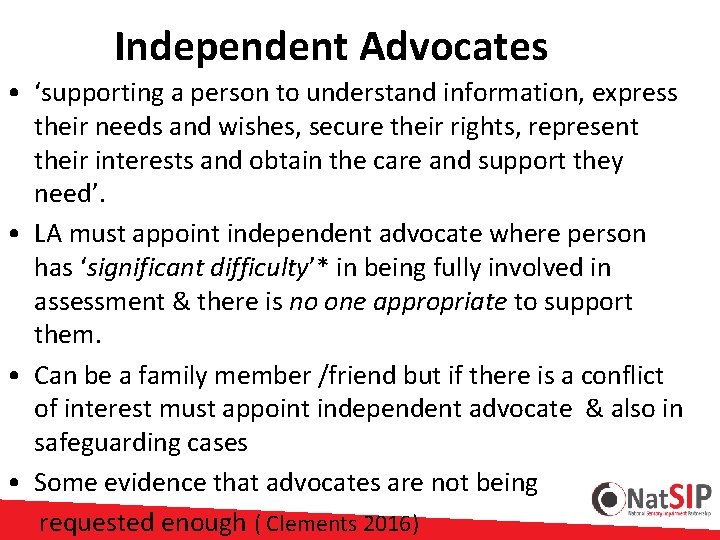
Independent Advocates • ‘supporting a person to understand information, express their needs and wishes, secure their rights, represent their interests and obtain the care and support they need’. • LA must appoint independent advocate where person has ‘significant difficulty’* in being fully involved in assessment & there is no one appropriate to support them. • Can be a family member /friend but if there is a conflict of interest must appoint independent advocate & also in safeguarding cases • Some evidence that advocates are not being requested enough ( Clements 2016)
Independent Advocates (2) • Broader definition of advocate than under the Care Act the Mental Capacity Act. • The independent advocate can also undertake a Mental Capacity Act assessment if suitably trained.
Deafblind statutory guidance Dec 2014 • make contact with & keep a record of all deafblind people • ensure assessments of need for care & support is are carried out by people with specific training & expertise • provide appropriate services for deafblind people • provide specially trained one-to-one support workers when necessary • provide accessible information for deafblind people • ensure that a Director-level member of the local authority senior team has overall responsibility for deafblind services.
Provision of auxiliary aids/reablement • when provided by a local authority as preventative services under s 2(1) of the Act all equipment and minor adaptation costing £ 1, 000 or less must be free of charge. • So too must any reablement support for up to six weeks. • LA’s should not direct people to buy equipment themselves if there is still the appearance of them having needs and therefore an assessment which could lead to eligible needs for that equipment • ( important for deaf and visually impaired equipment)
Care Act Case law ( Luke Clements) • concern over use of panels- lack of expertise, delays • councils trying to stop social workers making recommendations in their assessments • where individual packages of care reduced must be based on a full assessment where needs have changed. • must clearly re-assess impact on well-being and outcomes young adult wants to achieve • must not assume carers can provide additional care where support is reduced
Before an EHC assessment is considered The LA must; • provide a Link to social care to early years providers, schools and colleges with a contact for social care advice on children and young people with SEN & disabilities • There is a proactive requirement in Children & Families Act and Care Act for LA to provide information and advice on support and services to CYP/young adults with SEND/possible care needs & carers with possible support needs.
Undertake EHC assessments LA’s must; • assess YP age 19 -25 who request an EHC assessment. But must be a need for possible need for SEN support re education and or training first. • Join assessment & review process EHC/Care plans support plans to reduce multiple meetings ( 3. 56 SEND COP) • When the LA decides it will carry out an EHC assessment) it must request social care advice which must be returned within 6 weeks (9. 41 SEN COP) & • …this ‘should’ trigger a Care Act assessment where there hasn’t been a social care assessment before/or for sometime (low threshold for social care Care Act assessment)
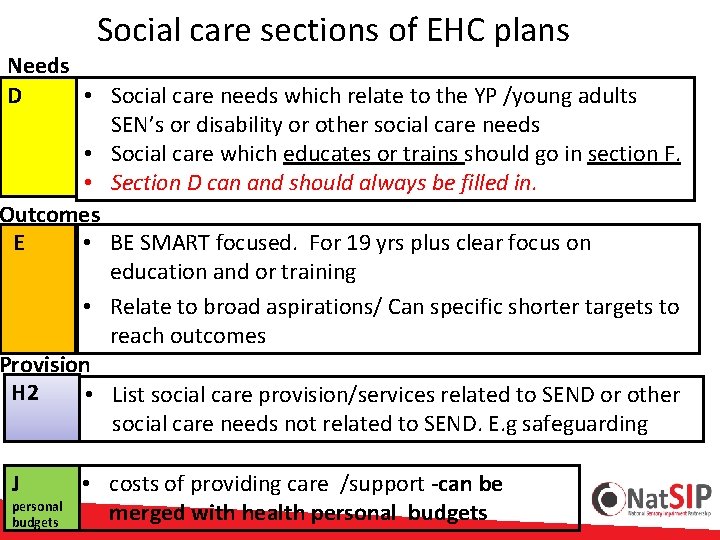
Social care sections of EHC plans Needs D • Social care needs which relate to the YP /young adults SEN’s or disability or other social care needs • Social care which educates or trains should go in section F. • Section D can and should always be filled in. Outcomes E • BE SMART focused. For 19 yrs plus clear focus on education and or training • Relate to broad aspirations/ Can specific shorter targets to reach outcomes Provision H 2 • List social care provision/services related to SEND or other social care needs not related to SEND. E. g safeguarding J personal budgets • costs of providing care /support -can be merged with health personal budgets
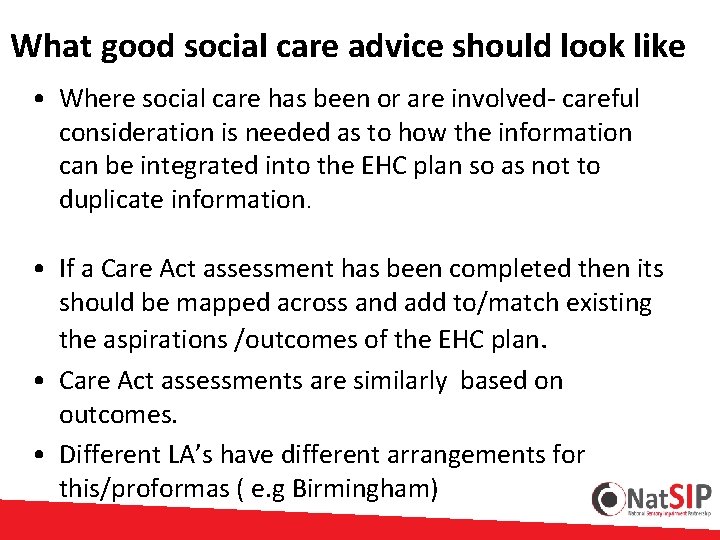
What good social care advice should look like • Where social care has been or are involved- careful consideration is needed as to how the information can be integrated into the EHC plan so as not to duplicate information. • If a Care Act assessment has been completed then its should be mapped across and add to/match existing the aspirations /outcomes of the EHC plan. • Care Act assessments are similarly based on outcomes. • Different LA’s have different arrangements for this/proformas ( e. g Birmingham)
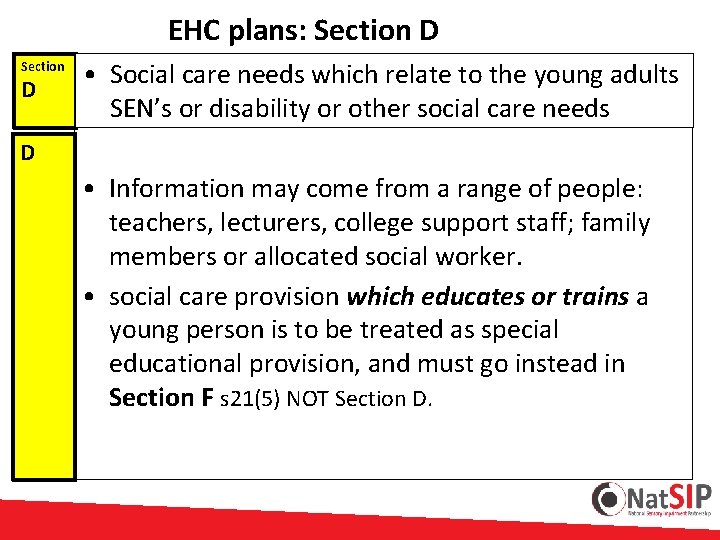
EHC plans: Section D • Social care needs which relate to the young adults SEN’s or disability or other social care needs D • Information may come from a range of people: teachers, lecturers, college support staff; family members or allocated social worker. • social care provision which educates or trains a young person is to be treated as special educational provision, and must go instead in Section F s 21(5) NOT Section D.
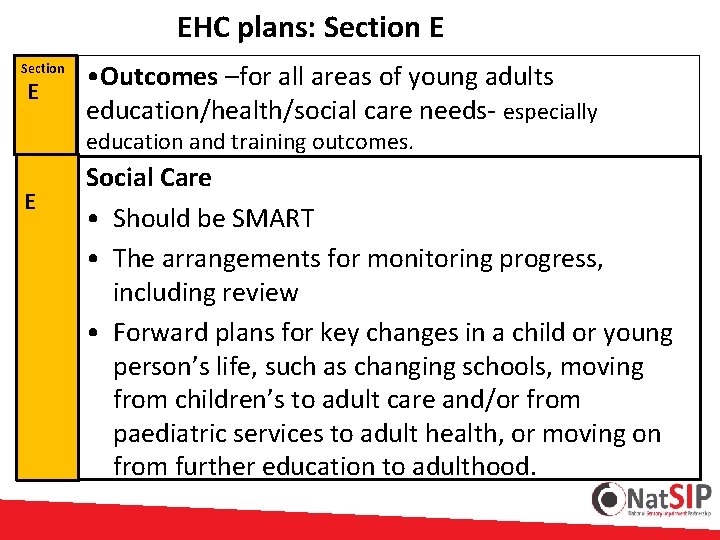
EHC plans: Section E • Outcomes –for all areas of young adults education/health/social care needs- especially education and training outcomes. E Social Care • Should be SMART • The arrangements for monitoring progress, including review • Forward plans for key changes in a child or young person’s life, such as changing schools, moving from children’s to adult care and/or from paediatric services to adult health, or moving on from further education to adulthood.
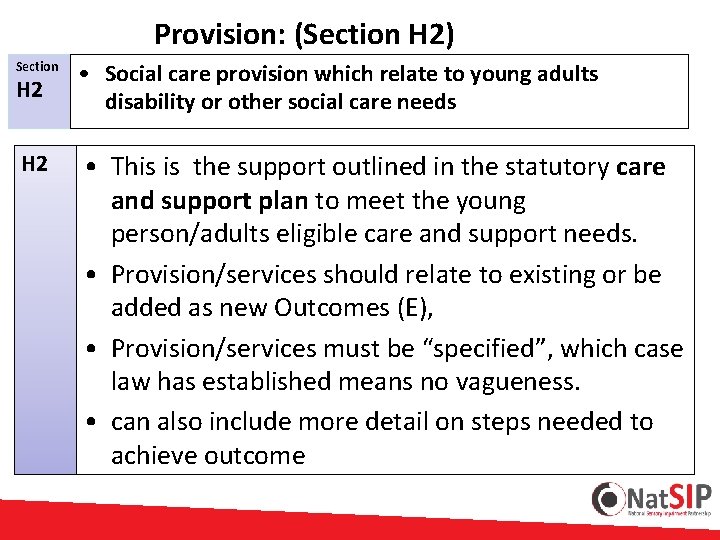
Provision: (Section H 2) Section H 2 • Social care provision which relate to young adults disability or other social care needs • This is the support outlined in the statutory care and support plan to meet the young person/adults eligible care and support needs. • Provision/services should relate to existing or be added as new Outcomes (E), • Provision/services must be “specified”, which case law has established means no vagueness. • can also include more detail on steps needed to achieve outcome
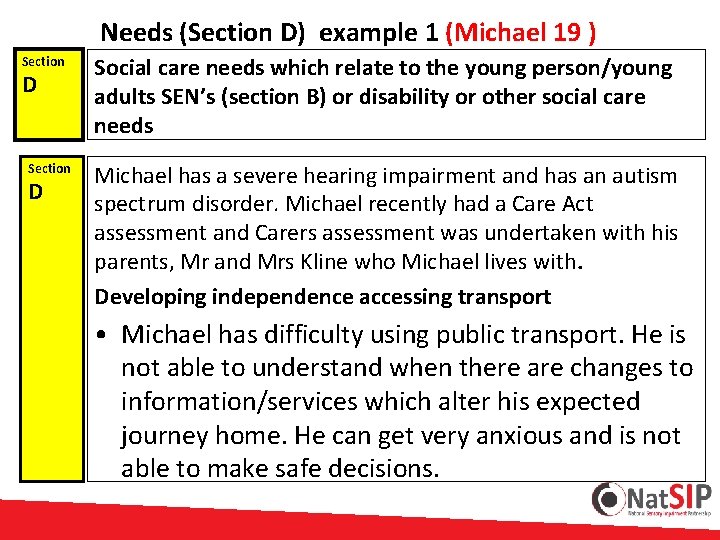
Needs (Section D) example 1 (Michael 19 ) Section D Social care needs which relate to the young person/young adults SEN’s (section B) or disability or other social care needs Michael has a severe hearing impairment and has an autism spectrum disorder. Michael recently had a Care Act assessment and Carers assessment was undertaken with his parents, Mr and Mrs Kline who Michael lives with. Developing independence accessing transport • Michael has difficulty using public transport. He is not able to understand when there are changes to information/services which alter his expected journey home. He can get very anxious and is not able to make safe decisions.
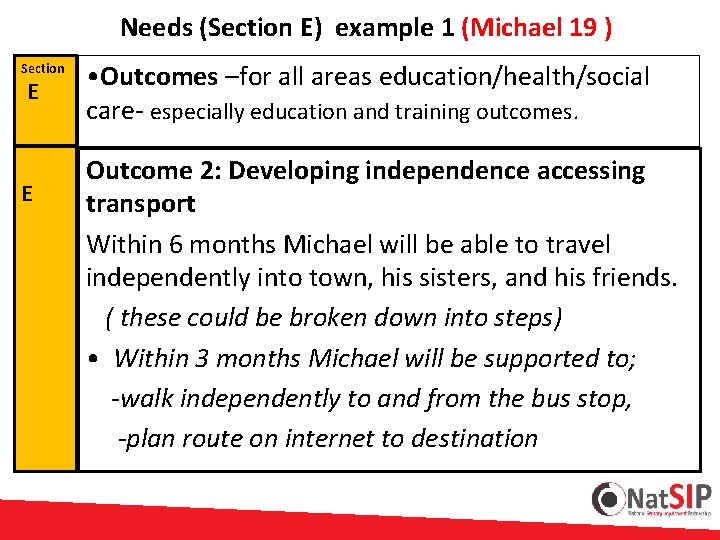
Needs (Section E) example 1 (Michael 19 ) Section E E • Outcomes –for all areas education/health/social care- especially education and training outcomes. Outcome 2: Developing independence accessing transport Within 6 months Michael will be able to travel independently into town, his sisters, and his friends. ( these could be broken down into steps) • Within 3 months Michael will be supported to; -walk independently to and from the bus stop, -plan route on internet to destination
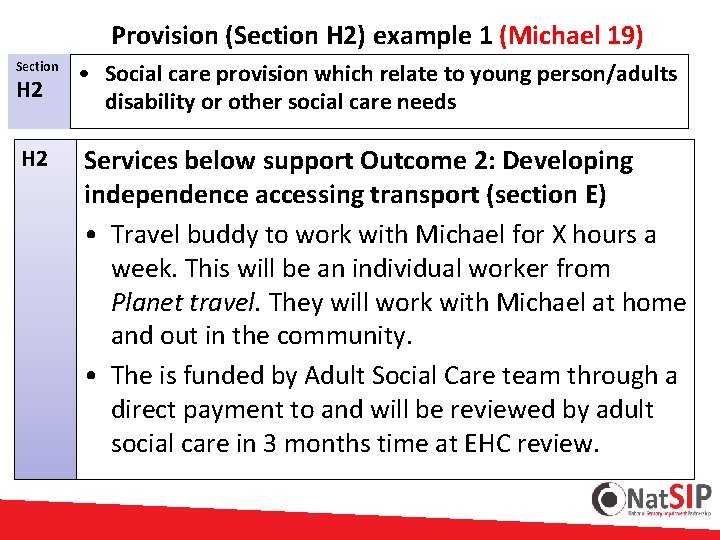
Provision (Section H 2) example 1 (Michael 19) Section H 2 • Social care provision which relate to young person/adults disability or other social care needs Services below support Outcome 2: Developing independence accessing transport (section E) • Travel buddy to work with Michael for X hours a week. This will be an individual worker from Planet travel. They will work with Michael at home and out in the community. • The is funded by Adult Social Care team through a direct payment to and will be reviewed by adult social care in 3 months time at EHC review.
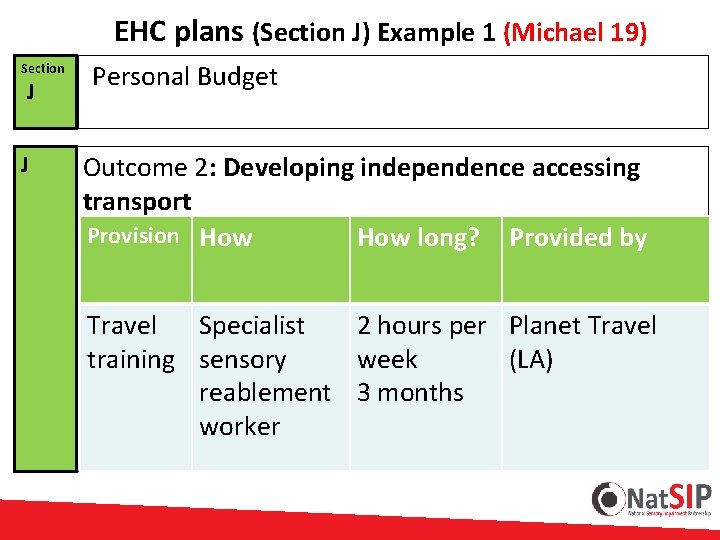
EHC plans (Section J) Example 1 (Michael 19) Section J J Personal Budget Outcome 2: Developing independence accessing transport Provision How long? Provided by Travel Specialist 2 hours per Planet Travel training sensory week (LA) reablement 3 months worker
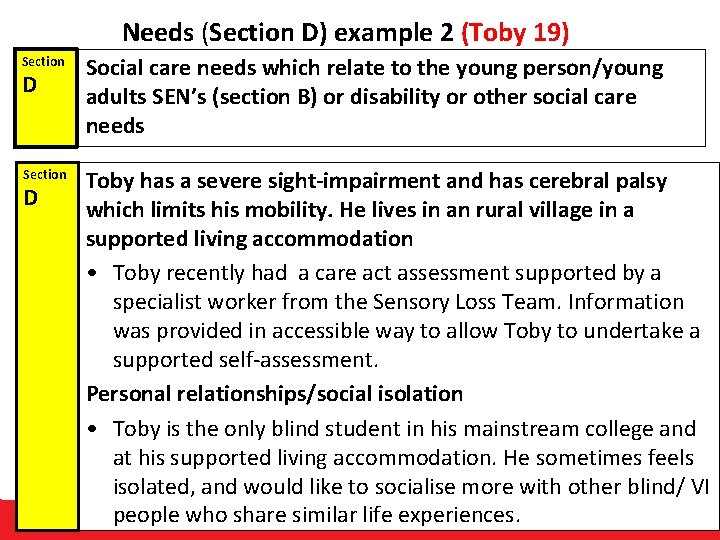
Needs (Section D) example 2 (Toby 19) Section Social care needs which relate to the young person/young adults SEN’s (section B) or disability or other social care needs Section Toby has a severe sight-impairment and has cerebral palsy which limits his mobility. He lives in an rural village in a supported living accommodation • Toby recently had a care act assessment supported by a specialist worker from the Sensory Loss Team. Information was provided in accessible way to allow Toby to undertake a supported self-assessment. Personal relationships/social isolation • Toby is the only blind student in his mainstream college and at his supported living accommodation. He sometimes feels isolated, and would like to socialise more with other blind/ VI people who share similar life experiences. D D
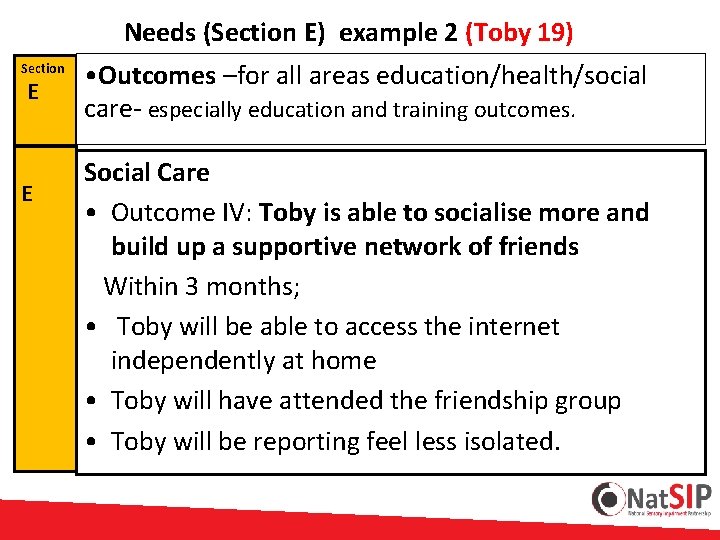
Needs (Section E) example 2 (Toby 19) Section E E • Outcomes –for all areas education/health/social care- especially education and training outcomes. Social Care • Outcome IV: Toby is able to socialise more and build up a supportive network of friends Within 3 months; • Toby will be able to access the internet independently at home • Toby will have attended the friendship group • Toby will be reporting feel less isolated.
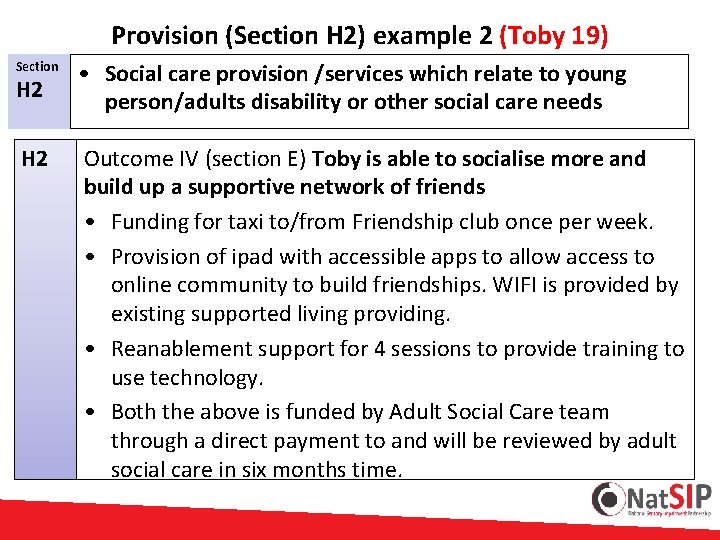
Provision (Section H 2) example 2 (Toby 19) Section H 2 • Social care provision /services which relate to young person/adults disability or other social care needs Outcome IV (section E) Toby is able to socialise more and build up a supportive network of friends • Funding for taxi to/from Friendship club once per week. • Provision of ipad with accessible apps to allow access to online community to build friendships. WIFI is provided by existing supported living providing. • Reanablement support for 4 sessions to provide training to use technology. • Both the above is funded by Adult Social Care team through a direct payment to and will be reviewed by adult social care in six months time.
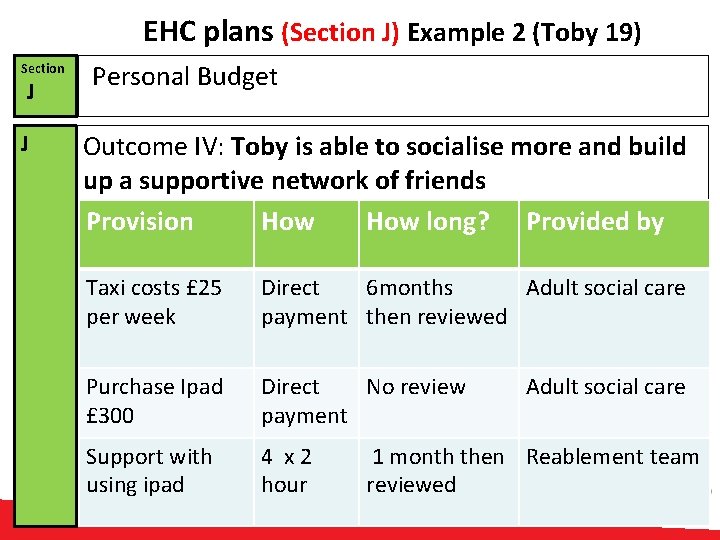
EHC plans (Section J) Example 2 (Toby 19) Section J J Personal Budget Outcome IV: Toby is able to socialise more and build up a supportive network of friends Provision How long? Provided by Taxi costs £ 25 per week Direct 6 months Adult social care payment then reviewed Purchase Ipad £ 300 Direct No review payment Support with using ipad 4 x 2 hour Adult social care 1 month then Reablement team reviewed
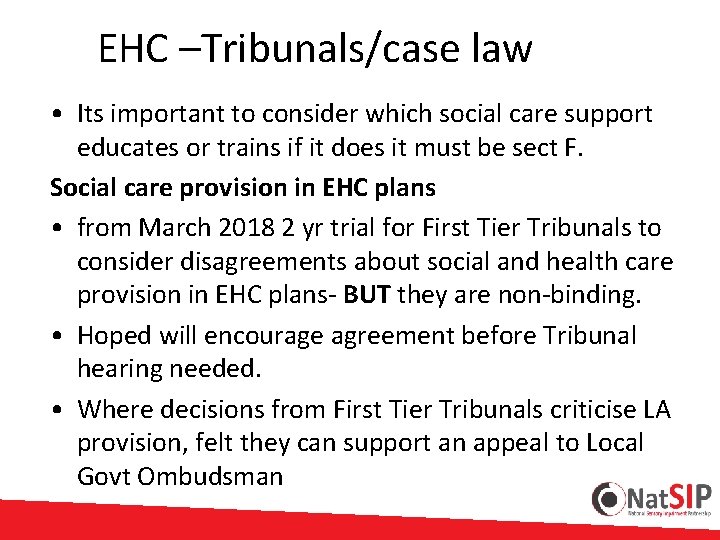
EHC –Tribunals/case law • Its important to consider which social care support educates or trains if it does it must be sect F. Social care provision in EHC plans • from March 2018 2 yr trial for First Tier Tribunals to consider disagreements about social and health care provision in EHC plans- BUT they are non-binding. • Hoped will encourage agreement before Tribunal hearing needed. • Where decisions from First Tier Tribunals criticise LA provision, felt they can support an appeal to Local Govt Ombudsman
Contact details Chris Mullen: Social Care Policy Advisor The National Deaf Children's’ Society ckmullen@ndcs. org. uk Tel: 0121 2349825 Social Care Advisory Service socialcare@ndcs. org. uk www. ndcs. org. uk/socialcareadvice