
Education for Overseas Koreans Definition of Overseas Koreans
- Slides: 21
Education for Overseas Koreans
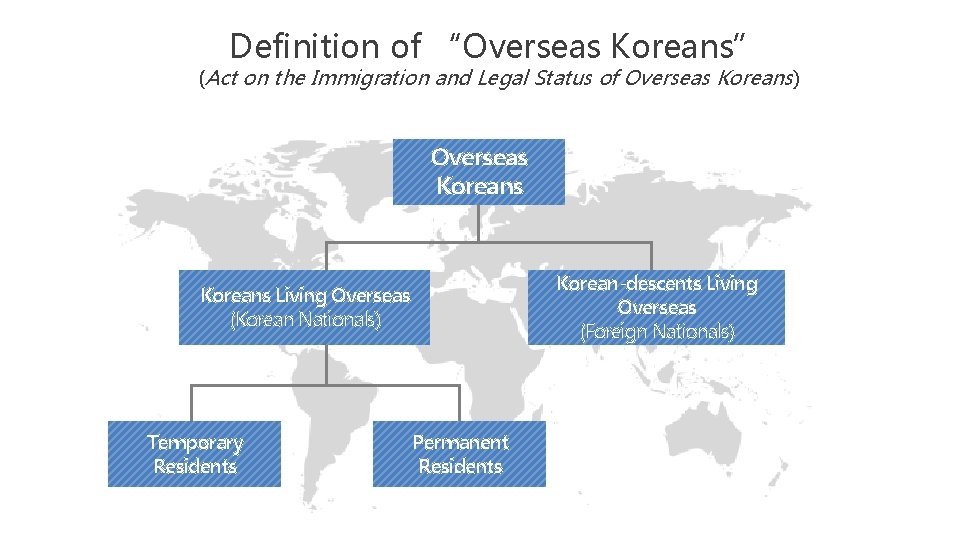
Definition of “Overseas Koreans” (Act on the Immigration and Legal Status of Overseas Koreans ) Overseas Korean-descents Living Overseas (Foreign Nationals) Koreans Living Overseas (Korean Nationals) Temporary Residents Permanent Residents
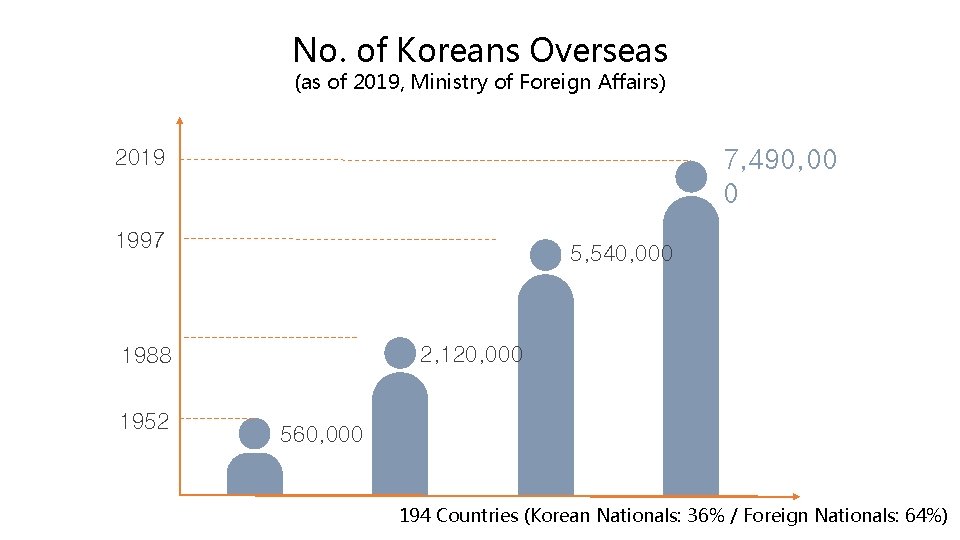
No. of Koreans Overseas (as of 2019, Ministry of Foreign Affairs) 7, 490, 00 0 2019 1997 5, 540, 000 2, 120, 000 1988 1952 560, 000 194 Countries (Korean Nationals: 36% / Foreign Nationals: 64%)
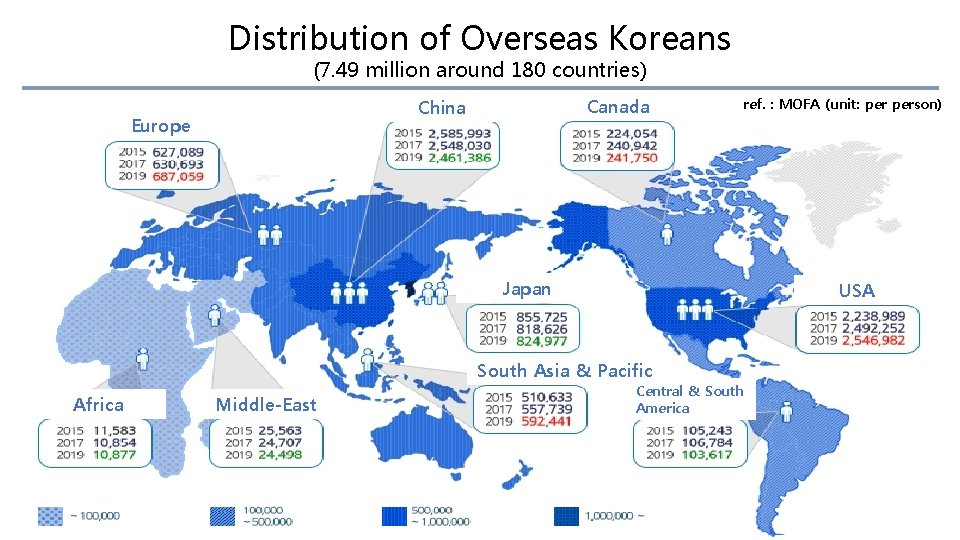
Distribution of Overseas Koreans (7. 49 million around 180 countries) Canada China Europe ref. : MOFA (unit: person) Japan USA South Asia & Pacific Africa Middle-East Central & South America
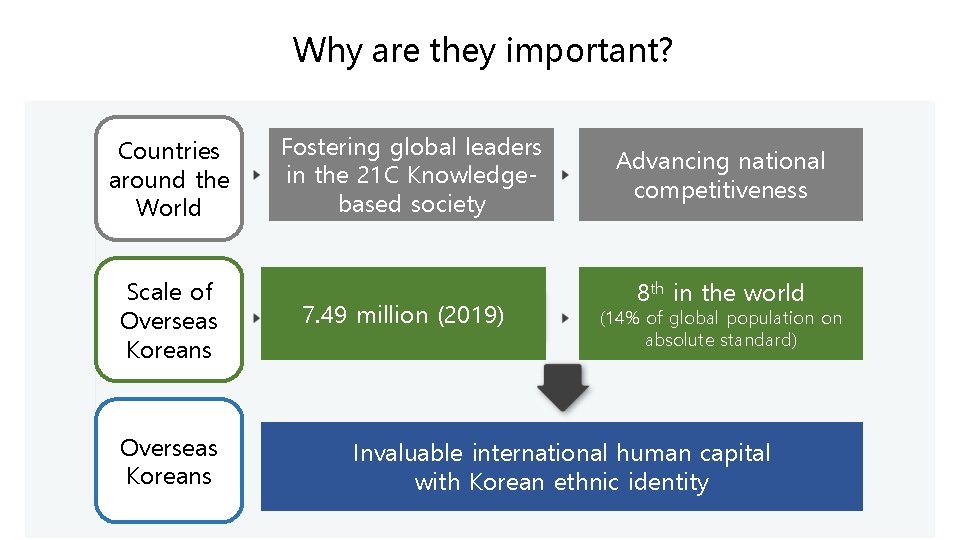
Why are they important? Countries around the World Scale of Overseas Koreans Fostering global leaders in the 21 C Knowledgebased society 7. 49약million (2019) 749만 명(‘ 19) Advancing national competitiveness 8 th in the world (14% of global population on absolute standard) Invaluable international human capital with Korean ethnic identity
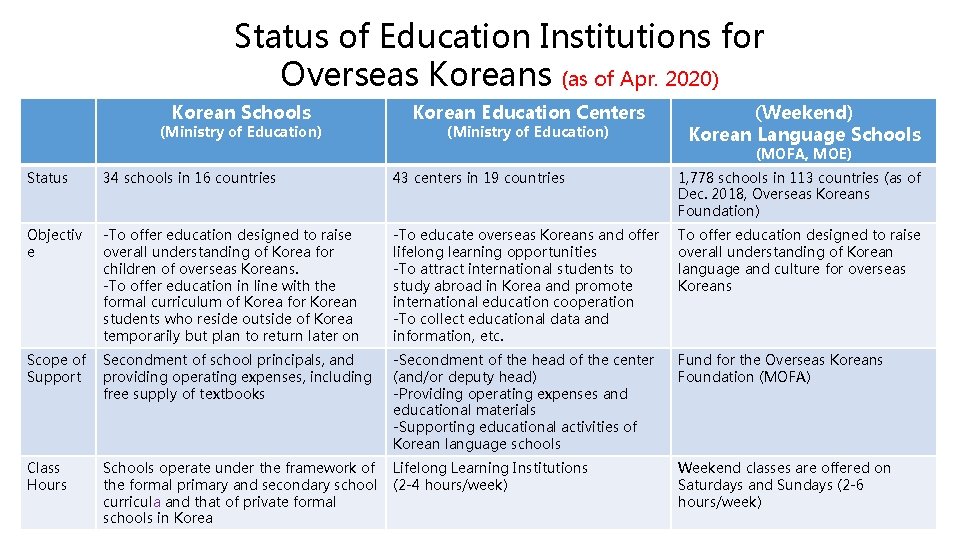
Status of Education Institutions for Overseas Koreans (as of Apr. 2020) Korean Schools (Ministry of Education) Korean Education Centers (Ministry of Education) (Weekend) Korean Language Schools (MOFA, MOE) Status 34 schools in 16 countries 43 centers in 19 countries 1, 778 schools in 113 countries (as of Dec. 2018, Overseas Koreans Foundation) Objectiv e -To offer education designed to raise overall understanding of Korea for children of overseas Koreans. -To offer education in line with the formal curriculum of Korea for Korean students who reside outside of Korea temporarily but plan to return later on -To educate overseas Koreans and offer lifelong learning opportunities -To attract international students to study abroad in Korea and promote international education cooperation -To collect educational data and information, etc. To offer education designed to raise overall understanding of Korean language and culture for overseas Koreans Scope of Support Secondment of school principals, and providing operating expenses, including free supply of textbooks -Secondment of the head of the center (and/or deputy head) -Providing operating expenses and educational materials -Supporting educational activities of Korean language schools Fund for the Overseas Koreans Foundation (MOFA) Class Hours Schools operate under the framework of the formal primary and secondary school curricula and that of private formal schools in Korea Lifelong Learning Institutions (2 -4 hours/week) Weekend classes are offered on Saturdays and Sundays (2 -6 hours/week)
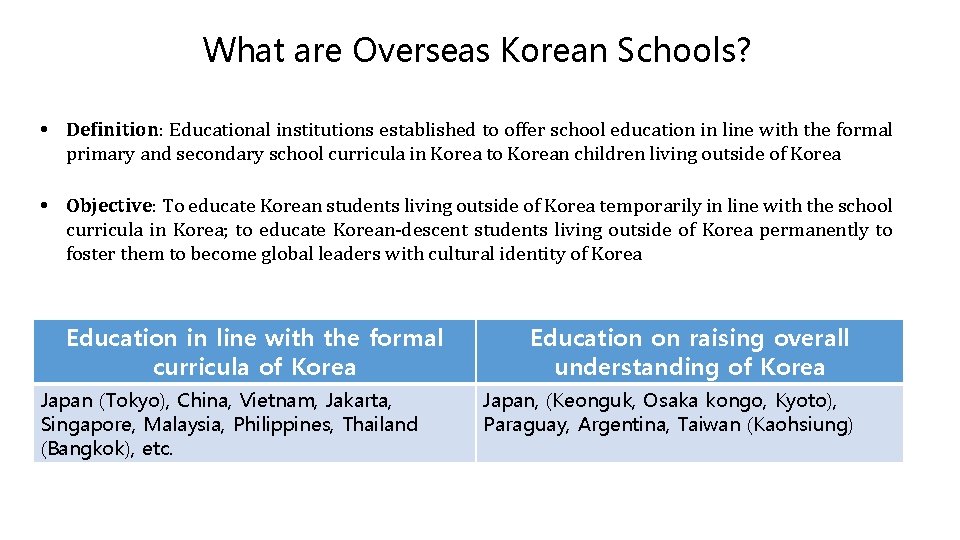
What are Overseas Korean Schools? Definition: Educational institutions established to offer school education in line with the formal primary and secondary school curricula in Korea to Korean children living outside of Korea Objective: To educate Korean students living outside of Korea temporarily in line with the school curricula in Korea; to educate Korean-descent students living outside of Korea permanently to foster them to become global leaders with cultural identity of Korea Education in line with the formal curricula of Korea Japan (Tokyo), China, Vietnam, Jakarta, Singapore, Malaysia, Philippines, Thailand (Bangkok), etc. Education on raising overall understanding of Korea Japan, (Keonguk, Osaka kongo, Kyoto), Paraguay, Argentina, Taiwan (Kaohsiung)
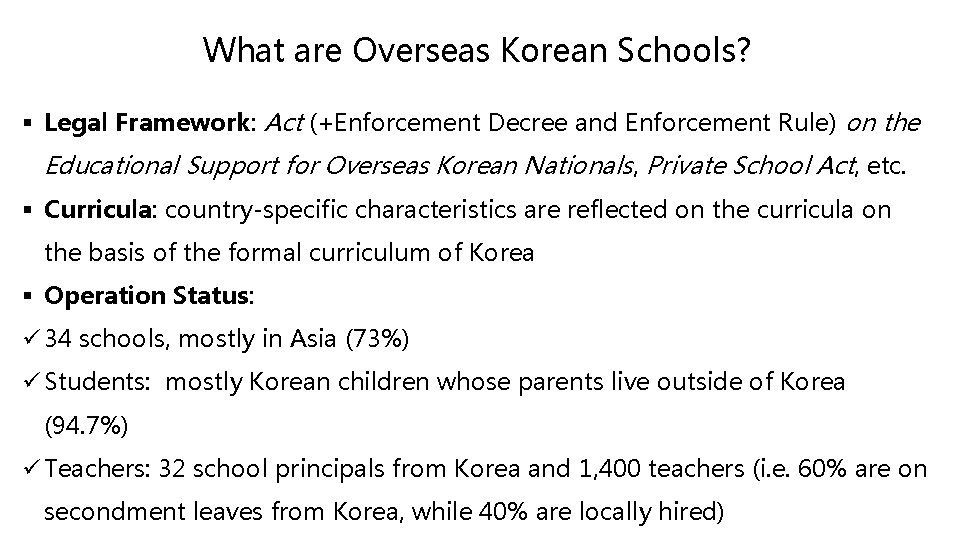
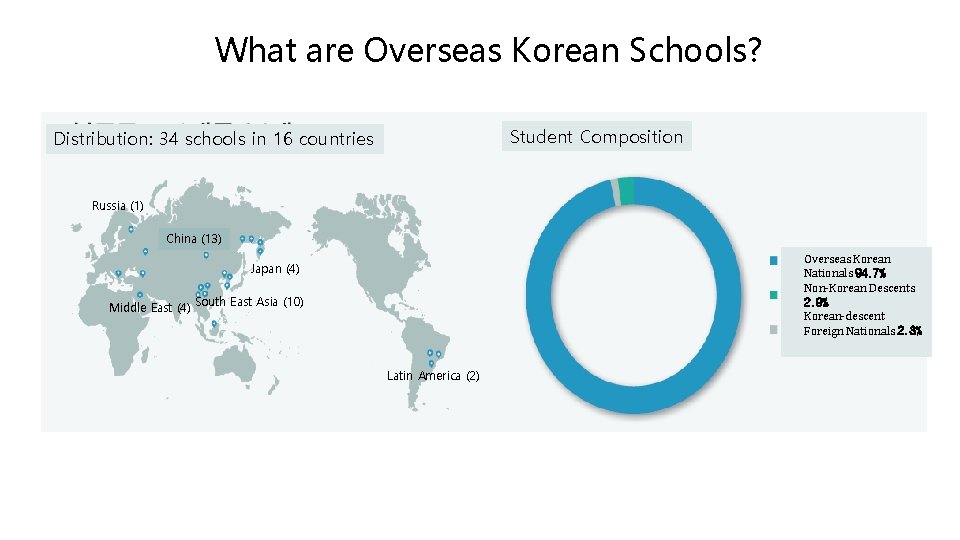
What are Overseas Korean Schools? § Legal Framework: Act (+Enforcement Decree and Enforcement Rule) on the Educational Support for Overseas Korean Nationals, Private School Act, etc. § Curricula: country-specific characteristics are reflected on the curricula on the basis of the formal curriculum of Korea § Operation Status: ü 34 schools, mostly in Asia (73%) ü Students: mostly Korean children whose parents live outside of Korea (94. 7%) ü Teachers: 32 school principals from Korea and 1, 400 teachers (i. e. 60% are on secondment leaves from Korea, while 40% are locally hired)
What are Overseas Korean Schools? Student Composition Distribution: 34 schools in 16 countries Russia (1) China (13) Overseas Korean Nationals 94. 7% Non-Korean Descents 2. 9% Korean-descent Foreign Nationals 2. 3% Japan (4) Middle East (4) South East Asia (10) Latin America (2)
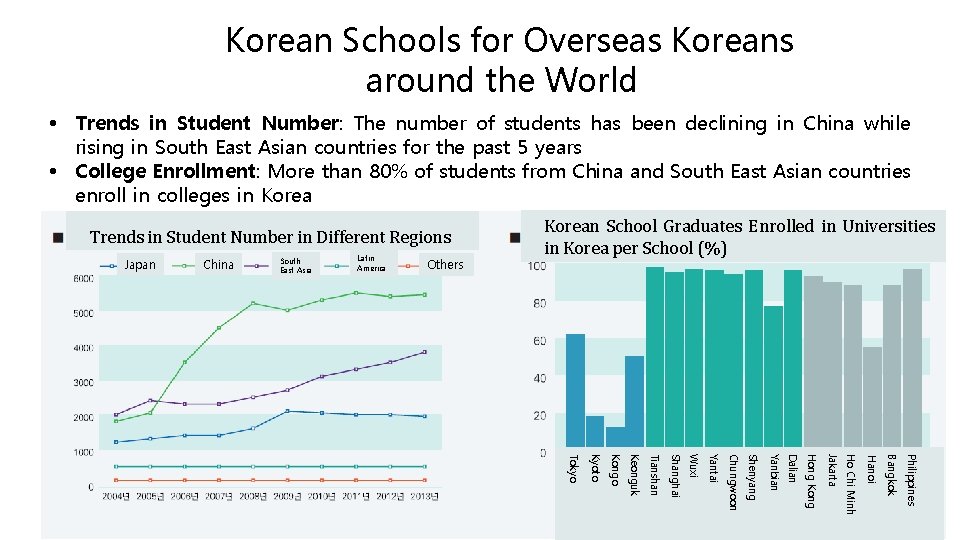
Korean Schools for Overseas Koreans around the World Trends in Student Number: The number of students has been declining in China while rising in South East Asian countries for the past 5 years College Enrollment: More than 80% of students from China and South East Asian countries enroll in colleges in Korea Trends in Student Number in Different Regions Japan China South East Asia Latin America Others Korean School Graduates Enrolled in Universities in Korea per School (%) Philippines Bangkok Hanoi Ho Chi Minh Jakarta Hong Kong Dalian Yanbian Shenyang Chungwoon Yantai Wuxi Shanghai Tianshan Keonguk Kongo Kyoto Tokyo
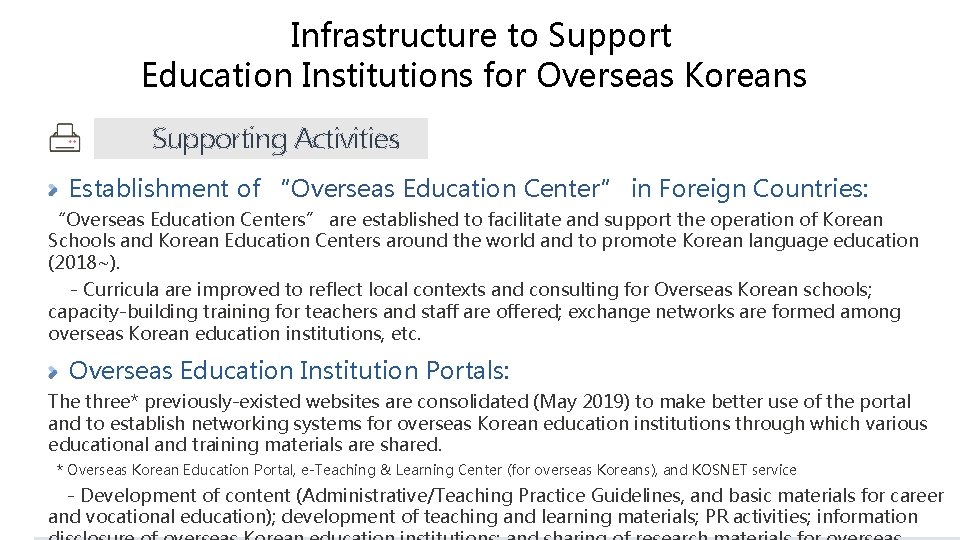
Infrastructure to Support Education Institutions for Overseas Koreans Supporting Activities Establishment of “Overseas Education Center” in Foreign Countries: “Overseas Education Centers” are established to facilitate and support the operation of Korean Schools and Korean Education Centers around the world and to promote Korean language education (2018~). - Curricula are improved to reflect local contexts and consulting for Overseas Korean schools; capacity-building training for teachers and staff are offered; exchange networks are formed among overseas Korean education institutions, etc. Overseas Education Institution Portals: The three* previously-existed websites are consolidated (May 2019) to make better use of the portal and to establish networking systems for overseas Korean education institutions through which various educational and training materials are shared. * Overseas Korean Education Portal, e-Teaching & Learning Center (for overseas Koreans), and KOSNET service - Development of content (Administrative/Teaching Practice Guidelines, and basic materials for career and vocational education); development of teaching and learning materials; PR activities; information
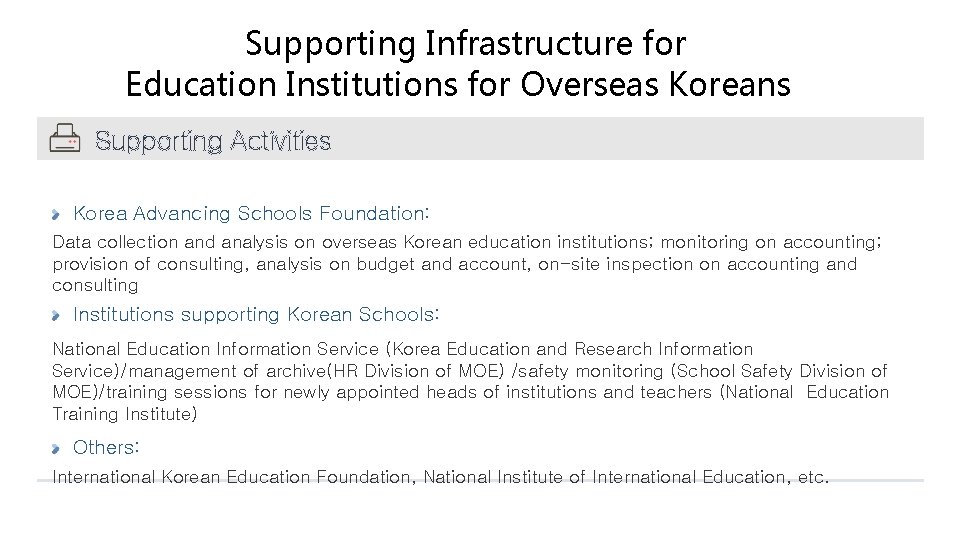
Supporting Infrastructure for Education Institutions for Overseas Koreans Supporting Activities Korea Advancing Schools Foundation: Data collection and analysis on overseas Korean education institutions; monitoring on accounting; provision of consulting, analysis on budget and account, on-site inspection on accounting and consulting Institutions supporting Korean Schools: National Education Information Service (Korea Education and Research Information Service)/management of archive(HR Division of MOE) /safety monitoring (School Safety Division of MOE)/training sessions for newly appointed heads of institutions and teachers (National Education Training Institute) Others: International Korean Education Foundation, National Institute of International Education, etc.
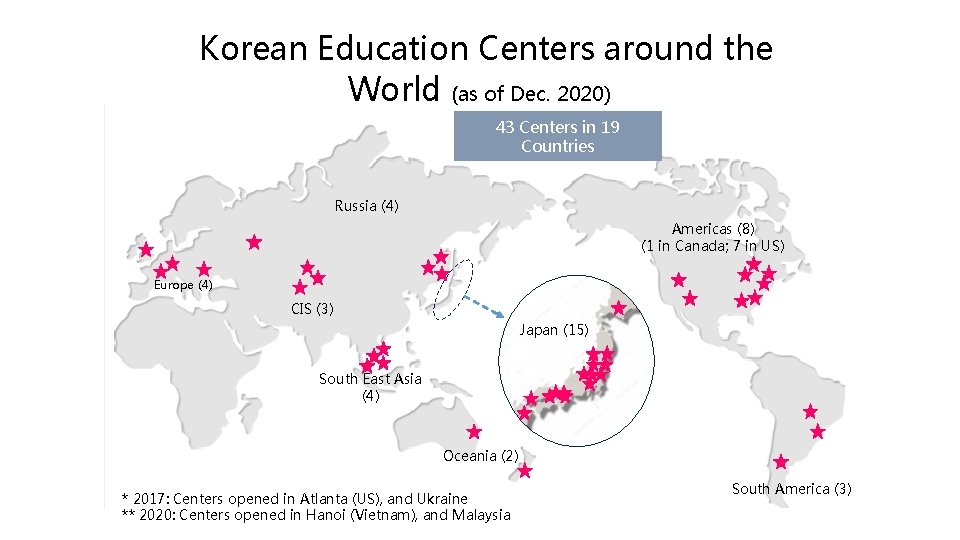
Korean Education Centers around the World (as of Dec. 2020) 43 Centers in 19 Countries Russia (4) Americas (8) (1 in Canada; 7 in US) Europe (4) CIS (3) Japan (15) South East Asia (4) Oceania (2) * 2017: Centers opened in Atlanta (US), and Ukraine * ** 2020: Centers opened in Hanoi (Vietnam), and Malaysia South America (3)
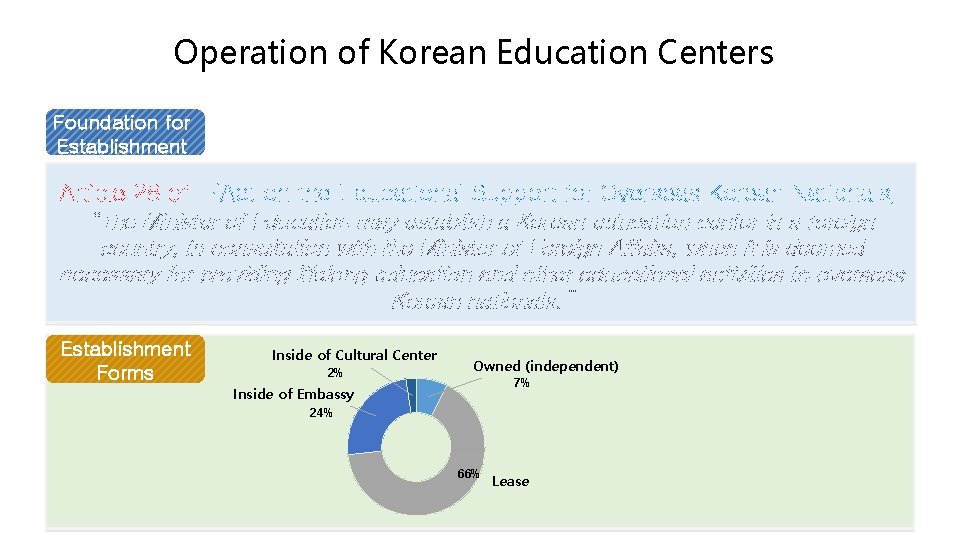
Operation of Korean Education Centers Foundation for Establishment Article 28 of 『Act on the Educational Support for Overseas Korean Nationals』 “The Minister of Education may establish a Korean education center in a foreign country, in consultation with the Minister of Foreign Affairs, when it is deemed necessary for providing lifelong education and other educational activities to overseas Korean nationals. ” Establishment Forms Inside 문화원내 of Cultural Center 2% Owned (independent) 소유(독립) 7% Inside of Embassy 공관내 24% 임차 공관내 임차 66% 문화원내 Lease
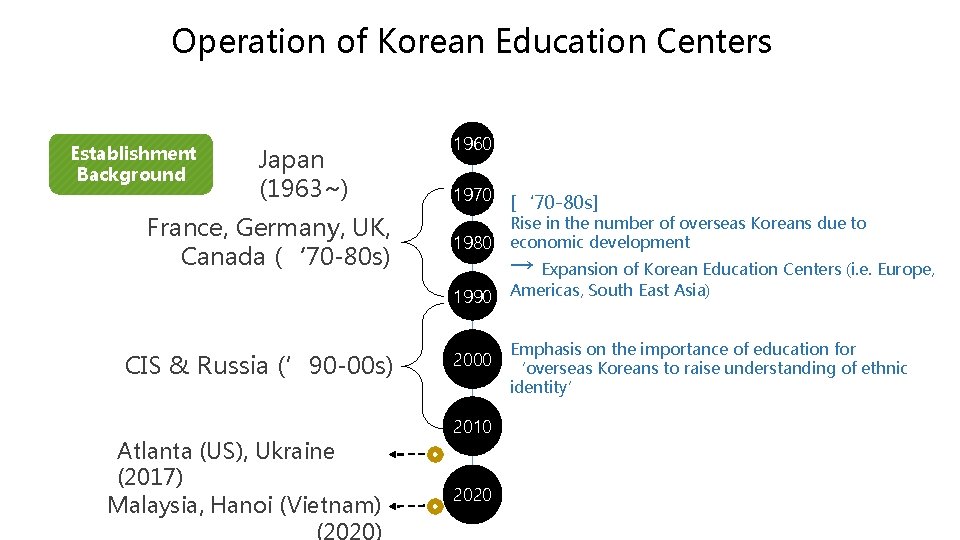
Operation of Korean Education Centers Establishment Background Japan (1963~) France, Germany, UK, Canada (‘ 70 -80 s) 1960 1970 [‘ 70 -80 s] 1980 Rise in the number of overseas Koreans due to economic development → Expansion of Korean Education Centers (i. e. Europe, 1990 Americas, South East Asia) CIS & Russia (’ 90 -00 s) Atlanta (US), Ukraine (2017) Malaysia, Hanoi (Vietnam) (2020) Emphasis on the importance of education for 2000 ‘overseas Koreans to raise understanding of ethnic identity’ 2010 2020
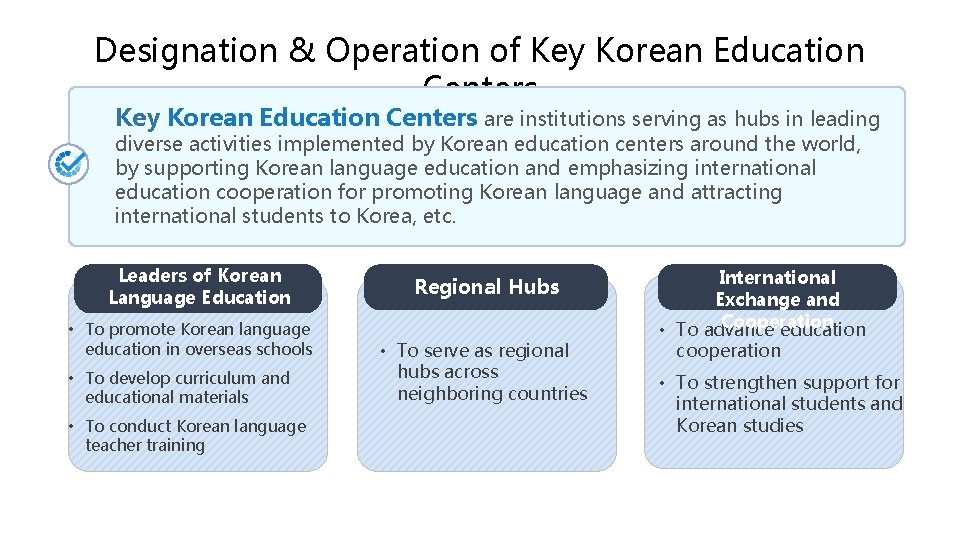
Designation & Operation of Key Korean Education Centers are institutions serving as hubs in leading diverse activities implemented by Korean education centers around the world, by supporting Korean language education and emphasizing international education cooperation for promoting Korean language and attracting international students to Korea, etc. Leaders of Korean Language Education • To promote Korean language education in overseas schools • To develop curriculum and educational materials • To conduct Korean language teacher training Regional Hubs • To serve as regional hubs across neighboring countries International Exchange and Cooperation • To advance education cooperation • To strengthen support for international students and Korean studies
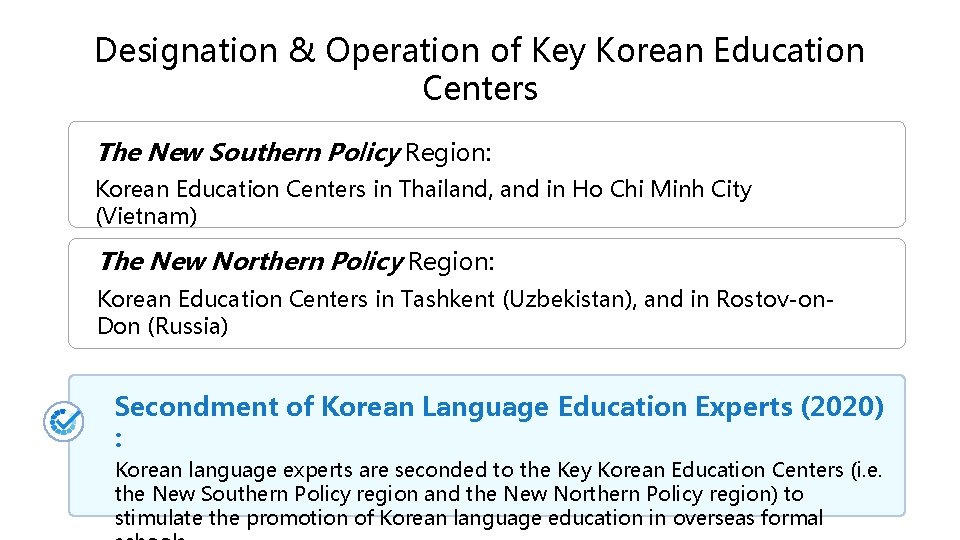
Designation & Operation of Key Korean Education Centers The New Southern Policy Region: Korean Education Centers in Thailand, and in Ho Chi Minh City (Vietnam) The New Northern Policy Region: Korean Education Centers in Tashkent (Uzbekistan), and in Rostov-on. Don (Russia) Secondment of Korean Language Education Experts (2020) : Korean language experts are seconded to the Key Korean Education Centers (i. e. the New Southern Policy region and the New Northern Policy region) to stimulate the promotion of Korean language education in overseas formal
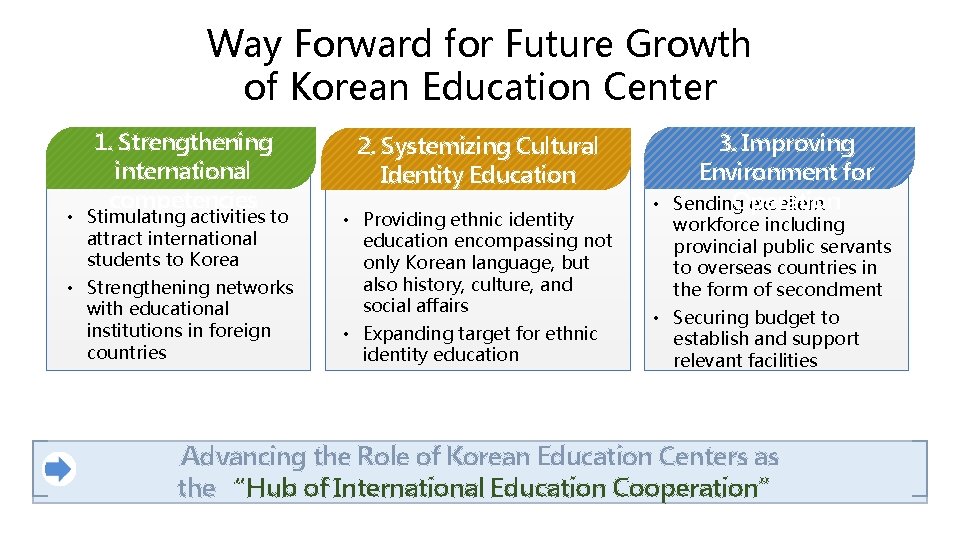
Way Forward for Future Growth of Korean Education Center 1. Strengthening international competencies • Stimulating activities to attract international students to Korea • Strengthening networks with educational institutions in foreign countries 2. Systemizing Cultural Identity Education • Providing ethnic identity education encompassing not only Korean language, but also history, culture, and social affairs • Expanding target for ethnic identity education • 3. Improving Environment for Operation Sending excellent workforce including provincial public servants to overseas countries in the form of secondment • Securing budget to establish and support relevant facilities Advancing the Role of Korean Education Centers as the “Hub of International Education Cooperation”
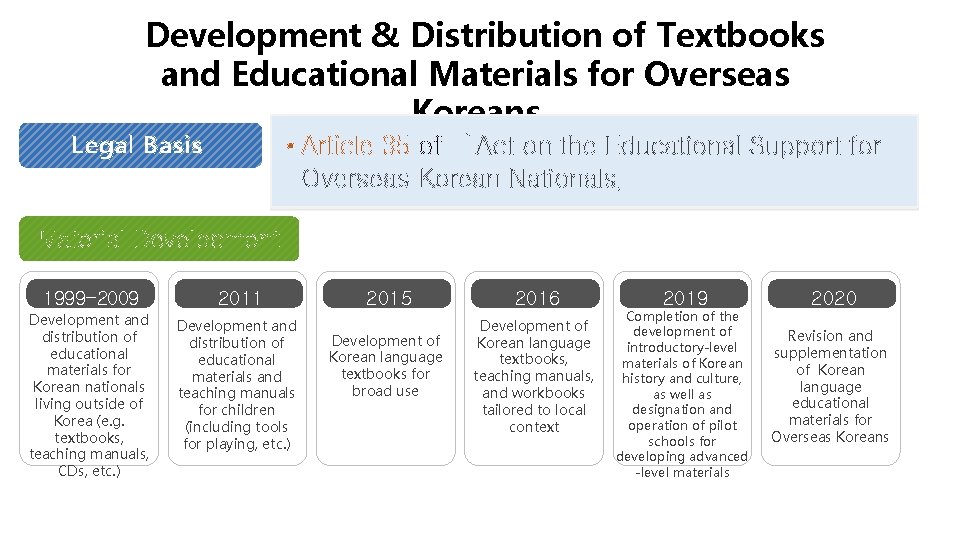
Development & Distribution of Textbooks and Educational Materials for Overseas Koreans Legal Basis • Article 35 of 『Act on the Educational Support for Overseas Korean Nationals』 Material Development 1999 -2009 Development and distribution of educational materials for Korean nationals living outside of Korea (e. g. textbooks, teaching manuals, CDs, etc. ) 2011 Development and distribution of educational materials and teaching manuals for children (including tools for playing, etc. ) 2015 Development of Korean language textbooks for broad use 2016 Development of Korean language textbooks, teaching manuals, and workbooks tailored to local context 2019 Completion of the development of introductory-level materials of Korean history and culture, as well as designation and operation of pilot schools for developing advanced -level materials 2020 Revision and supplementation of Korean language educational materials for Overseas Koreans
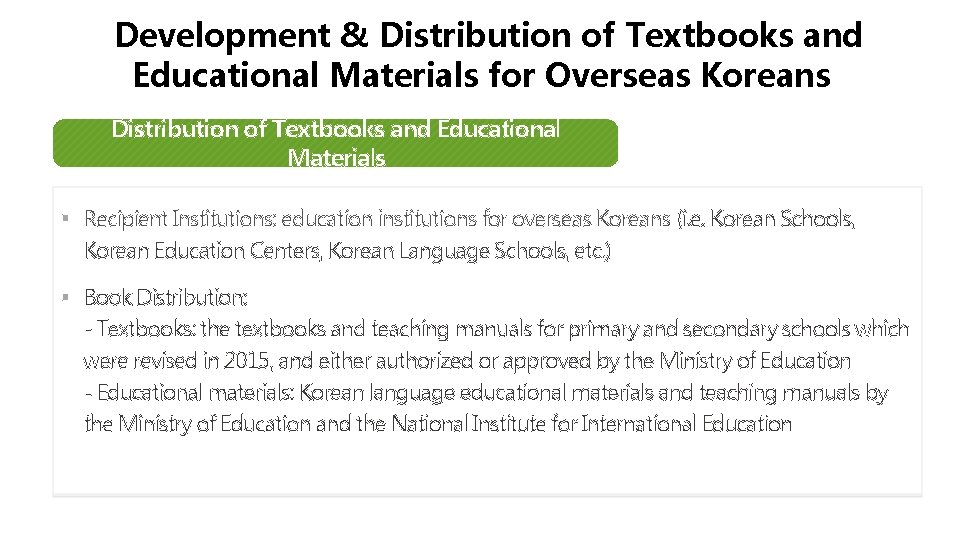
Development & Distribution of Textbooks and Educational Materials for Overseas Koreans Distribution of Textbooks and Educational Materials § Recipient Institutions: education institutions for overseas Koreans (i. e. Korean Schools, Korean Education Centers, Korean Language Schools, etc. ) § Book Distribution: - Textbooks: the textbooks and teaching manuals for primary and secondary schools which were revised in 2015, and either authorized or approved by the Ministry of Education - Educational materials: Korean language educational materials and teaching manuals by the Ministry of Education and the National Institute for International Education
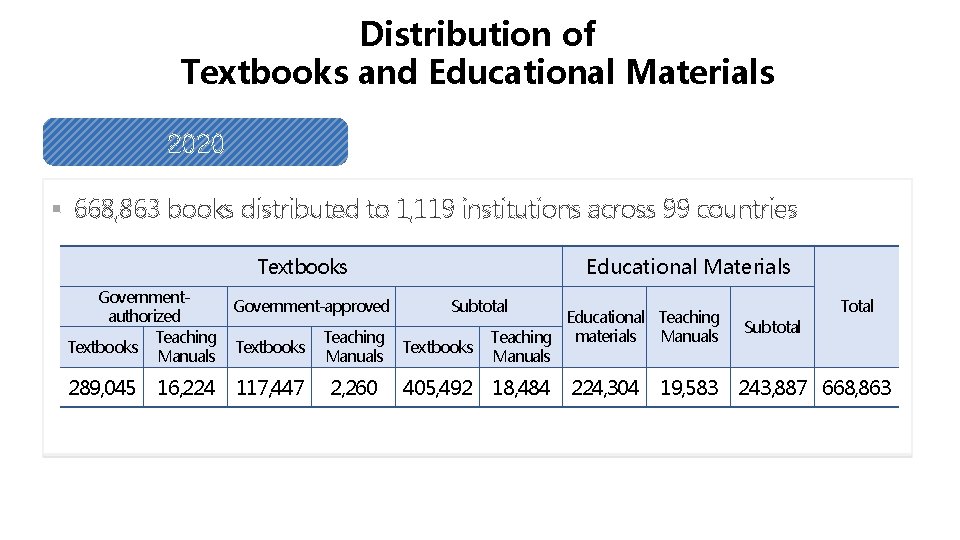
Distribution of Textbooks and Educational Materials 2020 § 668, 863 books distributed to 1, 119 institutions across 99 countries Textbooks Educational Materials Government-approved Subtotal authorized Educational Teaching materials Manuals Textbooks Manuals 289, 045 16, 224 117, 447 2, 260 405, 492 18, 484 224, 304 19, 583 Subtotal Total 243, 887 668, 863