
Education for children with disabilities in West and
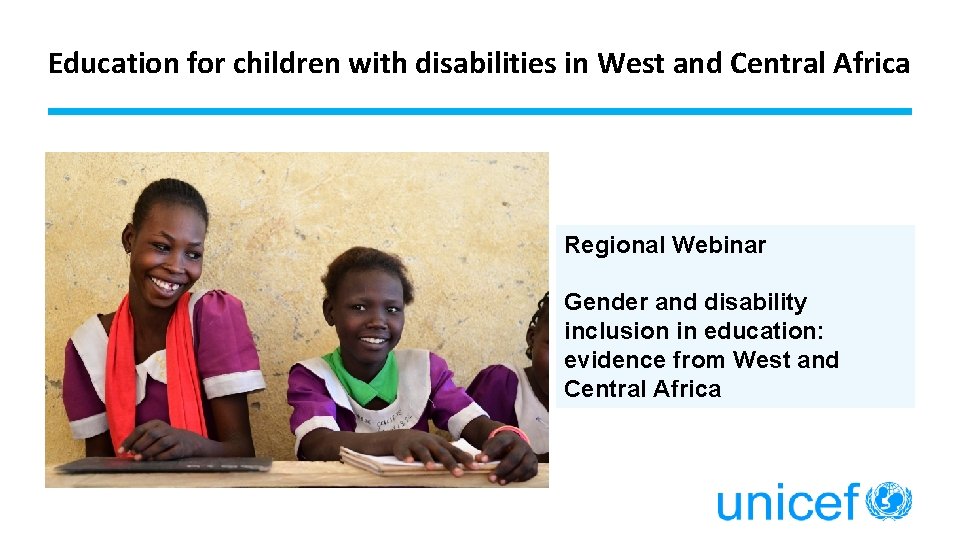
Education for children with disabilities in West and Central Africa Regional Webinar Gender and disability inclusion in education: evidence from West and Central Africa
Content of the presentation 1. Objective of the report and link to regional priorities 2. Source of data/information 3. Definition of child functioning 4. Selected results from the report 5. Recommendations
1. Objectives of the report and link to the regional priorities Bridging the data gaps on CWD: better diagnosis for integration in education sector plans and monitoring systems • Provide regional perspective, both qualitative and quantitative insights on education for children with functional difficulties in West and Central Africa • Strengthen both UNICEF and national ownership of data to support advocacy for CWD during education planning and monitoring process SDG 4 priorities on equitable access to quality education • Provide evidence for improving access to education and reduce the number of CWD that are out of school • Provide new evidence using Child Functioning Module for the development of inclusive education policies and strategies • Functional difficulties are part of the parity indicator SDG 4. 5. 1
2. Source of data • Quantitative data analysis focuses on children aged 2 to 17 using MICS 6 survey data, child functioning module • Qualitative data from UNICEF Strategic monitoring questions and UNESCO PEER • Target countries: 9 countries: Central African Republic; Chad; DRC; The Gambia; Ghana; Guinea-Bissau; Sierra Leone; Togo and Sao Tome and Principe

3. Child functioning as measured by UNICEF/WG Child Functioning Module What is child functioning? What are disabilities? Source: United Nations Children’s Fund, Do children with disabilities attend school? New findings from Sierra Leone, UNICEF, New York, 2019. Figure 1
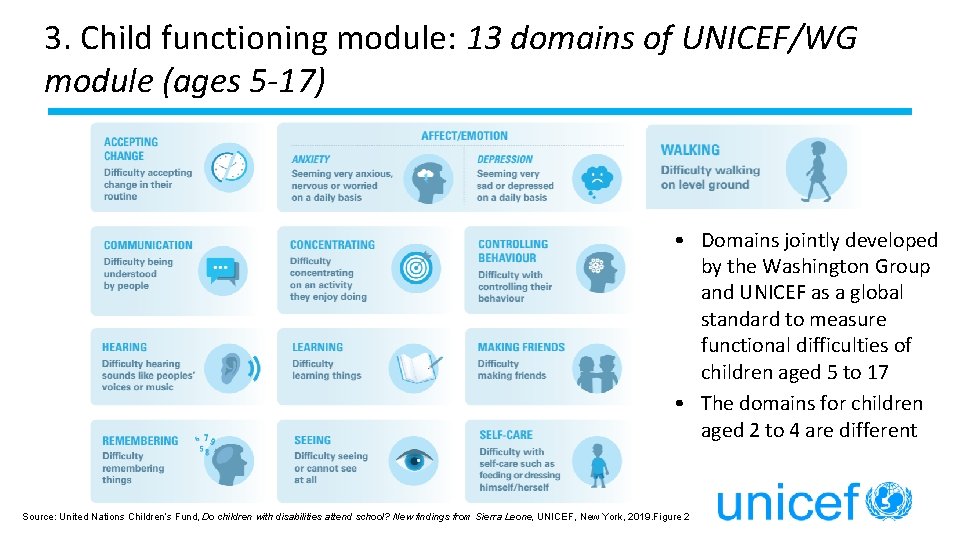
3. Child functioning module: 13 domains of UNICEF/WG module (ages 5 -17) • Domains jointly developed by the Washington Group and UNICEF as a global standard to measure functional difficulties of children aged 5 to 17 • The domains for children aged 2 to 4 are different Source: United Nations Children’s Fund, Do children with disabilities attend school? New findings from Sierra Leone, UNICEF, New York, 2019. Figure 2
3. Measuring child functioning • For most domains, children are considered to have functional difficulties if their mother/caretaker respond that they “have a lot of difficulty” in the functional domain or “are not able to perform the function at all” • For anxiety and depression, a child is considered to be anxious or depressed on a daily basis • Children are considered to have functional difficulties if they have difficulty in at least one functional domain
4. Selected results from the report
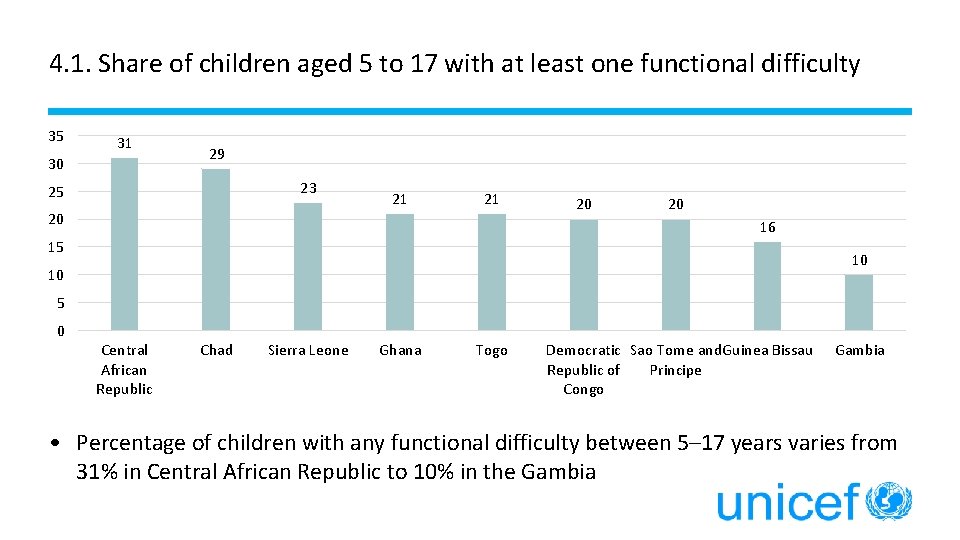
4. 1. Share of children aged 5 to 17 with at least one functional difficulty 35 31 30 29 23 25 21 21 20 20 20 16 15 10 10 5 0 Central African Republic Chad Sierra Leone Ghana Togo Democratic Sao Tome and. Guinea Bissau Republic of Principe Congo Gambia • Percentage of children with any functional difficulty between 5– 17 years varies from 31% in Central African Republic to 10% in the Gambia
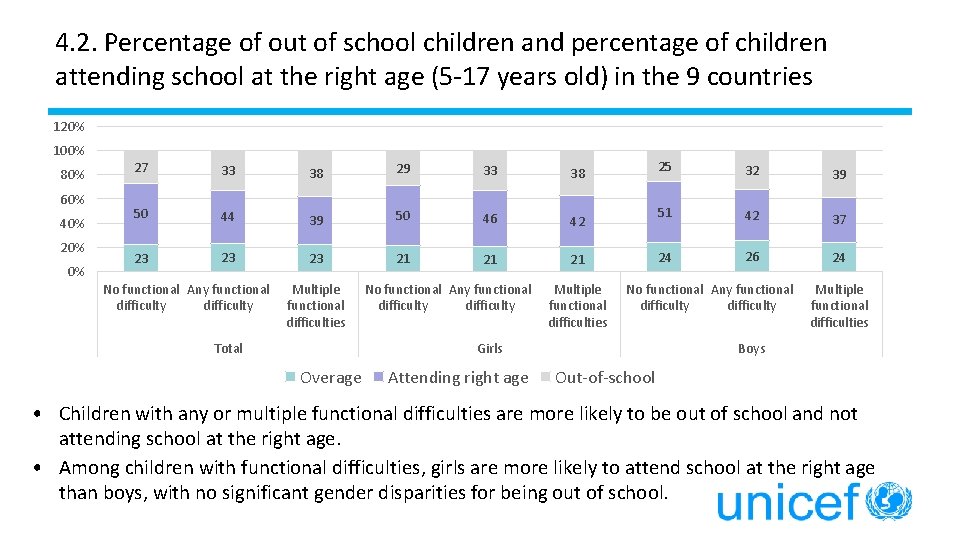
4. 2. Percentage of out of school children and percentage of children attending school at the right age (5 -17 years old) in the 9 countries 120% 100% 80% 60% 40% 20% 0% 27 33 38 29 33 38 50 44 39 50 46 42 23 23 23 21 21 21 No functional Any functional difficulty Multiple functional difficulties Total No functional Any functional difficulty Multiple functional difficulties Attending right age 32 39 51 42 37 24 26 24 No functional Any functional difficulty Girls Overage 25 Multiple functional difficulties Boys Out-of-school • Children with any or multiple functional difficulties are more likely to be out of school and not attending school at the right age. • Among children with functional difficulties, girls are more likely to attend school at the right age than boys, with no significant gender disparities for being out of school.
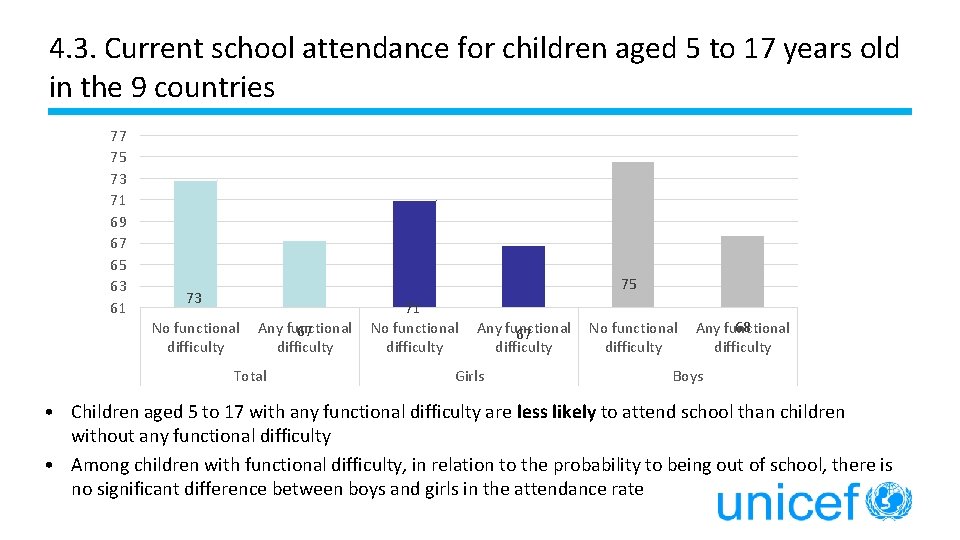
4. 3. Current school attendance for children aged 5 to 17 years old in the 9 countries 77 75 73 71 69 67 65 63 61 75 73 No functional difficulty Any functional 67 difficulty Total 71 No functional difficulty Any functional 67 difficulty Girls No functional difficulty 68 Any functional difficulty Boys • Children aged 5 to 17 with any functional difficulty are less likely to attend school than children without any functional difficulty • Among children with functional difficulty, in relation to the probability to being out of school, there is no significant difference between boys and girls in the attendance rate
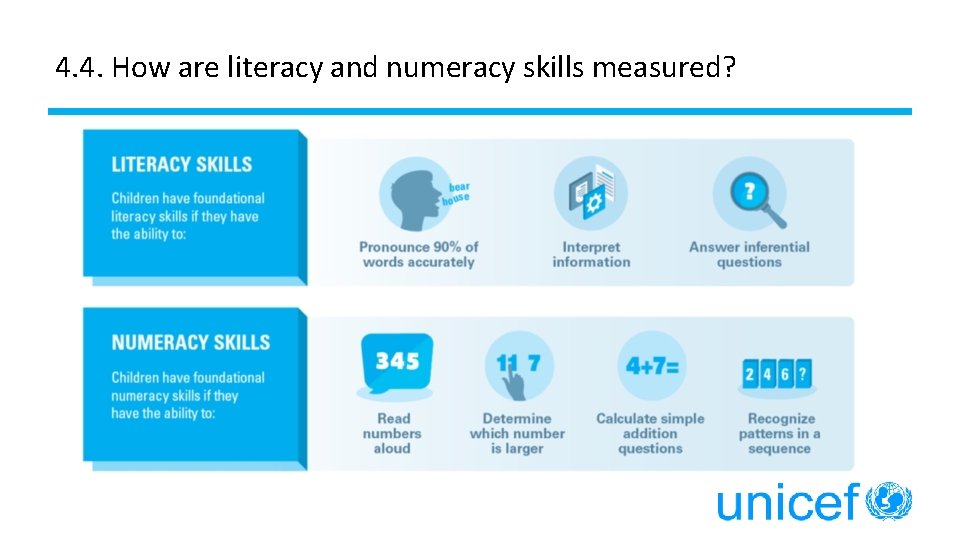
4. 4. How are literacy and numeracy skills measured?
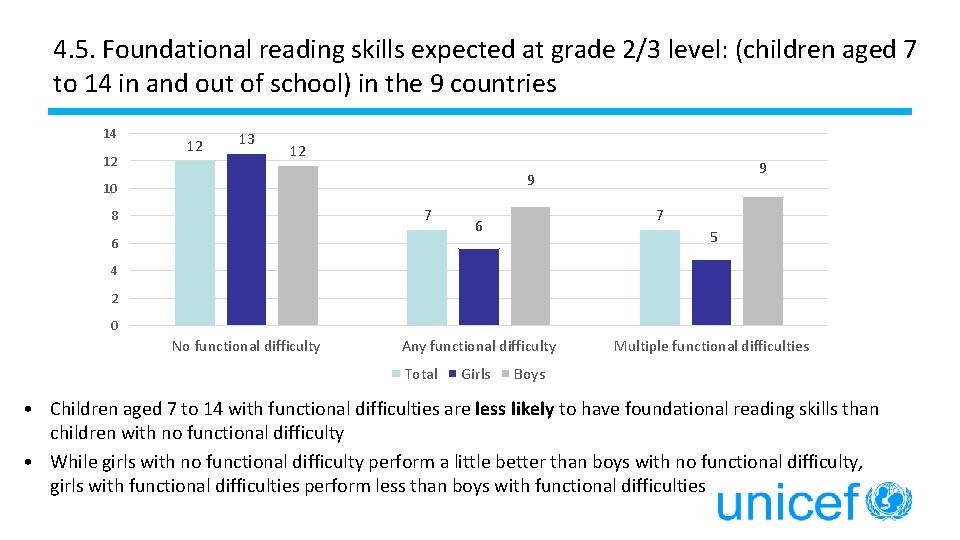
4. 5. Foundational reading skills expected at grade 2/3 level: (children aged 7 to 14 in and out of school) in the 9 countries 14 12 12 13 12 9 9 10 7 8 6 7 6 5 4 2 0 No functional difficulty Any functional difficulty Total Girls Multiple functional difficulties Boys • Children aged 7 to 14 with functional difficulties are less likely to have foundational reading skills than children with no functional difficulty • While girls with no functional difficulty perform a little better than boys with no functional difficulty, girls with functional difficulties perform less than boys with functional difficulties
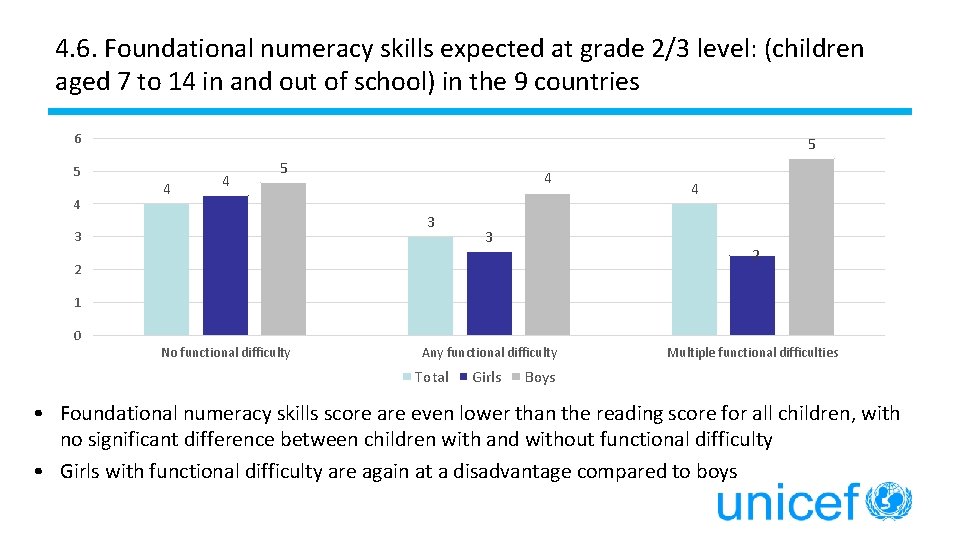
4. 6. Foundational numeracy skills expected at grade 2/3 level: (children aged 7 to 14 in and out of school) in the 9 countries 6 5 4 4 5 4 3 3 3 4 2 2 1 0 No functional difficulty Any functional difficulty Total Girls Multiple functional difficulties Boys • Foundational numeracy skills score are even lower than the reading score for all children, with no significant difference between children with and without functional difficulty • Girls with functional difficulty are again at a disadvantage compared to boys
5. Recommendations • Improve existing Education Management Information Systems (EMIS) to – collect regular data on children with disabilities/functional difficulties by using harmonized methodology and set of questions and disability disaggregated indicators – Include information, on school accessibility and teacher’s skills in inclusive education and in identifying students’ functional difficulties • Improve the existing learning outcomes assessment tools by measuring learning achievements for all students including those with disabilities/functional difficulties • Strengthen partnership with health and social services sectors in the early detection of disabilities/functional difficulties and the implementation of early interventions
Thank You © UNICEF/SUDA 2014 -XX 228/Noorani
- Slides: 16