
education coaching development BTEC Level 3 National Extended

education – coaching - development BTEC Level 3 National Extended Diploma in Sports Coaching and Development Unit B- health, wellbeing and sport Learning aim- B 1+b 2
Learning AIM B 1+B 2: Definition of physical health Assignment 2 P 3 - Explain physical health and the factors that can affect good physical health
B 1: DEFINITION OF PHYSICAL HEALTH What is health? Health is a state of complete physical, mental and social well-being and not merely the absence of disease or infirmity. (World Health Organisation, 2020) What is physical health? Physical health is defined as the condition of your body, taking into consideration everything from the absence of disease to fitness level. (EUPATI, 2018)
B 1: DEFINITION OF PHYSICAL HEALTH Indicators of physical health: • Moving freely • Ability to conduct day-to-day tasks, for example: walking up and down stairs, putting rubbish out, cleaning • Free from non-sport specific aches and pains • Good balance

B 2 - Factors affecting physical health Factors: • Physical activity levels • Medical conditions • Diet • Stress • Lifestyle • Consumption of alcohol/drugs • Smoking • Work • Education levels • Relationships
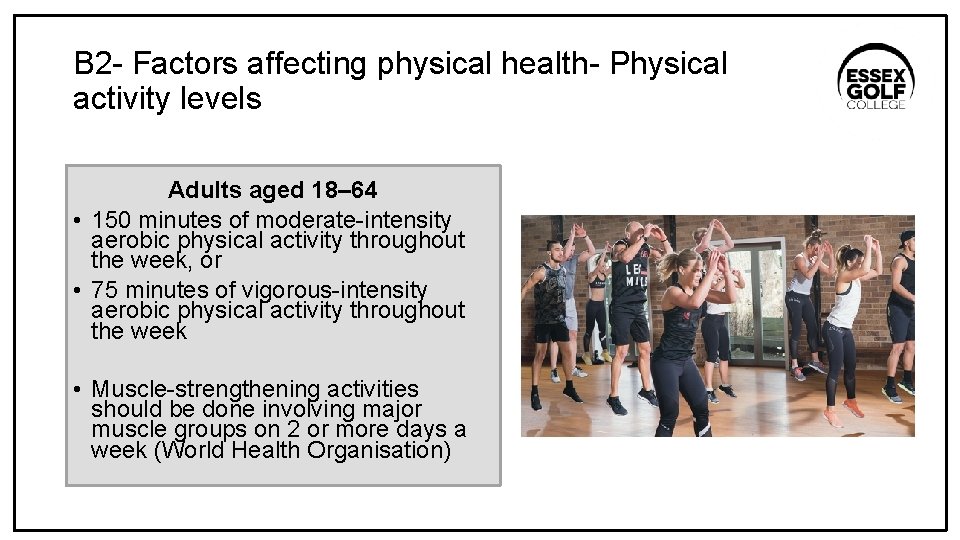
B 2 - Factors affecting physical health- Physical activity levels Adults aged 18– 64 • 150 minutes of moderate-intensity aerobic physical activity throughout the week, or • 75 minutes of vigorous-intensity aerobic physical activity throughout the week • Muscle-strengthening activities should be done involving major muscle groups on 2 or more days a week (World Health Organisation)
B 2 - Factors affecting physical health- Medical conditions Having a medical condition may well mean that your physical health is compromised. Consider how these may stop you moving freely, conducting day-today tasks, cause aches and pains, or reduce your balance. Conditions such as: • Diabetes • • • Cardiovascular (hypertension) Chronic respiratory (Asthma, COPD) Chronic pain (arthritis) Chronic Neurological (Parkinson’s) Cancer
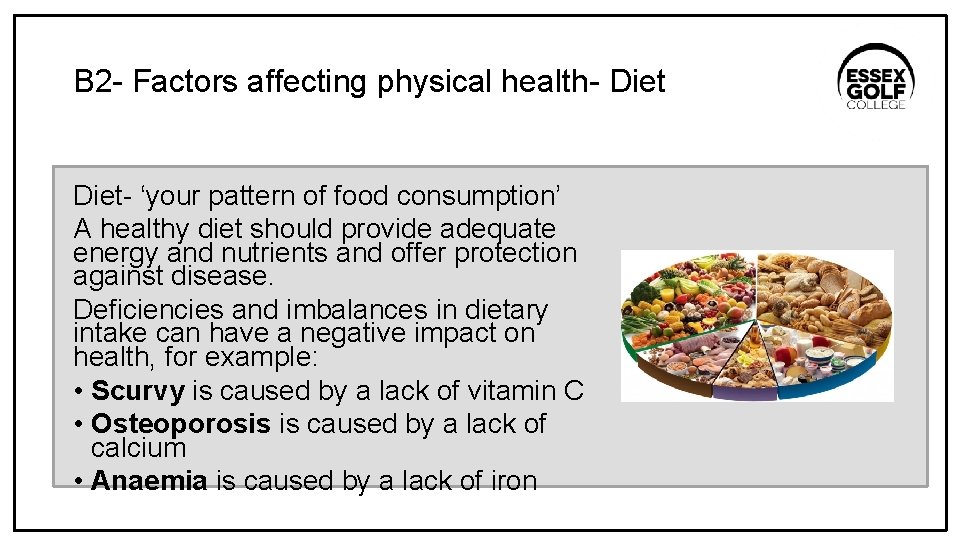
B 2 - Factors affecting physical health- Diet- ‘your pattern of food consumption’ A healthy diet should provide adequate energy and nutrients and offer protection against disease. Deficiencies and imbalances in dietary intake can have a negative impact on health, for example: • Scurvy is caused by a lack of vitamin C • Osteoporosis is caused by a lack of calcium • Anaemia is caused by a lack of iron
B 2 - Factors affecting physical health. Stress • Stress can be a physiological response to triggers in the environment. We need some stress to function correctly- ‘eustress’, the stress that affects us negatively is termed ‘distressed’. • Stressors are factors that initiate a stress response - fight or flight – adrenaline • Constant stress raises adrenaline level/cholesterol levels – can lead to things such as CHD, obesity, lower back pain, headaches, increased HR/BP, exhaustion, illness
B 2 - Factors affecting physical health. Stress If hormones & chemicals are not used up by exercise they place stress on blood vessels they become damaged and reduce ability to stretch affecting blood and O 2 to heart. Some examples of things that may cause stress include: • • • Work – feeling pressure at work, unemployment or retirement Family – relationship difficulties, divorce or caring for someone Financial problems – unexpected bills or borrowing money Health – illness, injury or losing someone (bereavement) Significant life events such as buying a house, having a baby or planning a wedding could lead to feelings of stress
B 2 - Factors affecting physical health. Lifestyle There are multiple other lifestyle factors that can affect physical health Socioeconomic class - lower social class is associated with poorer physical health and higher risk of mortality. Consider how someone’s education, income and occupation in combination can affect physical health (e. g. stresses, financial restraints, physical jobs can lead to more injuries or working out in all weathers and getting ill) Tech - the overuse and misuse of the technology, one of the current first-world problems with regards to physical health, consider how overusing or misusing can affect an individual physically (e. g. posture, stress, decrease in PA levels)
B 2 - Factors affecting physical health. Lifestyle Disability – some disabilities affect that individual’s ability to conduct dayto-day tasks, move freely, balance, or be free from aches or pains. e. g. spinal chord injuries or MS can completely change vision, arm or leg movement, sensation or balance. Resources – there are many people who do not have adequate resources to maintain good physical health, they might not have access to balanced diets, jobs, education, relationships, means of assistance if needed, treatment, medicine.
B 2 - Factors affecting physical health. Alcohol Moderate consumption may improve health with reduction of heart attacks and strokes Each unit of alcohol contains 56 empty calories
B 2 - Factors affecting physical health. Alcohol – associated risks to physical health: • • • Hypertension- above 140/90 Heart disease Stroke Cancers of liver, breast, mouth, throat Mood swings
B 2 - Factors affecting physical health. Illegal drugs Drug use can have a wide range of short- and long-term, direct and indirect effects. These effects often depend on the specific drug or drugs used, how they are taken, how much is taken, the person's health, and other factors. Short-term effects can range from changes in appetite, wakefulness, heart rate, blood pressure, and/or mood to heart attack, stroke, psychosis, overdose, and even death. These health effects may occur after just one use. Longer-term effects can include heart or lung disease, cancer, mental illness, HIV/AIDS, hepatitis, and others. Long-term drug use can also lead to addiction.
B 2 - Factors affecting physical health. Smoking • 12 million adults smoke in the UK (approx. ) • 114, 000 smokers die every year because of their habit • 30% of all cancers related to smoking • 4000 chemicals in tobacco smoke • Nicotine – addictive, stimulates the CNS and increase heart rate and blood pressure, can be extremely poisonous in large amounts • Tar – brown and treacly in appearance. Left in the lungs and respiratory system includes things like cyanide, arsenic and benzene • Carbon Monoxide – binds to haemoglobin and prevents the blood carrying oxygen around the body
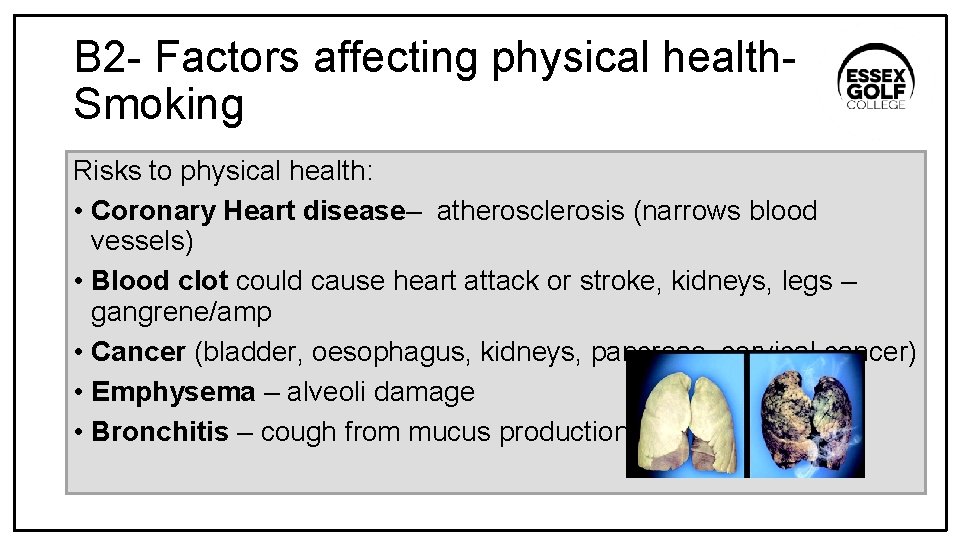
B 2 - Factors affecting physical health. Smoking Risks to physical health: • Coronary Heart disease– atherosclerosis (narrows blood vessels) • Blood clot could cause heart attack or stroke, kidneys, legs – gangrene/amp • Cancer (bladder, oesophagus, kidneys, pancreas, cervical cancer) • Emphysema – alveoli damage • Bronchitis – cough from mucus production
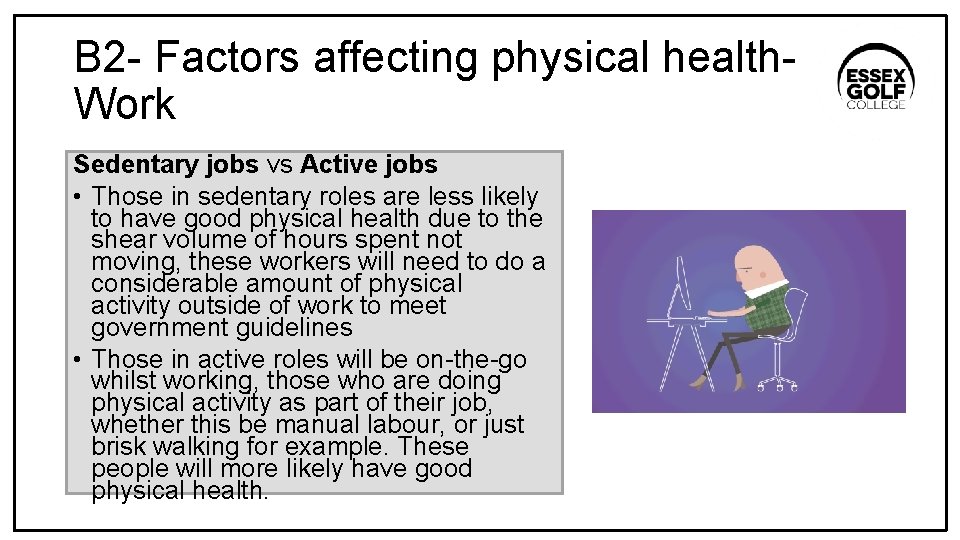
B 2 - Factors affecting physical health. Work Sedentary jobs vs Active jobs • Those in sedentary roles are less likely to have good physical health due to the shear volume of hours spent not moving, these workers will need to do a considerable amount of physical activity outside of work to meet government guidelines • Those in active roles will be on-the-go whilst working, those who are doing physical activity as part of their job, whether this be manual labour, or just brisk walking for example. These people will more likely have good physical health.
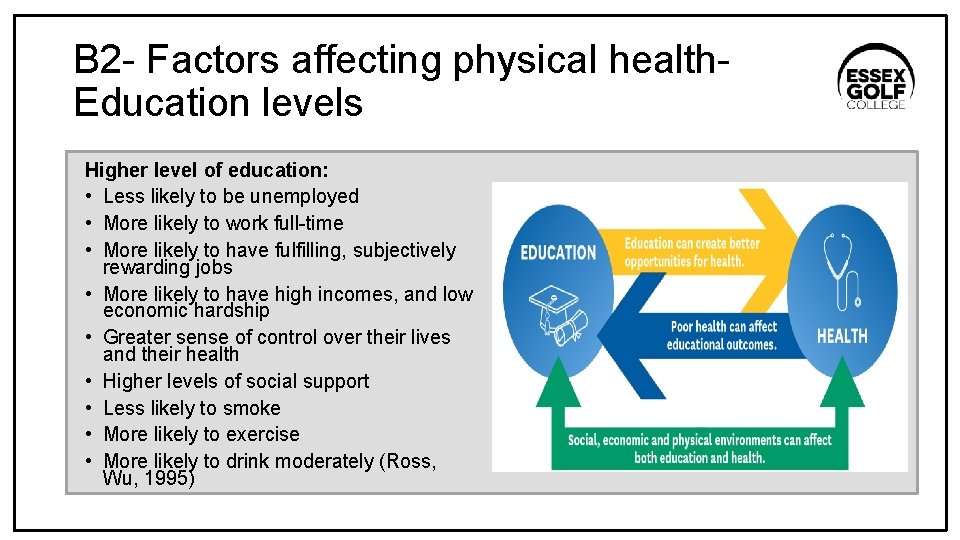
B 2 - Factors affecting physical health. Education levels Higher level of education: • Less likely to be unemployed • More likely to work full-time • More likely to have fulfilling, subjectively rewarding jobs • More likely to have high incomes, and low economic hardship • Greater sense of control over their lives and their health • Higher levels of social support • Less likely to smoke • More likely to exercise • More likely to drink moderately (Ross, Wu, 1995)
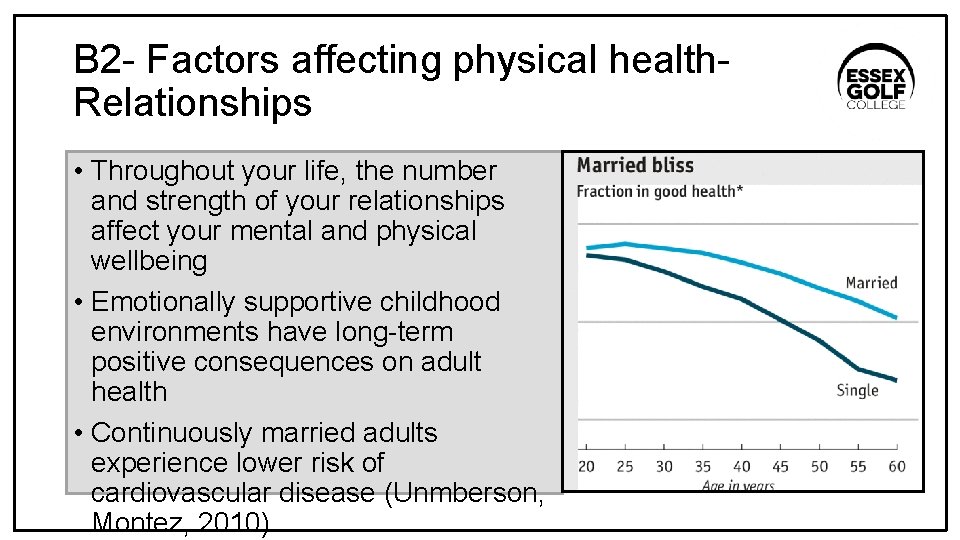
B 2 - Factors affecting physical health. Relationships • Throughout your life, the number and strength of your relationships affect your mental and physical wellbeing • Emotionally supportive childhood environments have long-term positive consequences on adult health • Continuously married adults experience lower risk of cardiovascular disease (Unmberson, Montez, 2010)
- Slides: 20