
EDUCATION ARCHITECTURE AND ART IN MIDDLE AGES EUROPE
- Slides: 27
EDUCATION, ARCHITECTURE, AND ART IN MIDDLE AGES EUROPE Western Civilization University High School 2011 -12
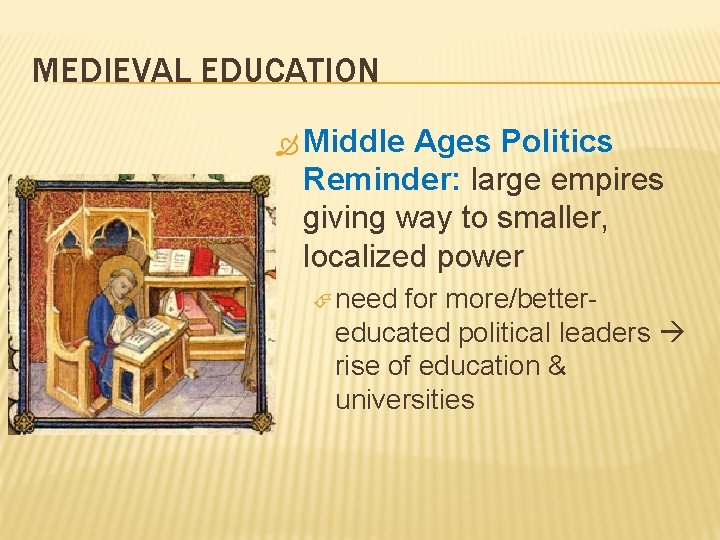
MEDIEVAL EDUCATION Middle Ages Politics Reminder: large empires giving way to smaller, localized power need for more/bettereducated political leaders rise of education & universities
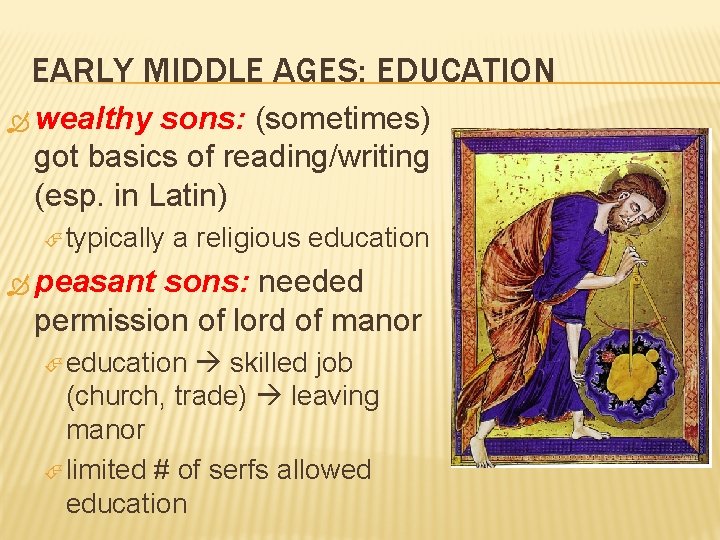
EARLY MIDDLE AGES: EDUCATION wealthy sons: (sometimes) got basics of reading/writing (esp. in Latin) typically a religious education peasant sons: needed permission of lord of manor education skilled job (church, trade) leaving manor limited # of serfs allowed education
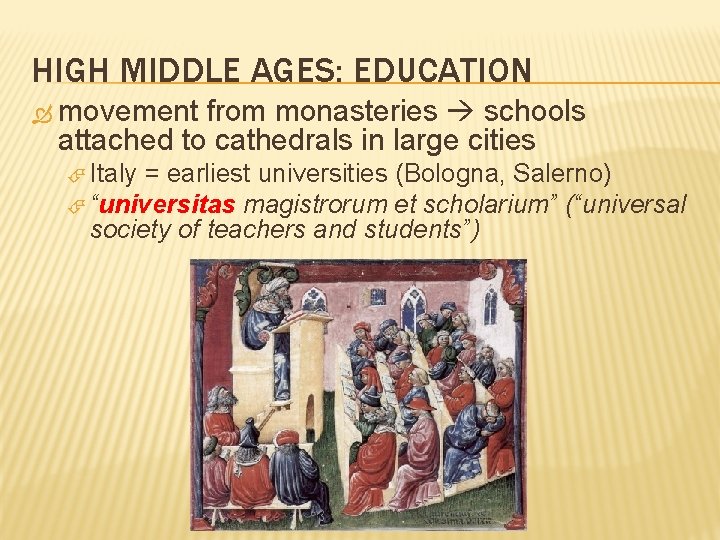
HIGH MIDDLE AGES: EDUCATION movement from monasteries schools attached to cathedrals in large cities Italy = earliest universities (Bologna, Salerno) “universitas magistrorum et scholarium” (“universal society of teachers and students”)
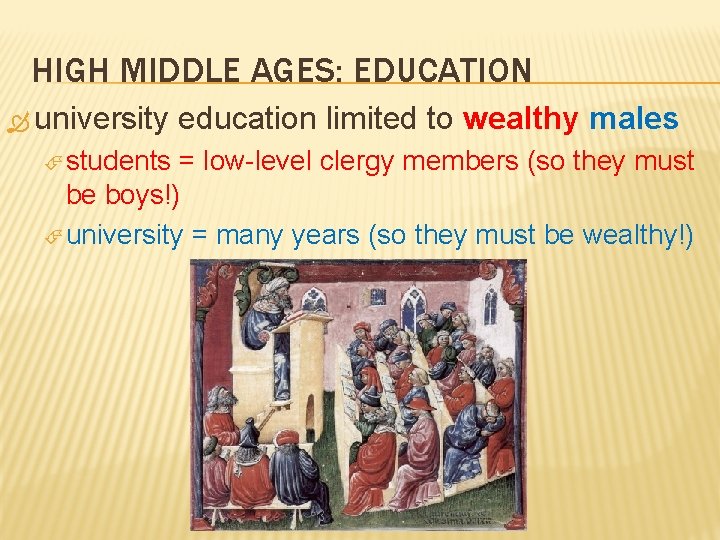
HIGH MIDDLE AGES: EDUCATION university students education limited to wealthy males = low-level clergy members (so they must be boys!) university = many years (so they must be wealthy!)
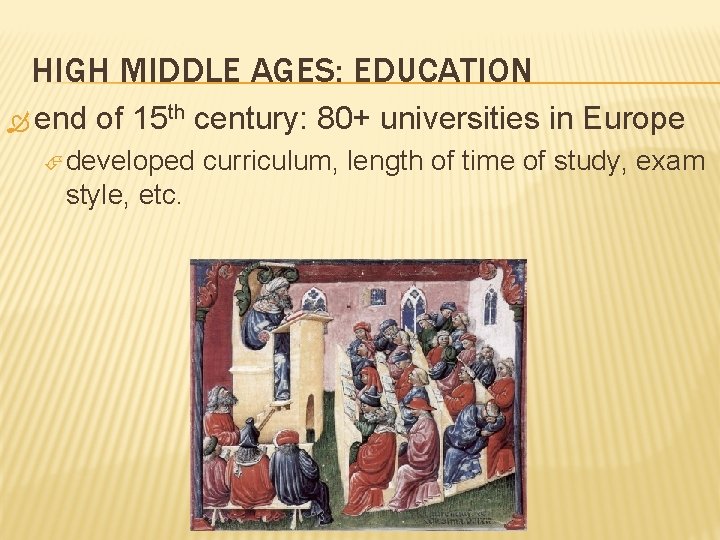
HIGH MIDDLE AGES: EDUCATION end of 15 th century: 80+ universities in Europe developed style, etc. curriculum, length of time of study, exam
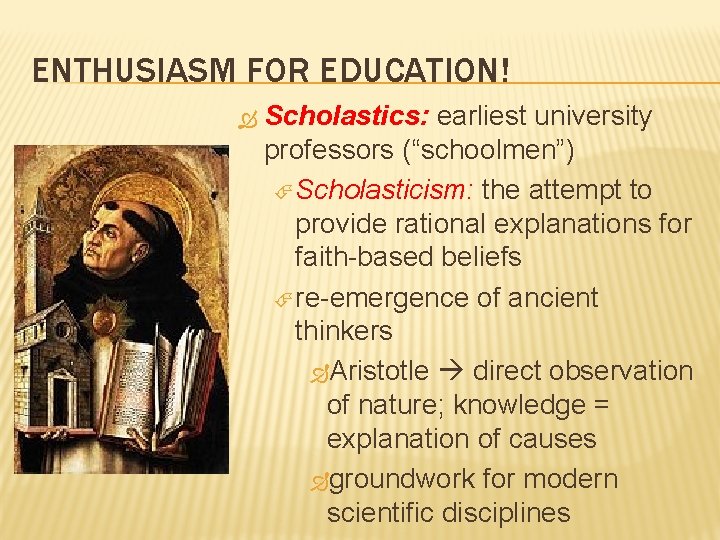
ENTHUSIASM FOR EDUCATION! Scholastics: earliest university professors (“schoolmen”) Scholasticism: the attempt to provide rational explanations for faith-based beliefs re-emergence of ancient thinkers Aristotle direct observation of nature; knowledge = explanation of causes groundwork for modern scientific disciplines
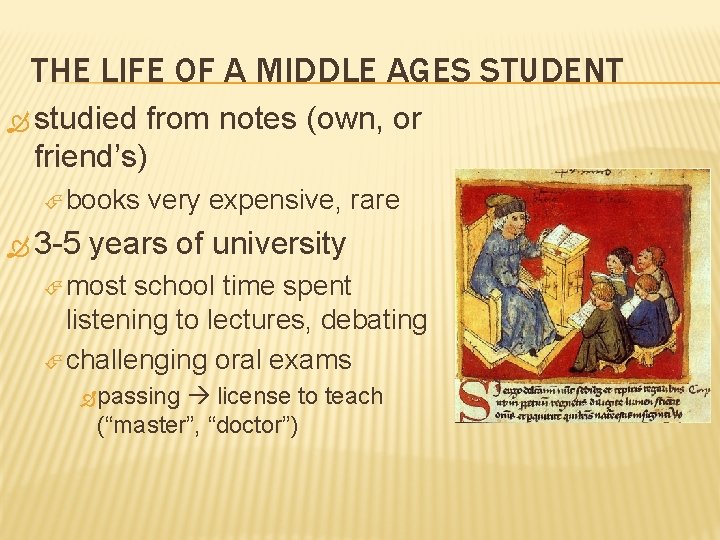
THE LIFE OF A MIDDLE AGES STUDENT studied from notes (own, or friend’s) books 3 -5 very expensive, rare years of university most school time spent listening to lectures, debating challenging oral exams passing license to teach (“master”, “doctor”)
THE LIFE OF A MIDDLE AGES STUDENT (MCKAY, PG. 349) “Students did not spend all their time listening to lectures or debating, however. Much information about medieval students concerns what we might call their ‘extracurricular’ activities: university regulations forbade them to throw rocks at professors; sermons talked about students’ breaking and entering, raping local women, attacking town residents, or disturbing church services; court records discussed their engaging in drunken brawls and riots or stabbing each other in fights and duels. ”
THE LIFE OF A MIDDLE AGES STUDENT (MCKAY, PG. 349) “The money sent by parents or patrons was often not sufficient for all expenses, so students augmented this by begging, thieving, or doing odd jobs. They also delayed finishing their studies because life as a student could be very pleasant, without the responsibilities that came with becoming fully adult. Student life was also described by those who know it best – students themselves – in poems, usually anonymous, that celebrated the joys of Venus (the goddess of love), Bacchus (the god of wine), and Decius (the god of dice). ”
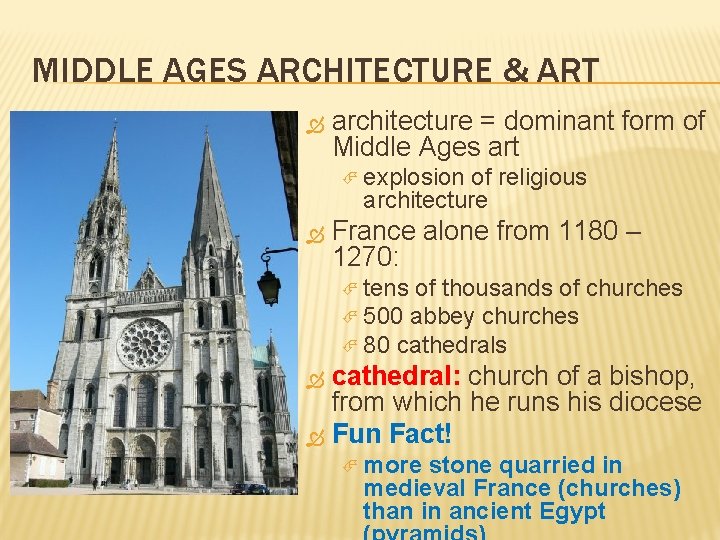
MIDDLE AGES ARCHITECTURE & ART architecture = dominant form of Middle Ages art explosion of religious architecture France alone from 1180 – 1270: tens of thousands of churches 500 abbey churches 80 cathedrals cathedral: church of a bishop, from which he runs his diocese Fun Fact! more stone quarried in medieval France (churches) than in ancient Egypt
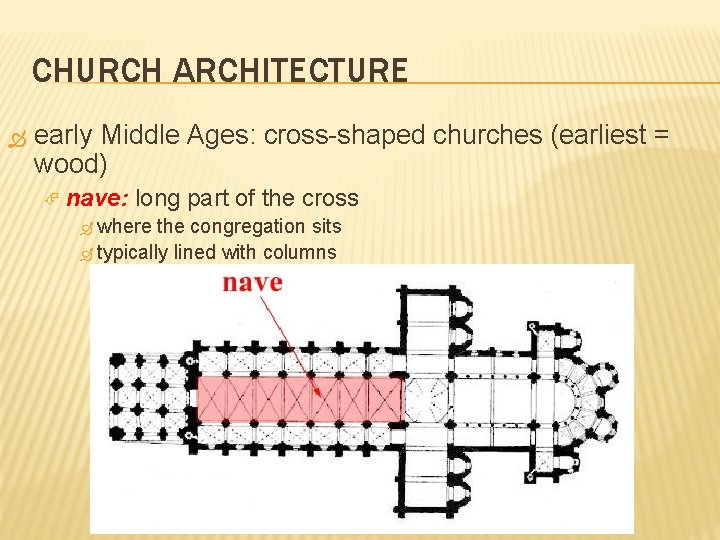
CHURCH ARCHITECTURE early Middle Ages: cross-shaped churches (earliest = wood) nave: long part of the cross where the congregation sits typically lined with columns
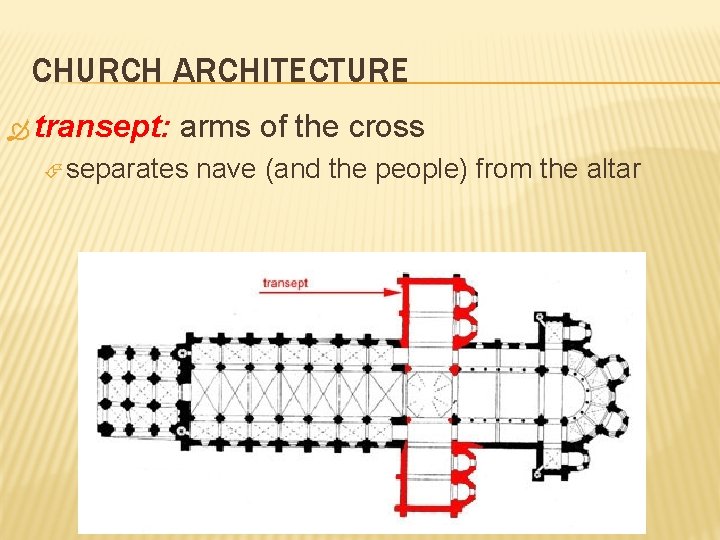
CHURCH ARCHITECTURE transept: arms of the cross separates nave (and the people) from the altar
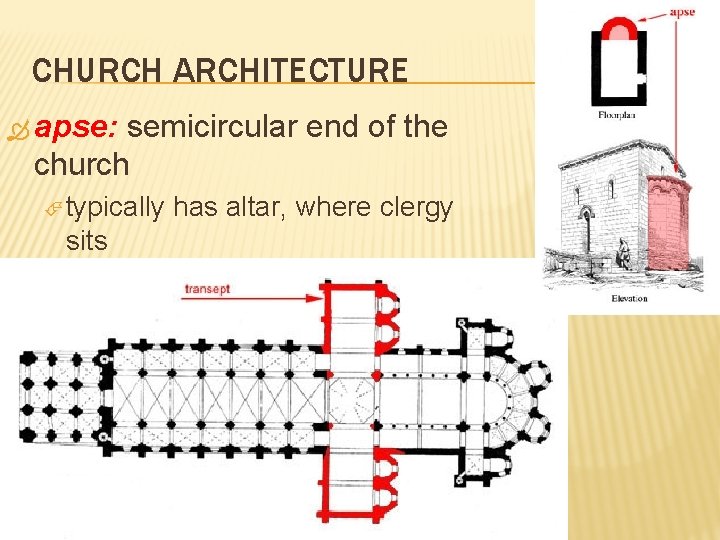
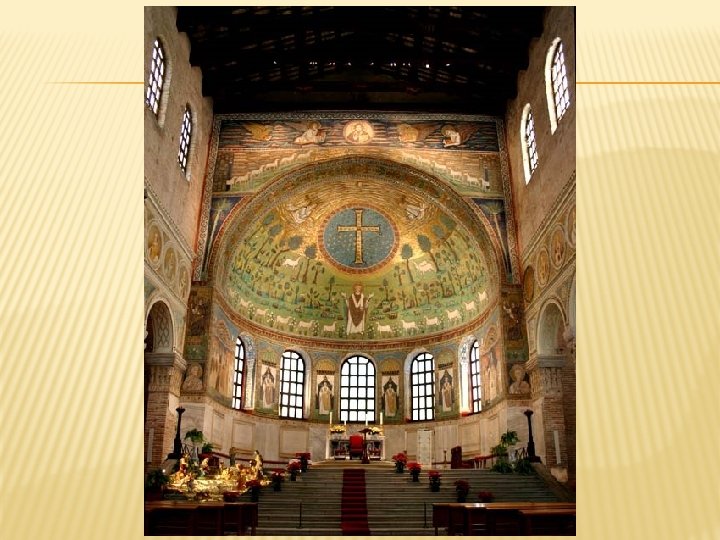
CHURCH ARCHITECTURE apse: semicircular end of the church typically sits has altar, where clergy
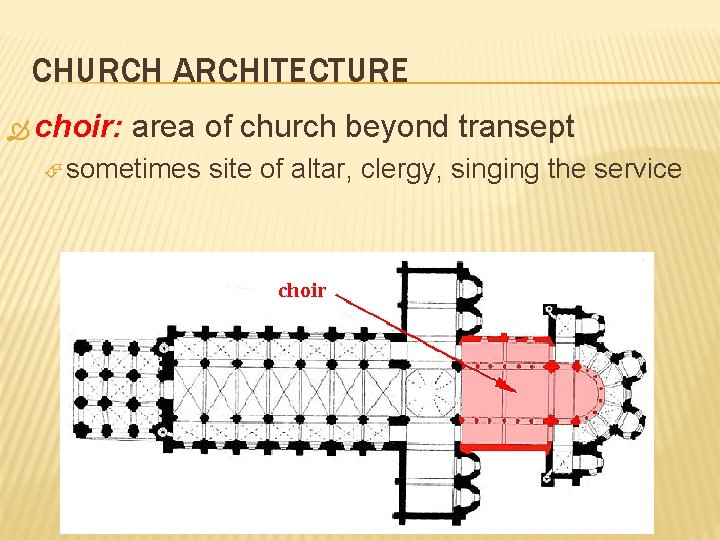
CHURCH ARCHITECTURE choir: area of church beyond transept sometimes site of altar, clergy, singing the service
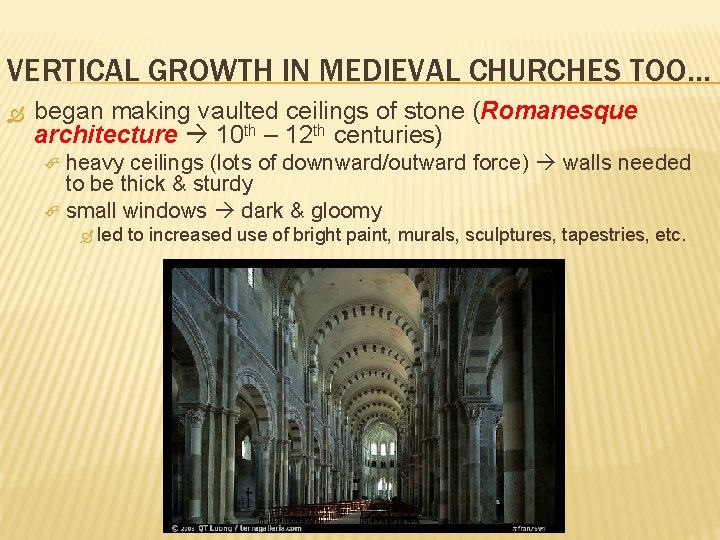
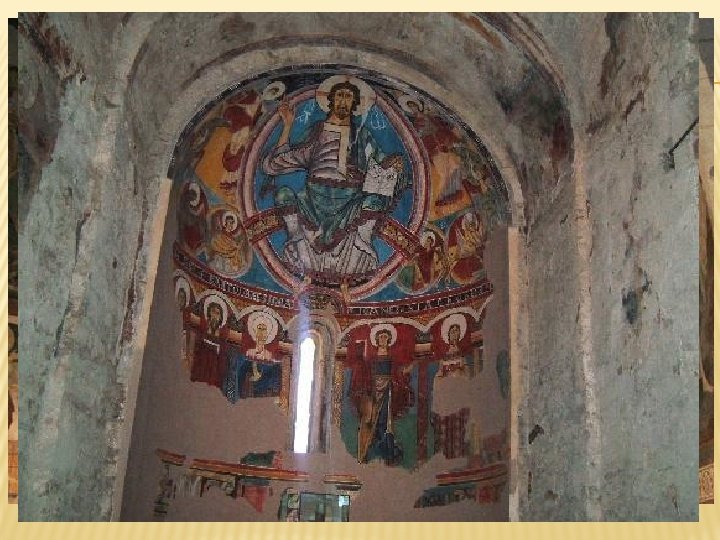
VERTICAL GROWTH IN MEDIEVAL CHURCHES TOO… began making vaulted ceilings of stone (Romanesque architecture 10 th – 12 th centuries) heavy ceilings (lots of downward/outward force) walls needed to be thick & sturdy small windows dark & gloomy led to increased use of bright paint, murals, sculptures, tapestries, etc.
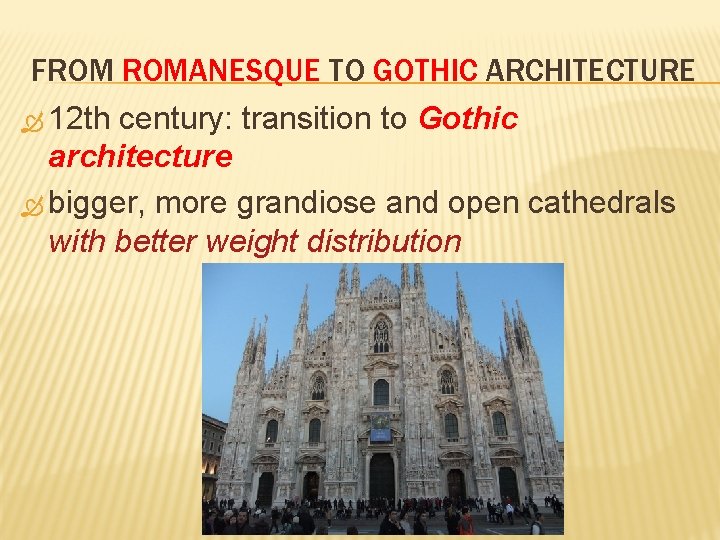
FROM ROMANESQUE TO GOTHIC ARCHITECTURE 12 th century: transition to Gothic architecture bigger, more grandiose and open cathedrals with better weight distribution
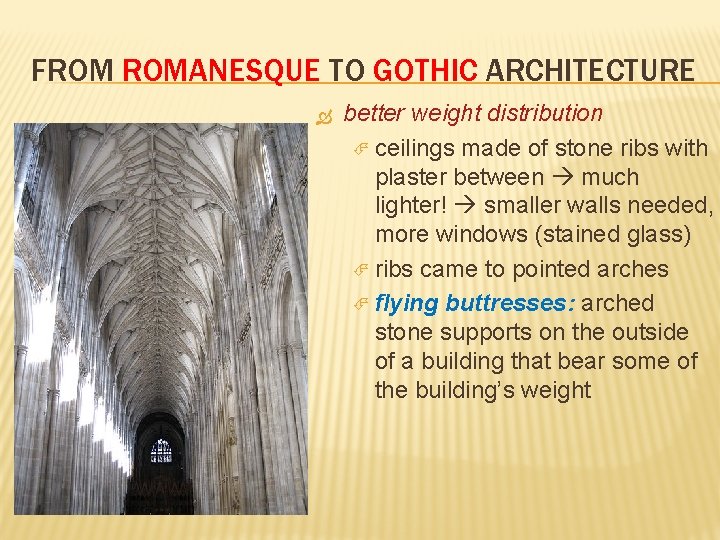
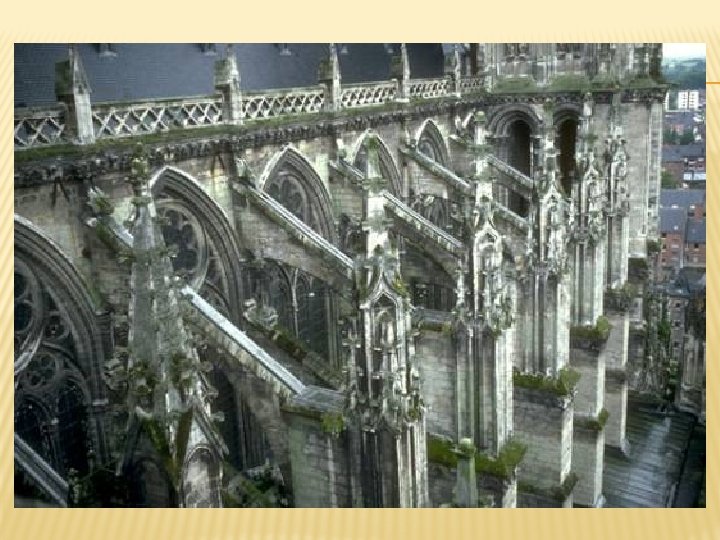
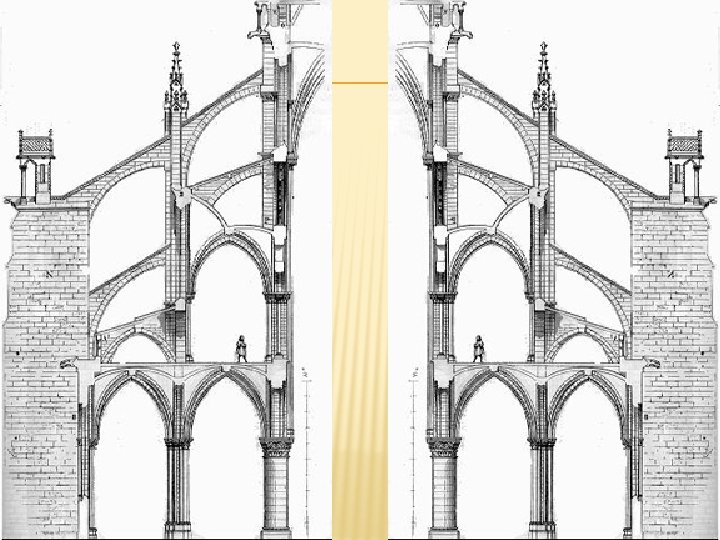
FROM ROMANESQUE TO GOTHIC ARCHITECTURE better weight distribution ceilings made of stone ribs with plaster between much lighter! smaller walls needed, more windows (stained glass) ribs came to pointed arches flying buttresses: arched stone supports on the outside of a building that bear some of the building’s weight
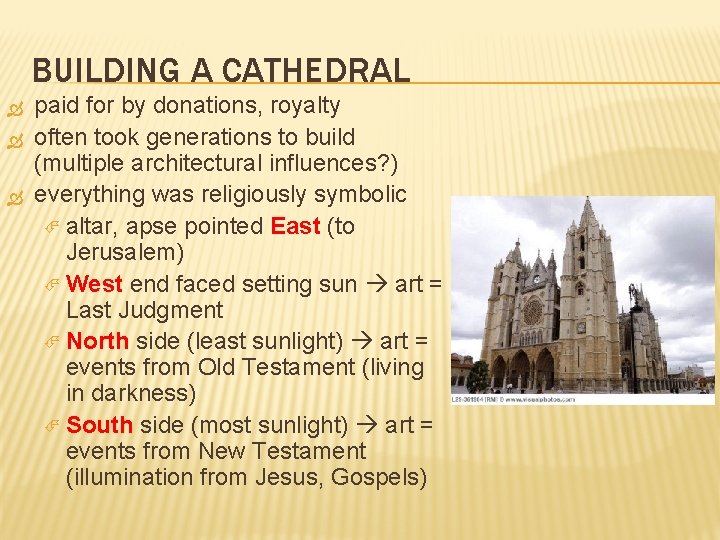
BUILDING A CATHEDRAL paid for by donations, royalty often took generations to build (multiple architectural influences? ) everything was religiously symbolic altar, apse pointed East (to Jerusalem) West end faced setting sun art = Last Judgment North side (least sunlight) art = events from Old Testament (living in darkness) South side (most sunlight) art = events from New Testament (illumination from Jesus, Gospels)
CLOSURE Discuss with a partner the following questions: Why do you suppose the dominant art form in the middle ages was architecture? In addition, why was art in the Middle Ages focused on Christian topics/themes?
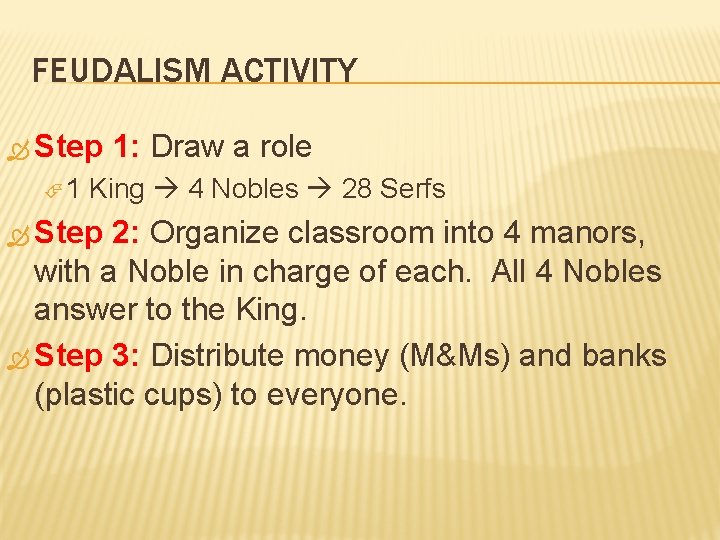
FEUDALISM ACTIVITY Step 1 1: Draw a role King 4 Nobles 28 Serfs Step 2: Organize classroom into 4 manors, with a Noble in charge of each. All 4 Nobles answer to the King. Step 3: Distribute money (M&Ms) and banks (plastic cups) to everyone.
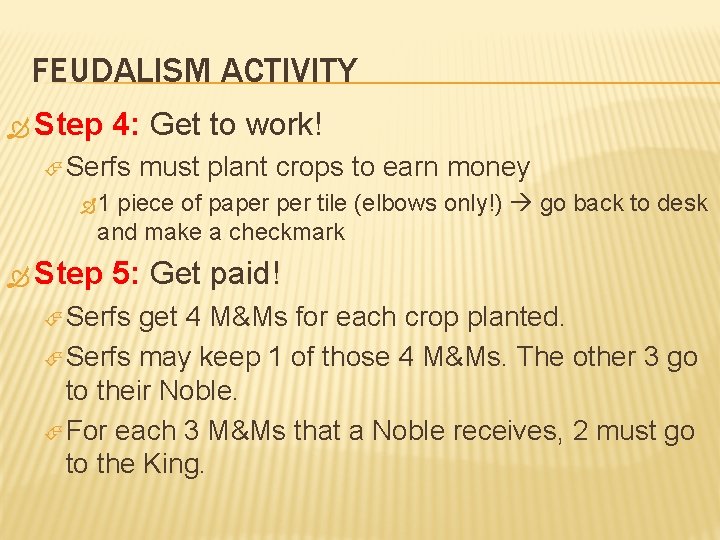
FEUDALISM ACTIVITY Step 4: Get to work! Serfs must plant crops to earn money 1 piece of paper tile (elbows only!) go back to desk and make a checkmark Step 5: Get paid! Serfs get 4 M&Ms for each crop planted. Serfs may keep 1 of those 4 M&Ms. The other 3 go to their Noble. For each 3 M&Ms that a Noble receives, 2 must go to the King.
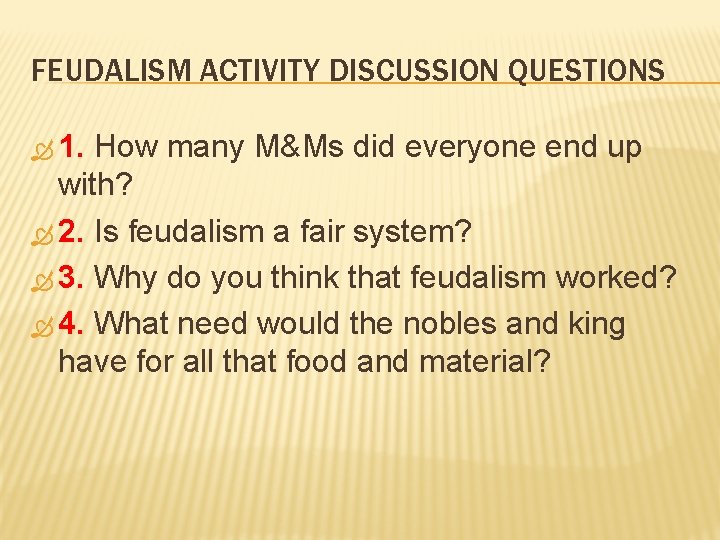
FEUDALISM ACTIVITY DISCUSSION QUESTIONS 1. How many M&Ms did everyone end up with? 2. Is feudalism a fair system? 3. Why do you think that feudalism worked? 4. What need would the nobles and king have for all that food and material?