
Education and Language Catalunya and the Basque Country
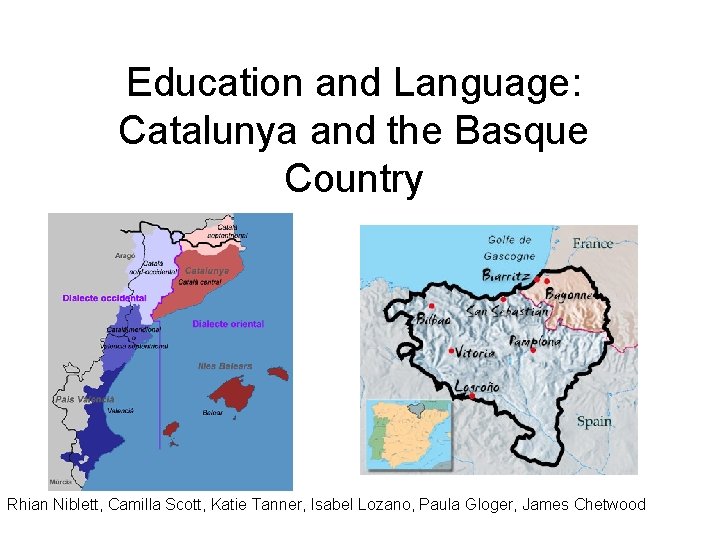
Education and Language: Catalunya and the Basque Country Rhian Niblett, Camilla Scott, Katie Tanner, Isabel Lozano, Paula Gloger, James Chetwood
Catalanisation of Pre-primary to Secondary Education The major official policies and legislation • 1951 – Deixonne law • 1978 – Constitution – Royal decree • 1978 – Catalan teaching service established • 1979 – Statute of Autonomy • 1980 – School system transfer from central state to Catalan government • 1983 – Law of linguistic normalisation • 1990 – LOGSE and recognition from European Parliament • 1992 – Decree • 1998 - Law
Funding Immigrant children in schools Catalan in the education system • Pre-primary • Primary • Secondary Teacher requirements and training Additional educational organisations
Conclusion • For a closer look at the linguistic situation in Catalunya… • Aranese • Catalan in the Balaeric Islands • Valenciano
Secondary Vocational Education • New measures to improve the FP • Plan General de FP en Catalunya (20072010)
Higher Education • Catalan in Universities • Legal statutes and official policies • Structure of university courses adapted to the EHEA
Adult Education • Ley de la Comunidad Autonoma de Catalunya: • Articulo 69 - Objectives of adult education • Articulo 70 – Types of adult education • Articulo 71 – Collaboration with local councils in adult education
Catalan in France • Promotional organisations involved in promoting introduction and use of Catalan within education system: • Federació per a la Defensa de la Llengua i de la Cultura Catalanes • GREC (1969) • La Bressola (1976), Arrels (1980) • APLEC
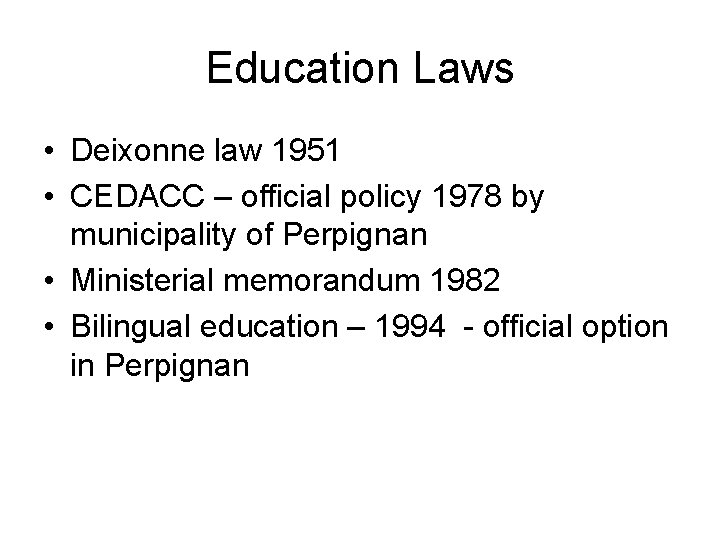
Education Laws • Deixonne law 1951 • CEDACC – official policy 1978 by municipality of Perpignan • Ministerial memorandum 1982 • Bilingual education – 1994 - official option in Perpignan
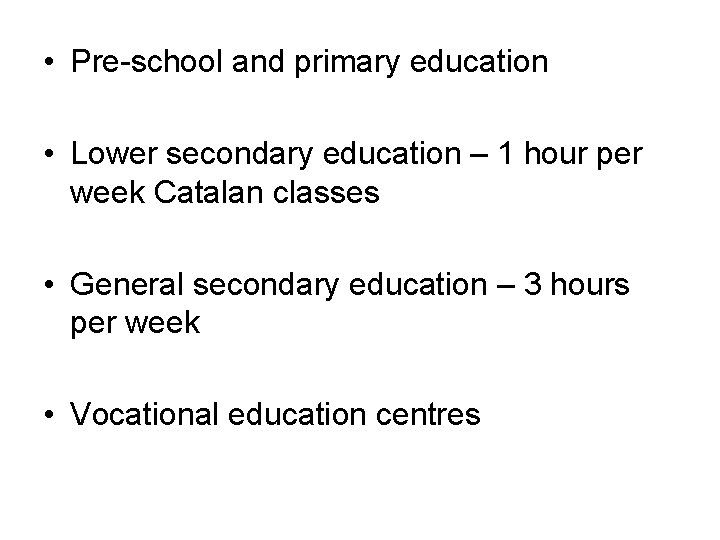
• Pre-school and primary education • Lower secondary education – 1 hour per week Catalan classes • General secondary education – 3 hours per week • Vocational education centres
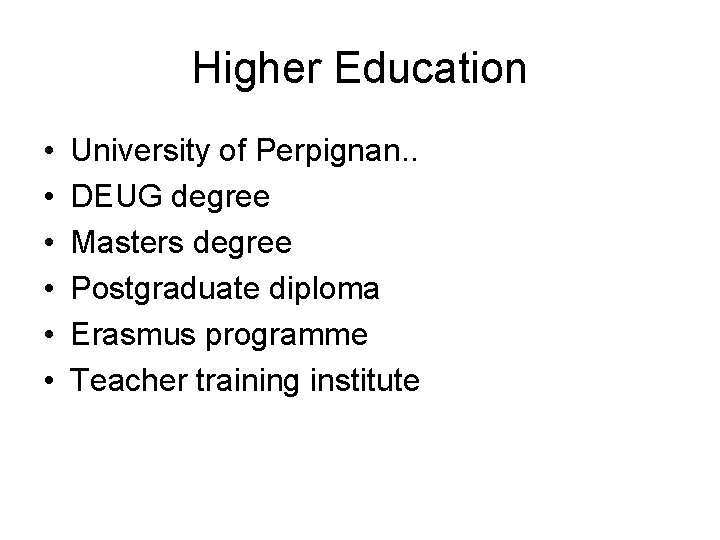
Higher Education • • • University of Perpignan. . DEUG degree Masters degree Postgraduate diploma Erasmus programme Teacher training institute
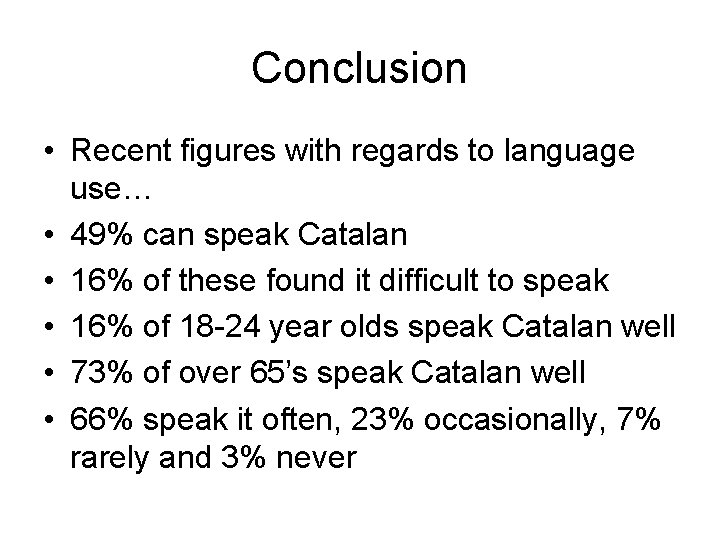
Conclusion • Recent figures with regards to language use… • 49% can speak Catalan • 16% of these found it difficult to speak • 16% of 18 -24 year olds speak Catalan well • 73% of over 65’s speak Catalan well • 66% speak it often, 23% occasionally, 7% rarely and 3% never
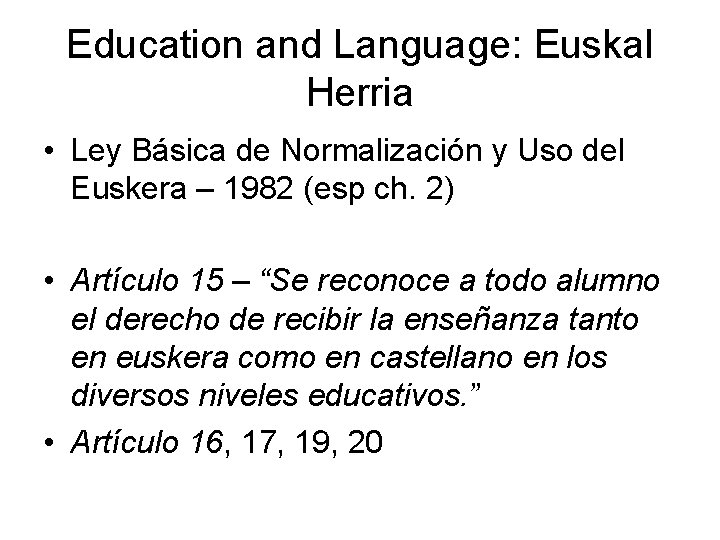
Education and Language: Euskal Herria • Ley Básica de Normalización y Uso del Euskera – 1982 (esp ch. 2) • Artículo 15 – “Se reconoce a todo alumno el derecho de recibir la enseñanza tanto en euskera como en castellano en los diversos niveles educativos. ” • Artículo 16, 17, 19, 20
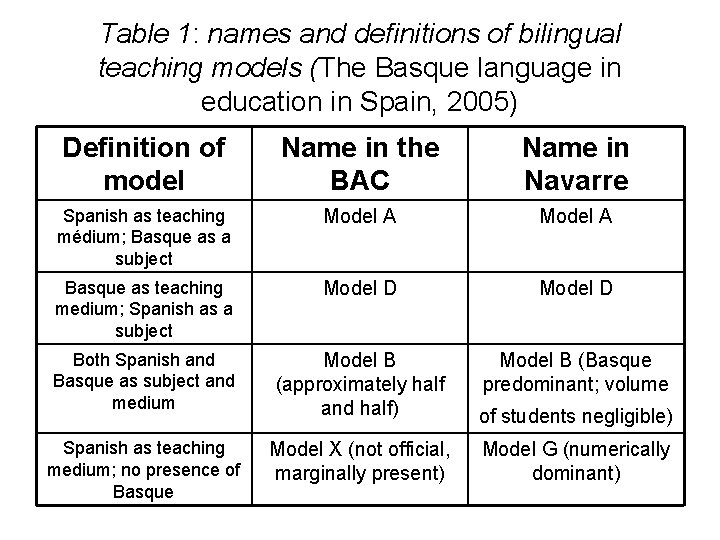
Table 1: names and definitions of bilingual teaching models (The Basque language in education in Spain, 2005) Definition of model Name in the BAC Name in Navarre Spanish as teaching médium; Basque as a subject Model A Basque as teaching medium; Spanish as a subject Model D Both Spanish and Basque as subject and medium Model B (approximately half and half) Model B (Basque predominant; volume of students negligible) Spanish as teaching medium; no presence of Basque Model X (not official, marginally present) Model G (numerically dominant)
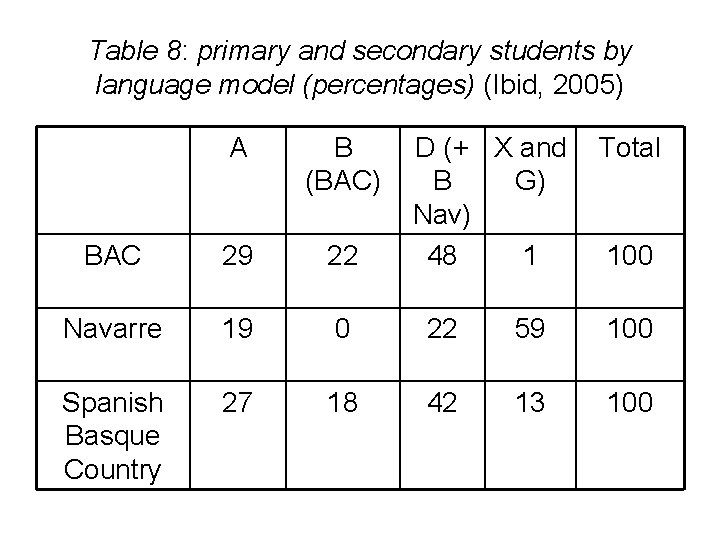
Table 8: primary and secondary students by language model (percentages) (Ibid, 2005) A B (BAC) D (+ X and Total B G) Nav) 48 1 100 BAC 29 22 Navarre 19 0 22 59 100 Spanish Basque Country 27 18 42 13 100
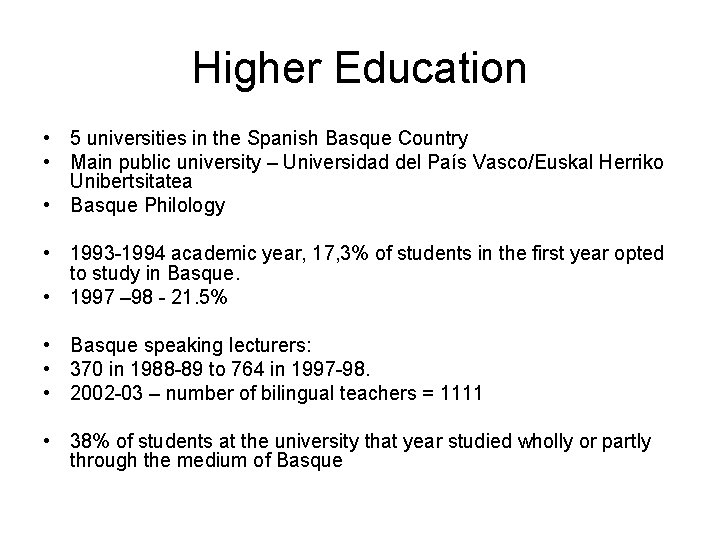
Higher Education • 5 universities in the Spanish Basque Country • Main public university – Universidad del País Vasco/Euskal Herriko Unibertsitatea • Basque Philology • 1993 -1994 academic year, 17, 3% of students in the first year opted to study in Basque. • 1997 – 98 - 21. 5% • Basque speaking lecturers: • 370 in 1988 -89 to 764 in 1997 -98. • 2002 -03 – number of bilingual teachers = 1111 • 38% of students at the university that year studied wholly or partly through the medium of Basque
• Teacher training • IRALE programme – offering teachers the opportunity to learn Basque • 2003 -2004 - 617 • Adult education • Udal Euskaltegiak – 1981 • Adults who may not have had the opportunity to learn Basque growing up in the Franco era. • At its height – 50, 000 adults but 2003 -2004 – 40, 000 adults
Conclusion • 2005 – a positive forecast for the future of the Basque language in education • Basque language = national politics • May 5 th 2009 – the election of the first socialist government for nearly 3 decades • Patxi Lopez - Halt a programme aimed at making Basque the main language in schools. • Isabel Celaá “estarán en pie de igualdad”
Language status in France • French political system based on a single unified state • French is the only official language • Basque has no official status
Basque in France • Basque speaking area of France is called Iparralde or the Northern Basque Country • 24. 7% of its inhabitants speak Basque • Number of Basque speakers declining, but the rate of decline has decreased • Basque has never been used by the authorities
Promoting the Basque Language • The Public Office of the Basque Language • The Seaska Association • Ikas-Bi • Euskal Haziak
French Education System • Largely state controlled • 28 académies • Iparralde is part of the académie of Bordeaux • Bilingual education is available in both public and private schools
3 strands of schooling in the Northern Basque Country • Public schools – some bilingual, some just teach in French • Catholic schools – same as public schools • Basque schools (Ikastolas) – primarily taught in Basque but aim to bring children up bilingual
Fillon Law • A new law of orientation for the future of the school introduced in 2005 • Significant change to the place granted to regional languages in the French school system • Not able to choose a regional language as a modern language at primary or secondary level
Adult Education • Mainly based on private initiatives. • AEK in charge of creating a greater awareness of Basque • Specific classes for council workers and civil servants
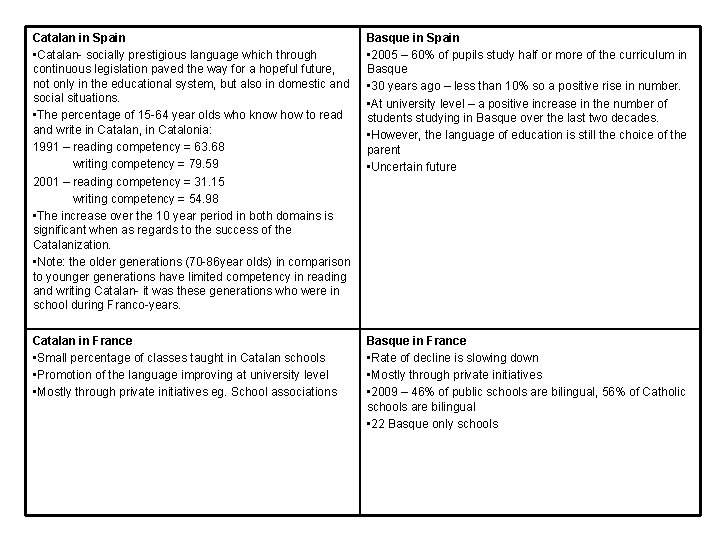
Catalan in Spain • Catalan- socially prestigious language which through continuous legislation paved the way for a hopeful future, not only in the educational system, but also in domestic and social situations. • The percentage of 15 -64 year olds who know how to read and write in Catalan, in Catalonia: 1991 – reading competency = 63. 68 writing competency = 79. 59 2001 – reading competency = 31. 15 writing competency = 54. 98 • The increase over the 10 year period in both domains is significant when as regards to the success of the Catalanization. • Note: the older generations (70 -86 year olds) in comparison to younger generations have limited competency in reading and writing Catalan- it was these generations who were in school during Franco-years. Basque in Spain • 2005 – 60% of pupils study half or more of the curriculum in Basque • 30 years ago – less than 10% so a positive rise in number. • At university level – a positive increase in the number of students studying in Basque over the last two decades. • However, the language of education is still the choice of the parent • Uncertain future Catalan in France • Small percentage of classes taught in Catalan schools • Promotion of the language improving at university level • Mostly through private initiatives eg. School associations Basque in France • Rate of decline is slowing down • Mostly through private initiatives • 2009 – 46% of public schools are bilingual, 56% of Catholic schools are bilingual • 22 Basque only schools
Bibliography • Book sources: • • La diversidad de lenguas en España- Extebarria, Maitena, Espasa Madrid 2002 El bilingüismo en el estado español – Etxebarria, Maitena. Ediciones FBV Bilbao 1995 • Internet sources: • • Gobierno de Catalunya - http: //www. gencat. cat/ Gobierno del Pais Vasco - http: //www. euskadi. net/r 33 -2220/es http: //www. mercator-research. eu/ http: //ec. europa. eu/ http: //www. idescat. cat/ http: //www. flarep. com/IKAS-BI/indexikas-bi. html http: //www. uoc. es/euromosaic/web/document/catala/an/i 5. html
- Slides: 27