
Educating English Language Learners In the Elementary Classroom
- Slides: 32
Educating English Language Learners In the Elementary Classroom Elizabeth Wallace Masters of Science in Education Bilingual Education Esqua 1@u. brockport. edu
Agenda � 8: 00 -8: 30 – Introductions and identifying goals for this workshop � 8: 30 -9: 00 – Second Language Acquisition � 9: 00 -9: 30 – ESL Strategies � 9: 30 -9: 45 – Break � 9: 45 -10: 15 – Language Simulation Experience � 10: 15 -10: 45 – 5 E Pedagogy & Inquiry Based Learning � 10: 45 – 11: 00 – Question and Answer/ Workshop Evaluation
Introductions 1. What’s your name? 2. What grade level do you teach? 3. Why did you sign up for this workshop?
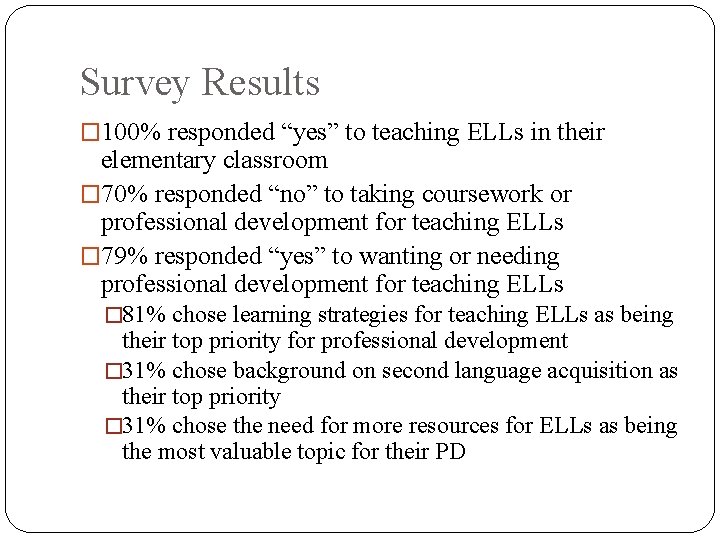
Survey Background � 12 -question survey designed for elementary classroom teachers �Focused on level of coursework/professional development for instructing English Language Learners (ELLs) �Teachers from Oswego and Liverpool school districts volunteered to take the survey � 20 teachers responded in total � 16 teachers work for Liverpool Central Schools � 4 teachers work for Oswego City Schools
Survey Results � 100% responded “yes” to teaching ELLs in their elementary classroom � 70% responded “no” to taking coursework or professional development for teaching ELLs � 79% responded “yes” to wanting or needing professional development for teaching ELLs � 81% chose learning strategies for teaching ELLs as being their top priority for professional development � 31% chose background on second language acquisition as their top priority � 31% chose the need for more resources for ELLs as being the most valuable topic for their PD
Second Language Acquisition What you need to know to effectively teach your ELLs in a second language.
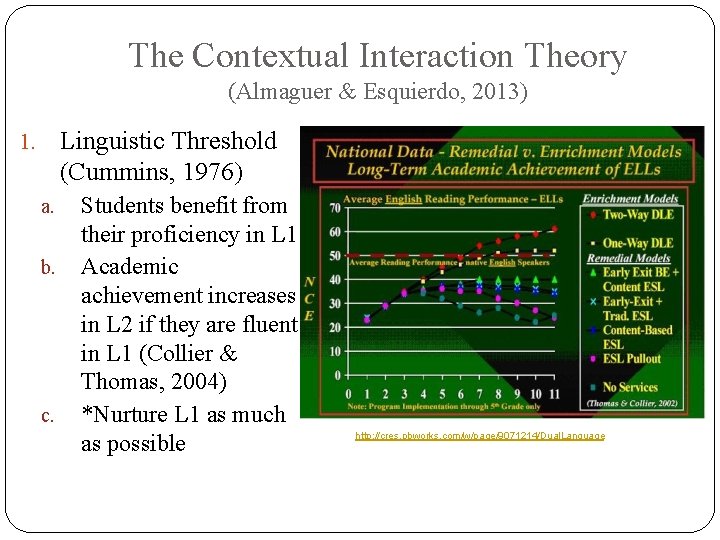
The Contextual Interaction Theory (Almaguer & Esquierdo, 2013) Linguistic Threshold (Cummins, 1976) 1. a. b. c. Students benefit from their proficiency in L 1 Academic achievement increases in L 2 if they are fluent in L 1 (Collier & Thomas, 2004) *Nurture L 1 as much as possible http: //cres. pbworks. com/w/page/9071214/Dual. Language
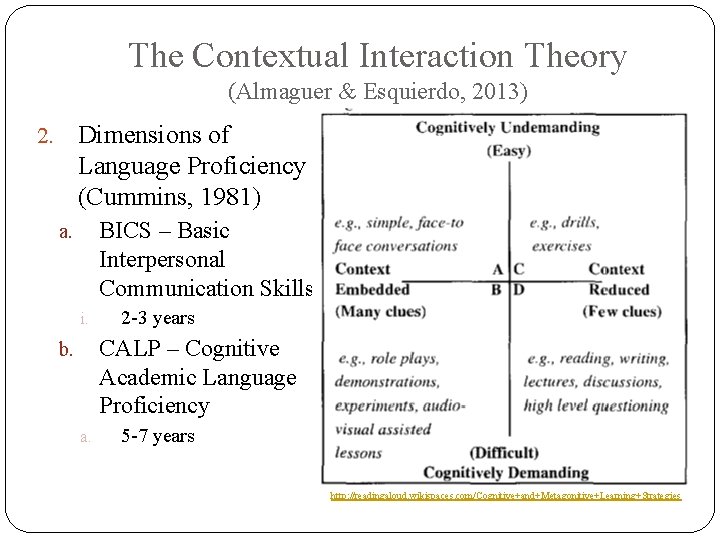
The Contextual Interaction Theory (Almaguer & Esquierdo, 2013) Dimensions of Language Proficiency (Cummins, 1981) 2. BICS – Basic Interpersonal Communication Skills a. i. 2 -3 years CALP – Cognitive Academic Language Proficiency b. a. 5 -7 years http: //readingaloud. wikispaces. com/Cognitive+and+Metagonitive+Learning+Strategies
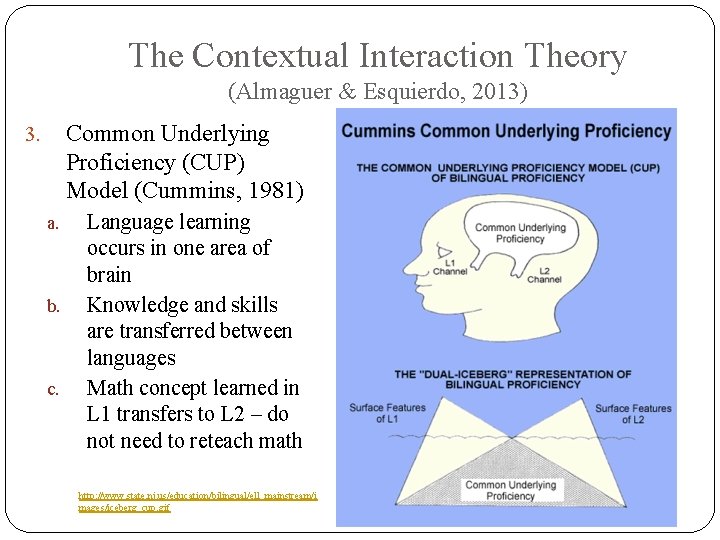
The Contextual Interaction Theory (Almaguer & Esquierdo, 2013) Common Underlying Proficiency (CUP) Model (Cummins, 1981) 3. a. b. c. Language learning occurs in one area of brain Knowledge and skills are transferred between languages Math concept learned in L 1 transfers to L 2 – do not need to reteach math http: //www. state. nj. us/education/bilingual/ell_mainstream/i mages/iceberg_cup. gif
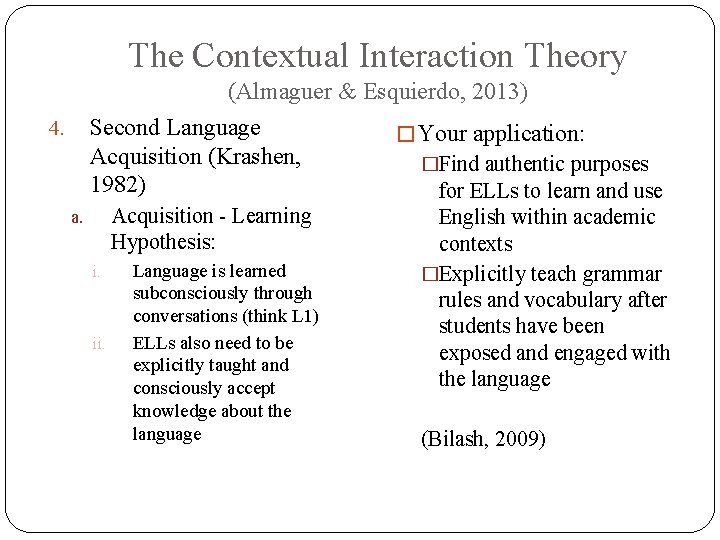
The Contextual Interaction Theory (Almaguer & Esquierdo, 2013) Second Language � Your application: Acquisition (Krashen, �Find authentic purposes 1982) for ELLs to learn and use 4. Acquisition - Learning Hypothesis: a. i. ii. Language is learned subconsciously through conversations (think L 1) ELLs also need to be explicitly taught and consciously accept knowledge about the language English within academic contexts �Explicitly teach grammar rules and vocabulary after students have been exposed and engaged with the language (Bilash, 2009)
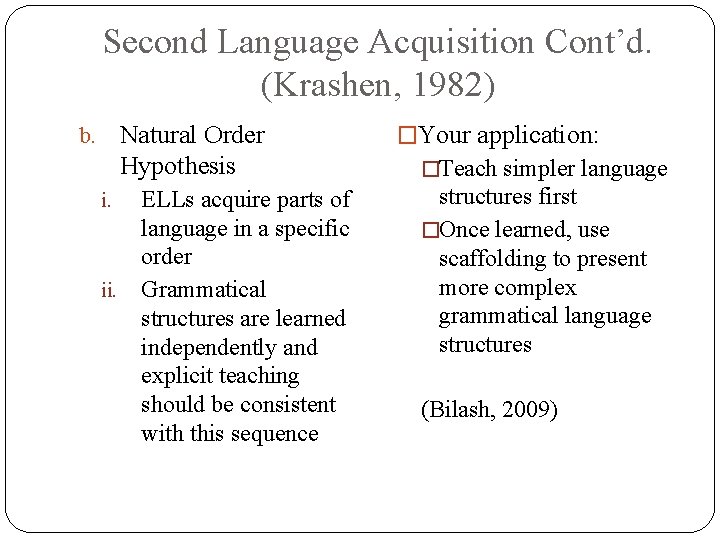
Second Language Acquisition Cont’d. (Krashen, 1982) Natural Order Hypothesis b. ELLs acquire parts of language in a specific order ii. Grammatical structures are learned independently and explicit teaching should be consistent with this sequence i. �Your application: �Teach simpler language structures first �Once learned, use scaffolding to present more complex grammatical language structures (Bilash, 2009)
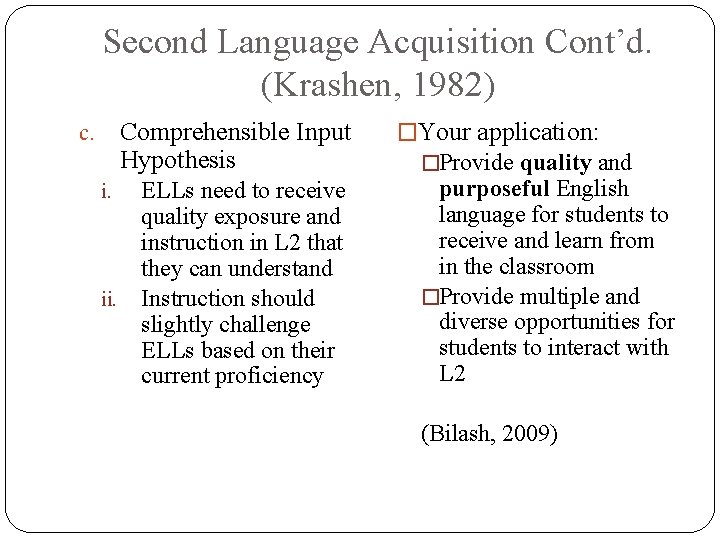
Second Language Acquisition Cont’d. (Krashen, 1982) Comprehensible Input Hypothesis c. ELLs need to receive quality exposure and instruction in L 2 that they can understand ii. Instruction should slightly challenge ELLs based on their current proficiency i. �Your application: �Provide quality and purposeful English language for students to receive and learn from in the classroom �Provide multiple and diverse opportunities for students to interact with L 2 (Bilash, 2009)
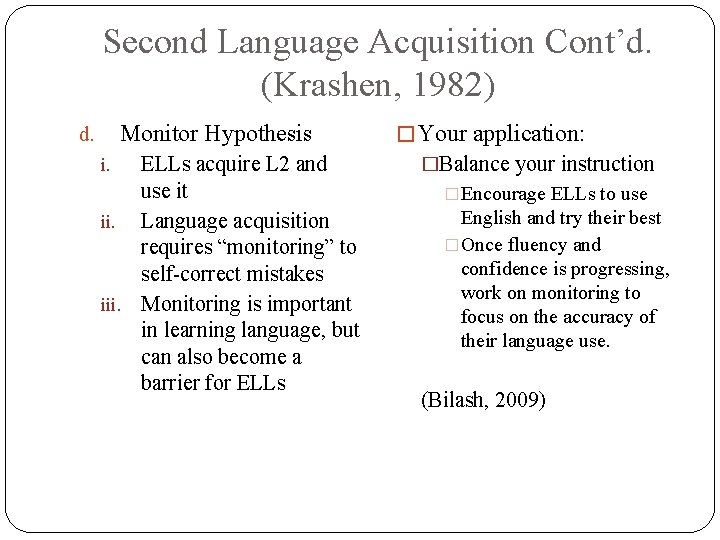
Second Language Acquisition Cont’d. (Krashen, 1982) Monitor Hypothesis d. ELLs acquire L 2 and use it ii. Language acquisition requires “monitoring” to self-correct mistakes iii. Monitoring is important in learning language, but can also become a barrier for ELLs i. � Your application: �Balance your instruction �Encourage ELLs to use English and try their best �Once fluency and confidence is progressing, work on monitoring to focus on the accuracy of their language use. (Bilash, 2009)
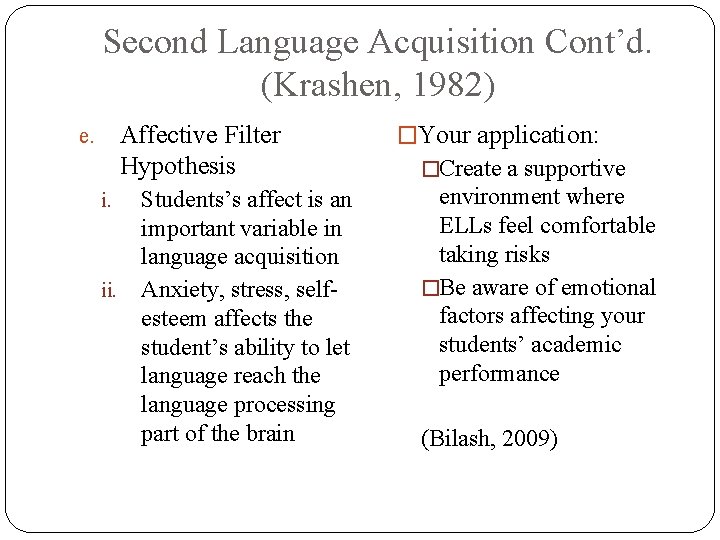
Second Language Acquisition Cont’d. (Krashen, 1982) Affective Filter Hypothesis e. Students’s affect is an important variable in language acquisition ii. Anxiety, stress, selfesteem affects the student’s ability to let language reach the language processing part of the brain i. �Your application: �Create a supportive environment where ELLs feel comfortable taking risks �Be aware of emotional factors affecting your students’ academic performance (Bilash, 2009)
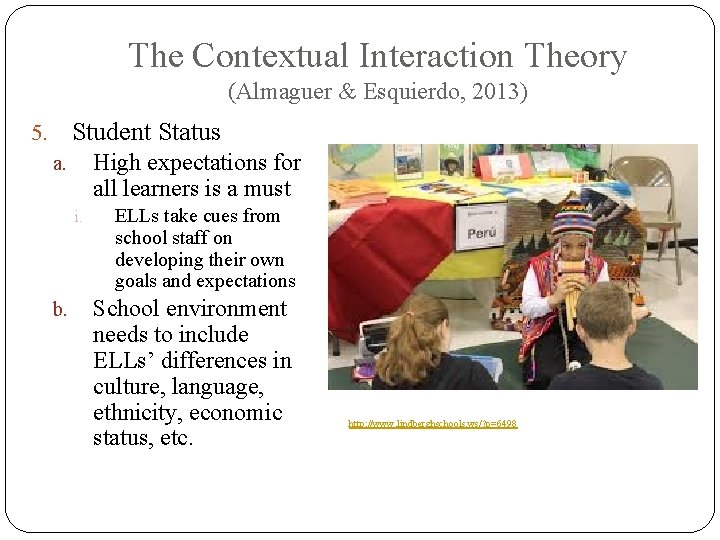
The Contextual Interaction Theory (Almaguer & Esquierdo, 2013) Student Status 5. High expectations for all learners is a must a. i. b. ELLs take cues from school staff on developing their own goals and expectations School environment needs to include ELLs’ differences in culture, language, ethnicity, economic status, etc. http: //www. lindberghschools. ws/? p=6498
Questions or Comments http: //carriekish. com/tag/leading-questions/
ESL Strategies What can you incorporate into your teaching?
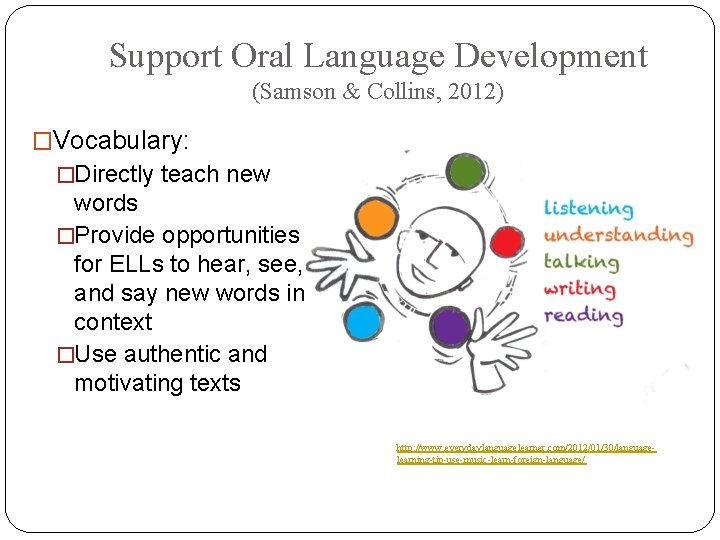
Support Oral Language Development (Samson & Collins, 2012) �Vocabulary: �Directly teach new words �Provide opportunities for ELLs to hear, see, and say new words in context �Use authentic and motivating texts http: //www. everydaylanguagelearner. com/2012/01/30/languagelearning-tip-use-music-learn-foreign-language/
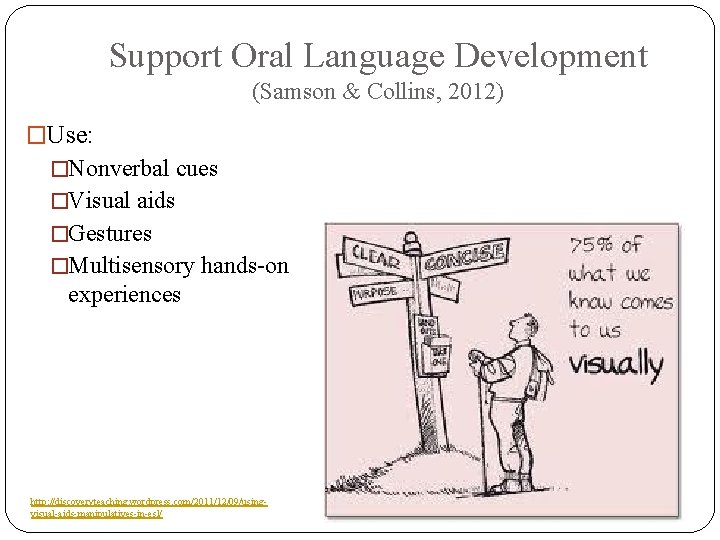
Support Oral Language Development (Samson & Collins, 2012) �Use: �Nonverbal cues �Visual aids �Gestures �Multisensory hands-on experiences http: //discoveryteaching. wordpress. com/2011/12/09/usingvisual-aids-manipulatives-in-esl/
Support Oral Language Development (Samson & Collins, 2012) �More strategies: �Establish routines �Extend discussion on 1 topic �Give immediate feedback �Speak slowly �Clear repetition �Paraphrase �Provide opportunities to converse with teachers and students http: //esl-professionaldevelopment. wikispaces. com/Methods+and+Strategies+for+ESL+ Instruction+Homepage
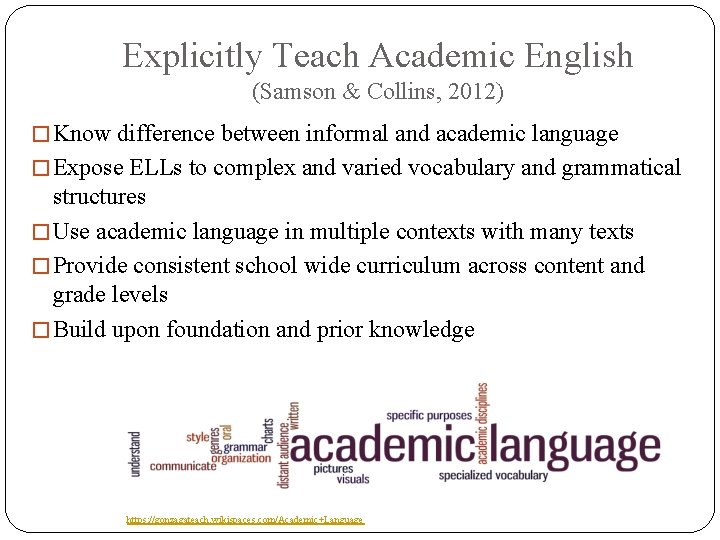
Explicitly Teach Academic English (Samson & Collins, 2012) � Know difference between informal and academic language � Expose ELLs to complex and varied vocabulary and grammatical structures � Use academic language in multiple contexts with many texts � Provide consistent school wide curriculum across content and grade levels � Build upon foundation and prior knowledge https: //gonzagateach. wikispaces. com/Academic+Language
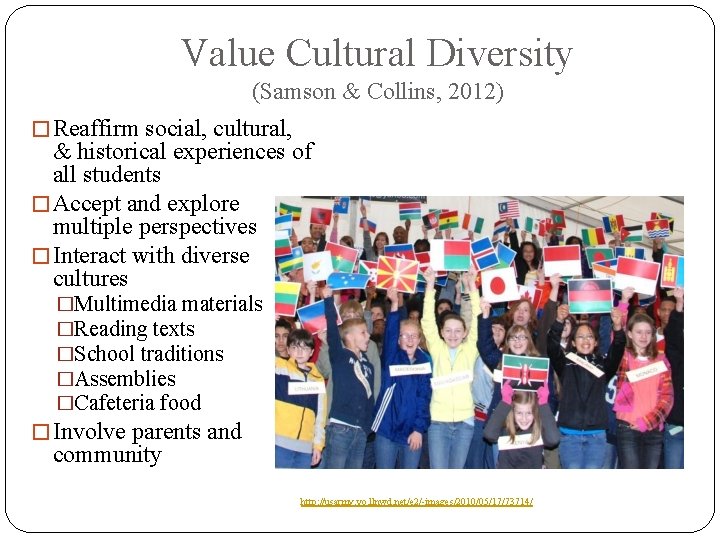
Value Cultural Diversity (Samson & Collins, 2012) � Reaffirm social, cultural, & historical experiences of all students � Accept and explore multiple perspectives � Interact with diverse cultures �Multimedia materials �Reading texts �School traditions �Assemblies �Cafeteria food � Involve parents and community http: //usarmy. vo. llnwd. net/e 2/-images/2010/05/17/73714/
Break Take 15 minutes
L 2 Simulation Experience (de Oliveira, 2011) Time to change perspectives!
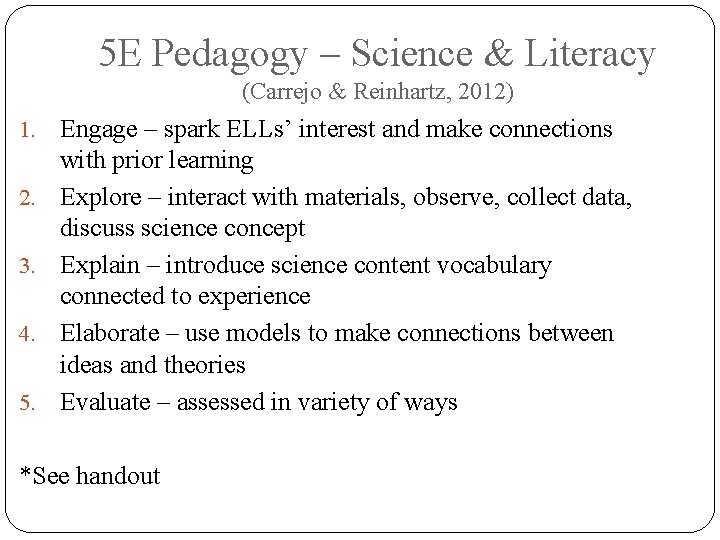
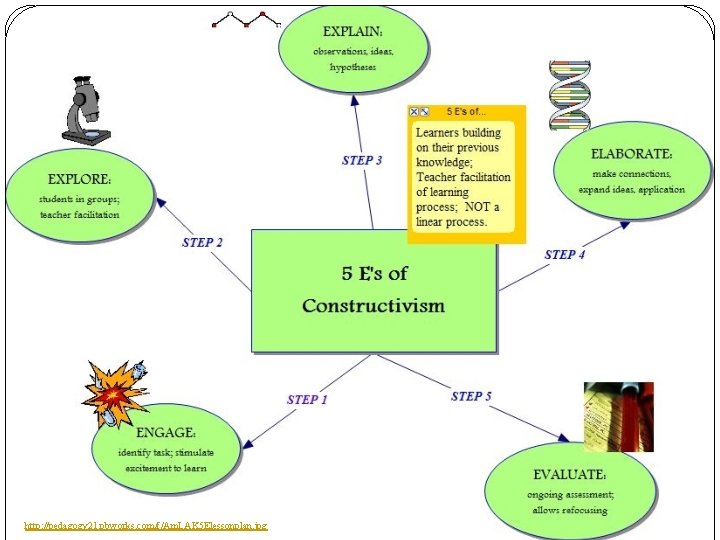
5 E Pedagogy – Science & Literacy (Carrejo & Reinhartz, 2012) 1. 2. 3. 4. 5. Engage – spark ELLs’ interest and make connections with prior learning Explore – interact with materials, observe, collect data, discuss science concept Explain – introduce science content vocabulary connected to experience Elaborate – use models to make connections between ideas and theories Evaluate – assessed in variety of ways *See handout
http: //pedagogy 21. pbworks. com/f/Am. LAK 5 Elessonplan. jpg
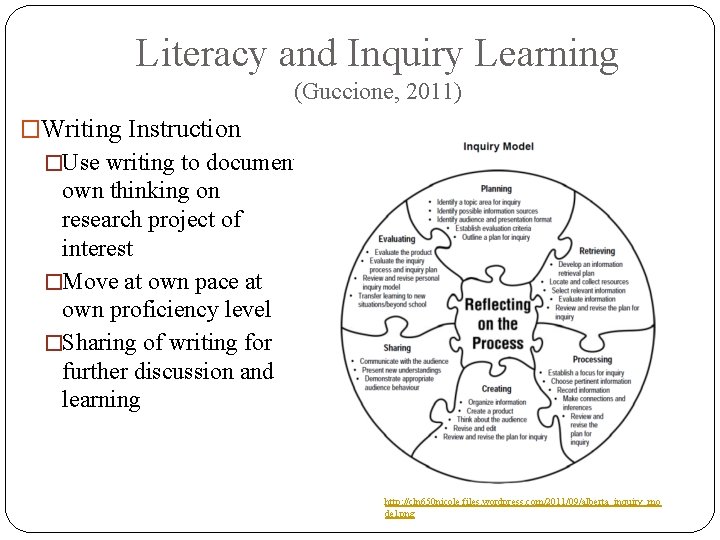
Literacy and Inquiry Learning (Guccione, 2011) �Writing Instruction �Use writing to document own thinking on research project of interest �Move at own pace at own proficiency level �Sharing of writing for further discussion and learning http: //cln 650 nicole. files. wordpress. com/2011/09/alberta_inquiry_mo del. png
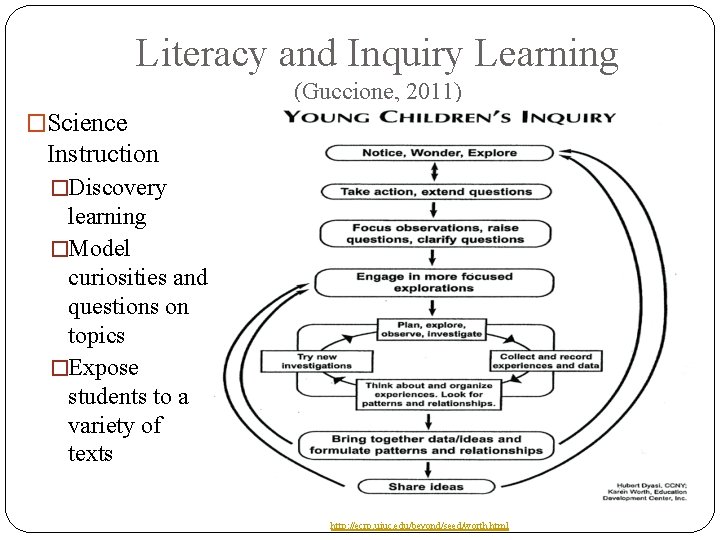
Literacy and Inquiry Learning (Guccione, 2011) �Science Instruction �Discovery learning �Model curiosities and questions on topics �Expose students to a variety of texts http: //ecrp. uiuc. edu/beyond/seed/worth. html
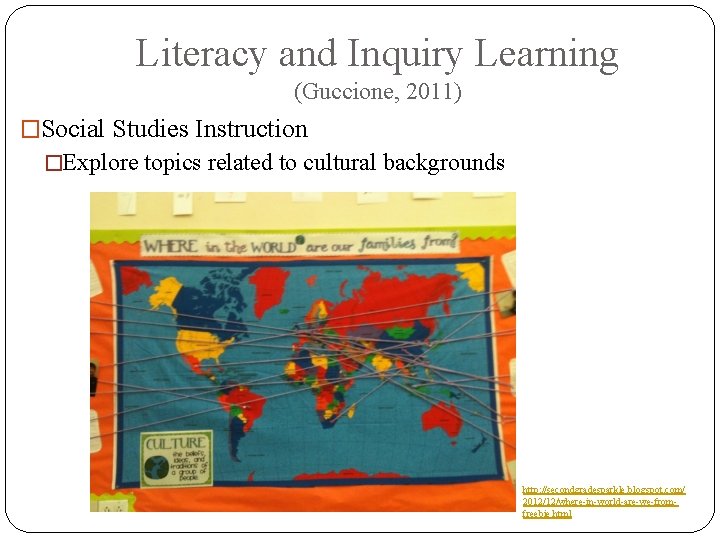
Literacy and Inquiry Learning (Guccione, 2011) �Social Studies Instruction �Explore topics related to cultural backgrounds http: //secondgradesparkle. blogspot. com/ 2012/12/where-in-world-are-we-fromfreebie. html
Final Thoughts 1. What has got you thinking? 2. What have you taken to heart? 3. What will you walk away with?
References � Almaguer, Isela, & Esquierdo, J. Joy. (2013). Cultivating bilingual learners’ language arts � � � knowledge: A framework for successful teaching. International Journal of Instruction, 6(2), 3 -17. Bilash, Olenka. (2009, May). Best of Bilash: Improving second language education. Retrieved from http: //www. educ. ualberta. ca/staff/olenka. bilash/best%20 of%20 bilash/krashen. html Carrejo, David J. , & Reinhartz, Judy. (2012). Exploring the synergy between science literacy and language literacy with English language learners: Lessons learned within a sustained professional development program. SRATE Journal, 21(2), 33 -38. de Oliveira, Luciana C. (2011). In their shoes: Teachers experience the needs of English language learners through a math simulation. Multicultural Education, 59 -62. Guccione, Lindsey M. (2011). Integrating iteracy and inquiry for English learners. The Reading Teacher, 64 (8), 567 -577. DOI: 10. 1598/RT. 64. 8. 2 Krashen, Stephen D. (1981). Second language acquisition and second language learning. Summit, New Jersey: Pergamon Press Inc. Samson, Jennifer F. & Collins, Brian A. (2012). Preparing all teachers to meet the needs of English language learners: Applying research to policy and practice for teacher effectiveness. Center for American Progress, 1 -25.
References � http: //cres. pbworks. com/w/page/9071214/Dual. Language � http: //readingaloud. wikispaces. com/Cognitive+and+Metagonitive+Learning+Strategies � http: //www. state. nj. us/education/bilingual/ell_mainstream/images/iceberg_cup. gif � http: //www. lindberghschools. ws/? p=6498 � http: //carriekish. com/tag/leading-questions/ � http: //www. everydaylanguagelearner. com/2012/01/30/language-learning-tip-use-music-learn� � � � foreign-language/ http: //discoveryteaching. wordpress. com/2011/12/09/using-visual-aids-manipulatives-in-esl/ http: //esl-professionaldevelopment. wikispaces. com/Methods+and+Strategies+for+ESL+Instruction+Homepage https: //gonzagateach. wikispaces. com/Academic+Language http: //usarmy. vo. llnwd. net/e 2/-images/2010/05/17/73714/ http: //pedagogy 21. pbworks. com/f/Am. LAK 5 Elessonplan. jpg http: //cln 650 nicole. files. wordpress. com/2011/09/alberta_inquiry_model. png http: //ecrp. uiuc. edu/beyond/seed/worth. html http: //secondgradesparkle. blogspot. com/2012/12/where-in-world-are-we-from-freebie. html