
EDUC 7610 Interactions Moderation Tyson S Barrett Ph
EDUC 7610 Interactions (Moderation) Tyson S. Barrett, Ph. D Updates by Carly Fox
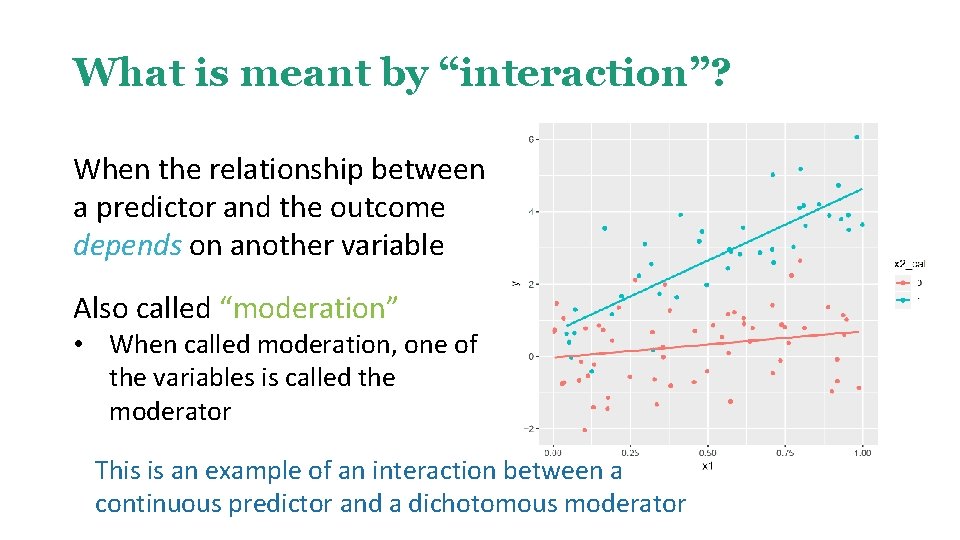
What is meant by “interaction”? When the relationship between a predictor and the outcome depends on another variable Also called “moderation” • When called moderation, one of the variables is called the moderator This is an example of an interaction between a continuous predictor and a dichotomous moderator
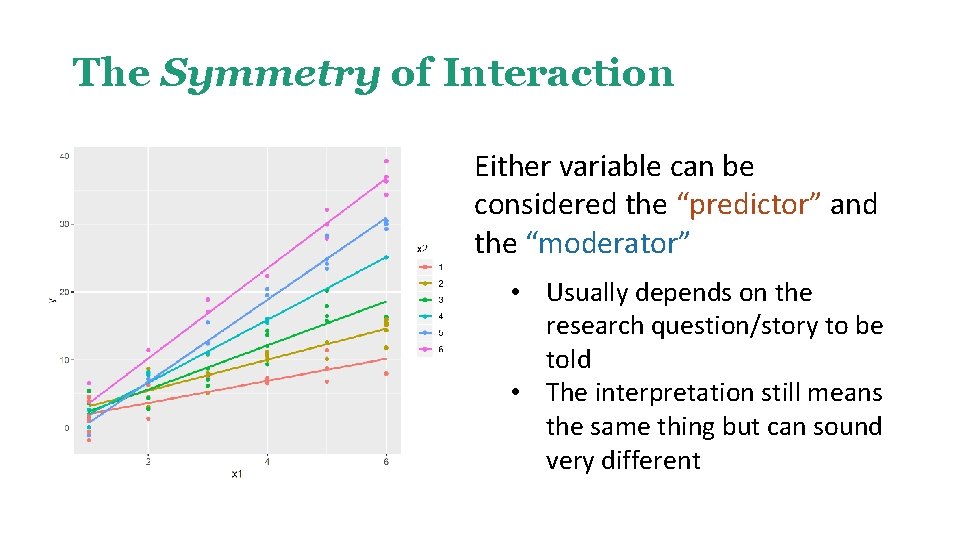
The Symmetry of Interaction Either variable can be considered the “predictor” and the “moderator” • Usually depends on the research question/story to be told • The interpretation still means the same thing but can sound very different
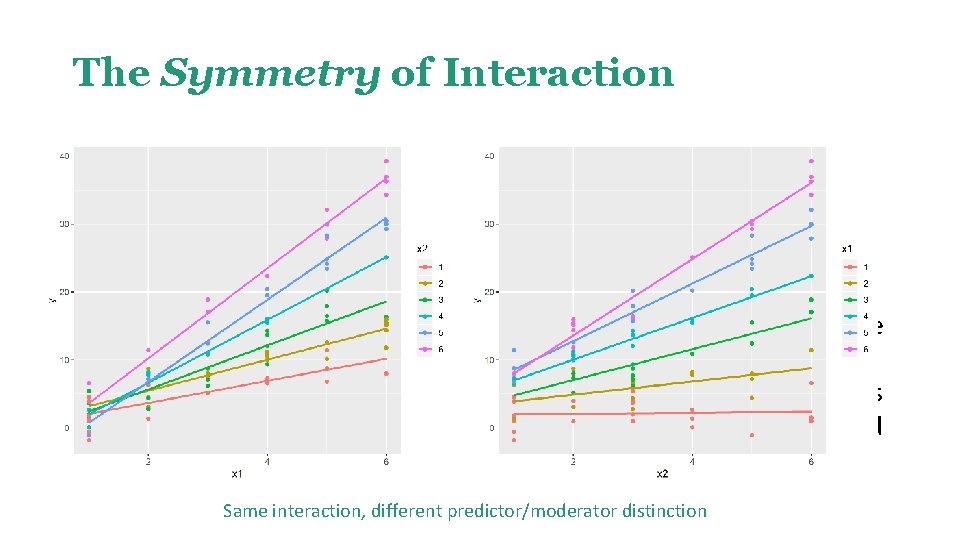
The Symmetry of Interaction Either variable can be considered the “predictor” and the “moderator” • Usually depends on the research question/story to be told • The interpretation still means the same thing but can sound very different Same interaction, different predictor/moderator distinction
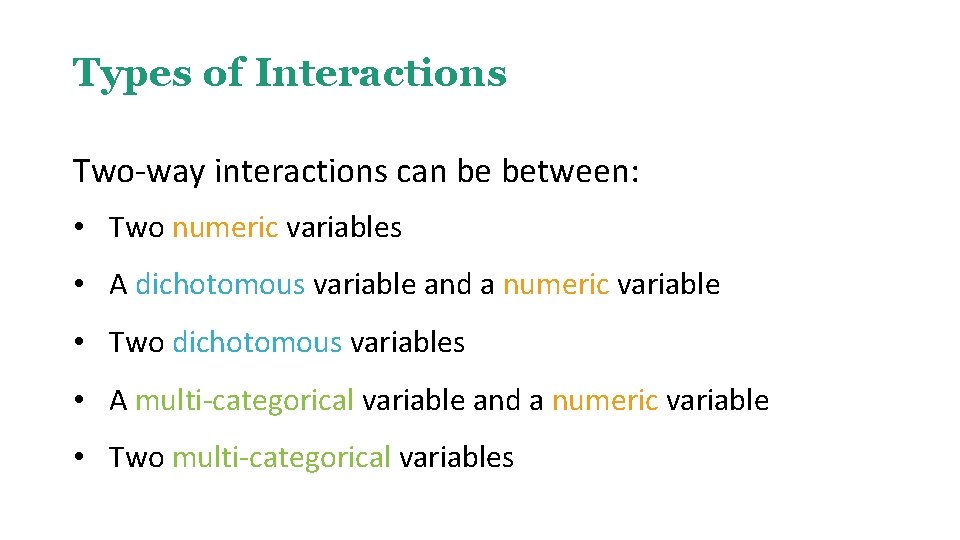
Types of Interactions Two-way interactions can be between: • Two numeric variables • A dichotomous variable and a numeric variable • Two dichotomous variables • A multi-categorical variable and a numeric variable • Two multi-categorical variables

Types of Interactions Two-way interactions can be between: Examples • Two numeric variables • • • The effect of the treatment on the outcome may depend on the sex of the participant A dichotomous variable and a numeric variable • The effect of smoking on heart condition may depend on age Two dichotomous variables • The effect of education on income may depend the economic climate A multi-categorical variable andon a numeric variable Could we reverse the way that we said each of Two multi-categorical variables these? Yes
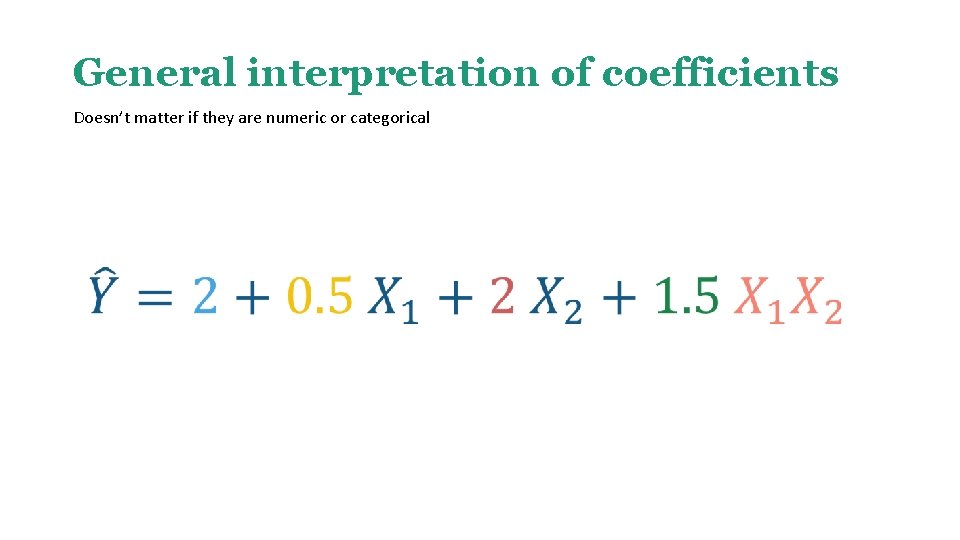
General interpretation of coefficients Doesn’t matter if they are numeric or categorical
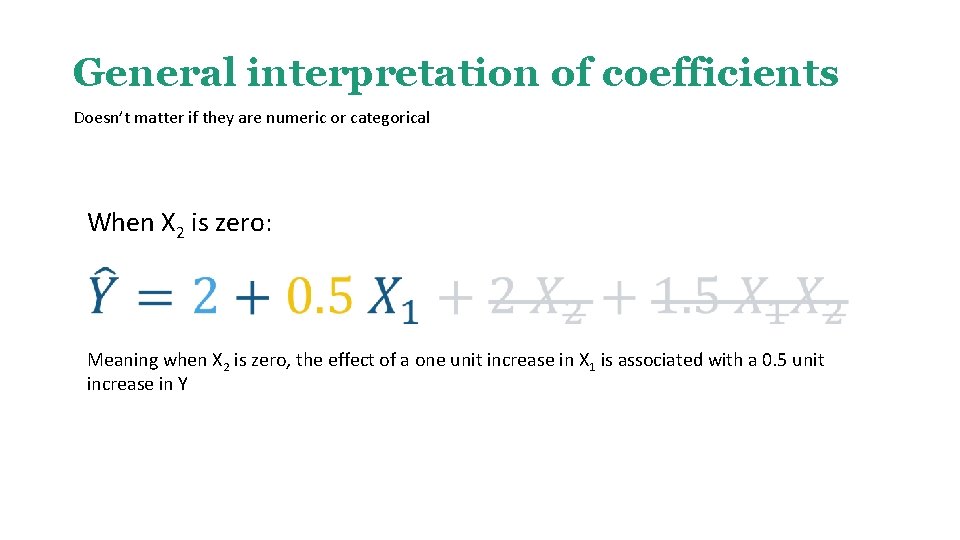
General interpretation of coefficients Doesn’t matter if they are numeric or categorical When X 2 is zero: Meaning when X 2 is zero, the effect of a one unit increase in X 1 is associated with a 0. 5 unit increase in Y
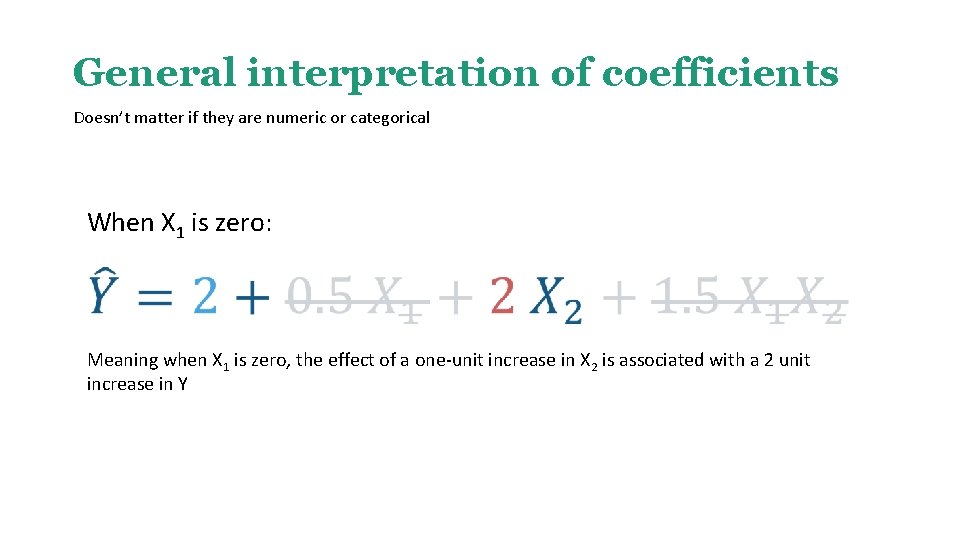
General interpretation of coefficients Doesn’t matter if they are numeric or categorical When X 1 is zero: Meaning when X 1 is zero, the effect of a one-unit increase in X 2 is associated with a 2 unit increase in Y
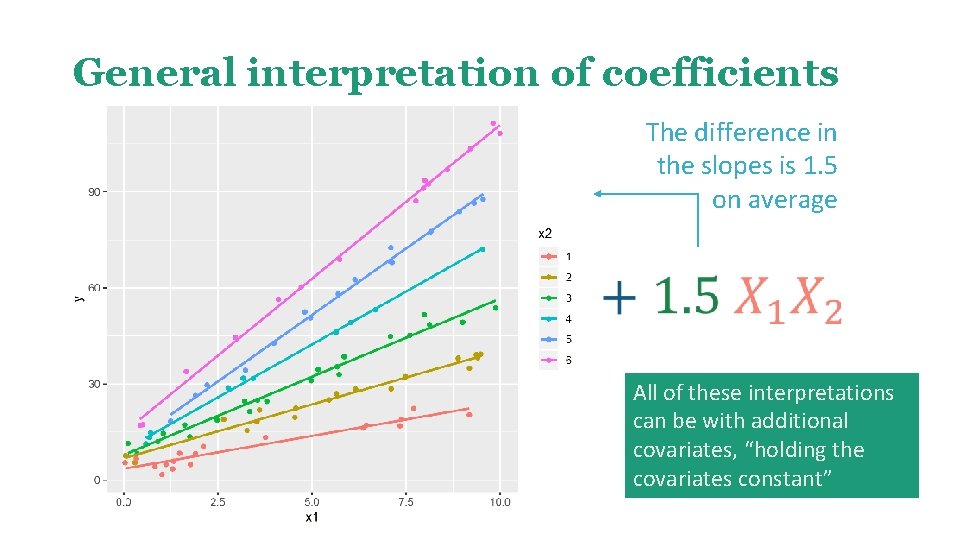
General interpretation of coefficients Doesn’t matter if they are numeric or categorical The difference in the slopes is 1. 5 on average All of these interpretations can be with additional covariates, “holding the covariates constant”
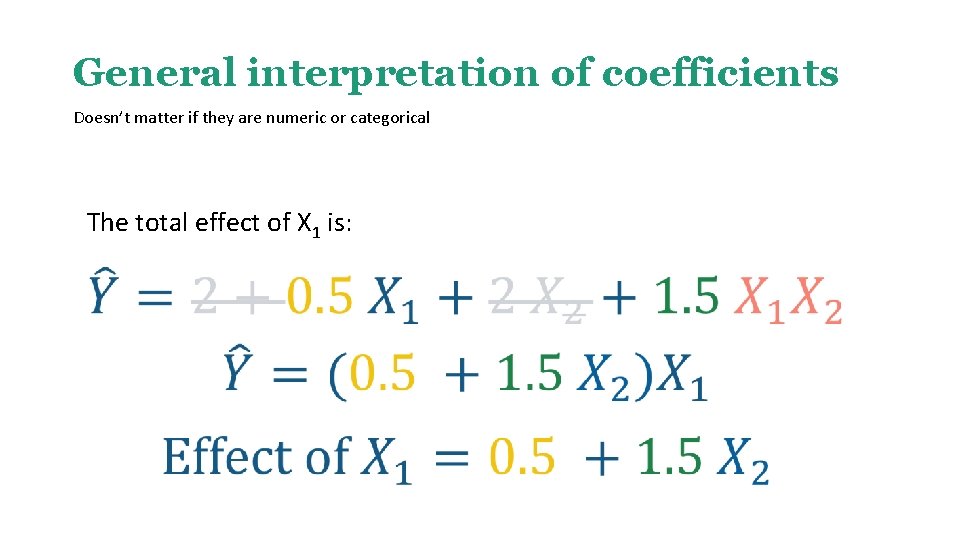
General interpretation of coefficients Doesn’t matter if they are numeric or categorical The total effect of X 1 is:
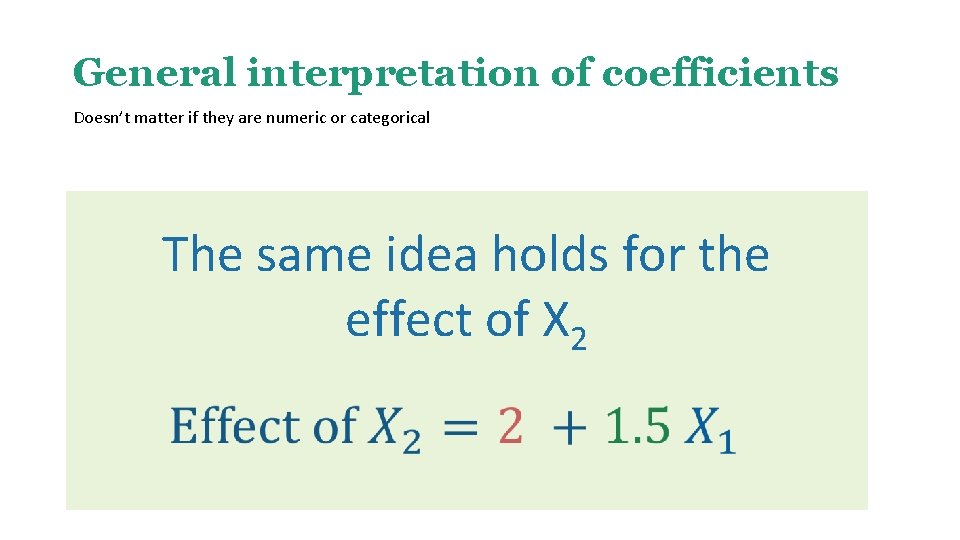
General interpretation of coefficients Doesn’t matter if they are numeric or categorical The total effect of X 1 is: The same idea holds for the effect of X 2
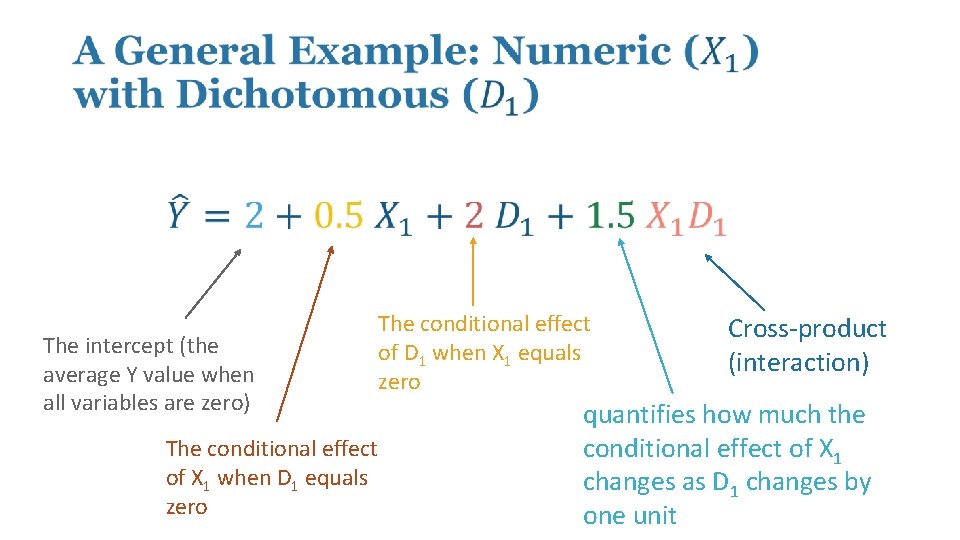
The intercept (the average Y value when all variables are zero) The conditional effect of D 1 when X 1 equals zero The conditional effect of X 1 when D 1 equals zero Cross-product (interaction) quantifies how much the conditional effect of X 1 changes as D 1 changes by one unit
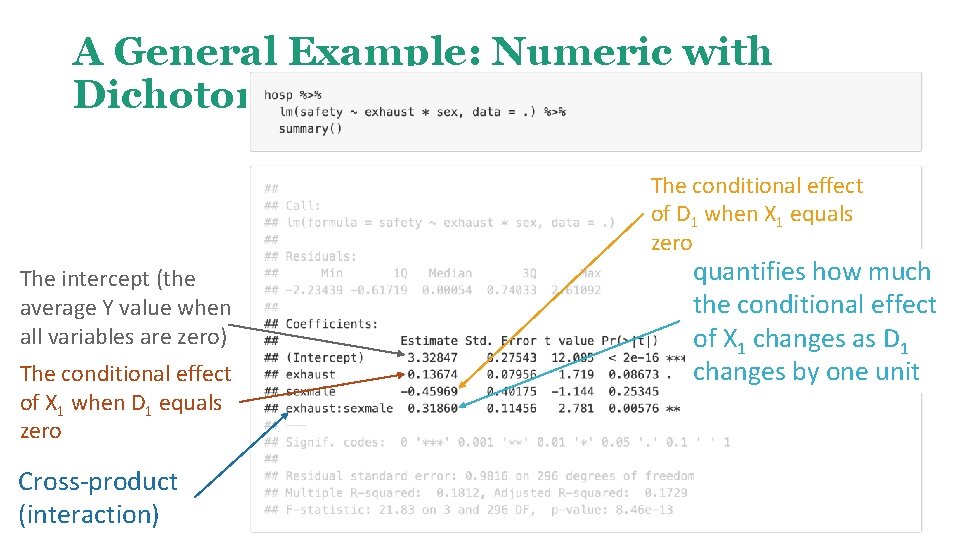
A General Example: Numeric with Dichotomous The conditional effect of D 1 when X 1 equals zero The intercept (the average Y value when all variables are zero) The conditional effect of X 1 when D 1 equals zero Cross-product (interaction) quantifies how much the conditional effect of X 1 changes as D 1 changes by one unit
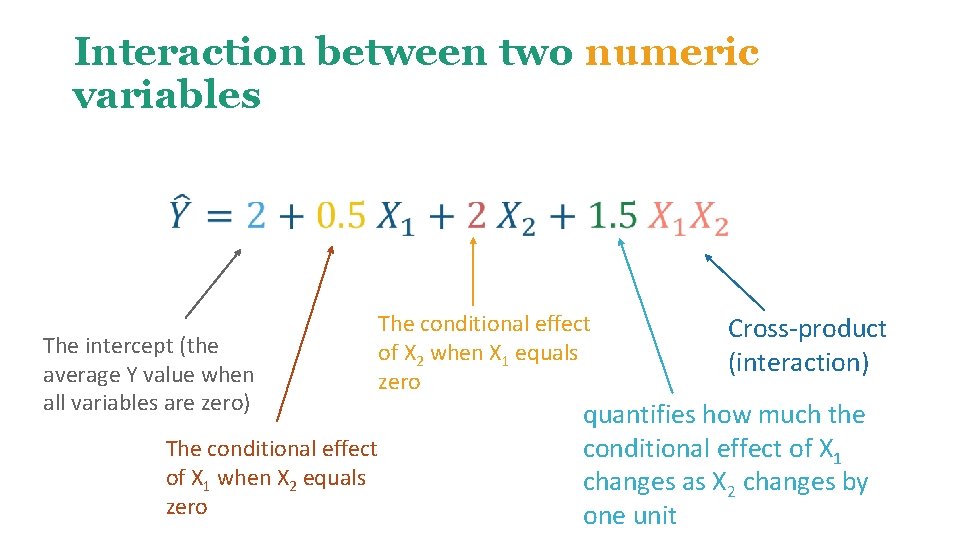
Interaction between two numeric variables The intercept (the average Y value when all variables are zero) The conditional effect of X 2 when X 1 equals zero The conditional effect of X 1 when X 2 equals zero Cross-product (interaction) quantifies how much the conditional effect of X 1 changes as X 2 changes by one unit
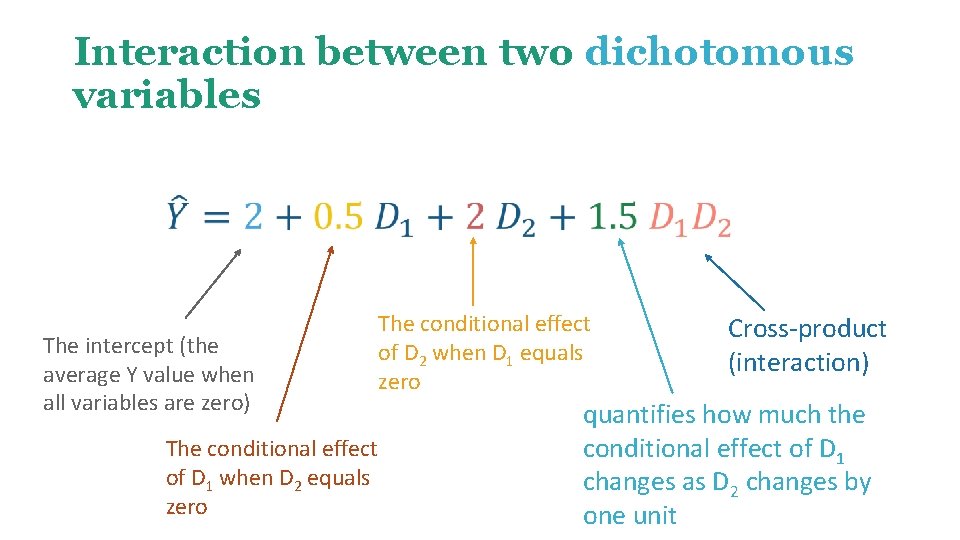
Interaction between two dichotomous variables The intercept (the average Y value when all variables are zero) The conditional effect of D 2 when D 1 equals zero The conditional effect of D 1 when D 2 equals zero Cross-product (interaction) quantifies how much the conditional effect of D 1 changes as D 2 changes by one unit
Recommendation: Always use a figure
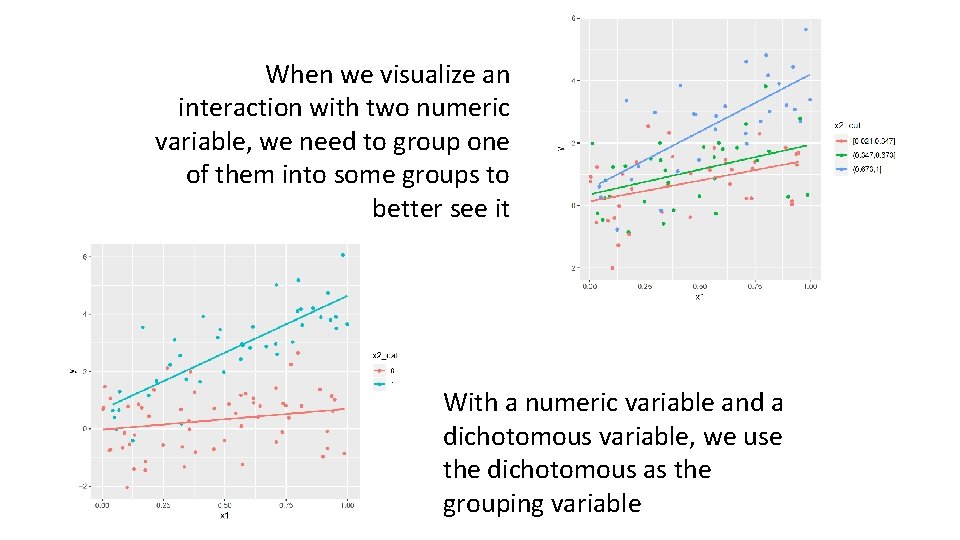
When we visualize an interaction with two numeric variable, we need to group one of them into some groups to better see it With a numeric variable and a dichotomous variable, we use the dichotomous as the grouping variable
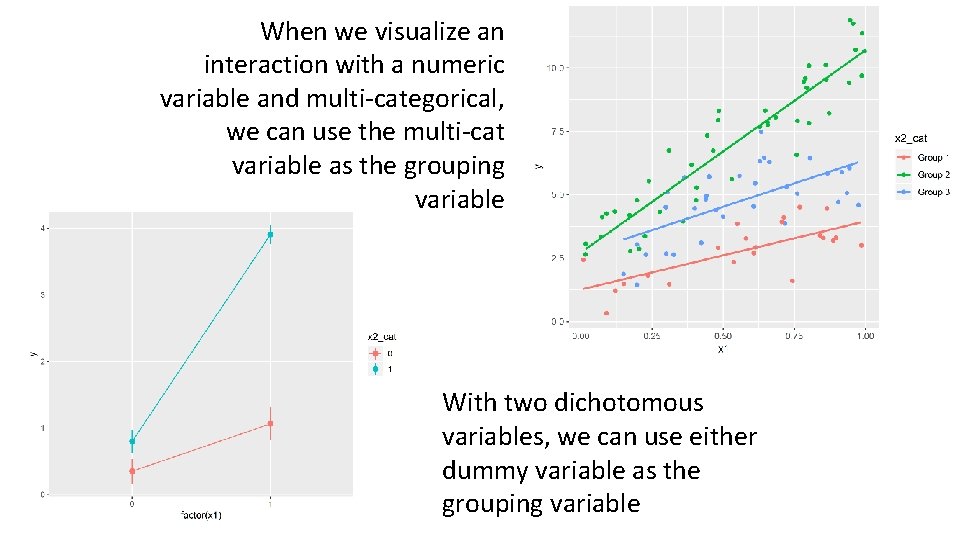
When we visualize an interaction with a numeric variable and multi-categorical, we can use the multi-cat variable as the grouping variable With two dichotomous variables, we can use either dummy variable as the grouping variable
Let’s Try an Example… You’ve been doing more binge-watching on Netflix and decide to analyze a dataset based on your new favorite show: Married at First Sight You decide to examine whether the length of these reality TV couples’ relationships (outcome) can be predicted by their age gap (predictor), and whether this effect is moderated by which “Love Expert” the couple worked with most often on the show Here we have a numerical variable predictor and dichotomous moderator
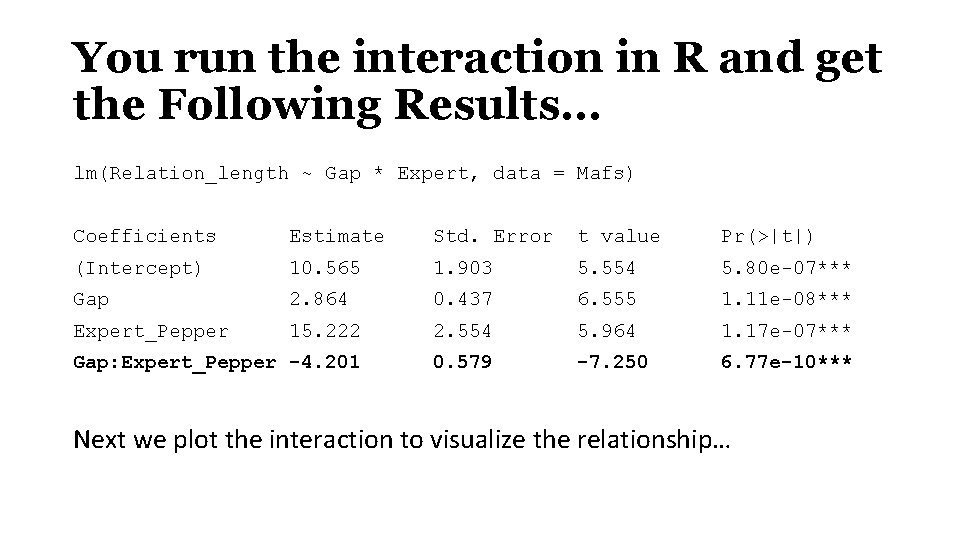
You run the interaction in R and get the Following Results… lm(Relation_length ~ Gap * Expert, data = Mafs) Coefficients Estimate Std. Error t value Pr(>|t|) (Intercept) 10. 565 1. 903 5. 554 5. 80 e-07*** Gap 2. 864 0. 437 6. 555 1. 11 e-08*** Expert_Pepper 15. 222 2. 554 5. 964 1. 17 e-07*** Gap: Expert_Pepper -4. 201 0. 579 -7. 250 6. 77 e-10*** Next we plot the interaction to visualize the relationship…
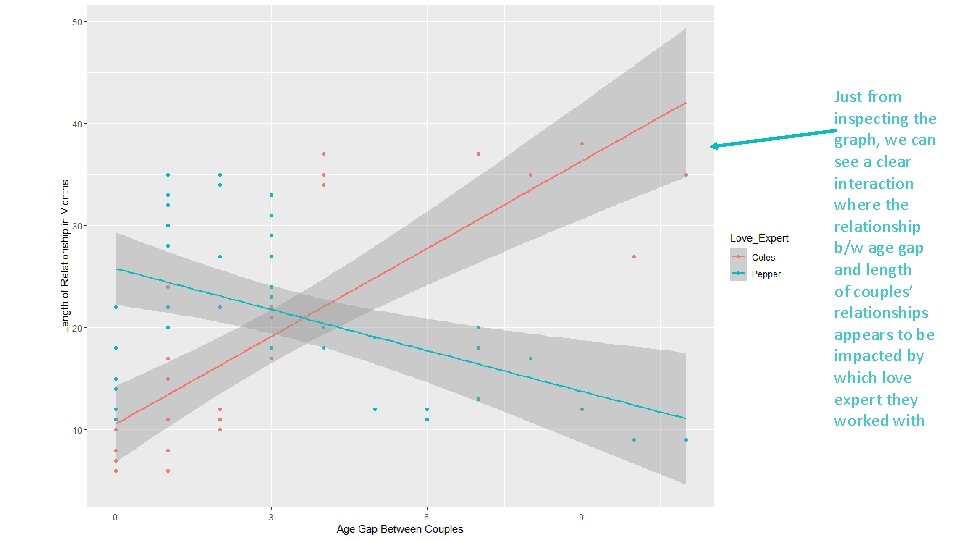
Just from inspecting the graph, we can see a clear interaction where the relationship b/w age gap and length of couples’ relationships appears to be impacted by which love expert they worked with
Interpretation Intercept: When couples work with Dr. Coles and have 0 years of age gap, their expected relationship duration is 10. 56 months Gap: For each one year increase in age gap, there is an associated 2. 86 month increase in relationship duration for couples who work with Dr. Coles Expert_Pepper: When there is no age gap and couples work with Dr. Pepper, the expected relationship duration is 15. 22 months higher than with Dr. Coles Interaction: The effect of age gap on the length of couples’ relationships decreases by 4. 20 months when couples’ work with Dr. Pepper compared to when they work with Dr. Coles In other words, age gap has differential associations with the length of couples’ relationships, depending on which “Love Expert” they worked with on the show
More about interpretation To make b 1 and b 2 more meaningful, we can shift the center of the predictor/moderator • E. g. , we can mean center the variables which makes b 1 and b 2 the effect of the predictor/moderator when the other is at its mean • This is the conditional effect of the variable at the other variable’s mean The conditional effect means the effect conditional on the other variable being a certain value
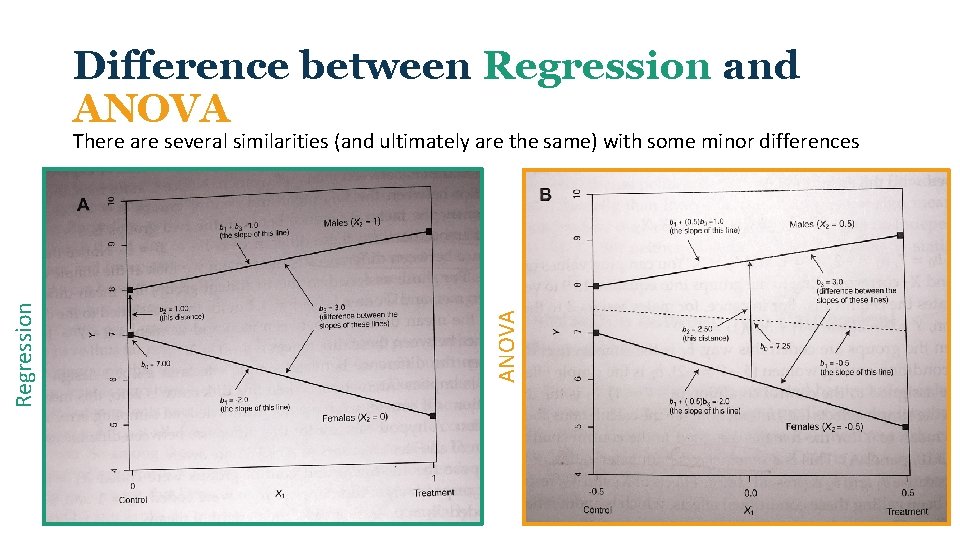
Difference between Regression and ANOVA Regression There are several similarities (and ultimately are the same) with some minor differences
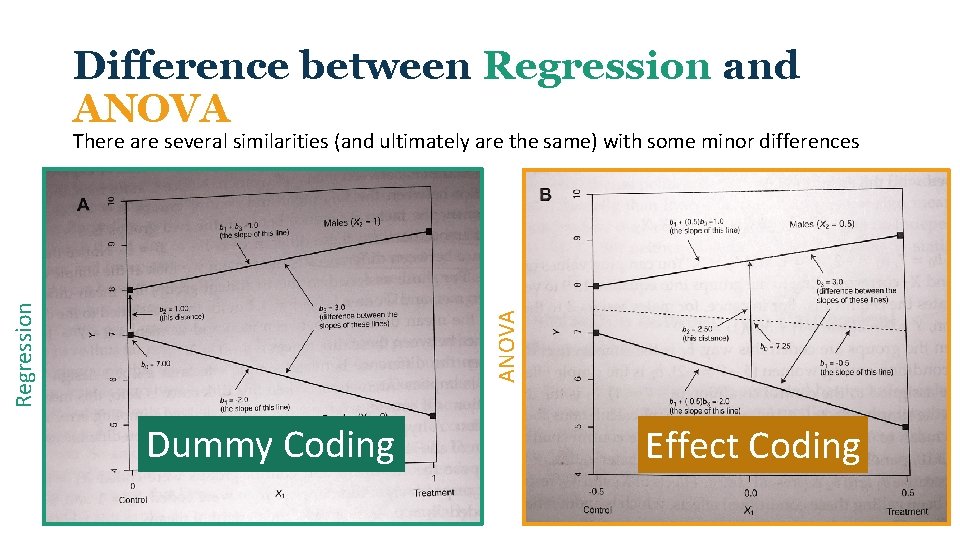
Difference between Regression and ANOVA Regression There are several similarities (and ultimately are the same) with some minor differences Dummy Coding Effect Coding
Probing an Interaction Lots of info, what to focus on? Lots of information we can glean from a model with an interaction • • But much of it relies on p-values and can get excessive Almost always, a figure can highlight all the important factors more easily, simply, and clearly • • A figure with some specific details is usually the best way to interpret it When you have two numeric variables interacting, using the Johnson-Neyman approach is great
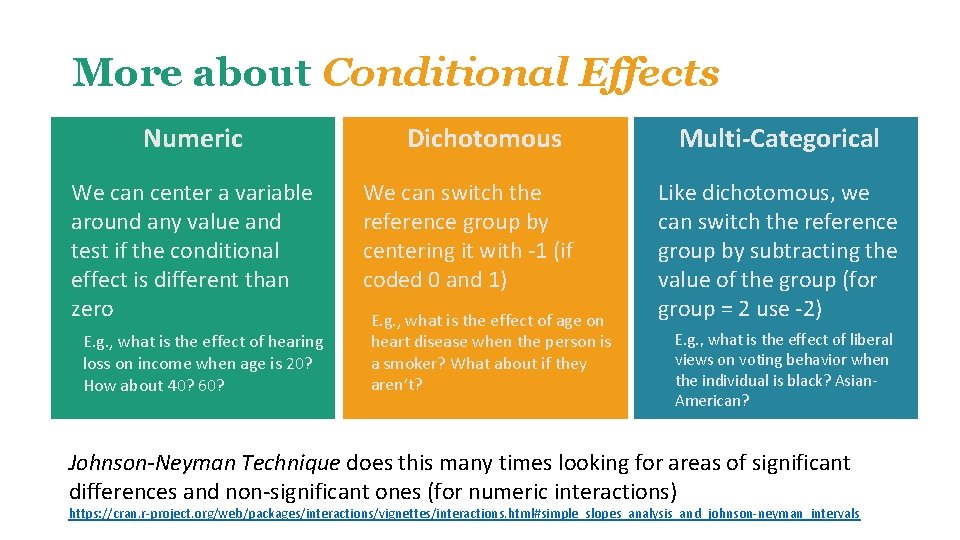
More about Conditional Effects Numeric We can center a variable around any value and test if the conditional effect is different than zero E. g. , what is the effect of hearing loss on income when age is 20? How about 40? 60? Dichotomous We can switch the reference group by centering it with -1 (if coded 0 and 1) E. g. , what is the effect of age on heart disease when the person is a smoker? What about if they aren’t? Multi-Categorical Like dichotomous, we can switch the reference group by subtracting the value of the group (for group = 2 use -2) E. g. , what is the effect of liberal views on voting behavior when the individual is black? Asian. American? Johnson-Neyman Technique does this many times looking for areas of significant differences and non-significant ones (for numeric interactions) https: //cran. r-project. org/web/packages/interactions/vignettes/interactions. html#simple_slopes_analysis_and_johnson-neyman_intervals
Issues with Detecting/Interpreting an Interactions are difficult to accurately detect • It is low powered • Easier to detect in experiments • • Is it curvilinear or interacting? Transformations of Y can greatly impact an interaction No “main effects” in model like in ANOVA Myths Get Busted (i. e. , the truth is stated below): • Don’t need to mean-center predictors in interaction • Don’t need to build model hierarchically • Don’t need to categorize variables in interaction
Read More Here! Interpreting Interaction Effects: https: //www. theanalysisfactor. com/interpreting-interactions-inregression/ Interactions between Categorical and Continuous Variables: https: //www. theanalysisfactor. com/interactions-categorical-andcontinuous-variables/ Simple Slopes Analysis and Johnson Neyman Intervals in R: https: //cran. rproject. org/web/packages/interactions/vignettes/interactions. html#si mple_slopes_analysis_and_johnson-neyman_intervals
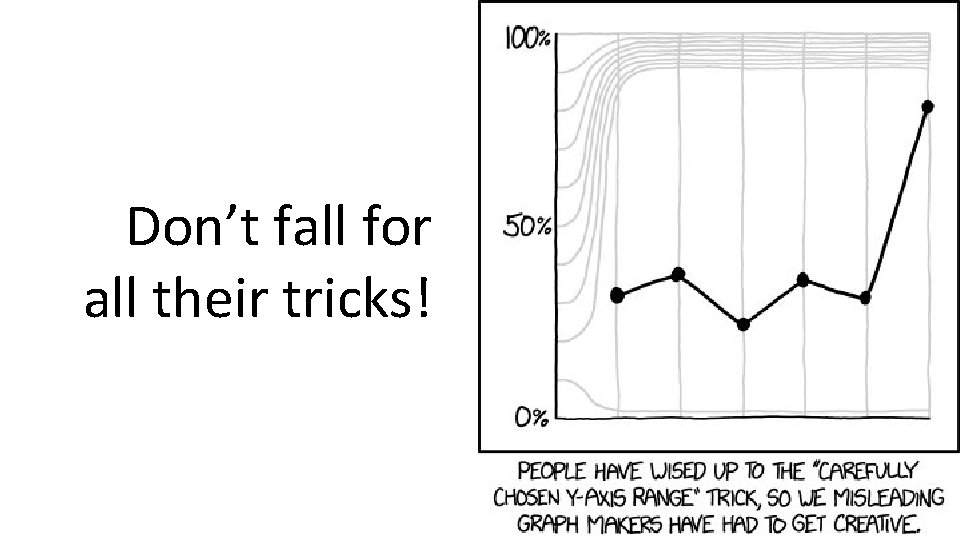
Don’t fall for all their tricks!

- Slides: 32