
EDTA Procedure for using EDTA to determine Ca
![Step 3 – Determination of [Ca 2+] • Prepare 4 more samples of your](https://slidetodoc.com/presentation_image_h2/8f132156527c6a4c233a04b3199ed1ae/image-5.jpg "Step 3 – Determination of [Ca 2+] • Prepare 4 more samples of your")
![Step 4 – Titrating to determine [Ca 2+] • Titrate one sample quickly to](https://slidetodoc.com/presentation_image_h2/8f132156527c6a4c233a04b3199ed1ae/image-6.jpg "Step 4 – Titrating to determine [Ca 2+] • Titrate one sample quickly to")
- Slides: 7
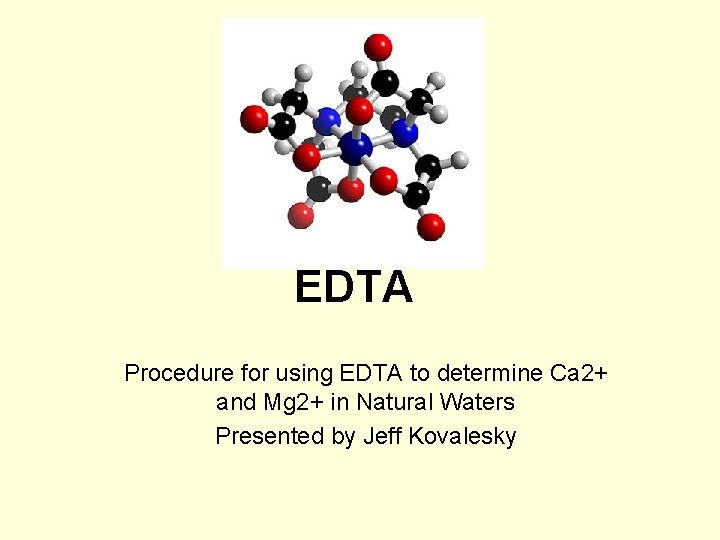
EDTA Procedure for using EDTA to determine Ca 2+ and Mg 2+ in Natural Waters Presented by Jeff Kovalesky
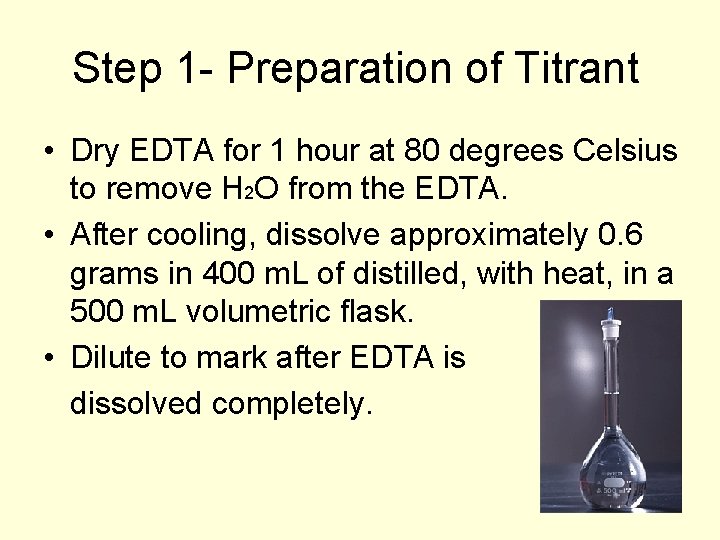
Step 1 - Preparation of Titrant • Dry EDTA for 1 hour at 80 degrees Celsius to remove H 2 O from the EDTA. • After cooling, dissolve approximately 0. 6 grams in 400 m. L of distilled, with heat, in a 500 m. L volumetric flask. • Dilute to mark after EDTA is dissolved completely.
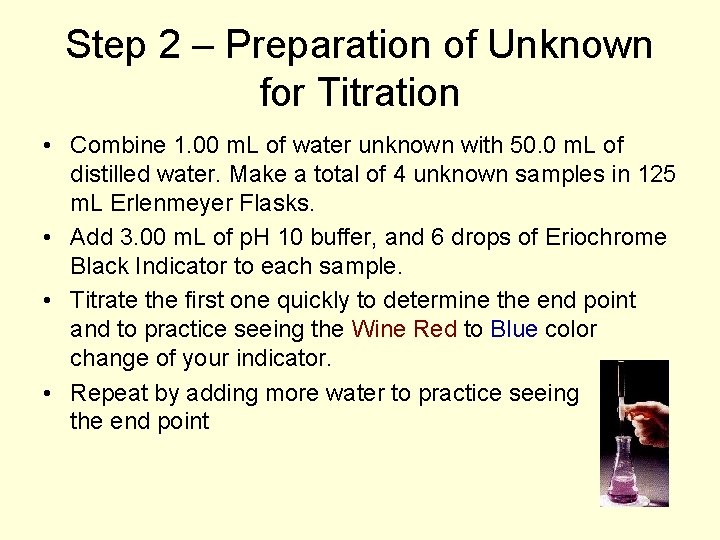
Step 2 – Preparation of Unknown for Titration • Combine 1. 00 m. L of water unknown with 50. 0 m. L of distilled water. Make a total of 4 unknown samples in 125 m. L Erlenmeyer Flasks. • Add 3. 00 m. L of p. H 10 buffer, and 6 drops of Eriochrome Black Indicator to each sample. • Titrate the first one quickly to determine the end point and to practice seeing the Wine Red to Blue color change of your indicator. • Repeat by adding more water to practice seeing the end point
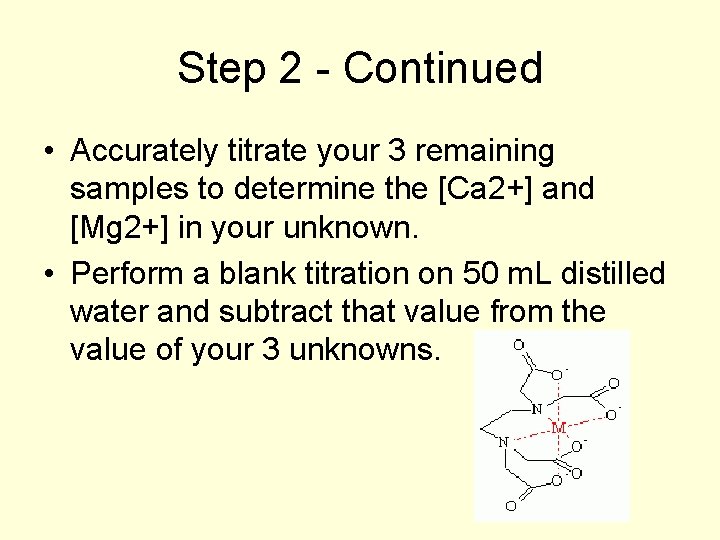
Step 2 - Continued • Accurately titrate your 3 remaining samples to determine the [Ca 2+] and [Mg 2+] in your unknown. • Perform a blank titration on 50 m. L distilled water and subtract that value from the value of your 3 unknowns.
Step 3 – Determination of [Ca 2+] • Prepare 4 more samples of your unknown by combining 1. 00 m. L of unknown with 50. 0 m. L distilled water. • This time, add 30 drops of 50 wt% Na. OH to precipitate Mg(OH)2 to each sample. • Add approximately 0. 1 grams of solid hydroxynapthol blue indicator to each sample. • Because we are preparing solutions with higher p. H levels, we must use this indicator because it remains blue at higher p. H levels.
Step 4 – Titrating to determine [Ca 2+] • Titrate one sample quickly to determine the approximate volume of your end point as well as practicing to see your color change of Red to Blue. • Carefully titrate 3 remaining samples. After reaching your end point, allow each sample to sit for 5 minutes with occasional swirling so that any Ca(OH)2 precipitate may redissolve. • If solution turns back to red, titrate back to blue end point. • Perform a blank on 50 m. L of water and subtract from values of 3 unknown samples.
Question? ? ? • Why was EDTA chosen over other chemicals as the titrant for this lab? • It works best to sequester di- and trivalent metal ions.