
EDRE 301 Assessment Task One Name Katia Mimikos
- Slides: 8
EDRE 301 Assessment Task One Name: Katia Mimikos Student number: S 00103858 Email: s 00103858@myacu. edu. au Course: Victoria Curriculum and Assessment Authority(VCAA): Religion and Society Study Design Unit: 2 - Ethics and Morality Area of study: 3 - Contemporary ethical issues in pluralist society Outcome: On completion of this unit the student should be able to analyse and evaluate two or more debates on contemporary ethical issues in pluralist society.
Resource One Activity Box Questions Students are asked to answer the questions in the activity box before discussion. This is a good way of introducing the topic by having the students brainstorm their own knowledge and views on the topic of marriage and family, before delving into the ethical issues related to marriage and family. With probing questions causing students to think about their views and the many different views held about this topic.
Resource Two Introduction to different types of marriages. http: //youtu. be/8 f. Jo. PI-xyt. M http: //youtu. be/b. Fq. ONTo. Bjy. M These are two clips from You. Tube demonstrating how married couples deal with ethical decisions such as their children's education and house financing. The comedic nature of the clips will help engage students in the topic as an introduction to how marriages have changed over time and how different marriages deal with ethical decisions. These clips will be followed by role plays from the students demonstrating how these stereotypical married couples handle other ethical decisions faced by married couples.
Resource Three Magazine Article: Housekeeping Monthly This is an article from a 1950’s housekeeping magazine with dot points of what a “good wife” should do for her husband. Some points students will be able to relate to as still relevant and others as irrelevant to a modern marriage. As students will have previously been looking at their own views on marriage and how marriages have changed over time this article will be a good way to sum up the changes in how married couples deal with ethical decisions.
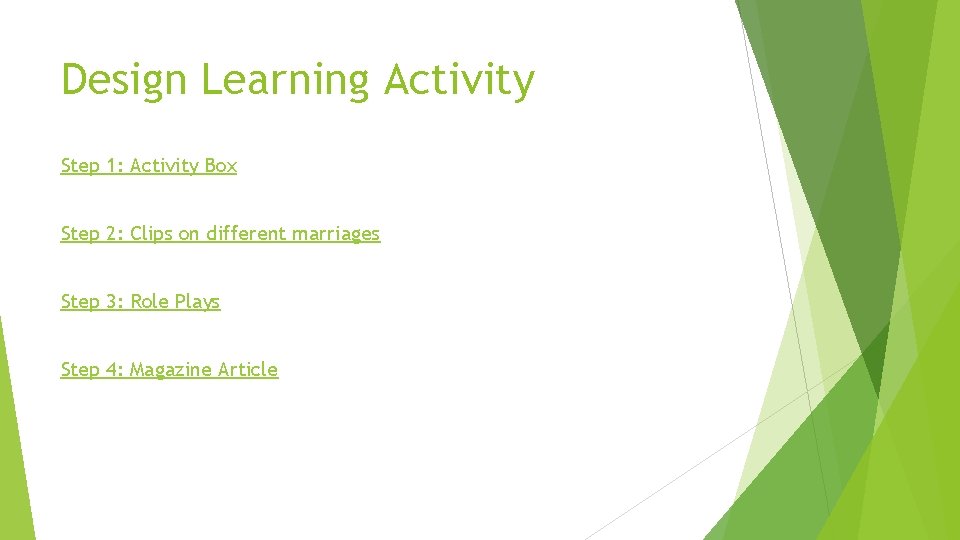
Design Learning Activity Step 1: Activity Box Step 2: Clips on different marriages Step 3: Role Plays Step 4: Magazine Article
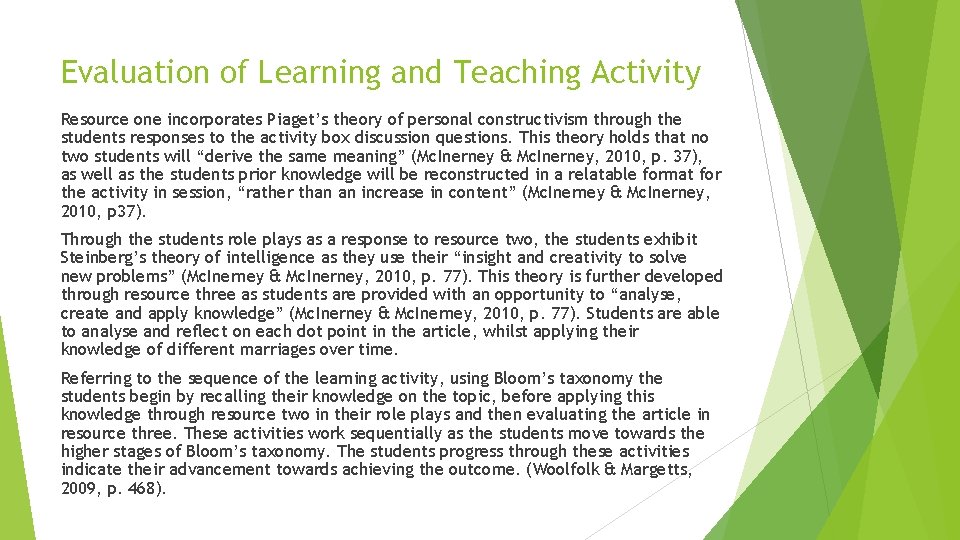
Evaluation of Learning and Teaching Activity Resource one incorporates Piaget’s theory of personal constructivism through the students responses to the activity box discussion questions. This theory holds that no two students will “derive the same meaning” (Mc. Inerney & Mc. Inerney, 2010, p. 37), as well as the students prior knowledge will be reconstructed in a relatable format for the activity in session, “rather than an increase in content” (Mc. Inerney & Mc. Inerney, 2010, p 37). Through the students role plays as a response to resource two, the students exhibit Steinberg’s theory of intelligence as they use their “insight and creativity to solve new problems” (Mc. Inerney & Mc. Inerney, 2010, p. 77). This theory is further developed through resource three as students are provided with an opportunity to “analyse, create and apply knowledge” (Mc. Inerney & Mc. Inerney, 2010, p. 77). Students are able to analyse and reflect on each dot point in the article, whilst applying their knowledge of different marriages over time. Referring to the sequence of the learning activity, using Bloom’s taxonomy the students begin by recalling their knowledge on the topic, before applying this knowledge through resource two in their role plays and then evaluating the article in resource three. These activities work sequentially as the students move towards the higher stages of Bloom’s taxonomy. The students progress through these activities indicate their advancement towards achieving the outcome. (Woolfolk & Margetts, 2009, p. 468).
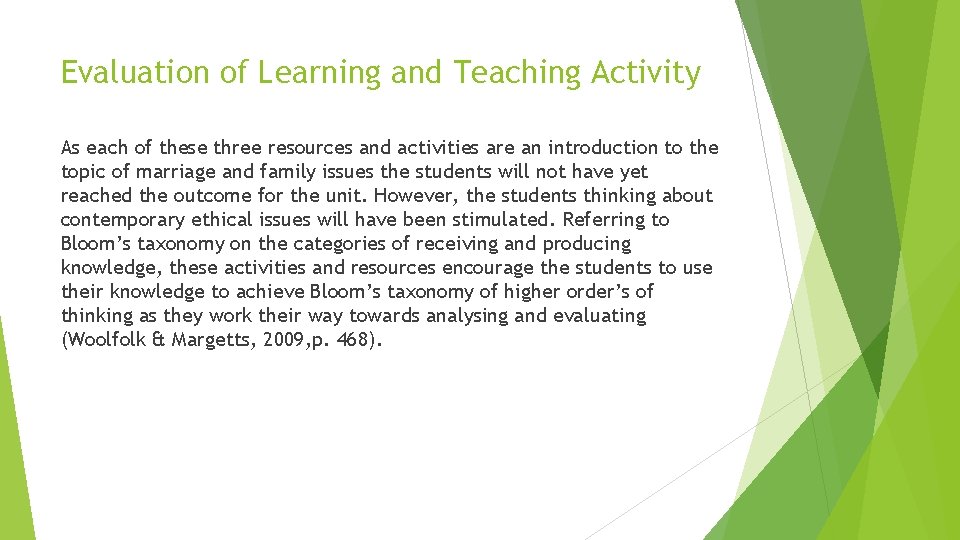
Evaluation of Learning and Teaching Activity As each of these three resources and activities are an introduction to the topic of marriage and family issues the students will not have yet reached the outcome for the unit. However, the students thinking about contemporary ethical issues will have been stimulated. Referring to Bloom’s taxonomy on the categories of receiving and producing knowledge, these activities and resources encourage the students to use their knowledge to achieve Bloom’s taxonomy of higher order’s of thinking as they work their way towards analysing and evaluating (Woolfolk & Margetts, 2009, p. 468).
Reference List Mc. Inerney, D. N. (2010). Educational Psychology: Constructing Learning. (5 th ed). Sydney: Prentice Hall. Woolfolk, A. E. (2009). Education Psychology. Frenchs Forest, NSW: Pearson Education Australia.