
EDNS 0 ClientSubnet for DNS based CDNs Matt
EDNS 0 Client-Subnet for DNS based CDNs Matt Jansen Akamai Technologies HKNOG 1, Hong Kong, September 1 st 2014
The Akamai Intelligent Platform The world’s largest on-demand, distributed computing platform delivers all forms of web content and applications The Akamai Intelligent Platform: 150, 000+ Servers 2, 000+ Locations 1, 200+ Networks 700+ Cities 92 Countries Typical daily traffic: • More than 2 trillion requests served • Delivering over 21 Terabits/second • 15 -30% of all daily web traffic © 2012 AKAMAI | FASTER FORWARDTM
How CDNs Work When content is requested from CDNs, the user is directed to the optimal server to serve this user There’s 2 common ways to do that: • anycast: the content is served from the location the request is received (easy to build, requires symmetric routing to work well) • DNS based: the CDN decides where to best serve the content from based on the resolver it receives the request from, and replies with the optimal server © 2012 AKAMAI | FASTER FORWARDTM
How DNS based CDNs Work Users querying a DNS-based CDNs will be returned different A (and AAAA) records for the same hostname depending on the resolver the request comes from This is called “mapping” The better the mapping, the better the CDN © 2012 AKAMAI | FASTER FORWARDTM
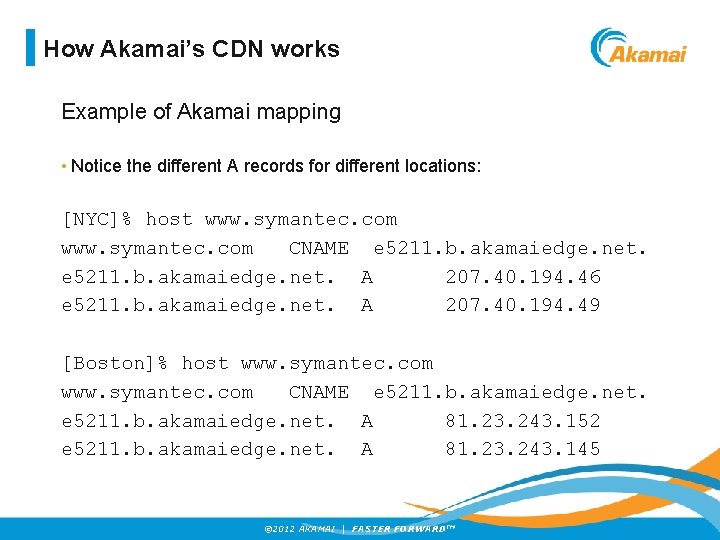
How Akamai’s CDN works Example of Akamai mapping • Notice the different A records for different locations: [NYC]% host www. symantec. com CNAME e 5211. b. akamaiedge. net. A 207. 40. 194. 46 e 5211. b. akamaiedge. net. A 207. 40. 194. 49 [Boston]% host www. symantec. com CNAME e 5211. b. akamaiedge. net. A 81. 23. 243. 152 e 5211. b. akamaiedge. net. A 81. 23. 243. 145 © 2012 AKAMAI | FASTER FORWARDTM
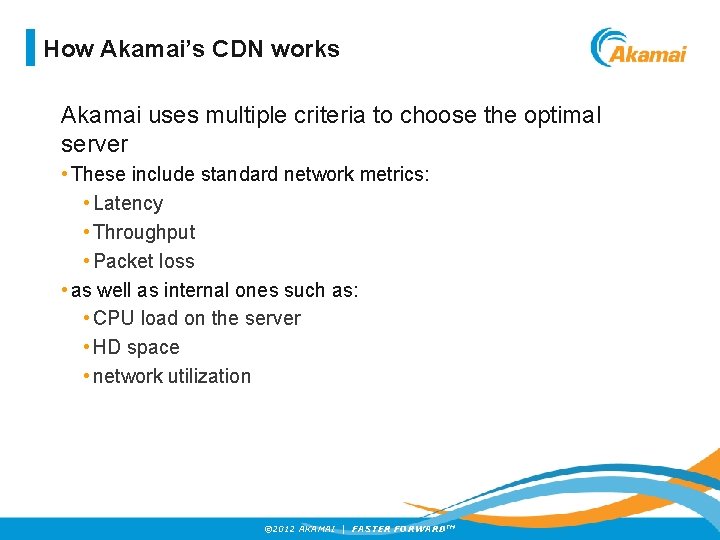
How Akamai’s CDN works Akamai uses multiple criteria to choose the optimal server • These include standard network metrics: • Latency • Throughput • Packet loss • as well as internal ones such as: • CPU load on the server • HD space • network utilization © 2012 AKAMAI | FASTER FORWARDTM
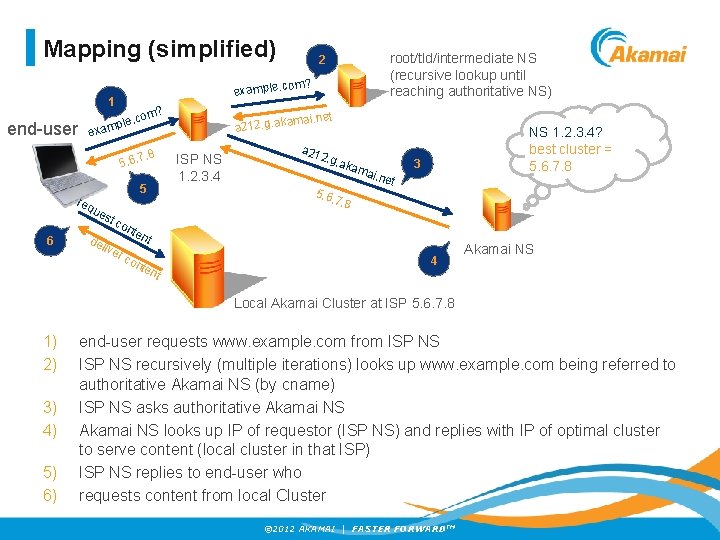
Mapping (simplified) o example. c 1 end-user om? c. e l p exam. 8 7 5. 6. req 6 5 ue de st co live root/tld/intermediate NS (recursive lookup until reaching authoritative NS) 2 m? amai. net a 212. g. ak ISP NS 1. 2. 3. 4 a 21 2. g. 5. 6. aka mai . net NS 1. 2. 3. 4? best cluster = 5. 6. 7. 8 3 7. 8 nte rc nt on ten t 4 Akamai NS Local Akamai Cluster at ISP 5. 6. 7. 8 1) 2) 3) 4) 5) 6) end-user requests www. example. com from ISP NS recursively (multiple iterations) looks up www. example. com being referred to authoritative Akamai NS (by cname) ISP NS asks authoritative Akamai NS looks up IP of requestor (ISP NS) and replies with IP of optimal cluster to serve content (local cluster in that ISP) ISP NS replies to end-user who requests content from local Cluster © 2012 AKAMAI | FASTER FORWARDTM

The Problem: 3 rd Party DNS servers All of this works very well if the end-user used their provider’s DNS servers. However if the end-user is making use of a 3 rd party DNS service like • Google DNS (28 locations worldwide) https: //developers. google. com/speed/public-dns/faq#locations • Open. DNS (20 locations worldwide) http: //www. opendns. com/network-map/ a DNS-based CDN does not know which network the request originated from, and can therefore in the best case serve it in the rough geographic area © 2012 AKAMAI | FASTER FORWARDTM
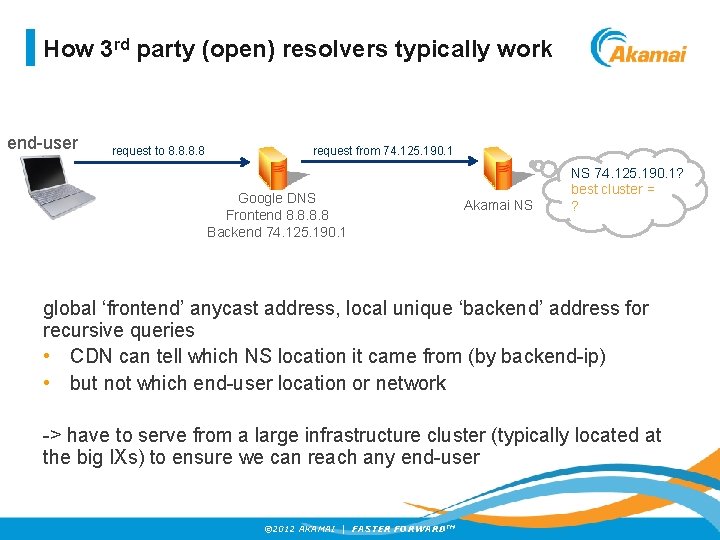
How 3 rd party (open) resolvers typically work end-user request to 8. 8 request from 74. 125. 190. 1 Google DNS Frontend 8. 8 Backend 74. 125. 190. 1 Akamai NS NS 74. 125. 190. 1? best cluster = ? global ‘frontend’ anycast address, local unique ‘backend’ address for recursive queries • CDN can tell which NS location it came from (by backend-ip) • but not which end-user location or network -> have to serve from a large infrastructure cluster (typically located at the big IXs) to ensure we can reach any end-user © 2012 AKAMAI | FASTER FORWARDTM
Use of 3 rd party DNS servers relatively small numbers in most countries with a mature internet ecosystem: USA, Germany, Netherlands, Singapore: less than 1% but very high percentage of users in developing countries and/or countries performing some form of DNS-based web-filtering: Turkey: 22%, Indonesia: 22%, Bangladesh: 25% Hong Kong: 2% © 2012 AKAMAI | FASTER FORWARDTM
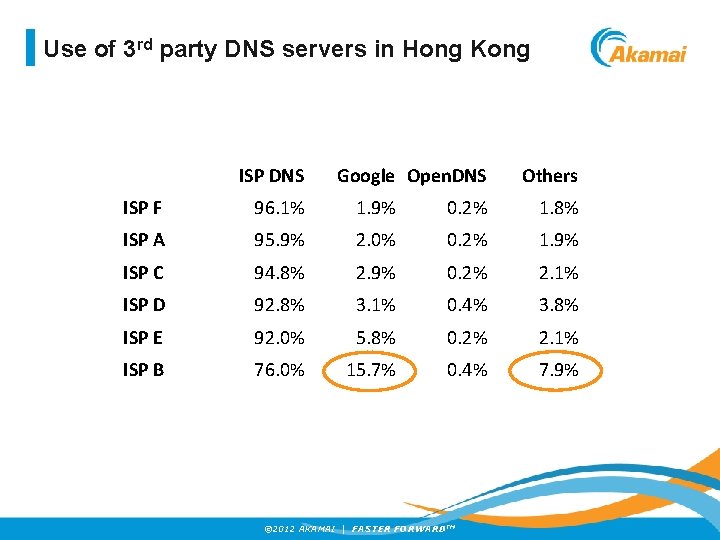
Use of 3 rd party DNS servers in Hong Kong ISP DNS Google Open. DNS Others ISP F 96. 1% 1. 9% 0. 2% 1. 8% ISP A 95. 9% 2. 0% 0. 2% 1. 9% ISP C 94. 8% 2. 9% 0. 2% 2. 1% ISP D 92. 8% 3. 1% 0. 4% 3. 8% ISP E 92. 0% 5. 8% 0. 2% 2. 1% ISP B 76. 0% 15. 7% 0. 4% 7. 9% © 2012 AKAMAI | FASTER FORWARDTM
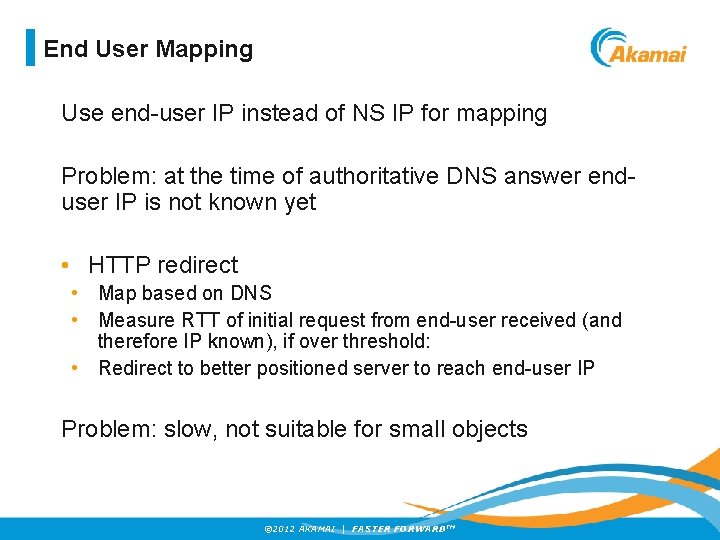
End User Mapping Use end-user IP instead of NS IP for mapping Problem: at the time of authoritative DNS answer enduser IP is not known yet • HTTP redirect • Map based on DNS • Measure RTT of initial request from end-user received (and therefore IP known), if over threshold: • Redirect to better positioned server to reach end-user IP Problem: slow, not suitable for small objects © 2012 AKAMAI | FASTER FORWARDTM
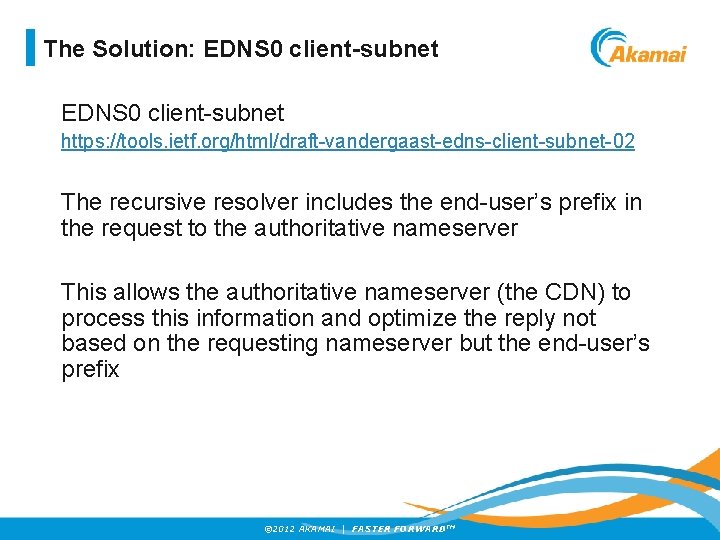
The Solution: EDNS 0 client-subnet https: //tools. ietf. org/html/draft-vandergaast-edns-client-subnet-02 The recursive resolver includes the end-user’s prefix in the request to the authoritative nameserver This allows the authoritative nameserver (the CDN) to process this information and optimize the reply not based on the requesting nameserver but the end-user’s prefix © 2012 AKAMAI | FASTER FORWARDTM
The Solution: EDNS 0 client-subnet • Open standard (draft) • Has to be supported by recursive resolver (3 rd Party DNS) • and by Authoritative NS (CDN) • Privacy: only prefix, not full address transmitted © 2012 AKAMAI | FASTER FORWARDTM
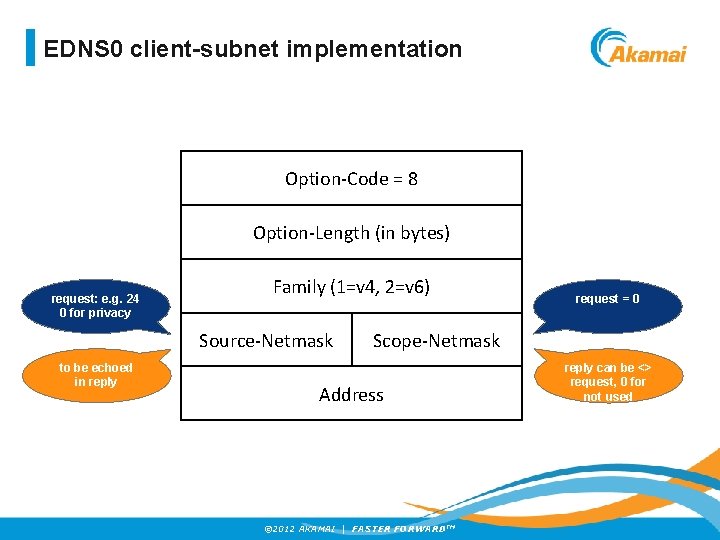
EDNS 0 client-subnet implementation Option-Code = 8 Option-Length (in bytes) request: e. g. 24 0 for privacy Family (1=v 4, 2=v 6) Source-Netmask to be echoed in reply request = 0 Scope-Netmask Address © 2012 AKAMAI | FASTER FORWARDTM reply can be <> request, 0 for not used

Mapping (EDNS 0) 2 ? om example. c 1 root/tld/intermediate NS (recursive lookup until reaching authoritative NS) om? amai. net a 212. g. ak a 2 12 clie. g. aka nt-s m ubn ai. net 7. 8 Google NS et=1 5. 6. . 1. 1 8. 8. 0/2 4 5 5. 6. 7. 8 e. c end-user exampl req ue de 6 st co live NS 8. 8 (whitelisted for edns 0) client subnet=1. 1. 1. 0/24 best cluster = 5. 6. 7. 8 3 nte rc nt on ten t 4 Akamai NS Local Akamai Cluster at ISP 5. 6. 7. 8 1) 2) 3) 4) 5) 6) end-user requests www. example. com from Google NS recursively looks up www. example. com being referred to authoritative Akamai NS (by cname) Google NS asks Akamai NS including client-subnet Akamai NS looks up client-subnet and replies with IP of optimal cluster to serve content (local cluster in that ISP) ISP NS replies to end-user who requests content from local Cluster © 2012 AKAMAI | FASTER FORWARDTM
Privacy concerns Only prefix, not full IP transmitted CDN already gets your full IP anyways (in the subsequent HTTP request) Set source-netmask/address to 0. 0/0 • Google DNS honors forwards request with 0. 0/0 • Open. DNS ignores at time of writing Do not use client-subnet capable resolver if intention is to hide client origin © 2012 AKAMAI | FASTER FORWARDTM
Security concerns Scanning/walking the mapping algorithm • double whitelist (at recursive resolver & auth NS) • enforced replacement of client-tagged edns 0 option by Google & Open. DNS before being send to Akamai Amplification • double whitelist • echoing request in reply • standard rate limiting methods work Cache pollution of recursive resolver can be a problem • separate reply stored for each prefix © 2012 AKAMAI | FASTER FORWARDTM
Prefix-Length Google/Open. DNS currently always send client-subnet as /24 (for privacy/caching-efficiency reasons) Mapping system has view of internet from it’s partners with differing prefix-lenghts • client-subnet more specific than Akamai • e. g. Akamai has /20 from partner-> can be mapped • scope-netmask send to resolver for caching purposes • client-subnet less specific than Akamai • e. g. Akamai has /26 s from partner in different locations -> no clear choice to map -> will take first match • also send scope-netmask to resolver for information © 2012 AKAMAI | FASTER FORWARDTM
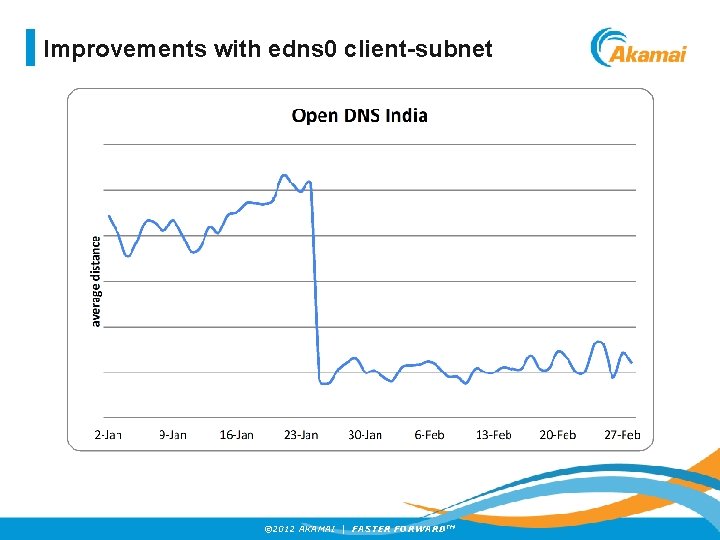
Improvements with edns 0 client-subnet © 2012 AKAMAI | FASTER FORWARDTM
Additional Use-Case can be used within a partner’s network instead of distributed DNS architecture A partner might have a widespread network (especially in countries spanning large geographical areas and/or different islands like Australia or Indonesia) • Would like to deploy clusters around the network to localize traffic • But central DNS infrastructure makes mapping traffic accurately difficult © 2012 AKAMAI | FASTER FORWARDTM
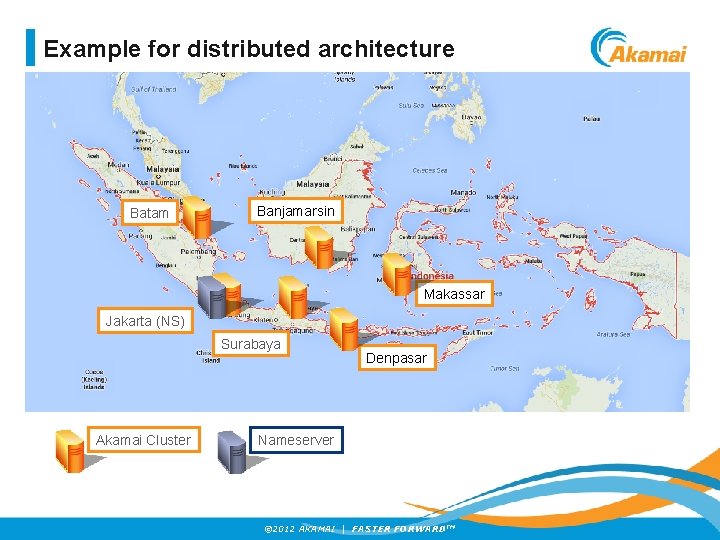
Example for distributed architecture Batam Banjamarsin Makassar Jakarta (NS) Surabaya Akamai Cluster Denpasar Nameserver © 2012 AKAMAI | FASTER FORWARDTM
Solutions Deploy additional NS in all locations • Benefit: better DNS responses, can use anycast frontend IP to simplify administration/failover (announcing same frontend IP to all end-users) • Drawback: some additional CAPEX & support-costs Virtual IPs on existing NS given to different geographic sets of end-users • Benefit: no additional CAPEX, easy to implement • Drawback: more difficult to administer, will require manual allocation of IPs to clusters on CDN side, no clear fallback EDNS 0 client-subnet within the providers network • Benefit: no additional CAPEX, only software change on the NS, can dynamically adapt by changing announcements, can scale for very small clusters in remote places • Drawback: needs compatible NS software © 2012 AKAMAI | FASTER FORWARDTM
Questions? Matt Jansen mj@akamai. com © 2012 AKAMAI | FASTER FORWARDTM
- Slides: 24