
Editorial Independence EI Public Accountability PA in Public
Editorial Independence (EI) & Public Accountability (PA) in Public Broadcasting Service: Editorial Policies at SABC Guy Berger
Covering: 1. 2. 3. 4. 5. Fundamental tension of PBS Analysing EI and PA SABC editorial policy & process Some hitches Proof of pudding.
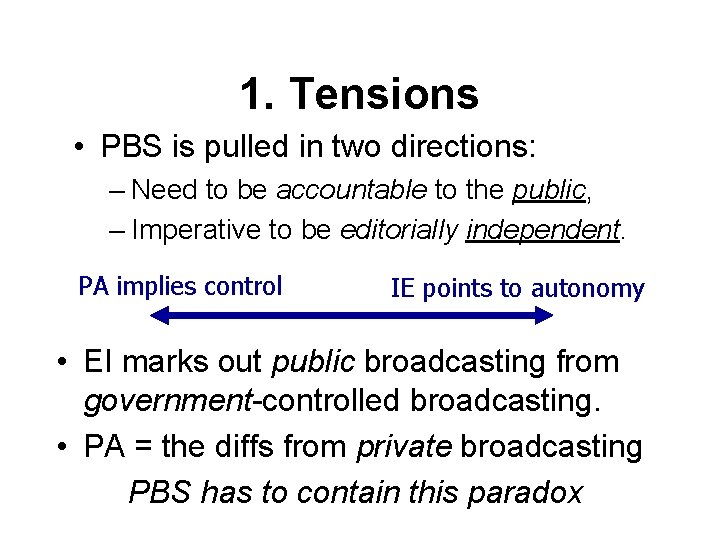
1. Tensions • PBS is pulled in two directions: – Need to be accountable to the public, – Imperative to be editorially independent. PA implies control IE points to autonomy • EI marks out public broadcasting from government-controlled broadcasting. • PA = the diffs from private broadcasting PBS has to contain this paradox
2. Threats & outcomes • Governments want to see more “accountability” – UK (BBC) and SA • Challenge is to preserve EI • SABC case: define what is meant by EI, and how to ensure internal PA. • = Editorial Policies and Processes. • EI = “what of PBS”; PA = “how” – Note: the “how” can undermine the “what”.
3. Editorial Independence • Autonomy from: – Owners and managers – Profit imperatives (even if not market) – Even, to an extent, from Editors – Especially from sources • BUT: EI ≠ licence! • EI ≠ independence from j. ethics & stds. • EI ≠ from public service (language, etc)
4. Public Accountability • • Laws, charters … therefore Courts representative public board independent regulator complaints systems with teeth advisory boards & public meetings listener/viewer groups What about internal systems?
5. SA background Was govt tool under apartheid, now PBS Pre 2002: • SABC legally enjoys EI, legislated Charter says: - “freedom of expression & journalistic, creative & programming independence” - “SABC is not the mouthpiece of the government” • SABC board appointed by Parliament • Board accounts to Regulator & Parliament Yet, SAfns felt it is not enough!
6. SA experience • 2002: SABC accused of doing its own thing: – Govt: content causing currency collapse – Civil soc: commercialised; lacking languages. • Minister declares: Editorial Policies needed, she will decide. • After outcry, incl by SABC, parliament rules: – Policies to be developed via public process – Regulator to approve & hold SABC to account.
7. Draft policy & process – ’ 03 • Policies give substance to EI through guidelines on: programming, news, language, education, universal service and access, local content, and religion. • i. e. They spell out public service & journ ethics. • Process: “Upward referral” to ensure internal accountability • Consultation: Distributed, publicised, meetings. • 920 inputs – tho’ unclear how processed.
8. Final system – April 04 • Policy: Good words, but interpretation is key; – hence qtn of accountability, i. e. control, is nb. • Process: upward referral: – Mandatory: select issues (eg. hidden camera) – “Voluntary”: content that is controversial, or likely to have an extraordinary impact. • Claim: "not intended to shift editorial-decision making upwards" • Improved from draft version, but could still compromise EI and stifle swift reaction.
9. Power/responsibility: who has final say? • Policies make CEO the “Editor-in-chief”. • Claim: good for BBC = good for us . • BUT: BBC = DG (civil servant), not CEO (businessman) – a CEO has to make money! • Possible conflict of interests in one individual: – chasing elite audiences to attract adverts – allowing product placement – avoiding upsets of specific advertisers
10. Prognosis • SABC system could fend off political & business control, defend space of PBS. • Dangers: – Legitimated showpiece (white elephant), – Selective/patchy implementation – Ignorance among staff and public – Poor/absent monitoring & review (uneven provisions in the policy document) • Development: now detailed license conditions
11. Conclusion • EI and PA = inherent tension • Editorial policies & processes can help to define a balance. • SABC has hitches, but at least has a system that is explicit, & not arbitrary. • Ideally, should constitute “rule of law” for all. • Board should require staff know & respect it. • Success hangs on external accountability esp by those in whose name PBS operates.
The policies will succeed if they are kept alive in public memory, So: people need to be continuously refreshed on what they can expect from their public broadcaster. Thank you

- Slides: 15