
Editing and Proofreading What to look for when
- Slides: 16
Editing and Proofreading What to look for when editing and proofreading your writing
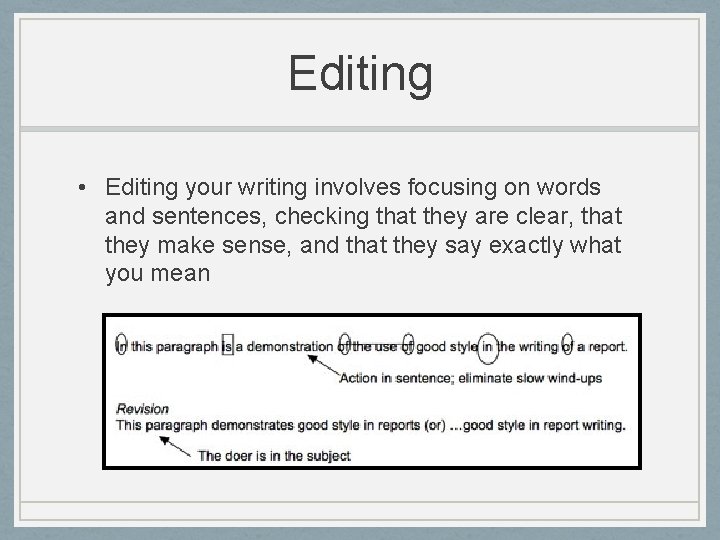
Editing • Editing your writing involves focusing on words and sentences, checking that they are clear, that they make sense, and that they say exactly what you mean
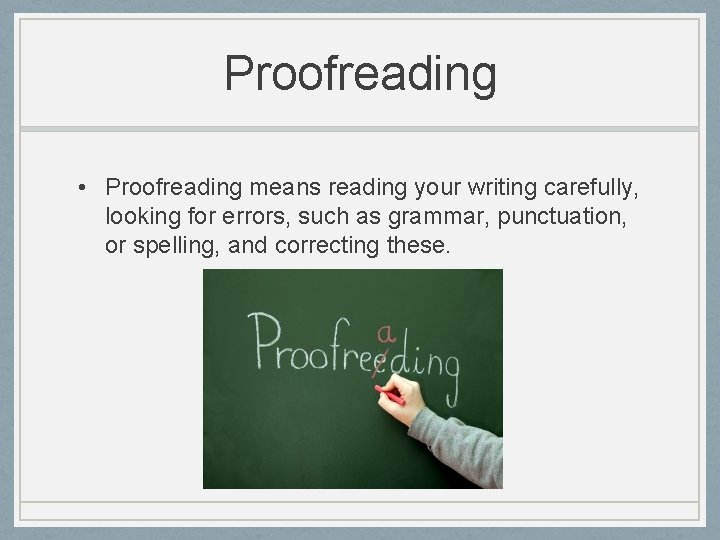
Proofreading • Proofreading means reading your writing carefully, looking for errors, such as grammar, punctuation, or spelling, and correcting these.
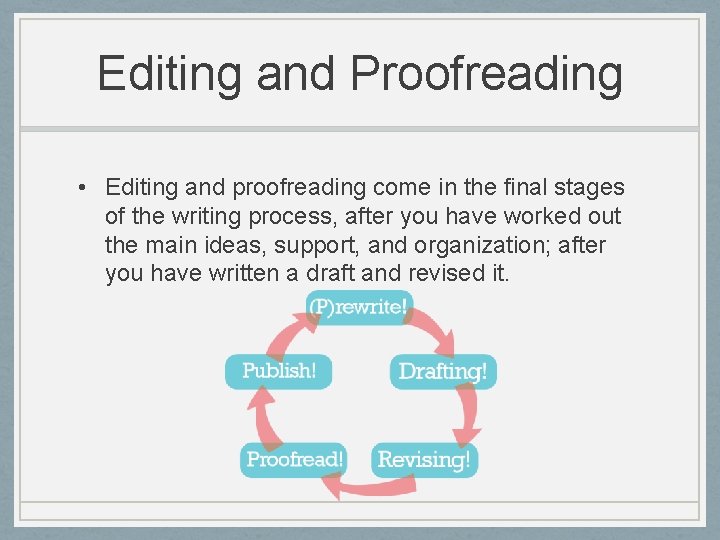
Editing and Proofreading • Editing and proofreading come in the final stages of the writing process, after you have worked out the main ideas, support, and organization; after you have written a draft and revised it.
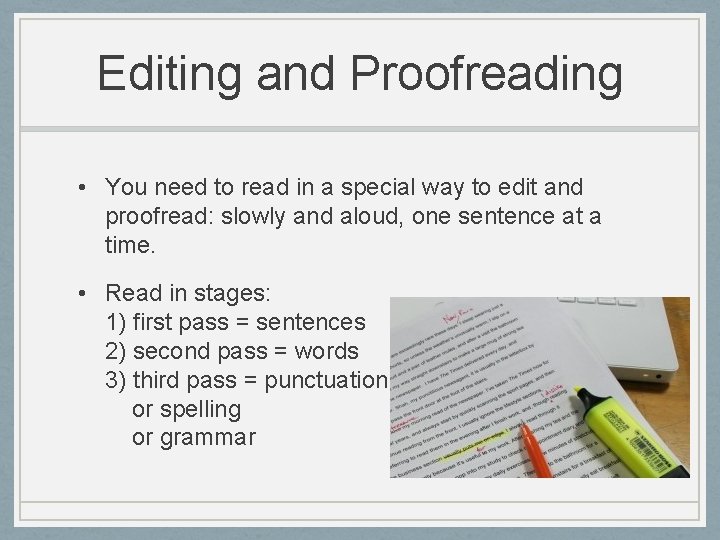
Editing and Proofreading • You need to read in a special way to edit and proofread: slowly and aloud, one sentence at a time. • Read in stages: 1) first pass = sentences 2) second pass = words 3) third pass = punctuation or spelling or grammar
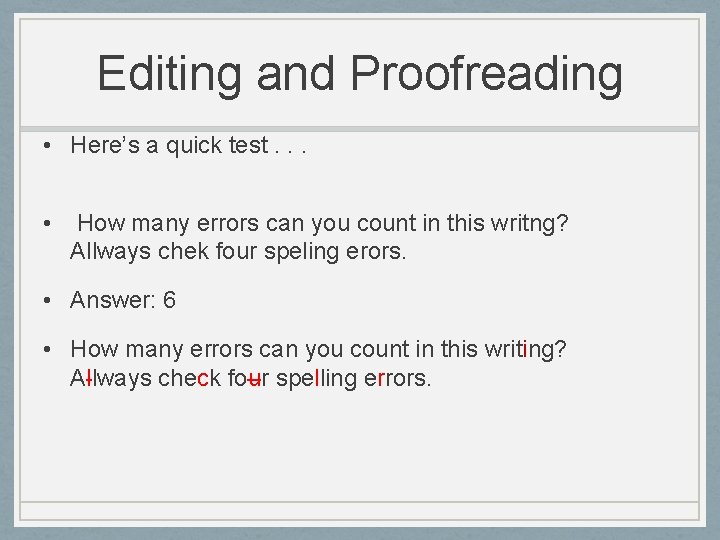
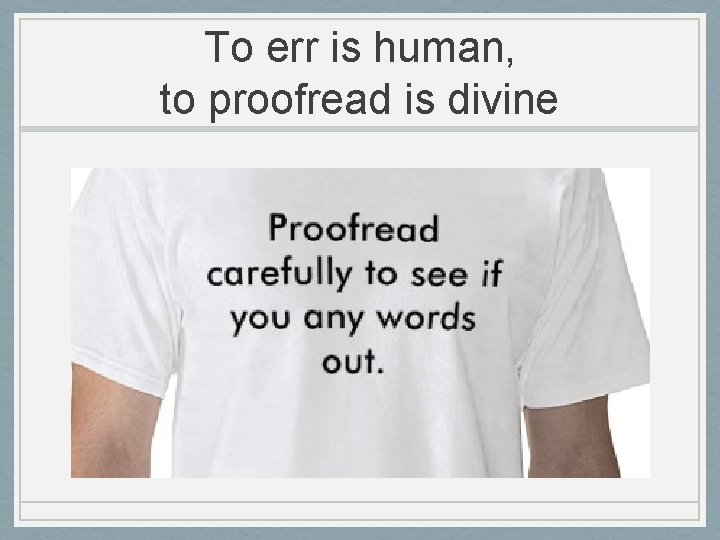
Editing and Proofreading • Here’s a quick test. . . • How many errors can you count in this writng? Allways chek four speling erors. • Answer: 6 • How many errors can you count in this writing? Allways check four spelling errors.
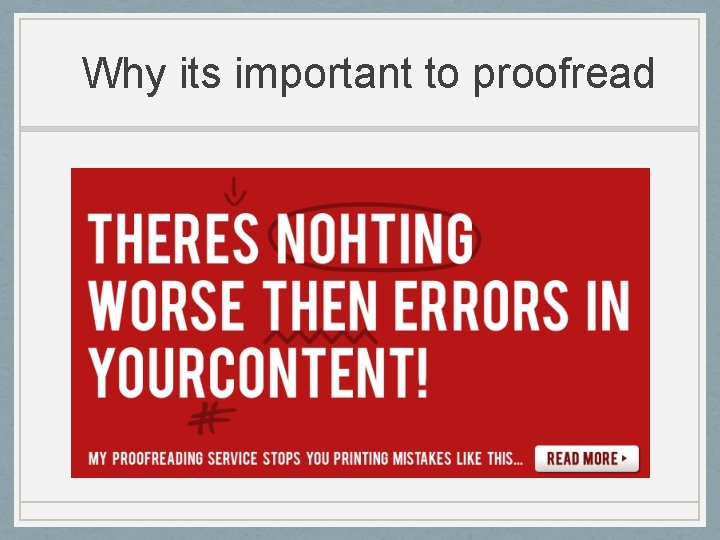
Why its important to proofread
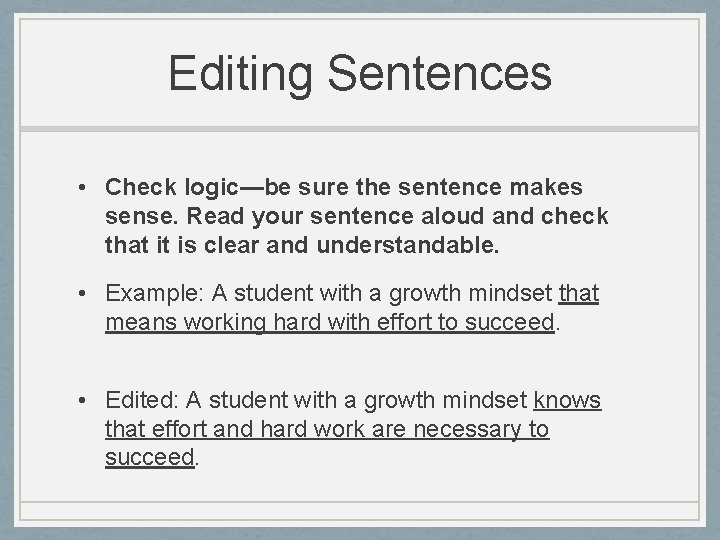
Editing Sentences • Check logic—be sure the sentence makes sense. Read your sentence aloud and check that it is clear and understandable. • Example: A student with a growth mindset that means working hard with effort to succeed. • Edited: A student with a growth mindset knows that effort and hard work are necessary to succeed.
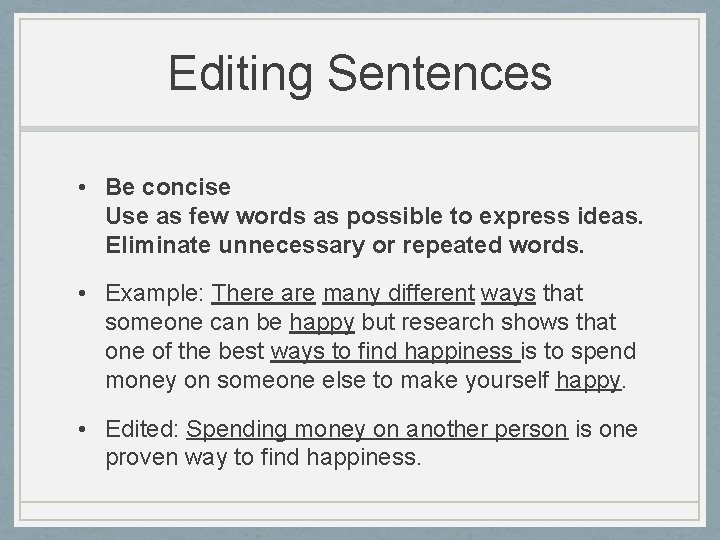
Editing Sentences • Be concise Use as few words as possible to express ideas. Eliminate unnecessary or repeated words. • Example: There are many different ways that someone can be happy but research shows that one of the best ways to find happiness is to spend money on someone else to make yourself happy. • Edited: Spending money on another person is one proven way to find happiness.
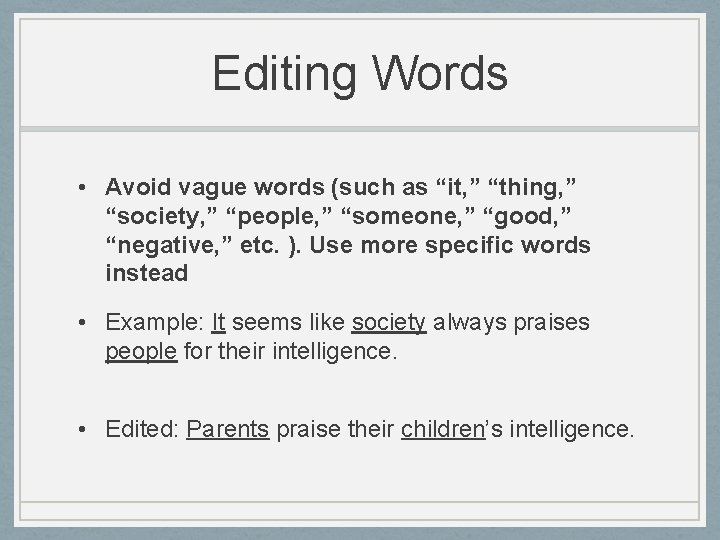
Editing Words • Avoid vague words (such as “it, ” “thing, ” “society, ” “people, ” “someone, ” “good, ” “negative, ” etc. ). Use more specific words instead • Example: It seems like society always praises people for their intelligence. • Edited: Parents praise their children’s intelligence.
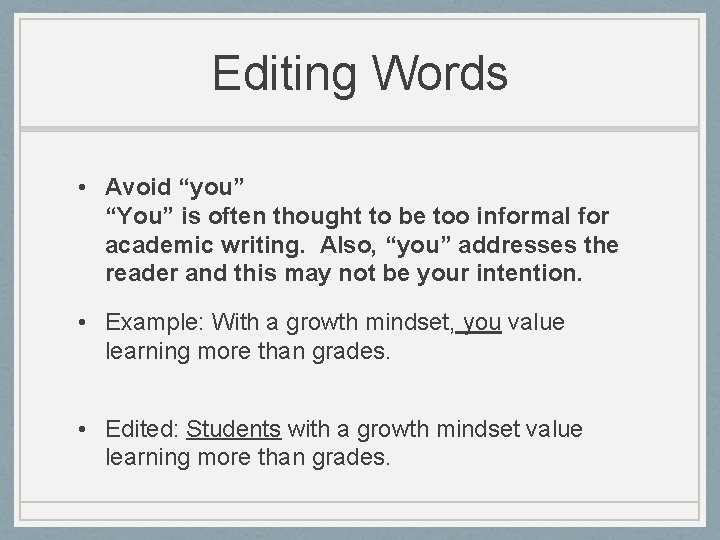
Editing Words • Avoid “you” “You” is often thought to be too informal for academic writing. Also, “you” addresses the reader and this may not be your intention. • Example: With a growth mindset, you value learning more than grades. • Edited: Students with a growth mindset value learning more than grades.
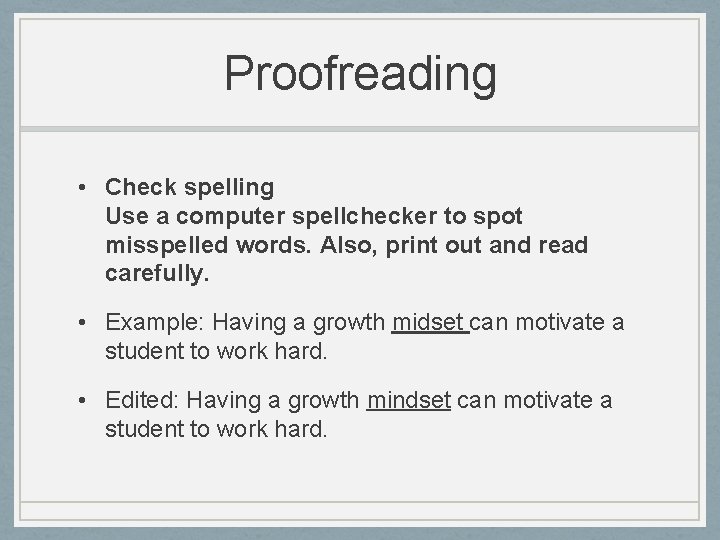
Proofreading • Check spelling Use a computer spellchecker to spot misspelled words. Also, print out and read carefully. • Example: Having a growth midset can motivate a student to work hard. • Edited: Having a growth mindset can motivate a student to work hard.
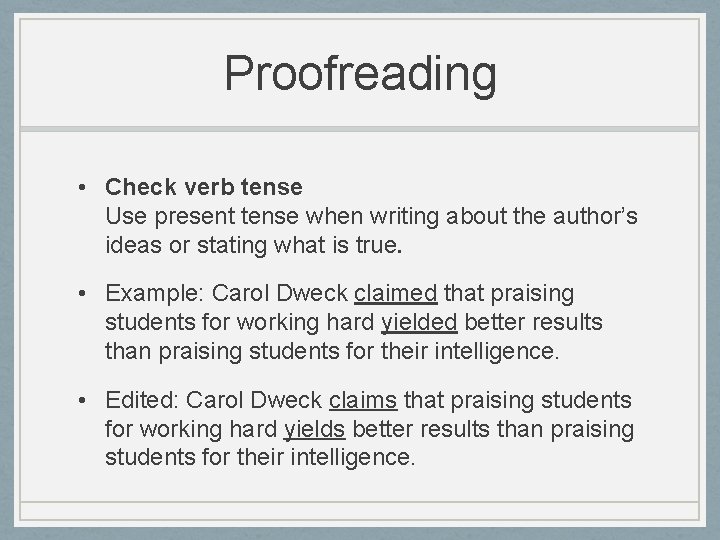
Proofreading • Check verb tense Use present tense when writing about the author’s ideas or stating what is true. • Example: Carol Dweck claimed that praising students for working hard yielded better results than praising students for their intelligence. • Edited: Carol Dweck claims that praising students for working hard yields better results than praising students for their intelligence.
To err is human, to proofread is divine
Questions?
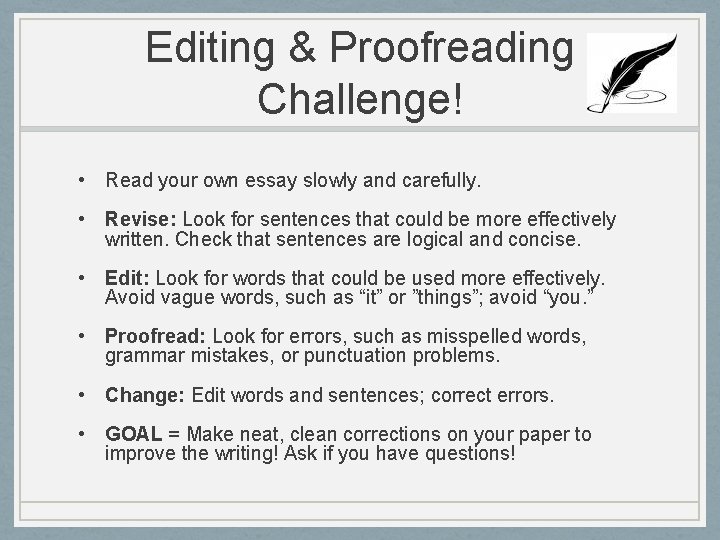
Editing & Proofreading Challenge! • Read your own essay slowly and carefully. • Revise: Look for sentences that could be more effectively written. Check that sentences are logical and concise. • Edit: Look for words that could be used more effectively. Avoid vague words, such as “it” or ”things”; avoid “you. ” • Proofread: Look for errors, such as misspelled words, grammar mistakes, or punctuation problems. • Change: Edit words and sentences; correct errors. • GOAL = Make neat, clean corrections on your paper to improve the writing! Ask if you have questions!