
Edit this presentation to suit your context as



- Slides: 29
Edit this presentation to suit your context as suggested in the presenter notes (below each slide) Please send feedback on your use of ‘the Face it’ activity and your participants’ responses to k. ford@sheffield. ac. uk Copyright © 2013 The University of Sheffield
Let’s ‘Face it’: Striving for Fair, accurate and transparent assessment Dr Karen Ford: Professional Development Team for Learning & Teaching Copyright © 2013 The University of Sheffield
Learning outcome By the end of the session, you should be able to: • Discuss how to assess student work accurately and fairly Copyright © 2013 The University of Sheffield
Overview • Assessment: • Grading student work • Using assessment criteria and rubrics • Moderation and external examiners Copyright © 2013 The University of Sheffield
Assessment: Key concepts Validity: The assessor is measuring what the assessment is intended to measure Reliability: Consistent marking - as an individual and among markers Copyright © 2013 The University of Sheffield
Constructive Alignment Biggs (2011) Intended Learning Outcomes Teaching & Learning Activities Copyright © 2013 The University of Sheffield Assessment Tasks
Example Learning outcome • Students will be able to identify different forms of communication Teaching and learning activities • A lecture on forms of communication Assessment task • Multiple choice exam questions which require identification of forms Copyright © 2013 The University of Sheffield
Decision makers and processes Who decides? • Learning outcomes • Assessment tasks • Teaching and learning activities When and how? Copyright © 2013 The University of Sheffield
Answer… • Course Directors/Module convenors • When programmes/modules created or revised • Approval via a university process • Not part of your remit(? ), but grading validly and reliably is(!) Copyright © 2013 The University of Sheffield
Validity • So how can we ensure the assessor (you as grader) is measuring what the assessment is intended to measure? • Time to do some grading… Copyright © 2013 The University of Sheffield
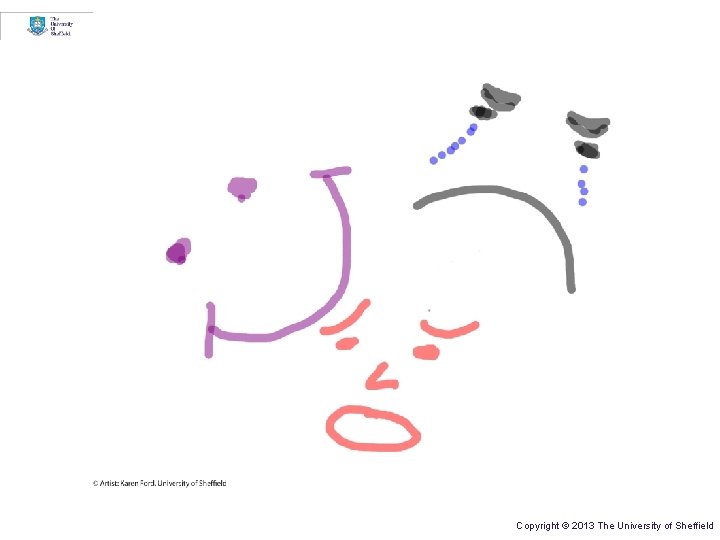
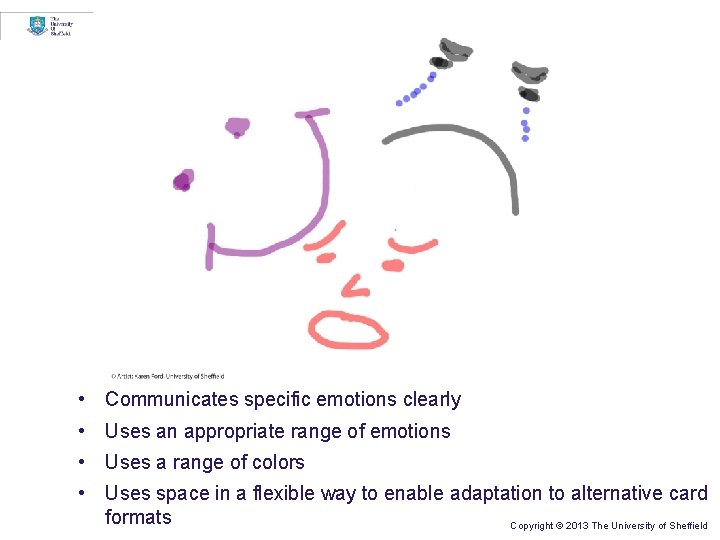
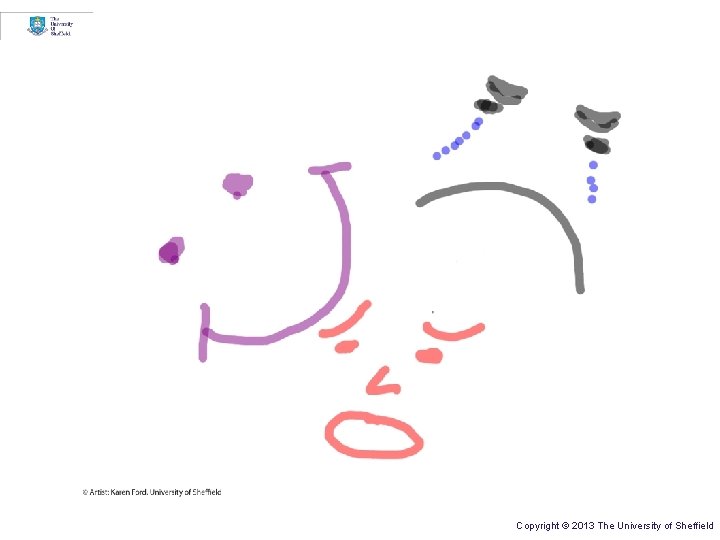
The Assignment Create an illustration for a greeting card using theme “Emotions”. The illustration should use a range of colors and the design should be flexible to enable adaptation to a range of card formats. Copyright © 2013 The University of Sheffield
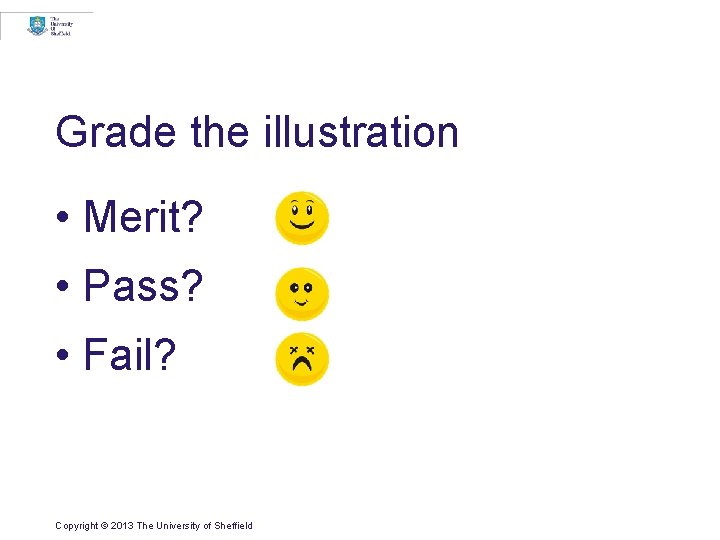
Grade the illustration • Merit? • Pass? • Fail? Copyright © 2013 The University of Sheffield
Copyright © 2013 The University of Sheffield
Grading outcome • Did we all agree on the grade to be awarded? • Why, why not? • If we all agree, have we graded accurately? • Ask yourself how would we know? (think about evidence) Copyright © 2013 The University of Sheffield
What were we measuring (outcomes)? • Communicates specific emotions clearly • Uses an appropriate range of emotions • Uses a range of colors • Uses space in a flexible way to enable adaptation to alternative card formats • Grade again using these Copyright © 2013 The University of Sheffield
• Communicates specific emotions clearly • Uses an appropriate range of emotions • Uses a range of colors • Uses space in a flexible way to enable adaptation to alternative card formats Copyright © 2013 The University of Sheffield
Grading outcome • Did we all agree on the grade to be awarded? • Why, why not? • If we all agree, have we graded accurately? • What else do we need to know? Copyright © 2013 The University of Sheffield
The rubric specifies • The evidence used to determine the achievement of the learning outcomes • Evidence used to determine the level of achievement Copyright © 2013 The University of Sheffield
Descriptor Merit Pass Fail Clarity of emotions Emotions are clearly identifiable with viewers highly likely to agree on all of the emotions represented, ambiguity is very unlikely. Emotions are clearly identifiable with viewers highly likely to agree on some of the emotions represented, but a level of ambiguity is evident. Emotions are not clearly identifiable with viewers highly unlikely to agree on any of the emotions represented; a high level of ambiguity is evident. Range of emotions More than four different emotions are evident (the artist has attempted to represent more than three). Three different emotions are evident (the artist has attempted to represent three). Less than three different emotions are evident (the artist has not attempted to represent more than two) Use of colour More than four colors have been used (not including the background). Three or four colors have been used (not including the background). Less than two colors have been used (not including the background). Use of space The illustration fits within the chosen format (rectangle or square or circle) and could fit in either of the other formats with little or no work required. The illustration fits within the chosen format (rectangle or square or circle) but some work would be required to adapt the illustration to fit in either of the other formats. The illustration fits poorly within the chosen format (rectangle or square or circle) and a significant amount of work would be required to adapt the illustration to fit in either of the other formats. Copyright © 2013 The University of Sheffield
Copyright © 2013 The University of Sheffield
How did we do this time? • Did we all agree? • What issues does this raise for you? • What can you do about them? Copyright © 2013 The University of Sheffield
Valid Use of Rubrics • Discuss any concerns about the rubric to the appropriate person (this can help for the development of the rubric and criteria) • However, your opinion of the rubric is irrelevant from a marking point of view • To ‘ensure’ valid marking you must use the rubric Copyright © 2013 The University of Sheffield
Checklist for reviewers: • What is the assessment task? • What teaching and learning activities have led to the assessment task? • What learning outcomes are being assessed? • What are the assessment criteria & rubric evidence for achievement and levels Copyright © 2013 The University of Sheffield
Review: Key concepts Validity: The assessor is measuring what the assessment is intended to measure Reliability: Consistent grading - as an individual and among assessors (reviewers) …and consistency across assessment activities e. g. exam papers across cohorts (but not your remit? ) Copyright © 2013 The University of Sheffield
Factors Affecting Reliability With your neighbours…. …. . brainstorm the factors that can affect reliability in assessing student work. …. . identify what can be done to improve reliability? Copyright © 2013 The University of Sheffield
Processes Standardisation • To the rubric for individual reviewer consistency (before using the rubric) • Ask how your department does this (e. g. samples of work) Moderation • Consistency among reviewers Copyright © 2013 The University of Sheffield
Add to your checklist… • What is the assessment task? • What teaching and learning activities have led to the assessment task? • What learning outcomes are being assessed? • What are the assessment criteria and rubric -evidence for achievement and levels? • Others? Copyright © 2013 The University of Sheffield
Learning outcome revisited Can you: • Discuss how to assess student work accurately and fairly? Copyright © 2013 The University of Sheffield
Reference Biggs, J. B. & Tang, C. (2011). Teaching for quality learning at university: what the student does. Maidenhead: Open University Press, 4 th ed. Copyright © 2013 The University of Sheffield