
Edible Race Cars Introduction Recall from the lesson
Edible Race Cars
Introduction • Recall from the lesson on internal combustion engines: engines with more cylinders produce more power, but use more fuel. • What are some other factors that cause a vehicle to use more fuel? – Weight of the vehicle – Load carried – Driving conditions (wind) – Terrain (hilly vs. flat) • Now let’s make some predictions about the average fuel economy (miles per gallon of gasoline traveled) for: – Cars, light duty trucks (pick ups), school buses, transit buses, motorcycle, semi trucks (class B trucks), garbage trucks
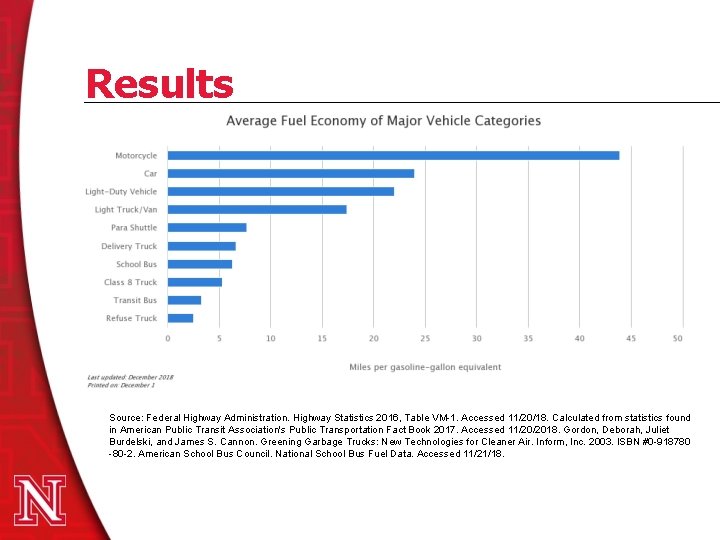
Results Source: Federal Highway Administration. Highway Statistics 2016, Table VM-1. Accessed 11/20/18. Calculated from statistics found in American Public Transit Association's Public Transportation Fact Book 2017. Accessed 11/20/2018. Gordon, Deborah, Juliet Burdelski, and James S. Cannon. Greening Garbage Trucks: New Technologies for Cleaner Air. Inform, Inc. 2003. ISBN #0 -918780 -80 -2. American School Bus Council. National School Bus Fuel Data. Accessed 11/21/18.
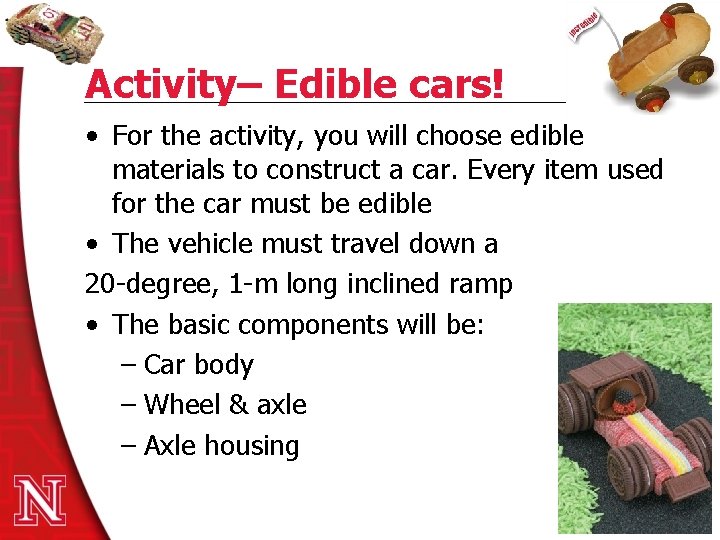
Activity– Edible cars! • For the activity, you will choose edible materials to construct a car. Every item used for the car must be edible • The vehicle must travel down a 20 -degree, 1 -m long inclined ramp • The basic components will be: – Car body – Wheel & axle – Axle housing
Some guiding questions • Why is it important to have axles that will spin freely? • How will you design your wheels and axles using food items?
Rules • You must use at least 3 food items. • The vehicle must have a body, wheels that rotate, and 2 axles. • The vehicle also must ROLL not slide down the given ramp. • You are allowed to eat your car only if your car has successfully rolled down the ramp.

ANY QUESTIONS?
- Slides: 7