
Ediacaran Life Precursors to the Cambrian Explosion Period
Ediacaran Life Precursors to the Cambrian Explosion
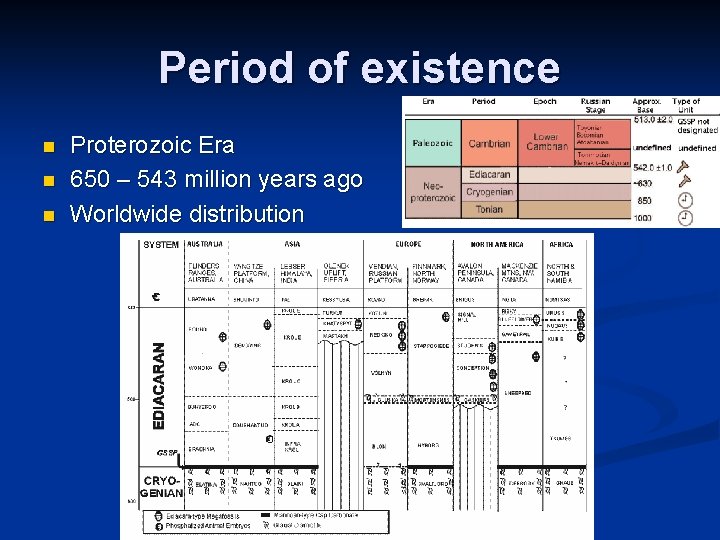
Period of existence n n n Proterozoic Era 650 – 543 million years ago Worldwide distribution
Disagreement n n n Stephen Jay Gould and Adolf Seilacher propose that the Ediacaran fauna are “failed experiments” in the evolution of multi cellular animals University of Oregon paleontologist Gregory Retallack believes that the Ediacaran fauna were actually lichens. Typical opinion today seems to be that a mix of cnidarians, fungi, and sponges were dominant in the Ediacaran.
The Oldest Fossils ≠ The Oldest Animals n n The Ediacaran Fauna represents the oldest collection of metazoan fossils on the planet, commencing in the fossil record around 610 mya. Geneticists however, n n "Calibrated rates of molecular sequence divergence were used to test this hypothesis. Seven independent data sets suggest that invertebrates diverged from chordates about a billion years ago, about twice as long ago as the Cambrian. Protostomes apparently diverged from chordates well before echinoderms, which suggests a prolonged radiation of animal phyla. " (Wray, Levinton, Shapiro) More recent studies have taken more factors into account and point towards a more recent divergence, sometime around 570 mya (Peterson, et al)
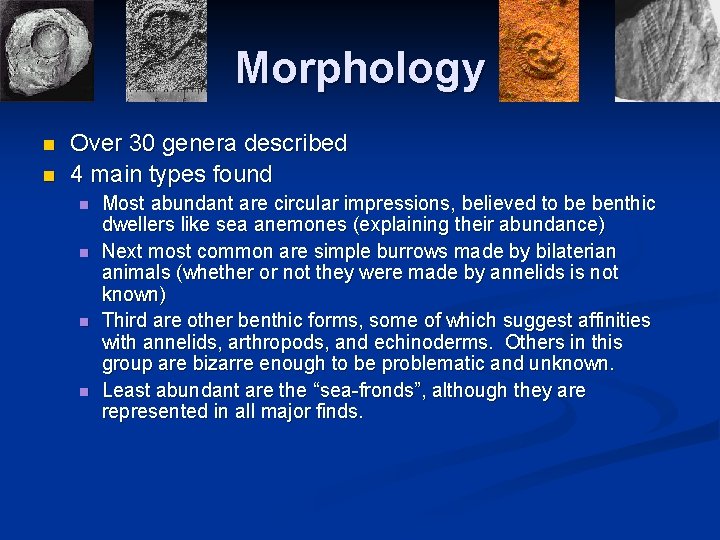
Morphology n n Over 30 genera described 4 main types found n n Most abundant are circular impressions, believed to be benthic dwellers like sea anemones (explaining their abundance) Next most common are simple burrows made by bilaterian animals (whether or not they were made by annelids is not known) Third are other benthic forms, some of which suggest affinities with annelids, arthropods, and echinoderms. Others in this group are bizarre enough to be problematic and unknown. Least abundant are the “sea fronds”, although they are represented in all major finds.
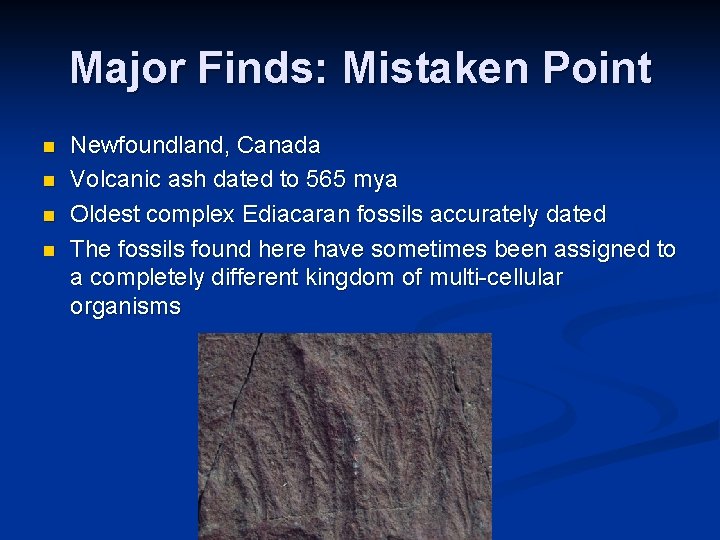
Major Finds: Mistaken Point n n Newfoundland, Canada Volcanic ash dated to 565 mya Oldest complex Ediacaran fossils accurately dated The fossils found here have sometimes been assigned to a completely different kingdom of multi cellular organisms
Fossils n n n The fossil record is incomplete. Biological, mechanical and diagenetic agents all destroy potential fossils. Normal fossil preservation is favored by rapid burial of durable hard parts. Exceptional preservation occurs via rapid burial in fine grained sediments under low oxygen conditions. The fossil record is biased because of differential preservation and uneven sampling. It is biased in favor of: 1) durably skeletonized organisms; 2) marine organisms; 3) geologically recent organisms Because of biases, knowledge of past life is far better at higher taxonomic levels than at lower taxonomic levels

Winter Coast, Russia n Contains the largest and most diverse collection of Ediacaran fossils.
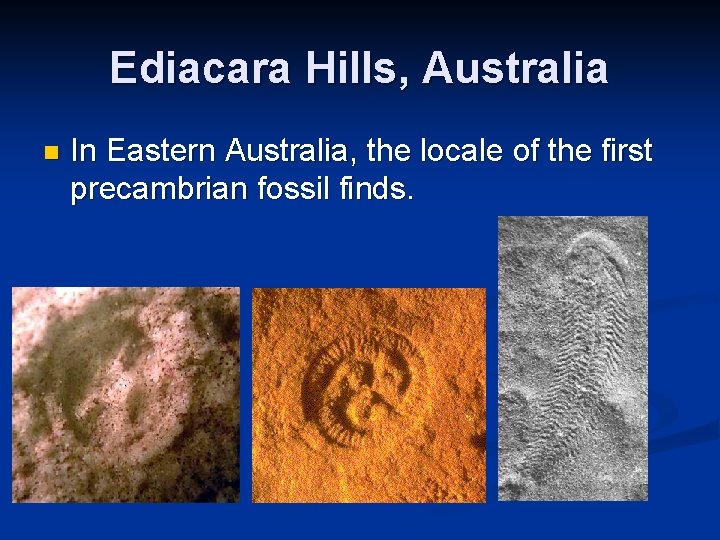
Ediacara Hills, Australia n In Eastern Australia, the locale of the first precambrian fossil finds.
Extinction There appears to have been a major extinction event at the boundary between the Precambrian and the Cambrian Explosion (around 545 mya). Some ediacaran representatives survive, but most go extinct. n By 580 mya, representatives of the major phyla found in the Cambrian explosion can be found swimming in the Precambrian seas. n
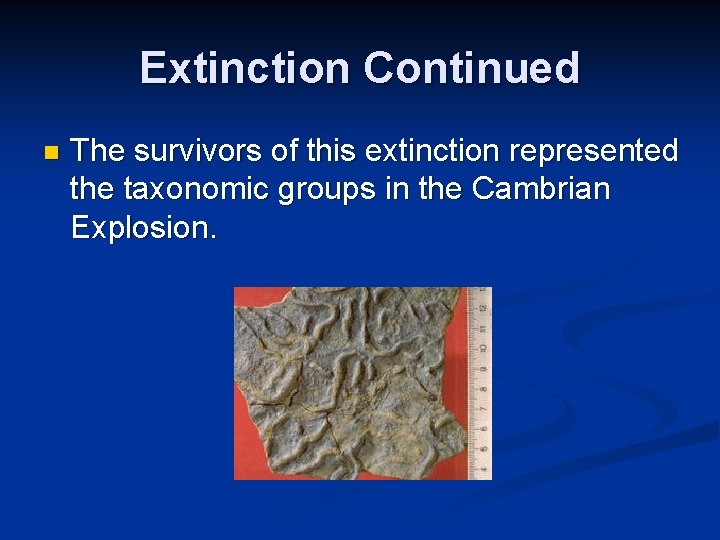
Extinction Continued n The survivors of this extinction represented the taxonomic groups in the Cambrian Explosion.
Conclusions Ediacaran fauna were all soft bodied n Led to the evolution of predators n At one point, coexisted with phlya represented in the Cambrian Explosion. n Not much known about what caused the extinction of the Ediacaran Fauna. n
References n n n n Woodmorappe, John. "The Cambrian Explosion Remains an Enigma for Organic Evolution: The Ediacaran Fauna: Much Ado about Lichens? " Revolution Against Evolution. 5 June 1999. 18 Nov. 2007 <http: //www. rae. org/cambrian. html>. "Vendian: Localities. " University of California Museum of Paleontology. 18 Nov. 2007 <http: //www. ucmp. berkeley. edu/vendianloc. html>. "Ediacara Biota. " Queens University Geology Department. 20 Apr. 2000. Queens University. 18 Nov. 2007 <http: //geol. queensu. ca/museum/exhibits/ediac. html>. "Australia Before Time. " Australian Heritage Commission. 18 Nov. 2007 <http: //www. ahc. gov. au/ publications/geofossil/ediacara. html>. Clowes, Chris. "The Ediacaran (Vendian). " The Palaeos Project. 2002. 18 Nov. 2007 <http: //www. palaeos. com/Proterozoic/Neoproterozoic/Ediacaran. htm>. Yarrington, Kate. "Ediacara Assembalge. " Fossil Lagerstatten. University of Bristol. 18 Nov. 2007 <http: //palaeo. gly. bris. ac. uk/palaeofiles/lagerstatten/Ediacara/flora%20 and%20 fauna. htm >. University Of California Riverside. "Dating Our Ancestors: Study Suggests Macroscopic Bilaterian Animals Did Not Appear Until 555 Million Years Ago. " Science. Daily 30 September 2002. 18 November 2007 <http: //www. sciencedaily. com /releases/2002/09/020927064725. htm>. Peterson, Kevin J, et al. "Estimating Metazoan Divergence Times with a Molecular Clock. " Proceedings of the National Academy of Sciences 101. 17 (Apr. 2004).
- Slides: 13