
EDI Electronic Data Interchange What is EDI Application

- Slides: 13
EDI Electronic Data Interchange
What is EDI? Application to Application transfer of business documents between computers l Means of speeding up cycle times and enhancing working relationships l Two way information exchange that is fast, accurate, and completely paperless. l Utilizes computers to effectively advance your ability to both keep in line with and stay ahead of your Group competition. X l
General Uses of EDI l Send: • Purchase orders • Invoices • Shipping notices Eliminate Paper-Intensive Business Processes l Reduces errors and frees clerks for valueadded activities such as telemarketing l Group X
General Benefits of EDI l EDI transmissions go from order desks to shop floors in minutes, the foundation of just- in-time manufacturing • Lets firms respond to product shortfalls without warehousing large inventories. Integration with other computerized operations such as accounting allows payment and instant inventory tracking. l Result: lower overheads, higher sales l Group X
EDI History l In use since mid-1960’s l Addressed the inefficiencies of intercorporate document movement l Started with Railroad Companies, Sears, K-Mart, and GM l Early Problems – Company specific systems i. e. no standards Group X
EDI History Cont. l In 1970’s shared EDI systems were sponsored by industries to temporarily solve standards issue. – IBM IVANS, ORDERNET l Same problems with need to communicate with other industries Group X
EDI History Cont. l In 1975 the TDCC (Transportation Data Coordinating Committee) moved towards the development of a standard for EDI between companies l Today there are two main standards Group X
Benefits of EDI l Saves Time l Saves Money l Improves Data Integrity l Improves Data Security l Expands Your Customer Base Group X
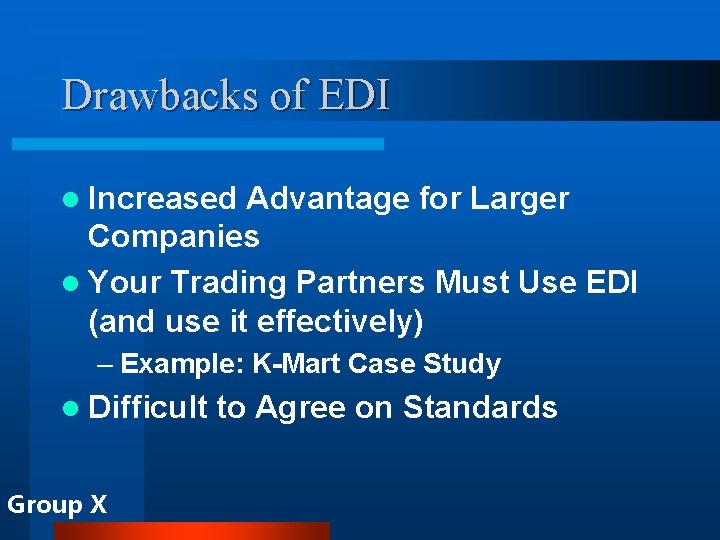
Drawbacks of EDI l Increased Advantage for Larger Companies l Your Trading Partners Must Use EDI (and use it effectively) – Example: K-Mart Case Study l Difficult Group X to Agree on Standards
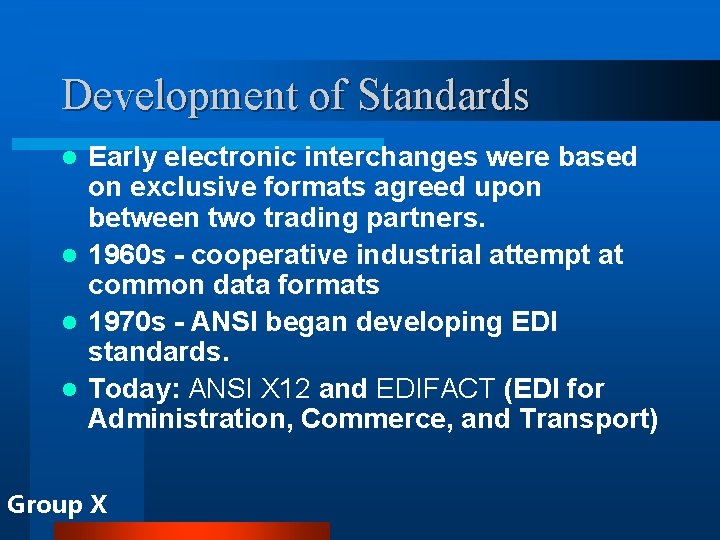
Development of Standards Early electronic interchanges were based on exclusive formats agreed upon between two trading partners. l 1960 s - cooperative industrial attempt at common data formats l 1970 s - ANSI began developing EDI standards. l Today: ANSI X 12 and EDIFACT (EDI for Administration, Commerce, and Transport) l Group X
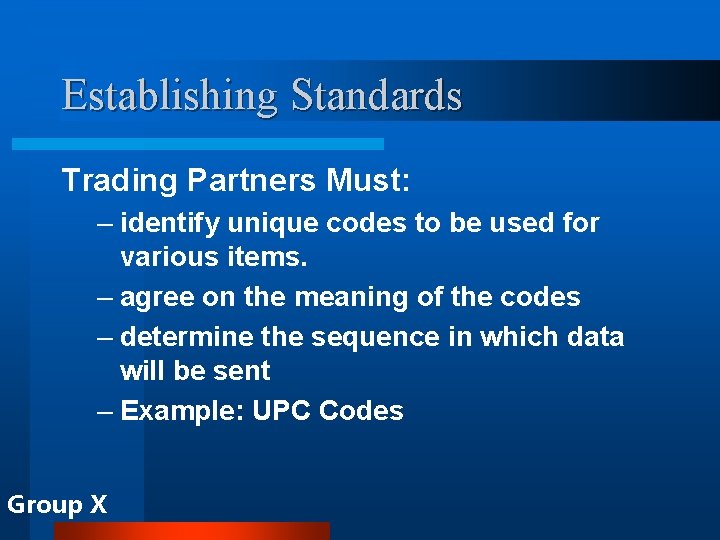
Establishing Standards Trading Partners Must: – identify unique codes to be used for various items. – agree on the meaning of the codes – determine the sequence in which data will be sent – Example: UPC Codes Group X
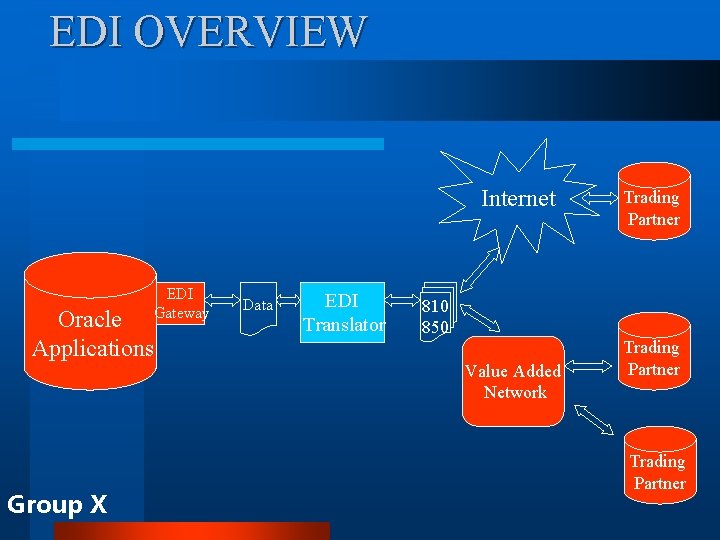
EDI OVERVIEW Internet EDI Gateway Oracle Applications Group X Data EDI Translator Trading Partner 810 850 Value Added Network Trading Partner
Questions?