
Edge Localized Modes propagation and fluctuations in the

- Slides: 19
Edge Localized Modes propagation and fluctuations in the JET SOL region presented by Bruno Gonçalves EURATOM/IST, Portugal
Contributors C. Hidalgo, M. Pedrosa, B. Gonçalves*, C. Silva*, R. Balbín, M. Hron** Euratom-Ciemat, 28040 Madrid, Spain *Euratom/IST, 1049 -001 Lisbon, Portugal **Euratom-IPP. CR, Prague, Czech Republic A. Loarte EFDA – Garching, Max-Planck-Institut für Plasmaphysik Germany K. Erents, G. F. Matthews Euratom-UKAEA, United Kingdom
Motivation • Understanding the impact of ELMs induced particle and energy fluxes in the divertor plates remains as one of the major concerns in the fusion community for future devices like ITER. • The possible link between the amplitude and the radial propagation of ELMs might have an important consequence in the extrapolation of ELMs impact in the divertor plates on future devices. • This work presents the investigation of the radial propagation of ELMs in JET SOL region.
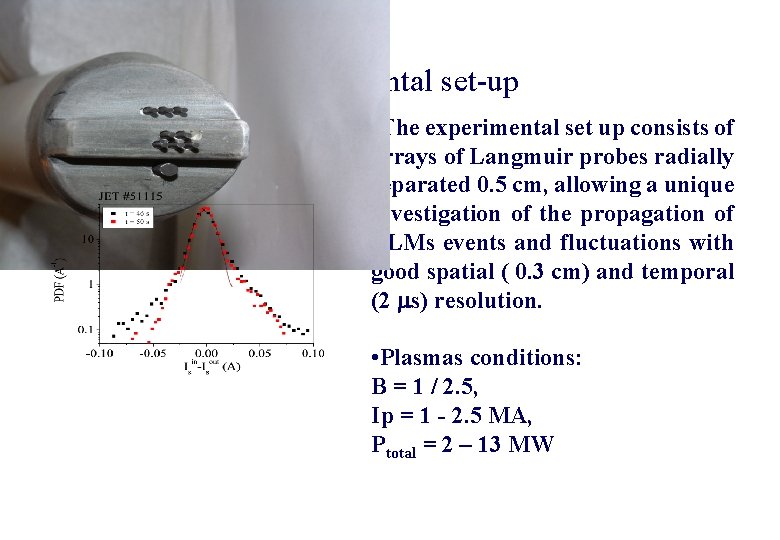
Experimental set-up • The experimental set up consists of arrays of Langmuir probes radially separated 0. 5 cm, allowing a unique investigation of the propagation of ELMs events and fluctuations with good spatial ( 0. 3 cm) and temporal (2 s) resolution. • Plasmas conditions: B = 1 / 2. 5, Ip = 1 - 2. 5 MA, Ptotal = 2 – 13 MW
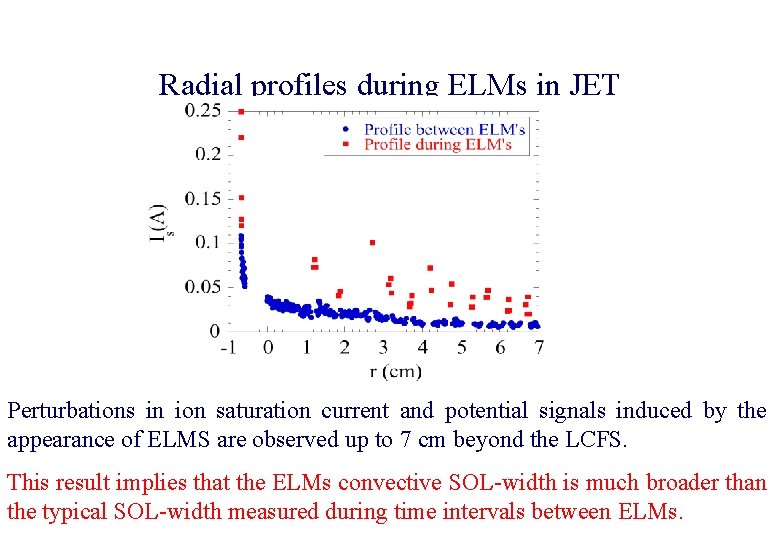
Radial profiles during ELMs in JET Perturbations in ion saturation current and potential signals induced by the appearance of ELMS are observed up to 7 cm beyond the LCFS. This result implies that the ELMs convective SOL-width is much broader than the typical SOL-width measured during time intervals between ELMs.
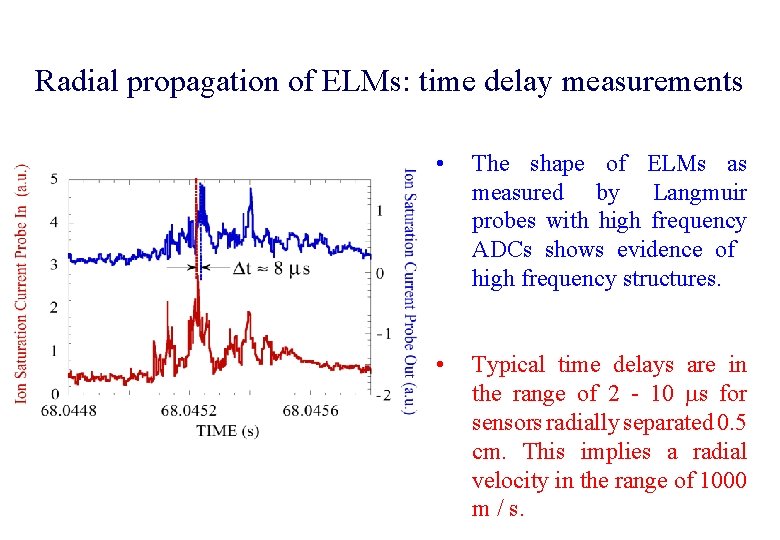
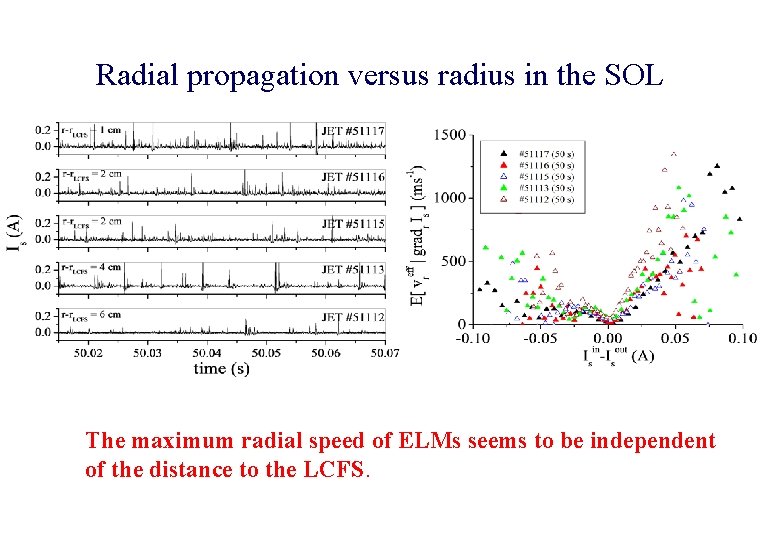
Radial propagation of ELMs: time delay measurements • The shape of ELMs as measured by Langmuir probes with high frequency ADCs shows evidence of high frequency structures. • Typical time delays are in the range of 2 - 10 s for sensors radially separated 0. 5 cm. This implies a radial velocity in the range of 1000 m / s.
Dynamical relation between Ex. B turbulent transport and gradients in ELMy discharges: The radial effective velocity of ELMs
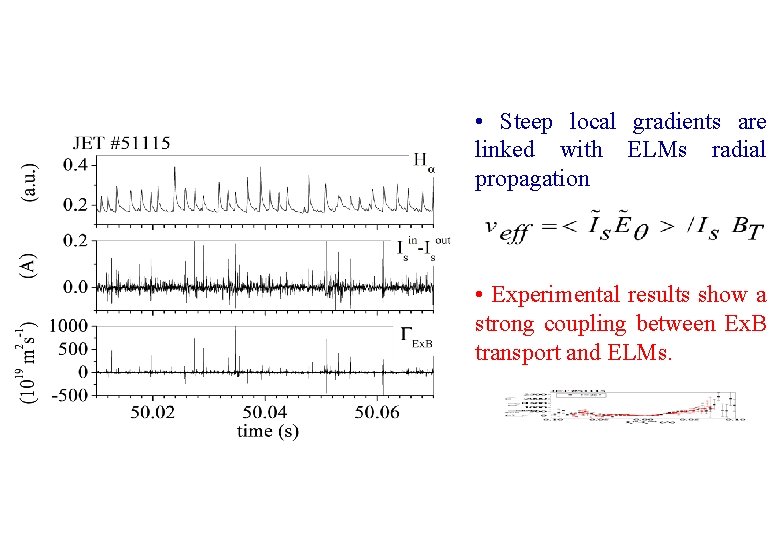
• Steep local gradients are linked with ELMs radial propagation • Experimental results show a strong coupling between Ex. B transport and ELMs.
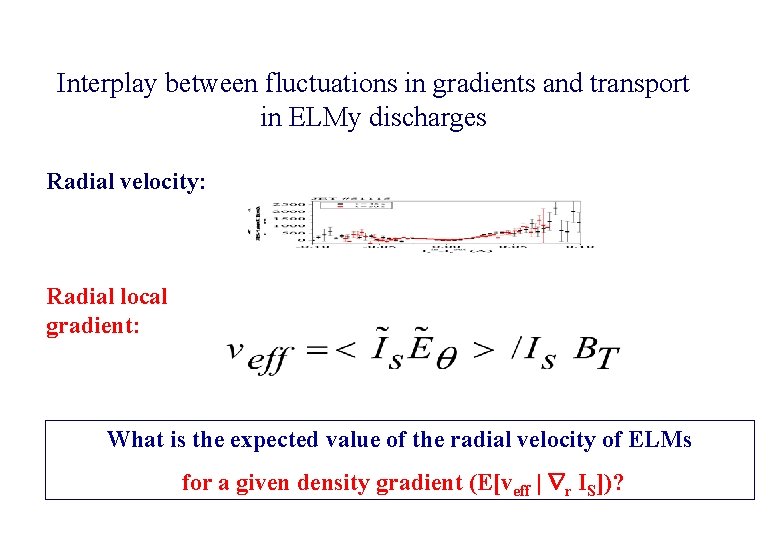
Interplay between fluctuations in gradients and transport in ELMy discharges Radial velocity: Radial local gradient: What is the expected value of the radial velocity of ELMs for a given density gradient (E[veff | r IS])?
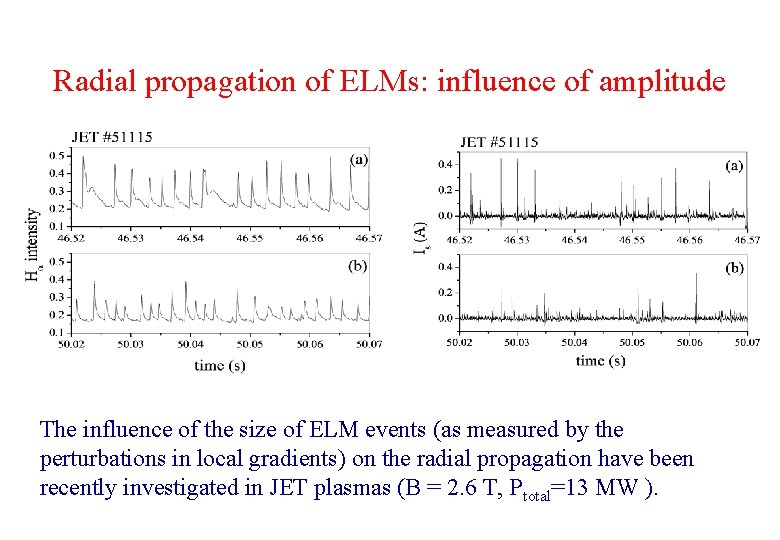
Radial propagation of ELMs: influence of amplitude The influence of the size of ELM events (as measured by the perturbations in local gradients) on the radial propagation have been recently investigated in JET plasmas (B = 2. 6 T, Ptotal=13 MW ).
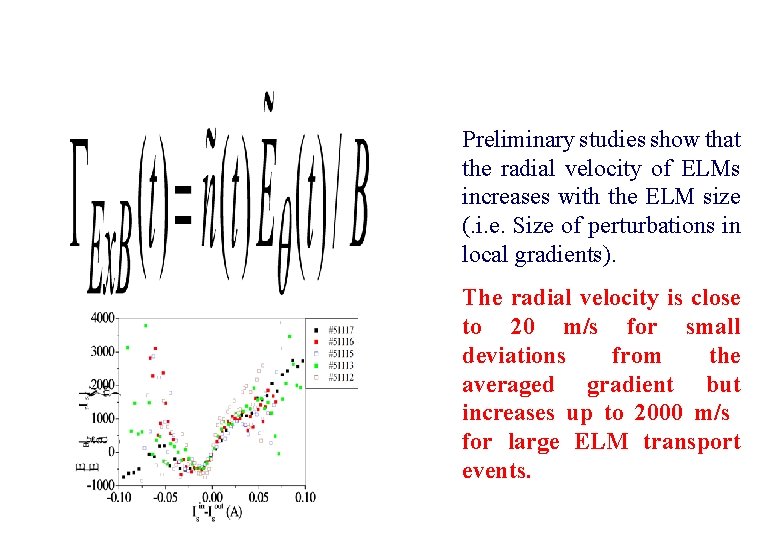
Preliminary studies show that the radial velocity of ELMs increases with the ELM size (. i. e. Size of perturbations in local gradients). The radial velocity is close to 20 m/s for small deviations from the averaged gradient but increases up to 2000 m/s for large ELM transport events.
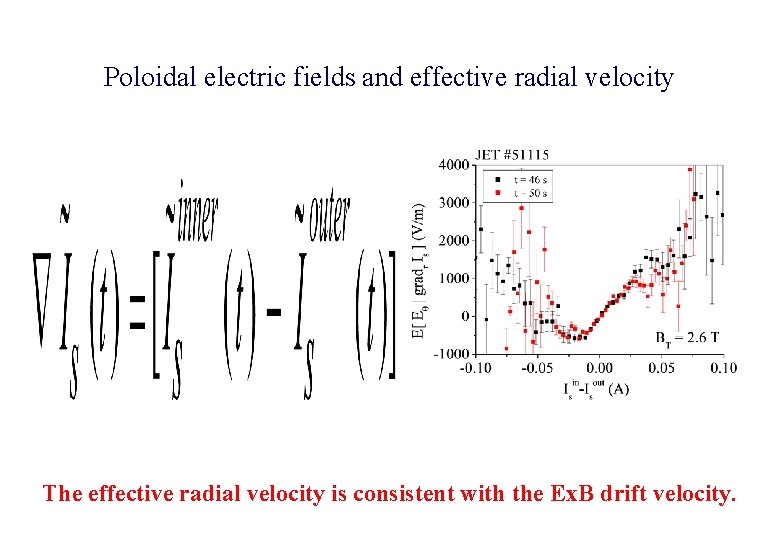
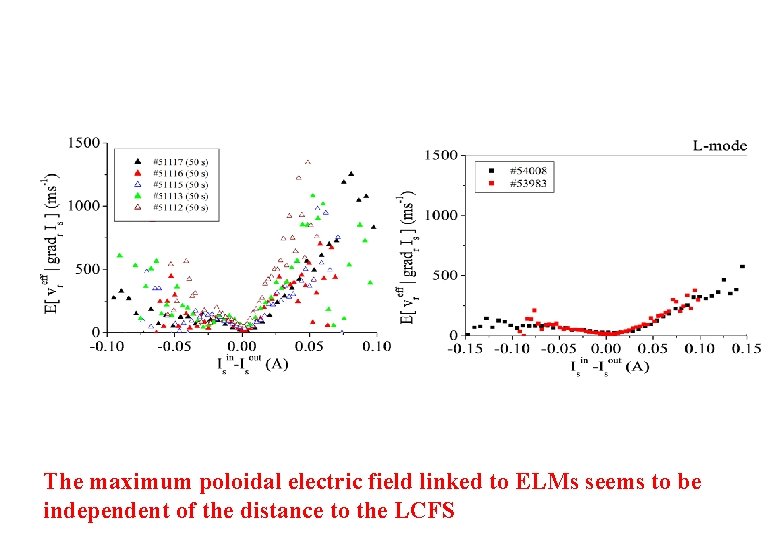
Poloidal electric fields and effective radial velocity The effective radial velocity is consistent with the Ex. B drift velocity.
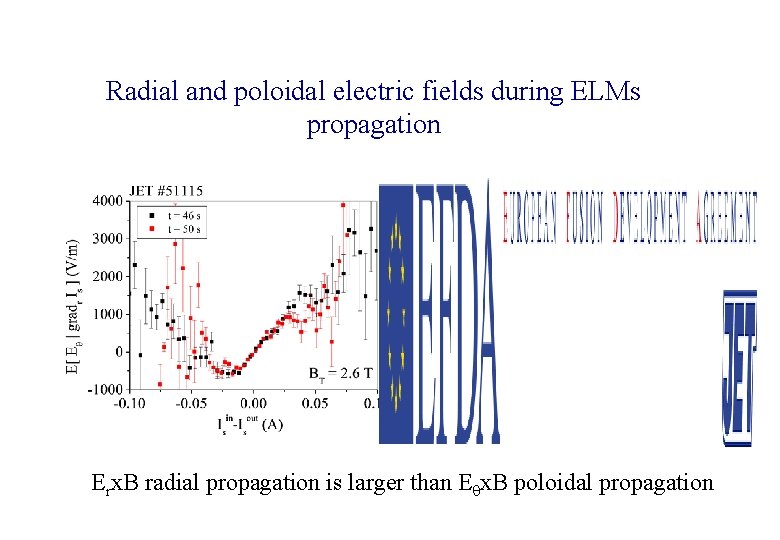
Radial and poloidal electric fields during ELMs propagation Erx. B radial propagation is larger than Eqx. B poloidal propagation
Radial propagation versus radius in the SOL The maximum radial speed of ELMs seems to be independent of the distance to the LCFS.
The maximum poloidal electric field linked to ELMs seems to be independent of the distance to the LCFS
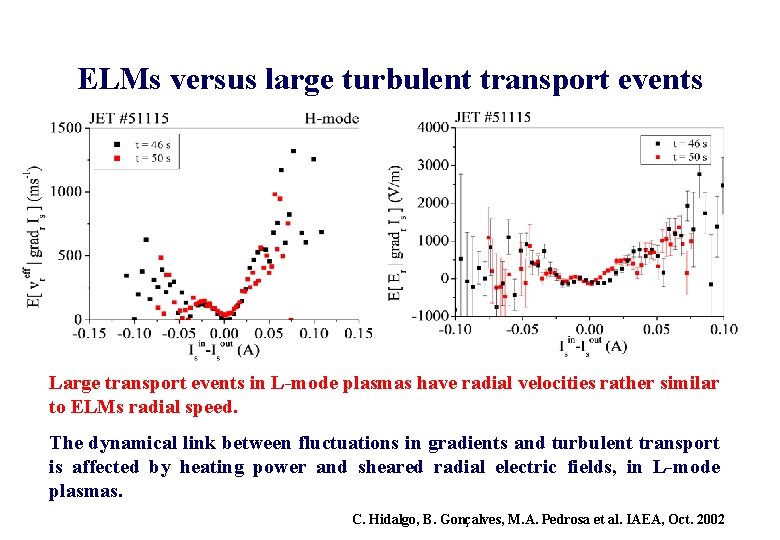
ELMs versus large turbulent transport events Large transport events in L-mode plasmas have radial velocities rather similar to ELMs radial speed. The dynamical link between fluctuations in gradients and turbulent transport is affected by heating power and sheared radial electric fields, in L-mode plasmas. C. Hidalgo, B. Gonçalves, M. A. Pedrosa et al. IAEA, Oct. 2002
Radial versus parallel propagation ELMs arrival time to the plasma wall can be comparable to, or even smaller than, the characteristic time of transport to the divertor plates (in the range of 0. 1 – 0. 5 ms). In these circumstances we have to consider the competition between parallel and radial transport of ELMs to explain and predict particle and energy fluxes onto the divertor plates in ITER. The large radial speed of ELMs might explain experimental results showing that only about 60 % of the energy losses due to large type I ELMs arrives to the divertor plates.
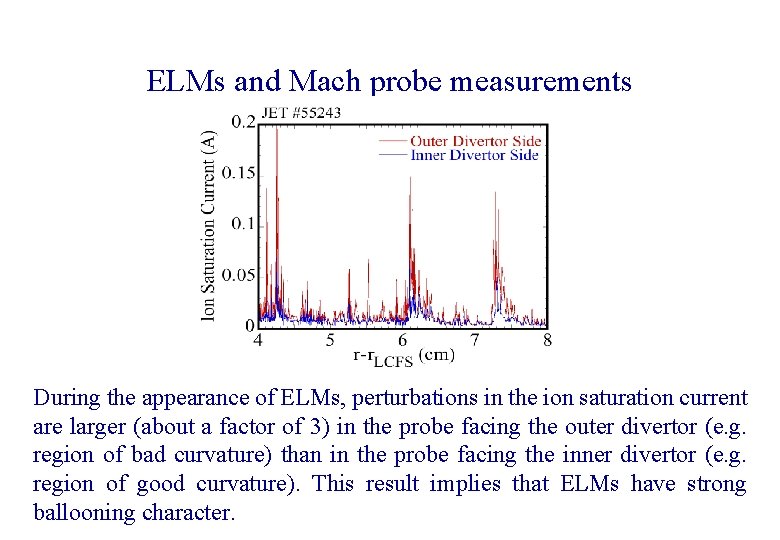
ELMs and Mach probe measurements During the appearance of ELMs, perturbations in the ion saturation current are larger (about a factor of 3) in the probe facing the outer divertor (e. g. region of bad curvature) than in the probe facing the inner divertor (e. g. region of good curvature). This result implies that ELMs have strong ballooning character.
Conclusions • ELMs propagate radially with an effective velocity in the range of 1000 m/s. • ELMs arrival time to the plasma wall can be comparable to, or even smaller than, the characteristic time of transport to the divertor plates (in the range of (0. 1 – 0. 5 ms); in these circumstances we have to consider the competition between parallel and radial transport of ELMs to explain and predict particle and energy fluxes onto the divertor plates in ITER. • Experimental results suggest a link between the radial velocity and the size of ELMs transport events. This result might have an important consequence in the extrapolation of the impact of ELM in the divertor plates on future devices.