
EDGE LINKING BOUNDARY DETECTION Ms Mona Deshmukh Edge
EDGE LINKING & BOUNDARY DETECTION Ms. Mona Deshmukh

Edge Linking & Boundary Detection • Ideal case: – Techniques detecting intensity discontinuities should yield pixels lying only on edges ( or the boundary between regions). • Real life: – The detected set of pixels very rarely describes a complete edge due to effects from: noise, breaks in the edge due to non-uniform illumination.
Edge Linking & Boundary Detection • Solution: – Edge-detection techniques are followed by linking and other boundary detection procedures which assemble edge pixels into meaningful boundaries.
Local Processing • Analyze the pixel characteristics in a small neighborhood (3 x 3, 5 x 5) about every (x, y) in an image. • Link similar points to form a edge/boundary of pixels sharing common properties.
Local Processing • Criteria used/Properties: 1. The strength of the response of the gradient operator that produced the edge pixel. 2. The direction of the gradient vector.
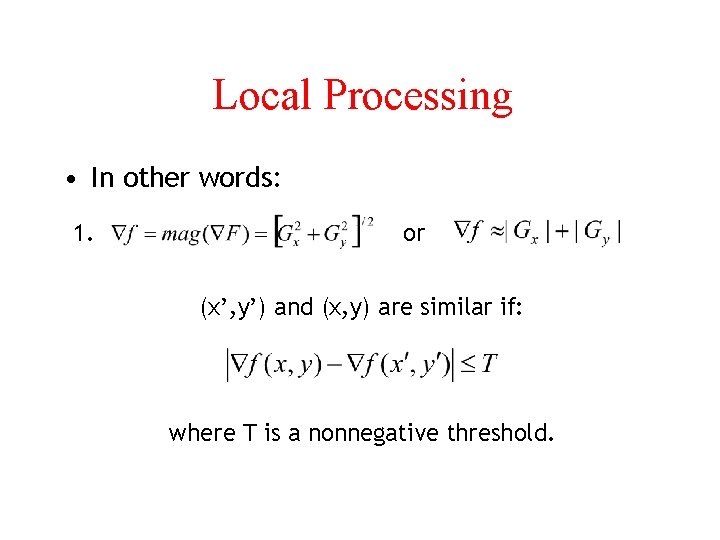
Local Processing • In other words: 1. or (x’, y’) and (x, y) are similar if: where T is a nonnegative threshold.
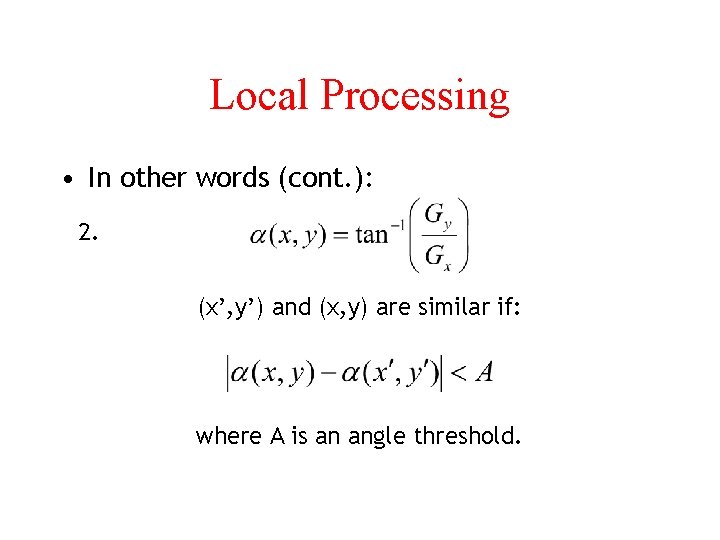
Local Processing • In other words (cont. ): 2. (x’, y’) and (x, y) are similar if: where A is an angle threshold.
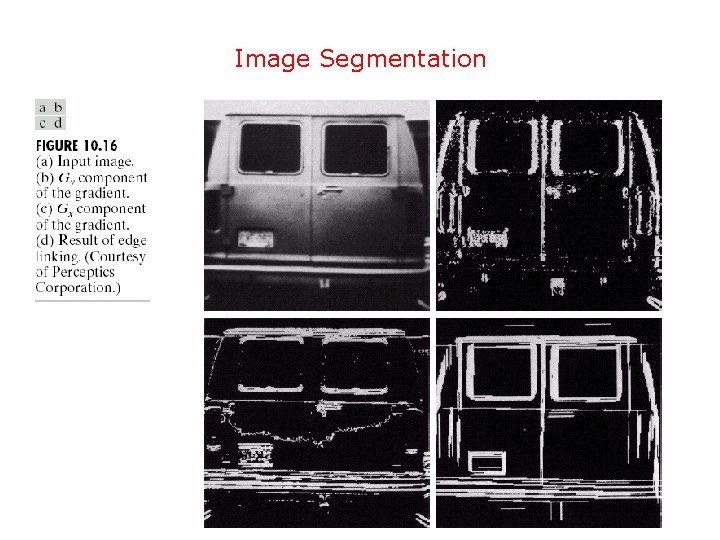
Image Segmentation
Global Processing via the Hough Transform • Points are linked by determining whether they lie on a curve of specified shape. • Problem: – Find subsets of n points that lie on straight lines.
Global Processing via the Hough Transform • Solution: – Find all lines determined by every pair of points – Find all subsets of points close to particular lines – Involves: n(n-1)/2 ~ n 2 lines n(n(n-1))/2 ~ n 3 computations for comparing every point to all lines.
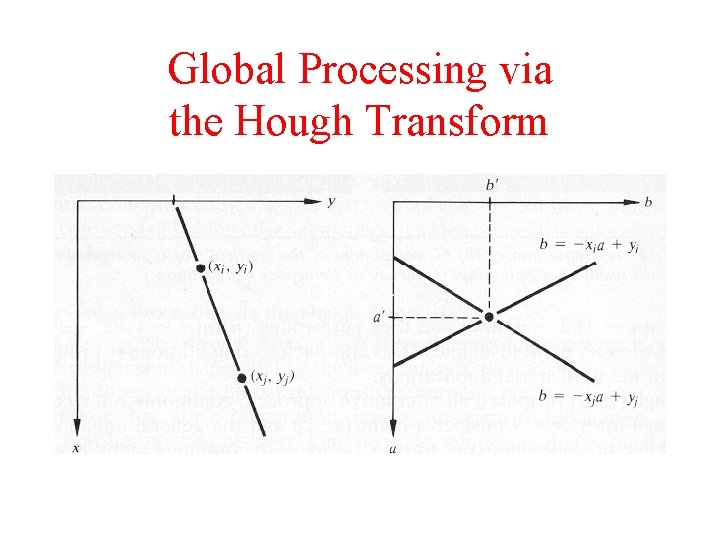
Global Processing via the Hough Transform • Better solution: Hough Transform – Equation of line passing through point (xi, yi): yi = axi + b (a, b varies) – But: b = -xia + yi equation of single line on ab plane
Global Processing via the Hough Transform
Global Processing via the Hough Transform • A line in the (x, y) plane passes through several points of interest and has a set of specific (a, b) values. • A line in parameter space [(a, b) plane] denotes all lines that pass through a certain point (xi, yi) and has an infinite number of (a, b) values.
Global Processing via the Hough Transform • A specific line is represented by a point in the (a, b) plane. • Two lines in parameter space that meet at a certain point show points belonging to the same line (in x, y plane).
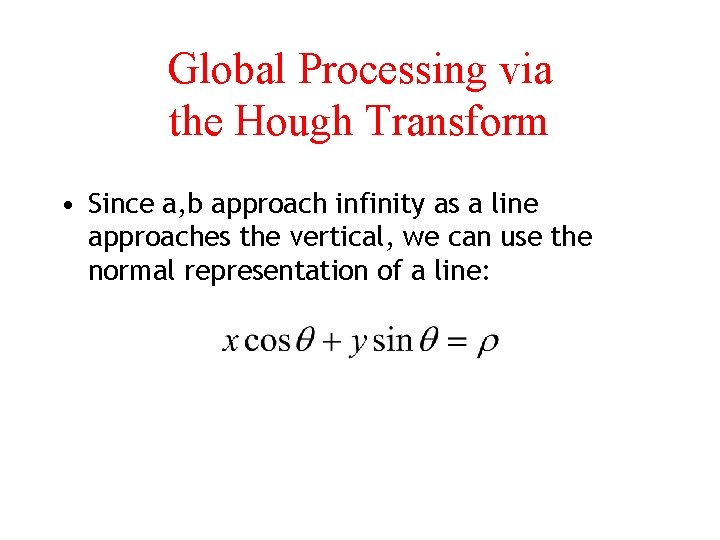
Global Processing via the Hough Transform • Since a, b approach infinity as a line approaches the vertical, we can use the normal representation of a line:
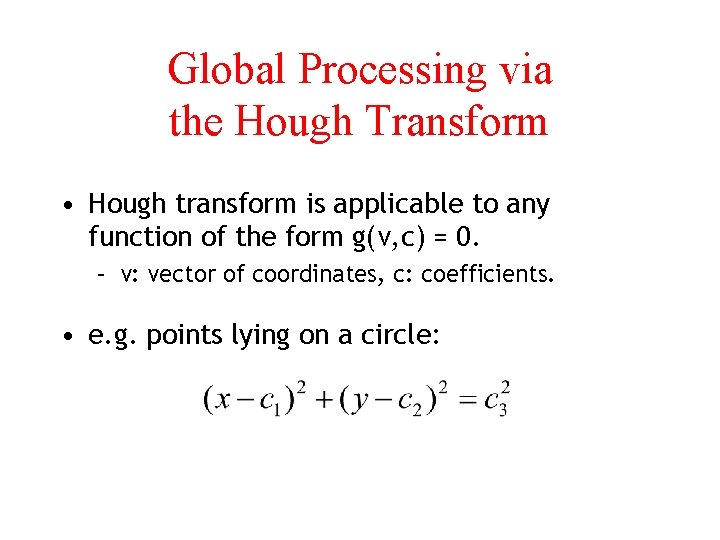
Global Processing via the Hough Transform • Hough transform is applicable to any function of the form g(v, c) = 0. – v: vector of coordinates, c: coefficients. • e. g. points lying on a circle:
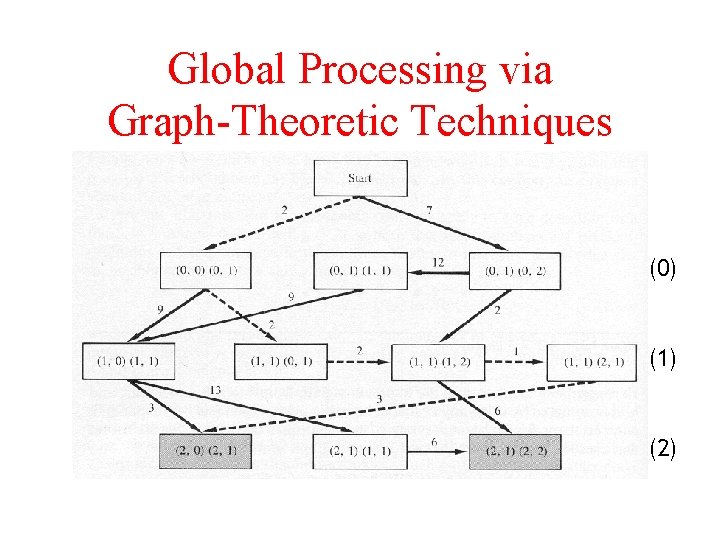
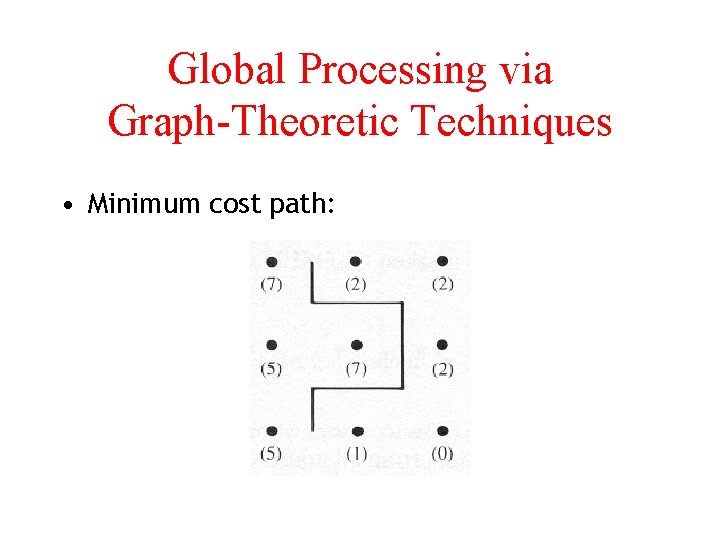
Global Processing via Graph-Theoretic Techniques • A global approach based on representing edge segments in the form of a graph and searching the graph for low-cost paths that correspond to significant edges.
Global Processing via Graph-Theoretic Techniques • Advantage: – performs well in the presence of noise • Disadvantage: – complicated and requires more processing time.
Global Processing via Graph-Theoretic Techniques • Graph G = (N, U): – A finite, nonempty set of nodes N together with a set U of unordered pairs of distinct elements of N. • (ni, nj) of U: arc
Global Processing via Graph-Theoretic Techniques • Directed graph: – a graph in which arcs are directed – If ni to nj is directed, nj is a successor of its parent node ni.
Global Processing via Graph-Theoretic Techniques • Expansion of node: – To identify the successors of a node – Level 0 consists of a single node (start node) – Last level contains the goal nodes.
Global Processing via Graph-Theoretic Techniques • A sequence of nodes n 1, n 2, …, nk (with each ni being a successor of ni-1) is called a path from n 1 to nk and its cost is:
Global Processing via Graph-Theoretic Techniques • Edge element: – The boundary between two pixels p & q such that p and q are 4 -neighbors. • Edge: – A sequence of connected edge elements.
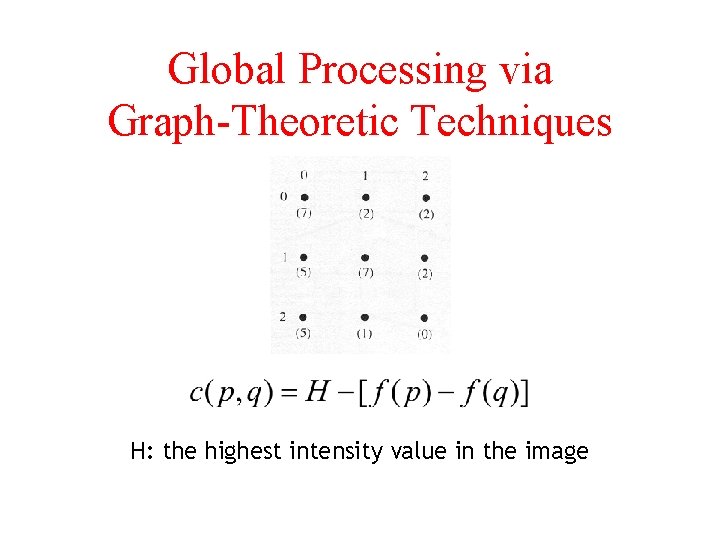
Global Processing via Graph-Theoretic Techniques H: the highest intensity value in the image
Global Processing via Graph-Theoretic Techniques (0) (1) (2)
Global Processing via Graph-Theoretic Techniques • Minimum cost path:
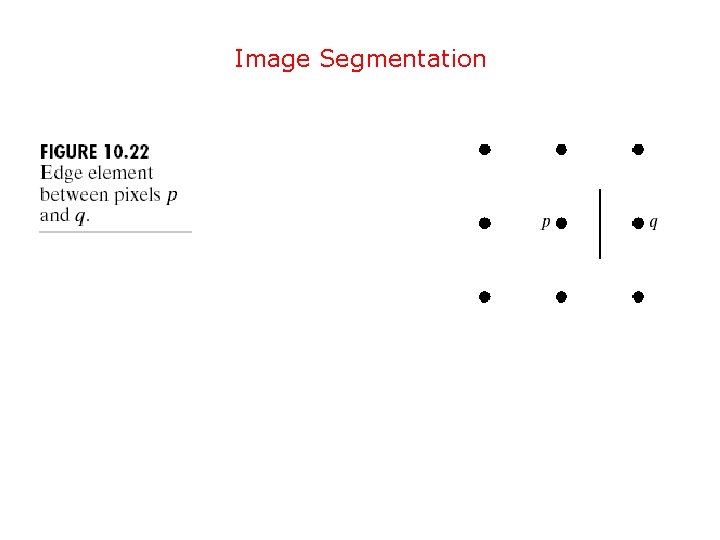
Image Segmentation
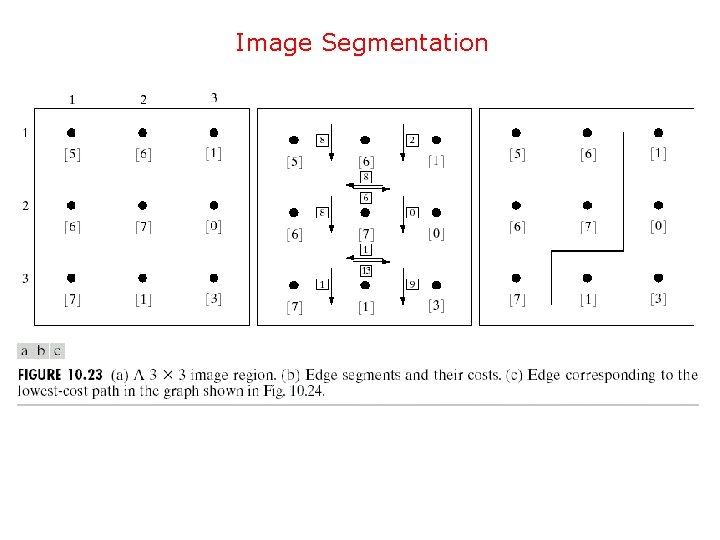
Image Segmentation
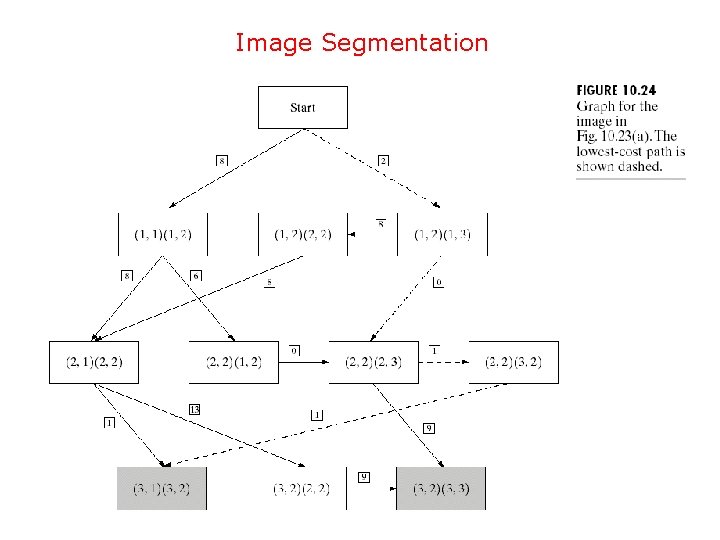
Image Segmentation
- Slides: 30