
Edgar Allan Poe Literary Terms to Consider Alliteration





- Slides: 34
Edgar Allan Poe Literary Terms to Consider
Alliteration Repetition of consonant sounds at the beginning of words
Alliteration Hearken! and observe how healthily, how calmly, I can tell you the whole story. It is the beating of his hideous heart! The repetition of the /h/ sounds like breath—h-h-h-h. This sound is similar to the breathless quality of the insane narrator who is rushing to convince us that he is not mad. To start the story with this alliteration, Poe begins to set-up the reader to understand that while the narrator claims that he is not mad, in reality, he is mad. The author is implying that the narrator is overly emotional and dishonest
Allusion A reference to a person, place, object in history, or another famous piece of literature
“Tell me what thy lordly name is on the Night’s Plutonian shore!” A reference to the underworld of Roman mythology
Repetition (Anaphora) A technique in which a sound, word, phrase, or line is repeated for effect or emphasis
And the Raven, never flitting, still is sitting
Assonance A repetition of vowel sounds
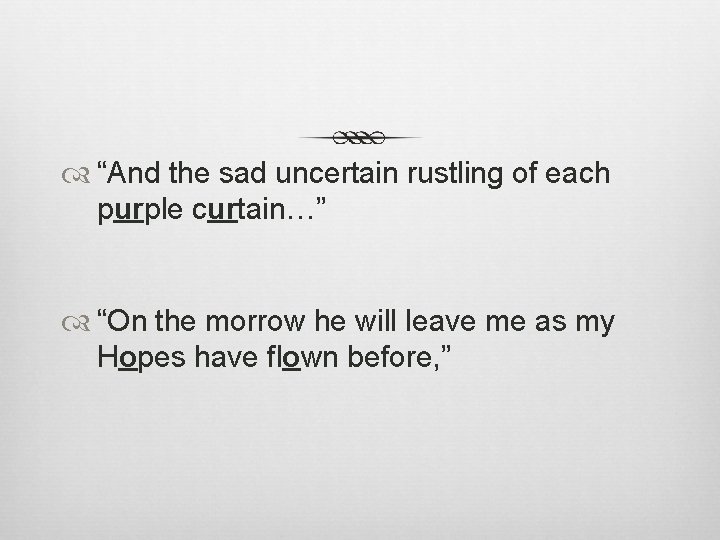
“And the sad uncertain rustling of each purple curtain…” “On the morrow he will leave me as my Hopes have flown before, ”
Flashback An interruption of the action to present events that took place at an earlier time. A flashback can provide information that helps readers understand a character’s current situation
In “The Raven” the tells his story as a return or “flashback” to the time he first encountered the raven. “Ah distinctly I remember it was in the bleak December, ” The narrator returns to the present in the final stanza.
Foreshadowing Hints provided by a writer that suggest future events in a story. Foreshadowing creates suspense, while preparing the reader for what is to come
Poe’s mention of the Plutonian shores and use of the word “nevermore” hints to the reader that the raven will continue to haunt the narrator forever, until his death.
Hyperbole A very exaggerated description or statement used for emphasis or dramatic effect
"I was helpless. I did not know what in the world to do. I was quaking from head to foot, and could have hung my hat on my eyes, they stuck out so far. " (Mark Twain, "Old Times on the Mississippi")
Imagery Words and phrases that appeal to the readers’ five senses. Writers use imagery to help readers imagine how things look, feel, smell, sound, and taste in stories or poems.
"At the next table a woman stuck her nose in a novel; a college kid pecked at a laptop. Overlaying all this, a soundtrack: choo-k-choo-k-choo-k--the metronomic rhythm of an Amtrak train rolling down the line to California, a sound that called to mind an old camera reel moving frames of images along a linear track, telling a story. ” (Andy Isaacson, "Riding the Rails. " The New York Times, March 8, 2009)
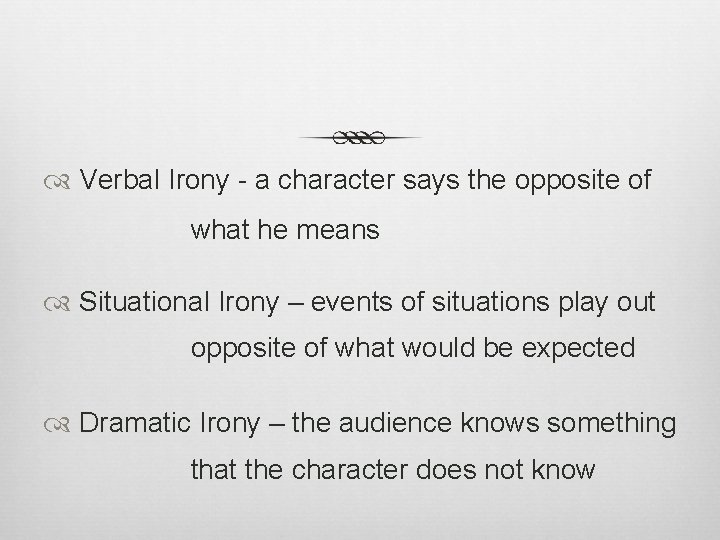
Irony A contrast between what is expected and what actually exists or happens. (A situation turns out exactly opposite of what you would expect. )
Verbal Irony - a character says the opposite of what he means Situational Irony – events of situations play out opposite of what would be expected Dramatic Irony – the audience knows something that the character does not know
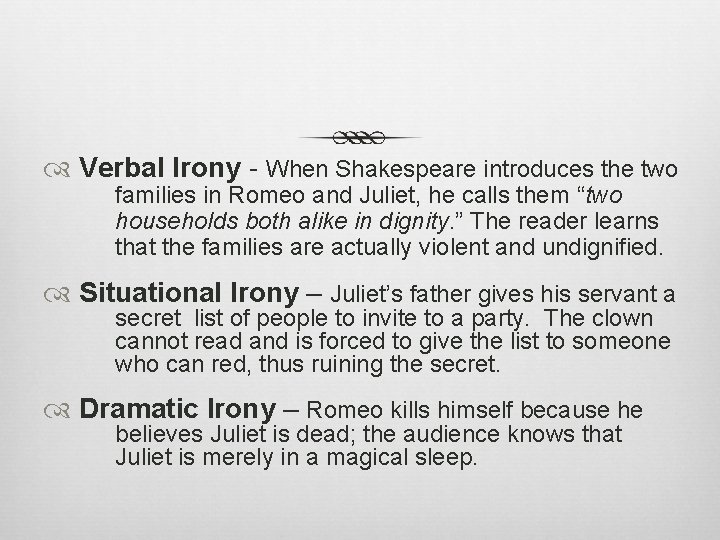
Verbal Irony - When Shakespeare introduces the two families in Romeo and Juliet, he calls them “two households both alike in dignity. ” The reader learns that the families are actually violent and undignified. Situational Irony – Juliet’s father gives his servant a secret list of people to invite to a party. The clown cannot read and is forced to give the list to someone who can red, thus ruining the secret. Dramatic Irony – Romeo kills himself because he believes Juliet is dead; the audience knows that Juliet is merely in a magical sleep.
Metaphor A comparison of two things that have some quality in common. Unlike a simile, a metaphor does not contain an explicit word of comparison such as “like” or “as. ”
“And each separate dying ember wrought its ghost upon the floor. ” Poe is comparing the shadows made by the dying fire to ghosts, but he does not use the words like or as.
Mood The feeling a literary work gives to the readers
Ah, distinctly I remember it was in the bleak December, And each separate dying ember wrought its ghost upon the floor These words create a depressed, eerie mood
Oxymoron A combination of opposite words used to create a literary effect
In “The Raven, ” “fantastic terrors” is an example of oxymoron. (third stanza, second line)
Paradox A statement that seems to contradict itself but is, nevertheless, true
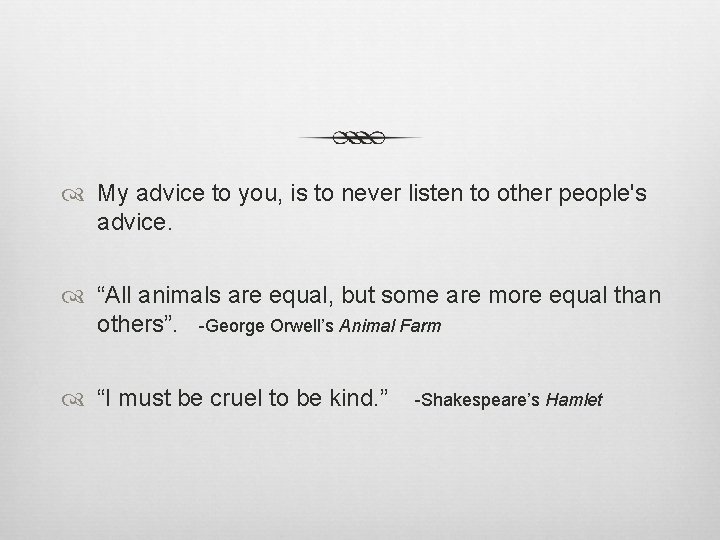
My advice to you, is to never listen to other people's advice. “All animals are equal, but some are more equal than others”. -George Orwell’s Animal Farm “I must be cruel to be kind. ” -Shakespeare’s Hamlet
Personification Giving human qualities, ideas or characteristics or non-human entities
The wind stood up and gave a shout. He whistled on his fingers and Kicked the withered leaves about And thumped the branches with his hand. from James Stephen’s The Wind
Simile A comparison of two things that have some quality in common. In a simile, the comparison is expressed by means of a word such as “like, ” or “as. ”
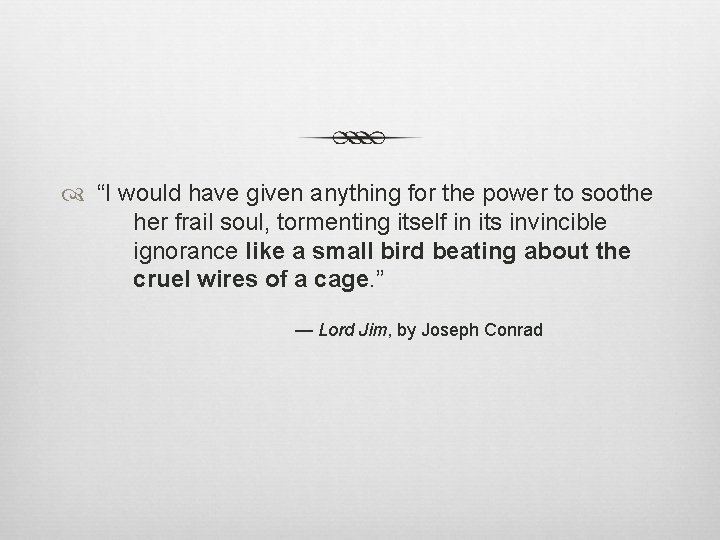
“I would have given anything for the power to soothe her frail soul, tormenting itself in its invincible ignorance like a small bird beating about the cruel wires of a cage. ” — Lord Jim, by Joseph Conrad
Symbolism The use of objects, figures or marks to represent other concepts or ideas
Symbols referring to damnation: Fire, flames, heat Symbols referring to salvation: Crosses, angels, haloes, clouds, churches Symbols referring to reincarnation or reinvention: Phoenix rising from flames, rainbows, passing storms, dawn, sunrise Symbols referring to death or endings: Gravestones, cemeteries, Grim Reaper, skulls, candle blowing out, coffin