
Edexcel Geography Alevel The Water Cycle and Water
- Slides: 11
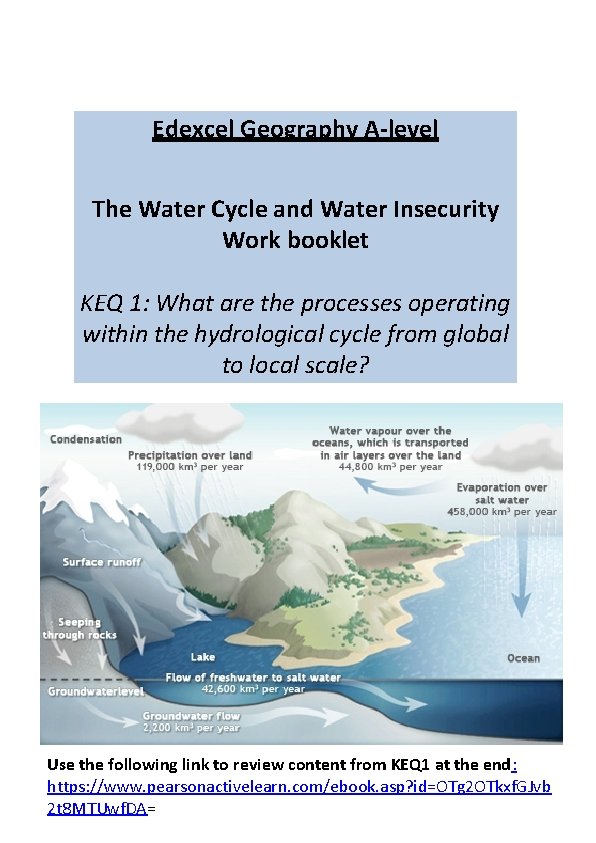
Edexcel Geography A-level The Water Cycle and Water Insecurity Work booklet KEQ 1: What are the processes operating within the hydrological cycle from global to local scale? Use the following link to review content from KEQ 1 at the end: https: //www. pearsonactivelearn. com/ebook. asp? id=OTg 2 OTkxf. GJvb 2 t 8 MTUwf. DA=
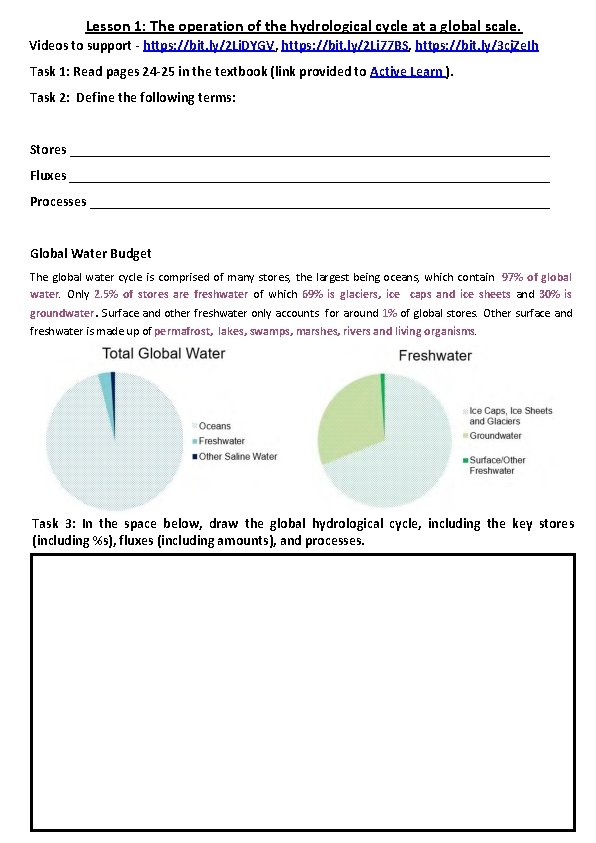
Lesson 1: The operation of the hydrological cycle at a global scale. Videos to support - https: //bit. ly/2 Li. DYGV, https: //bit. ly/2 Li 77 BS, https: //bit. ly/3 cj. Ze. Ih Task 1: Read pages 24 -25 in the textbook (link provided to Active Learn ). Task 2: Define the following terms: Stores ___________________________________ Fluxes ___________________________________ Processes _________________________________ Global Water Budget The global water cycle is comprised of many stores, the largest being oceans, which contain 97% of global water. Only 2. 5% of stores are freshwater of which 69% is glaciers, ice caps and ice sheets and 30% is groundwater. Surface and other freshwater only accounts for around 1% of global stores. Other surface and freshwater is made up of permafrost, lakes, swamps, marshes, rivers and living organisms. Task 3: In the space below, draw the global hydrological cycle, including the key stores (including %s), fluxes (including amounts), and processes.
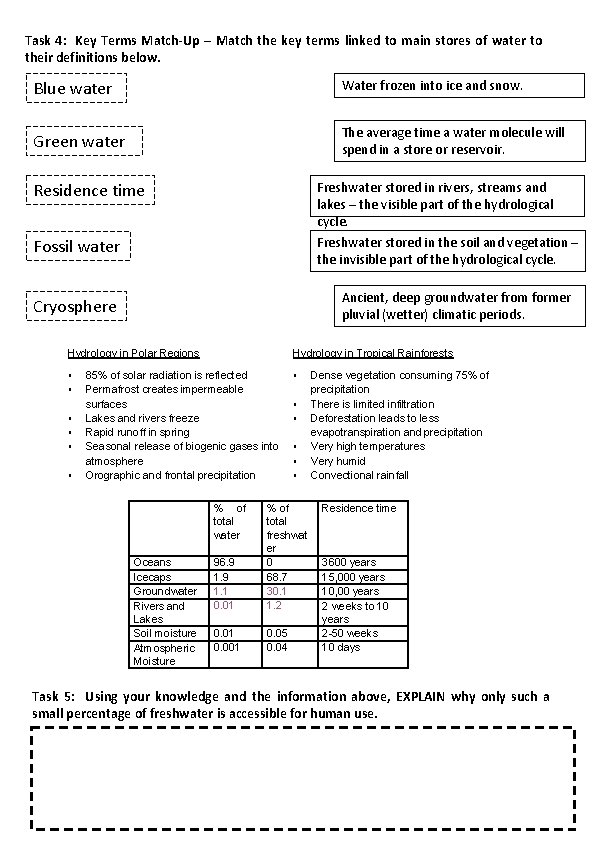
Task 4: Key Terms Match-Up – Match the key terms linked to main stores of water to their definitions below. Blue water Water frozen into ice and snow. Green water The average time a water molecule will spend in a store or reservoir. Residence time Freshwater stored in rivers, streams and lakes – the visible part of the hydrological cycle. Fossil water Freshwater stored in the soil and vegetation – the invisible part of the hydrological cycle. Ancient, deep groundwater from former pluvial (wetter) climatic periods. Cryosphere Hydrology in Polar Regions Hydrology in Tropical Rainforests ▪ ▪ ▪ ▪ 85% of solar radiation is reflected Permafrost creates impermeable surfaces Lakes and rivers freeze Rapid runoff in spring Seasonal release of biogenic gases into atmosphere Orographic and frontal precipitation % of total water Oceans Icecaps Groundwater Rivers and Lakes Soil moisture Atmospheric Moisture ▪ ▪ ▪ 96. 9 1. 1 0. 01 % of total freshwat er 0 68. 7 30. 1 1. 2 0. 01 0. 05 0. 04 Dense vegetation consuming 75% of precipitation There is limited infiltration Deforestation leads to less evapotranspiration and precipitation Very high temperatures Very humid Convectional rainfall Residence time 3600 years 15, 000 years 10, 00 years 2 weeks to 10 years 2 -50 weeks 10 days Task 5: Using your knowledge and the information above, EXPLAIN why only such a small percentage of freshwater is accessible for human use.
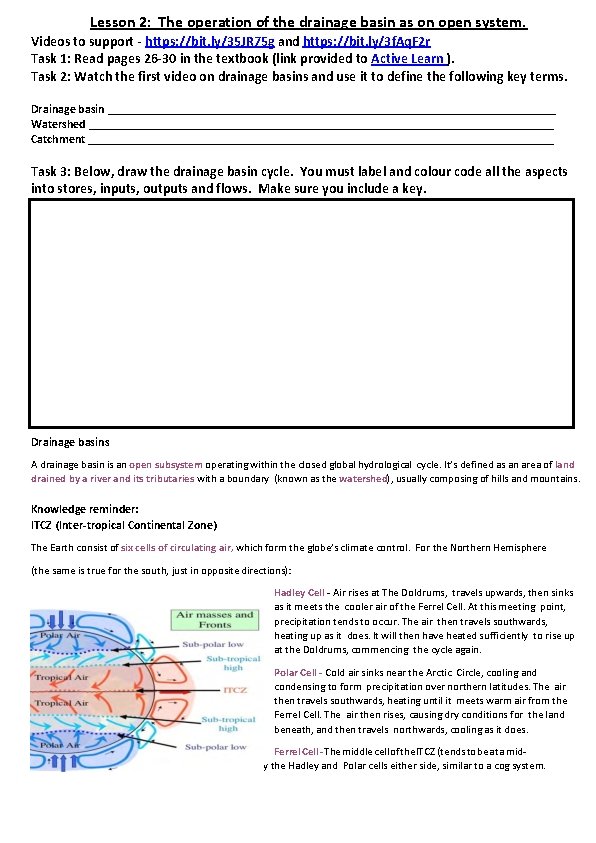
Lesson 2: The operation of the drainage basin as on open system. Videos to support - https: //bit. ly/35 JR 75 g and https: //bit. ly/3 f. Aq. F 2 r Task 1: Read pages 26 -30 in the textbook (link provided to Active Learn ). Task 2: Watch the first video on drainage basins and use it to define the following key terms. Drainage basin ______________________________________ Watershed _______________________________________ Catchment _______________________________________ Task 3: Below, draw the drainage basin cycle. You must label and colour code all the aspects into stores, inputs, outputs and flows. Make sure you include a key. Drainage basins A drainage basin is an open subsystem operating within the closed global hydrological cycle. It’s defined as an area of land drained by a river and its tributaries with a boundary (known as the watershed), usually composing of hills and mountains. Knowledge reminder: ITCZ (Inter-tropical Continental Zone) The Earth consist of six cells of circulating air, which form the globe’s climate control. For the Northern Hemisphere (the same is true for the south, just in opposite directions): Hadley Cell - Air rises at The Doldrums, travels upwards, then sinks as it meets the cooler air of the Ferrel Cell. At this meeting point, precipitation tends to occur. The air then travels southwards, heating up as it does. It will then have heated sufficiently to rise up at the Doldrums, commencing the cycle again. Polar Cell - Cold air sinks near the Arctic Circle, cooling and condensing to form precipitation over northern latitudes. The air then travels southwards, heating until it meets warm air from the Ferrel Cell. The air then rises, causing dry conditions for the land beneath, and then travels northwards, cooling as it does. Ferrel Cell - The middle cell of the. ITCZ (tends to be at a midlatitude location). The air circulation is determined by the Hadley and Polar cells either side, similar to a cog system.
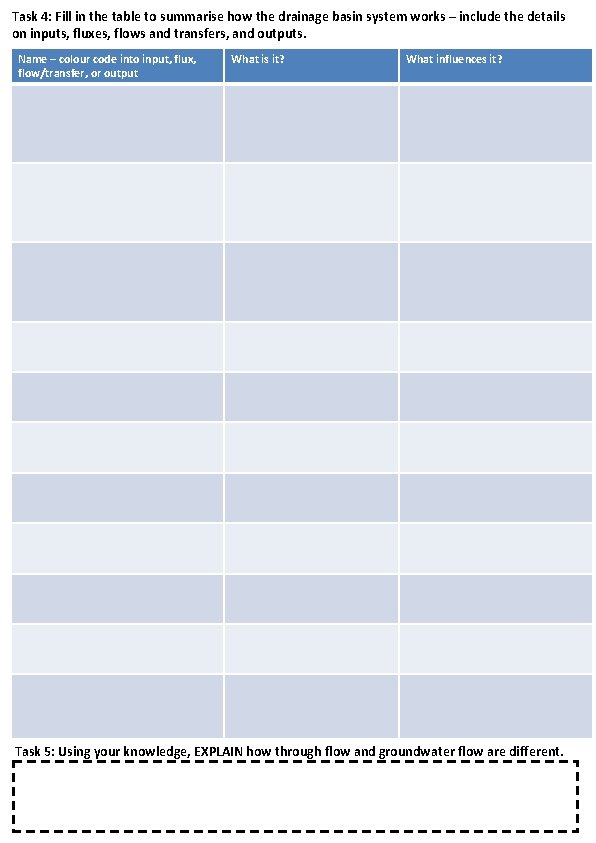
Task 4: Fill in the table to summarise how the drainage basin system works – include the details on inputs, fluxes, flows and transfers, and outputs. Name – colour code into input, flux, flow/transfer, or output What is it? What influences it? Task 5: Using your knowledge, EXPLAIN how through flow and groundwater flow are different.
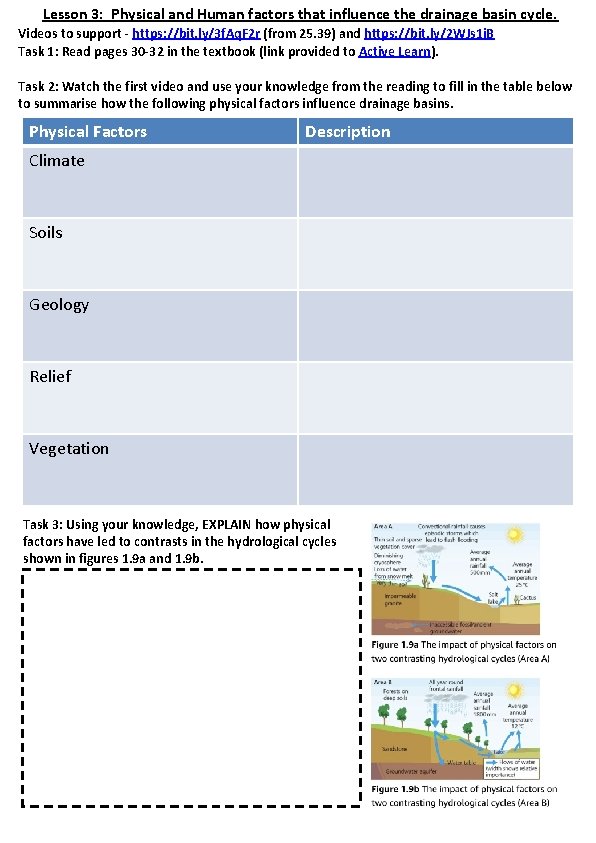
Lesson 3: Physical and Human factors that influence the drainage basin cycle. Videos to support - https: //bit. ly/3 f. Aq. F 2 r (from 25. 39) and https: //bit. ly/2 WJs 1 i. B Task 1: Read pages 30 -32 in the textbook (link provided to Active Learn). Task 2: Watch the first video and use your knowledge from the reading to fill in the table below to summarise how the following physical factors influence drainage basins. Physical Factors Description Climate Soils Geology Relief Vegetation Task 3: Using your knowledge, EXPLAIN how physical factors have led to contrasts in the hydrological cycles shown in figures 1. 9 a and 1. 9 b.
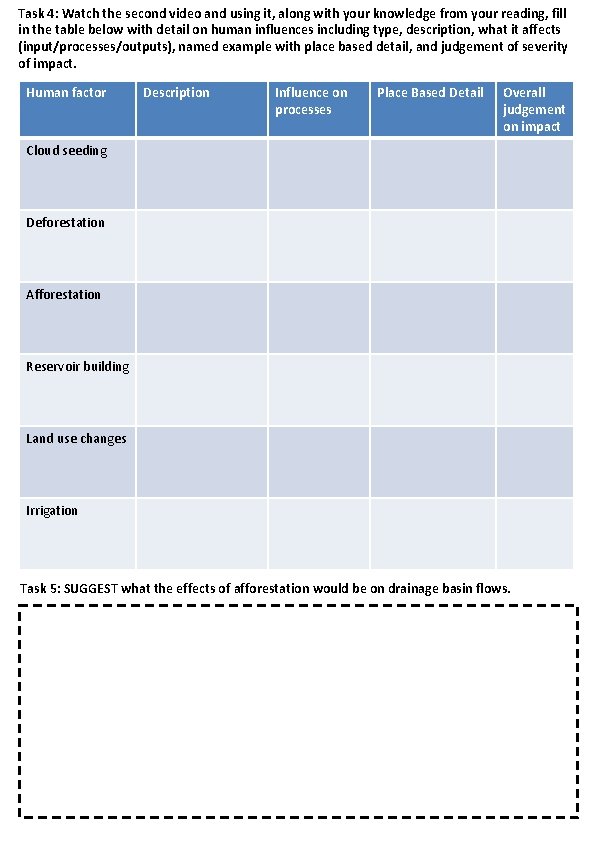
Task 4: Watch the second video and using it, along with your knowledge from your reading, fill in the table below with detail on human influences including type, description, what it affects (input/processes/outputs), named example with place based detail, and judgement of severity of impact. Human factor Description Influence on processes Place Based Detail Overall judgement on impact Cloud seeding Deforestation Afforestation Reservoir building Land use changes Irrigation Task 5: SUGGEST what the effects of afforestation would be on drainage basin flows.
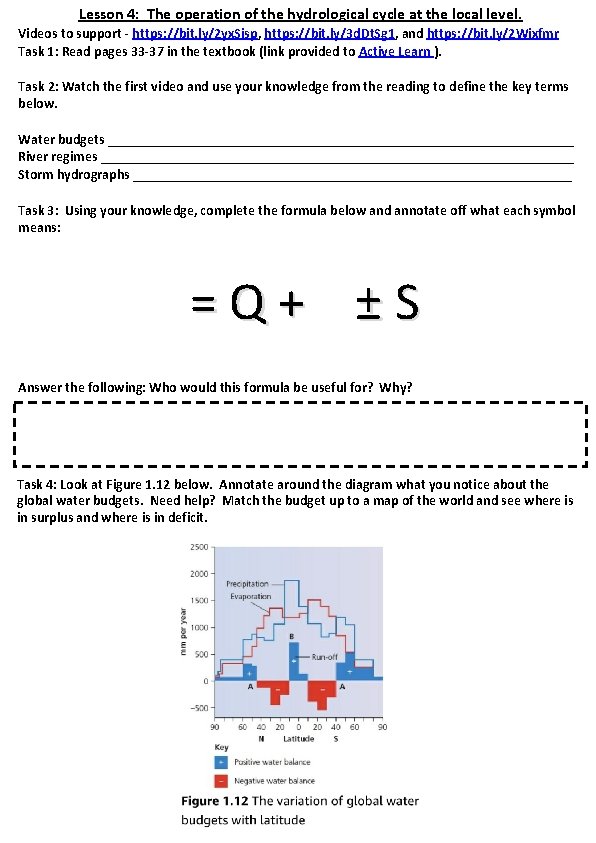
Lesson 4: The operation of the hydrological cycle at the local level. Videos to support - https: //bit. ly/2 yx. Sisp, https: //bit. ly/3 d. Dt. Sg 1, and https: //bit. ly/2 Wixfmr Task 1: Read pages 33 -37 in the textbook (link provided to Active Learn ). Task 2: Watch the first video and use your knowledge from the reading to define the key terms below. Water budgets __________________________________ River regimes __________________________________ Storm hydrographs ________________________________ Task 3: Using your knowledge, complete the formula below and annotate off what each symbol means: P=Q+E±S Answer the following: Who would this formula be useful for? Why? Task 4: Look at Figure 1. 12 below. Annotate around the diagram what you notice about the global water budgets. Need help? Match the budget up to a map of the world and see where is in surplus and where is in deficit.
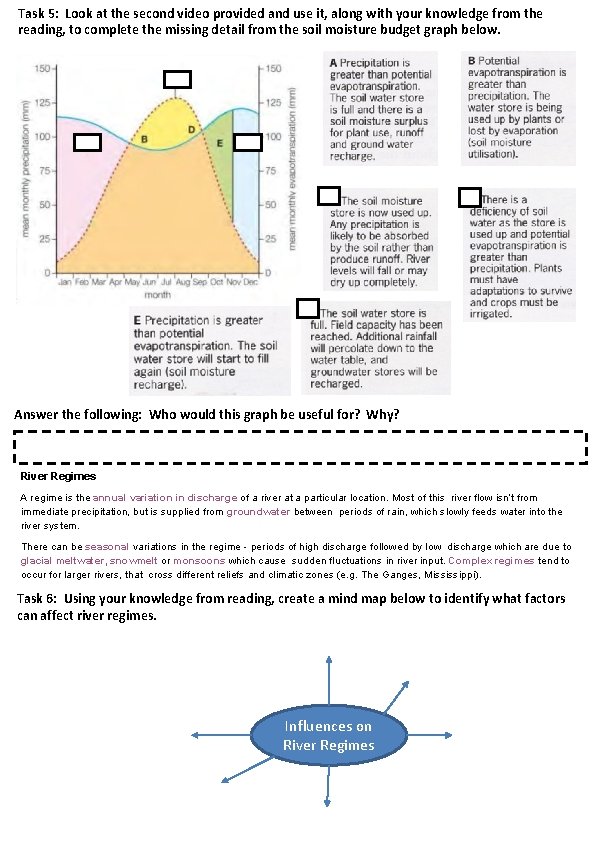
Task 5: Look at the second video provided and use it, along with your knowledge from the reading, to complete the missing detail from the soil moisture budget graph below. Answer the following: Who would this graph be useful for? Why? River Regimes A regime is the annual variation in discharge of a river at a particular location. Most of this river flow isn’t from immediate precipitation, but is supplied from groundwater between periods of rain, which slowly feeds water into the river system. There can be seasonal variations in the regime - periods of high discharge followed by low discharge which are due to glacial meltwater, snowmelt or monsoons which cause sudden fluctuations in river input. Complex regimes tend to occur for larger rivers, that cross different reliefs and climatic zones (e. g. The Ganges, Mississippi). Task 6: Using your knowledge from reading, create a mind map below to identify what factors can affect river regimes. Influences on River Regimes
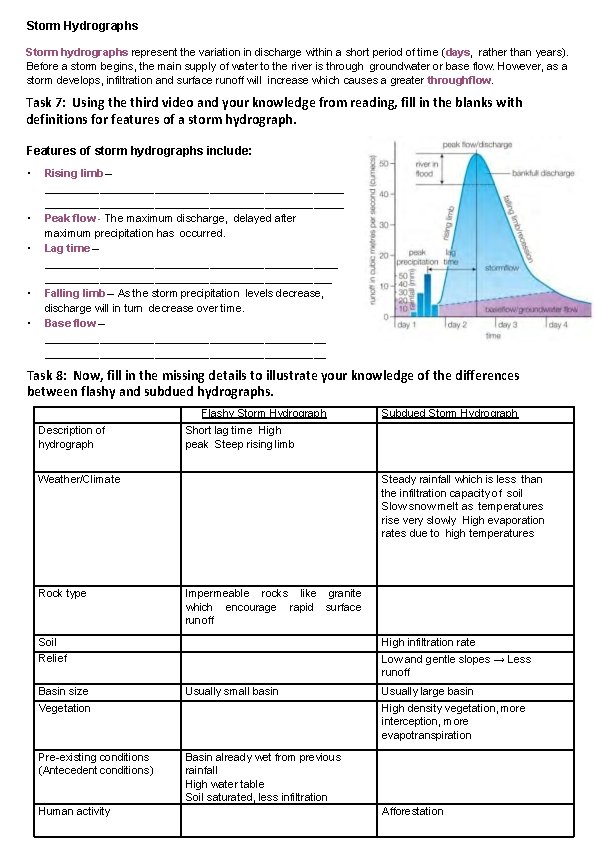
Storm Hydrographs Storm hydrographs represent the variation in discharge within a short period of time (days, rather than years). Before a storm begins, the main supply of water to the river is through groundwater or base flow. However, as a storm develops, infiltration and surface runoff will increase which causes a greater throughflow. Task 7: Using the third video and your knowledge from reading, fill in the blanks with definitions for features of a storm hydrograph. Features of storm hydrographs include: ▪ ▪ ▪ Rising limb – _________________________________________________ Peak flow - The maximum discharge, delayed after maximum precipitation has occurred. Lag time – ________________________ Falling limb – As the storm precipitation levels decrease, discharge will in turn decrease over time. Base flow – ______________________________________________ Task 8: Now, fill in the missing details to illustrate your knowledge of the differences between flashy and subdued hydrographs. Flashy Storm Hydrograph Description of hydrograph Short lag time High peak Steep rising limb Weather/Climate Rock type Subdued Storm Hydrograph Steady rainfall which is less than the infiltration capacity of soil Slow snow melt as temperatures rise very slowly High evaporation rates due to high temperatures Impermeable rocks like granite which encourage rapid surface runoff Soil High infiltration rate Relief Low and gentle slopes → Less runoff Basin size Usually small basin Vegetation Pre-existing conditions (Antecedent conditions) Human activity Usually large basin High density vegetation, more interception, more evapotranspiration Basin already wet from previous rainfall High water table Soil saturated, less infiltration Afforestation
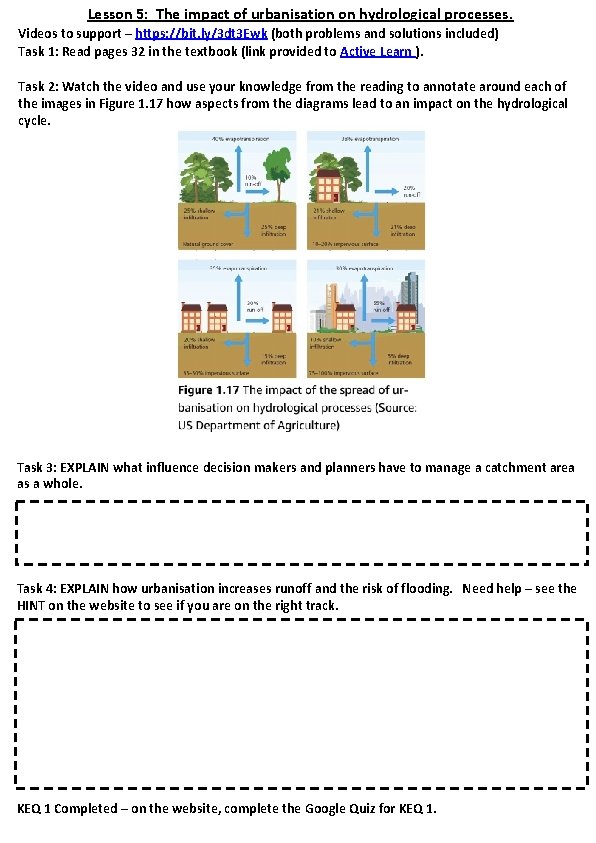
Lesson 5: The impact of urbanisation on hydrological processes. Videos to support – https: //bit. ly/3 dt 3 Ewk (both problems and solutions included) Task 1: Read pages 32 in the textbook (link provided to Active Learn ). Task 2: Watch the video and use your knowledge from the reading to annotate around each of the images in Figure 1. 17 how aspects from the diagrams lead to an impact on the hydrological cycle. Task 3: EXPLAIN what influence decision makers and planners have to manage a catchment area as a whole. Task 4: EXPLAIN how urbanisation increases runoff and the risk of flooding. Need help – see the HINT on the website to see if you are on the right track. KEQ 1 Completed – on the website, complete the Google Quiz for KEQ 1.