
Edexcel Alevel Business Theme 1 1 3 Marketing
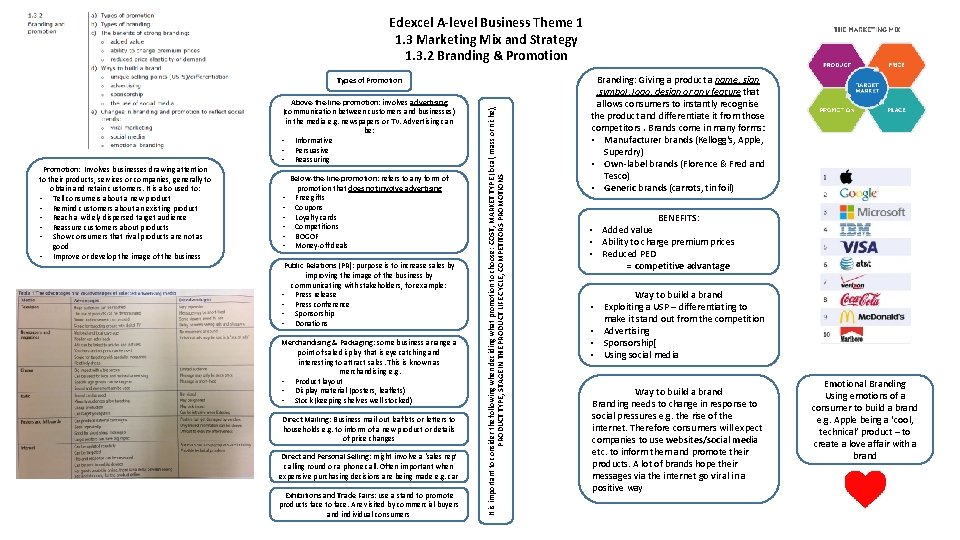
Edexcel A-level Business Theme 1 1. 3 Marketing Mix and Strategy 1. 3. 2 Branding & Promotion Above-the-line-promotion: involves advertising (communication between customers and businesses) in the media e. g. newspapers or TV. Advertising can be: • Informative • Persuasive • Reassuring Promotion: Involves businesses drawing attention to their products, services or companies, generally to obtain and retain customers. It is also used to: • Tell consumers about a new product • Remind customers about an existing product • Reach a widely dispersed target audience • Reassure customers about products • Show consumers that rival products are not as good • Improve or develop the image of the business • • • Below-the-line-promotion: refers to any form of promotion that does not involve advertising Free gifts Coupons Loyalty cards Competitions BOGOF Money-off deals Public Relations (PR): purpose is to increase sales by improving the image of the business by communicating with stakeholders, for example: • Press release • Press conference • Sponsorship • Donations Merchandising & Packaging: some business arrange a point of sale display that is eye catching and interesting to attract sales. This is known as merchandising e. g. • Product layout • Display material (posters, leaflets) • Stock (keeping shelves well stocked) Direct Mailing: Business mail out leaflets or letters to households e. g. to inform of a new product or details of price changes Direct and Personal Selling: might involve a ‘sales rep’ calling round or a phone call. Often important when expensive purchasing decisions are being made e. g. car Exhibitions and Trade Fairs: use a stand to promote products face to face. Are visited by commercial buyers and individual consumers It is important to consider the following when deciding what promotion to choose: COST, MARKET TYPE (local, mass or niche), PRODUCT TYPE, STAGE IN THE PRODUCT LIFE CYCLE, COMPETITORS PROMOTIONS Types of Promotion Branding: Giving a product a name, sign , symbol, logo, design or any feature that allows consumers to instantly recognise the product and differentiate it from those competitors. Brands come in many forms: • Manufacturer brands (Kellogg's, Apple, Superdry) • Own-label brands (Florence & Fred and Tesco) • Generic brands (carrots, tin foil) BENEFITS: • Added value • Ability to charge premium prices • Reduced PED = competitive advantage Way to build a brand • Exploiting a USP – differentiating to make it stand out from the competition • Advertising • Sponsorship[ • Using social media Way to build a brand Branding needs to change in response to social pressures e. g. the rise of the internet. Therefore consumers will expect companies to use websites/social media etc. to inform them and promote their products. A lot of brands hope their messages via the internet go viral in a positive way Emotional Branding Using emotions of a consumer to build a brand e. g. Apple being a ‘cool, technical’ product – to create a love affair with a brand
- Slides: 1