
Edexcel A 2 Business 3 3 1 Quantitative
Edexcel A 2 Business 3. 3. 1 Quantitative sales forecasting Revisionstation
Worksheet
From Edexcel a) Calculation of time-series analysis: • moving averages (three period/four quarter) b) Interpretation of scatter graphs and line of best fit – extrapolation of past data to future c) Limitations of quantitative sales forecasting techniques
Starter • Which two months of the year are you likely to have the most money?
Calculators will be needed for this topic
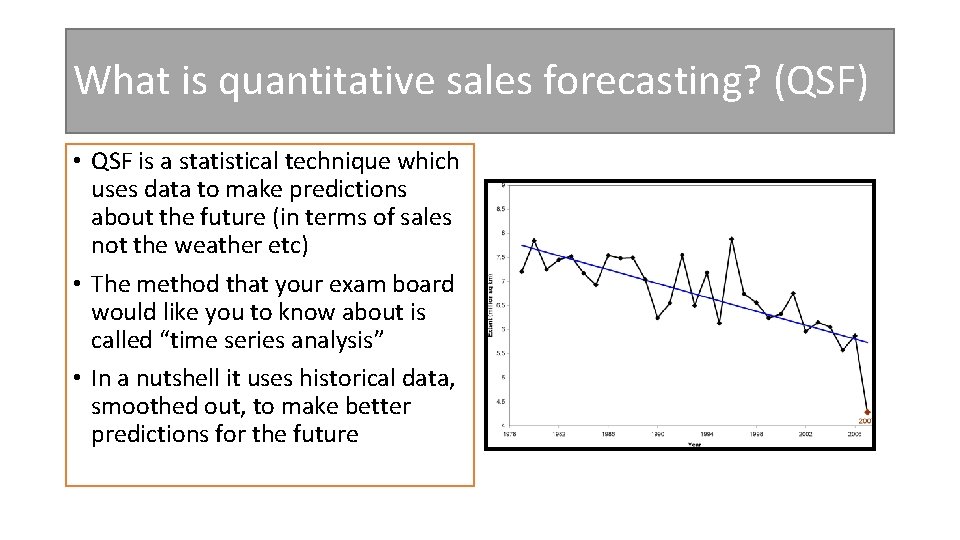
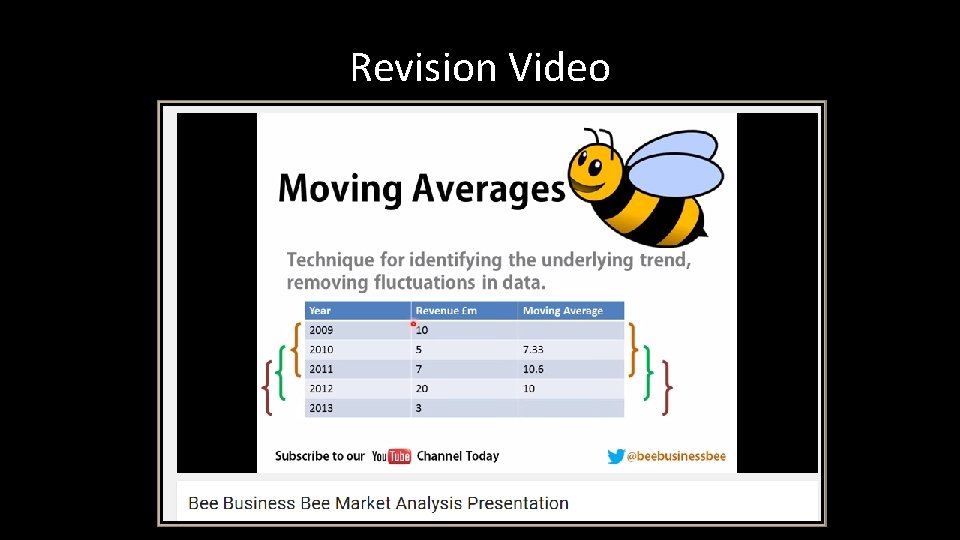
What is quantitative sales forecasting? (QSF) • QSF is a statistical technique which uses data to make predictions about the future (in terms of sales not the weather etc) • The method that your exam board would like you to know about is called “time series analysis” • In a nutshell it uses historical data, smoothed out, to make better predictions for the future
What can a business do with QSF information? • Once a business has carried out time series analysis they will use this information to; • Organise production • Organise resources in the business e. g. employees, premises, raw materials • Organise marketing to back up the sales predictions
Calculations
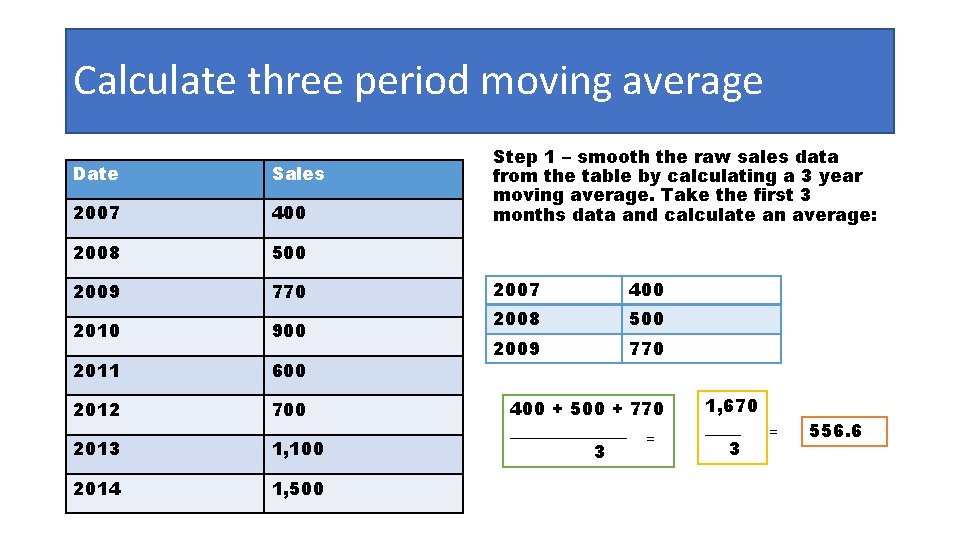
Calculate three period moving average Date Sales 2007 400 2008 500 2009 770 2010 900 2011 600 2012 700 2013 1, 100 2014 1, 500 Step 1 – smooth the raw sales data from the table by calculating a 3 year moving average. Take the first 3 months data and calculate an average: 2007 400 2008 500 2009 770 400 + 500 + 770 _______ = 3 1, 670 ____ = 3 556. 6
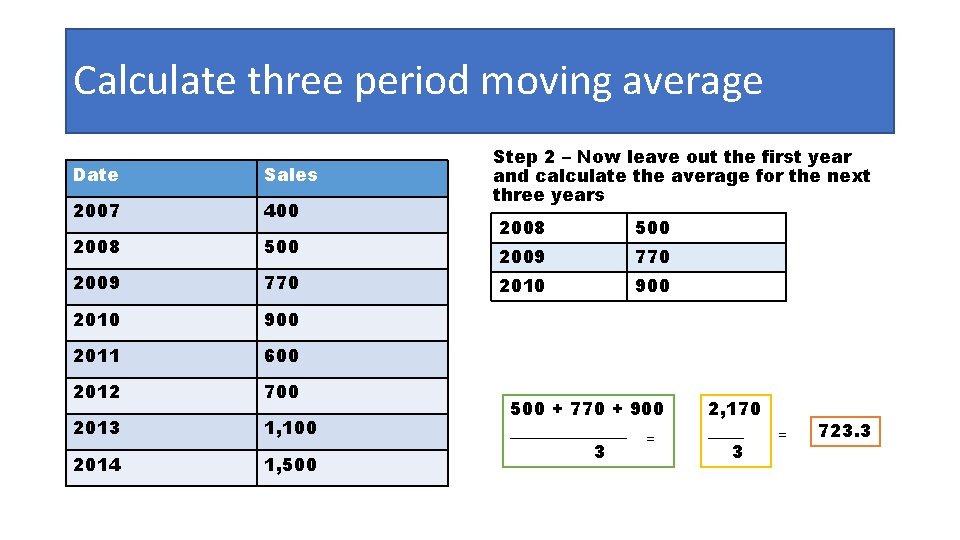
Calculate three period moving average Date Sales 2007 400 2008 500 2009 770 2010 900 2011 600 2012 700 2013 1, 100 2014 1, 500 Step 2 – Now leave out the first year and calculate the average for the next three years 2008 500 2009 770 2010 900 500 + 770 + 900 _______ = 3 2, 170 ____ = 3 723. 3

Calculate three period moving average Step 3 – Now add all your calculated averages to the table: Date Sales 3 year moving average 2007 400 2008 500 556. 6 2009 770 723. 3 2010 900 756. 6 2011 600 733. 3 2012 700 800 2013 1, 100 2014 1, 500 The new calculation goes next to the middle year
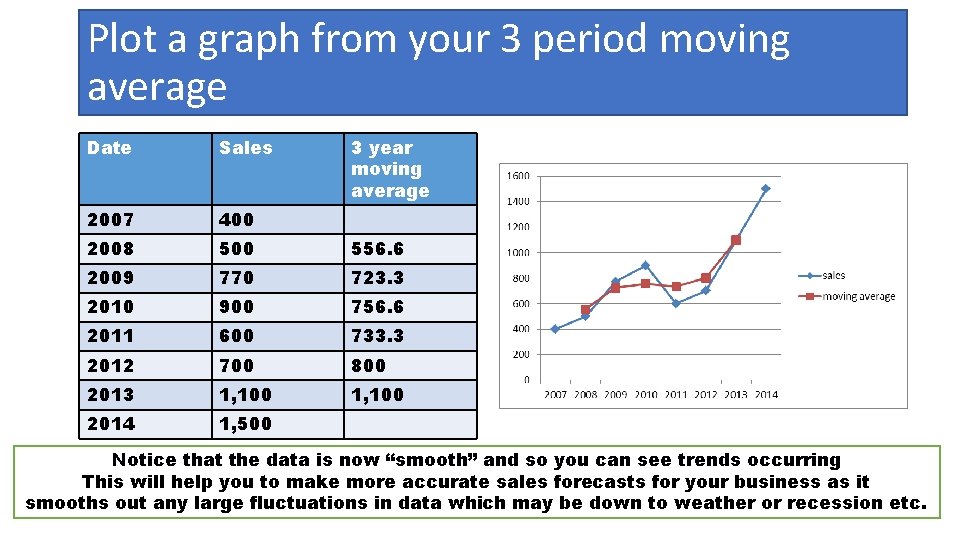
Plot a graph from your 3 period moving average Date Sales 3 year moving average 2007 400 2008 500 556. 6 2009 770 723. 3 2010 900 756. 6 2011 600 733. 3 2012 700 800 2013 1, 100 2014 1, 500 Notice that the data is now “smooth” and so you can see trends occurring This will help you to make more accurate sales forecasts for your business as it smooths out any large fluctuations in data which may be down to weather or recession etc.
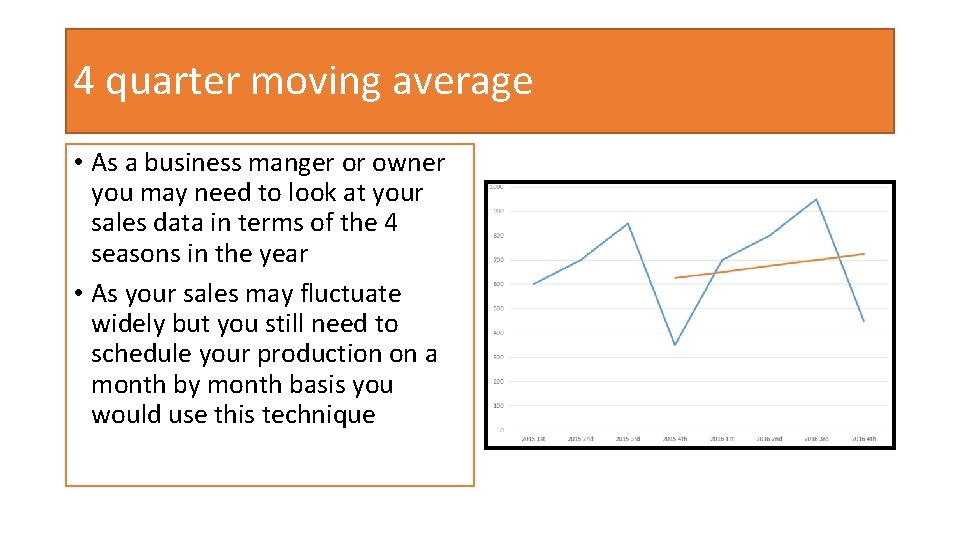
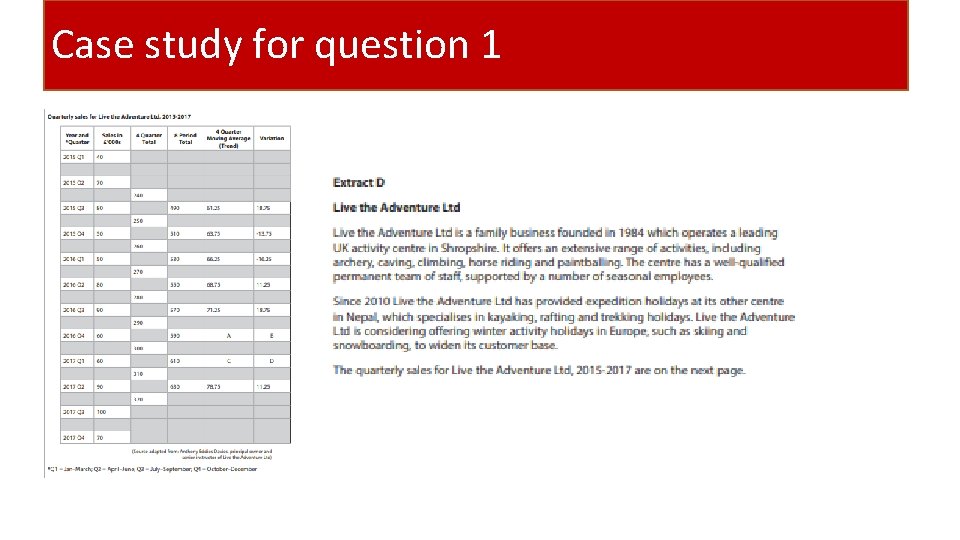
4 quarter moving average • As a business manger or owner you may need to look at your sales data in terms of the 4 seasons in the year • As your sales may fluctuate widely but you still need to schedule your production on a month by month basis you would use this technique
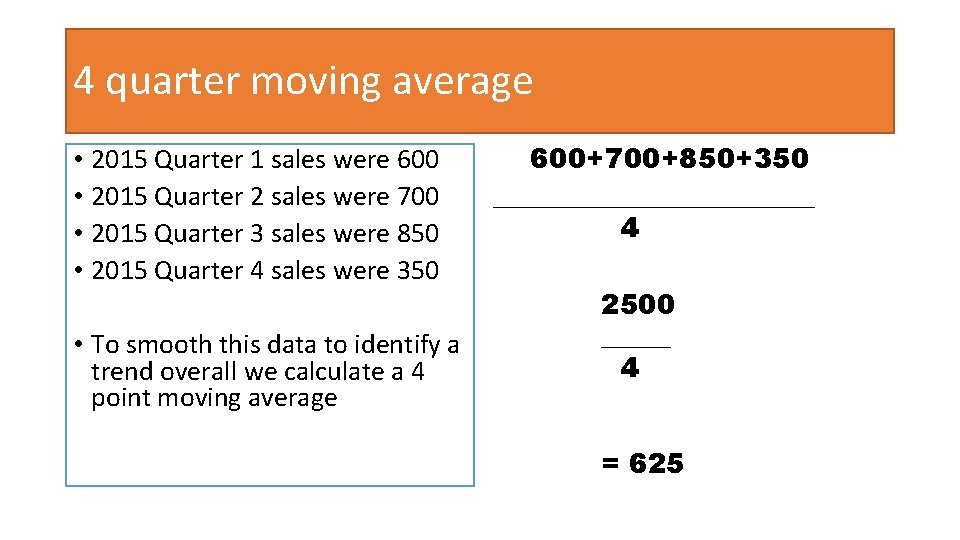
4 quarter moving average • 2015 Quarter 1 sales were 600 • 2015 Quarter 2 sales were 700 • 2015 Quarter 3 sales were 850 • 2015 Quarter 4 sales were 350 • To smooth this data to identify a trend overall we calculate a 4 point moving average 600+700+850+350 ____________ 4 2500 _____ 4 = 625
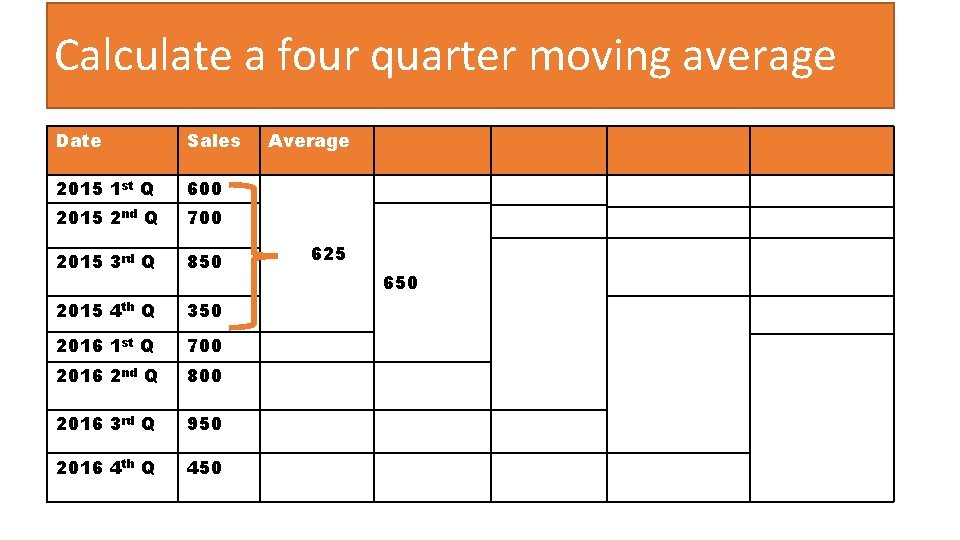
Calculate a four quarter moving average Date Sales 2015 1 st Q 600 2015 2 nd Q 700 2015 3 rd Q 850 2015 4 th Q 350 2016 1 st Q 700 2016 2 nd Q 800 2016 3 rd Q 950 2016 4 th Q 450 Average 625 650
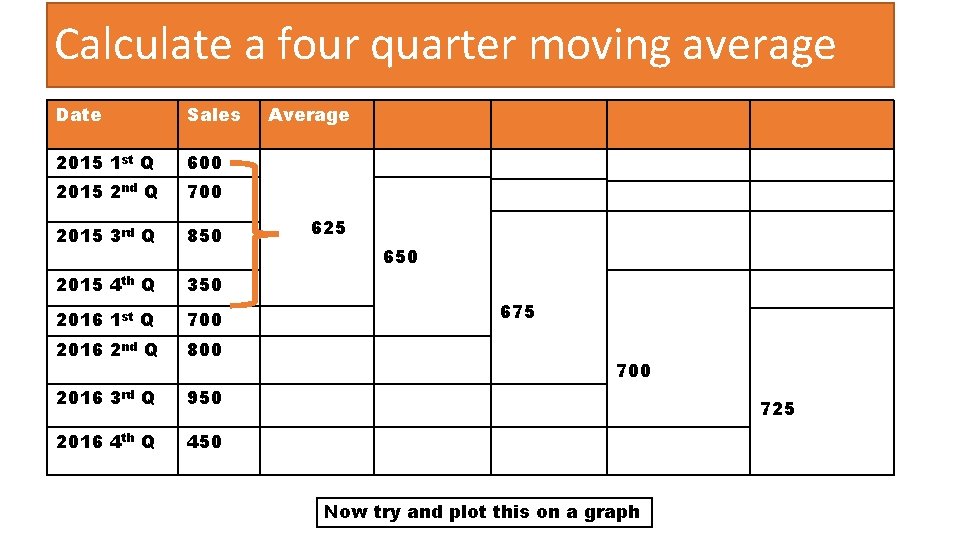
Calculate a four quarter moving average Date Sales 2015 1 st Q 600 2015 2 nd Q 700 2015 3 rd Q 850 2015 4 th Q 350 2016 1 st Q 700 2016 2 nd Q 800 2016 3 rd Q 950 2016 4 th Q 450 Average 625 650 675 700 725 Now try and plot this on a graph
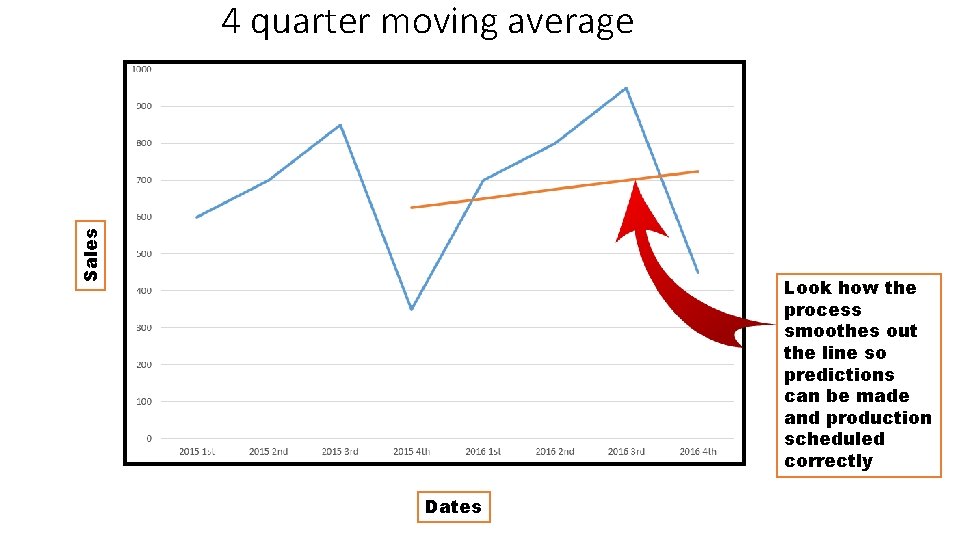
Sales 4 quarter moving average Look how the process smoothes out the line so predictions can be made and production scheduled correctly Dates
Interpretation
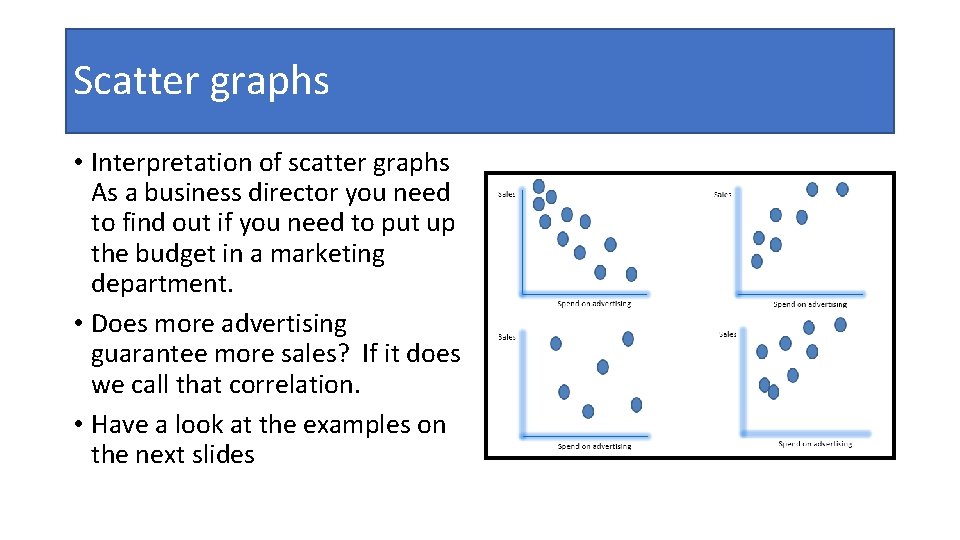
Scatter graphs • Interpretation of scatter graphs As a business director you need to find out if you need to put up the budget in a marketing department. • Does more advertising guarantee more sales? If it does we call that correlation. • Have a look at the examples on the next slides
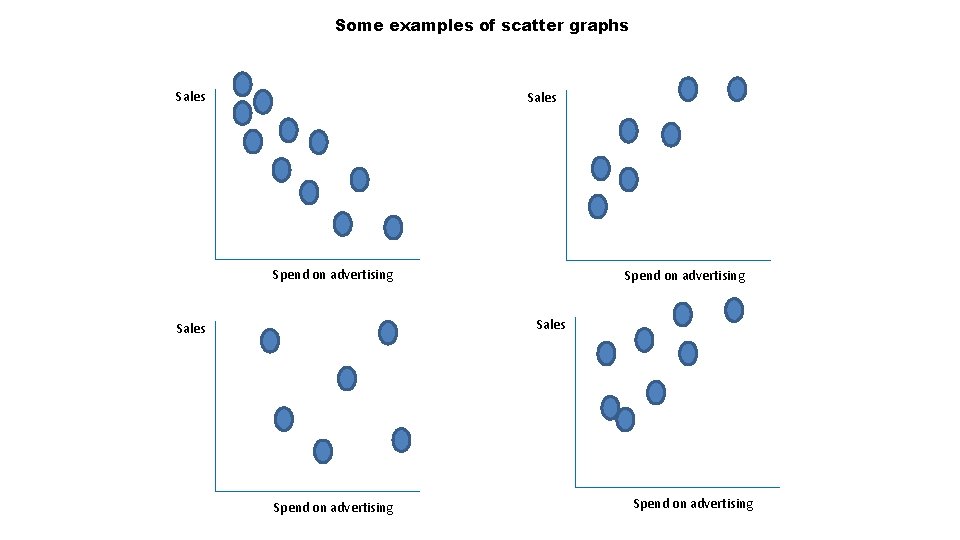
Some examples of scatter graphs Sales Spend on advertising
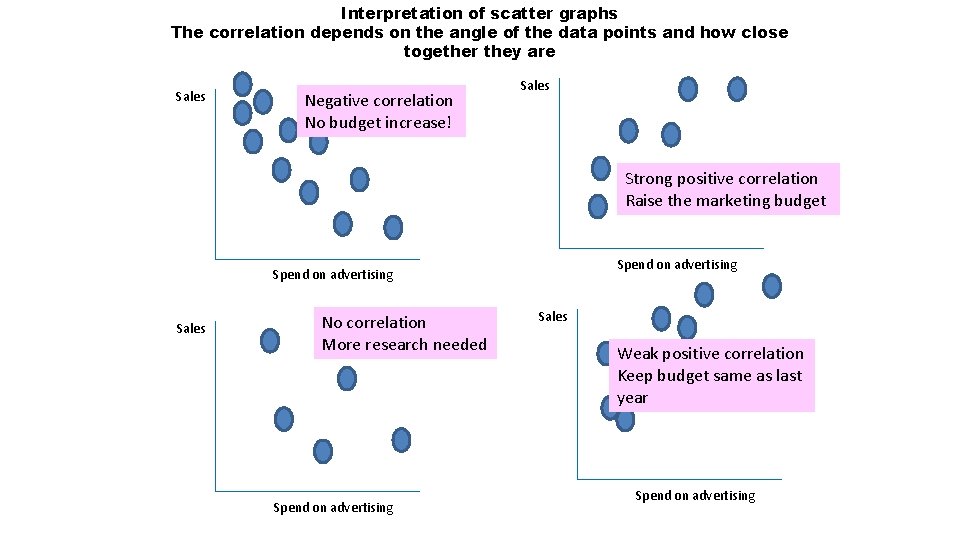
Interpretation of scatter graphs The correlation depends on the angle of the data points and how close together they are Sales Negative correlation No budget increase! Sales Strong positive correlation Raise the marketing budget Spend on advertising Sales No correlation More research needed Spend on advertising Sales Weak positive correlation Keep budget same as last year Spend on advertising
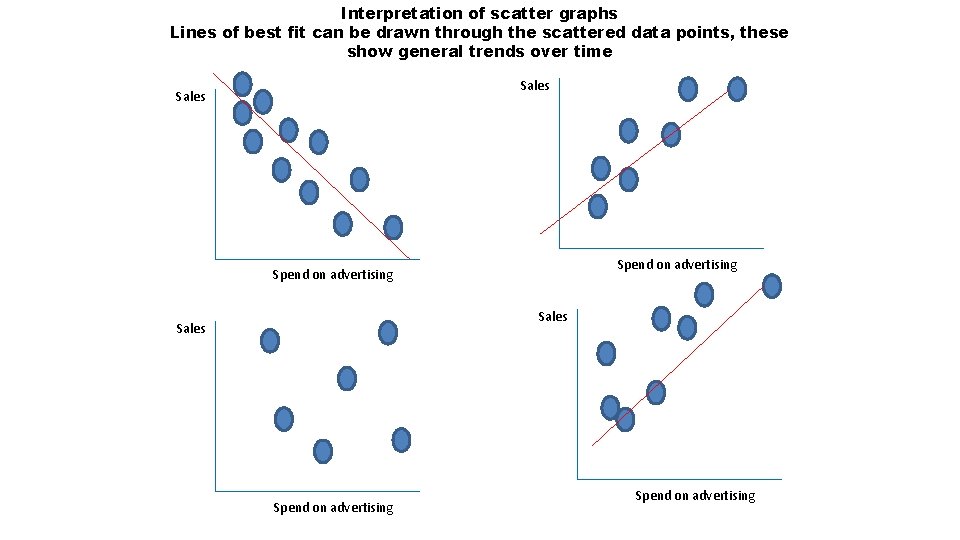
Interpretation of scatter graphs Lines of best fit can be drawn through the scattered data points, these show general trends over time Sales Spend on advertising
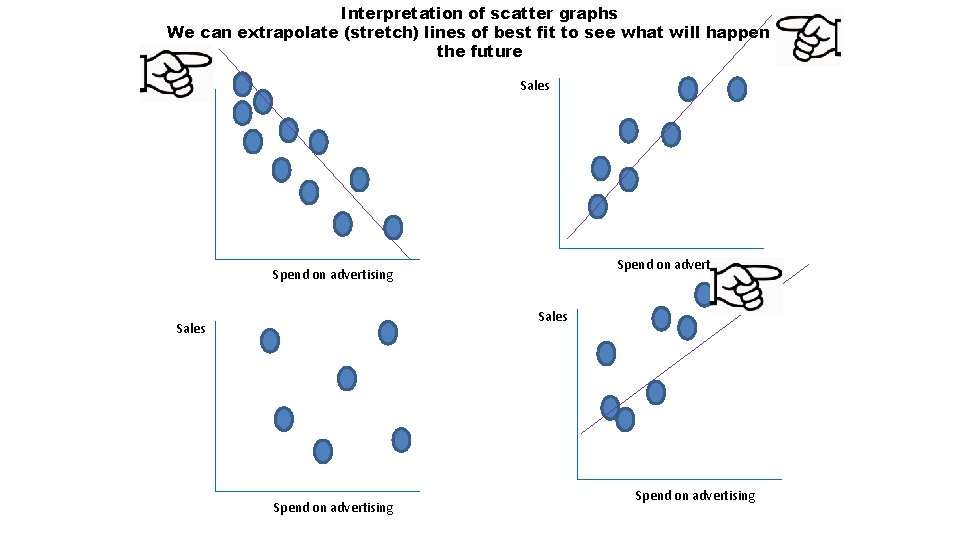
Interpretation of scatter graphs We can extrapolate (stretch) lines of best fit to see what will happen in the future Sales Spend on advertising

Limitations
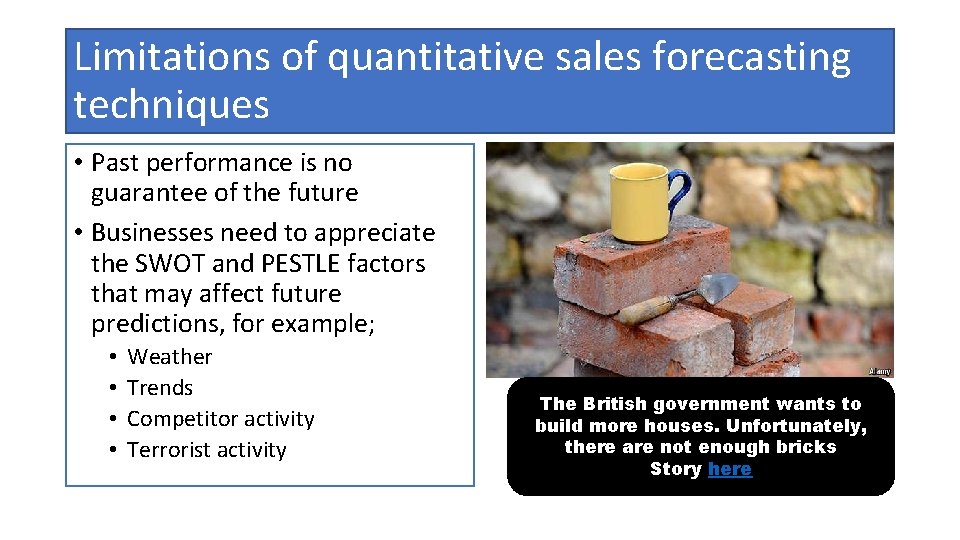
Limitations of quantitative sales forecasting techniques • Past performance is no guarantee of the future • Businesses need to appreciate the SWOT and PESTLE factors that may affect future predictions, for example; • • Weather Trends Competitor activity Terrorist activity The British government wants to build more houses. Unfortunately, there are not enough bricks Story here
More limitations • Relies on what has happened in the past continuing to happen, and historical data is not always a good indication of what might happen in the future • In high technology markets change happens rapidly and products have a short product life cycle, therefore extrapolation can be misleading • It is time-consuming and complex and is only as reliable as the data put in • Use of moving averages doesn’t take into account how recent the data is • Doesn’t link with corporate objectives
Revision Video

Sample Edexcel A 2 questions
Case study for question 1
Sample question 1 Level 1 1 -4 Level 2 5 -8 Level 3 9 -14 Level 4 15 -20
Answer sample question 1
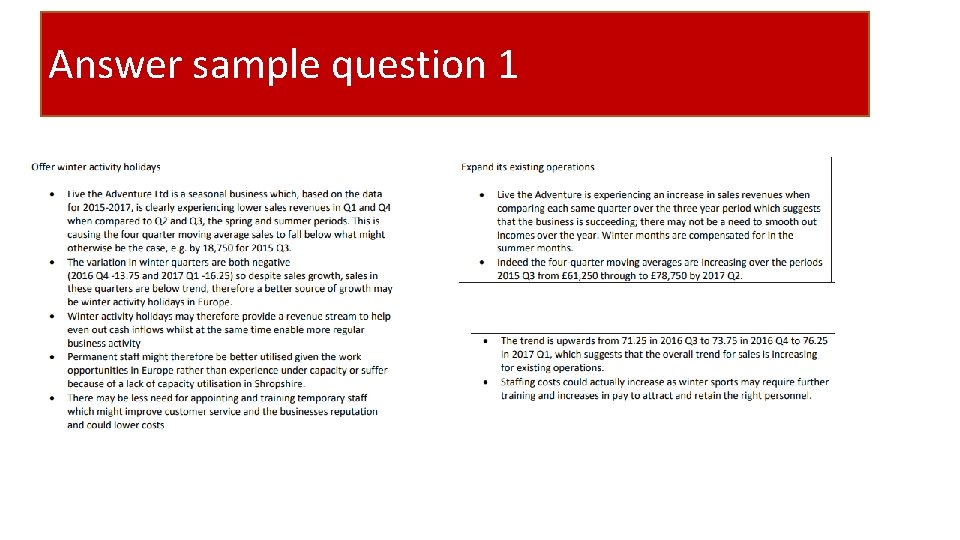
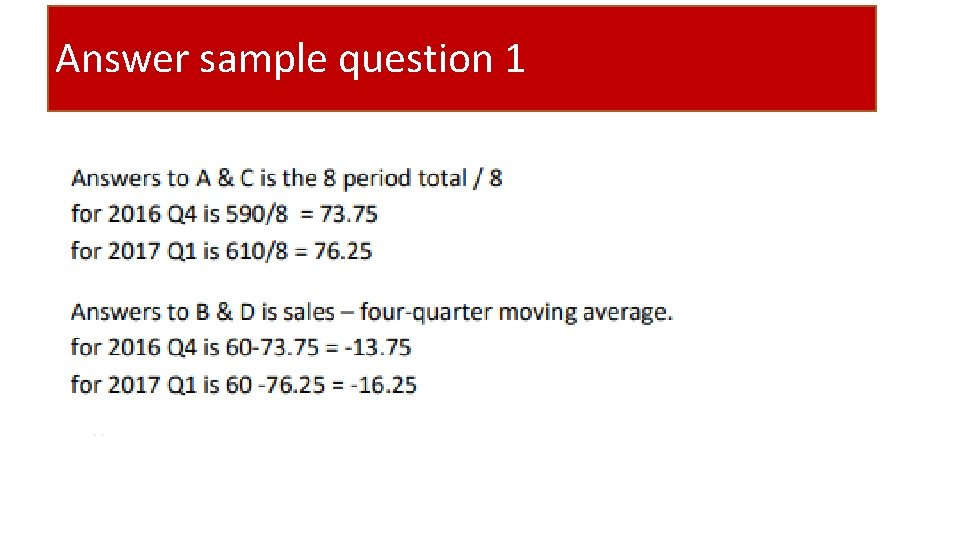
Answer sample question 1
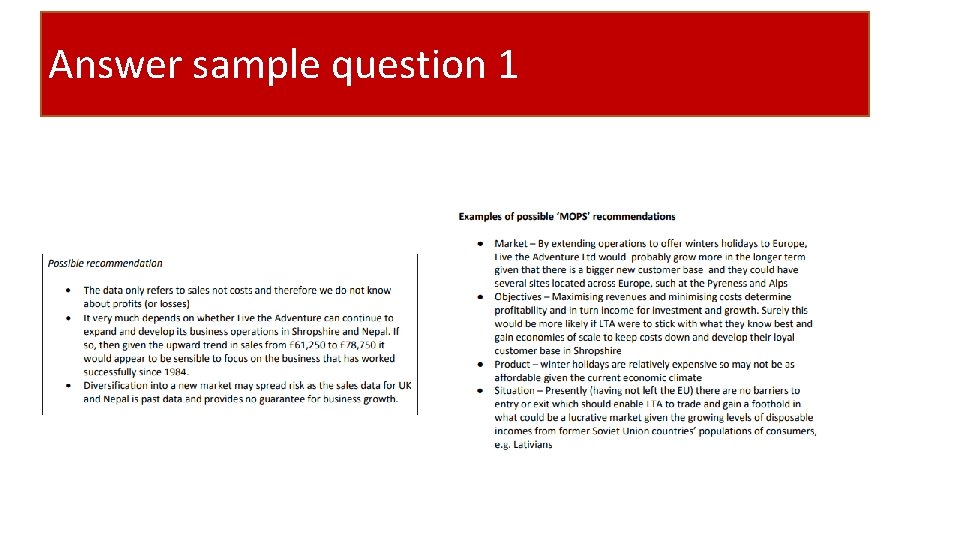
Answer sample question 1
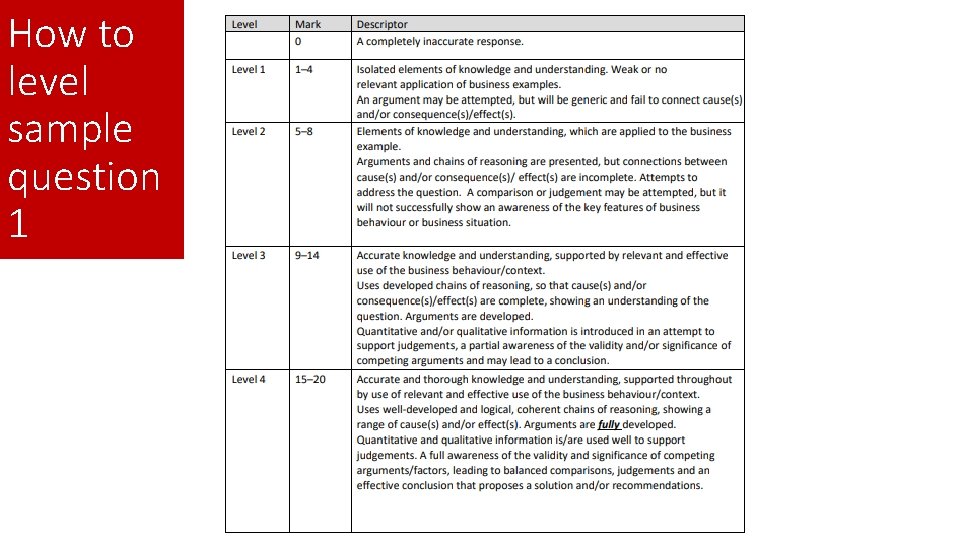
How to level sample question 1
Glossary • Time series analysis; a management tool to make predictions from past data • Scattergraph; a graph which shows the performance of one variable (sales) against another (spend on marketing) • Cyclical; Changes in the data due to large changes such as a recession • Correlation; a relationship between two sets of variables • Line of best fit; a line that can be drawn through a series of data to look for a trend • Extrapolation; When data is stretched out over a line of best fit to predict what will happen in the future

- Slides: 36