
Ed GCM Lab 1 Introducing Ed GCM ADD
Ed. GCM Lab 1: Introducing Ed. GCM [ADD YOUR COURSES DETAILS HERE]
Ed. GCM Lab 1 Agenda Familiarizing ourselves with Ed. GCM (20 min) Structured exploration of Ed. GCM (45 min)
Our Scientific Approach • As you explore Ed. GCM, you will practice one of the oldest scientific skills…OBSERVATION • To facilitate this, make sure you keep your journal open and write down anything you notice, even the smallest details!
Familiarizing Yourself with Ed. GCM 1. 2. 3. 4. 5. Can you open 4 D? How do the menu/buttons change as you click on different things? What do the DVD-like controls do? Can you start one of the existing scenarios running? Pause it? Stop it? What does clicking on the pencil do? The folder? The colorful blob? The image of Earth? 6. Can you run more than one simulation at once? 7. What happens to the circles next to each simulation name as the model runs? 8. When you have the setup simulation tab open, what do the “open all sections” and “close all sections” buttons do? 9. If you wanted to write a scientific article complete with maps and graphs produced by Ed. GCM, how would you do it? 10. What do we need to do to analyze our output? What is output? (Note: We do not yet have any output. ) 11. What is EVA for? How does it work?
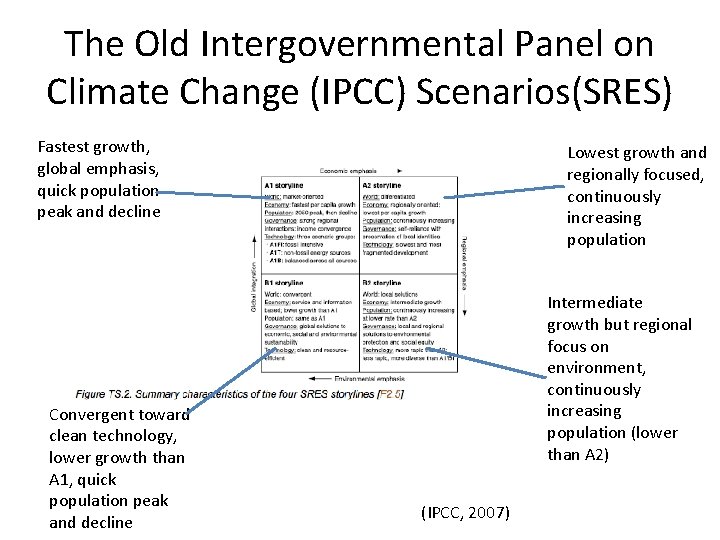
The Old Intergovernmental Panel on Climate Change (IPCC) Scenarios(SRES) Fastest growth, global emphasis, quick population peak and decline Convergent toward clean technology, lower growth than A 1, quick population peak and decline Lowest growth and regionally focused, continuously increasing population Intermediate growth but regional focus on environment, continuously increasing population (lower than A 2) (IPCC, 2007)
IPCC_A 1 F 1_CO 2 The IPCC's A 1 scenario family specifies a future world of very rapid economic growth, global population that peaks in mid-century and declines thereafter, and the rapid introduction of new and more efficient technologies. The A 1 FI illustrative scenario signifies an emphasis on fossil-fuel intensive sources of CO 2.
IPCC_B 2 The IPCC's B 2 scenario family specifies a future world in which the emphasis is on local solutions to economic, social and environmental sustainability. It is a world with increasing global population (at a rate lower than A 2), intermediate levels of economic development, and less rapid and more diverse technological change than the B 1 and A 1 storylines.
1) Why Are We Doing This? 2) Why Do Climate Scientists use Global Climate Models (GCMs)?
Why Are We Doing This? 1) To learn the methods climate scientists use to predict future climate changes. 2) To visualize what those changes could look like. 3) To better understand the factors which are causing climate change.
Why Do Scientists Use GCMs? 1) To understand present climate and what factors create a particular climate in any one region. 2) To project climatic conditions into the future. 3) As a tool to find out what natural processes or human activities may affect a region’s environment in the future.
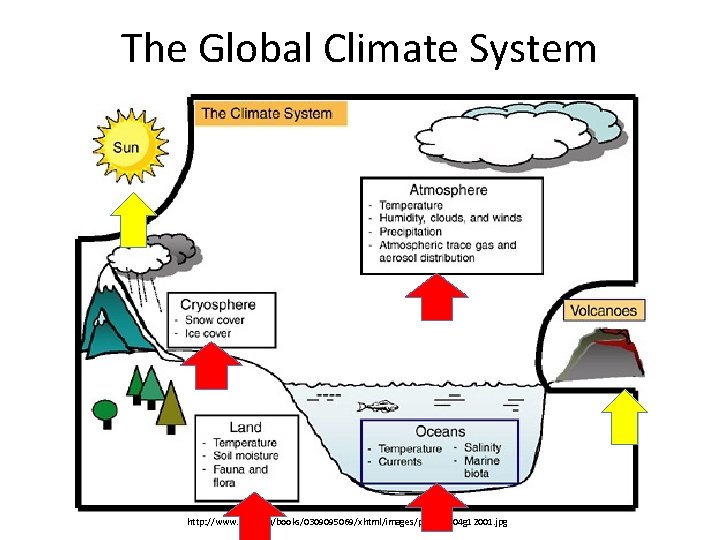
The Global Climate System http: //www. nap. edu/books/0309095069/xhtml/images/p 2000 c 604 g 12001. jpg
How Do We Consider the Ocean? Can you find this on the setup panel for Ed. GCM? An interesting side note: Early models did not couple together the ocean and atmosphere. They were separate models. We now refer to modern GCMs as an atmosphereocean coupled general circulation model.
Global Climate Models “Models are built to estimate trends rather than events. For example, a climate model can tell you it will be cold in winter, but it can’t tell you what the temperature will be on a specific day – that’s weather forecasting. Climate trends are weather, averaged out over time—usually 30 years. Trends are important because they eliminate—or "smooth out”—single events that may be extreme, but quite rare. ” -Graham Wayne

Starting Our Guided Exploration
Going Back to Running the Model… Let’s take 5 minutes to make sure we can all do this…I’ll show you first… 1. Why does the model stop at first? 2. What year and month does it start with? 3. Why does the model look like this? Why am I referring to just that window that opens when you push play? 4. Why does it take soooooo long?
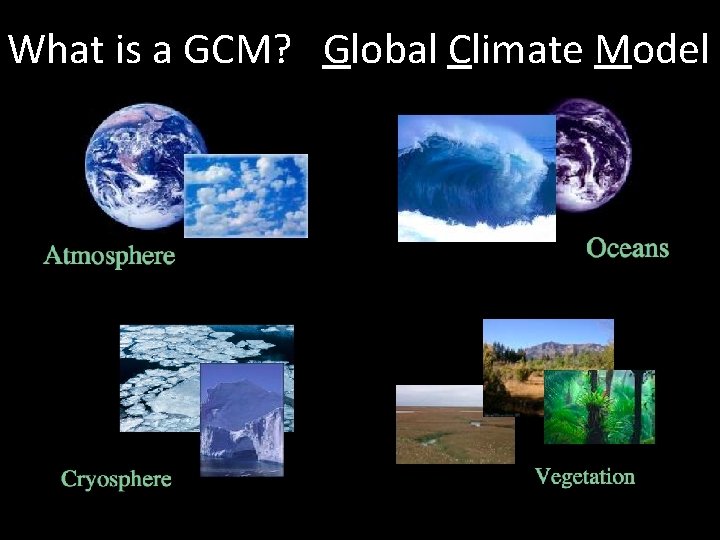
What is a GCM? Global Climate Model
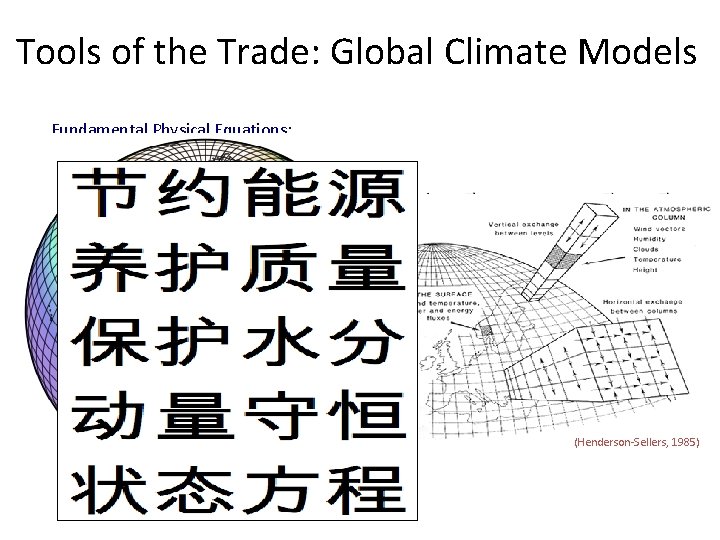
Tools of the Trade: Global Climate Models Fundamental Physical Equations: (Henderson-Sellers, 1985)
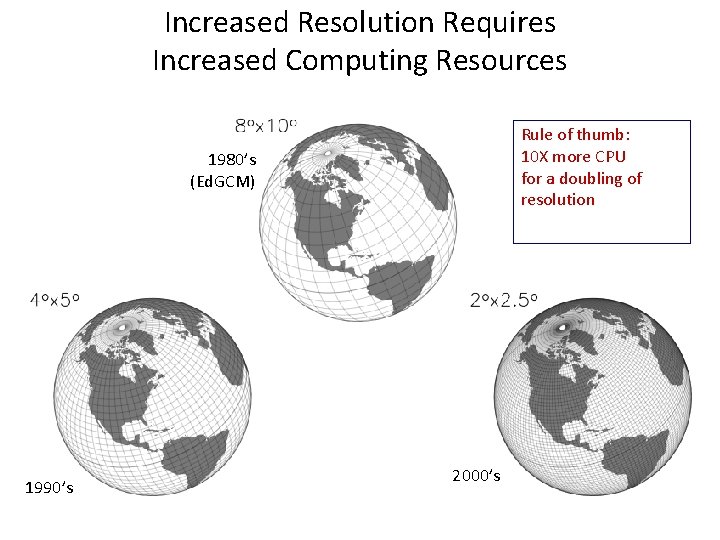
Increased Resolution Requires Increased Grid Resolution Increased Computing Resources Requires Increased Computing Power Rule of thumb: 10 X more CPU for a doubling of resolution 1980’s (Ed. GCM) 1990’s 2000’s
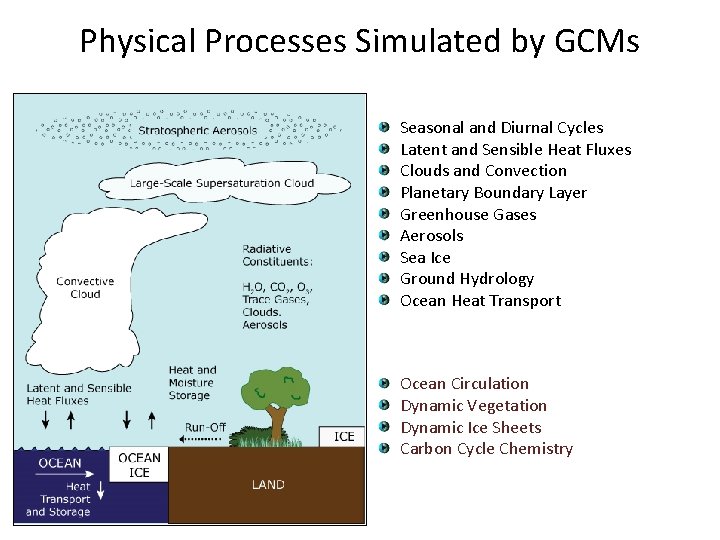
Physical Processes Simulated by GCMs Seasonal and Diurnal Cycles Latent and Sensible Heat Fluxes Clouds and Convection Planetary Boundary Layer Greenhouse Gases Aerosols Sea Ice Ground Hydrology Ocean Heat Transport Ocean Circulation Dynamic Vegetation Dynamic Ice Sheets Carbon Cycle Chemistry
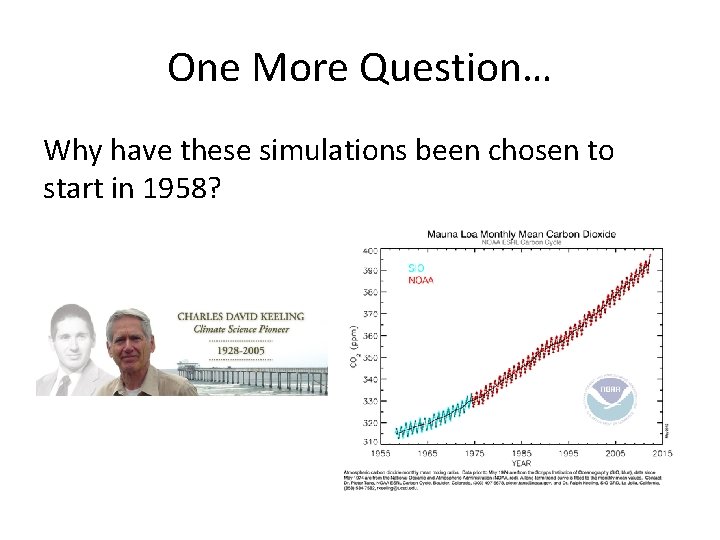
One More Question… Why have these simulations been chosen to start in 1958?
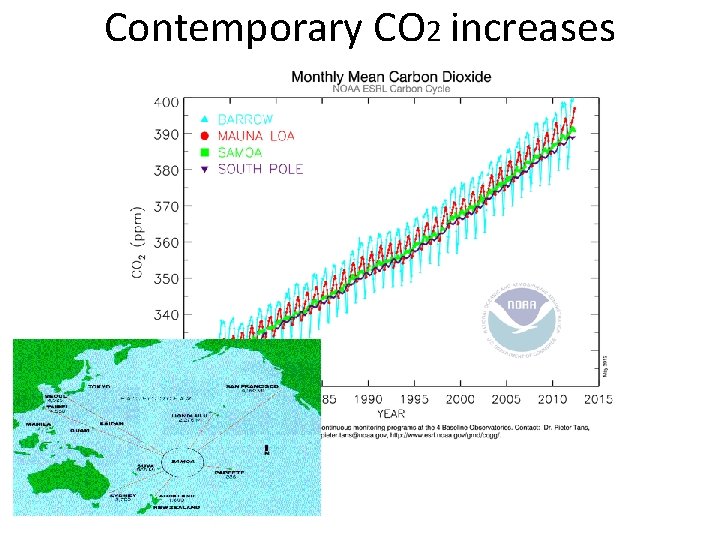
Contemporary CO 2 increases
Setting Up the Model… Let’s take 5 minutes to make sure we can all do this…I’ll show you first… • How come we can’t manipulate any of those initial or boundary conditions? • What if I want to create my own hypothesis? • What fields should I fill in? • Why is it important to leave a detailed comment?
Setting Up a Run… Let’s take 10 minutes to make sure we can all do this…I’ll show you first… • What do the terms initial and boundary conditions mean? • What do we mean when we say the global climate (or a model) has reached equilibrium? • How does global climate reach equilibrium? • What could prevent this?
A Few More Ideas About GCMS
What Goes Into a Climate Simulation? Need to supply the GCM with information • Boundary conditions: inputs that do not change over the course of the simulation - Examples: Topography, land/sea distribution, land ice extent, vegetation • Initial conditions: inputs prescribed at the beginning of a run that change as the simulation proceeds - Examples: Greenhouse gas trends, solar trends, sea surface temperatures Some model inputs, such as greenhouse gas levels, can fall into either category of input
Not all models are the same Models can vary from each other - What initial/boundary conditions go into them - How they handle variability - How they use parameters (or simulate relationships not governed by the physical equations) -Even if they simulate certain processes
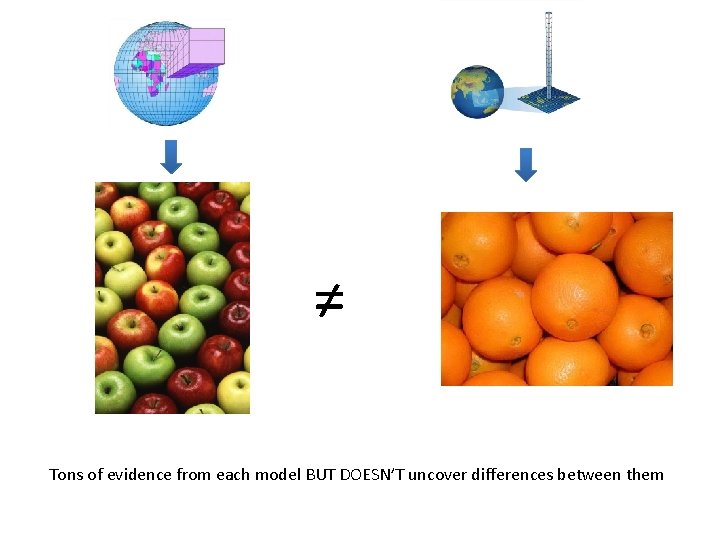
≠ Tons of evidence from each model BUT DOESN’T uncover differences between them
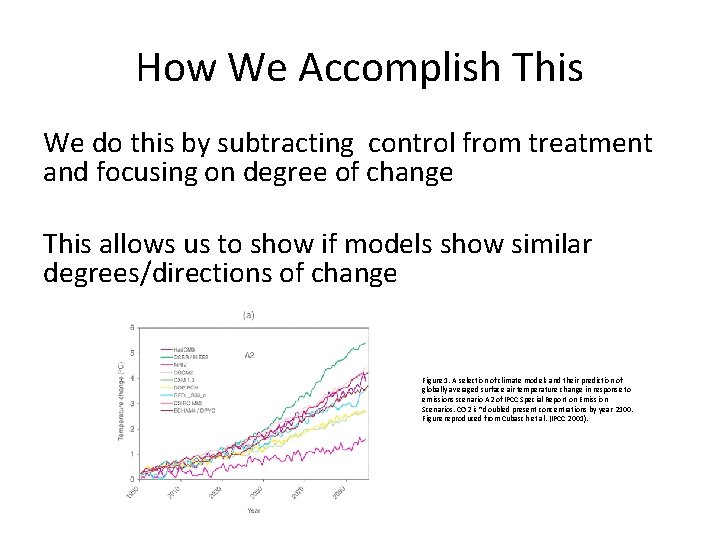
How We Accomplish This We do this by subtracting control from treatment and focusing on degree of change This allows us to show if models show similar degrees/directions of change Figure 1. A selection of climate models and their prediction of globally averaged surface air temperature change in response to emissions scenario A 2 of IPCC Special Report on Emission Scenarios. CO 2 is ~doubled present concentrations by year 2100. Figure reproduced from Cubasch et al. (IPCC 2001).
Hindcasting Key Idea: That models used to predict future global warming can accurately map past climate changes Models are tested against the past, against what we know happened
Confirms Importance of CO 2 Testing models against the existing instrumental record suggested CO 2 must cause global warming, because the models could not simulate what had already happened unless the extra CO 2 was added to the model. All other known forcings are adequate in explaining temperature variations prior to the rise in temperature over the last thirty years, while none of them are capable of explaining the rise in the past thirty years. CO 2 does explain that rise, and explains it completely without any need for additional, as yet unknown forcings.

In Other Words…
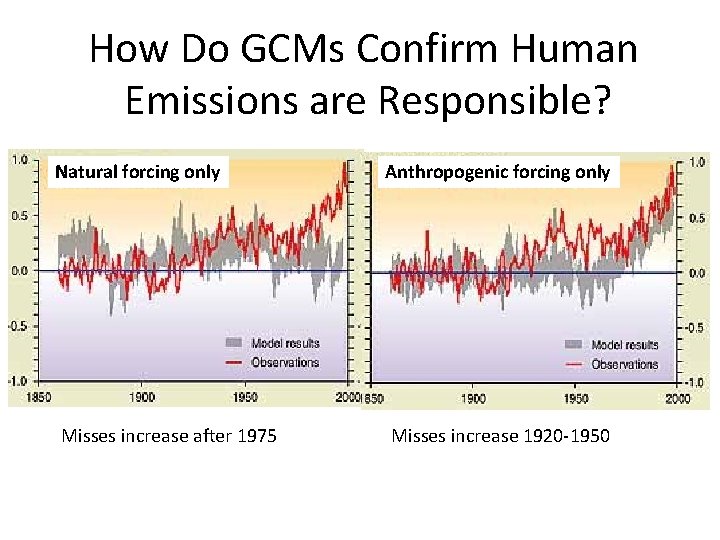
How Do GCMs Confirm Human Emissions are Responsible? Natural forcing only Anthropogenic forcing only Misses increase after 1975 Misses increase 1920 -1950
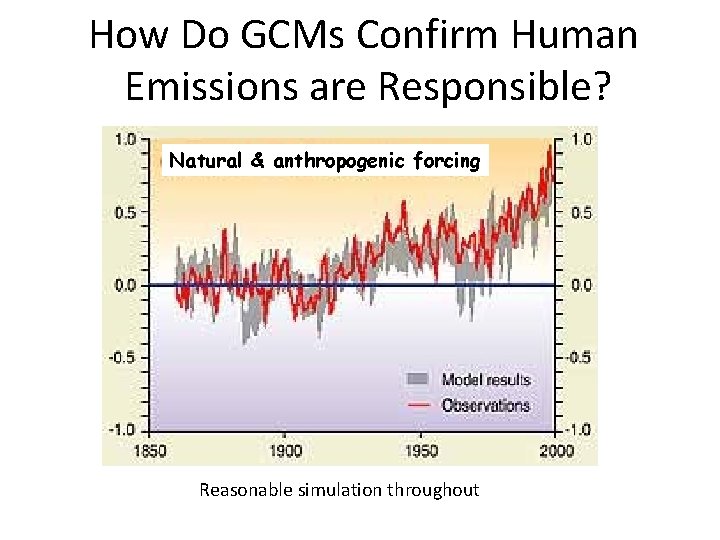
How Do GCMs Confirm Human Emissions are Responsible? Natural & anthropogenic forcing Reasonable simulation throughout
- Slides: 34