
ED 260 Educational Psychology Ashley Swanson This Weeks






- Slides: 45
ED 260 -Educational Psychology Ashley Swanson
This Week’s Topics Module 15 -Behavioral Theory Module 16 -Cognitive Theories Module 17 -Self Theories
Module 15 - Behavioral Theory
Operant Conditioning Reinforcement = increase in behaviors Punishment = decreasing behaviors
Motivation Extrinsic Motivation: individuals engage in an activity or behavior to obtain an external outcome, such as a praise or reward Intrinsic Motivation: individuals engage in an activity or behavior for the internal satisfaction it provides, rather than the external reward
Motivation Many learning activities can be both intrinsically and extrinsically motivating Students’ intrinsic motivation decreases as they get older
Motivation Locus of Control: belief that the result of one’s behavior is due to either external factors outside one’s control (external locus) or internal factors under one’s control (internal locus).
Rewards Teachers attempt to stimulate students’ intrinsic motivation by using extrinsic motivators Research has found rewards actually undermine intrinsic motivation
Rewards To use rewards to enhance intrinsic motivation teachers must consider: Purpose of reward How students perceive reward Context in which reward is given Task-contingent rewards= undermine intrinsic motivation Performance-contingent rewards= encourage intrinsic motivation
Using Rewards Effectively Occasionally use unexpected rewards Use expected, tangible rewards sparingly Withdraw rewards ASAP Use the most modest reward possible Make rewards contingent on quality of work Minimize authoritarian style teaching
Discuss with your group ways that you have seen rewards used in the classroom. Where they effective for intrinsically motivating students?
Classroom Economy This teacher’s classroom economy is one example of an effective way of using rewards in the classroom and balancing intrinsic and extrinsic motivation: http: //www. scholastic. com/teachers/top_te aching/2010/01/class-economy
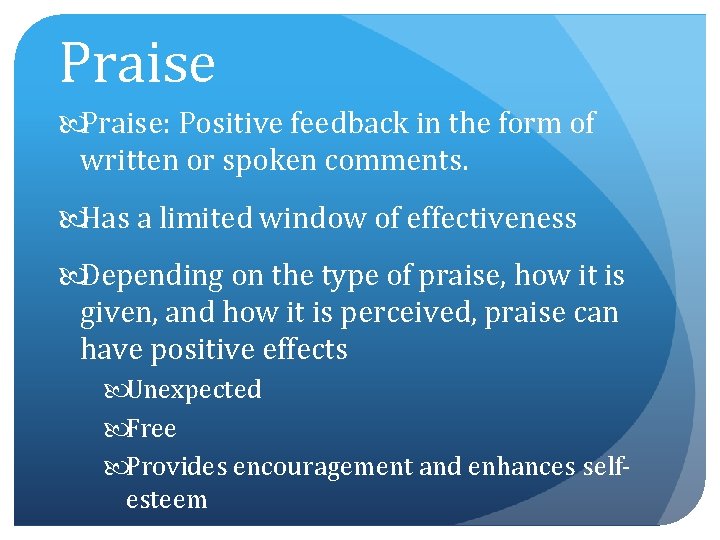
Praise: Positive feedback in the form of written or spoken comments. Has a limited window of effectiveness Depending on the type of praise, how it is given, and how it is perceived, praise can have positive effects Unexpected Free Provides encouragement and enhances selfesteem
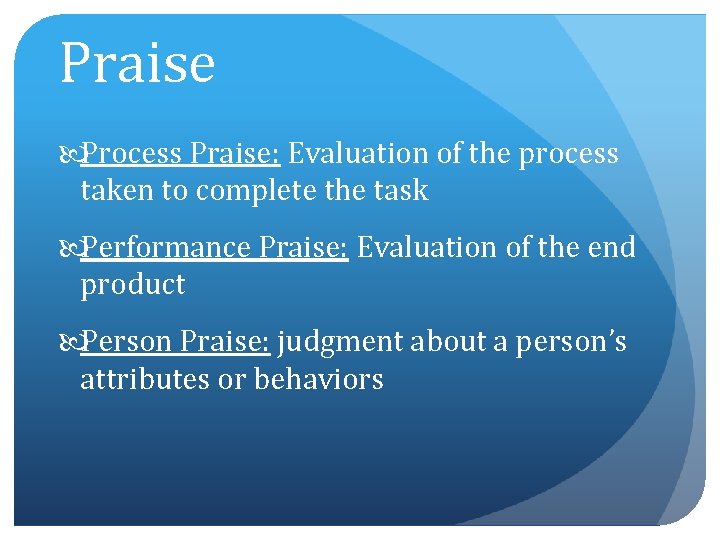
Praise Process Praise: Evaluation of the process taken to complete the task Performance Praise: Evaluation of the end product Person Praise: judgment about a person’s attributes or behaviors
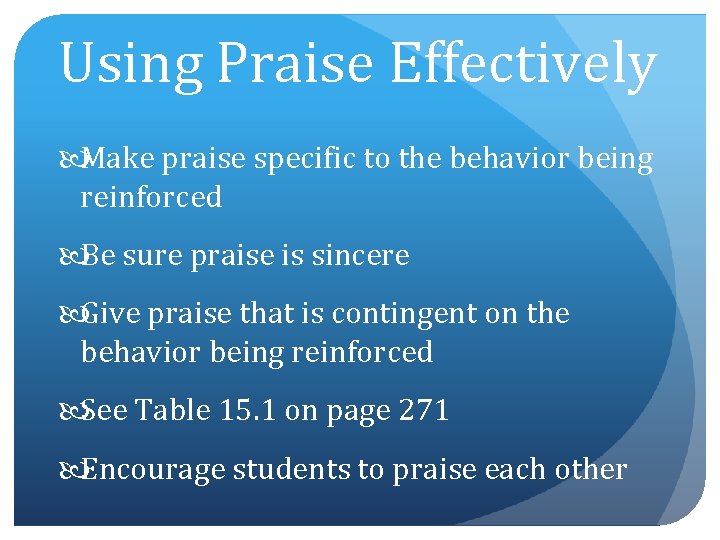
Using Praise Effectively Make praise specific to the behavior being reinforced Be sure praise is sincere Give praise that is contingent on the behavior being reinforced See Table 15. 1 on page 271 Encourage students to praise each other
Be a “Bucket Filler” Website: http: //www. bucketfillers 101. com Image from: http: //www. derbyps. org/page. cfm? p=14 48
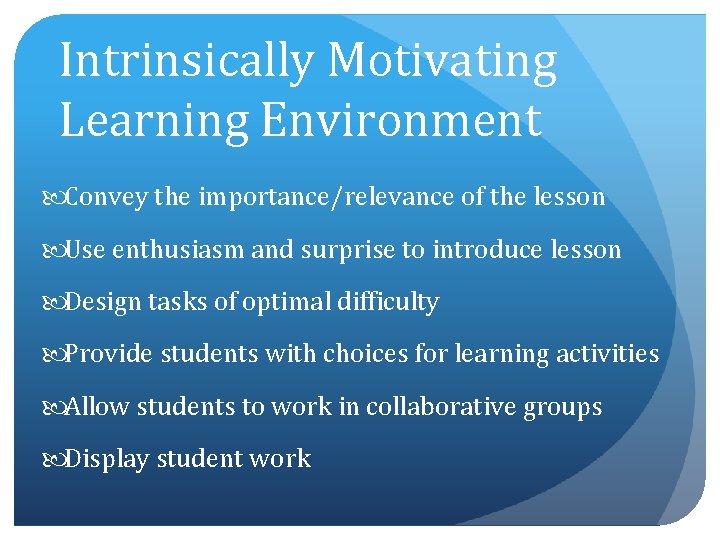
Intrinsically Motivating Learning Environment Convey the importance/relevance of the lesson Use enthusiasm and surprise to introduce lesson Design tasks of optimal difficulty Provide students with choices for learning activities Allow students to work in collaborative groups Display student work
Module 16 - Cognitive Theories
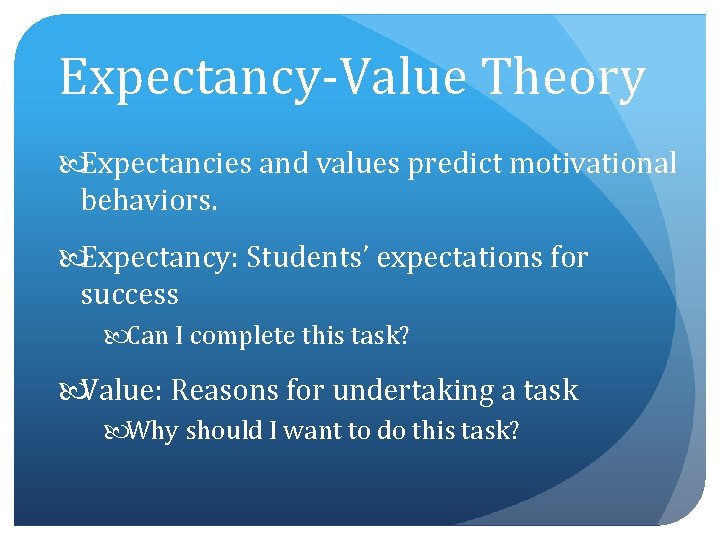
Expectancy-Value Theory Expectancies and values predict motivational behaviors. Expectancy: Students’ expectations for success Can I complete this task? Value: Reasons for undertaking a task Why should I want to do this task?
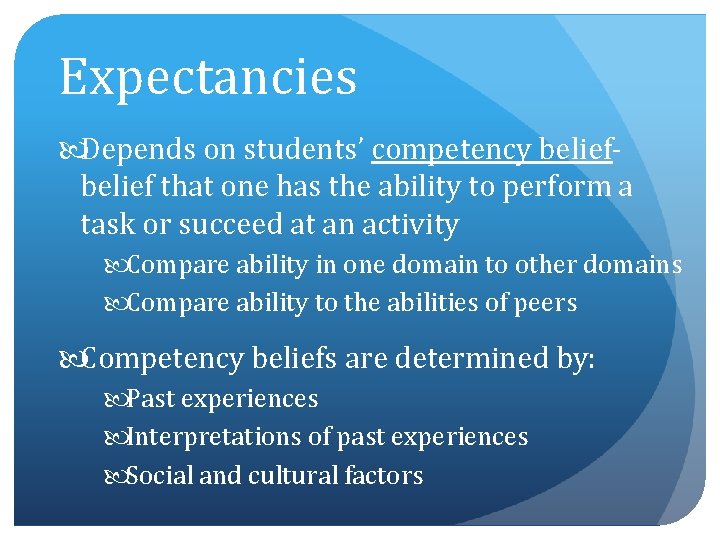
Expectancies Depends on students’ competency belief that one has the ability to perform a task or succeed at an activity Compare ability in one domain to other domains Compare ability to the abilities of peers Competency beliefs are determined by: Past experiences Interpretations of past experiences Social and cultural factors
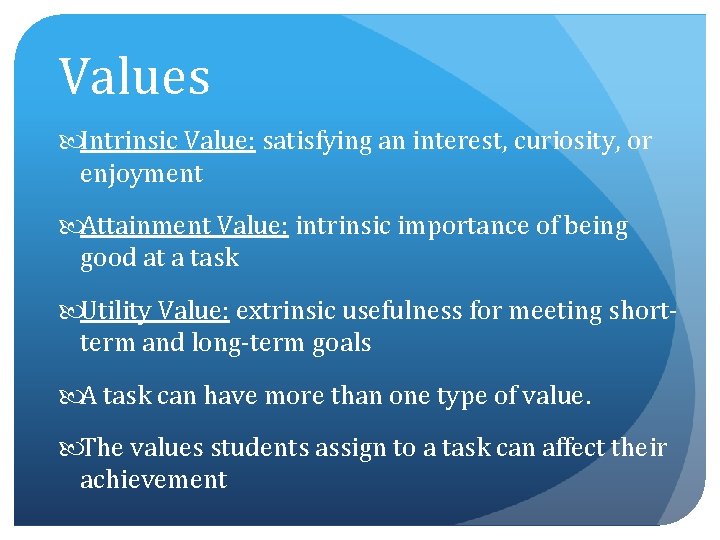
Values Intrinsic Value: satisfying an interest, curiosity, or enjoyment Attainment Value: intrinsic importance of being good at a task Utility Value: extrinsic usefulness for meeting shortterm and long-term goals A task can have more than one type of value. The values students assign to a task can affect their achievement
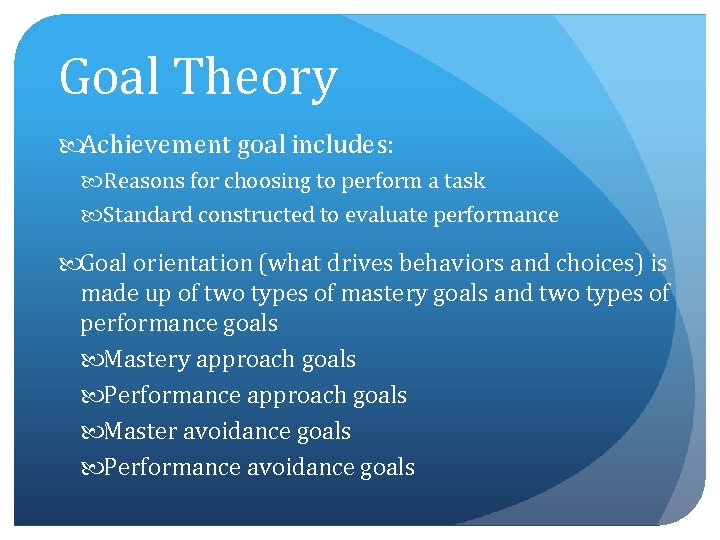
Goal Theory Achievement goal includes: Reasons for choosing to perform a task Standard constructed to evaluate performance Goal orientation (what drives behaviors and choices) is made up of two types of mastery goals and two types of performance goals Mastery approach goals Performance approach goals Master avoidance goals Performance avoidance goals
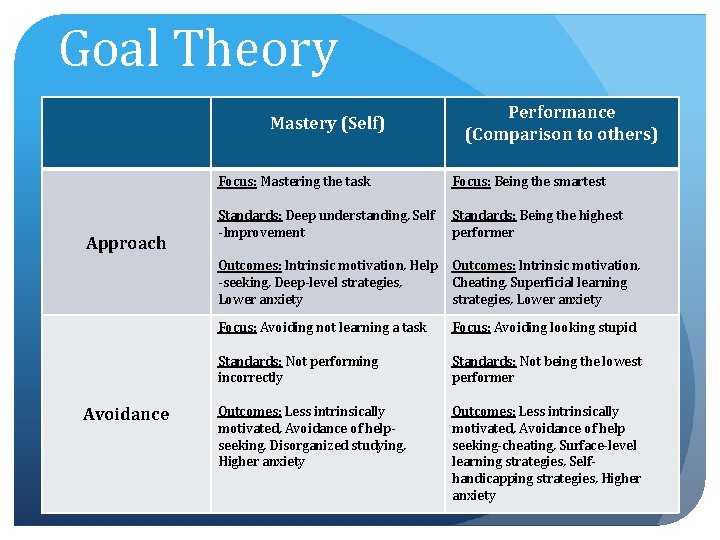
Goal Theory Mastery (Self) Approach Avoidance Performance (Comparison to others) Focus: Mastering the task Focus: Being the smartest Standards: Deep understanding, Self -Improvement Standards: Being the highest performer Outcomes: Intrinsic motivation, Help -seeking, Deep-level strategies, Lower anxiety Outcomes: Intrinsic motivation, Cheating, Superficial learning strategies, Lower anxiety Focus: Avoiding not learning a task Focus: Avoiding looking stupid Standards: Not performing incorrectly Standards: Not being the lowest performer Outcomes: Less intrinsically motivated, Avoidance of helpseeking, Disorganized studying, Higher anxiety Outcomes: Less intrinsically motivated, Avoidance of help seeking-cheating, Surface-level learning strategies, Selfhandicapping strategies, Higher anxiety
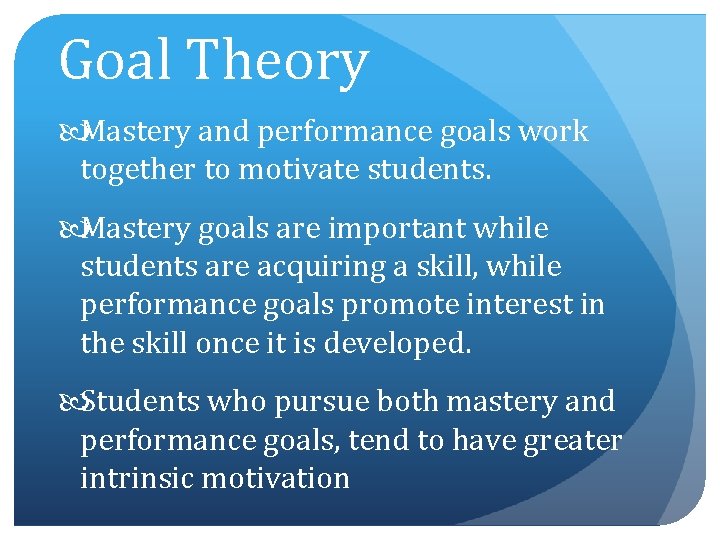
Goal Theory Mastery and performance goals work together to motivate students. Mastery goals are important while students are acquiring a skill, while performance goals promote interest in the skill once it is developed. Students who pursue both mastery and performance goals, tend to have greater intrinsic motivation
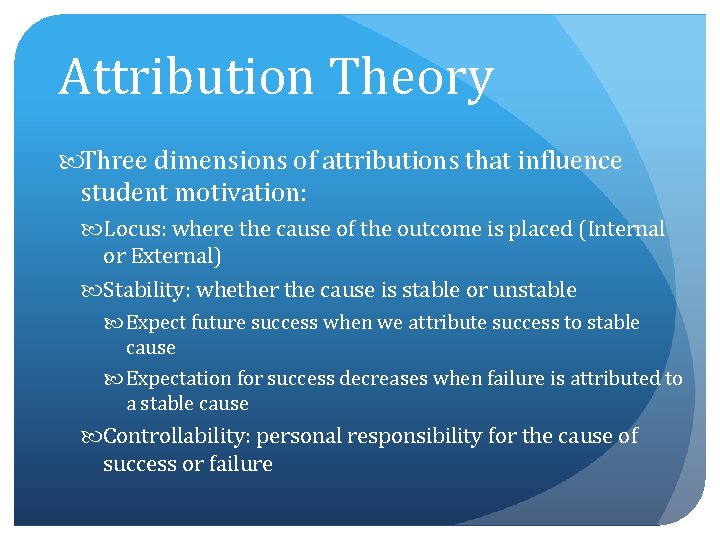
Attribution Theory Three dimensions of attributions that influence student motivation: Locus: where the cause of the outcome is placed (Internal or External) Stability: whether the cause is stable or unstable Expect future success when we attribute success to stable cause Expectation for success decreases when failure is attributed to a stable cause Controllability: personal responsibility for the cause of success or failure
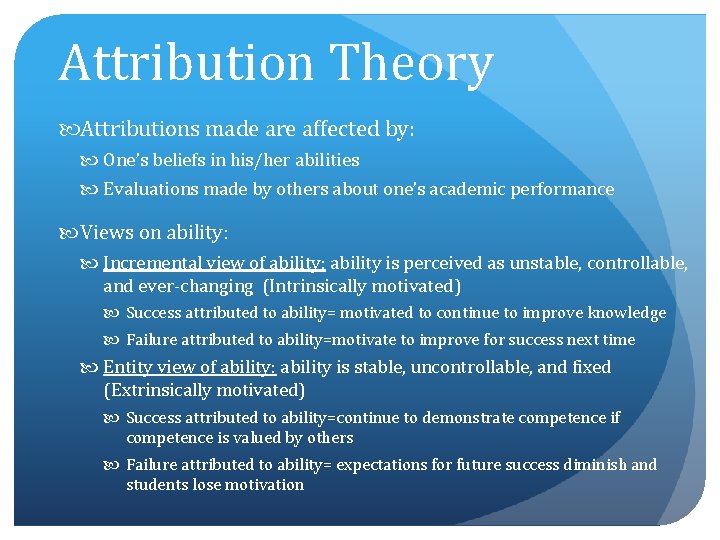
Attribution Theory Attributions made are affected by: One’s beliefs in his/her abilities Evaluations made by others about one’s academic performance Views on ability: Incremental view of ability: ability is perceived as unstable, controllable, and ever-changing (Intrinsically motivated) Success attributed to ability= motivated to continue to improve knowledge Failure attributed to ability=motivate to improve for success next time Entity view of ability: ability is stable, uncontrollable, and fixed (Extrinsically motivated) Success attributed to ability=continue to demonstrate competence if competence is valued by others Failure attributed to ability= expectations for future success diminish and students lose motivation
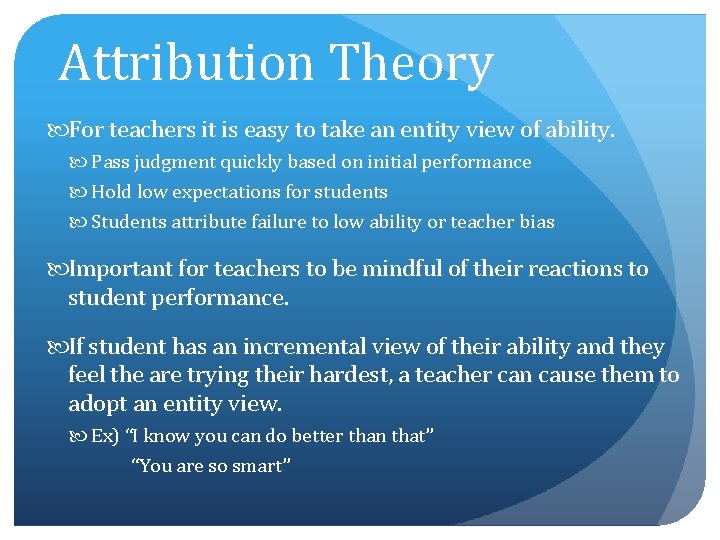
Attribution Theory For teachers it is easy to take an entity view of ability. Pass judgment quickly based on initial performance Hold low expectations for students Students attribute failure to low ability or teacher bias Important for teachers to be mindful of their reactions to student performance. If student has an incremental view of their ability and they feel the are trying their hardest, a teacher can cause them to adopt an entity view. Ex) “I know you can do better than that” “You are so smart”
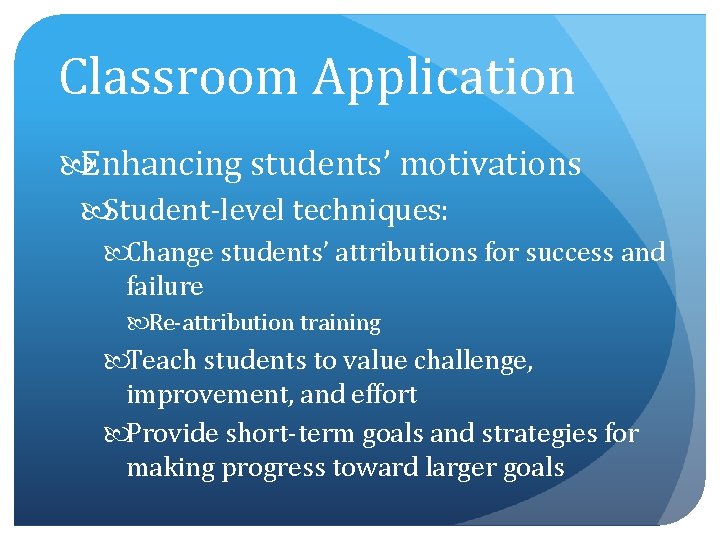
Classroom Application Enhancing students’ motivations Student-level techniques: Change students’ attributions for success and failure Re-attribution training Teach students to value challenge, improvement, and effort Provide short-term goals and strategies for making progress toward larger goals
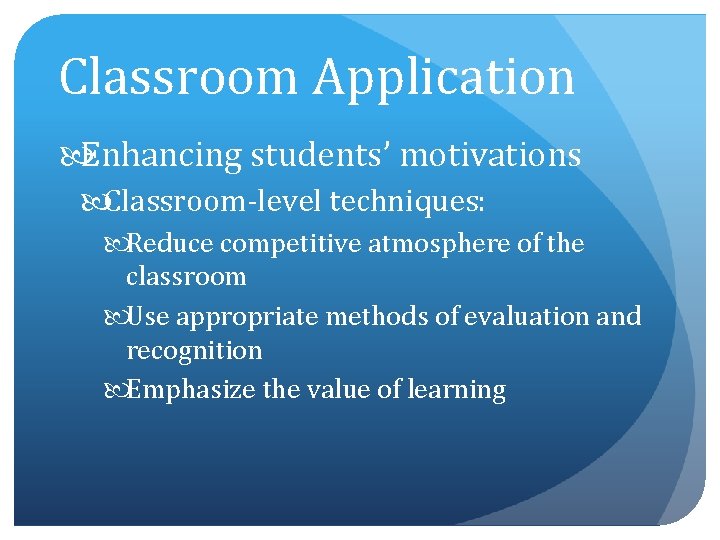
Classroom Application Enhancing students’ motivations Classroom-level techniques: Reduce competitive atmosphere of the classroom Use appropriate methods of evaluation and recognition Emphasize the value of learning
Serious Motivational Problems Learned Helplessness: occurs when students who have experienced repeated failures attribute their failures to causes beyond their control. Reduce learned helplessness: Use of motivational techniques Providing students with opportunities for success
Serious Motivational Problems Anxiety: Mental thoughts related to worrying and negative emotions such as nervousness or tension, which can impair academic performance. Emotional: nervousness, tension Cognitive: worry that interferes with learning tasks Physical: increased heart rate, sweaty palms, shortness of breath
Serious Motivational Problems Anxiety can occur at three stages during instruction: Preprocessing Processing Output Sources of anxiety: Parents Student’s outlook Learning environment Subject matter Chart 16. 1 on page 294 for helpful tips on reducing student anxiety
Module 17 - Self Theories
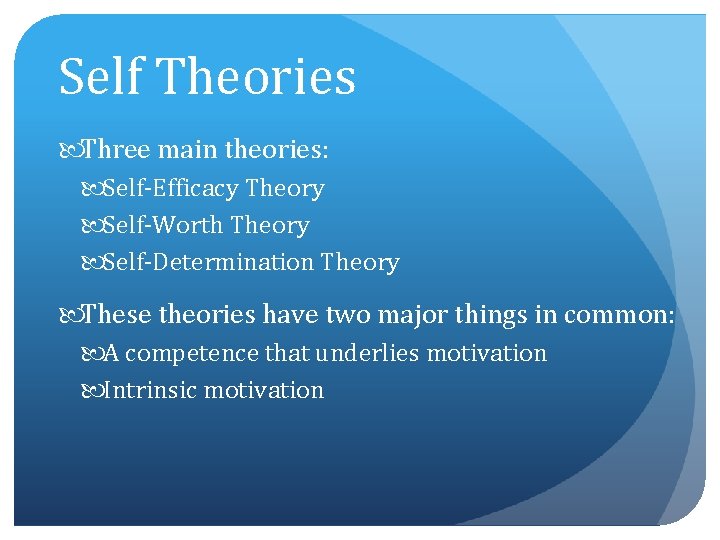
Self Theories Three main theories: Self-Efficacy Theory Self-Worth Theory Self-Determination Theory These theories have two major things in common: A competence that underlies motivation Intrinsic motivation
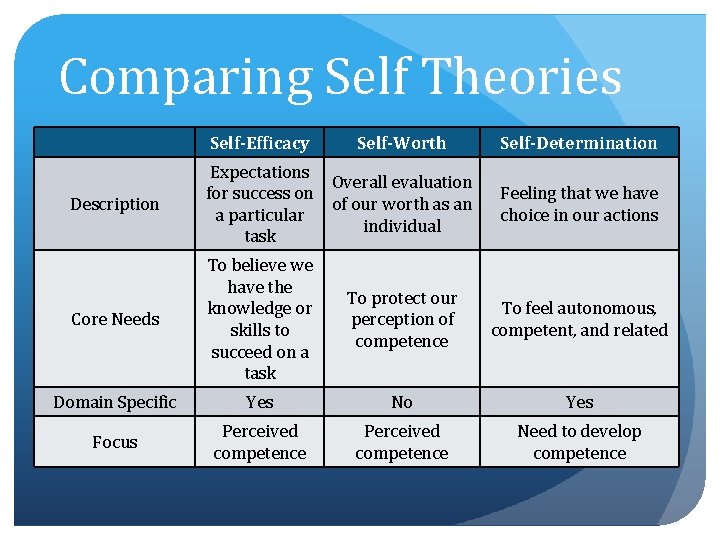
Comparing Self Theories Self-Efficacy Self-Worth Self-Determination Description Expectations for success on a particular task Overall evaluation of our worth as an individual Feeling that we have choice in our actions Core Needs To believe we have the knowledge or skills to succeed on a task To protect our perception of competence To feel autonomous, competent, and related Domain Specific Yes No Yes Focus Perceived competence Need to develop competence
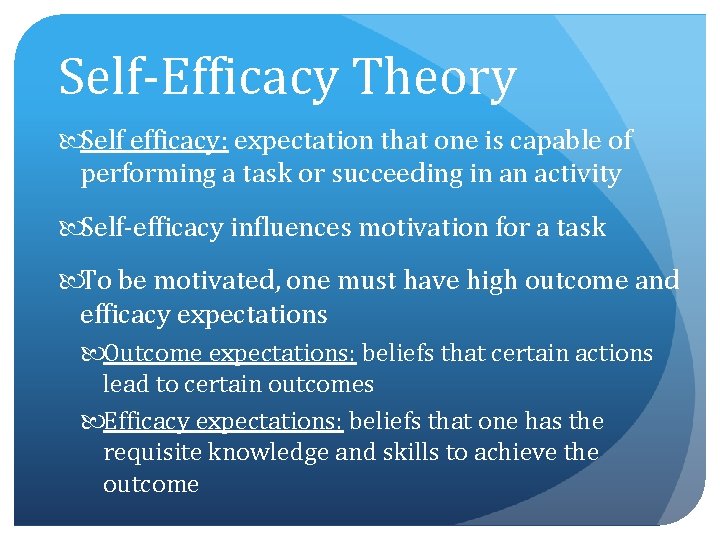
Self-Efficacy Theory Self efficacy: expectation that one is capable of performing a task or succeeding in an activity Self-efficacy influences motivation for a task To be motivated, one must have high outcome and efficacy expectations Outcome expectations: beliefs that certain actions lead to certain outcomes Efficacy expectations: beliefs that one has the requisite knowledge and skills to achieve the outcome
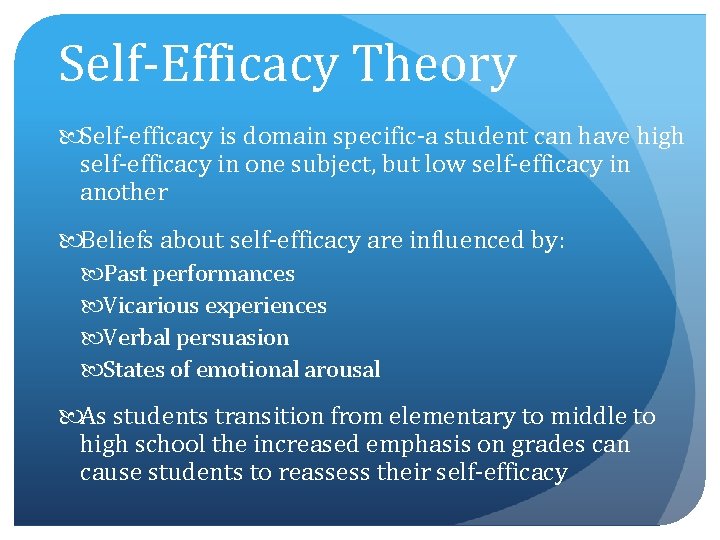
Self-Efficacy Theory Self-efficacy is domain specific-a student can have high self-efficacy in one subject, but low self-efficacy in another Beliefs about self-efficacy are influenced by: Past performances Vicarious experiences Verbal persuasion States of emotional arousal As students transition from elementary to middle to high school the increased emphasis on grades can cause students to reassess their self-efficacy
Self-Efficacy Theory Self-regulation: the ability to control one’s emotions, cognitions, and behaviors by providing consequences to oneself Students with higher self-efficacy are more likely to engage in self-regulatory processes (goal setting, planning, strategy use, self-monitoring, & self-reflection) Self-regulatory processes are linked to higher intrinsic motivation
Self-Efficacy Theory Teacher efficacy: belief by teachers that they have the necessary skills to effectively teach all students Teachers with high efficacy: Spend more time planning and organizing Are willing to try new instructional methods Modify the curriculum for students with varying abilities Use effective classroom management strategies Show persistence when it comes to helping struggling students
Self-Worth Theory Self-worth: appraisal of one’s own value as a person Students’ perceptions of their abilities contribute to their self-worth. Proving ability can become the main focus of students’ learning and can cause their motivation to shift from learning to avoiding negative consequences, such as looking incompetent
Self-Worth Theory Understanding the difference between “approaching success” and “avoiding failure” is key to understanding the motivation of different types of students. Four main types of students: Success-oriented students Overstrivers Failure-avoiding students Failure-accepting students
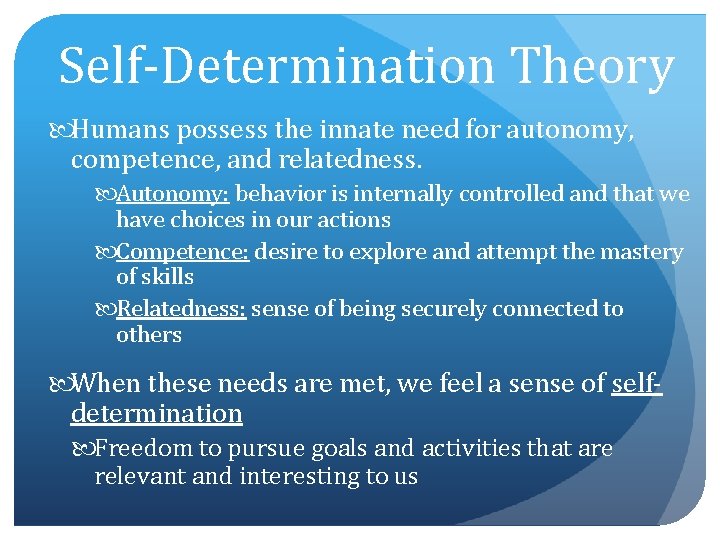
Self-Determination Theory Humans possess the innate need for autonomy, competence, and relatedness. Autonomy: behavior is internally controlled and that we have choices in our actions Competence: desire to explore and attempt the mastery of skills Relatedness: sense of being securely connected to others When these needs are met, we feel a sense of selfdetermination Freedom to pursue goals and activities that are relevant and interesting to us
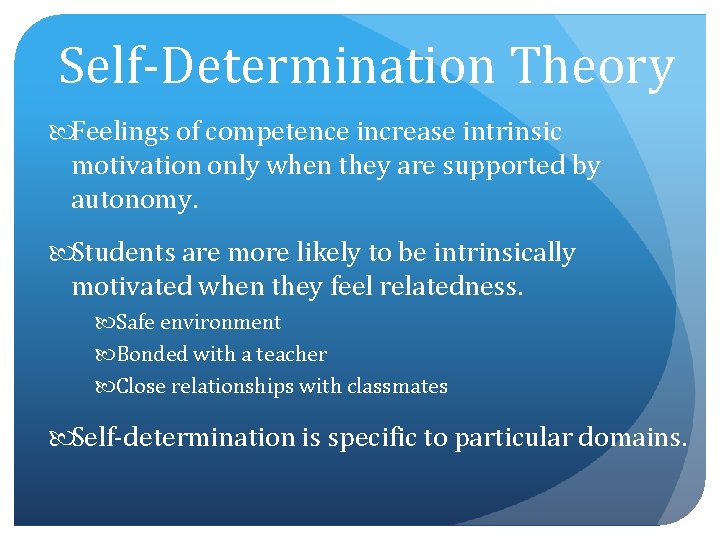
Self-Determination Theory Feelings of competence increase intrinsic motivation only when they are supported by autonomy. Students are more likely to be intrinsically motivated when they feel relatedness. Safe environment Bonded with a teacher Close relationships with classmates Self-determination is specific to particular domains.
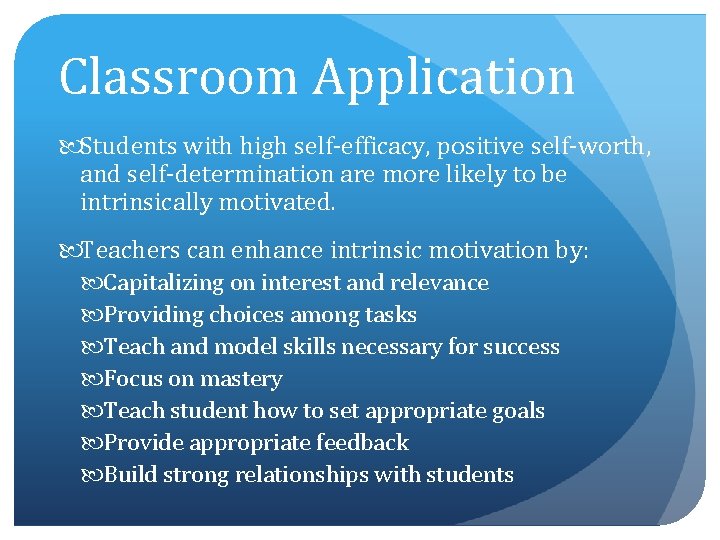
Classroom Application Students with high self-efficacy, positive self-worth, and self-determination are more likely to be intrinsically motivated. Teachers can enhance intrinsic motivation by: Capitalizing on interest and relevance Providing choices among tasks Teach and model skills necessary for success Focus on mastery Teach student how to set appropriate goals Provide appropriate feedback Build strong relationships with students
Main Sources: Bohlin, L. , Durwin, C. C. , & Reese-Weber, M. (2009). Ed. Psych: Modules. New York: Mc. Graw-Hill Newingham, B. (2010). “My Classroom Economy: Bringing the “Real World” into the Classroom”. Retrieved from: http: //www. scholastic. com/teachers/top_teaching/2010/ 01/class-economy