
ED 2210 Electromagnetic processes in dispersive media Lecture




- Slides: 44
ED 2210, Electromagnetic processes in dispersive media Lecture 1: Properties and representations of electromagnetic fields by Thomas Jonsson
Outline Fundamentals of electromagnetic theory (Ch. 1) • Maxwell’s equations • Continuity equations • Scalar and vector potentials Tensor index notation (Ch. 2) • Component representations of vectors and matrixes • Scalar and vector products • Symmetric/Antisymmetric and Hermitian/Antihermitian Multipoles (Ch. 3) • Multipole moments • Multipole fields ED 2210, LECTURE 1 MAY 24, 2021 2
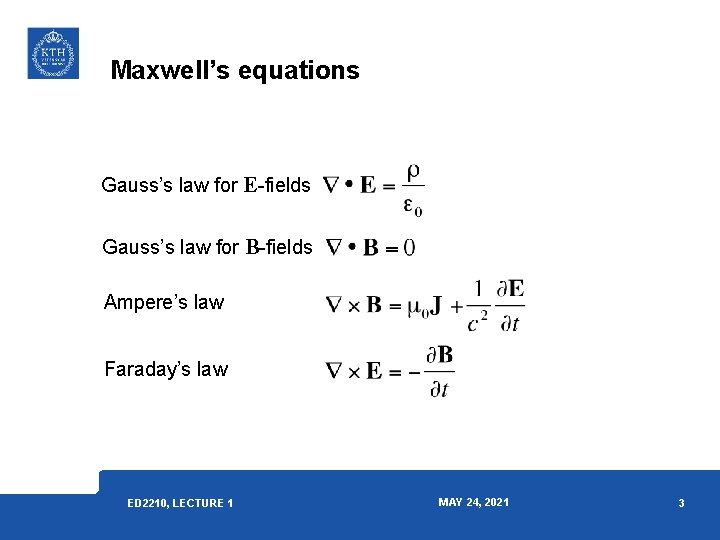
Maxwell’s equations Gauss’s law for E-fields Gauss’s law for B-fields Ampere’s law Faraday’s law ED 2210, LECTURE 1 MAY 24, 2021 3
Wave equation Time derivative of Faraday’s law: Curl of Ampere’s law: The wave equation in B: Exercise: Derive a wave equation for the electric field. ED 2210, LECTURE 1 MAY 24, 2021 4
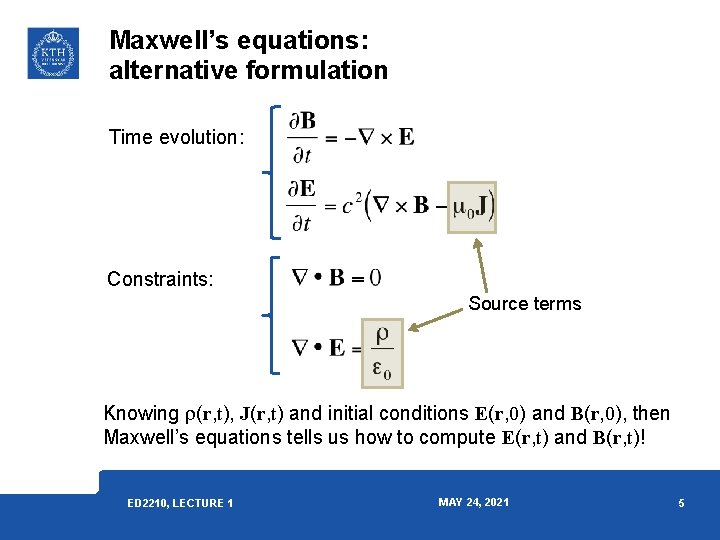
Maxwell’s equations: alternative formulation Time evolution: Constraints: Source terms Knowing r(r, t), J(r, t) and initial conditions E(r, 0) and B(r, 0), then Maxwell’s equations tells us how to compute E(r, t) and B(r, t)! ED 2210, LECTURE 1 MAY 24, 2021 5
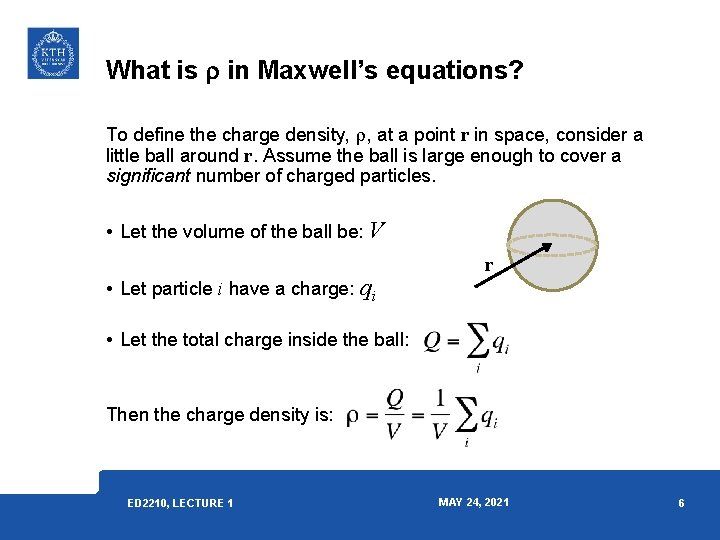
What is r in Maxwell’s equations? To define the charge density, r, at a point r in space, consider a little ball around r. Assume the ball is large enough to cover a significant number of charged particles. • Let the volume of the ball be: V • Let particle i have a charge: qi r • Let the total charge inside the ball: Then the charge density is: ED 2210, LECTURE 1 MAY 24, 2021 6
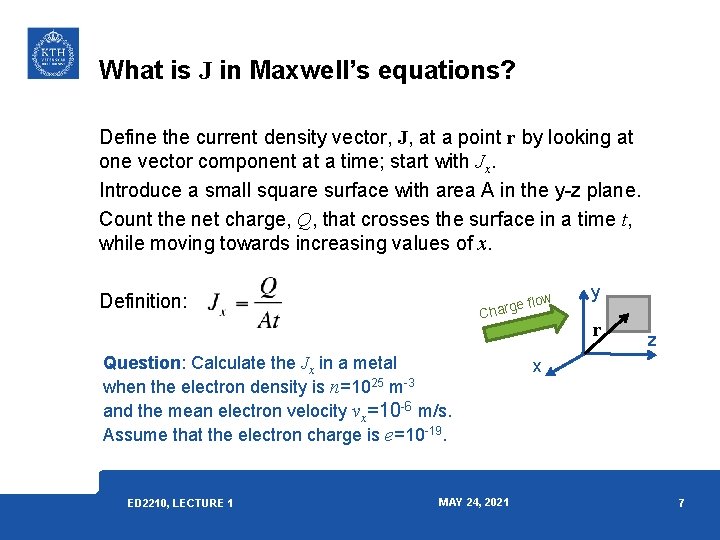
What is J in Maxwell’s equations? Define the current density vector, J, at a point r by looking at one vector component at a time; start with Jx. Introduce a small square surface with area A in the y-z plane. Count the net charge, Q, that crosses the surface in a time t, while moving towards increasing values of x. Definition: e flow Charg Question: Calculate the Jx in a metal when the electron density is n=1025 m-3 and the mean electron velocity vx=10 -6 m/s. Assume that the electron charge is e=10 -19. ED 2210, LECTURE 1 MAY 24, 2021 y r z x 7
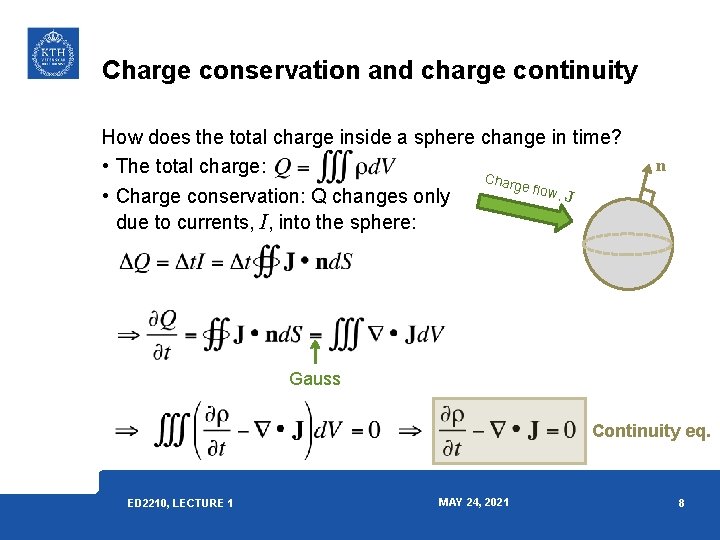
Charge conservation and charge continuity How does the total charge inside a sphere change in time? • The total charge: Charg e flow , J • Charge conservation: Q changes only due to currents, I, into the sphere: n Gauss Continuity eq. ED 2210, LECTURE 1 MAY 24, 2021 8
Energy When a particle is accelerated by an electrostatic field it gains both energy and momentum. Where do the energy and the momentum come from? If the particle is accelerated by an electromagnetic wave; where do the energy and the momentum come from? ED 2210, LECTURE 1 MAY 24, 2021 9
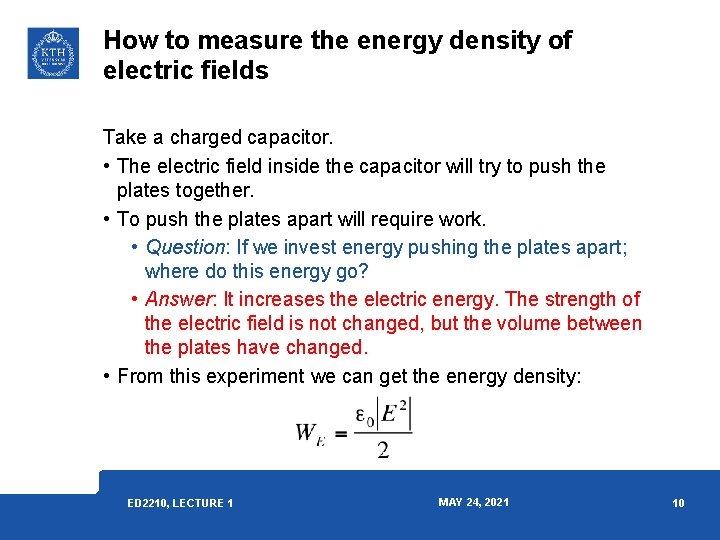
How to measure the energy density of electric fields Take a charged capacitor. • The electric field inside the capacitor will try to push the plates together. • To push the plates apart will require work. • Question: If we invest energy pushing the plates apart; where do this energy go? • Answer: It increases the electric energy. The strength of the electric field is not changed, but the volume between the plates have changed. • From this experiment we can get the energy density: ED 2210, LECTURE 1 MAY 24, 2021 10
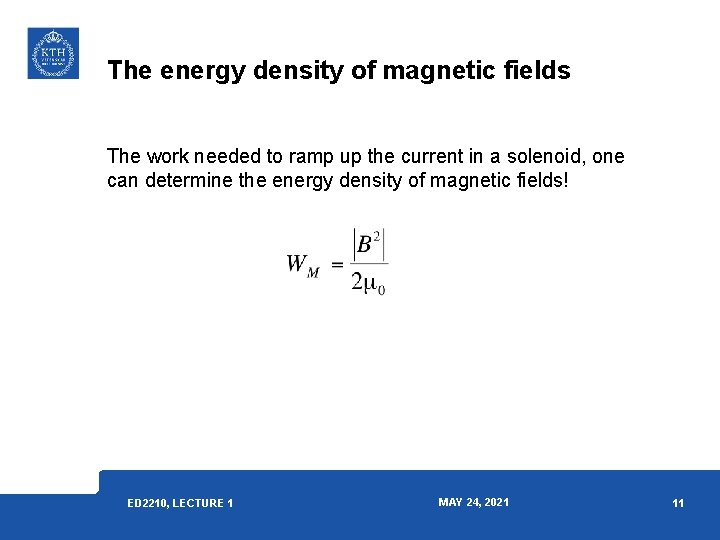
The energy density of magnetic fields The work needed to ramp up the current in a solenoid, one can determine the energy density of magnetic fields! ED 2210, LECTURE 1 MAY 24, 2021 11
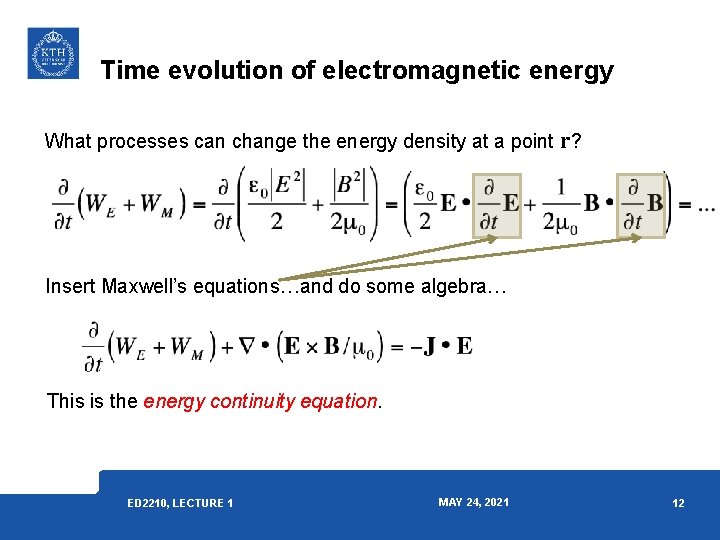
Time evolution of electromagnetic energy What processes can change the energy density at a point r? Insert Maxwell’s equations…and do some algebra… This is the energy continuity equation. ED 2210, LECTURE 1 MAY 24, 2021 12
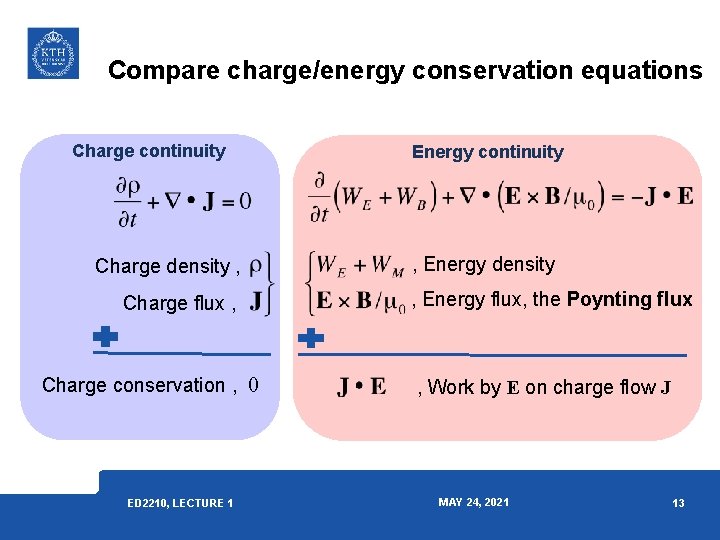
Compare charge/energy conservation equations Charge continuity Charge density , Charge flux , Charge conservation , 0 ED 2210, LECTURE 1 Energy continuity , Energy density , Energy flux, the Poynting flux , Work by E on charge flow J MAY 24, 2021 13
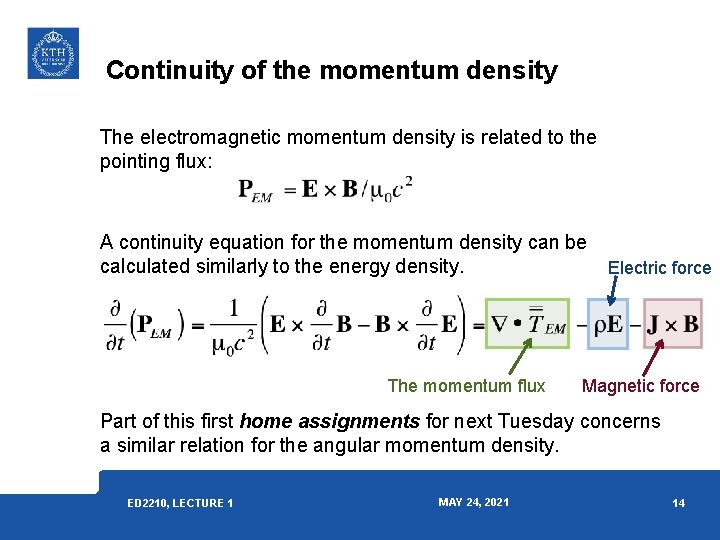
Continuity of the momentum density The electromagnetic momentum density is related to the pointing flux: A continuity equation for the momentum density can be calculated similarly to the energy density. Electric force The momentum flux Magnetic force Part of this first home assignments for next Tuesday concerns a similar relation for the angular momentum density. ED 2210, LECTURE 1 MAY 24, 2021 14
Questions 1. What is an electric current? 2. What sources are there for electro-magnetic fields? 3. Describe the charge continuity equation. 4. Describe the continuity equation for electromagnetic energy. ED 2210, LECTURE 1 MAY 24, 2021 15
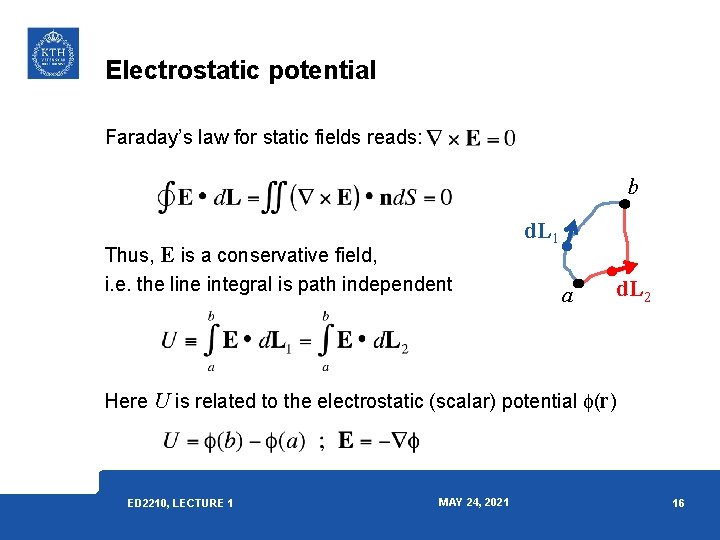
Electrostatic potential Faraday’s law for static fields reads: b Thus, E is a conservative field, i. e. the line integral is path independent d. L 1 a d. L 2 Here U is related to the electrostatic (scalar) potential f(r) ED 2210, LECTURE 1 MAY 24, 2021 16
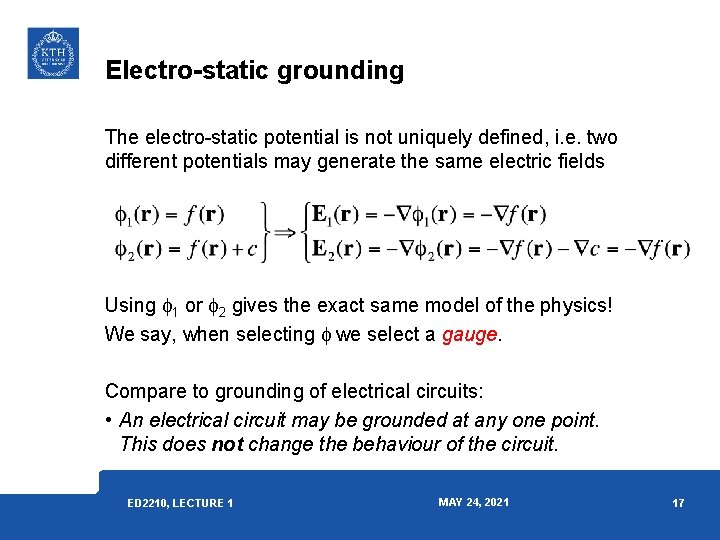
Electro-static grounding The electro-static potential is not uniquely defined, i. e. two different potentials may generate the same electric fields Using f 1 or f 2 gives the exact same model of the physics! We say, when selecting f we select a gauge. Compare to grounding of electrical circuits: • An electrical circuit may be grounded at any one point. This does not change the behaviour of the circuit. ED 2210, LECTURE 1 MAY 24, 2021 17
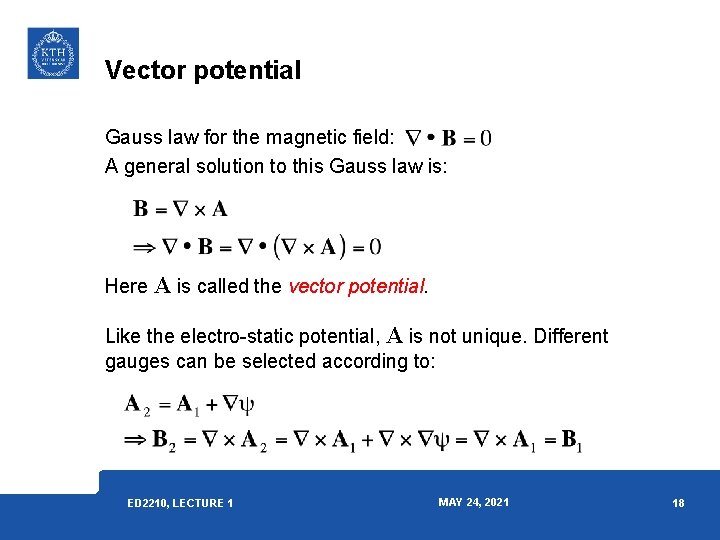
Vector potential Gauss law for the magnetic field: A general solution to this Gauss law is: Here A is called the vector potential. Like the electro-static potential, A is not unique. Different gauges can be selected according to: ED 2210, LECTURE 1 MAY 24, 2021 18
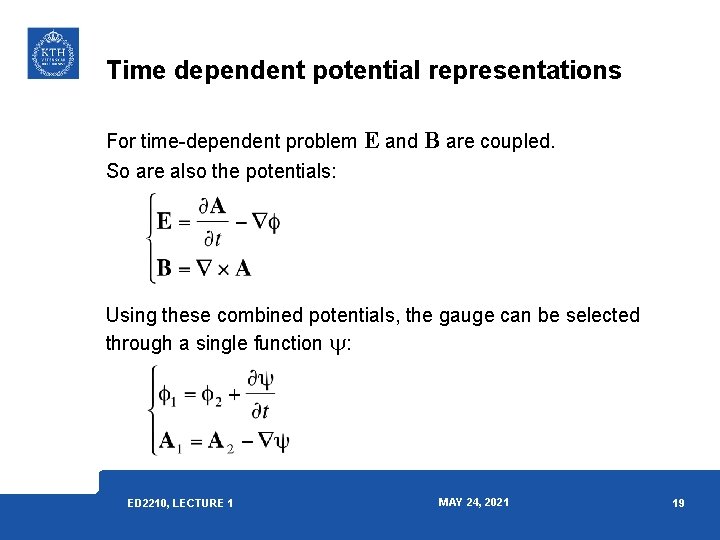
Time dependent potential representations For time-dependent problem E and B are coupled. So are also the potentials: Using these combined potentials, the gauge can be selected through a single function y: ED 2210, LECTURE 1 MAY 24, 2021 19
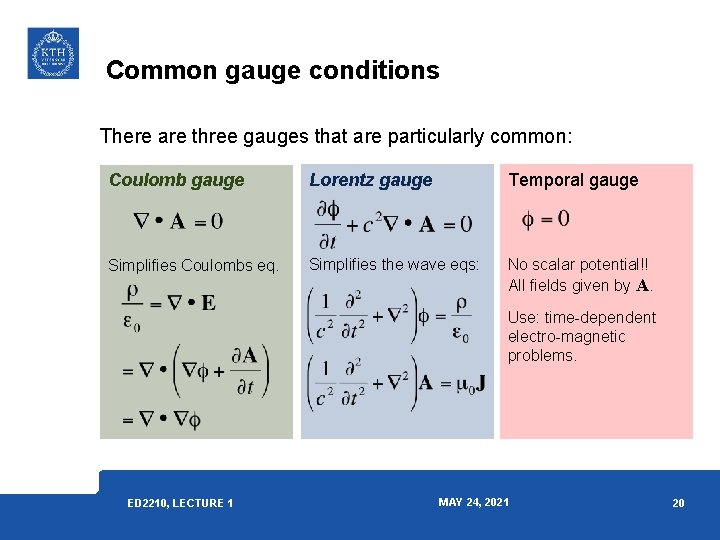
Common gauge conditions There are three gauges that are particularly common: Coulomb gauge Lorentz gauge Temporal gauge Simplifies Coulombs eq. Simplifies the wave eqs: No scalar potential!! All fields given by A. Use: time-dependent electro-magnetic problems. ED 2210, LECTURE 1 MAY 24, 2021 20
Outline Fundamentals of electromagnetic theory (Ch. 1) • Maxwell’s equations • Continuity equations • Scalar and vector potentials Tensor index notation (Ch. 2) • Component representations of vectors and matrixes • Scalar and vector products • Symmetric/Antisymmetric and Hermitian/Antihermitian Multipoles (Ch. 3) • Multipole moments • Multipole fields ED 2210, LECTURE 1 MAY 24, 2021 21
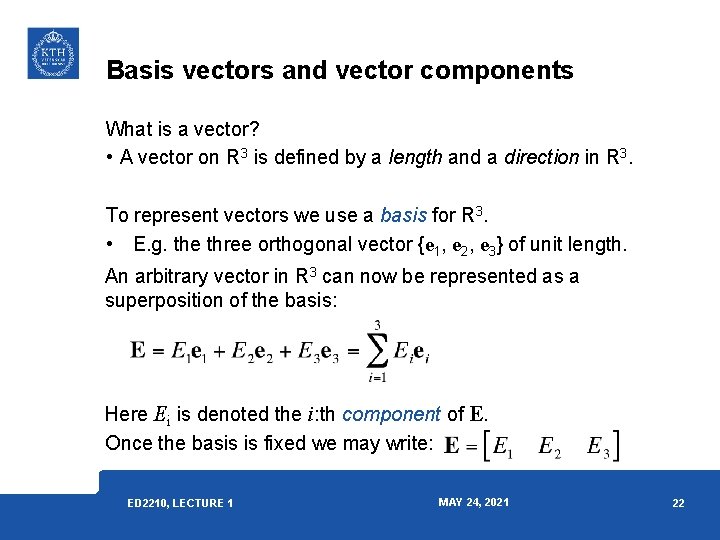
Basis vectors and vector components What is a vector? • A vector on R 3 is defined by a length and a direction in R 3. To represent vectors we use a basis for R 3. • E. g. the three orthogonal vector {e 1, e 2, e 3} of unit length. An arbitrary vector in R 3 can now be represented as a superposition of the basis: Here Ei is denoted the i: th component of E. Once the basis is fixed we may write: ED 2210, LECTURE 1 MAY 24, 2021 22
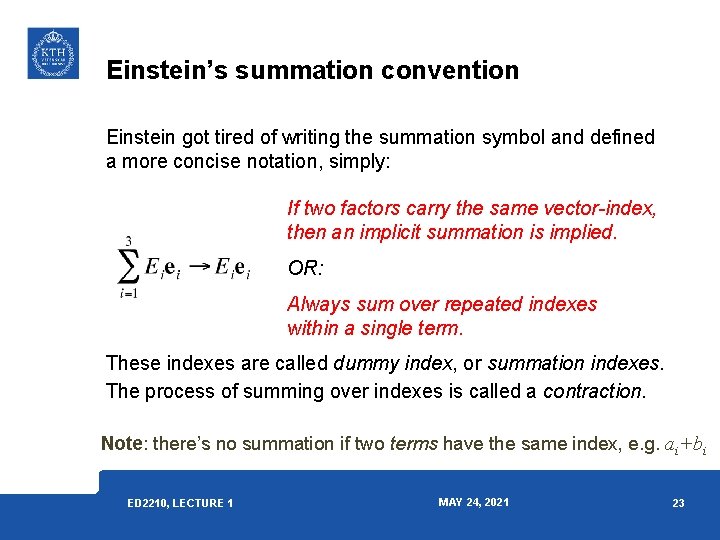
Einstein’s summation convention Einstein got tired of writing the summation symbol and defined a more concise notation, simply: If two factors carry the same vector-index, then an implicit summation is implied. OR: Always sum over repeated indexes within a single term. These indexes are called dummy index, or summation indexes. The process of summing over indexes is called a contraction. Note: there’s no summation if two terms have the same index, e. g. ai+bi ED 2210, LECTURE 1 MAY 24, 2021 23
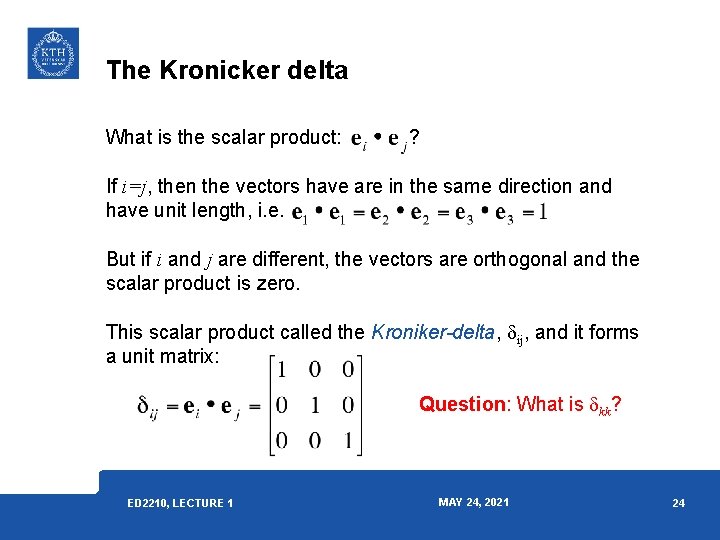
The Kronicker delta What is the scalar product: ? If i=j, then the vectors have are in the same direction and have unit length, i. e. But if i and j are different, the vectors are orthogonal and the scalar product is zero. This scalar product called the Kroniker-delta, dij, and it forms a unit matrix: Question: What is dkk? ED 2210, LECTURE 1 MAY 24, 2021 24
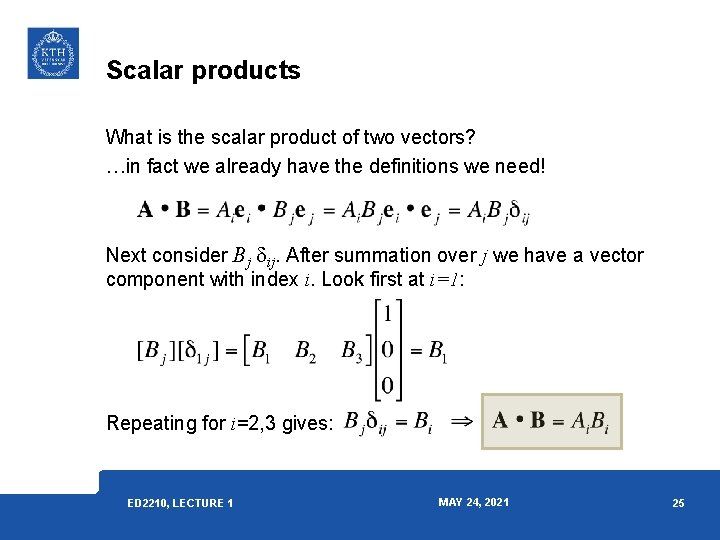
Scalar products What is the scalar product of two vectors? …in fact we already have the definitions we need! Next consider Bj dij. After summation over j we have a vector component with index i. Look first at i=1: Repeating for i=2, 3 gives: ED 2210, LECTURE 1 MAY 24, 2021 25
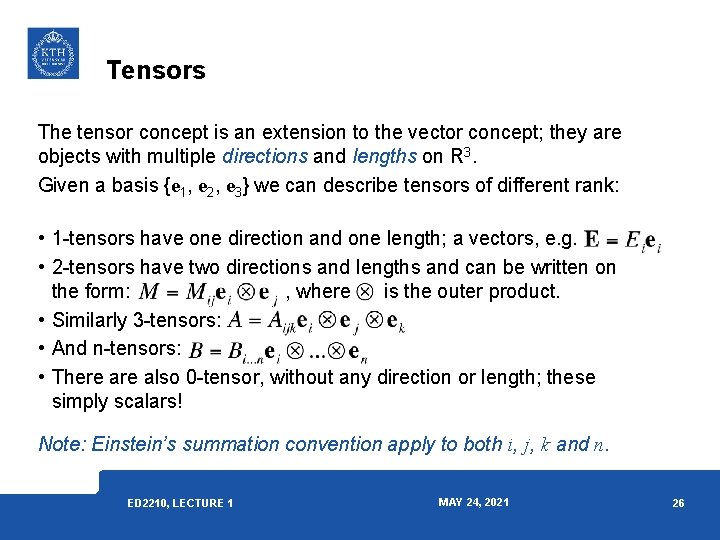
Tensors The tensor concept is an extension to the vector concept; they are objects with multiple directions and lengths on R 3. Given a basis {e 1, e 2, e 3} we can describe tensors of different rank: • 1 -tensors have one direction and one length; a vectors, e. g. • 2 -tensors have two directions and lengths and can be written on the form: , where is the outer product. • Similarly 3 -tensors: • And n-tensors: • There also 0 -tensor, without any direction or length; these simply scalars! Note: Einstein’s summation convention apply to both i, j, k and n. ED 2210, LECTURE 1 MAY 24, 2021 26
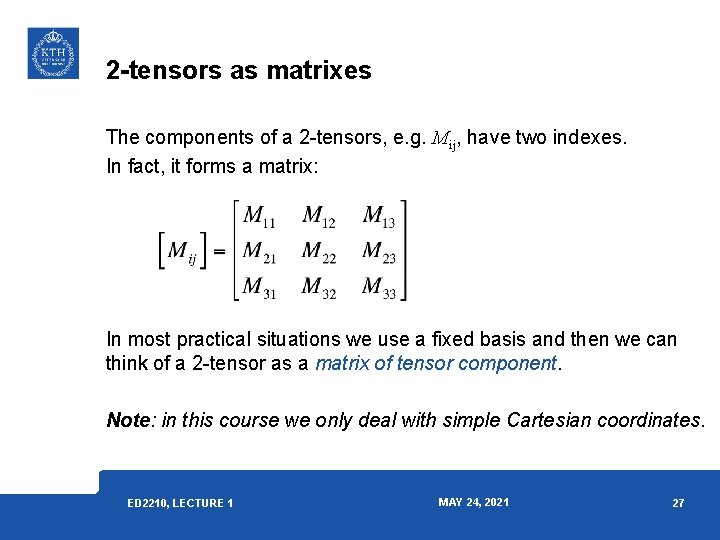
2 -tensors as matrixes The components of a 2 -tensors, e. g. Mij, have two indexes. In fact, it forms a matrix: In most practical situations we use a fixed basis and then we can think of a 2 -tensor as a matrix of tensor component. Note: in this course we only deal with simple Cartesian coordinates. ED 2210, LECTURE 1 MAY 24, 2021 27
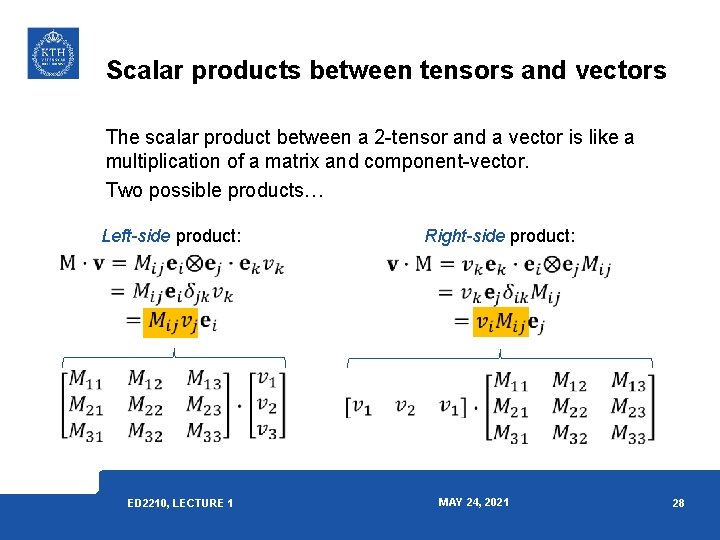
Scalar products between tensors and vectors The scalar product between a 2 -tensor and a vector is like a multiplication of a matrix and component-vector. Two possible products… Left-side product: ED 2210, LECTURE 1 Right-side product: MAY 24, 2021 28
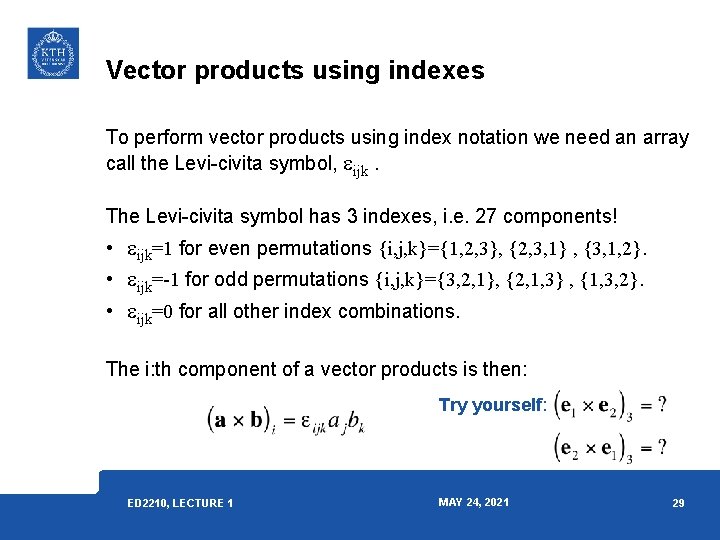
Vector products using indexes To perform vector products using index notation we need an array call the Levi-civita symbol, eijk. The Levi-civita symbol has 3 indexes, i. e. 27 components! • eijk=1 for even permutations {i, j, k}={1, 2, 3}, {2, 3, 1} , {3, 1, 2}. • eijk=-1 for odd permutations {i, j, k}={3, 2, 1}, {2, 1, 3} , {1, 3, 2}. • eijk=0 for all other index combinations. The i: th component of a vector products is then: Try yourself: ED 2210, LECTURE 1 MAY 24, 2021 29
Symmetric and anti-symmetric matrixes Symmetric matrixes are symmetric around the diagonal. Examples: Antisymmetric matrixes are anti-symmetric around the diagonal. Examples: Note that the diagonal is always zero! ED 2210, LECTURE 1 MAY 24, 2021 30
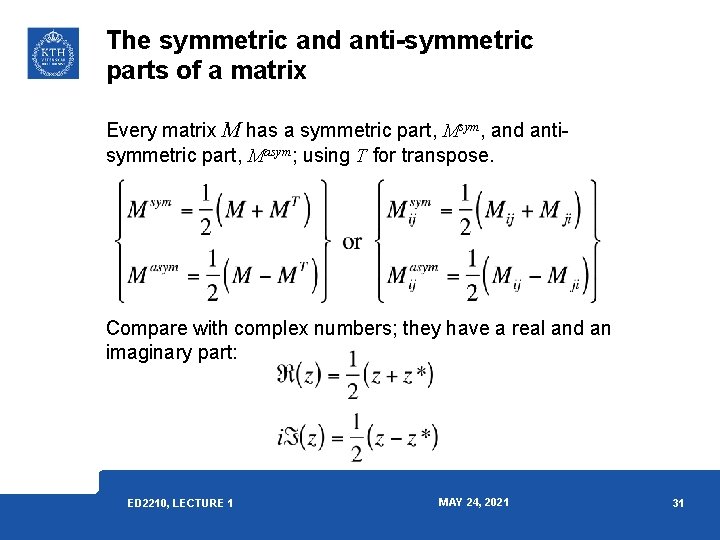
The symmetric and anti-symmetric parts of a matrix Every matrix M has a symmetric part, Msym, and antisymmetric part, Masym; using T for transpose. Compare with complex numbers; they have a real and an imaginary part: ED 2210, LECTURE 1 MAY 24, 2021 31
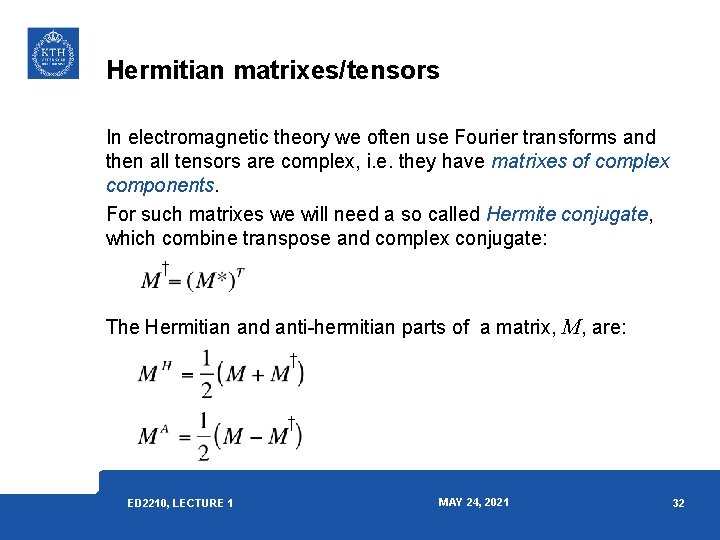
Hermitian matrixes/tensors In electromagnetic theory we often use Fourier transforms and then all tensors are complex, i. e. they have matrixes of complex components. For such matrixes we will need a so called Hermite conjugate, which combine transpose and complex conjugate: † The Hermitian and anti-hermitian parts of a matrix, M, are: † † ED 2210, LECTURE 1 MAY 24, 2021 32
Outline Fundamentals of electromagnetic theory (Ch. 1) • Maxwell’s equations • Continuity equations • Scalar and vector potentials Tensor index notation (Ch. 2) • Component representations of vectors and matrixes • Scalar and vector products • Symmetric/Antisymmetric and Hermitian/Antihermitian Multipoles (Ch. 3) • Multipole moments • Multipole fields ED 2210, LECTURE 1 MAY 24, 2021 33
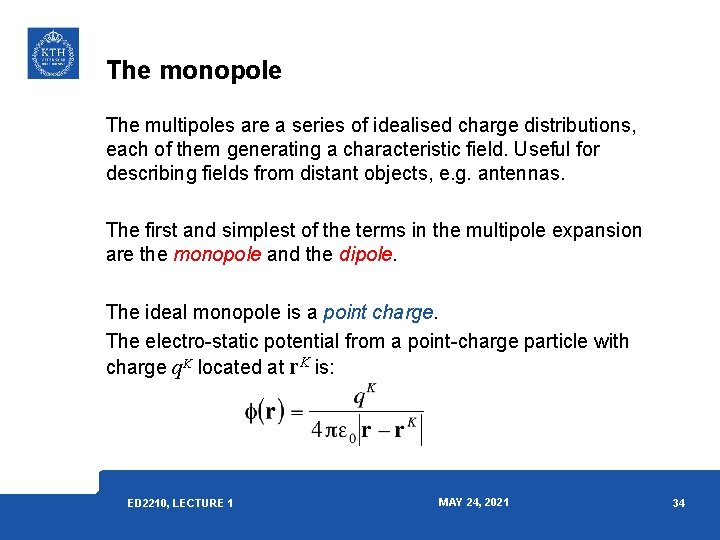
The monopole The multipoles are a series of idealised charge distributions, each of them generating a characteristic field. Useful for describing fields from distant objects, e. g. antennas. The first and simplest of the terms in the multipole expansion are the monopole and the dipole. The ideal monopole is a point charge. The electro-static potential from a point-charge particle with charge q. K located at r. K is: ED 2210, LECTURE 1 MAY 24, 2021 34
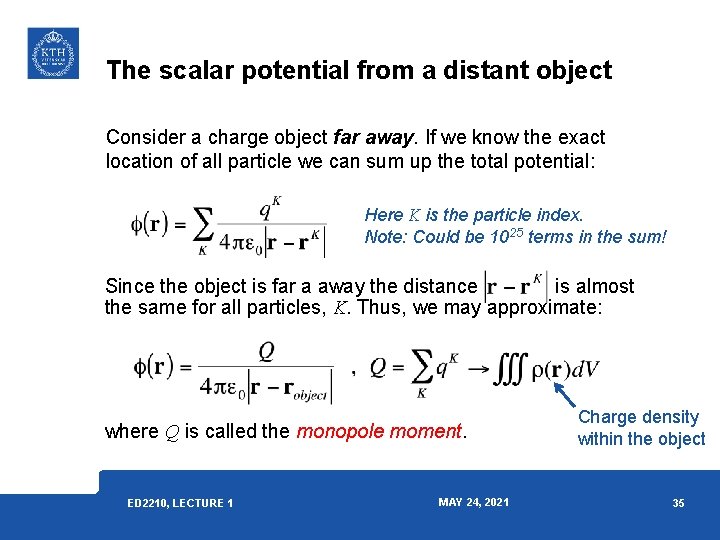
The scalar potential from a distant object Consider a charge object far away. If we know the exact location of all particle we can sum up the total potential: Here K is the particle index. Note: Could be 1025 terms in the sum! Since the object is far a away the distance is almost the same for all particles, K. Thus, we may approximate: where Q is called the monopole moment. ED 2210, LECTURE 1 MAY 24, 2021 Charge density within the object 35
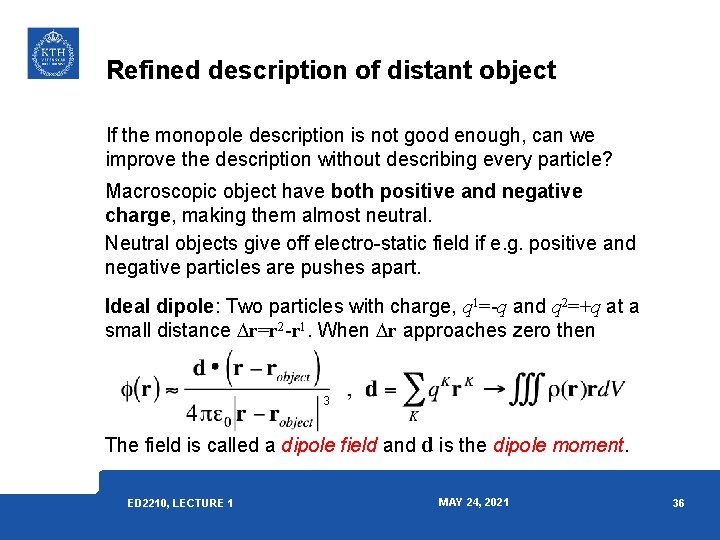
Refined description of distant object If the monopole description is not good enough, can we improve the description without describing every particle? Macroscopic object have both positive and negative charge, making them almost neutral. Neutral objects give off electro-static field if e. g. positive and negative particles are pushes apart. Ideal dipole: Two particles with charge, q 1=-q and q 2=+q at a small distance Dr=r 2 -r 1. When Dr approaches zero then 3 The field is called a dipole field and d is the dipole moment. ED 2210, LECTURE 1 MAY 24, 2021 36
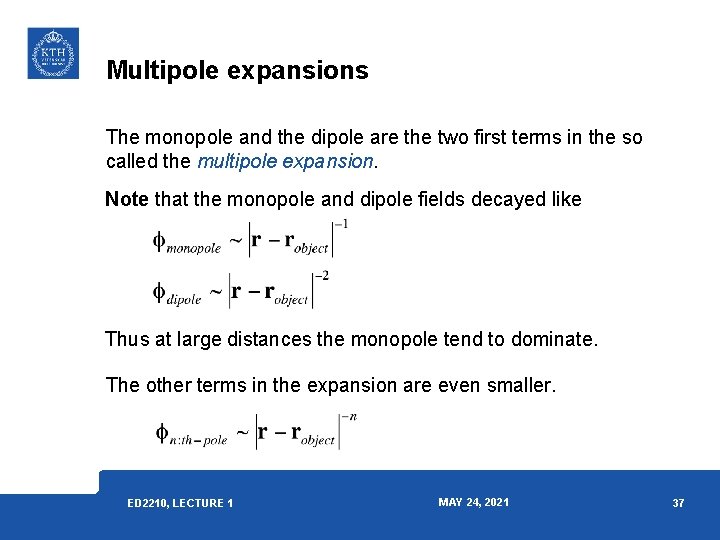
Multipole expansions The monopole and the dipole are the two first terms in the so called the multipole expansion. Note that the monopole and dipole fields decayed like Thus at large distances the monopole tend to dominate. The other terms in the expansion are even smaller. ED 2210, LECTURE 1 MAY 24, 2021 37
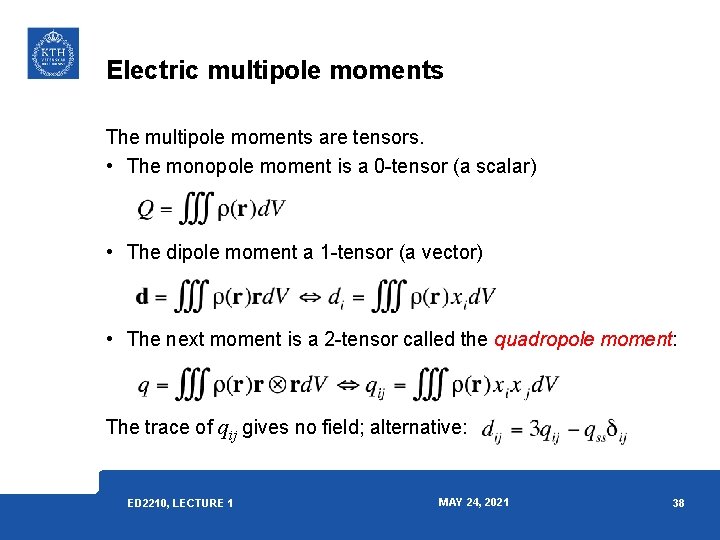
Electric multipole moments The multipole moments are tensors. • The monopole moment is a 0 -tensor (a scalar) • The dipole moment a 1 -tensor (a vector) • The next moment is a 2 -tensor called the quadropole moment: The trace of qij gives no field; alternative: ED 2210, LECTURE 1 MAY 24, 2021 38
Magnetic multipole moments Similarly there is a multipole expansion for magnetic fields. • Magnetic monopoles does not exist! (Well, it can’t be proved…) • Magnetic dipole moment: • In general the magnetic moment are generated from the series: • Example: ED 2210, LECTURE 1 MAY 24, 2021 39
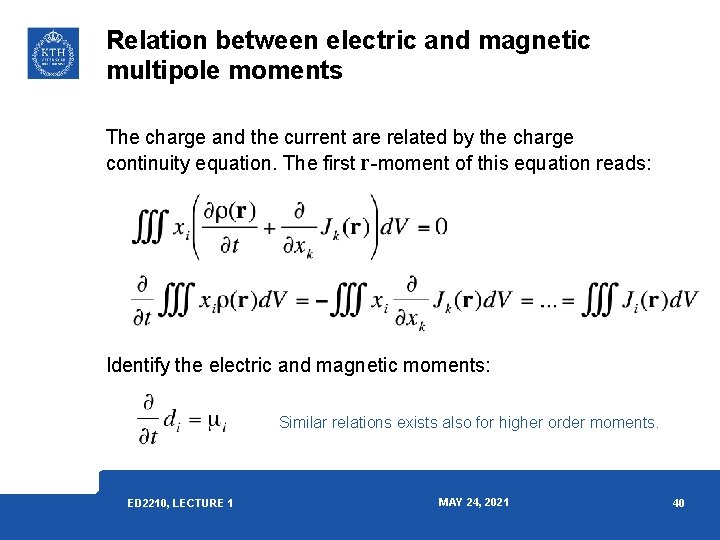
Relation between electric and magnetic multipole moments The charge and the current are related by the charge continuity equation. The first r-moment of this equation reads: Identify the electric and magnetic moments: Similar relations exists also for higher order moments. ED 2210, LECTURE 1 MAY 24, 2021 40
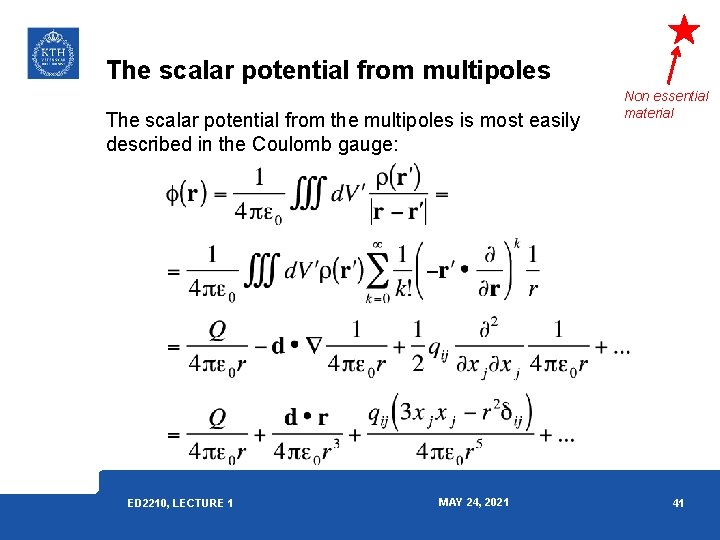
The scalar potential from multipoles The scalar potential from the multipoles is most easily described in the Coulomb gauge: ED 2210, LECTURE 1 MAY 24, 2021 Non essential material 41
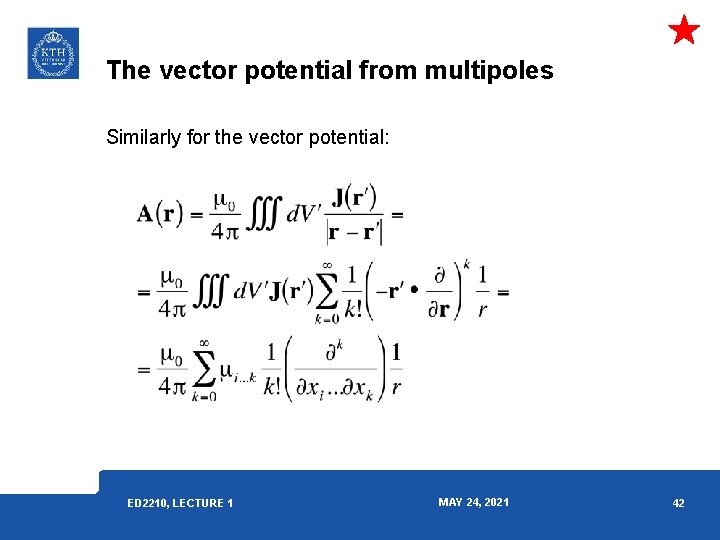
The vector potential from multipoles Similarly for the vector potential: ED 2210, LECTURE 1 MAY 24, 2021 42
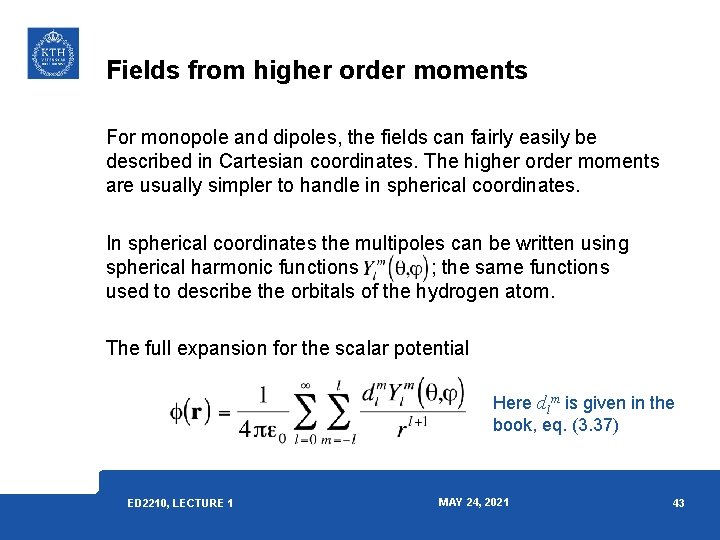
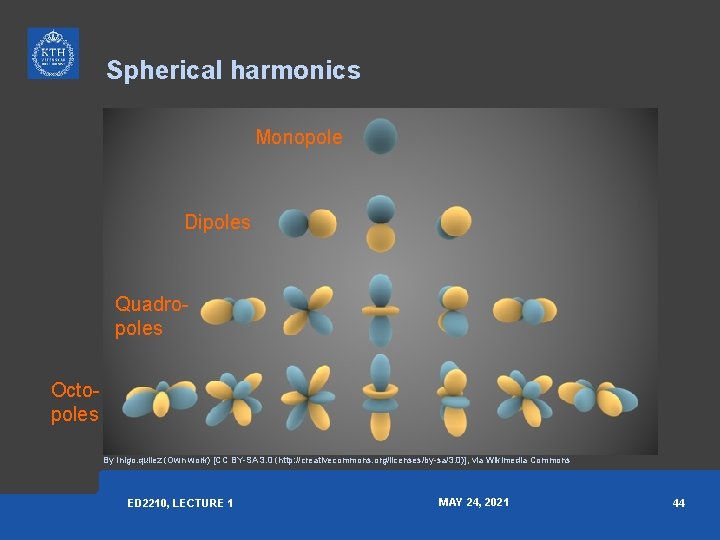
Fields from higher order moments For monopole and dipoles, the fields can fairly easily be described in Cartesian coordinates. The higher order moments are usually simpler to handle in spherical coordinates. In spherical coordinates the multipoles can be written using spherical harmonic functions ; the same functions used to describe the orbitals of the hydrogen atom. The full expansion for the scalar potential Here dlm is given in the book, eq. (3. 37) ED 2210, LECTURE 1 MAY 24, 2021 43
Spherical harmonics Monopole Dipoles Quadropoles Octopoles By Inigo. quilez (Own work) [CC BY-SA 3. 0 (http: //creativecommons. org/licenses/by-sa/3. 0)], via Wikimedia Commons ED 2210, LECTURE 1 MAY 24, 2021 44