
ECZEMA LEARNING OBJECTIVES Recognise the features of an

ECZEMA
LEARNING OBJECTIVES Recognise the features of an eczematous rash Develop a rational method for classifying eczema Name the main types of endogenous and exogenous eczema Know how to distinguish irritant contact from allergic contact dermatitis Describe theory behind patch testing, its method and indications Recognise and describe the distribution and morphology of atopic, discoid, varicose, pompholytic and seborrhoeic eczema List the common exacerbating factors for atopic eczema Develop a management plan for a patient with moderately severe atopic eczema List the main side effects of topical steroids and the measures needed to safeguard against these
ECZEMA FEATURES §Itching §Scaling §Dryness §Fissures §Bleeding §Weeping §Lichenification
TYPES OF ECZEMA §Atopic §Discoid §Seborrhoeic §Venous/Gravitational §Irritant Contact §Allergic Contact
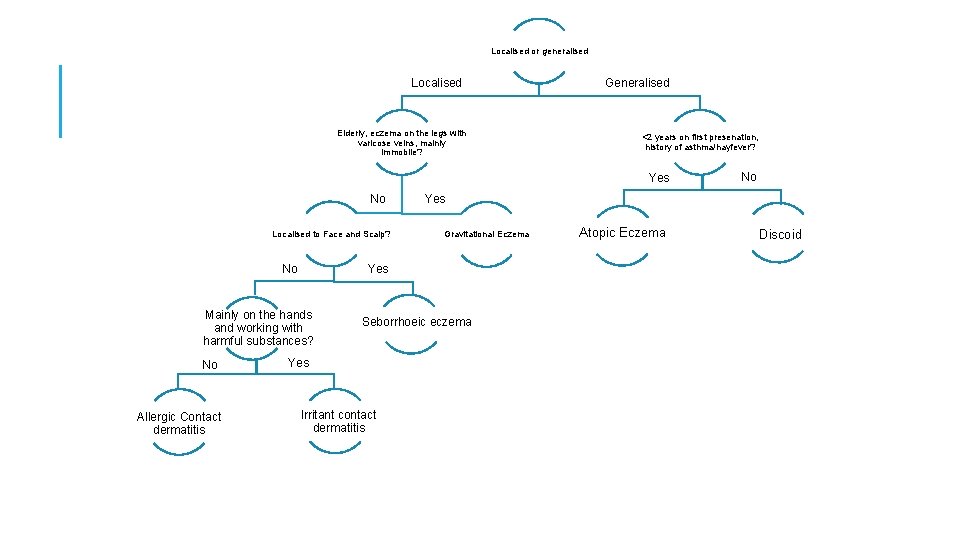
Localised or generalised Localised Elderly, eczema on the legs with varicose veins, mainly immobile? Generalised <2 years on first presenation, history of asthma/hayfever? Yes No Localised to Face and Scalp? Mainly on the hands and working with harmful substances? No Allergic Contact dermatitis Yes Gravitational Eczema Yes No Seborrhoeic eczema Yes Irritant contact dermatitis No Atopic Eczema Discoid
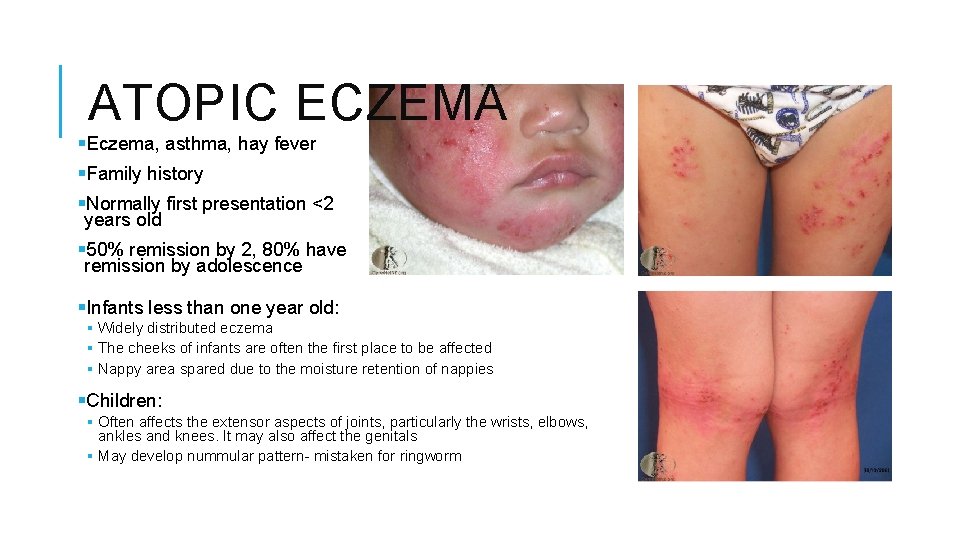
ATOPIC ECZEMA §Eczema, asthma, hay fever §Family history §Normally first presentation <2 years old § 50% remission by 2, 80% have remission by adolescence §Infants less than one year old: § Widely distributed eczema § The cheeks of infants are often the first place to be affected § Nappy area spared due to the moisture retention of nappies §Children: § Often affects the extensor aspects of joints, particularly the wrists, elbows, ankles and knees. It may also affect the genitals § May develop nummular pattern- mistaken for ringworm

DISCOID ECZEMA §Nummular dermatitis §May be associated with staph aureus §Affects children and adults, males>females §Men over 50, chronic alcohol abuse §Mainly limbs and trunk, asymmetrical distribution §Two types: § Exudative acute discoid eczema: oozy papules, blisters and plaques § Dry discoid eczema: subacute or chronic erythematous, dry plaques §Tests: § bacterial swabs for staph aureus- antibiotics § Scrapings to rule out ring worm (tinea corporis)
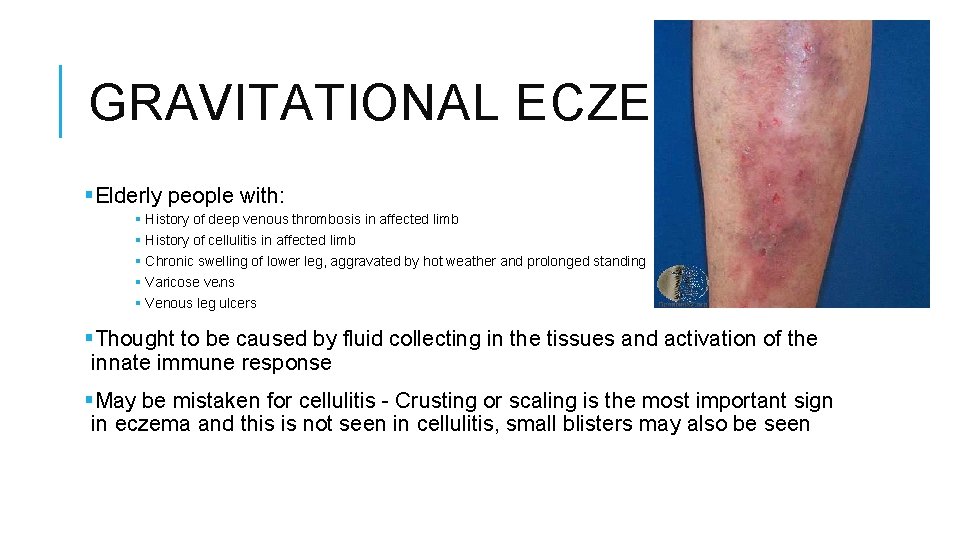
GRAVITATIONAL ECZEMA §Elderly people with: § History of deep venous thrombosis in affected limb § History of cellulitis in affected limb § Chronic swelling of lower leg, aggravated by hot weather and prolonged standing § Varicose veins § Venous leg ulcers §Thought to be caused by fluid collecting in the tissues and activation of the innate immune response §May be mistaken for cellulitis - Crusting or scaling is the most important sign in eczema and this is not seen in cellulitis, small blisters may also be seen
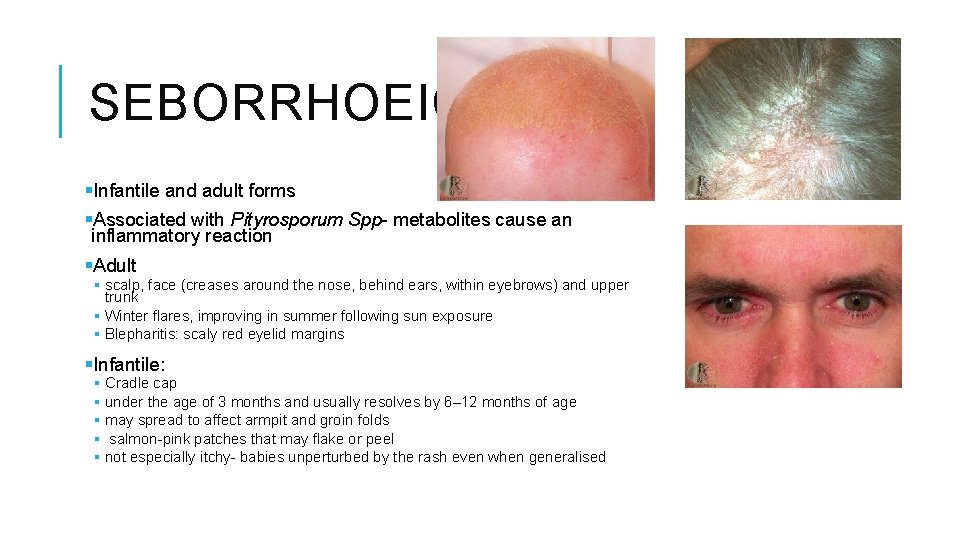
SEBORRHOEIC §Infantile and adult forms §Associated with Pityrosporum Spp- metabolites cause an inflammatory reaction §Adult § scalp, face (creases around the nose, behind ears, within eyebrows) and upper trunk § Winter flares, improving in summer following sun exposure § Blepharitis: scaly red eyelid margins §Infantile: § Cradle cap § under the age of 3 months and usually resolves by 6– 12 months of age § may spread to affect armpit and groin folds § salmon-pink patches that may flake or peel § not especially itchy- babies unperturbed by the rash even when generalised
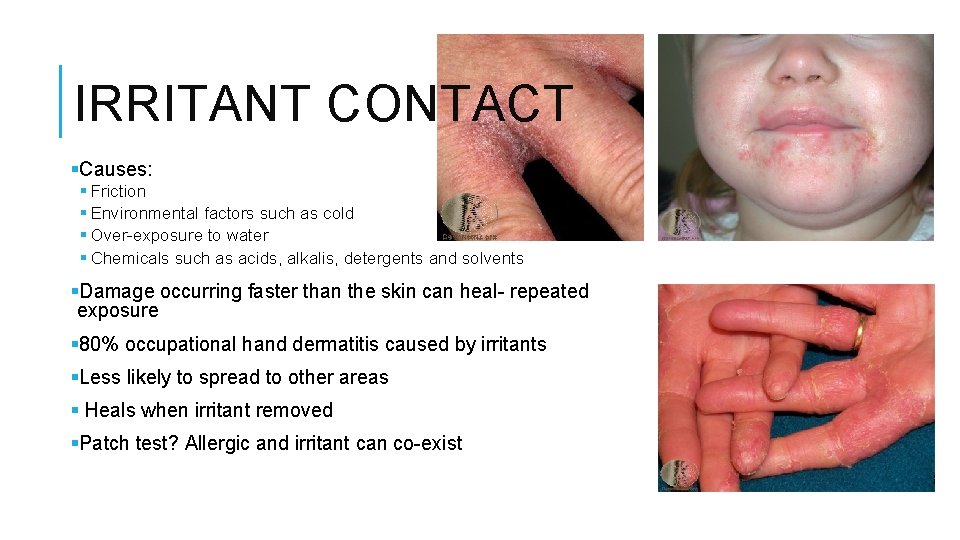
IRRITANT CONTACT §Causes: § Friction § Environmental factors such as cold § Over-exposure to water § Chemicals such as acids, alkalis, detergents and solvents §Damage occurring faster than the skin can heal- repeated exposure § 80% occupational hand dermatitis caused by irritants §Less likely to spread to other areas § Heals when irritant removed §Patch test? Allergic and irritant can co-exist
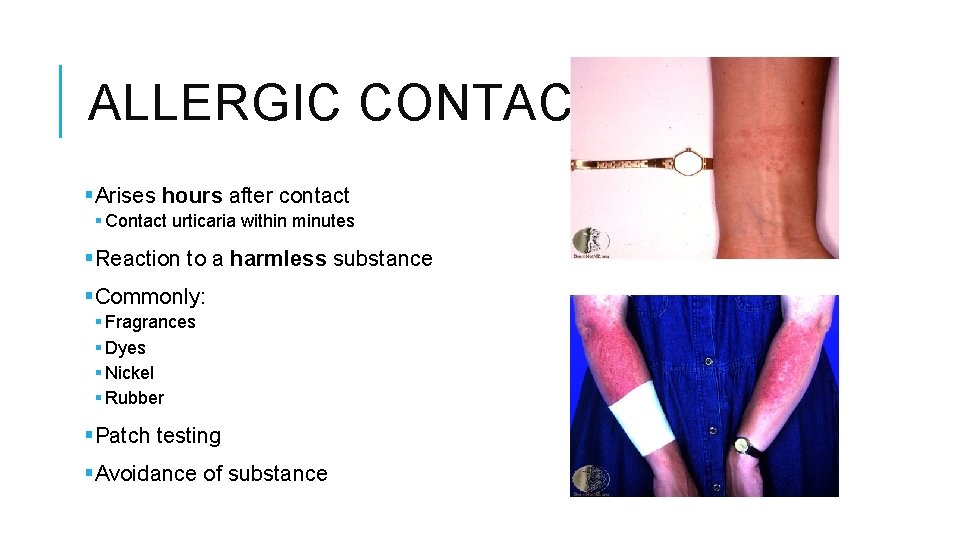
ALLERGIC CONTACT §Arises hours after contact § Contact urticaria within minutes §Reaction to a harmless substance §Commonly: § Fragrances § Dyes § Nickel § Rubber §Patch testing §Avoidance of substance
MANAGEMENT Principles q. Reduction of exposure to trigger factors (where possible) q. Regular emollients to treat dry skin qtopical steroids Potency steroid Mild Hydrocortisone 1% moderate eumovate Potent Elocon, betnovate Very potent dermovate ØIMPORTANT TO HAVE STEROID FREE DAYS
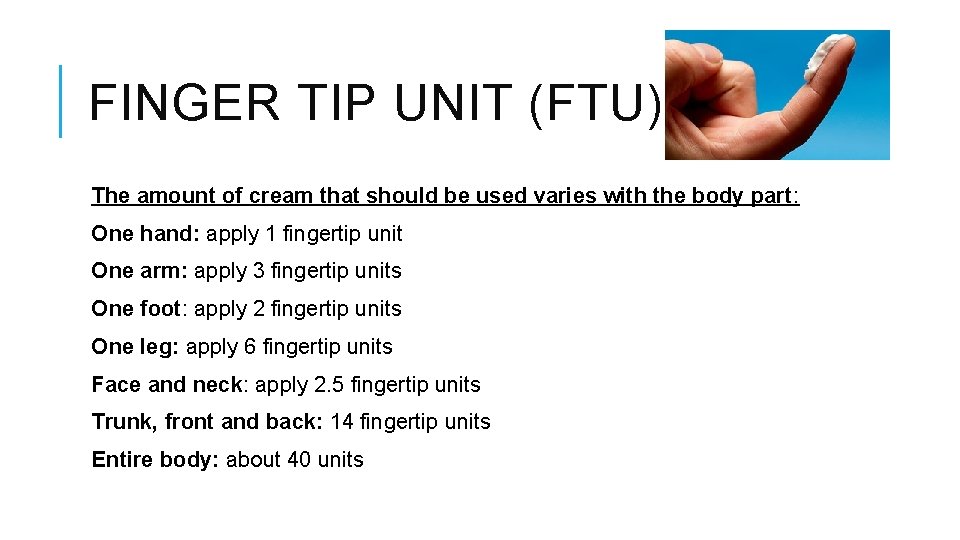
FINGER TIP UNIT (FTU) The amount of cream that should be used varies with the body part: One hand: apply 1 fingertip unit One arm: apply 3 fingertip units One foot: apply 2 fingertip units One leg: apply 6 fingertip units Face and neck: apply 2. 5 fingertip units Trunk, front and back: 14 fingertip units Entire body: about 40 units
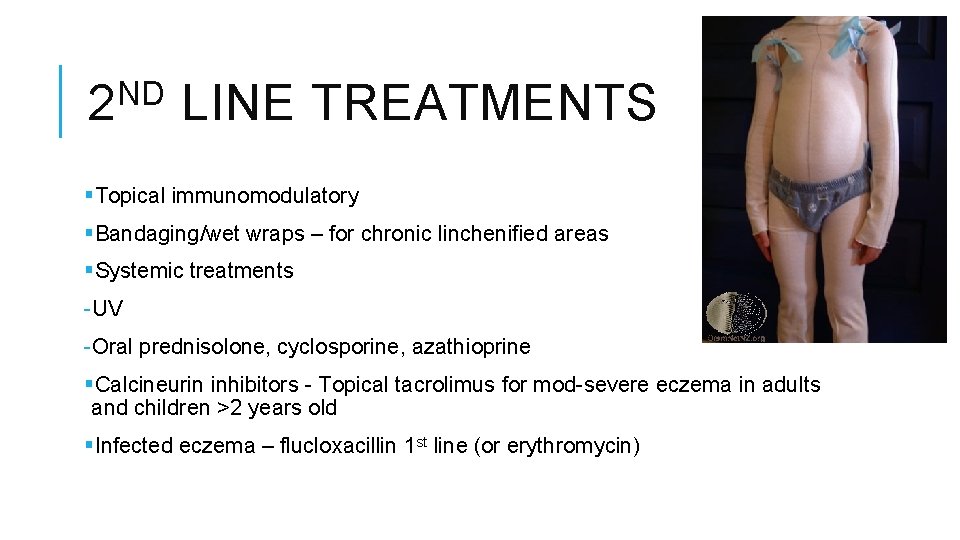
ND 2 LINE TREATMENTS §Topical immunomodulatory §Bandaging/wet wraps – for chronic linchenified areas §Systemic treatments -UV -Oral prednisolone, cyclosporine, azathioprine §Calcineurin inhibitors - Topical tacrolimus for mod-severe eczema in adults and children >2 years old §Infected eczema – flucloxacillin 1 st line (or erythromycin)
WHICH ONE OF THE FOLLOWING BEST DESCRIBES THE TYPICAL DISTRIBUTION OF ATOPIC ECZEMA IN A 10 -MONTH-OLD CHILD? 1) nappy area and flexor surfaces of arms and legs 2) face and trunk 3) nappy area and trunk 4) flexor surfaces of arms and legs 5) scalp and arms 2)
A 19 -YEAR-OLD FEMALE WHO HAS JUST STARTED WORK AS A CLEANER PRESENTS WITH A RASH ON HER HANDS. ON EXAMINATION THERE IS A GENERALISED ERYTHEMATOUS RASH ON THE DORSUM OF BOTH HANDS. THERE IS NO EVIDENCE OF SCALING OR VESICLES. WHAT IS THE MOST LIKELY DIAGNOSIS? 1) Tinea manuum 2) Irritant contact dermatitis 3) Allergic contact dermatitis 4) Ichthyosis vulgaris 5) Pustular psoriasis 2)
- Slides: 16