
ECR Positioning of the Quench Heaters on the
- Slides: 5
ECR: Positioning of the Quench Heaters on the 11 T magnet D. Schoerling TCC 2 nd of May 2019 1
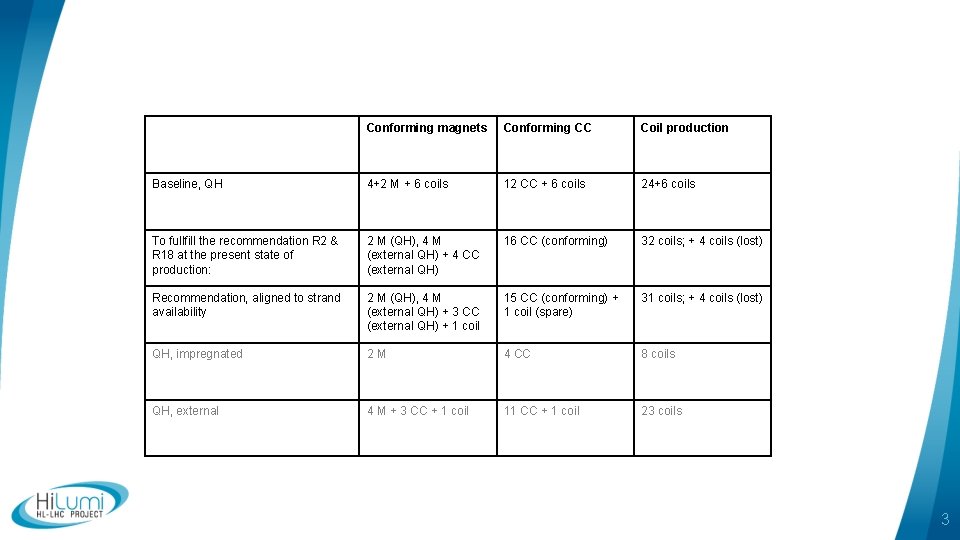
Comments § The technical aspects have been discussed in detail in the 67 th TCC (14 th February 2019). In this meeting the outcome of the dedicated technical meeting chaired by Felix Rodriguez Mateos has also been presented. § It is planned to produce two coils (12 and 13) still with quench heaters impregnated to be able to equip magnet 2 with collared coils of the same kind as magnet 1 (QH impregnated) § The production with external quench heaters has been impregnated (coil 10); the next coil with external QH will be impregnated on May 5 th (coil 11). Following all coils (except 12 and 13) will be produced with external QH. Comments: Benoit: At WP 11 PSM of 07/02/19, it was explained that this change might induce 5 coils and 4 collared coils more. Why does this ECR refer to 8 coils and 4 collared coils? This has an impact on the cost of this ECR. The plan presented in PSM was estimated to cost 580 k. CHF for components and about 1420 k. CHf for the S 197 manpower, i. e. a total of 2000 k. CHF. This ECR amounts to about 2700 k. CHF. I guess this change shall be clarified at TCC. The impact on the manpower needed for cabling activities should also be assessed (additional unit length of cable to be produced). Answer: Please refer to the table on the next slide for clarification on the number of coils, CC and magnets to be produced. This table will be included in the ECR for clarification. In a success oriented planning, we have to do 5 additional coils and 3 additional collared coils, with a cost of: Components 500 k. CHF GE contractual price 1300 k. CHF TOTAL 1800 k. CHF
Conforming magnets Conforming CC Coil production Baseline, QH 4+2 M + 6 coils 12 CC + 6 coils 24+6 coils To fullfill the recommendation R 2 & R 18 at the present state of production: 2 M (QH), 4 M (external QH) + 4 CC (external QH) 16 CC (conforming) 32 coils; + 4 coils (lost) Recommendation, aligned to strand availability 2 M (QH), 4 M (external QH) + 3 CC (external QH) + 1 coil 15 CC (conforming) + 1 coil (spare) 31 coils; + 4 coils (lost) QH, impregnated 2 M 4 CC 8 coils QH, external 4 M + 3 CC + 1 coil 11 CC + 1 coil 23 coils 3
Comments Laurent: Following the test results in September 2019, the Master Schedule of the WP 11 will be updated for the next C&S review scheduled in November 2019. Answer: In September the go/no-go decision will be taken based on an internal review after testing one 11 T dipole magnet Daniel W: The recent use of the u. QDS prototype for the protection of the 11 T hybrid magnet in SM 18 has been very successful and gives us the confidence that the specified interlock limits and reaction times can be fulfilled. It should, nevertheless, clearly be stated that the threshold and evaluation time needs to be significantly increased for currents below 6 k. A to avoid trips by flux jumps Answer: Thank you for this confirmation. It will be clarified that the threshold and evaluation time needs to be significantly increased for currents below 6 k. A to avoid trips by flux jumps. The values used in SM 18 were 200 m. V threshold and 40 ms evaluation time for < 6 k. A, the same values are planned to be used in the LHC. Analytical estimates of the MITTs, based on measurements on the short models in SM 18, show that also with these settings the MIITs are largest at nominal current; therefore, the largest hot-spot is expected to arise in case of quench at nominal current (values as presented in the QH ECR). The analytical estimates will be discussed in MCF.
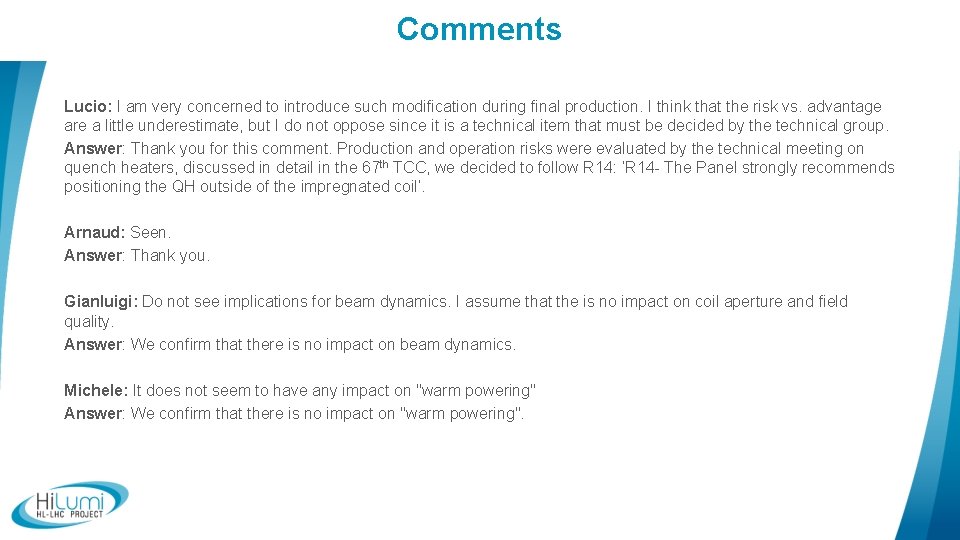
Comments Lucio: I am very concerned to introduce such modification during final production. I think that the risk vs. advantage are a little underestimate, but I do not oppose since it is a technical item that must be decided by the technical group. Answer: Thank you for this comment. Production and operation risks were evaluated by the technical meeting on quench heaters, discussed in detail in the 67 th TCC, we decided to follow R 14: ‘R 14 - The Panel strongly recommends positioning the QH outside of the impregnated coil’. Arnaud: Seen. Answer: Thank you. Gianluigi: Do not see implications for beam dynamics. I assume that the is no impact on coil aperture and field quality. Answer: We confirm that there is no impact on beam dynamics. Michele: It does not seem to have any impact on "warm powering" Answer: We confirm that there is no impact on "warm powering".