
ECR ion source for the highly charged intensive
- Slides: 25
ECR ion source for the highly charged, intensive ion beams University of Jyväskylä, Department of Physics H. Koivisto December 2007 ESF-Workshop, Athens, Greece
Content 1. Production of highly charged ion beams (by ECRIS) 2. Present projects and challenges 3. (Metal) Ion beam production 4. Beam transport December 2007 ESF-Workshop, Athens, Greece
What kind of ion source? Accelerator (linear/cyclotron) gives some boundary condition! - Continues or pulsed beam? - A+ or Aq+(low versus high charge states)? - Intensity requirement? - Variety of elements? Charge breeding? Etc. . . ECRIS December 2007 ESF-Workshop, Athens, Greece
Operation principle (ECRIS) 1) Sufficient magnetic field (including correct structure) 2) Electrons rotating in magnetic field 3) Microwaves ECR: Electron Cyclotron Resonance December 2007 ESF-Workshop, Athens, Greece
Scaling laws (magnetic, frequency) 1) Magnetic field: Axial magnetic field Baxial by solenoids Radial magnetic field Bradial by multipole 14 GHz : 0. 5 T 28 GHz: 1 T V E N U S December 2007 ESF-Workshop, Athens, Greece
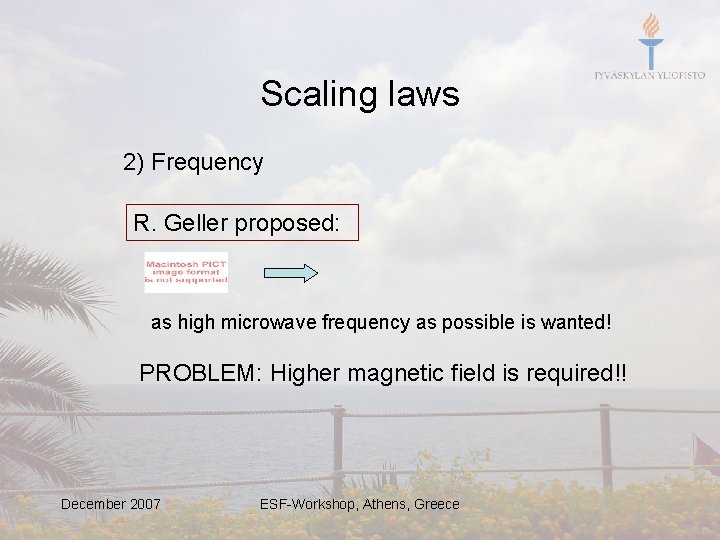
Scaling laws 2) Frequency R. Geller proposed: as high microwave frequency as possible is wanted! PROBLEM: Higher magnetic field is required!! December 2007 ESF-Workshop, Athens, Greece
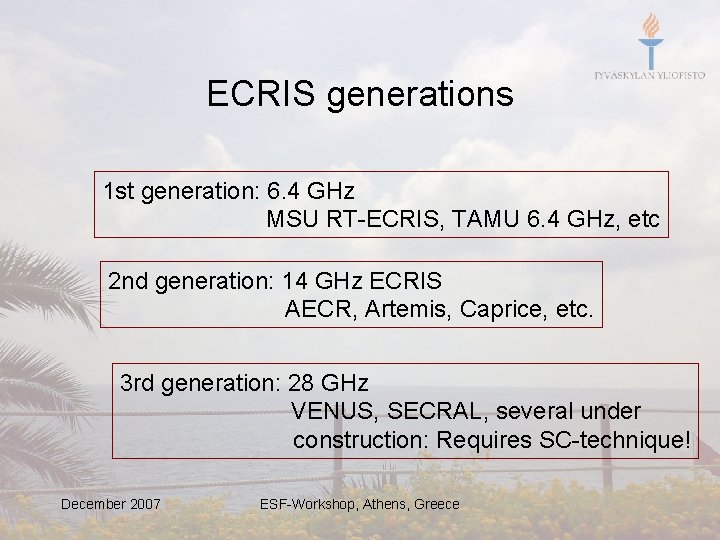
ECRIS generations 1 st generation: 6. 4 GHz MSU RT-ECRIS, TAMU 6. 4 GHz, etc 2 nd generation: 14 GHz ECRIS AECR, Artemis, Caprice, etc. 3 rd generation: 28 GHz VENUS, SECRAL, several under construction: Requires SC-technique! December 2007 ESF-Workshop, Athens, Greece
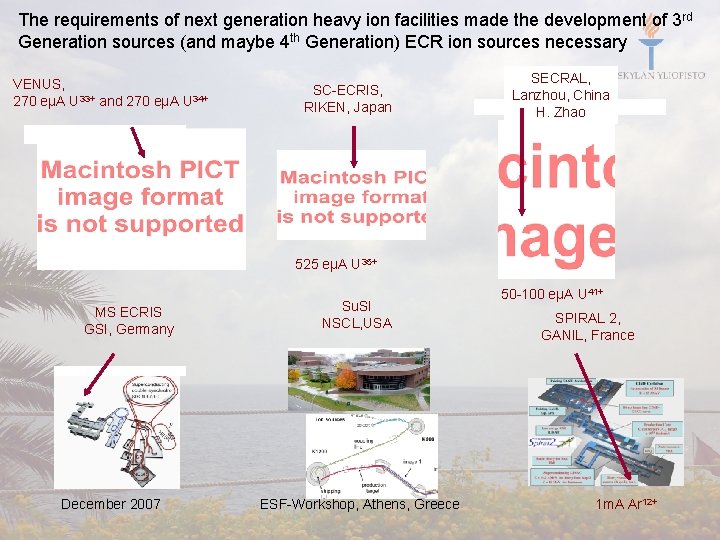
The requirements of next generation heavy ion facilities made the development of 3 rd Generation sources (and maybe 4 th Generation) ECR ion sources necessary VENUS, 270 eµA U 33+ and 270 eµA U 34+ SC-ECRIS, RIKEN, Japan SECRAL, Lanzhou, China H. Zhao 525 eµA U 35+ MS ECRIS GSI, Germany December 2007 Su. SI NSCL, USA ESF-Workshop, Athens, Greece 50 -100 eµA U 41+ SPIRAL 2, GANIL, France 1 m. A Ar 12+
December 2007 ESF-Workshop, Athens, Greece
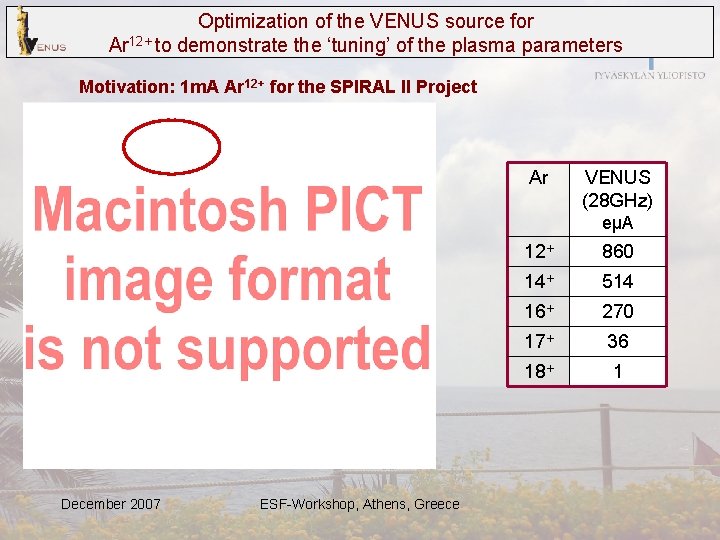
Optimization of the VENUS source for Ar 12+ to demonstrate the ‘tuning’ of the plasma parameters Motivation: 1 m. A Ar 12+ for the SPIRAL II Project Ar VENUS (28 GHz) eμA December 2007 ESF-Workshop, Athens, Greece 12+ 860 14+ 514 16+ 270 17+ 36 18+ 1
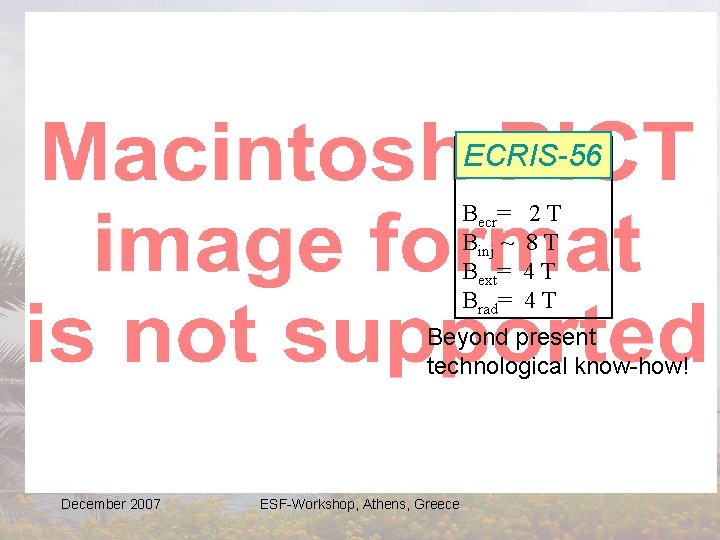
Comparison of different generations 1 st generation: Itot<1 m. A ECRIS-56 2 nd generation: Itot= 2 -4 m. A Becr= 2 T 3 rd tot= 10 m. A Binjgeneration: I ~ 8 T Bext= 4 T Brad= 4 T Beyond present technological know-how! December 2007 ESF-Workshop, Athens, Greece
MS-ECRIS won’t be a 4 th generation ECRIS even if 56 GHz can be tested It won’t fulfill the scaling law for the magnetic fields! It will be a step between the 3 rd and 4 th generation ECRIS (3. 5 generation) 4 th generation ECRIS requires a lot of development work for example in the field of superconductive technique December 2007 ESF-Workshop, Athens, Greece
Some engineering current densities December 2007 ESF-Workshop, Athens, Greece
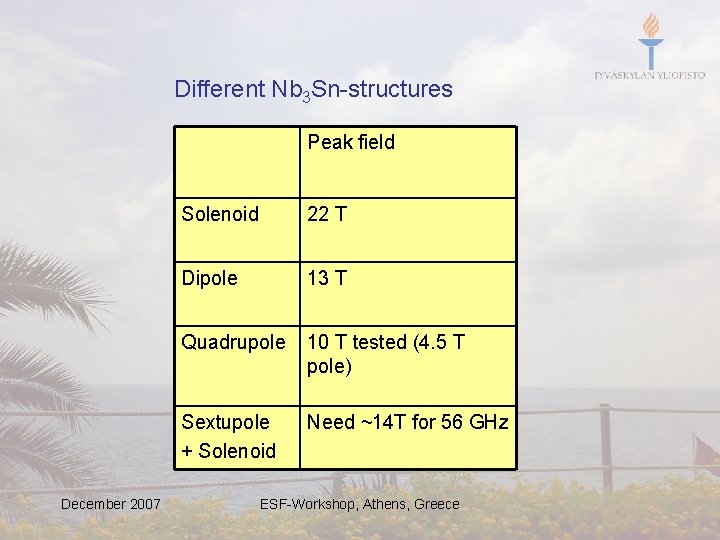
Different Nb 3 Sn-structures Peak field December 2007 Solenoid 22 T Dipole 13 T Quadrupole 10 T tested (4. 5 T pole) Sextupole + Solenoid Need ~14 T for 56 GHz ESF-Workshop, Athens, Greece
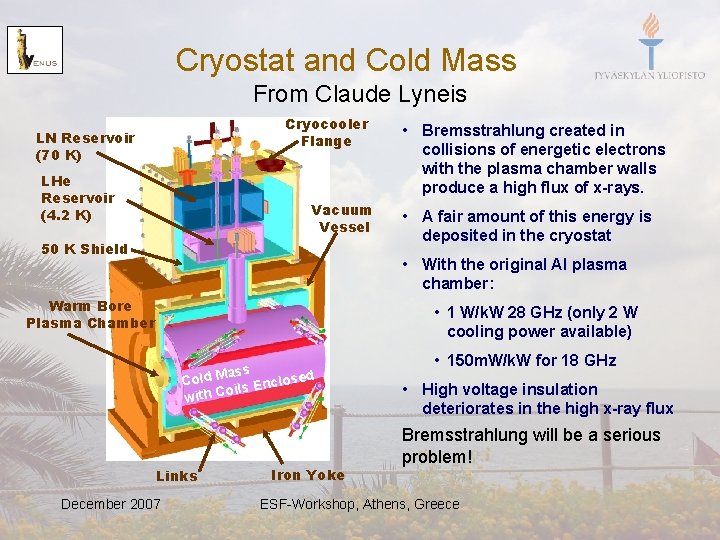
Cryostat and Cold Mass From Claude Lyneis Cryocooler Flange LN Reservoir (70 K) LHe Reservoir (4. 2 K) Vacuum Vessel 50 K Shield • Bremsstrahlung created in collisions of energetic electrons with the plasma chamber walls produce a high flux of x-rays. • A fair amount of this energy is deposited in the cryostat • With the original Al plasma chamber: Warm Bore Plasma Chamber • 1 W/k. W 28 GHz (only 2 W cooling power available) ass Cold M s Enclosed oil with C Links December 2007 Iron Yoke • 150 m. W/k. W for 18 GHz • High voltage insulation deteriorates in the high x-ray flux Bremsstrahlung will be a serious problem! ESF-Workshop, Athens, Greece
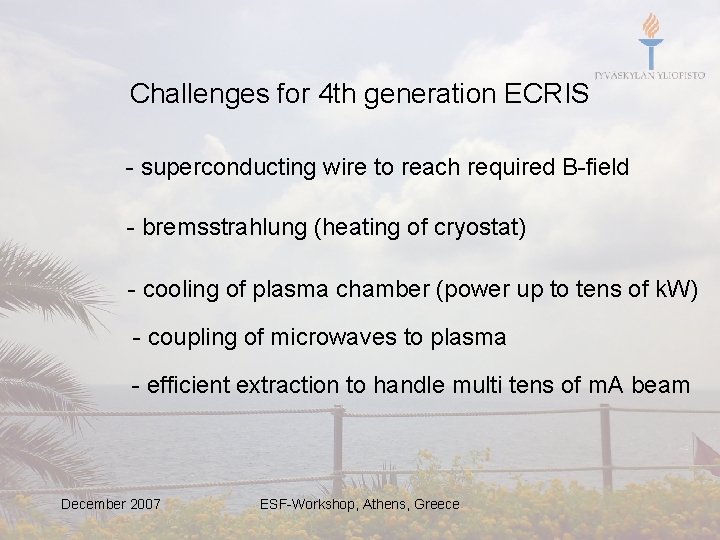
Challenges for 4 th generation ECRIS - superconducting wire to reach required B-field - bremsstrahlung (heating of cryostat) - cooling of plasma chamber (power up to tens of k. W) - coupling of microwaves to plasma - efficient extraction to handle multi tens of m. A beam December 2007 ESF-Workshop, Athens, Greece
Production of metal ion beams ECOS working group: “In order to meet the requirements of the future experiments with high-intensity beams, further development is needed, especially in the production of metal-ion beams. Consequently, the development of ECR ion source will be one of the most active areas in accelerator physics. ” Consequently a lot of human resources will be invested in this work (very visible role during FP 7) December 2007 ESF-Workshop, Athens, Greece
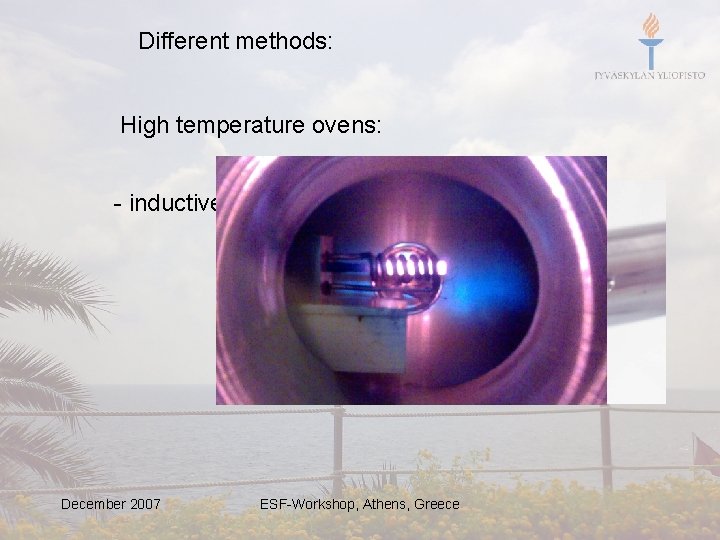
Different methods: High temperature ovens: - inductively heated oven (above 2000˙C) December 2007 ESF-Workshop, Athens, Greece
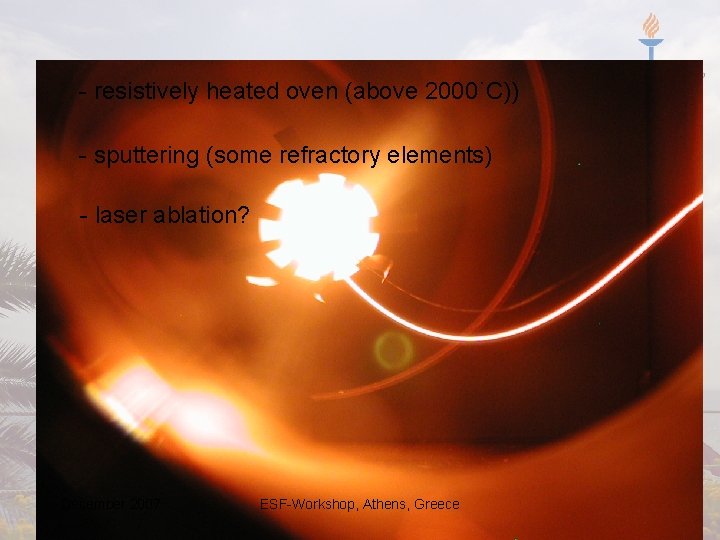
- resistively heated oven (above 2000˙C)) - sputtering (some refractory elements) - laser ablation? December 2007 ESF-Workshop, Athens, Greece
Beam transport More beam intensity from the cyclotron is needed for the experiments!! Improvement of ECRIS performance does not always increase the intensity for the experiments beam formation or/and transmission problem!! Problem in several laboratory! December 2007 ESF-Workshop, Athens, Greece
Statistics (2004) JYFL 14 GHz ECRIS Icycl/IECR 2 nd harmonic Transmission efficiency decreases when beam intensity increases! Some reasons: 1) space charge effect (strong focusing) 2) Emittance increases with beam intensity December 2007 ESF-Workshop, Athens, Greece
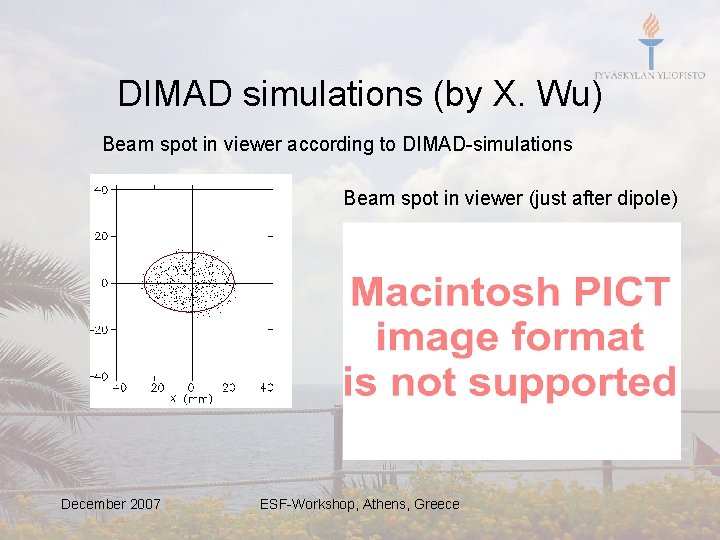
DIMAD simulations (by X. Wu) Beam spot in viewer according to DIMAD-simulations Beam spot in viewer (just after dipole) December 2007 ESF-Workshop, Athens, Greece
Hollow beam JYFL NSCL December 2007 ESF-Workshop, Athens, Greece
“ECOS” needs the development of: - ion sources for higher intensity and higher charge states - beam formation to produce high quality beams - high quality beam transport facility to transport beam efficiently to accelerator -development of metal ion beam production to make new and exotic beams available December 2007 ESF-Workshop, Athens, Greece
Thanks to the following for providing slides for this presentation: - Santo Gammino - Daniela Leitner - Claude Lyneis - Marc Doleans December 2007 ESF-Workshop, Athens, Greece