
ECOWAS Model Structure and Training Jim Hansen Nancy
- Slides: 29
ECOWAS Model Structure and Training Jim Hansen, Nancy Cochrane, and Getachew Nigatu USDA, Economic Research Service
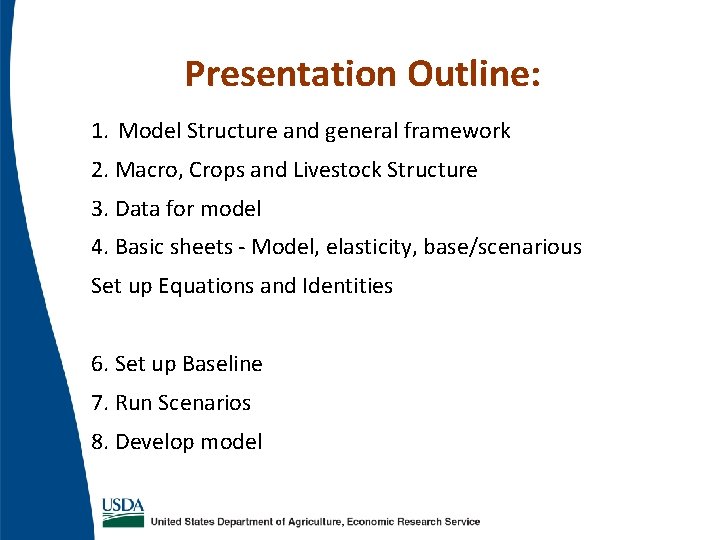
Presentation Outline: 1. Model Structure and general framework 2. Macro, Crops and Livestock Structure 3. Data for model 4. Basic sheets - Model, elasticity, base/scenarious Set up Equations and Identities 6. Set up Baseline 7. Run Scenarios 8. Develop model
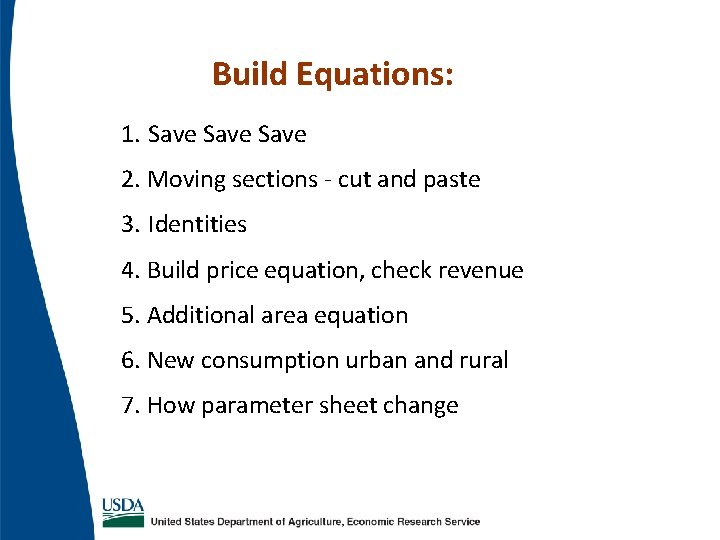
Build Equations: 1. Save 2. Moving sections - cut and paste 3. Identities 4. Build price equation, check revenue 5. Additional area equation 6. New consumption urban and rural 7. How parameter sheet change
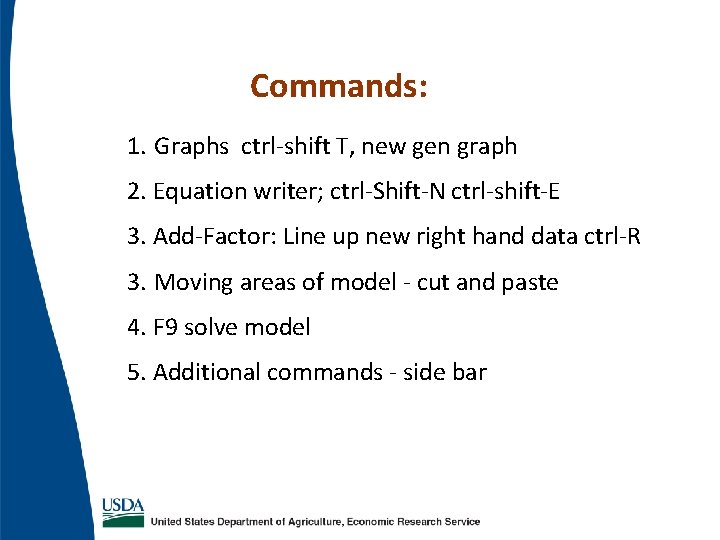
Commands: 1. Graphs ctrl-shift T, new gen graph 2. Equation writer; ctrl-Shift-N ctrl-shift-E 3. Add-Factor: Line up new right hand data ctrl-R 3. Moving areas of model - cut and paste 4. F 9 solve model 5. Additional commands - side bar
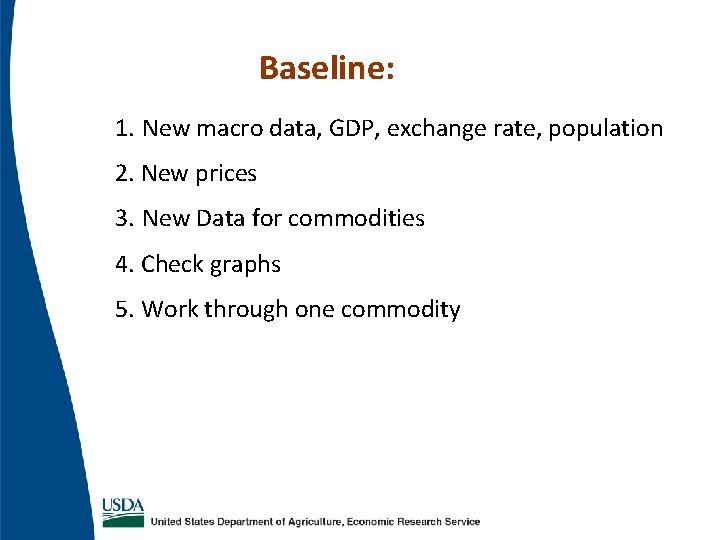
Baseline: 1. New macro data, GDP, exchange rate, population 2. New prices 3. New Data for commodities 4. Check graphs 5. Work through one commodity
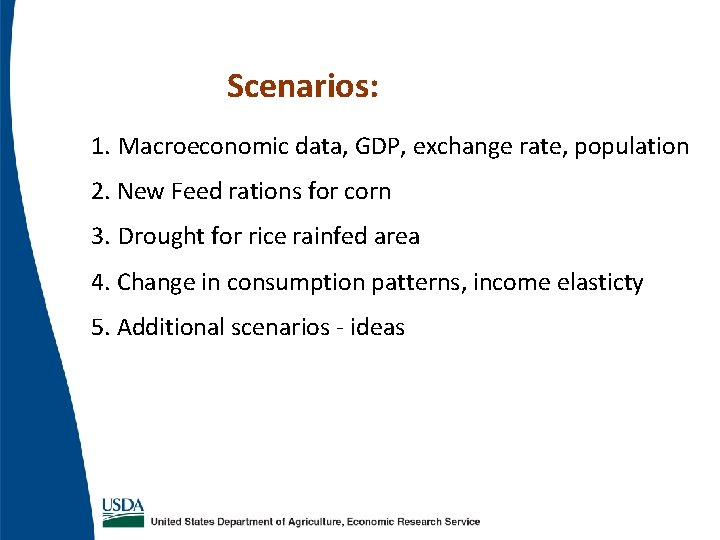
Scenarios: 1. Macroeconomic data, GDP, exchange rate, population 2. New Feed rations for corn 3. Drought for rice rainfed area 4. Change in consumption patterns, income elasticty 5. Additional scenarios - ideas
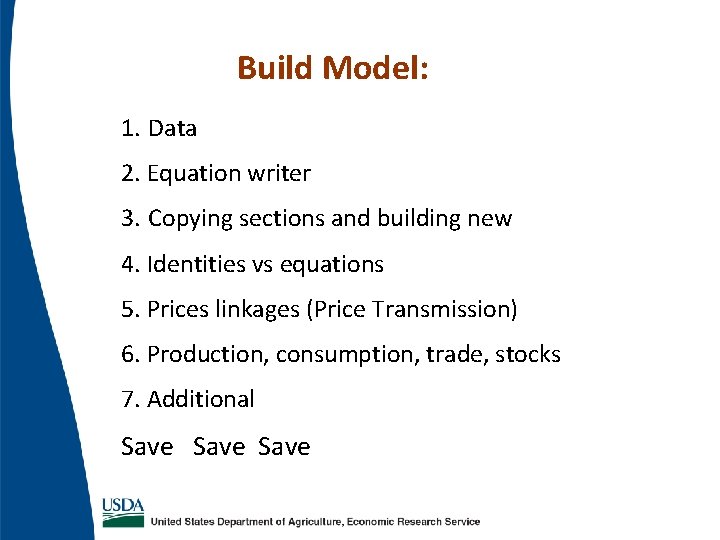
Build Model: 1. Data 2. Equation writer 3. Copying sections and building new 4. Identities vs equations 5. Prices linkages (Price Transmission) 6. Production, consumption, trade, stocks 7. Additional Save
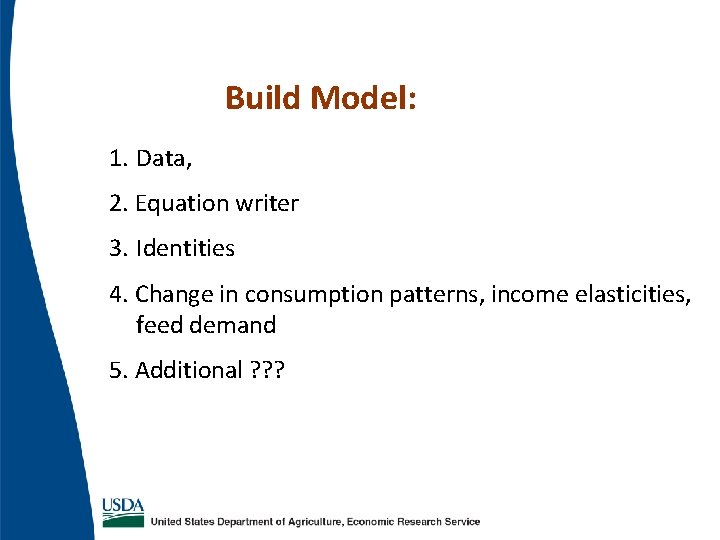
Build Model: 1. Data, 2. Equation writer 3. Identities 4. Change in consumption patterns, income elasticities, feed demand 5. Additional ? ? ?
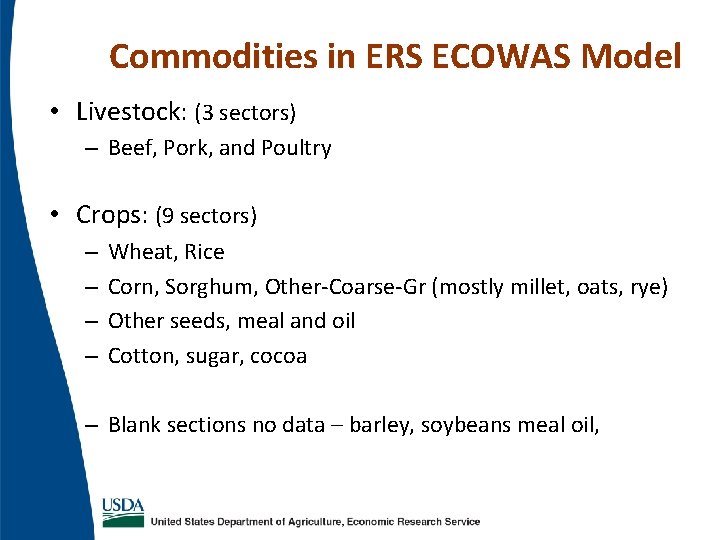
Commodities in ERS ECOWAS Model • Livestock: (3 sectors) – Beef, Pork, and Poultry • Crops: (9 sectors) – – Wheat, Rice Corn, Sorghum, Other-Coarse-Gr (mostly millet, oats, rye) Other seeds, meal and oil Cotton, sugar, cocoa – Blank sections no data – barley, soybeans meal oil,
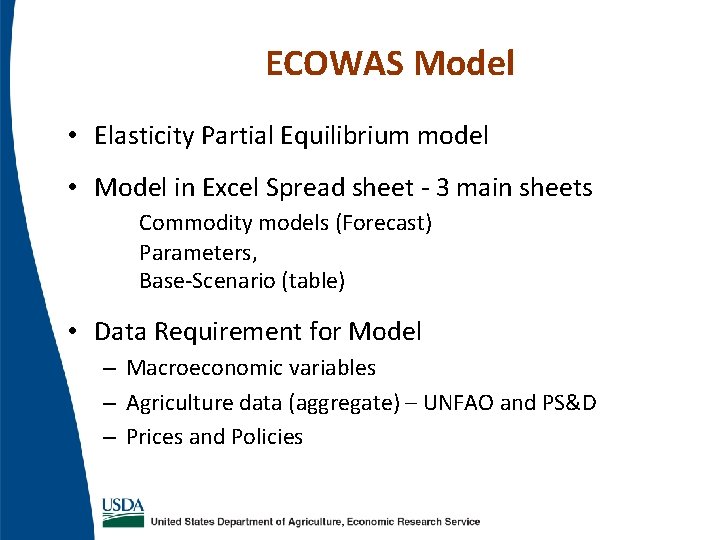
ECOWAS Model • Elasticity Partial Equilibrium model • Model in Excel Spread sheet - 3 main sheets Commodity models (Forecast) Parameters, Base-Scenario (table) • Data Requirement for Model – Macroeconomic variables – Agriculture data (aggregate) – UNFAO and PS&D – Prices and Policies
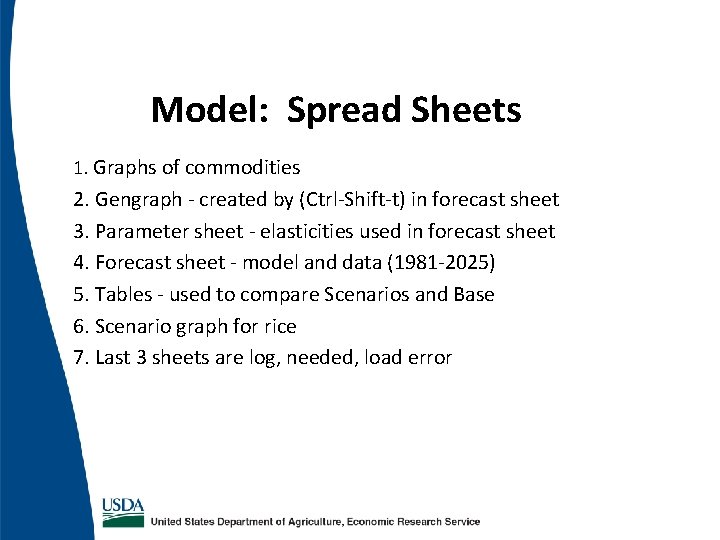
Model: Spread Sheets 1. Graphs of commodities 2. Gengraph - created by (Ctrl-Shift-t) in forecast sheet 3. Parameter sheet - elasticities used in forecast sheet 4. Forecast sheet - model and data (1981 -2025) 5. Tables - used to compare Scenarios and Base 6. Scenario graph for rice 7. Last 3 sheets are log, needed, load error
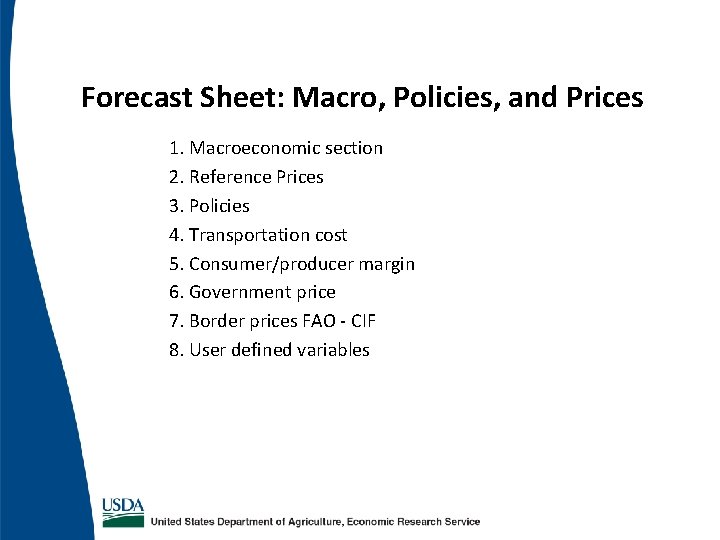
Forecast Sheet: Macro, Policies, and Prices 1. Macroeconomic section 2. Reference Prices 3. Policies 4. Transportation cost 5. Consumer/producer margin 6. Government price 7. Border prices FAO - CIF 8. User defined variables
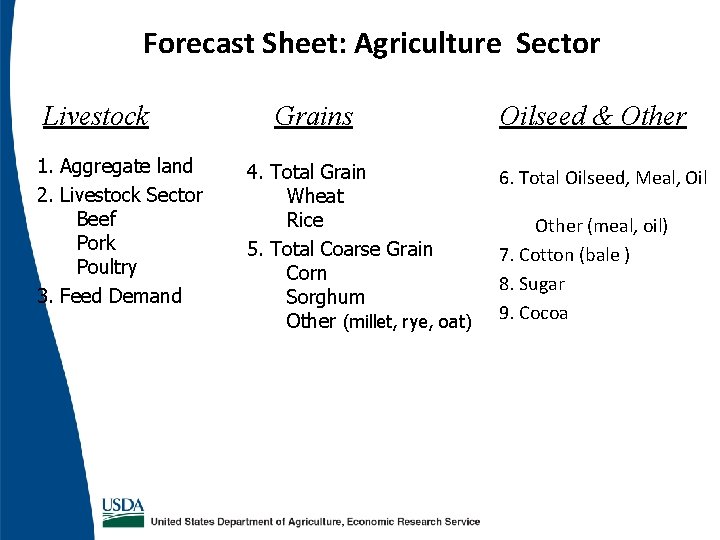
Forecast Sheet: Agriculture Sector Livestock 1. Aggregate land 2. Livestock Sector Beef Pork Poultry 3. Feed Demand Grains 4. Total Grain Wheat Rice 5. Total Coarse Grain Corn Sorghum Other (millet, rye, oat) Oilseed & Other 6. Total Oilseed, Meal, Oil Other (meal, oil) 7. Cotton (bale ) 8. Sugar 9. Cocoa
Scenario vs Base Comparison Sheet
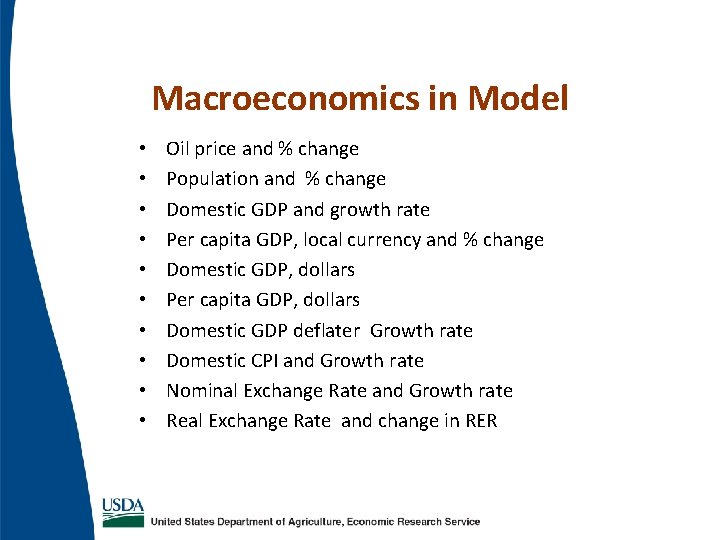
Macroeconomics in Model • • • Oil price and % change Population and % change Domestic GDP and growth rate Per capita GDP, local currency and % change Domestic GDP, dollars Per capita GDP, dollars Domestic GDP deflater Growth rate Domestic CPI and Growth rate Nominal Exchange Rate and Growth rate Real Exchange Rate and change in RER
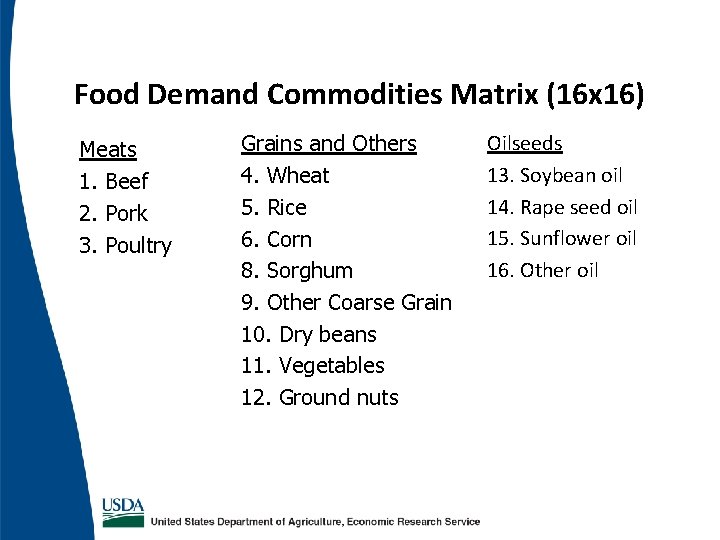
Food Demand Commodities Matrix (16 x 16) Meats 1. Beef 2. Pork 3. Poultry Grains and Others 4. Wheat 5. Rice 6. Corn 8. Sorghum 9. Other Coarse Grain 10. Dry beans 11. Vegetables 12. Ground nuts Oilseeds 13. Soybean oil 14. Rape seed oil 15. Sunflower oil 16. Other oil
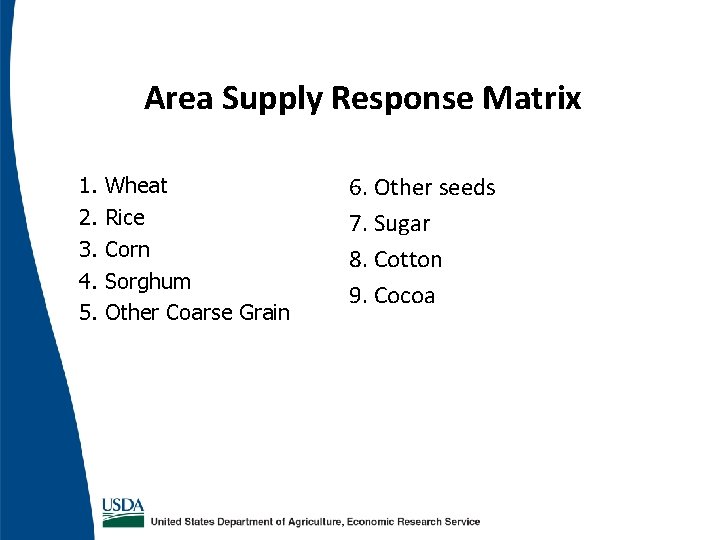
Area Supply Response Matrix 1. 2. 3. 4. 5. Wheat Rice Corn Sorghum Other Coarse Grain 6. Other seeds 7. Sugar 8. Cotton 9. Cocoa
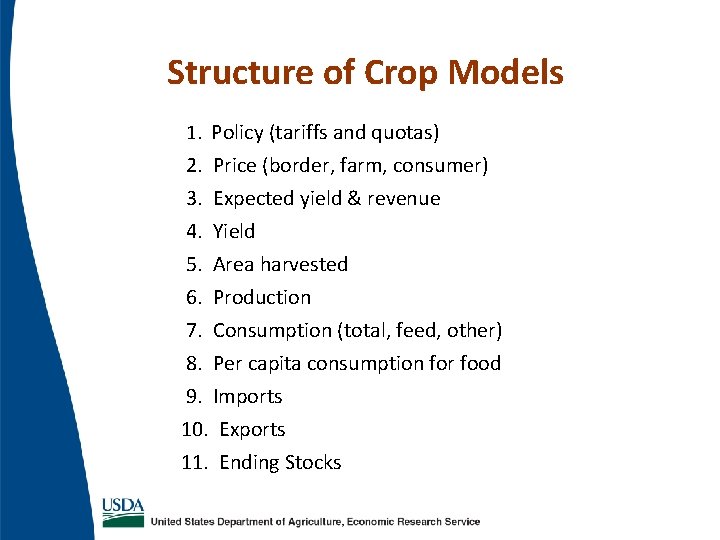
Structure of Crop Models 1. Policy (tariffs and quotas) 2. Price (border, farm, consumer) 3. Expected yield & revenue 4. Yield 5. Area harvested 6. Production 7. Consumption (total, feed, other) 8. Per capita consumption for food 9. Imports 10. Exports 11. Ending Stocks
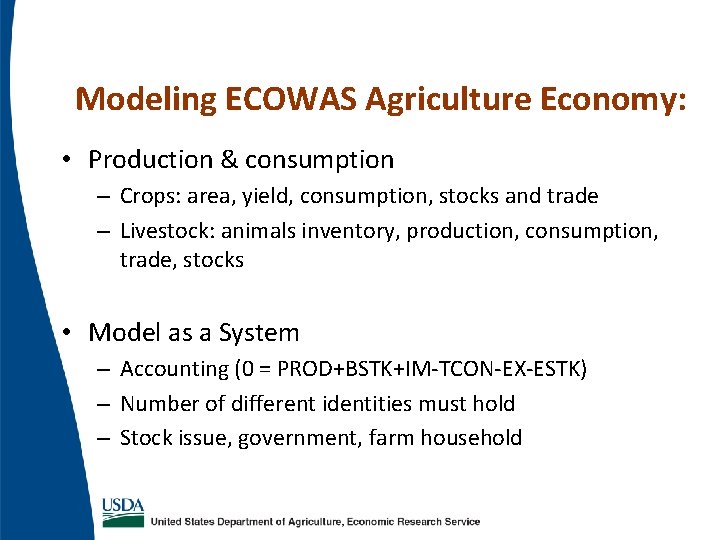
Modeling ECOWAS Agriculture Economy: • Production & consumption – Crops: area, yield, consumption, stocks and trade – Livestock: animals inventory, production, consumption, trade, stocks • Model as a System – Accounting (0 = PROD+BSTK+IM-TCON-EX-ESTK) – Number of different identities must hold – Stock issue, government, farm household
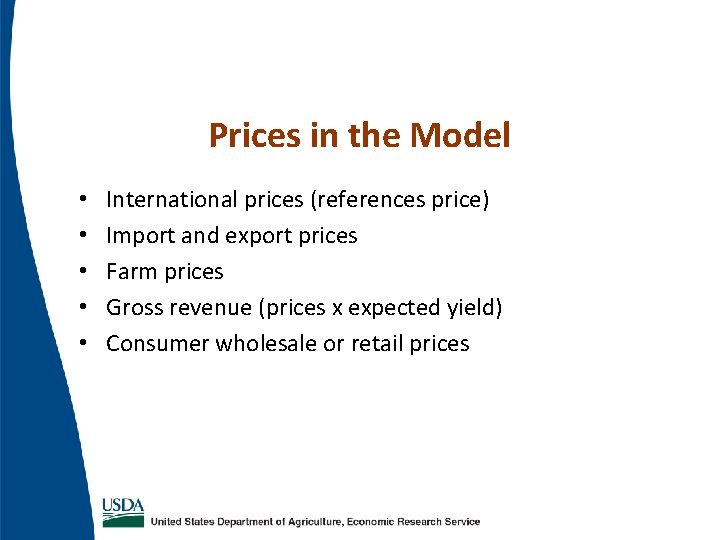
Prices in the Model • • • International prices (references price) Import and export prices Farm prices Gross revenue (prices x expected yield) Consumer wholesale or retail prices
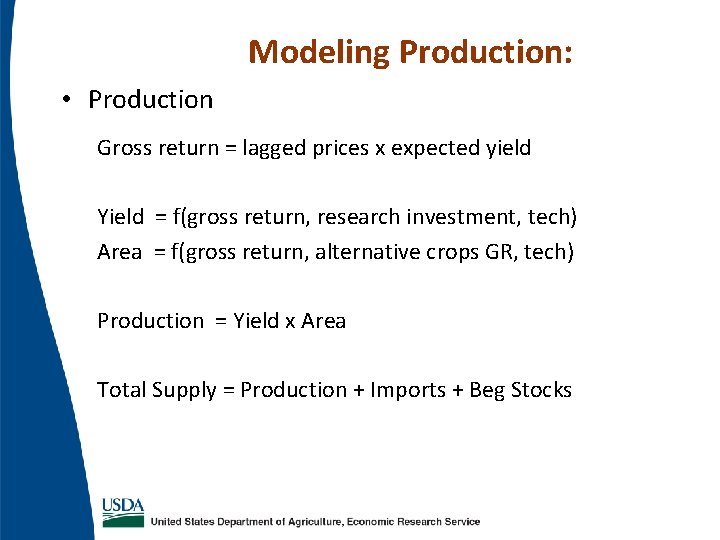
Modeling Production: • Production Gross return = lagged prices x expected yield Yield = f(gross return, research investment, tech) Area = f(gross return, alternative crops GR, tech) Production = Yield x Area Total Supply = Production + Imports + Beg Stocks
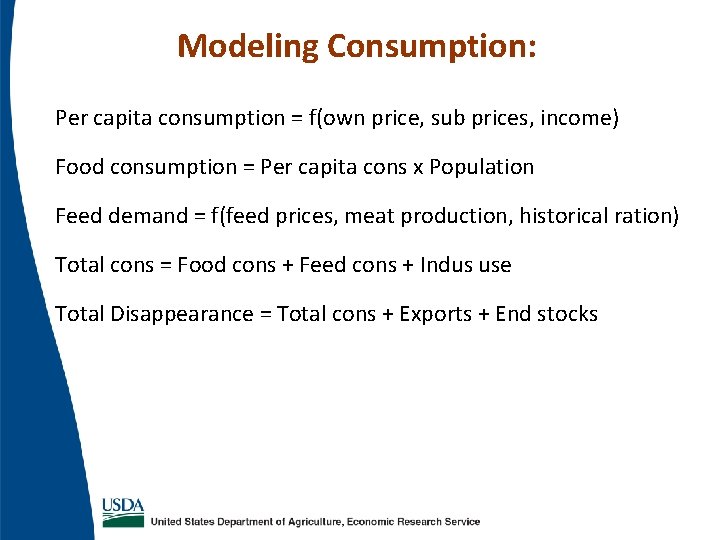
Modeling Consumption: Per capita consumption = f(own price, sub prices, income) Food consumption = Per capita cons x Population Feed demand = f(feed prices, meat production, historical ration) Total cons = Food cons + Feed cons + Indus use Total Disappearance = Total cons + Exports + End stocks
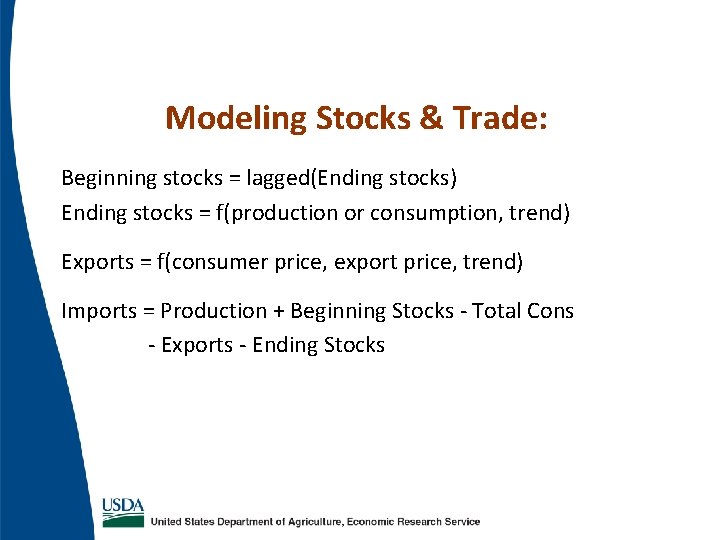
Modeling Stocks & Trade: Beginning stocks = lagged(Ending stocks) Ending stocks = f(production or consumption, trend) Exports = f(consumer price, export price, trend) Imports = Production + Beginning Stocks - Total Cons - Exports - Ending Stocks
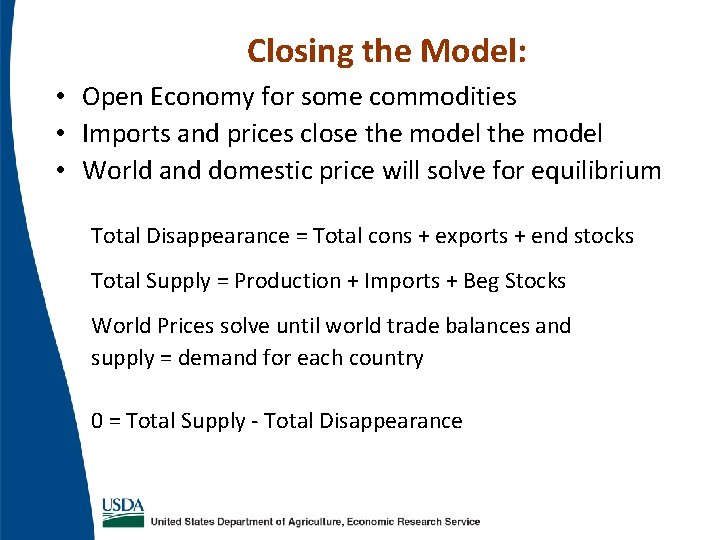
Closing the Model: • Open Economy for some commodities • Imports and prices close the model • World and domestic price will solve for equilibrium Total Disappearance = Total cons + exports + end stocks Total Supply = Production + Imports + Beg Stocks World Prices solve until world trade balances and supply = demand for each country 0 = Total Supply - Total Disappearance
Elasticities in the Model • Consumer price elasticities • Consumer income elasticities • Producers supply response elasticities
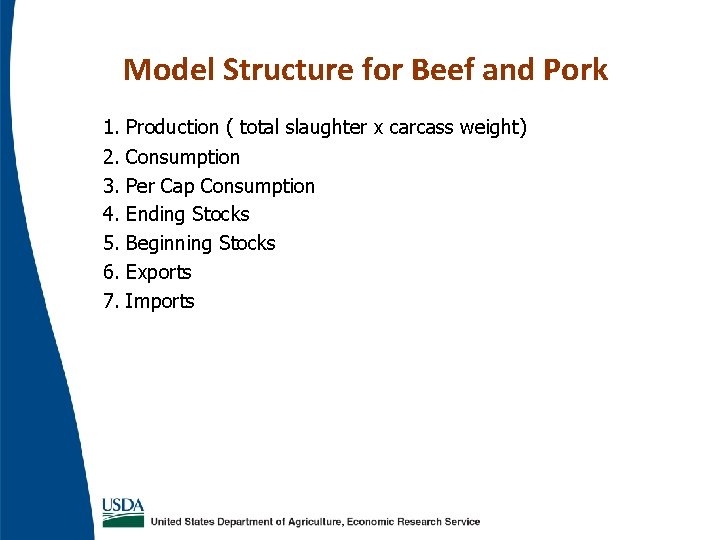
Model Structure for Beef and Pork 1. 2. 3. 4. 5. 6. 7. Production ( total slaughter x carcass weight) Consumption Per Cap Consumption Ending Stocks Beginning Stocks Exports Imports
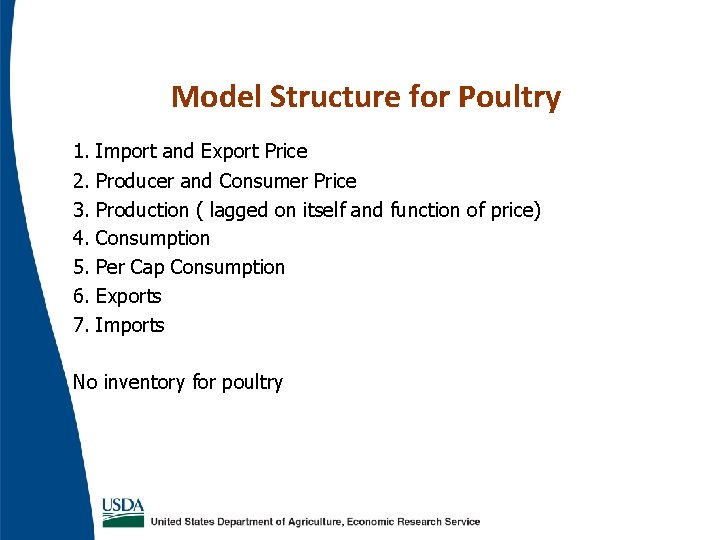
Model Structure for Poultry 1. 2. 3. 4. 5. 6. 7. Import and Export Price Producer and Consumer Price Production ( lagged on itself and function of price) Consumption Per Cap Consumption Exports Imports No inventory for poultry
Thank you USDA, Economic Research Service