
Ecosystems Science 7 Mrs Wirz Ecosystems are made
- Slides: 40
Ecosystems Science 7 Mrs. Wirz
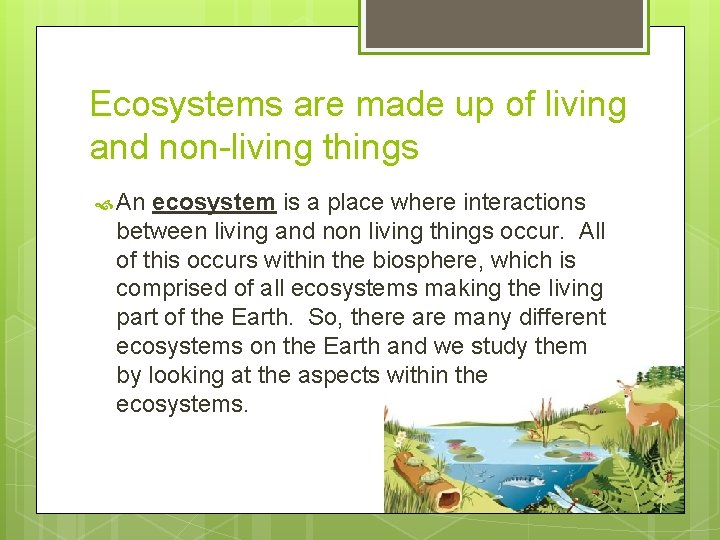
Ecosystems are made up of living and non-living things An ecosystem is a place where interactions between living and non living things occur. All of this occurs within the biosphere, which is comprised of all ecosystems making the living part of the Earth. So, there are many different ecosystems on the Earth and we study them by looking at the aspects within the ecosystems.
What are some examples of non-living things? What are some examples of living things? A species is the most closely related group of living things that are able to mate and produce more of the same kind of living things. All living things have needs and requirements necessary for its survival. For instance all living things live in a particular habitat. A habitat is a place that provides living things with oxygen, water, food, shelter, and anything else they need for survival.
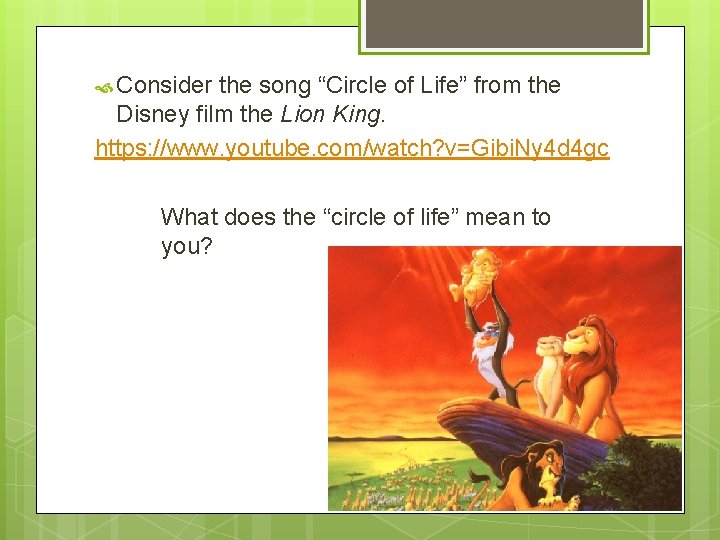
Consider the song “Circle of Life” from the Disney film the Lion King. https: //www. youtube. com/watch? v=Gibi. Ny 4 d 4 gc What does the “circle of life” mean to you?
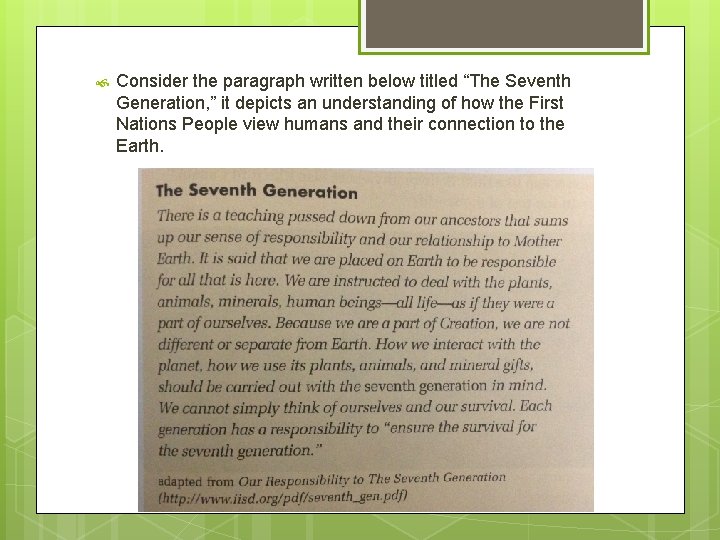
Consider the paragraph written below titled “The Seventh Generation, ” it depicts an understanding of how the First Nations People view humans and their connection to the Earth.
How do people generally interact with “Mother Nature”? How do you interact with the planet? What does the message in this statement have in common with today’s environmental movement? What Why is meant by the “seventh generation”? does nature need our protection?
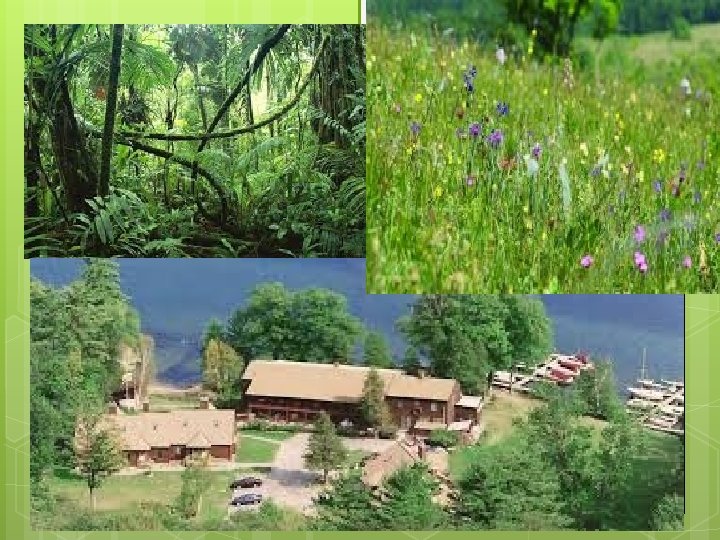
Choose one of the photos from the previous slide. Imagine walking into the scene. Record your answers to the following questions. What does the air smell like? What sounds do you hear, and who or what is making them? What sights do you see? What sensations do you feel? Do you like this place? Why or why not? Have you visited one like it before? If so where? How might this place be different 3 months from now? 6 months from now?
Investigate the school yard activity Which living things probably live in your school yard full-time? What is it about your schoolyard that make this a good place for them to live? What other living things just visit or pass through your schoolyard? Where do you think they live? Why would they live there and not your schoolyard? What do you have in common with these living things in your school yard?
The Basic Needs of All Living Things Need: Water Energy Food Oxygen Suitable Living Conditions To interact with each other and with non-living things https: //www. youtube. com/watch? v=2 xi. Aac. Sg 4 b. I
Parts of an Ecosystem An ecosystem is the interactions and relationship between living things and nonliving things. The living things are called the biotic parts. The Greek word bio means living. The non-living things are called the abiotic parts. In Greek the a stands for not, therefore not living.
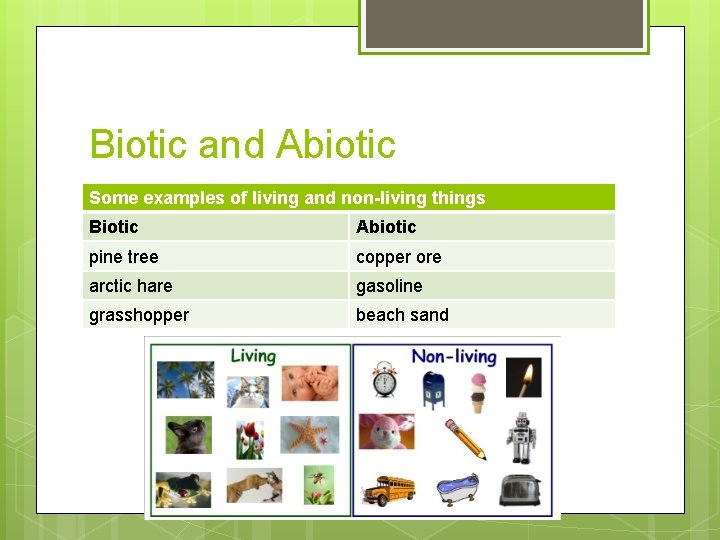
Biotic and Abiotic Some examples of living and non-living things Biotic Abiotic pine tree copper ore arctic hare gasoline grasshopper beach sand
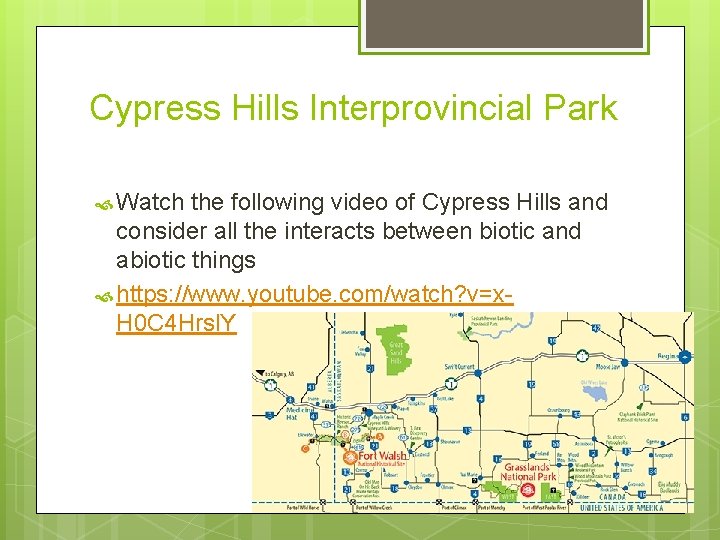
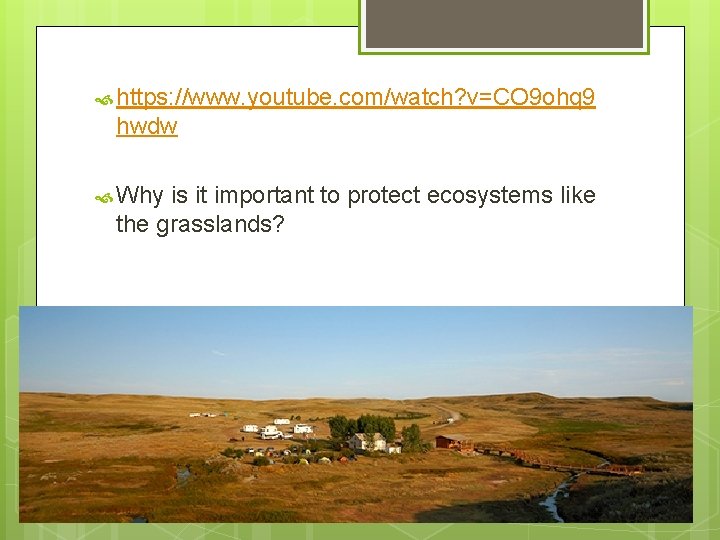
Grasslands National Park in Southern Saskatchewan is Canada’s first park that protects prairie grasslands. The region is home to a number of different features (called complexes) such as wetlands, coulees, sandhills, and salt flats. Each complex has its own ecosystem.
Cypress Hills Interprovincial Park Watch the following video of Cypress Hills and consider all the interacts between biotic and abiotic things https: //www. youtube. com/watch? v=x. H 0 C 4 Hrsl. Y
https: //www. youtube. com/watch? v=CO 9 ohq 9 hwdw Why is it important to protect ecosystems like the grasslands?
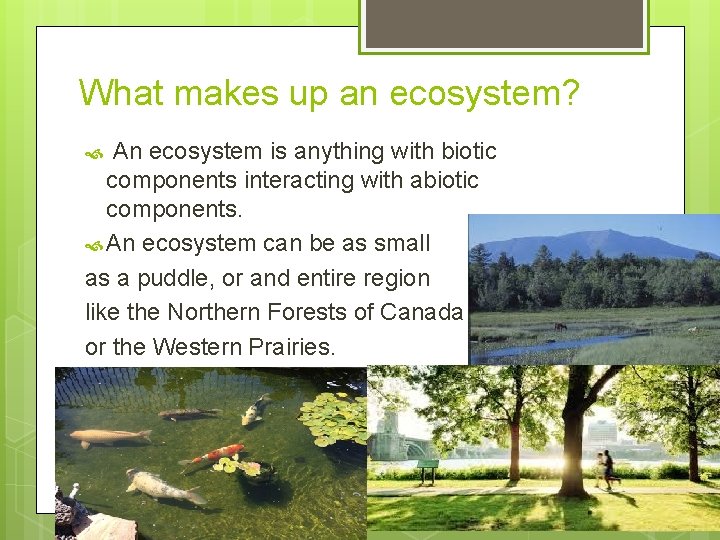
What makes up an ecosystem? An ecosystem is anything with biotic components interacting with abiotic components. An ecosystem can be as small as a puddle, or and entire region like the Northern Forests of Canada or the Western Prairies.
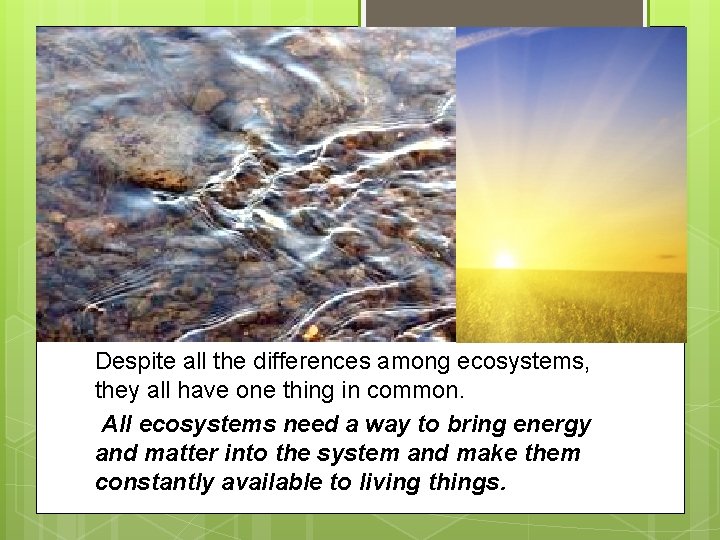
Despite all the differences among ecosystems, they all have one thing in common. All ecosystems need a way to bring energy and matter into the system and make them constantly available to living things.
Progress Check 1. 2. a)Name four abiotic components of our planet. b) Name four biotic components of our planet. c) Choose one abiotic and one biotic component that interact. Use words, pictures, or both to explain how they are connected to each other. Write a sentence that shows clearly how these three words are related to one another: abiotic, and ecosystem.
Progress Check 3. Which of the following are, or could be ecosystems? Give reasons to support your answer in each case. You might want to draw a picture if you feel it can help you explain your thinking. a) a forest b) a lake c) a town’s or city’s downtown d) a tree e) a piece of moldy bread f) Earth
Components of Ecosystems Define the following: consumer carnivores herbivores omnivores
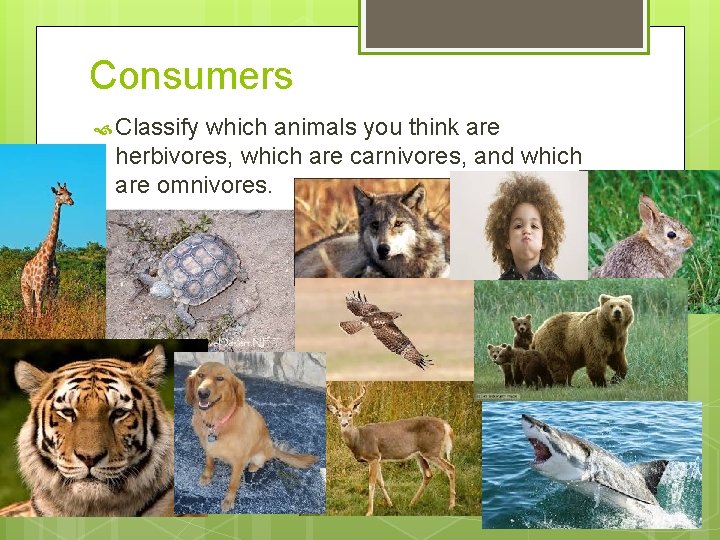
Consumers Classify which animals you think are herbivores, which are carnivores, and which are omnivores.
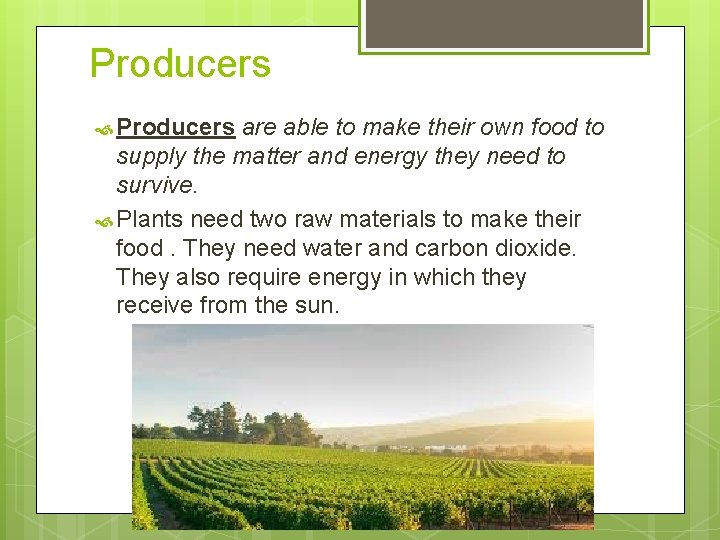
Producers are able to make their own food to supply the matter and energy they need to survive. Plants need two raw materials to make their food. They need water and carbon dioxide. They also require energy in which they receive from the sun.
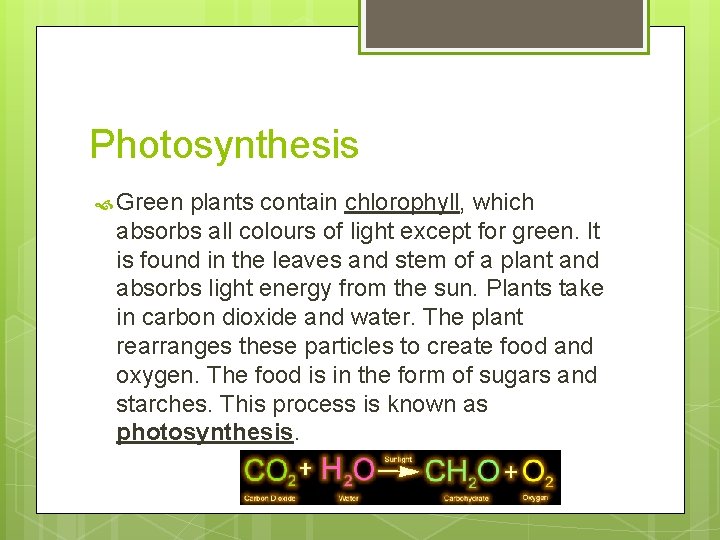
Photosynthesis Green plants contain chlorophyll, which absorbs all colours of light except for green. It is found in the leaves and stem of a plant and absorbs light energy from the sun. Plants take in carbon dioxide and water. The plant rearranges these particles to create food and oxygen. The food is in the form of sugars and starches. This process is known as photosynthesis.
Photosynthesis is vital to your life for three many reasons: 1. Photosynthesis turns the Sun’s energy into chemical energy in plants that your body can use for its energy. 2. Photosynthesis provides plants with food that your body can use to function properly. 3. Photosynthesis provides the oxygen in the air that you breathe.
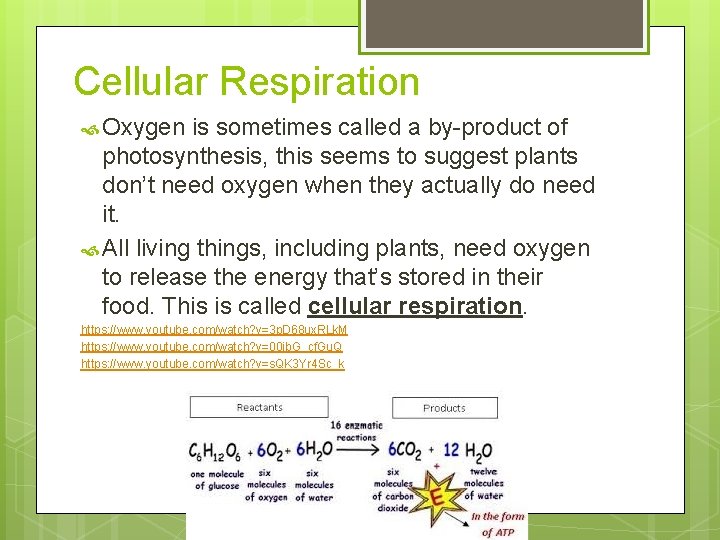
Cellular Respiration Oxygen is sometimes called a by-product of photosynthesis, this seems to suggest plants don’t need oxygen when they actually do need it. All living things, including plants, need oxygen to release the energy that’s stored in their food. This is called cellular respiration. https: //www. youtube. com/watch? v=3 p. D 68 ux. RLk. M https: //www. youtube. com/watch? v=00 jb. G_cf. Gu. Q https: //www. youtube. com/watch? v=s. QK 3 Yr 4 Sc_k
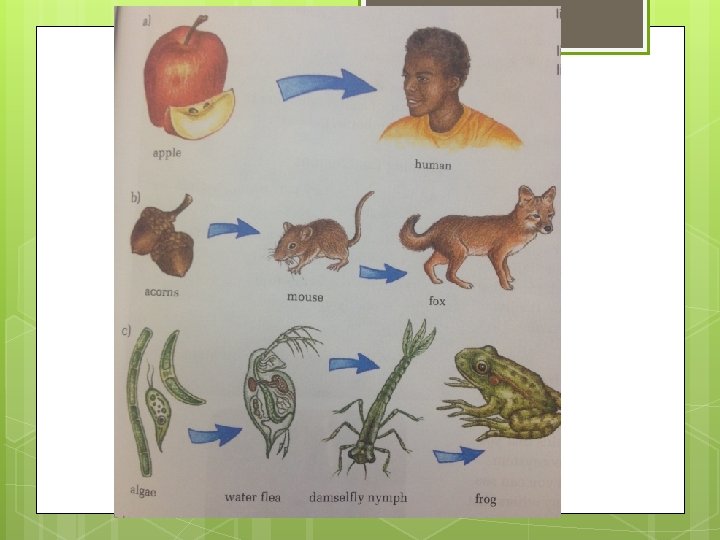
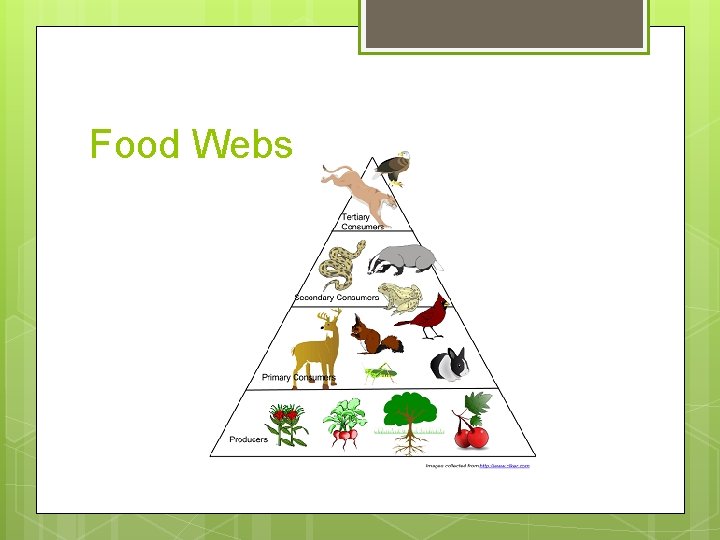
Food Chains A food chain is a way to show energy moves among living things in an ecosystem. Food chains start with a primary producer and the item that eats that is called the primary consumer. An arrow will point from a primary producer to the primary consumer. More arrows can continue on to a secondary consumer, tertiary consumer, quaternary consumer, and so on…
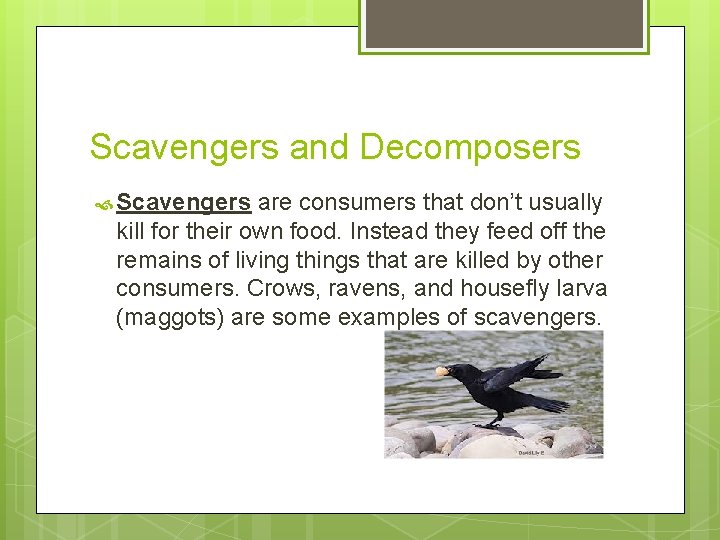
Scavengers and Decomposers Scavengers are consumers that don’t usually kill for their own food. Instead they feed off the remains of living things that are killed by other consumers. Crows, ravens, and housefly larva (maggots) are some examples of scavengers.
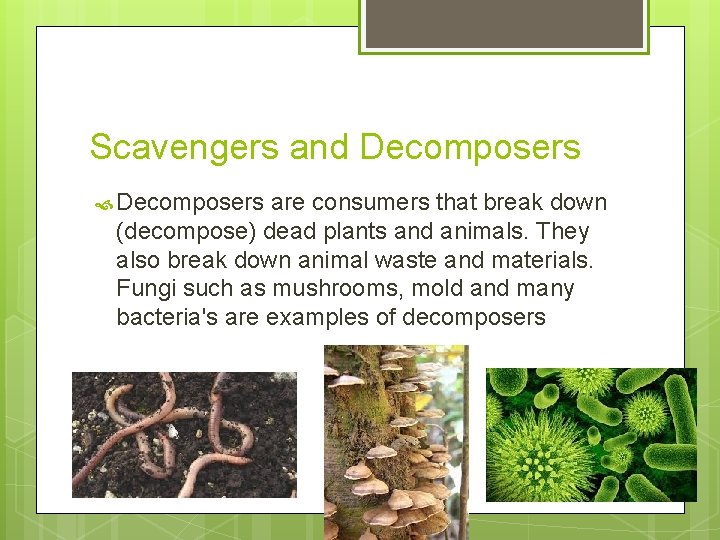
Scavengers and Decomposers are consumers that break down (decompose) dead plants and animals. They also break down animal waste and materials. Fungi such as mushrooms, mold and many bacteria's are examples of decomposers
Decomposers What are decomposers good for? Clean up the world from dead bodies, feces, urine, ect. YUCK! • Provide plants and soil with their required nutrients They are the bridge between abiotic and biotic things in an ecosystem. •
Progress Check #2 1. a) Think of a park or natural setting. Name two producers, two herbivorous consumers, and two carnivorous consumers you would find in this ecosystem. b) Explain how these living things are related to one another. c) Would you expect to find scavengers and decomposers in a park ecosystem? Why or why not?
Progress Check #2 2. The list below shows typical producers and consumers you would find in a pond ecosystem. Reorganize the below list into producers and consumers. algae leopard frog water flea mosquito bladderwort water horsetail pickerel bullrush water lily Canadian toad red fox whitetail deer reed sweet grass wolf dragon fly duckweed roundworm great blue herron spider Construct at least five food chains using the living things in the above list.
Food Webs Food chains show a simplified version of how living things are connected and interact in an ecosystem. In the real world there are many food chains and these food chains are often interwoven with other food chains. If you connect all the food chains, you would have a food web.
Food Webs
Matter and Energy Matter and energy are both abiotic components. Matter continually moves from the abiotic environment to the biotic environment and back again to the abiotic environment. The over-and-over movement of matter is referred to as a cycle.
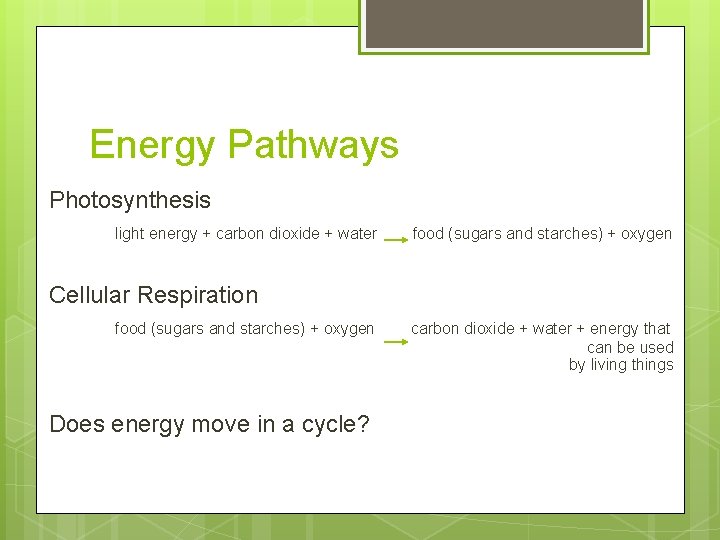
Energy Pathways Photosynthesis light energy + carbon dioxide + water food (sugars and starches) + oxygen Cellular Respiration food (sugars and starches) + oxygen Does energy move in a cycle? carbon dioxide + water + energy that can be used by living things
Energy Pathways A plant uses as much as 90% of the energy it gets from its food to support its life functions. The rest is stored in its roots, leaves, and other plant parts. That’s all the energy that’s available to a herbivore that eats the plant, about 10%. The herbivore also uses about 90% of the energy from its plant food to support its life functions. What do you think that means for a carnivore that eats a carnivore?
The Circle of Life First Nations and Metis have always known the importance of cycles in nature. They are a way to understand the natural world. By studying the behavior of animals and the seasonal changes to plant life, First Nations and Metis peoples learn the natural laws of circular interactions. They adapt their lives to those cycles for survival.
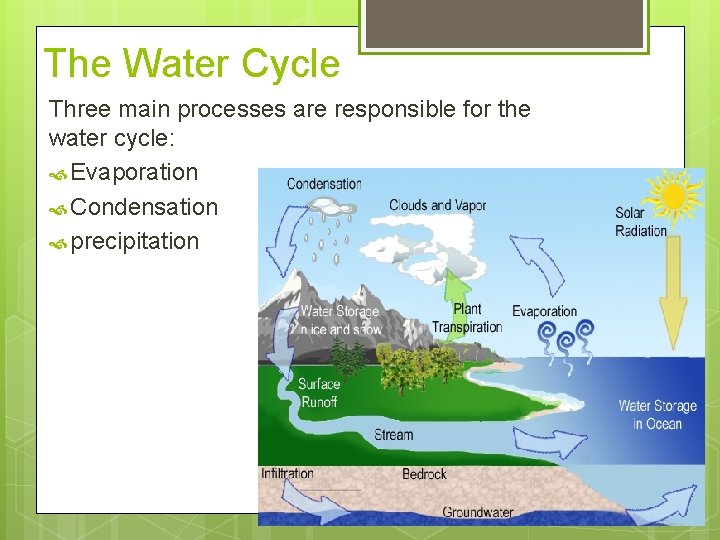
The Water Cycle Three main processes are responsible for the water cycle: Evaporation Condensation precipitation
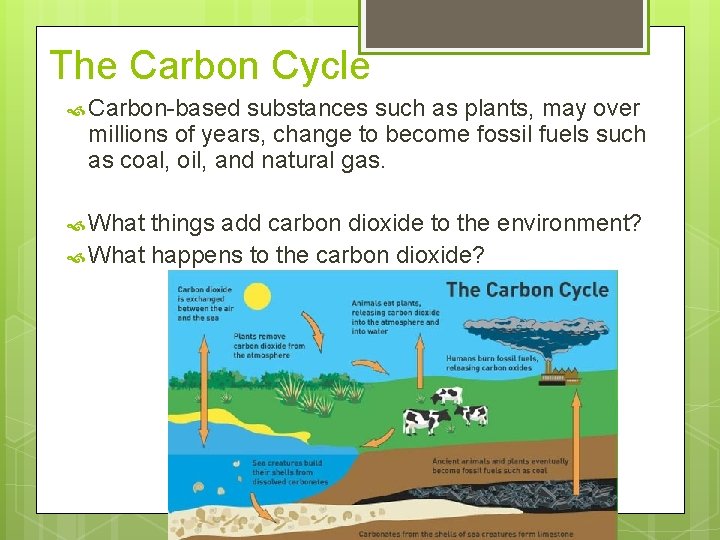
The Carbon Cycle Carbon-based substances such as plants, may over millions of years, change to become fossil fuels such as coal, oil, and natural gas. What things add carbon dioxide to the environment? What happens to the carbon dioxide?