
Ecosystems Population Balance Navigation Table Ecosystems Population Balance
Ecosystems Population Balance
Navigation Table Ecosystems: Population Balance Pre-Test Introduction Why It Matters How We Know What We Know Story Time Activities Self-Study Game Post-Test Glossary
Population Balance Pre-Test Ecosyste ms: Populatio n Balance Pre-Test Introductio n Why It Matters How We Know What We Know Story Time Activities Self-Study Game Post-Test Click a link below to take the pre-test for this unit! • Google assessment
Population Balance Ecosyste ms: Populatio n Balance Pre-Test Introductio n Why It Matters How We Know What We Know Story Time Activities Self-Study Game Post-Test Introduction
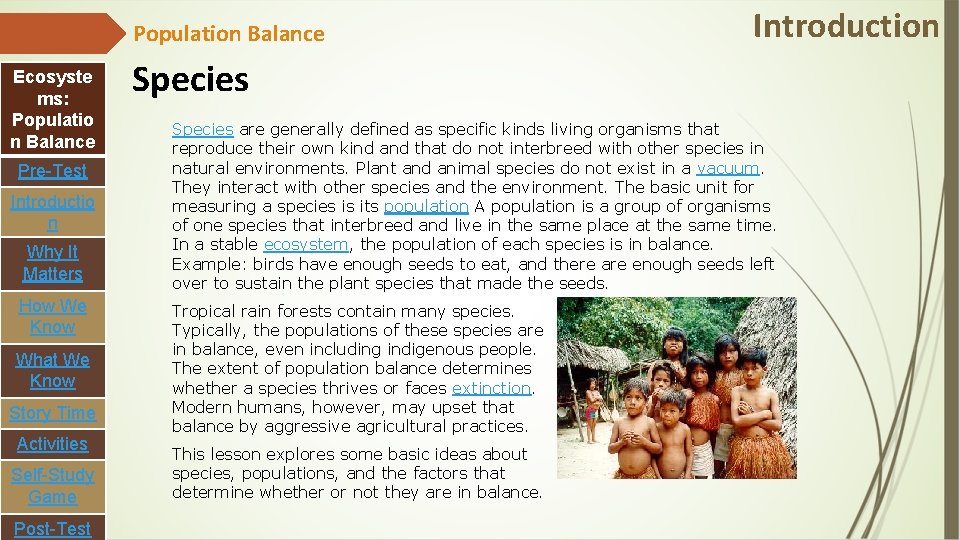
Population Balance Ecosyste ms: Populatio n Balance Pre-Test Introductio n Why It Matters How We Know What We Know Story Time Activities Self-Study Game Post-Test Introduction Species are generally defined as specific kinds living organisms that reproduce their own kind and that do not interbreed with other species in natural environments. Plant and animal species do not exist in a vacuum. They interact with other species and the environment. The basic unit for measuring a species is its population A population is a group of organisms of one species that interbreed and live in the same place at the same time. In a stable ecosystem, the population of each species is in balance. Example: birds have enough seeds to eat, and there are enough seeds left over to sustain the plant species that made the seeds. Tropical rain forests contain many species. Typically, the populations of these species are in balance, even including indigenous people. The extent of population balance determines whether a species thrives or faces extinction. Modern humans, however, may upset that balance by aggressive agricultural practices. This lesson explores some basic ideas about species, populations, and the factors that determine whether or not they are in balance.
Population Balance Objectives Ecosyste ms: Populatio n Balance Pre-Test Introductio n Why It Matters How We Know What We Know Story Time Activities Self-Study Game Post-Test After completing this lesson, each student should be able to: ➢ ➢ Explain what is meant by species, population, and population balance Know what "ecological diversity" means and why it is important Recognize elements of the environment that might upset population balance Predict what might happen after a population becomes out of balance
Population Balance Ecosyste ms: Populatio n Balance Pre-Test Introductio n Why It Matters How We Know What We Know Story Time Activities Self-Study Game Post-Test Why It Matters
Population Balance Ecosyste ms: Populatio n Balance Pre-Test Introductio n Why It Matters How We Know What We Know Story Time Activities Self-Study Game Post-Test Surviving in an Ecosystem Many scientists think that the most important function in the study of ecosystems is to prevent their collapse. Populations of different species are the building blocks of ecosystems. So the question becomes, why would the failure of an ecosystem be so significant? The first rule of species survival in an ecosystem is that the population must be large enough to withstand disease, shortages of food and water, predators, and the other hazards of living. Why It Matters
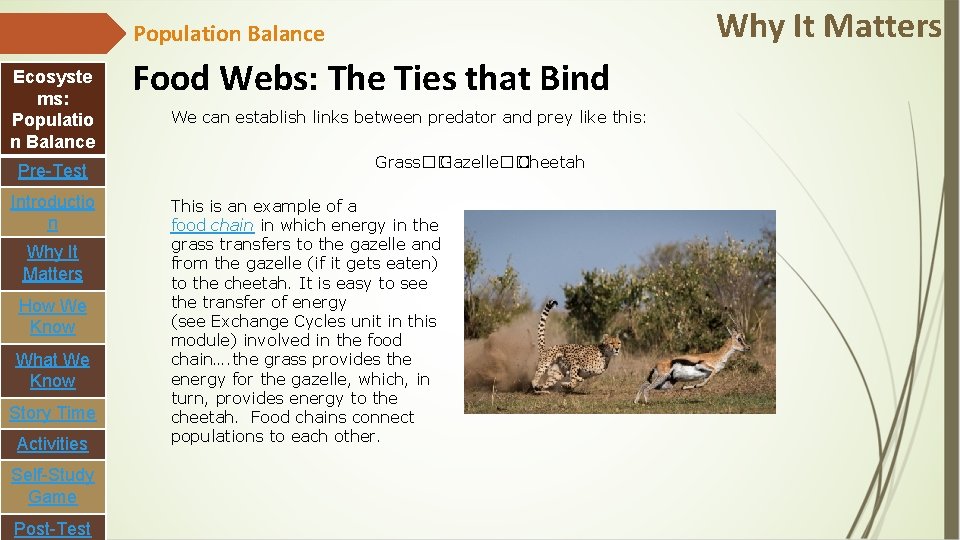
Why It Matters Population Balance Ecosyste ms: Populatio n Balance Pre-Test Introductio n Why It Matters How We Know What We Know Story Time Activities Self-Study Game Post-Test Food Webs: The Ties that Bind We can establish links between predator and prey like this: Grass�� Gazelle�� Cheetah This is an example of a food chain in which energy in the grass transfers to the gazelle and from the gazelle (if it gets eaten) to the cheetah. It is easy to see the transfer of energy (see Exchange Cycles unit in this module) involved in the food chain…. the grass provides the energy for the gazelle, which, in turn, provides energy to the cheetah. Food chains connect populations to each other.
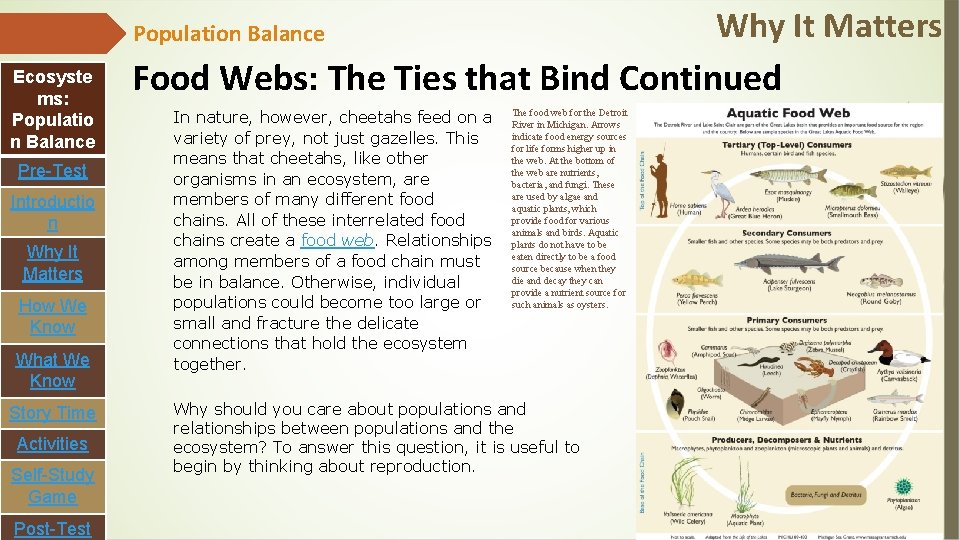
Why It Matters Population Balance Ecosyste ms: Populatio n Balance Pre-Test Introductio n Why It Matters How We Know What We Know Story Time Activities Self-Study Game Post-Test Food Webs: The Ties that Bind Continued In nature, however, cheetahs feed on a variety of prey, not just gazelles. This means that cheetahs, like other organisms in an ecosystem, are members of many different food chains. All of these interrelated food chains create a food web. Relationships among members of a food chain must be in balance. Otherwise, individual populations could become too large or small and fracture the delicate connections that hold the ecosystem together. The food web for the Detroit River in Michigan. Arrows indicate food energy sources for life forms higher up in the web. At the bottom of the web are nutrients, bacteria, and fungi. These are used by algae and aquatic plants, which provide food for various animals and birds. Aquatic plants do not have to be eaten directly to be a food source because when they die and decay they can provide a nutrient source for such animals as oysters. Why should you care about populations and relationships between populations and the ecosystem? To answer this question, it is useful to begin by thinking about reproduction.
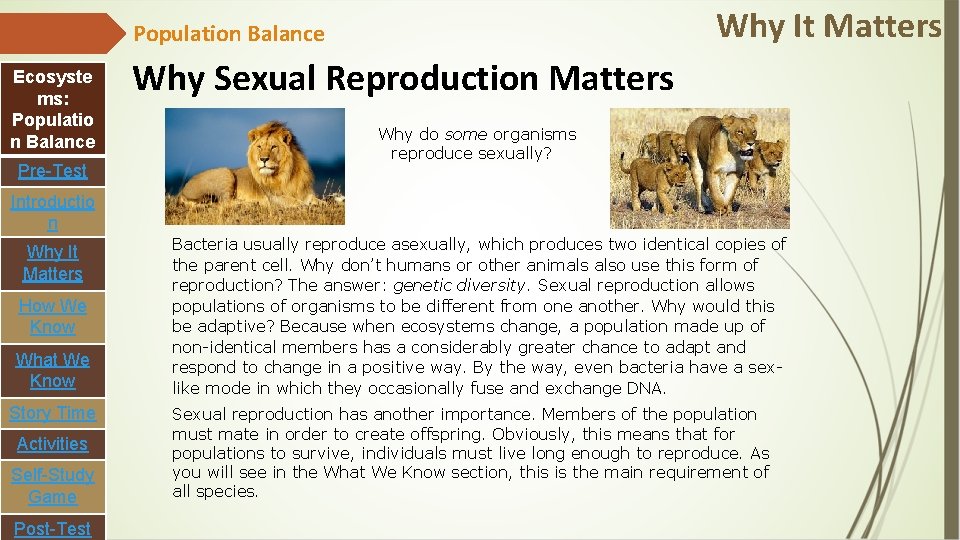
Why It Matters Population Balance Ecosyste ms: Populatio n Balance Pre-Test Why Sexual Reproduction Matters Why do some organisms reproduce sexually? Introductio n Why It Matters How We Know What We Know Story Time Activities Self-Study Game Post-Test Bacteria usually reproduce asexually, which produces two identical copies of the parent cell. Why don’t humans or other animals also use this form of reproduction? The answer: genetic diversity. Sexual reproduction allows populations of organisms to be different from one another. Why would this be adaptive? Because when ecosystems change, a population made up of non-identical members has a considerably greater chance to adapt and respond to change in a positive way. By the way, even bacteria have a sexlike mode in which they occasionally fuse and exchange DNA. Sexual reproduction has another importance. Members of the population must mate in order to create offspring. Obviously, this means that for populations to survive, individuals must live long enough to reproduce. As you will see in the What We Know section, this is the main requirement of all species.
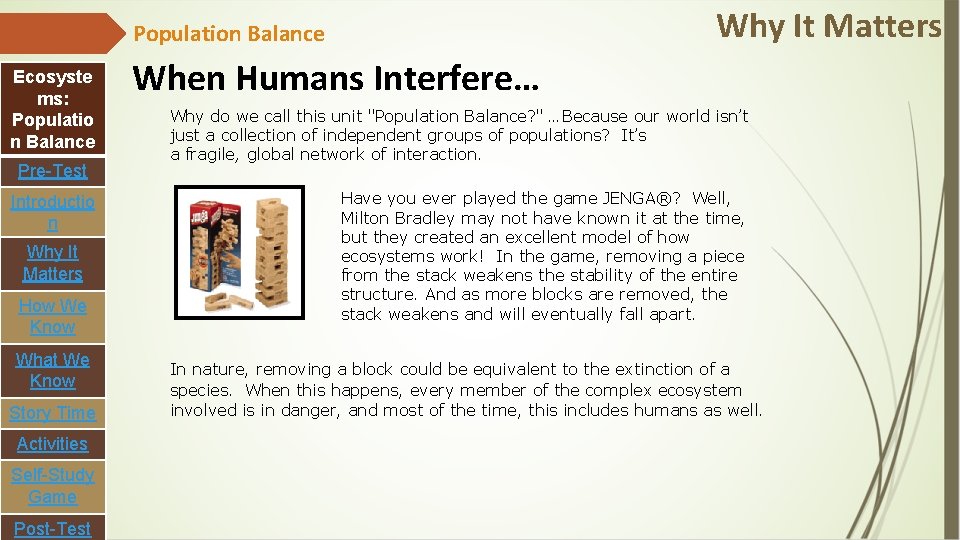
Why It Matters Population Balance Ecosyste ms: Populatio n Balance Pre-Test Introductio n Why It Matters How We Know What We Know Story Time Activities Self-Study Game Post-Test When Humans Interfere… Why do we call this unit "Population Balance? " …Because our world isn’t just a collection of independent groups of populations? It’s a fragile, global network of interaction. Have you ever played the game JENGA®? Well, Milton Bradley may not have known it at the time, but they created an excellent model of how ecosystems work! In the game, removing a piece from the stack weakens the stability of the entire structure. And as more blocks are removed, the stack weakens and will eventually fall apart. In nature, removing a block could be equivalent to the extinction of a species. When this happens, every member of the complex ecosystem involved is in danger, and most of the time, this includes humans as well.
Population Balance Ecosyste ms: Populatio n Balance Pre-Test Introductio n Why It Matters How We Know What We Know Story Time Activities Self-Study Game Post-Test Why It Matters Species Diversity—Who Cares? Why does it matter if species go extinct? Who should care if the number of species on earth decreases? Several answers come to mind. Practical applications in medicine and agriculture often result from discovering unique properties of species, and the more species there are the greater the potential for finding useful genes. These genes can be inserted into existing organisms to produce medicine, disease resistance properties, growth enhancement, and other desirable things. Human activity is creating massive extinctions. A term, “anthropogenic, ” has been used to note a condition that results from the influence of human beings on nature. Only a few areas on earth support highly diverse species. Nearly one half of the earth's plant species and over 1/3 of the vertebrate species are found in only 25 local areas. To learn more about these diversity "hot spots, " click here.
Population Balance Ecosyste ms: Populatio n Balance Pre-Test Introductio n Why It Matters How We Know What We Know Story Time Activities Self-Study Game Post-Test Why It Matters Human-Driven (Anthropogenic) Extinction Why should humans worry about species extinction and the disruption of ecosystems? When our actions cause a population to become extinct we lose valuable knowledge, and in some cases, even potential aides to humankind. For instance, many medicines are discovered in plants. What happens if these plant species become extinct before scientists discover that they contain useful chemicals? Also, with every extinction, many food chains lose valuable links, upsetting the ecological balance. For these reasons, the U. S. Fish and Wildlife Service Endangered Species Program was created by the Endangered Species Act of 1973.
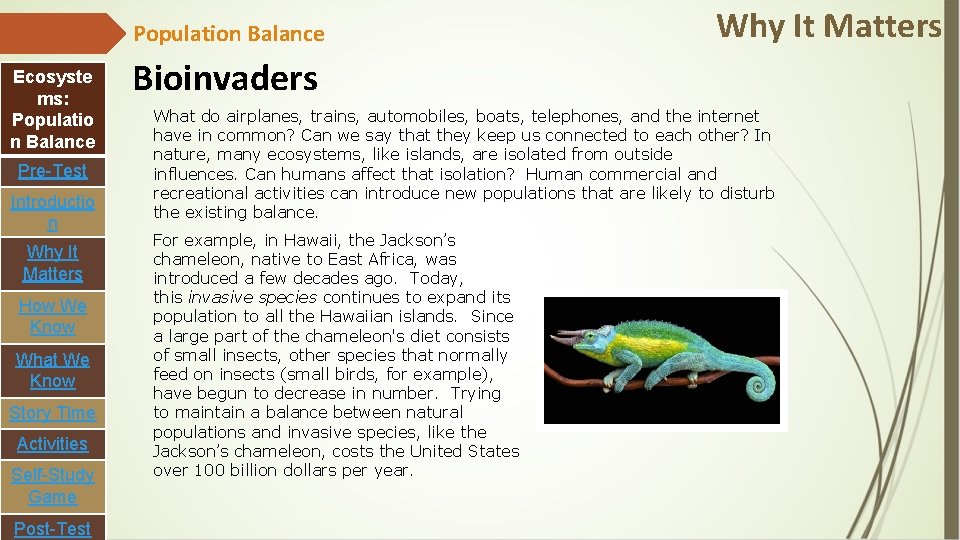
Population Balance Ecosyste ms: Populatio n Balance Pre-Test Introductio n Why It Matters How We Know What We Know Story Time Activities Self-Study Game Post-Test Why It Matters Bioinvaders What do airplanes, trains, automobiles, boats, telephones, and the internet have in common? Can we say that they keep us connected to each other? In nature, many ecosystems, like islands, are isolated from outside influences. Can humans affect that isolation? Human commercial and recreational activities can introduce new populations that are likely to disturb the existing balance. For example, in Hawaii, the Jackson’s chameleon, native to East Africa, was introduced a few decades ago. Today, this invasive species continues to expand its population to all the Hawaiian islands. Since a large part of the chameleon's diet consists of small insects, other species that normally feed on insects (small birds, for example), have begun to decrease in number. Trying to maintain a balance between natural populations and invasive species, like the Jackson’s chameleon, costs the United States over 100 billion dollars per year.
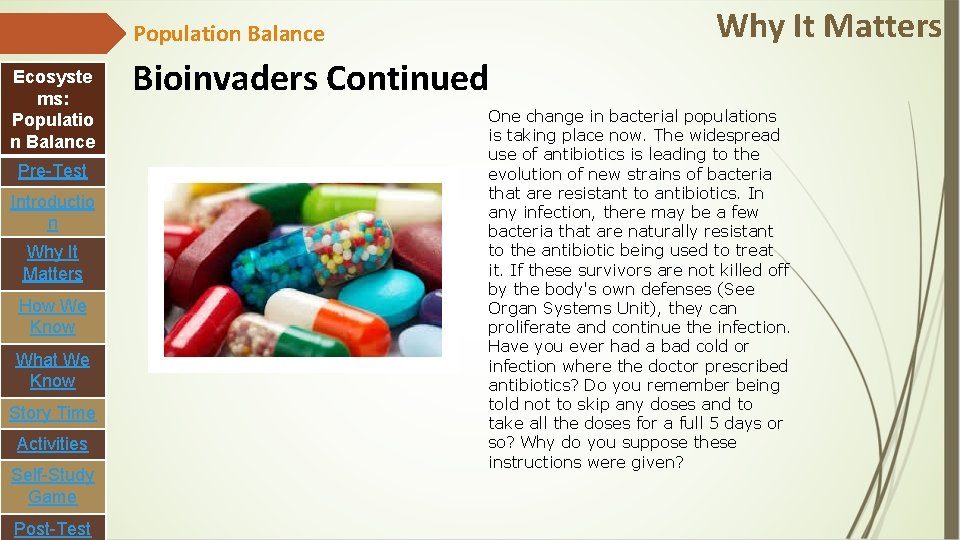
Why It Matters Population Balance Ecosyste ms: Populatio n Balance Pre-Test Introductio n Why It Matters How We Know What We Know Story Time Activities Self-Study Game Post-Test Bioinvaders Continued One change in bacterial populations is taking place now. The widespread use of antibiotics is leading to the evolution of new strains of bacteria that are resistant to antibiotics. In any infection, there may be a few bacteria that are naturally resistant to the antibiotic being used to treat it. If these survivors are not killed off by the body's own defenses (See Organ Systems Unit), they can proliferate and continue the infection. Have you ever had a bad cold or infection where the doctor prescribed antibiotics? Do you remember being told not to skip any doses and to take all the doses for a full 5 days or so? Why do you suppose these instructions were given?
Population Balance Ecosyste ms: Populatio n Balance Pre-Test Introductio n Why It Matters How We Know What We Know Story Time Activities Self-Study Game Post-Test How We Know
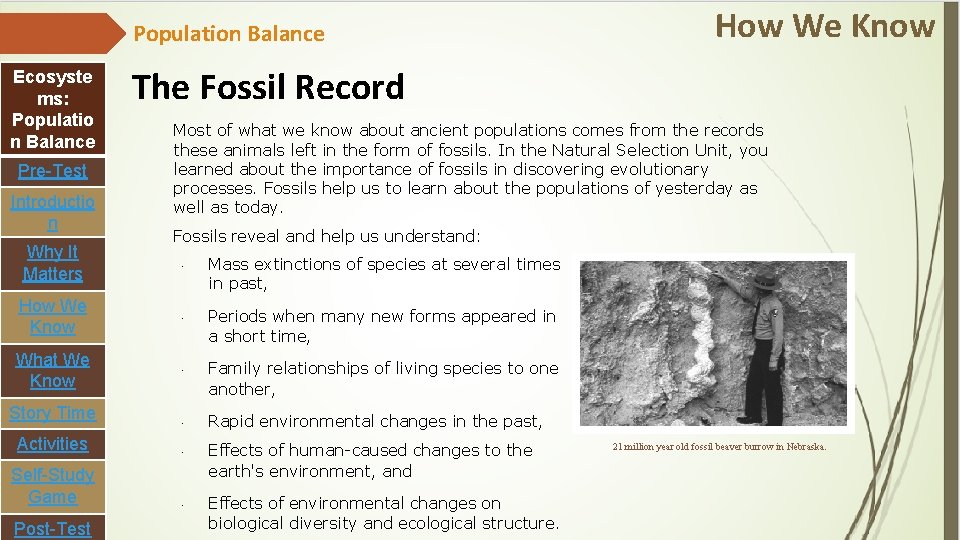
Population Balance Ecosyste ms: Populatio n Balance Pre-Test Introductio n Why It Matters The Fossil Record Most of what we know about ancient populations comes from the records these animals left in the form of fossils. In the Natural Selection Unit, you learned about the importance of fossils in discovering evolutionary processes. Fossils help us to learn about the populations of yesterday as well as today. Fossils reveal and help us understand: ∙ How We Know ∙ What We Know ∙ Story Time ∙ Activities ∙ Self-Study Game ∙ Post-Test How We Know Mass extinctions of species at several times in past, Periods when many new forms appeared in a short time, Family relationships of living species to one another, Rapid environmental changes in the past, Effects of human-caused changes to the earth's environment, and Effects of environmental changes on biological diversity and ecological structure. 21 million year old fossil beaver burrow in Nebraska.
Population Balance Ecosyste ms: Populatio n Balance Pre-Test Introductio n Why It Matters How We Know What We Know Story Time Activities Self-Study Game Post-Test How We Know The Fossil Record Continued We can literally unearth information about species that lived millions of years ago. In layers of earth that were formed around 100 -200 million years ago, scientists have found numerous fossils of various types of dinosaurs and fossils of many plant species that dinosaurs could have eaten. Therefore, we conclude that this was an Age of Dinosaurs. But rocks younger than about 65 million years ago contain no dinosaur fossils. Because there are no dinosaurs today and because there is no fossil record of them between now and 65 million years ago, we conclude that dinosaurs became extinct about that time. Click here for a Website on fossils. Have you ever heard the saying, “History repeats itself”? Can we predict future extinctions and the future of our planet’s current ecosystems? That would be very valuable indeed! We do know that there have been massive Ice Ages and worldwide tropical conditions at various times - long before humans were around. Unfortunately, we do not understand weather well enough yet to know what caused these global changes nor how they might predict future weather for us.
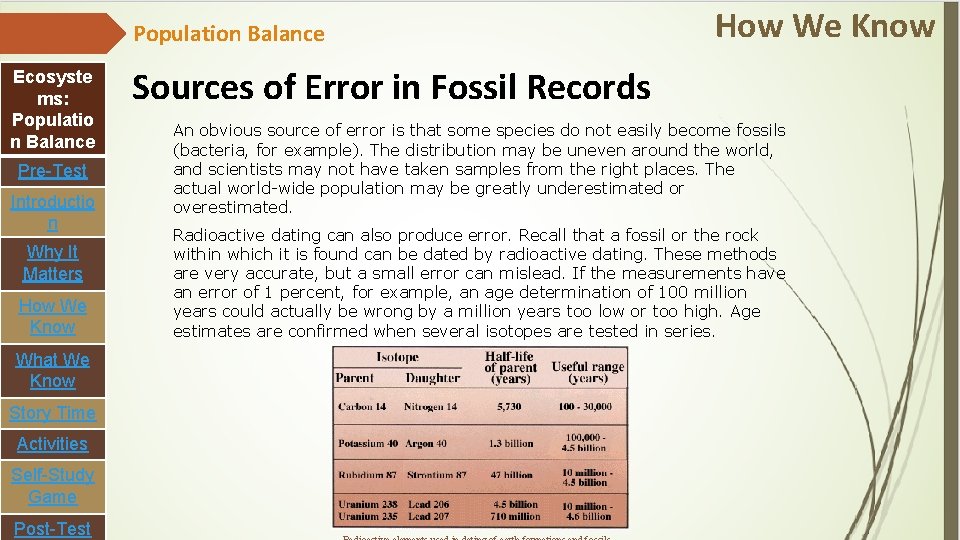
Population Balance Ecosyste ms: Populatio n Balance Pre-Test Introductio n Why It Matters How We Know What We Know Story Time Activities Self-Study Game Post-Test How We Know Sources of Error in Fossil Records An obvious source of error is that some species do not easily become fossils (bacteria, for example). The distribution may be uneven around the world, and scientists may not have taken samples from the right places. The actual world-wide population may be greatly underestimated or overestimated. Radioactive dating can also produce error. Recall that a fossil or the rock within which it is found can be dated by radioactive dating. These methods are very accurate, but a small error can mislead. If the measurements have an error of 1 percent, for example, an age determination of 100 million years could actually be wrong by a million years too low or too high. Age estimates are confirmed when several isotopes are tested in series.
Population Balance Ecosyste ms: Populatio n Balance How We Know The Number Game: the Capture-Recapture Method Introductio n You’re probably wondering how ecologists determine that a population grows or that a species has become extinct. It’s simple really. They count them. But not in the usual way. Great amounts of time and effort would be required to count even small populations. Imagine what it would be like to count millions of invisible organisms like bacteria. So, how do they measure the size of a population? Why It Matters 1. The most common method used to measure animal populations is the capture-recapture method. Here are the steps involved: How We Know 2. Some members of the population are captured, usually by some sort of trap. Pre-Test What We Know Story Time Activities Self-Study Game Post-Test 3. Ecologists then mark the captured animal in a distinctive way (colorful band, dye, etc. ). 4. These marked animals are released back into the population and allowed to circulate for an extended period of time. 5. Then, the ecologists return to capture another sample of the population. 6. Finally, they use the number of marked animals captured this time to estimate the population size.
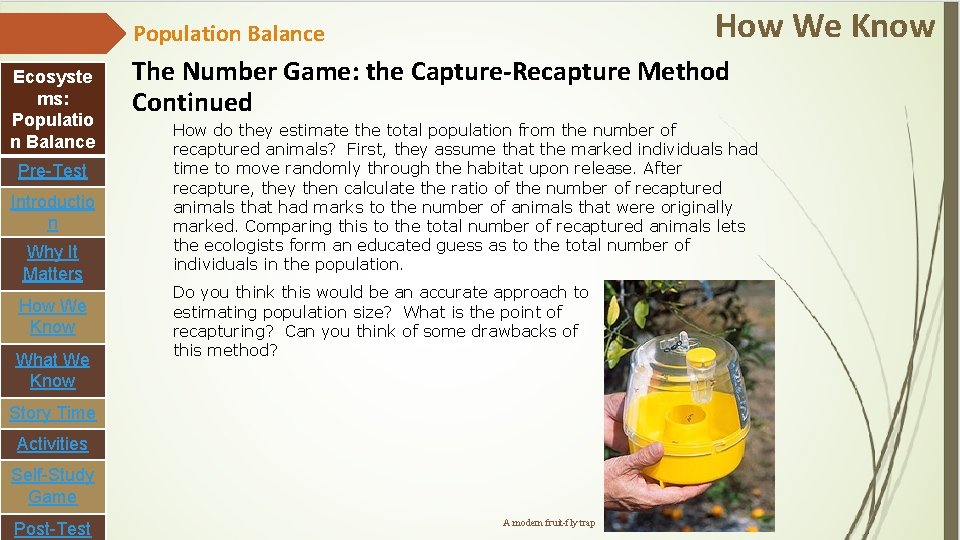
How We Know Population Balance Ecosyste ms: Populatio n Balance Pre-Test Introductio n Why It Matters How We Know What We Know The Number Game: the Capture-Recapture Method Continued How do they estimate the total population from the number of recaptured animals? First, they assume that the marked individuals had time to move randomly through the habitat upon release. After recapture, they then calculate the ratio of the number of recaptured animals that had marks to the number of animals that were originally marked. Comparing this to the total number of recaptured animals lets the ecologists form an educated guess as to the total number of individuals in the population. Do you think this would be an accurate approach to estimating population size? What is the point of recapturing? Can you think of some drawbacks of this method? Story Time Activities Self-Study Game Post-Test A modern fruit-fly trap
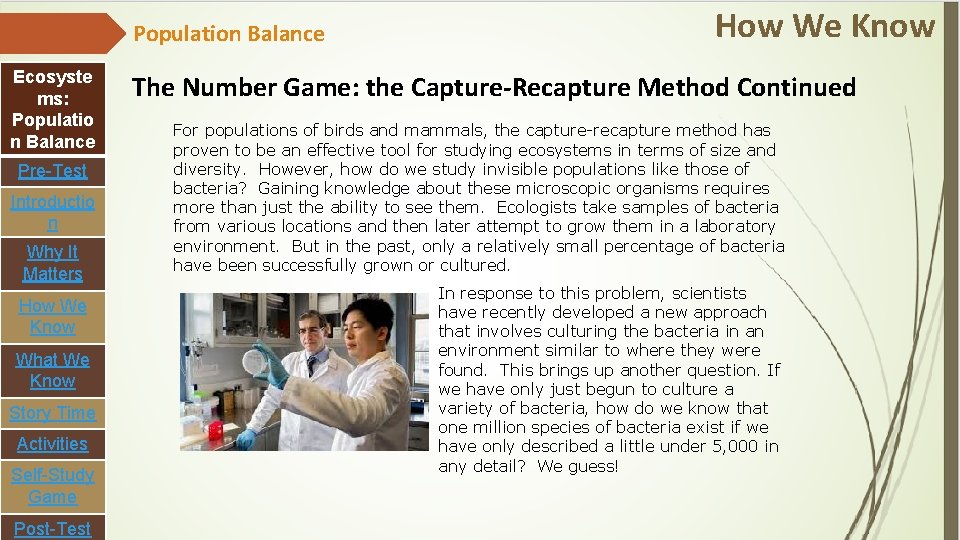
Population Balance Ecosyste ms: Populatio n Balance Pre-Test Introductio n Why It Matters How We Know What We Know Story Time Activities Self-Study Game Post-Test How We Know The Number Game: the Capture-Recapture Method Continued For populations of birds and mammals, the capture-recapture method has proven to be an effective tool for studying ecosystems in terms of size and diversity. However, how do we study invisible populations like those of bacteria? Gaining knowledge about these microscopic organisms requires more than just the ability to see them. Ecologists take samples of bacteria from various locations and then later attempt to grow them in a laboratory environment. But in the past, only a relatively small percentage of bacteria have been successfully grown or cultured. In response to this problem, scientists have recently developed a new approach that involves culturing the bacteria in an environment similar to where they were found. This brings up another question. If we have only just begun to culture a variety of bacteria, how do we know that one million species of bacteria exist if we have only described a little under 5, 000 in any detail? We guess!
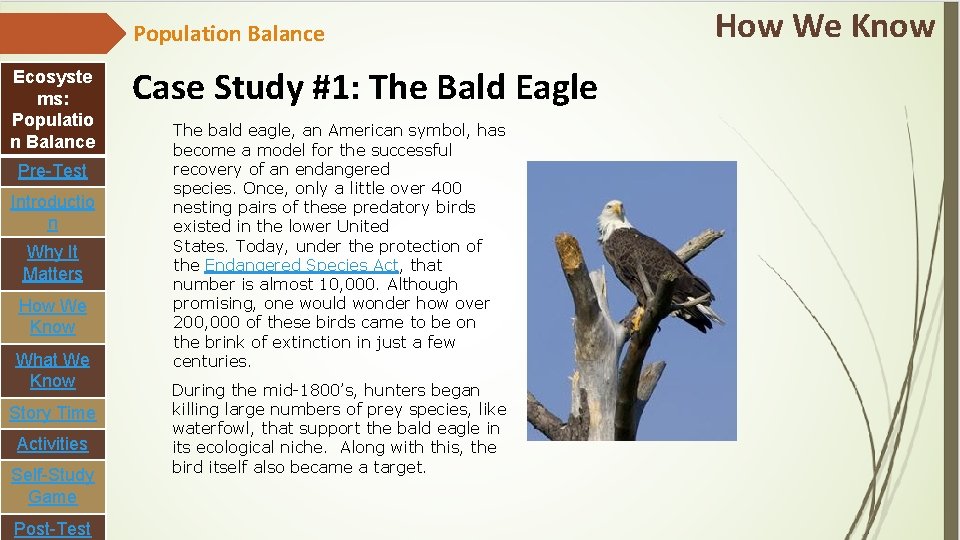
Population Balance Ecosyste ms: Populatio n Balance Pre-Test Introductio n Why It Matters How We Know What We Know Story Time Activities Self-Study Game Post-Test Case Study #1: The Bald Eagle The bald eagle, an American symbol, has become a model for the successful recovery of an endangered species. Once, only a little over 400 nesting pairs of these predatory birds existed in the lower United States. Today, under the protection of the Endangered Species Act, that number is almost 10, 000. Although promising, one would wonder how over 200, 000 of these birds came to be on the brink of extinction in just a few centuries. During the mid-1800’s, hunters began killing large numbers of prey species, like waterfowl, that support the bald eagle in its ecological niche. Along with this, the bird itself also became a target. How We Know
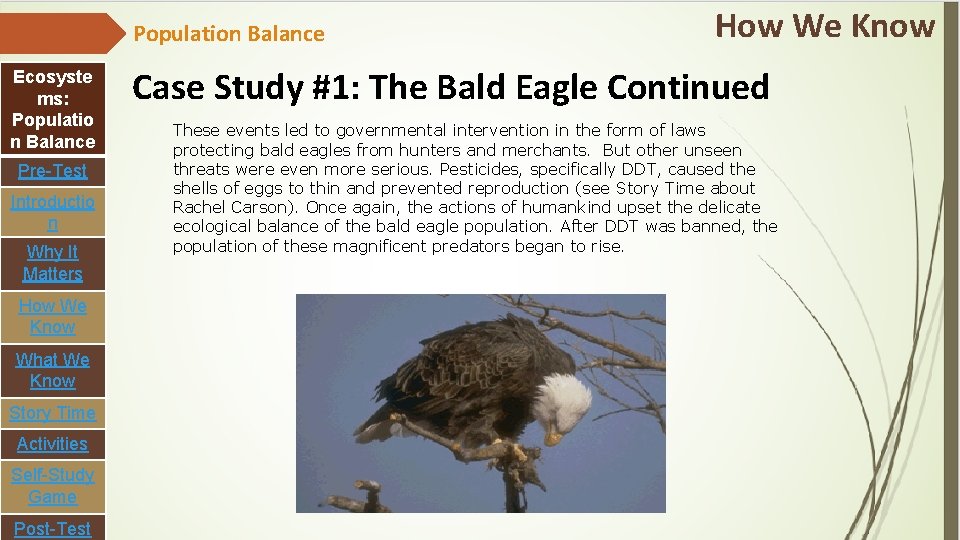
Population Balance Ecosyste ms: Populatio n Balance Pre-Test Introductio n Why It Matters How We Know What We Know Story Time Activities Self-Study Game Post-Test How We Know Case Study #1: The Bald Eagle Continued These events led to governmental intervention in the form of laws protecting bald eagles from hunters and merchants. But other unseen threats were even more serious. Pesticides, specifically DDT, caused the shells of eggs to thin and prevented reproduction (see Story Time about Rachel Carson). Once again, the actions of humankind upset the delicate ecological balance of the bald eagle population. After DDT was banned, the population of these magnificent predators began to rise.
Population Balance Ecosyste ms: Populatio n Balance Pre-Test Introductio n Why It Matters How We Know What We Know Story Time Activities Self-Study Game Post-Test How We Know Case Study #2: A Look at Whooping Cranes Aransas National Wildlife Refuge, located on the Texas Gulf Coast, is home to some of the best bird watching our nation has to offer. Perhaps this same place is also the birthplace one of our nation's most unique efforts to rescue an endangered species. About sixty years ago, ecologists estimated that only 15 whooping cranes remained alive. Their numbers had been decimated by the human activities of hunting and farming. So the Wildlife Refuge was created where no hunting was allowed. Today the Aransas population is estimated to include 174 whooping cranes, which has inspired other notable efforts to save this species. The ecosystem at Aransas cannot support infinite numbers of whoopers. So, ecologists came up with a clever idea of training young whoopers to migrate to another safe winter haven, in Florida.
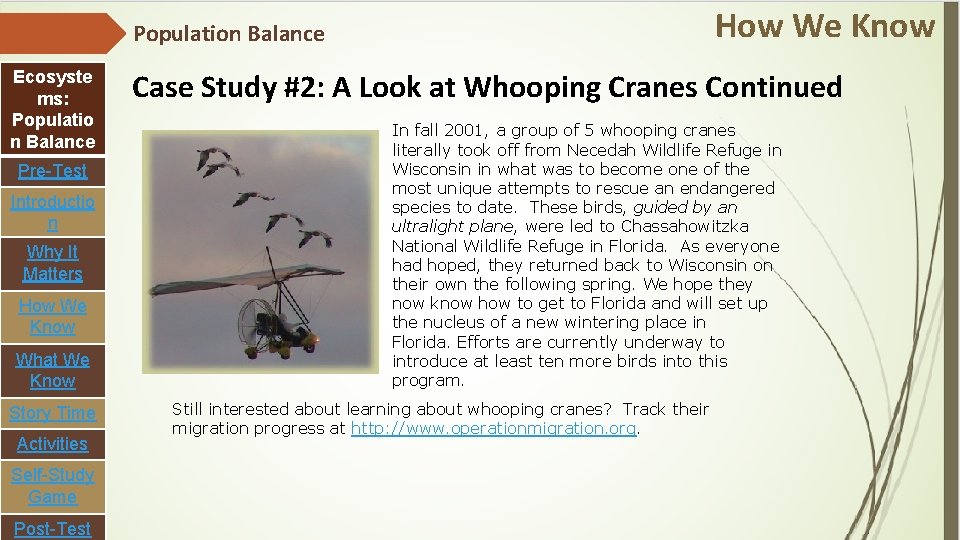
Population Balance Ecosyste ms: Populatio n Balance Pre-Test Introductio n Why It Matters How We Know What We Know Story Time Activities Self-Study Game Post-Test How We Know Case Study #2: A Look at Whooping Cranes Continued In fall 2001, a group of 5 whooping cranes literally took off from Necedah Wildlife Refuge in Wisconsin in what was to become one of the most unique attempts to rescue an endangered species to date. These birds, guided by an ultralight plane, were led to Chassahowitzka National Wildlife Refuge in Florida. As everyone had hoped, they returned back to Wisconsin on their own the following spring. We hope they now know how to get to Florida and will set up the nucleus of a new wintering place in Florida. Efforts are currently underway to introduce at least ten more birds into this program. Still interested about learning about whooping cranes? Track their migration progress at http: //www. operationmigration. org.
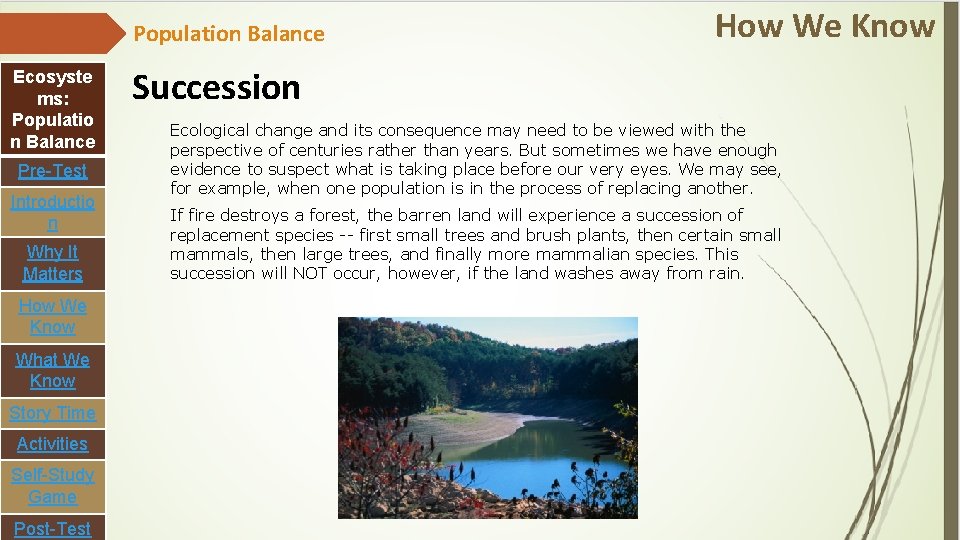
Population Balance Ecosyste ms: Populatio n Balance Pre-Test Introductio n Why It Matters How We Know What We Know Story Time Activities Self-Study Game Post-Test How We Know Succession Ecological change and its consequence may need to be viewed with the perspective of centuries rather than years. But sometimes we have enough evidence to suspect what is taking place before our very eyes. We may see, for example, when one population is in the process of replacing another. If fire destroys a forest, the barren land will experience a succession of replacement species -- first small trees and brush plants, then certain small mammals, then large trees, and finally more mammalian species. This succession will NOT occur, however, if the land washes away from rain.
Population Balance Ecosyste ms: Populatio n Balance Pre-Test Introductio n Why It Matters How We Know What We Know Story Time Activities Self-Study Game Post-Test How We Know Succession Continued This doesn’t mean that an ecologist decides to camp out in a grassland for a few decades. Usually an area will be photographed every few years. When viewed in sequence, such pictures provide an accurate account of how populations grow and dwindle over time in a particular area. In your own experience, you may have seen the succession that takes place when a forest or brush is cleared from land that land is turned into pasture. Can you name some species that might thrive in the forest or brush that could not exist in a pasture environment? When one population succeeds another, individuals in those populations must have the right genes -- genes that allow them to thrive in that environment. This leads us to the question of how to we know about gene frequencies.
Population Balance Ecosyste ms: Populatio n Balance Pre-Test Introductio n Why It Matters How We Know What We Know Story Time Activities Self-Study Game Post-Test How We Know Molecular Clocks Although fossils can be very helpful in studying ecology, we can’t always trace the fossil record forward to modern organisms. By studying genetic material, which also changes over time, we can be certain that any gene present in an organism today is a descendant from a gene in the past. So, if we can determine a rate of change for genetic information, we can determine how populations change over time. How can we figure out the time frame of genetic change? We simply look for any events in the past that might have caused a population to split, and then, new species to occur. Recently, geneticists have used the information that the Isthmus of Panama rose above the ocean surface about 5 million years ago. This rise separated many populations of fish in the area. By comparing the DNA of similar fish species on each side of this isthmus, scientists are able to determine both how populations change over time and how long it takes.
Population Balance Ecosyste ms: Populatio n Balance Pre-Test Introductio n Why It Matters How We Know What We Know Story Time Activities Self-Study Game Post-Test What We Know
Population Balance Ecosyste ms: Populatio n Balance Pre-Test Introductio n Why It Matters How We Know What We Know Story Time Activities Self-Study Game Post-Test What We Know What’s A Species? Earlier in the Cells are Us module, you learned that humans are made up of huge populations of millions of cells. Just like your body, ecosystems are also composed of interacting units called species. How would you define a species? For our purposes, organisms are of the same species if they produce offspring that can reproduce. Recent evidence, however, shows that this definition may be outdated. For example, a cow and a bison can mate and produce offspring that can reproduce, but they are definitely different species. These days, many scientists use genetic variation as the factor in determining which organisms are in the same species. It is important to remember that how an organism is defined is mostly based upon a subjective interpretation of the data. Let's look at the mule as an example:
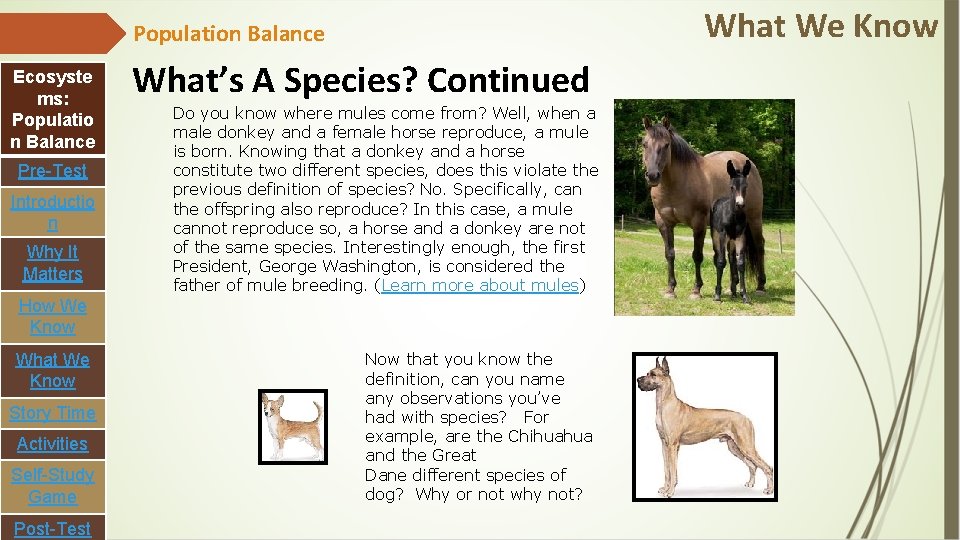
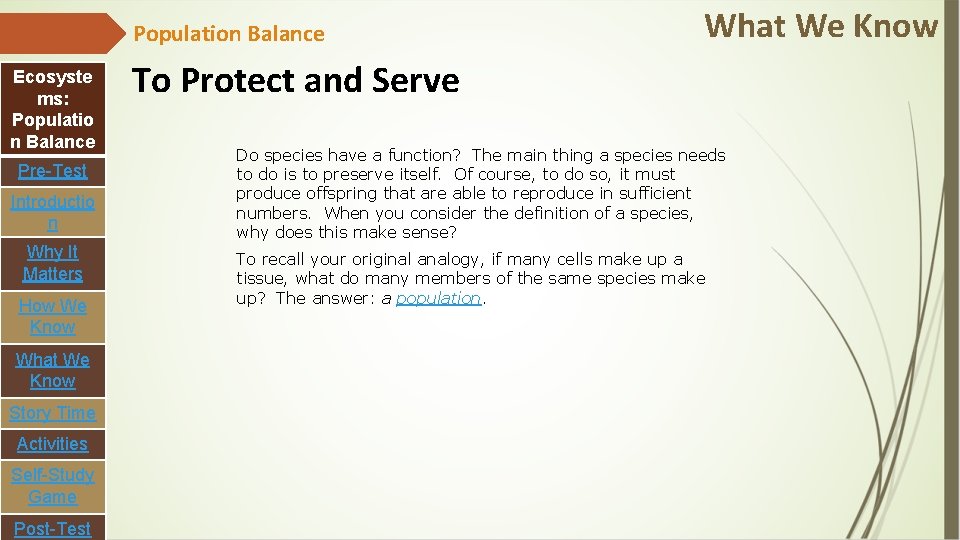
What We Know Population Balance Ecosyste ms: Populatio n Balance Pre-Test Introductio n Why It Matters What’s A Species? Continued Do you know where mules come from? Well, when a male donkey and a female horse reproduce, a mule is born. Knowing that a donkey and a horse constitute two different species, does this violate the previous definition of species? No. Specifically, can the offspring also reproduce? In this case, a mule cannot reproduce so, a horse and a donkey are not of the same species. Interestingly enough, the first President, George Washington, is considered the father of mule breeding. (Learn more about mules) How We Know What We Know Story Time Activities Self-Study Game Post-Test Now that you know the definition, can you name any observations you’ve had with species? For example, are the Chihuahua and the Great Dane different species of dog? Why or not why not?
Population Balance Ecosyste ms: Populatio n Balance Pre-Test Introductio n Why It Matters How We Know What We Know Story Time Activities Self-Study Game Post-Test What We Know To Protect and Serve Do species have a function? The main thing a species needs to do is to preserve itself. Of course, to do so, it must produce offspring that are able to reproduce in sufficient numbers. When you consider the definition of a species, why does this make sense? To recall your original analogy, if many cells make up a tissue, what do many members of the same species make up? The answer: a population.
What We Know Population Balance Ecosyste ms: Populatio n Balance Pre-Test Introductio n Why It Matters How We Know What We Know Story Time Activities Self-Study Game Post-Test Populations Within any given species, populations can be characterized in the following three major ways: • Density • Age Distribution • Sex Ratio
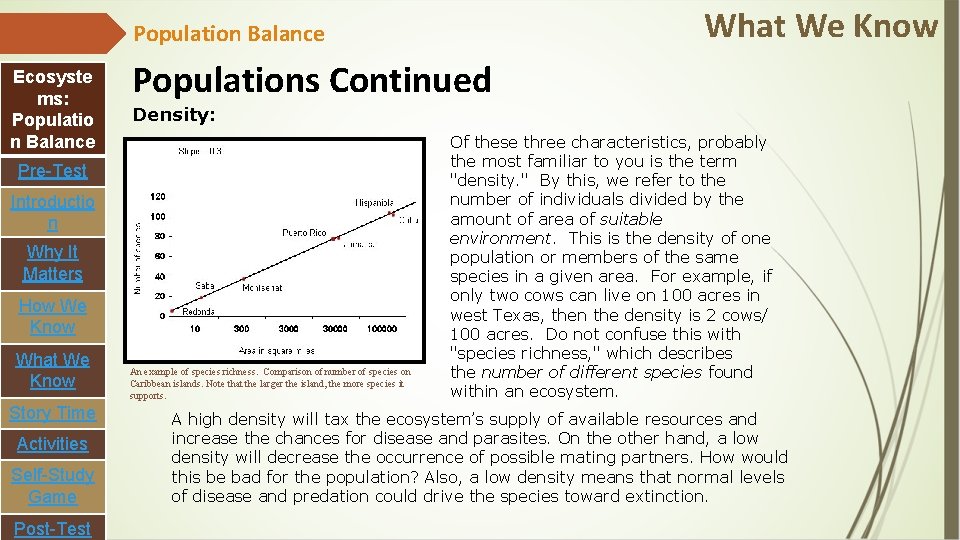
What We Know Population Balance Ecosyste ms: Populatio n Balance Populations Continued Density: Pre-Test Introductio n Why It Matters How We Know What We Know Story Time Activities Self-Study Game Post-Test An example of species richness. Comparison of number of species on Caribbean islands. Note that the larger the island, the more species it supports. Of these three characteristics, probably the most familiar to you is the term "density. " By this, we refer to the number of individuals divided by the amount of area of suitable environment. This is the density of one population or members of the same species in a given area. For example, if only two cows can live on 100 acres in west Texas, then the density is 2 cows/ 100 acres. Do not confuse this with "species richness, " which describes the number of different species found within an ecosystem. A high density will tax the ecosystem’s supply of available resources and increase the chances for disease and parasites. On the other hand, a low density will decrease the occurrence of possible mating partners. How would this be bad for the population? Also, a low density means that normal levels of disease and predation could drive the species toward extinction.
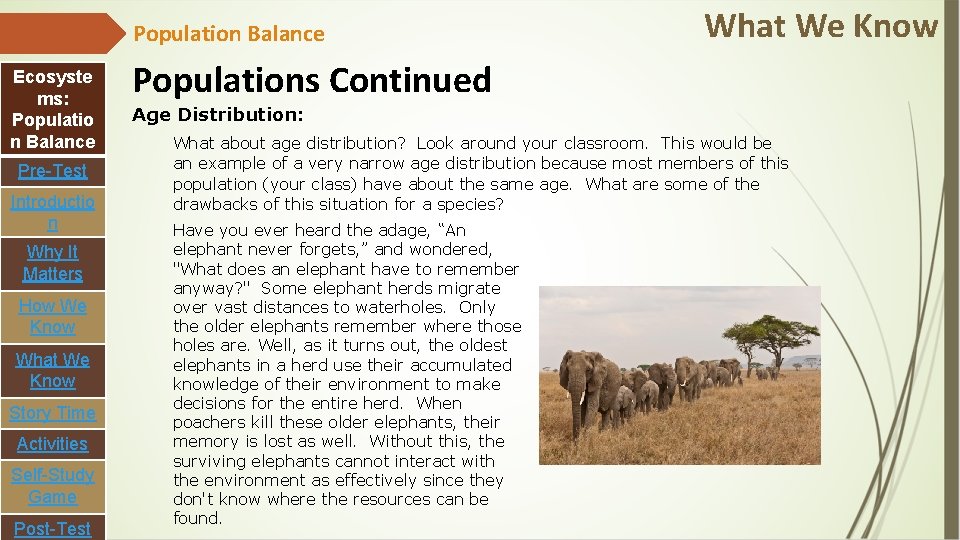
Population Balance Ecosyste ms: Populatio n Balance Pre-Test Introductio n Why It Matters How We Know What We Know Story Time Activities Self-Study Game Post-Test What We Know Populations Continued Age Distribution: What about age distribution? Look around your classroom. This would be an example of a very narrow age distribution because most members of this population (your class) have about the same age. What are some of the drawbacks of this situation for a species? Have you ever heard the adage, “An elephant never forgets, ” and wondered, "What does an elephant have to remember anyway? " Some elephant herds migrate over vast distances to waterholes. Only the older elephants remember where those holes are. Well, as it turns out, the oldest elephants in a herd use their accumulated knowledge of their environment to make decisions for the entire herd. When poachers kill these older elephants, their memory is lost as well. Without this, the surviving elephants cannot interact with the environment as effectively since they don't know where the resources can be found.
Population Balance Ecosyste ms: Populatio n Balance Pre-Test Introductio n Why It Matters How We Know What We Know Story Time Activities Self-Study Game Post-Test What We Know Populations Continued Age Distribution: Generally, ecologists use the age distribution to determine the growth of a population. If most members are of young age, the population is said to be growing. One practical application of age distribution deals with the body's response to infection. Bacterial infections stimulate white blood cells to proliferate. Older white cells look different from young ones. Medical technicians are sometimes asked to count the percentage of young white cells and the percentage of old ones. If you have many young cells, it means that your body is responding well to the infection. But if the population is dominated by old white cells, that is a bad sign.
Population Balance Ecosyste ms: Populatio n Balance Pre-Test Introductio n Why It Matters How We Know What We Know Story Time Activities Self-Study Game Post-Test What We Know Populations Continued Sex Ratio: Lastly, a "sex ratio" (the ratio of males to females) helps us to characterize population. For instance, if your karate class has four boys and six girls, the sex ratio is 4: 6. What would be the sex ratio of an all-boy karate class? Why would such ratios be important to ecosystems? Recently, scientists have recognized the significance of the sex ratio in the Columbia River. In response to environmental pollutants, developing male salmon sometimes undergo a sex reversal. They change sex! This phenomenon is considered a major factor in the observed decline in salmon population size. Why?
Population Balance Ecosyste ms: Populatio n Balance Pre-Test Introductio n Why It Matters How We Know What We Know Story Time Activities Self-Study Game Post-Test What We Know Extinction You’ve probably heard the word “extinction” before -- most likely in the context of a discussion of dinosaurs or dodo birds. But did you know that without extinction, we wouldn’t be here? Since life on earth began, 99. 9% of all species have become extinct! This means that of all the species that ever existed, only a very small fraction remains around today. How does this happen? As the characteristics of a population, like density, age distribution, and sex ratio, change, so does the population’s ability to survive. Unlike the salmon, most organisms aren’t able to adapt to an environment with only one sex, and they become extinct. How do conditions necessary for extinction arise? Each population occupies a specific place, or niche, in the ecosystem. If something disturbs that ecological niche, the population’s size may change. But don’t think that the only way to go is down! A change may produce population growth as well as decline, which may or may not lead to extinction. To see how this affects you, see the section "Why It Matters. "
Population Balance Ecosyste ms: Populatio n Balance Pre-Test Introductio n Why It Matters How We Know What We Know Story Time Activities Self-Study Game Post-Test What We Know Populations on the Genetic Level In the Cells are Us unit on Information Coding and Transmission, you were introduced to genes. But you may be wondering about their significance in the context of ecosystems? Think about what members of a population share with each other? Being of the same species, you would expect individuals to be very similar. To get a better perspective, look around at your classmates. Unless you have a pair of identical twins in your class, each individual will possess a different appearance. What accounts for this distinction between individuals of the same species? A large part of this difference comes from having different combinations of dominant and recessive alleles.
What We Know Population Balance Ecosyste ms: Populatio n Balance Pre-Test Introductio n Why It Matters Gene Frequencies A given population of a species has a certain distribution of genes, called gene frequencies. If these frequencies are changing, it could suggest that the species has a lot of capacity for evolution, if selection forces act more on one set of genes than on others. Two scientists, named Hardy and Weinberg, tackled the problem of describing how alleles in a population change over time. They determined that allele frequencies remain constant over time if these characteristics of the population were met: • The population is large How We Know • Mates are chosen at random What We Know • Mutation is not present • Migration does not occur • Natural selection forces are absent Story Time Activities Self-Study Game Post-Test
Population Balance Ecosyste ms: Populatio n Balance Pre-Test Introductio n Why It Matters How We Know What We Know Story Time Activities Self-Study Game Post-Test What We Know Gene Frequencies Continued Are these conditions ever met in nature? If so, in what situations? Sharks and turtles, for example, come very close to fulfilling these requirements. So, would we expect sharks to exhibit relatively constant allele frequencies? Sure! In fact, researchers have determined that the genetic information in mammals changes about 3% every 1 million years, while the genetic information of sharks change at a rate seven to eight times slower than this. Do any populations ever fulfill all of the conditions perfectly? No. The Hardy-Weinberg law describes an imaginary situation in which no selection forces (natural selection, migration…) were acting. However, in reality, some combination of selection forces is always present. For some advanced science, go to The Hardy-Weinberg Calculator and experiment with this principle.
Population Balance Ecosyste ms: Populatio n Balance Pre-Test Introductio n Why It Matters How We Know What We Know Story Time Activities Self-Study Game Post-Test What We Know Creating New Species Now that we have a grasp of species and populations, we can begin to see how different species arise. As you learned in the Information Coding and Translation section of the Cells are Us module, genes carry the genetic information codes for the various traits of organisms. The gene pool refers to all the genes found within a population. Differences in the gene pool separate populations from each other. In another sense, a significant change in the gene pool of an existing population could mark the formation of a new population and even a new species. Why would this be important from an ecological perspective? How does this happen? A species may arise whenever there is a major change in its gene pool. To change the gene pool, you must alter the normal process that maintains it.
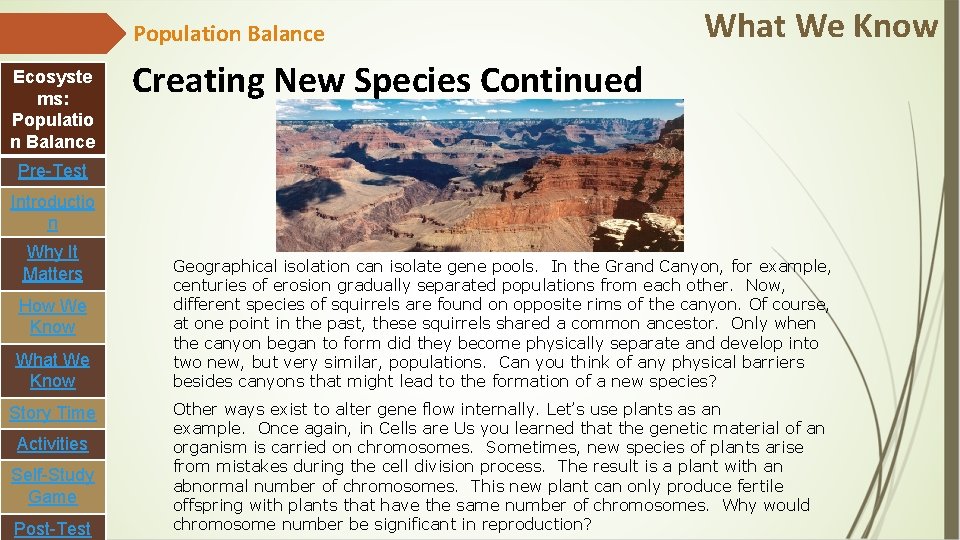
Population Balance Ecosyste ms: Populatio n Balance What We Know Creating New Species Continued Pre-Test Introductio n Why It Matters How We Know What We Know Story Time Activities Self-Study Game Post-Test Geographical isolation can isolate gene pools. In the Grand Canyon, for example, centuries of erosion gradually separated populations from each other. Now, different species of squirrels are found on opposite rims of the canyon. Of course, at one point in the past, these squirrels shared a common ancestor. Only when the canyon began to form did they become physically separate and develop into two new, but very similar, populations. Can you think of any physical barriers besides canyons that might lead to the formation of a new species? Other ways exist to alter gene flow internally. Let’s use plants as an example. Once again, in Cells are Us you learned that the genetic material of an organism is carried on chromosomes. Sometimes, new species of plants arise from mistakes during the cell division process. The result is a plant with an abnormal number of chromosomes. This new plant can only produce fertile offspring with plants that have the same number of chromosomes. Why would chromosome number be significant in reproduction?
Population Balance Ecosyste ms: Populatio n Balance Pre-Test Introductio n Why It Matters How We Know What We Know Story Time Activities Self-Study Game Post-Test What We Know Population Growth You’ve learned why sexual reproduction is important for survival in the Natural Selection unit, but now, we will uncover the big picture behind all reproduction…population growth! As a population grows, the chances for evolving new species may also increase because more individuals with specific gene frequencies are available to be acted on by natural selection. The growth of populations occurs exponentially unless something limits it, such as running out of food. What does this mean? This means that initial growth is slow, but as time increases, so does the growth rate. How does this type of growth differ from linear growth? If you can't answer this question, Activity 1 might be a good exercise to do now.
Population Balance Ecosyste ms: Populatio n Balance Pre-Test Introductio n Why It Matters How We Know What We Know Story Time Activities Self-Study Game Post-Test What We Know Population Growth Continued Bacteria provide us with a useful model of population growth. One bacterial cell divides into two cells. Each of these cells then divide, and so on. In reality, some bacteria divide every eight minutes! So, if you left one bacterial cell to divide when you left for school in the morning, by the time you arrived home from school, over six quadrillion, or 1015, cells could be waiting for you. If lined up, all of these bacteria could circle the earth at the equator fifteen times! So, now that we know how fast bacteria can grow and given that they’ve had a few billion years of time, why isn’t our planet mile deep in bacteria? This kind of growth is impossible. Can you think of some reasons why? Refer to Activity #1 to explore bacterial growth further.
What We Know Population Balance Ecosyste ms: Populatio n Balance Pre-Test Introductio n Why It Matters How We Know What We Know Population Growth Continued What conditions need to be met for growth to proceed at the fastest possible rate? First, a population would need unlimited environmental resources and space. Then, all the organisms in the population must live and reproduce at a maximum rate. For humans, some resources, such as food, may seem to be unlimited, but in reality, people starve to death every day. The Irish Potato Famine caused the death of over a million people. Could something like that happen in today’s technological society? In May 2002, Zimbabwe declared a state of disaster as drought swept the country, bringing with it widespread famine. Zimbabwe’s agricultural harvest was expected to produce one-quarter of the normal yield, at most. Many other African countries share the same food supply concerns. Here are some factors that influence population growth: • Light Story Time • Predators Activities • Food and Water Self-Study Game • Contagious Disease Post-Test
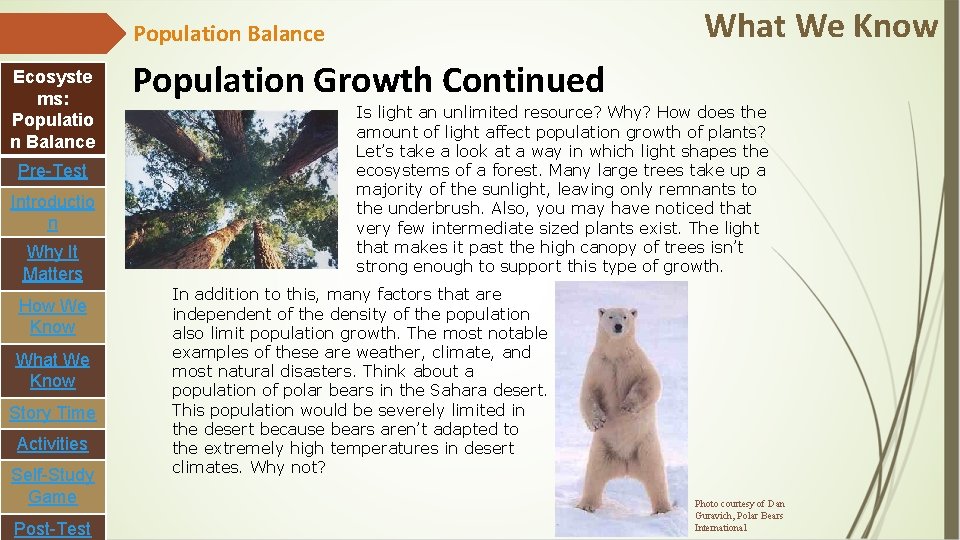
What We Know Population Balance Ecosyste ms: Populatio n Balance Pre-Test Introductio n Why It Matters How We Know What We Know Story Time Activities Self-Study Game Post-Test Population Growth Continued Is light an unlimited resource? Why? How does the amount of light affect population growth of plants? Let’s take a look at a way in which light shapes the ecosystems of a forest. Many large trees take up a majority of the sunlight, leaving only remnants to the underbrush. Also, you may have noticed that very few intermediate sized plants exist. The light that makes it past the high canopy of trees isn’t strong enough to support this type of growth. In addition to this, many factors that are independent of the density of the population also limit population growth. The most notable examples of these are weather, climate, and most natural disasters. Think about a population of polar bears in the Sahara desert. This population would be severely limited in the desert because bears aren’t adapted to the extremely high temperatures in desert climates. Why not? Photo courtesy of Dan Guravich, Polar Bears International
Population Balance Ecosyste ms: Populatio n Balance Pre-Test Introductio n Why It Matters How We Know What We Know Story Time Activities Self-Study Game Post-Test What We Know Population Growth Continued With this knowledge we can talk about communities, or interactions of populations living in the same area. Rarely in the environment do members of a single species live without any influence on the population density and growth of another species. Even in the case with humans, cities might have a disproportionate number of people, but their living space is shared with many other organisms, like plants, dogs, birds, and bacteria. Can you give some examples of how the presence of humans affects the population growth of plants, dogs, birds, and bacteria living in the shared environment of a city?
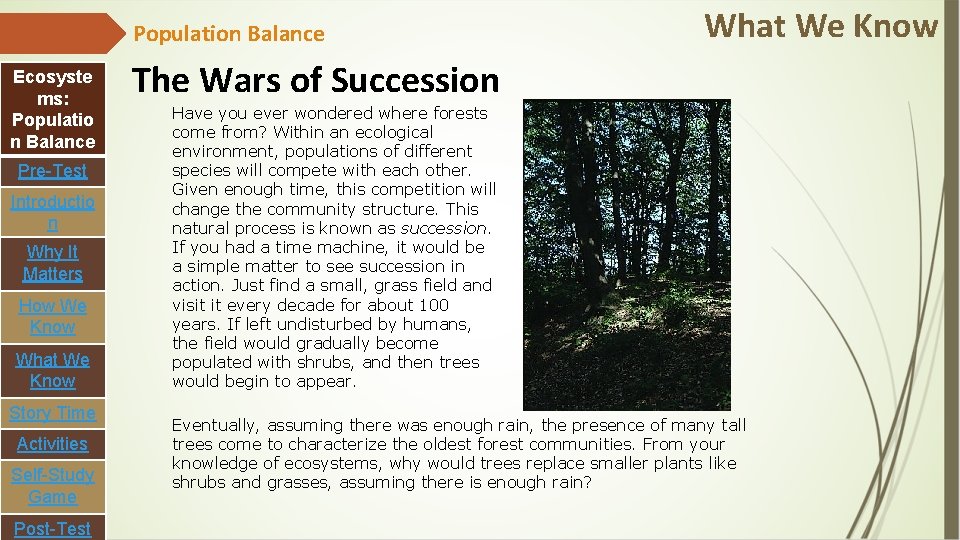
Population Balance Ecosyste ms: Populatio n Balance Pre-Test Introductio n Why It Matters How We Know What We Know Story Time Activities Self-Study Game Post-Test What We Know The Wars of Succession Have you ever wondered where forests come from? Within an ecological environment, populations of different species will compete with each other. Given enough time, this competition will change the community structure. This natural process is known as succession. If you had a time machine, it would be a simple matter to see succession in action. Just find a small, grass field and visit it every decade for about 100 years. If left undisturbed by humans, the field would gradually become populated with shrubs, and then trees would begin to appear. Eventually, assuming there was enough rain, the presence of many tall trees come to characterize the oldest forest communities. From your knowledge of ecosystems, why would trees replace smaller plants like shrubs and grasses, assuming there is enough rain?
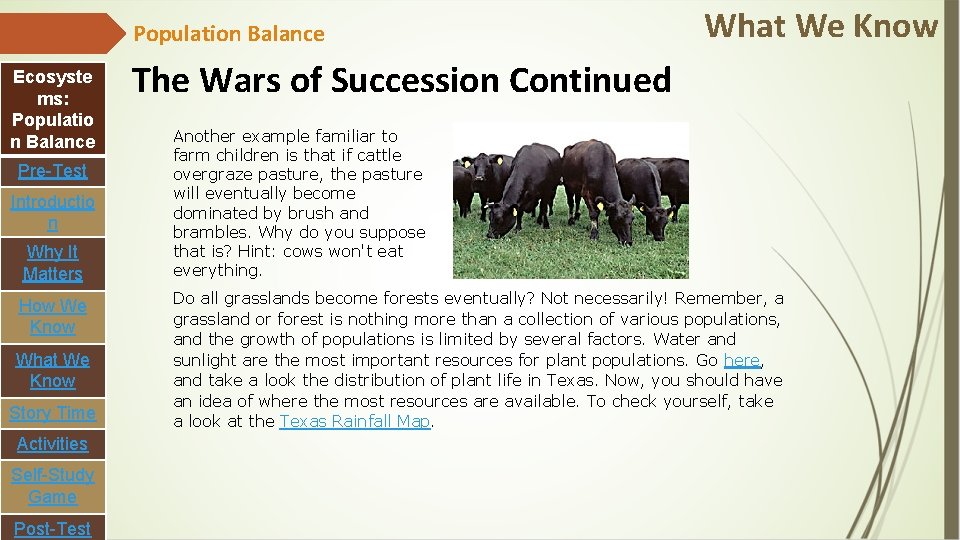
Population Balance Ecosyste ms: Populatio n Balance Pre-Test Introductio n Why It Matters How We Know What We Know Story Time Activities Self-Study Game Post-Test What We Know The Wars of Succession Continued Another example familiar to farm children is that if cattle overgraze pasture, the pasture will eventually become dominated by brush and brambles. Why do you suppose that is? Hint: cows won't eat everything. Do all grasslands become forests eventually? Not necessarily! Remember, a grassland or forest is nothing more than a collection of various populations, and the growth of populations is limited by several factors. Water and sunlight are the most important resources for plant populations. Go here, and take a look the distribution of plant life in Texas. Now, you should have an idea of where the most resources are available. To check yourself, take a look at the Texas Rainfall Map.
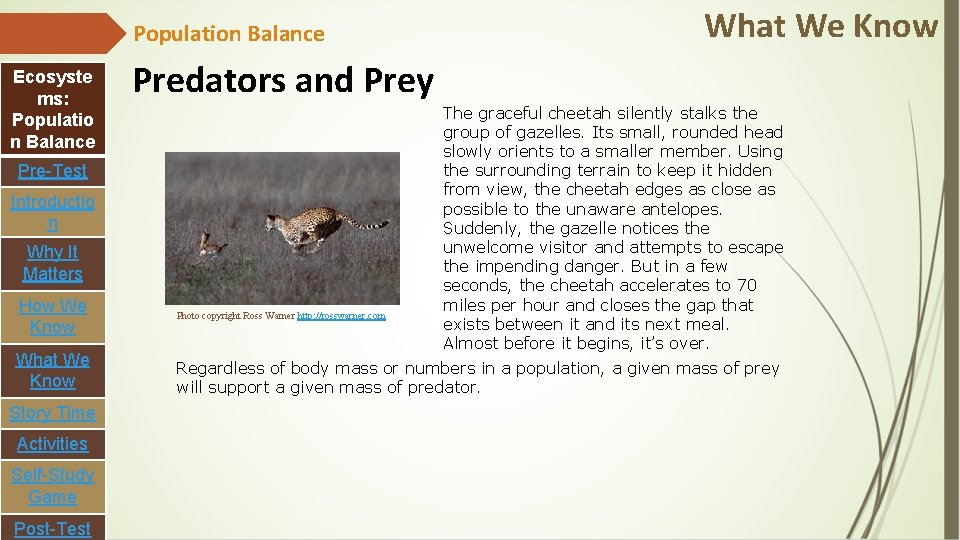
Population Balance Ecosyste ms: Populatio n Balance Predators and Prey Pre-Test Introductio n Why It Matters How We Know What We Know Story Time Activities Self-Study Game Post-Test What We Know Photo copyright Ross Warner http: //rosswarner. com The graceful cheetah silently stalks the group of gazelles. Its small, rounded head slowly orients to a smaller member. Using the surrounding terrain to keep it hidden from view, the cheetah edges as close as possible to the unaware antelopes. Suddenly, the gazelle notices the unwelcome visitor and attempts to escape the impending danger. But in a few seconds, the cheetah accelerates to 70 miles per hour and closes the gap that exists between it and its next meal. Almost before it begins, it’s over. Regardless of body mass or numbers in a population, a given mass of prey will support a given mass of predator.
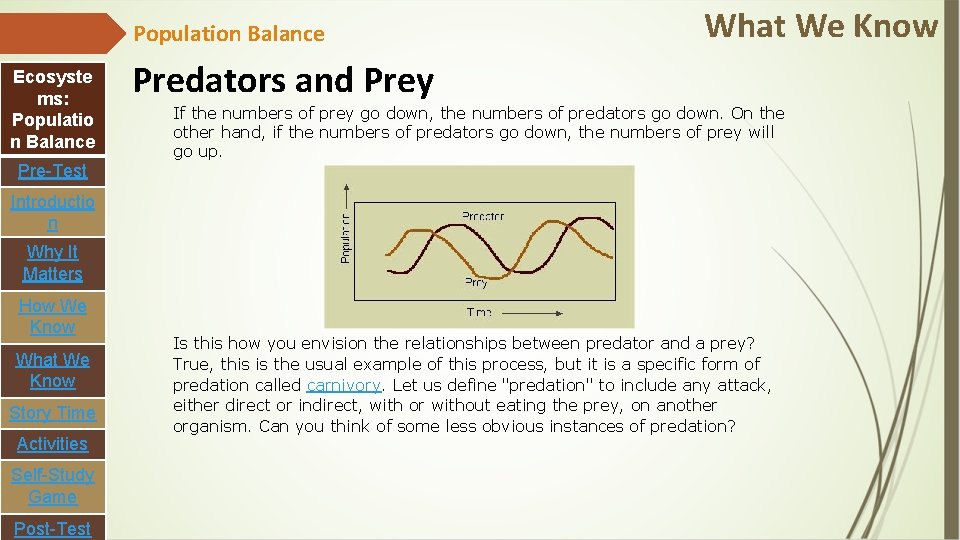
Population Balance Ecosyste ms: Populatio n Balance What We Know Predators and Prey If the numbers of prey go down, the numbers of predators go down. On the other hand, if the numbers of predators go down, the numbers of prey will go up. Pre-Test Introductio n Why It Matters How We Know What We Know Story Time Activities Self-Study Game Post-Test Is this how you envision the relationships between predator and a prey? True, this is the usual example of this process, but it is a specific form of predation called carnivory. Let us define "predation" to include any attack, either direct or indirect, with or without eating the prey, on another organism. Can you think of some less obvious instances of predation?
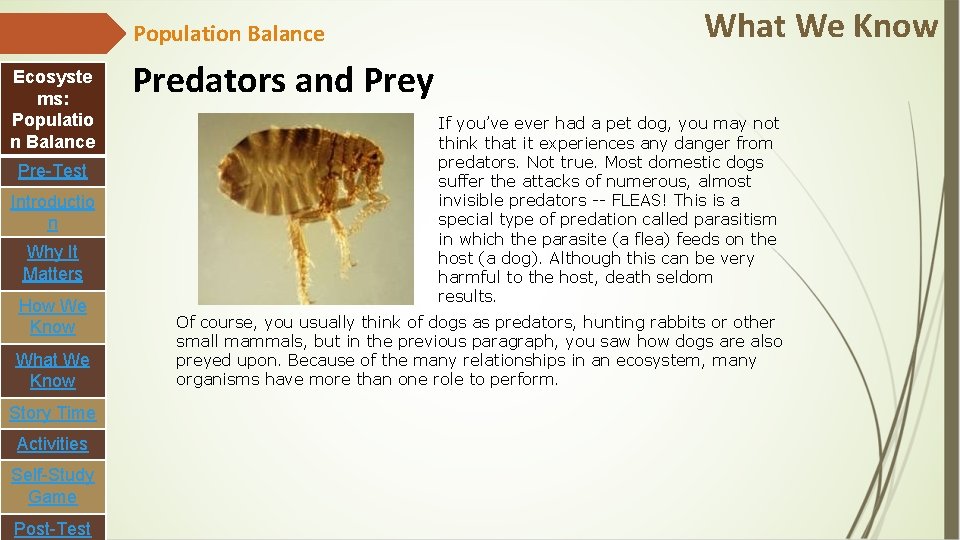
Population Balance Ecosyste ms: Populatio n Balance Pre-Test Introductio n Why It Matters How We Know What We Know Story Time Activities Self-Study Game Post-Test What We Know Predators and Prey If you’ve ever had a pet dog, you may not think that it experiences any danger from predators. Not true. Most domestic dogs suffer the attacks of numerous, almost invisible predators -- FLEAS! This is a special type of predation called parasitism in which the parasite (a flea) feeds on the host (a dog). Although this can be very harmful to the host, death seldom results. Of course, you usually think of dogs as predators, hunting rabbits or other small mammals, but in the previous paragraph, you saw how dogs are also preyed upon. Because of the many relationships in an ecosystem, many organisms have more than one role to perform.
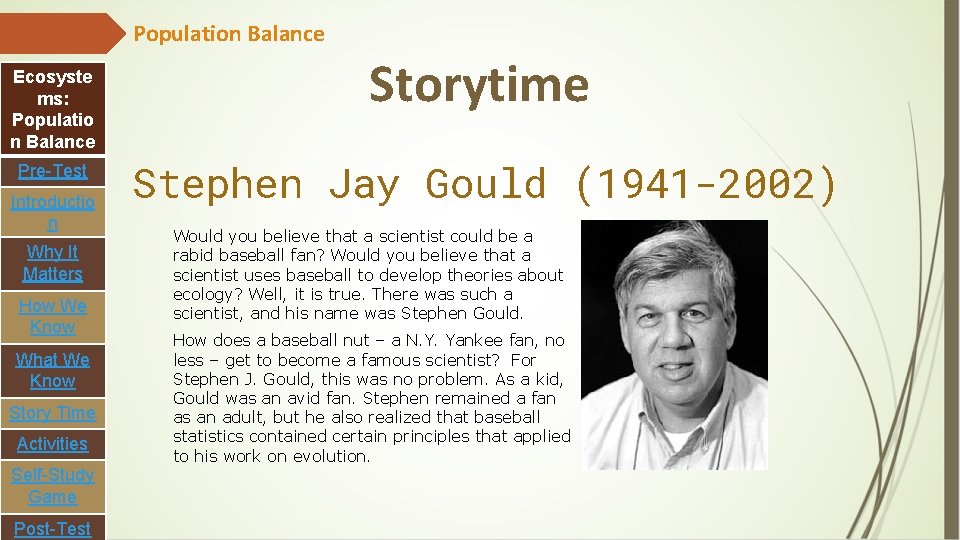
Population Balance Ecosyste ms: Populatio n Balance Pre-Test Introductio n Why It Matters How We Know What We Know Story Time Activities Self-Study Game Post-Test Storytime Stephen Jay Gould (1941 -2002) Would you believe that a scientist could be a rabid baseball fan? Would you believe that a scientist uses baseball to develop theories about ecology? Well, it is true. There was such a scientist, and his name was Stephen Gould. How does a baseball nut – a N. Y. Yankee fan, no less – get to become a famous scientist? For Stephen J. Gould, this was no problem. As a kid, Gould was an avid fan. Stephen remained a fan as an adult, but he also realized that baseball statistics contained certain principles that applied to his work on evolution.
Population Balance Ecosyste ms: Populatio n Balance Pre-Test Introductio n Why It Matters How We Know What We Know Story Time Activities Self-Study Game Post-Test Stephen Jay Gould Stephen grew up in New York City, the son of a dedicated Marxist, whose parents were Jewish immigrants. As a kid, the Marxist indoctrination from his father meant little. It was baseball, particularly the Yankees, that Stephen cared about. He went to public school in Queens section of the city. Early on, Stephen got interested in biology and evolution. Like most kids, he was interested in dinosaurs. Living in New York, Stephen got to see many real dinosaur skeletons at the American Museum of Natural History. He wrote later about his childhood dream: ‘I dreamed of becoming a scientist, in general, and a paleontologist, in particular, ever since the Tyrannosaurus skeleton awed and scared me. ’ Kids sometimes made fun of him, calling him "fossil face. " But, Stephen says his childhood wasn’t too bad. He said that the name calling was "no more than New York kids inevitably put up with. " Also, he said, "the only time I ever got beat up was when I admitted to being a Yankee fan in Brooklyn. That was kind of dumb. " Storytime
Population Balance Ecosyste ms: Populatio n Balance Pre-Test Introductio n Why It Matters How We Know What We Know Story Time Activities Self-Study Game Post-Test Stephen Jay Gould Stephen never did become a political activist, nor even a Communist. He went to college at Antioch College in Ohio. He got his Ph. D from Columbia University. His work on evolution brought him such recognition that he was hired into the faculty at Harvard. At Harvard, his classes became very popular with students, because he gave funny talks, laced with anecdotes, cartoons, jokes, baseball stories, and put-downs of stuffy scientists. In his later years he developed an explanation for the appearance of complex animals based on his interest in baseball. Gould was fascinated with the question of why there have been no 0. 400 hitters since Boston Red Sox Ted Williams, who hit 0. 406 in 1941. Going into the last day of the season, Ted had a 0. 401 average and the manager wanted to bench him to preserve the record. Williams would not hear of it. He played in both ends of a double header that last day, hitting 6 for 8. The closest anybody has come to matching this feat was George Brett in 1980 (0. 390), Rod Carew in 1977 (0. 388) and Williams himself in 1957 (0. 388). Storytime
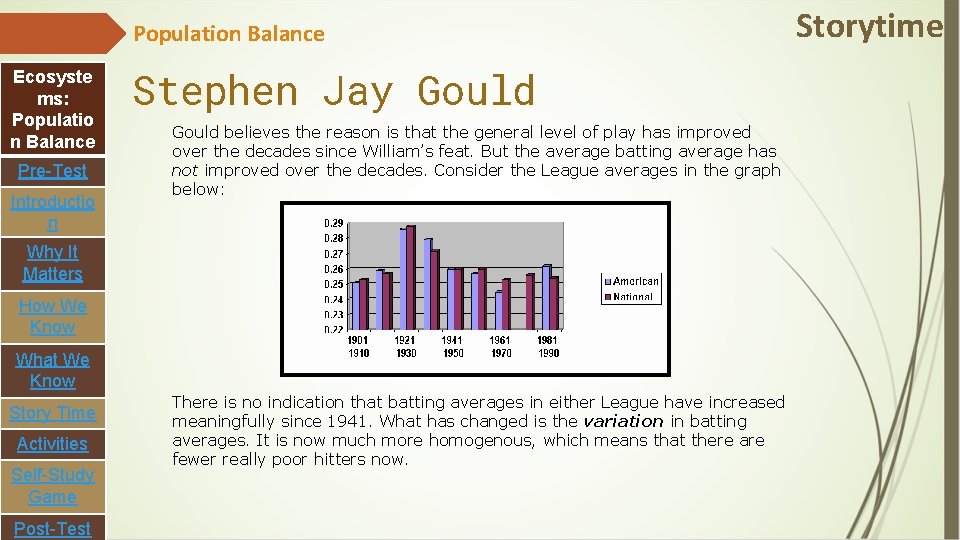
Population Balance Ecosyste ms: Populatio n Balance Pre-Test Introductio n Stephen Jay Gould believes the reason is that the general level of play has improved over the decades since William’s feat. But the average batting average has not improved over the decades. Consider the League averages in the graph below: Why It Matters How We Know What We Know Story Time Activities Self-Study Game Post-Test There is no indication that batting averages in either League have increased meaningfully since 1941. What has changed is the variation in batting averages. It is now much more homogenous, which means that there are fewer really poor hitters now. Storytime
Population Balance Ecosyste ms: Populatio n Balance Pre-Test Introductio n Why It Matters How We Know What We Know Story Time Activities Self-Study Game Post-Test Stephen Jay Gould So how does this answer the 0. 400 hitter question? There is less spread around the typical annual average of 0. 260. This means that the right-hand tail of the curve (toward 0. 400 hitting) has shifted toward the average, toward the left. Among the whole population of all baseball players, there are fewer hitters now out there on the right-hand tail who have a remote chance of hitting 0. 400. Why there is less variability now is open to interesting debate, involving such things as uniform training methods, night baseball, better pitching, relief pitchers, and so on. You can read the whole story in his last book, Full House. Gould is not the only baseball nut among scientists. He and a Nobel Prize winning physicist, Ed Purcell, published a paper on batting streaks and slumps. All of the streaks and slumps they measured fell within the range of chance – except one. Joe Dimaggio’s streak of hitting in 56 straight games should not have happened by chance. Love, hate, joy, envy, and respect are some of the many opinions that scientists have held of Stephen J. Gould. Despite the quaint and arcane nature of his primary research interest, the evolution of land snails, Gould had many ideas that expanded far beyond snails. He was a bold and creative thinker, and his ideas – still being debated today – demanded consideration. Storytime
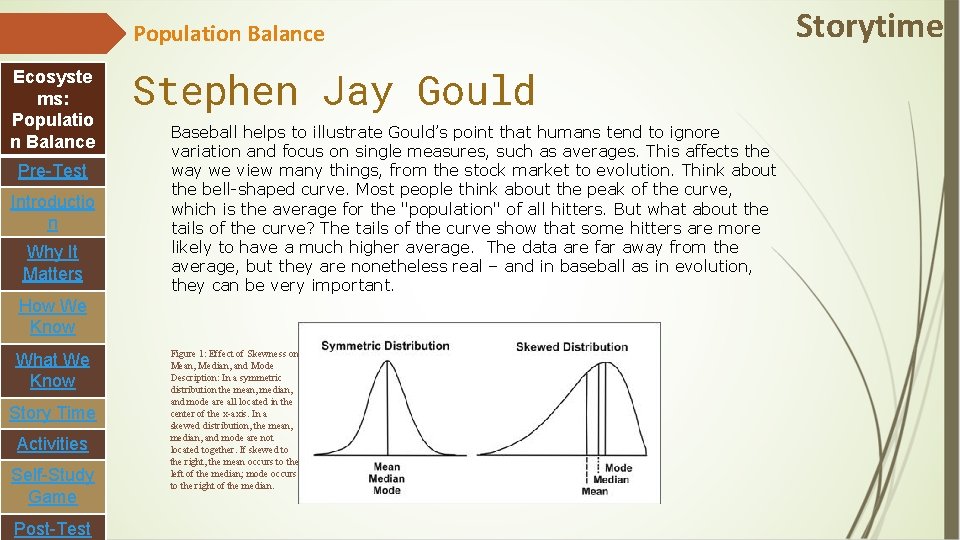
Population Balance Ecosyste ms: Populatio n Balance Pre-Test Introductio n Why It Matters Stephen Jay Gould Baseball helps to illustrate Gould’s point that humans tend to ignore variation and focus on single measures, such as averages. This affects the way we view many things, from the stock market to evolution. Think about the bell-shaped curve. Most people think about the peak of the curve, which is the average for the "population" of all hitters. But what about the tails of the curve? The tails of the curve show that some hitters are more likely to have a much higher average. The data are far away from the average, but they are nonetheless real – and in baseball as in evolution, they can be very important. How We Know What We Know Story Time Activities Self-Study Game Post-Test Figure 1: Effect of Skewness on Mean, Median, and Mode Description: In a symmetric distribution the mean, median, and mode are all located in the center of the x-axis. In a skewed distribution, the mean, median, and mode are not located together. If skewed to the right, the mean occurs to the left of the median; mode occurs to the right of the median. Storytime
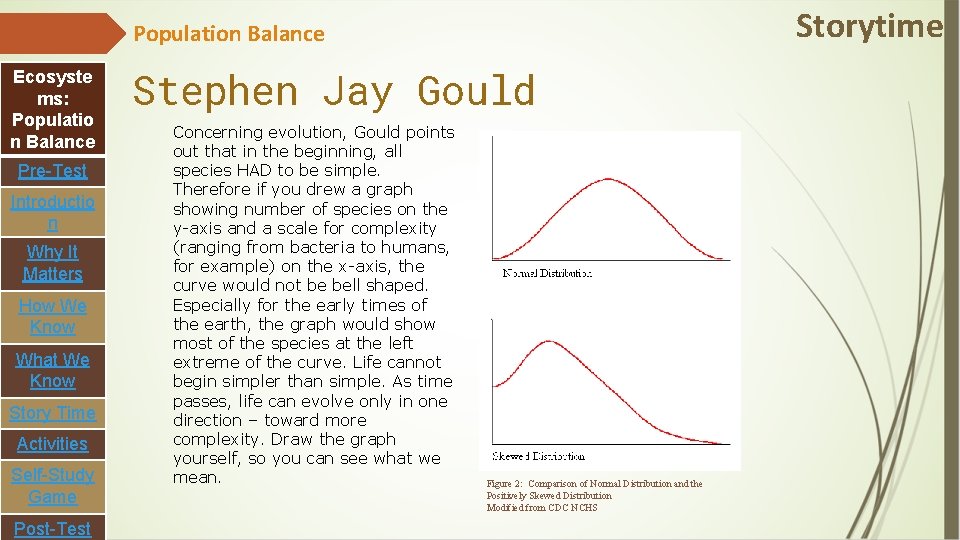
Storytime Population Balance Ecosyste ms: Populatio n Balance Pre-Test Introductio n Why It Matters How We Know What We Know Story Time Activities Self-Study Game Post-Test Stephen Jay Gould Concerning evolution, Gould points out that in the beginning, all species HAD to be simple. Therefore if you drew a graph showing number of species on the y-axis and a scale for complexity (ranging from bacteria to humans, for example) on the x-axis, the curve would not be bell shaped. Especially for the early times of the earth, the graph would show most of the species at the left extreme of the curve. Life cannot begin simpler than simple. As time passes, life can evolve only in one direction – toward more complexity. Draw the graph yourself, so you can see what we mean. Figure 2: Comparison of Normal Distribution and the Positively Skewed Distribution Modified from CDC NCHS
Population Balance Ecosyste ms: Populatio n Balance Pre-Test Introductio n Why It Matters How We Know What We Know Story Time Activities Self-Study Game Post-Test Stephen Jay Gould The other part of his point is that in the early history of earth, the curve for primitive species always had a few species out on the tail of the curve. That is, they – by chance – were more complex than simple bacteria. Some of these more complex species found suitable niches and thus survived. Now the curve becomes fatter, spread out more toward the right, with more complex species. The process repeats. Now the fatter curve still is not bell shaped, but its extreme right-hand tail again has a few more complex species, some of whom will survive. Thus life seems to be purposefully evolving toward more complex forms. But according to Gould’s view, random variation and the laws of probability are driving evolution toward the more complex, given that you can’t drive evolution toward organisms simpler that the simplest life forms. Storytime
Population Balance Ecosyste ms: Populatio n Balance Pre-Test Introductio n Why It Matters How We Know What We Know Story Time Activities Self-Study Game Post-Test Stephen Jay Gould One controversial idea was his attempt to explain sudden changes in the fossil record. Most scientists believe that the changes were not sudden and that intermediate forms are just poorly preserved or have not yet been found. Critics of evolution say there are no intermediate forms, although intermediate fossil forms have been found for some lines of evolution. Gould argued that in cases where there are no intermediate fossil forms, the evolution was sudden. His idea was that many species exist for long periods without much change, with occasional "bursts" of new species formation. Gould calls this "punctuated equilibrium. " His critics sarcastically called the idea "evolution by jerks. " Gould quipped in retaliation by calling his critics' theory of slow evolution "evolution by creeps. " Who says scientists don't have a sense of humor? Actually, most scientists believe that both ideas are probably right, depending on the species. Modern genetics research lends support to Gould’s idea: one or a few mutations in major regulatory genes generate major changes in body form. In plants, for example, just one inactivated gene changes a bilaterally symmetrical flower into a radial one. Storytime
Population Balance Ecosyste ms: Populatio n Balance Pre-Test Introductio n Why It Matters Stephen Jay Gould argued that most people do not realize how easy it is for an apparent pattern to emerge from random events. Even in a table of random numbers, there are regions where patterns can be seen. The example he gives is coin flipping where the chances of flipping a head is 1 in 2 tries. The odds for getting five heads in a row is ½ x ½ /x ½ x ½ or 1 time in 32 tries. But it DOES happen that you can flip five heads in a row. Likewise in evolution, although the odds for a sudden, species-forming mutation may be small, it does happen. Self-Study Game Along with the astronomer, Carl Sagan, Gould was one of the few scientists who tried to make science popular. From his very readable books to his appearances on television (Johnny Carson Show, The Simpsons) he became a celebrity. Gould never shied away from controversy among scientists, and he never did so with the public. He was an active opponent of "Creationism and Intelligent Design. " He wrote many magazine articles, appeared in Board of Education hearings, and testified in court cases on behalf of theory of evolution as the only valid scientific explanation for creation. Among his many honors, perhaps the one that meant the most, because he was a writer at heart, was to be named a "Living Legend" by the Library of Congress. Post-Test To read more about punctuated equilibrium, click here. How We Know What We Know Story Time Activities Storytime
Population Balance Ecosyste ms: Populatio n Balance Pre-Test Introductio n Why It Matters How We Know What We Know Story Time Activities Self-Study Game Post-Test Storytime References 1. Fortey, R. A. 2002. Stephen Jay Gould (1941 -2002). Science. 296: 1984. 2. Gould, S. J. 2002. The Structure of Evolutionary Theory. Harvard University Press. Cambridge, Ma. 3. Palevitz, Barry A. 2002. Love him or hate him, Stephen Jay Gould made a difference. The Scientist 16 (12): 12. Text viewable at https: //www. thescientist. com/opinion-old/love-him-or-hate-him-stephen-jay-gould-made-adifference-53204 4. Figure 1. Effect of Skewness on Mean, Median, and Mode. Reprinted from Centers for Disease Control and Prevention Principles of Epidemiology in Public Health Practice, Third Edition An Introduction to Applied Epidemiology and Biostatistics, developed by U. S. Department of Health and Human Services, Centers for Disease Control and Prevention, Office of Workforce and Career Development, Career Development Division, 2012, Retrieved from https: //www. cdc. gov/csels/dsepd/ss 1978/Lesson 2/Section 8. html#ALT 210 5. Figure 2. Comparison of the Normal Distribution and the Skewed Distribution in Environmental Chemical Data. Adapted from Centers for Disease Control and Prevention NHANES Environmental Chemical Data Tutorial, by by Centers for Disease Control and Prevention, 2013, Retrieved from https: //www. cdc. gov/NCHS/Tutorials/environmental/preparing/review_create/ Info 3. htm
Population Balance Ecosyste ms: Populatio n Balance Pre-Test Introductio n Why It Matters How We Know What We Know Story Time Activities Self-Study Game Post-Test Activities
Population Balance Ecosyste ms: Populatio n Balance Pre-Test Introductio n Why It Matters How We Know What We Know Story Time Activities Self-Study Game Post-Test Click to download an activity ● Student Activity Sheet #1 - Population Growth ● Student Activity Sheet #2 - A Thought Exercise on the Origin of Species ● Student Activity Sheet #3 - A Bird Watching Activity ● Student Activity Sheet #5 - Root Beer Energy ● Student Activity Sheet #6 - Arctic Food Web Activities
Population Balance Ecosyste ms: Populatio n Balance Pre-Test Introductio n Why It Matters How We Know What We Know Story Time Activities Self-Study Game Post-Test Self-Study Game
Population Balance Ecosyste ms: Populatio n Balance Pre-Test Introductio n Why It Matters How We Know What We Know Story Time Activities Self-Study Game Post-Test Click to play a game • Quizizz Self-Study Game
Population Balance Ecosyste ms: Populatio n Balance Pre-Test Introductio n Why It Matters How We Know What We Know Story Time Activities Self-Study Game Post-Test Click below to take the post-test for this unit! • Google assessment
A-Exp Ecosyste ms: Populatio n Balance Pre-Test Introductio n Why It Matters How We Know What We Know Story Time Activities Self-Study Game Post-Test Glossary allele - one of two or more alternative forms of the same gene that are located in the same place on homologous chromosomes in the nucleus of the cell. Alleles are usually characterized as being dominant or recessive. Return to What We Know allele frequency - the proportion of a gene in a population that is made up of a specific allele. Return to What We Know carnivory - the type of predation in which an animal kills and eats another animal for food. Return to What We Know diversity - the number of species in a given location. Return to Why It Matters ecosystem - A group of organisms that are interdependent and the environment they live in and depend on. For example, cows grazing on a pasture reflect an ecosystem. It would include the cows and everything that surrounds them, for example, the grass, water, and of course other animals, like the cow birds, army worms, fire ants, soil microbes, and other living things associated with the pasture. Return to Introduction exponential growth - the instantaneous rate of population growth, represented by a J shaped curve. Exponential growth has no upper limit. Return to What We Know Source: Open. Stax
Ext-N Ecosyste ms: Populatio n Balance Pre-Test Introductio n Why It Matters How We Know What We Know Story Time Activities Self-Study Game Post-Test Glossary extinction - when a species dies off completely from the earth. Return to Introduction | Return to What We Know food chain - the sequence of food and nutrient distribution among different species. For example, small plant cells in water are eaten by small fish, small fish are eaten by big fish, big fish are eaten by people. Return to Why It Matters food web- a food web represents feeding relationships within a community. It also show the transfer of food energy from its source in plants through herbivores to carnivores. Normally, food webs consist of a number of food chains meshed together. Each food chain is a descriptive diagram including a series of arrows, each pointing from one species to another, representing the flow of food energy from one feeding group of organisms to another. Return to Why It Matters Marxism- the social and political theories supported by Marx. These theories support a form of government called socialism in which either the people or the government administrates and owns everything, and in turn, unequally distributes the goods and pay according to work done. Return to Storytime niche- the role of species based upon its function within a community. This includes the activities of the individuals and how they interact with each other and the habitat around them. Return to What We Know
P-V Ecosyste ms: Populatio n Balance Pre-Test Introductio n Why It Matters How We Know What We Know Story Time Activities Self-Study Game Post-Test Glossary population- A group of organisms of one species that interbreed and live in the same place at the same time. Return to Introduction | Return to What We Know species- a group of living organisms consisting of similar individuals capable of exchanging genes or interbreeding. Return to Introduction vacuum - a space completely devoid of matter, including air. Return to Introduction
- Slides: 74