
ECOSYSTEMS AND BIOMES REVIEW ECOLOGICAL LEVELS OF ORGANIZATION

ECOSYSTEMS AND BIOMES REVIEW
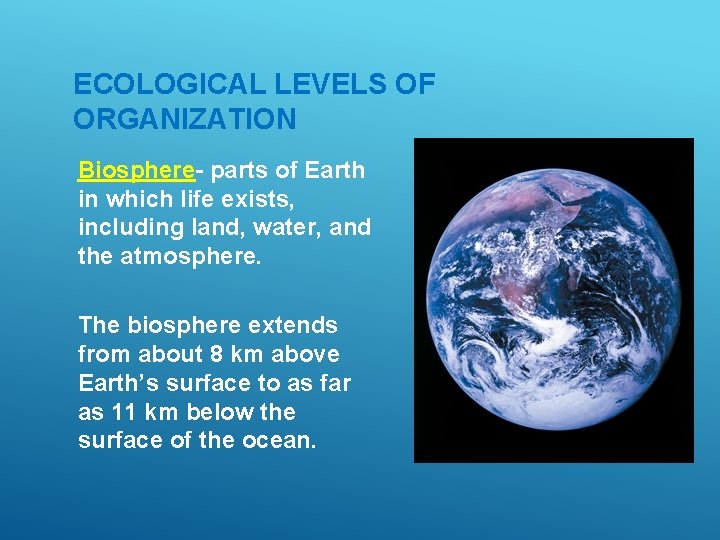
ECOLOGICAL LEVELS OF ORGANIZATION Biosphere- parts of Earth in which life exists, including land, water, and the atmosphere. The biosphere extends from about 8 km above Earth’s surface to as far as 11 km below the surface of the ocean.
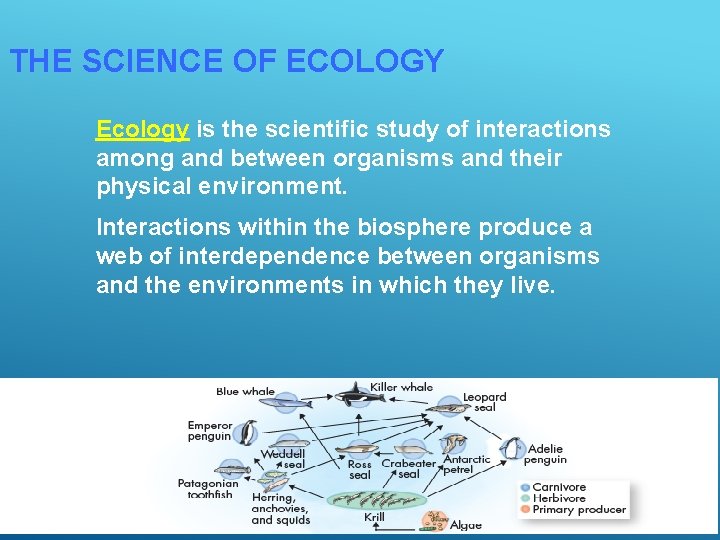
THE SCIENCE OF ECOLOGY Ecology is the scientific study of interactions among and between organisms and their physical environment. Interactions within the biosphere produce a web of interdependence between organisms and the environments in which they live.
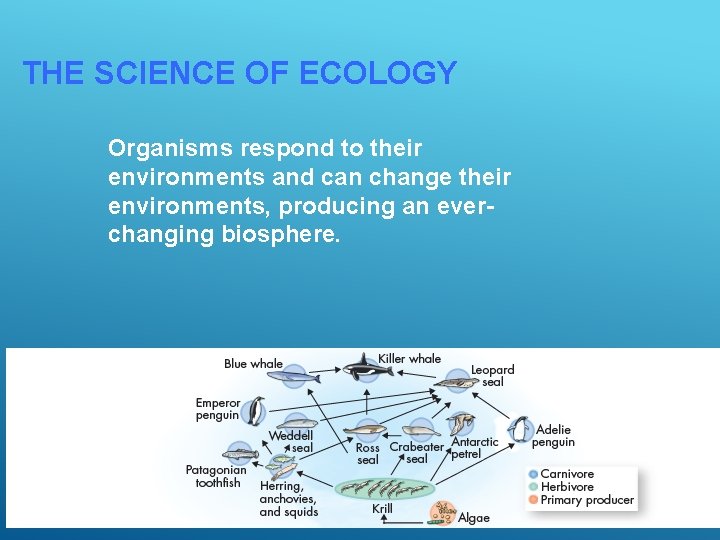
THE SCIENCE OF ECOLOGY Organisms respond to their environments and can change their environments, producing an everchanging biosphere.
LEVELS OF ORGANIZATION Ecological studies may focus on levels of organization that include the following from smallest to largest: 1. Organism-an individual living thing Ex. a catfish

LEVELS OF ORGANIZATION 2. Population—a group of individuals that belong to the same species and live in the same area Ex. all the spotted catfish in a lake
LEVELS OF ORGANIZATION 3. Community—an assemblage of different populations that live together in a defined area. Ex. all the fish, amphibians, insects, etc. in/near a lake
LEVELS OF ORGANIZATION 4. Ecosystem—all the organisms that live in a place, together with their physical environment Ex. all the fish, amphibians, insects, etc. in/near a lake and other nonliving environmental features such as water, sunlight, and soil.
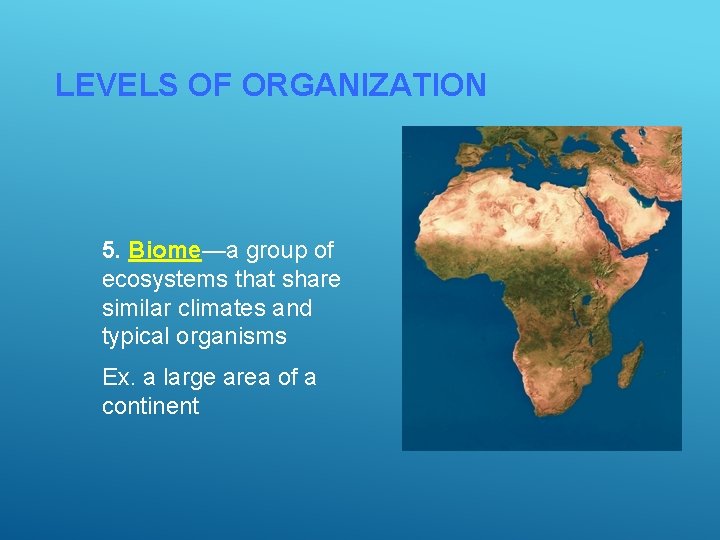
LEVELS OF ORGANIZATION 5. Biome—a group of ecosystems that share similar climates and typical organisms Ex. a large area of a continent
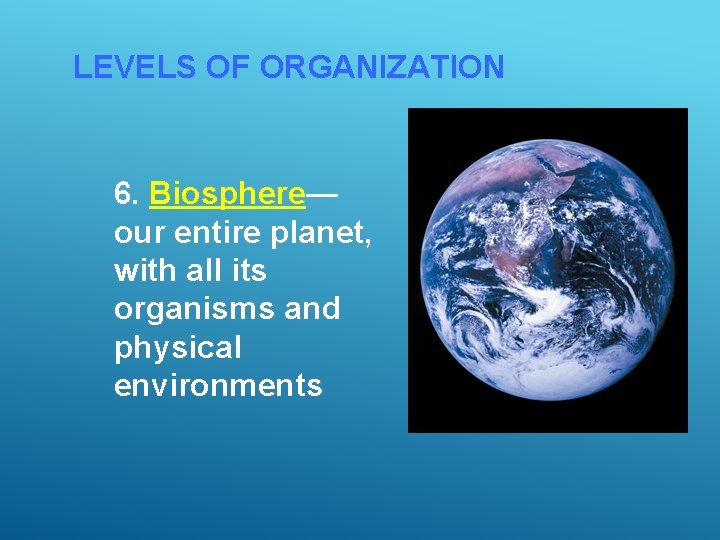
LEVELS OF ORGANIZATION 6. Biosphere— our entire planet, with all its organisms and physical environments
An organism’s niche describes not only the environment where it lives, but how it interacts with living and nonliving factors in the environment. In other words, an organism’s niche includes not only the physical and biological aspects of its environment, but also the way in which the organism uses them to survive and reproduce.

BIOTIC FACTORS A biotic factor is any living part of the environment with which an organism might interact, including animals, plants, mushrooms and bacteria. Biotic factors relating to a bullfrog might include the algae it eats as a tadpole, the herons that eat bullfrogs, and other species competing with the bullfrog for food or space.
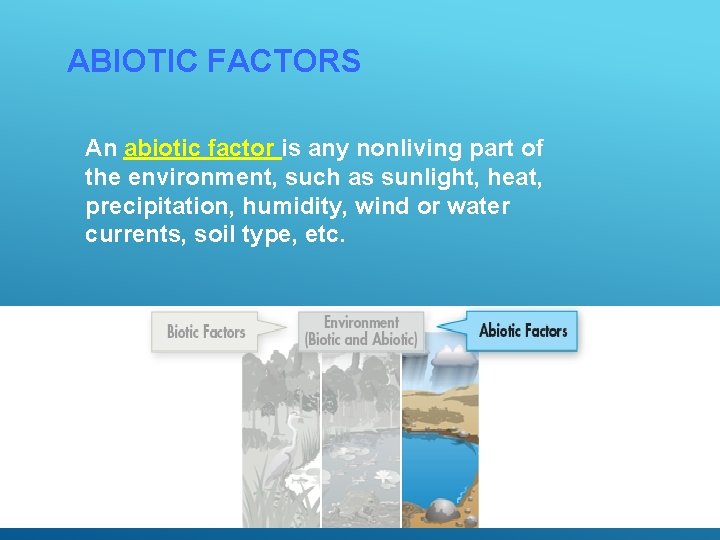
ABIOTIC FACTORS An abiotic factor is any nonliving part of the environment, such as sunlight, heat, precipitation, humidity, wind or water currents, soil type, etc.
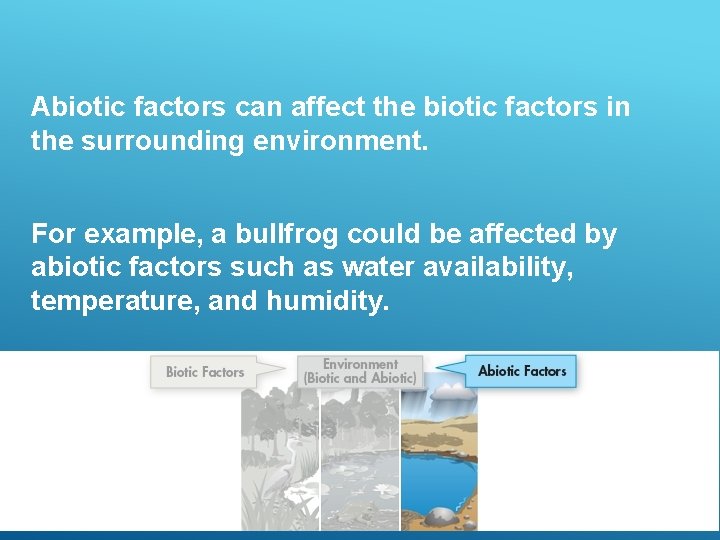
Abiotic factors can affect the biotic factors in the surrounding environment. For example, a bullfrog could be affected by abiotic factors such as water availability, temperature, and humidity.
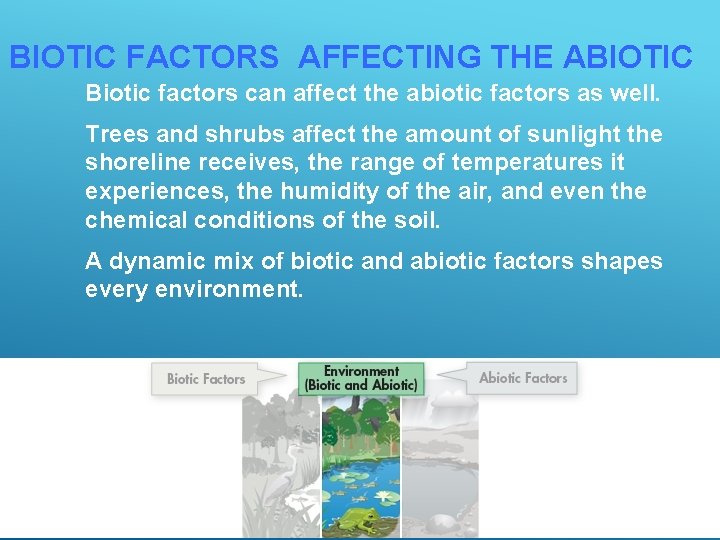
BIOTIC FACTORS AFFECTING THE ABIOTIC Biotic factors can affect the abiotic factors as well. Trees and shrubs affect the amount of sunlight the shoreline receives, the range of temperatures it experiences, the humidity of the air, and even the chemical conditions of the soil. A dynamic mix of biotic and abiotic factors shapes every environment.
Biomes
DEFINING BIOMES Ecologists classify Earth’s terrestrial ecosystems into at least ten different groups of regional climate communities called biomes. Biomes are described in terms of abiotic factors like climate and soil type, and biotic factors like plant and animal life.
THE MAJOR BIOMES Latitude and the heat transported by winds are factors that affect global climate. Other factors, among them an area’s proximity to an ocean or mountain range, also influence climate.

DEFINING BIOMES The map shows the locations of the major biomes.
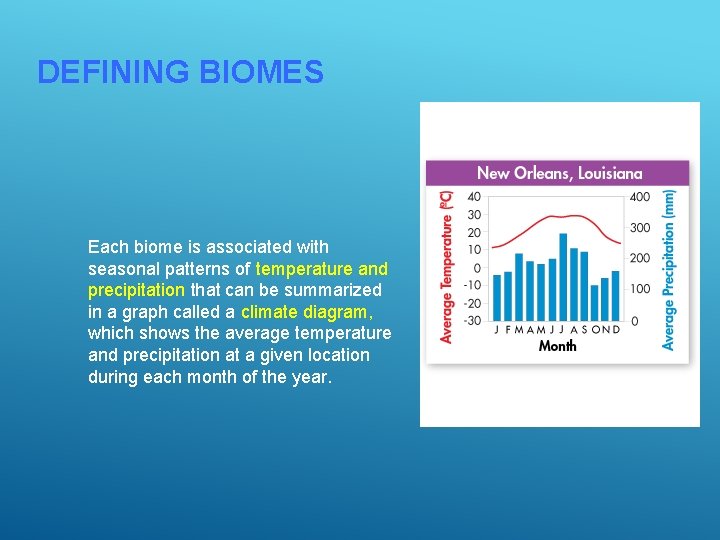
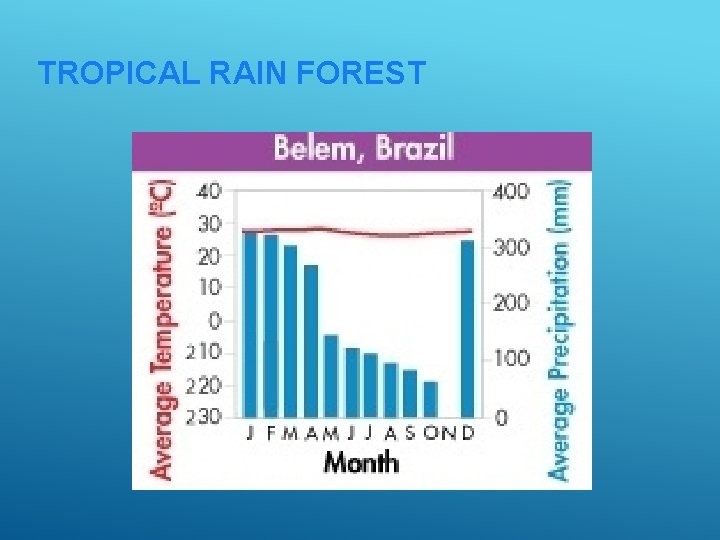
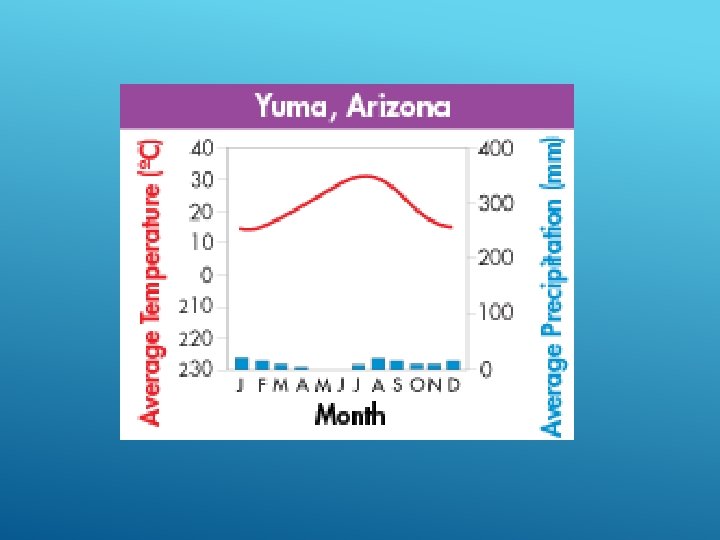
DEFINING BIOMES Each biome is associated with seasonal patterns of temperature and precipitation that can be summarized in a graph called a climate diagram, which shows the average temperature and precipitation at a given location during each month of the year.
DEFINING BIOMES Organisms within each biome can be characterized by adaptations that enable them to live and reproduce successfully in the environment.
TROPICAL RAIN FOREST -home to more species than all the other biomes combined - get at least 2 meters of rain a year -tall trees form a dense, leafy covering called a canopy and shorter trees and vines form a layer called the understory -Epiphytes(plants) grow on the branches of taller plants as opposed to soil to take advantage of available sunlight while obtaining nutrients through its host
TROPICAL RAIN FOREST
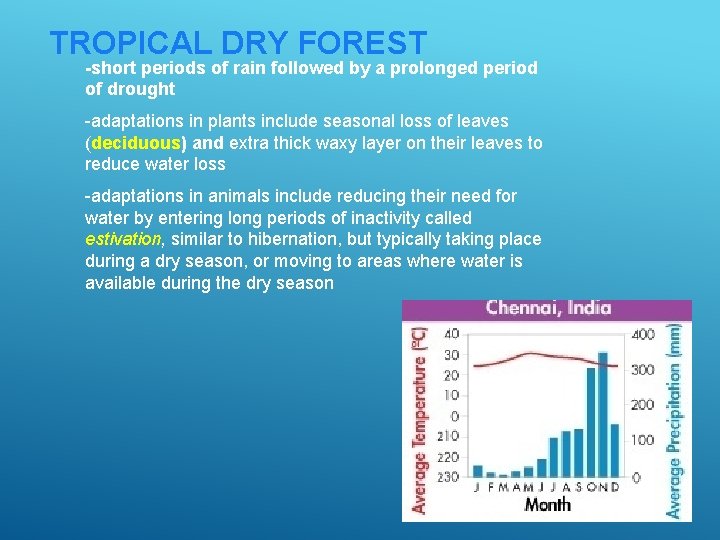
TROPICAL DRY FOREST -short periods of rain followed by a prolonged period of drought -adaptations in plants include seasonal loss of leaves (deciduous) and extra thick waxy layer on their leaves to reduce water loss -adaptations in animals include reducing their need for water by entering long periods of inactivity called estivation, similar to hibernation, but typically taking place during a dry season, or moving to areas where water is available during the dry season
TROPICAL GRASSLAND/SAVANNA/SHRUBLAND -some grasses have a high silica content that makes them less appetizing to grazing herbivores; unlike most plants, grasses grow from their bases, not their tips, so they can continue to grow after being grazed. -animals migrate during the dry season in search of water or burrow and remain dormant
DESERT -less than 25 centimeters of precipitation annually and vary greatly depending on elevation and latitude -undergo extreme daily temperature changes, alternating between hot and cold -many plants store water in their tissues, and minimize leaf surface area to cut down on water loss; cactus spines are actually modified leaves; modified photosynthesis requires leaf pores to open only at night, conserving moisture -animals get the water they need from the food they eat and often are nocturnal—active only at night. Large or elongated ears and other extremities often have many blood vessels close to the surface to help lose body heat and regulate body temperature
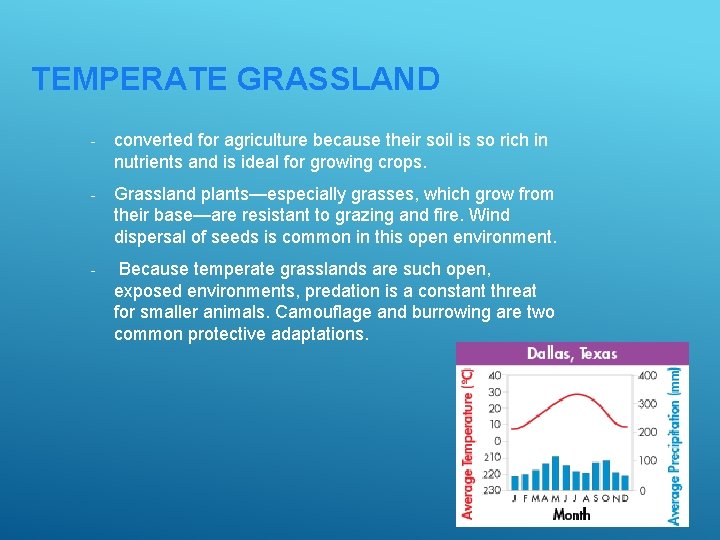
TEMPERATE GRASSLAND - converted for agriculture because their soil is so rich in nutrients and is ideal for growing crops. - Grassland plants—especially grasses, which grow from their base—are resistant to grazing and fire. Wind dispersal of seeds is common in this open environment. - Because temperate grasslands are such open, exposed environments, predation is a constant threat for smaller animals. Camouflage and burrowing are two common protective adaptations.
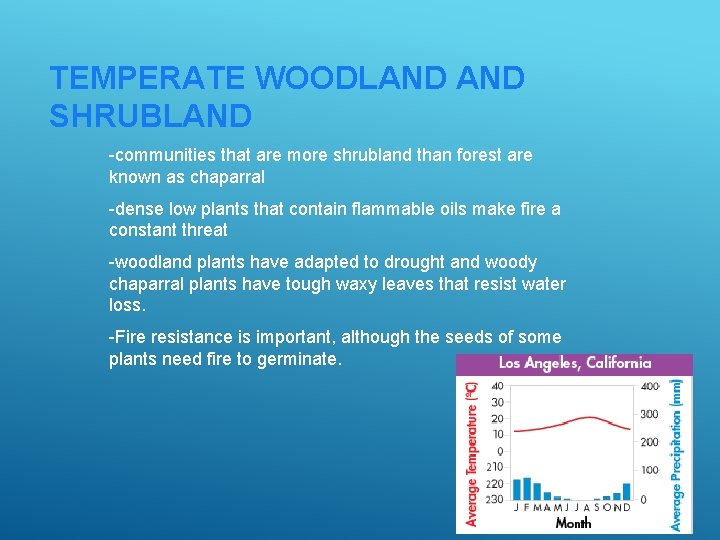
TEMPERATE WOODLAND SHRUBLAND -communities that are more shrubland than forest are known as chaparral -dense low plants that contain flammable oils make fire a constant threat -woodland plants have adapted to drought and woody chaparral plants have tough waxy leaves that resist water loss. -Fire resistance is important, although the seeds of some plants need fire to germinate.
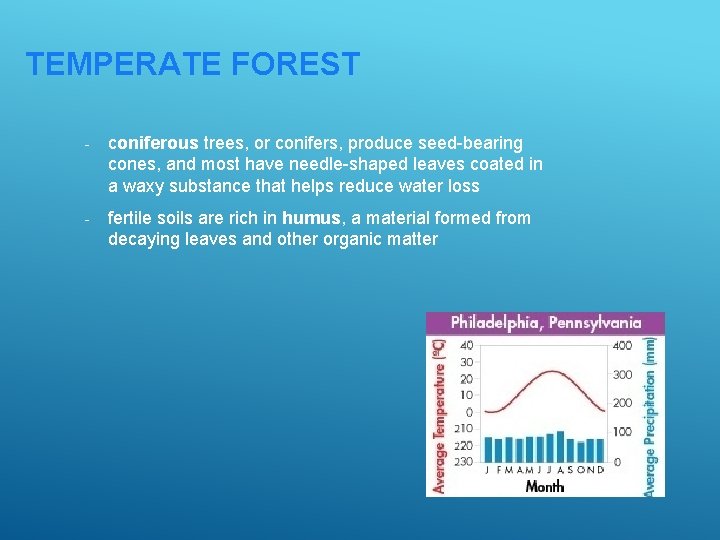
TEMPERATE FOREST - coniferous trees, or conifers, produce seed-bearing cones, and most have needle-shaped leaves coated in a waxy substance that helps reduce water loss - fertile soils are rich in humus, a material formed from decaying leaves and other organic matter
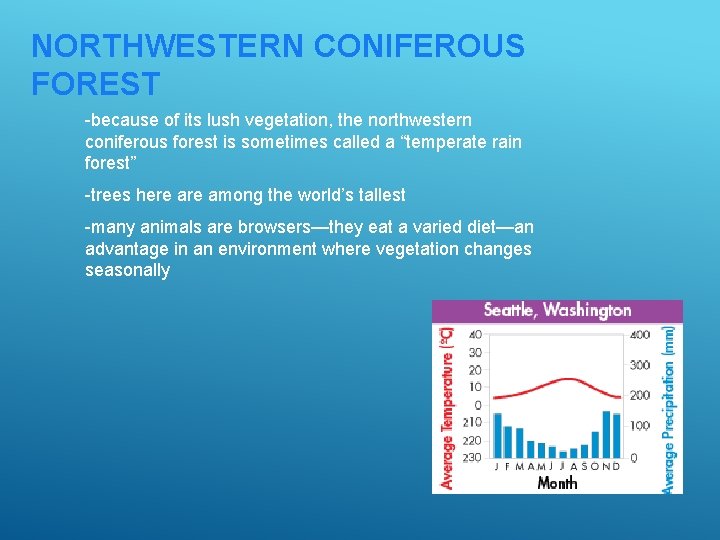
NORTHWESTERN CONIFEROUS FOREST -because of its lush vegetation, the northwestern coniferous forest is sometimes called a “temperate rain forest” -trees here among the world’s tallest -many animals are browsers—they eat a varied diet—an advantage in an environment where vegetation changes seasonally
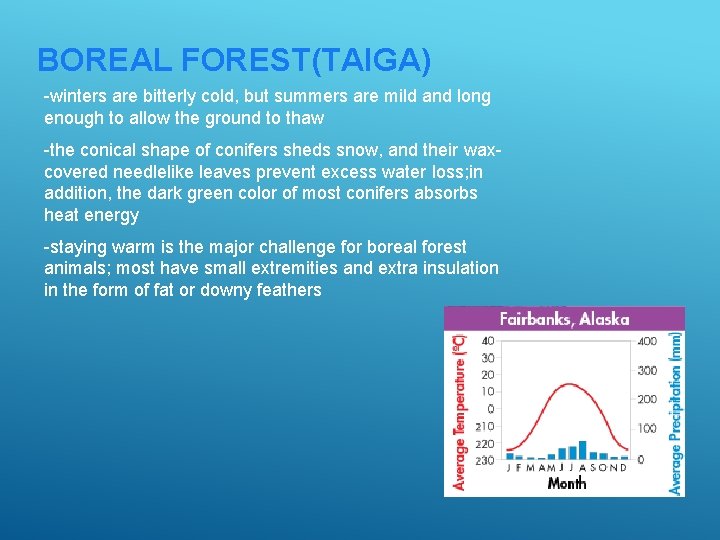
BOREAL FOREST(TAIGA) -winters are bitterly cold, but summers are mild and long enough to allow the ground to thaw -the conical shape of conifers sheds snow, and their waxcovered needlelike leaves prevent excess water loss; in addition, the dark green color of most conifers absorbs heat energy -staying warm is the major challenge for boreal forest animals; most have small extremities and extra insulation in the form of fat or downy feathers
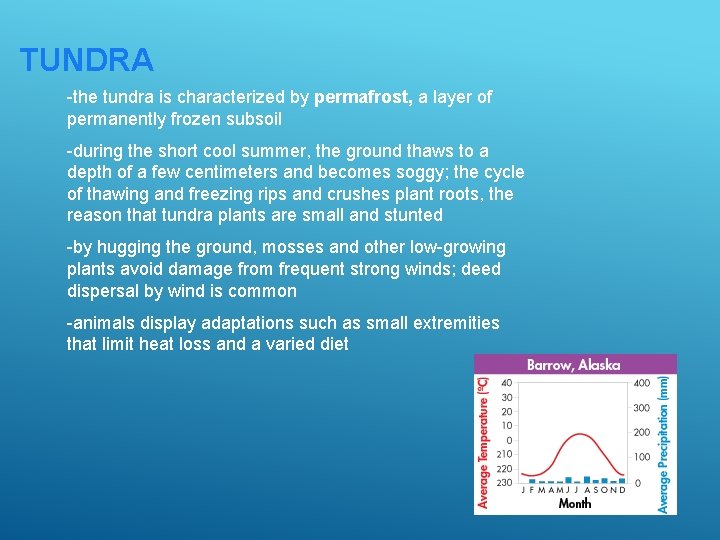
TUNDRA -the tundra is characterized by permafrost, a layer of permanently frozen subsoil -during the short cool summer, the ground thaws to a depth of a few centimeters and becomes soggy; the cycle of thawing and freezing rips and crushes plant roots, the reason that tundra plants are small and stunted -by hugging the ground, mosses and other low-growing plants avoid damage from frequent strong winds; deed dispersal by wind is common -animals display adaptations such as small extremities that limit heat loss and a varied diet
OTHER LAND AREAS Because they are not easily defined in terms of a typical community of plants and animals, mountain ranges and polar ice caps are not usually classified into biomes.
MOUNTAIN RANGES If you climb the Rocky Mountains in Colorado, for example, you begin in a grassland. You then pass through pine woodland then a forest of spruce and other conifers; finally, higher up, tundra like surroundings Glaciers are found at the peaks of many ranges.
POLAR ICE CAPS Polar regions border the tundra and are cold year-round. Plants are few, though some algae grow on snow and ice. Where rocks and ground are exposed seasonally, mosses and lichens may grow. Marine mammals, insects, and mites are the typical animals. In the north, where polar bears live, the Arctic Ocean is covered with sea ice, although more and more ice is melting each summer. In the south, the continent of Antarctica is covered by ice nearly 5 kilometers thick in places.
Aquatic Ecosystems
CONDITIONS UNDERWATER Aquatic organisms are affected primarily by the water’s depth, temperature, flow, and amount of dissolved nutrients.
WATER DEPTH Water depth strongly influences aquatic life because sunlight penetrates only a relatively short distance through water. The sunlit region near the surface in which photosynthesis can occur is known as the photic zone. Photosynthetic algae, called phytoplankton, live in the photic zone. Zooplankton—tiny free-floating animals—eat phytoplankton. This is the first step in many aquatic food webs. Below the photic zone is the dark aphotic zone, where photosynthesis cannot occur.
WATER DEPTH Many aquatic organisms live on, or in, rocks and sediments on the bottoms of lakes, streams, and oceans. These organisms are called the benthos, and their habitat is the benthic zone. When the water is shallow enough for the benthic zone to be within the photic zone, algae and rooted aquatic plants can grow. When the benthic zone is below the photic zone, chemosynthetic autotrophs are the only primary producers.
TEMPERATURE AND CURRENTS Aquatic habitats are warmer near the equator and colder near the poles. Temperature in aquatic habitats also often varies with depth. The deepest parts of lakes and oceans are often colder than surface waters. Currents in lakes and oceans can dramatically affect water temperature because they can carry water that is significantly warmer or cooler than would be typical for any given latitude, depth, or distance from shore.
NUTRIENT AVAILABILITY Organisms need certain substances to live, such as oxygen, nitrogen, potassium, and phosphorus. The type and availability of these dissolved substances vary within and between bodies of water, greatly affecting the types of organisms that can survive there.
FRESHWATER ECOSYSTEMS Freshwater ecosystems can be divided into three main categories: rivers and streams, lakes and ponds, and freshwater wetlands.
FRESHWATER ECOSYSTEMS Freshwater ecosystems include streams, lakes, and freshwater wetlands (bogs, swamps, and marshes).
RIVERS AND STREAMS Rivers, streams, creeks, and brooks often originate from underground water sources in mountains or hills. Near a source, water has plenty of dissolved oxygen but little plant life. Downstream, sediments build up and plants establish themselves. Farther downstream, water may meander slowly through flat areas. Animals in many rivers and streams depend on terrestrial plants and animals that live along their banks for food.
LAKES AND PONDS The food webs in lakes and ponds often are based on a combination of plankton and attached algae and plants. Plankton is a general term that includes both phytoplankton and zooplankton. Water flows in and out of lakes and ponds and circulates between the surface and the benthos, distributing heat, oxygen, and nutrients.
FRESHWATER WETLANDS A wetland is an ecosystem in which water either covers the soil or is present at or near the surface for at least part of the year. Water may flow through freshwater wetlands or stay in place. Wetlands are often nutrient-rich, highly productive, and serve as breeding grounds for many organisms. Freshwater wetlands purify water by filtering pollutants and help to prevent flooding by absorbing large amounts of water and slowly releasing it. Three main types of freshwater wetlands are freshwater bogs, freshwater marshes, and freshwater swamps.
ESTUARIES An estuary is a special kind of wetland, formed where a river meets the sea. Estuaries contain a mixture of fresh water and salt water, and are affected by the rise and fall of ocean tides. Many are shallow, which means that enough sunlight reaches the benthos to power photosynthesis. Estuaries serve as spawning and nursery grounds for many ecologically and commercially important fish and shellfish species including bluefish, striped bass, shrimp, and crabs. Salt marshes are temperate estuaries that have salt-tolerant grasses above the low-tide line and seagrasses below water. Mangrove swamps are tropical estuaries that have several species of salt-tolerant trees, collectively called mangroves.
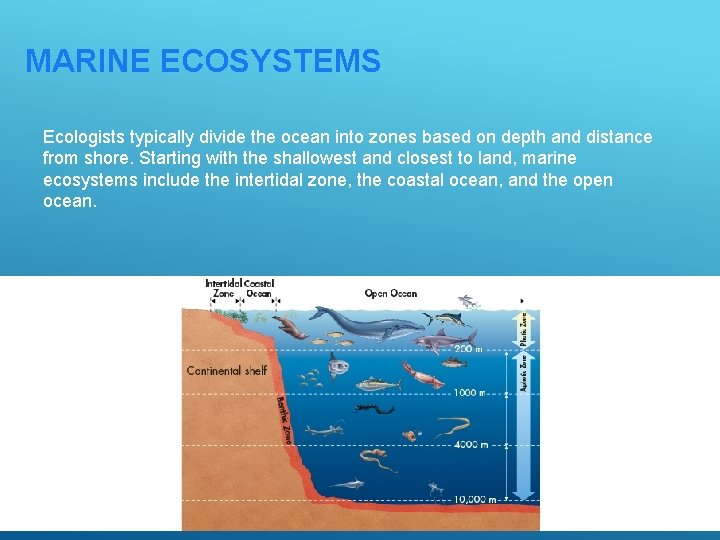
MARINE ECOSYSTEMS Ecologists typically divide the ocean into zones based on depth and distance from shore. Starting with the shallowest and closest to land, marine ecosystems include the intertidal zone, the coastal ocean, and the open ocean.
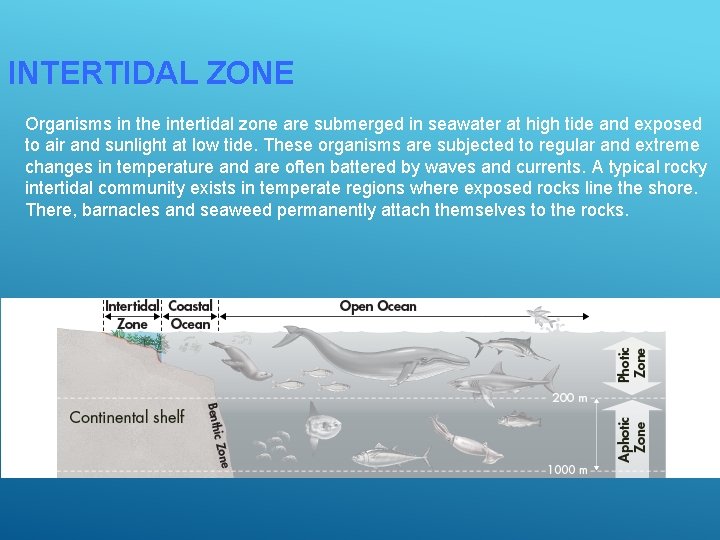
INTERTIDAL ZONE Organisms in the intertidal zone are submerged in seawater at high tide and exposed to air and sunlight at low tide. These organisms are subjected to regular and extreme changes in temperature and are often battered by waves and currents. A typical rocky intertidal community exists in temperate regions where exposed rocks line the shore. There, barnacles and seaweed permanently attach themselves to the rocks.
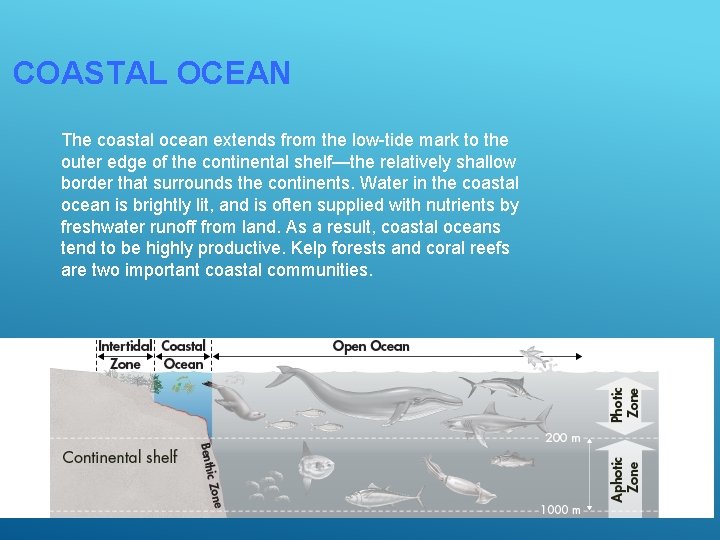
COASTAL OCEAN The coastal ocean extends from the low-tide mark to the outer edge of the continental shelf—the relatively shallow border that surrounds the continents. Water in the coastal ocean is brightly lit, and is often supplied with nutrients by freshwater runoff from land. As a result, coastal oceans tend to be highly productive. Kelp forests and coral reefs are two important coastal communities.
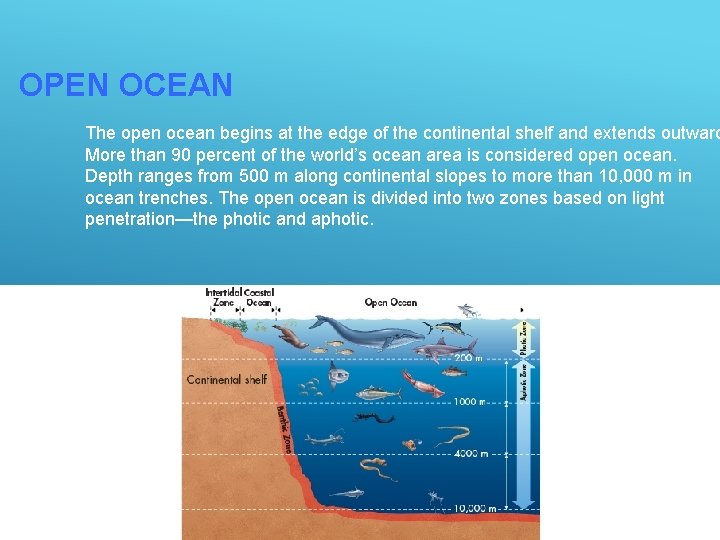
OPEN OCEAN The open ocean begins at the edge of the continental shelf and extends outward More than 90 percent of the world’s ocean area is considered open ocean. Depth ranges from 500 m along continental slopes to more than 10, 000 m in ocean trenches. The open ocean is divided into two zones based on light penetration—the photic and aphotic.
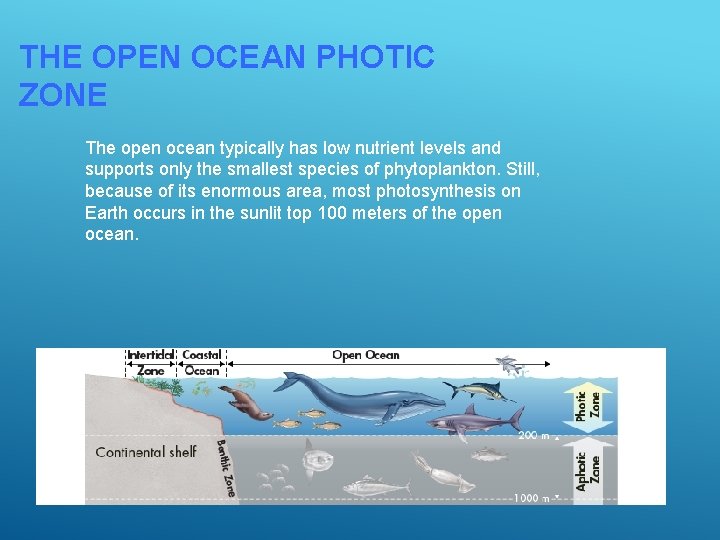
THE OPEN OCEAN PHOTIC ZONE The open ocean typically has low nutrient levels and supports only the smallest species of phytoplankton. Still, because of its enormous area, most photosynthesis on Earth occurs in the sunlit top 100 meters of the open ocean.
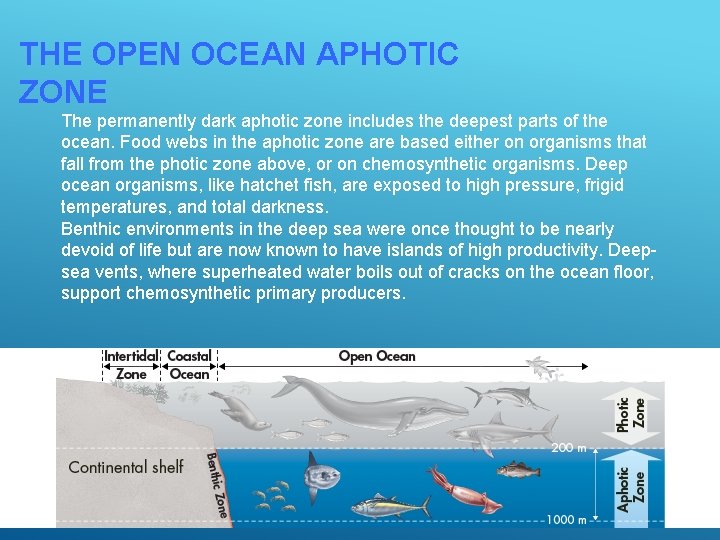
THE OPEN OCEAN APHOTIC ZONE The permanently dark aphotic zone includes the deepest parts of the ocean. Food webs in the aphotic zone are based either on organisms that fall from the photic zone above, or on chemosynthetic organisms. Deep ocean organisms, like hatchet fish, are exposed to high pressure, frigid temperatures, and total darkness. Benthic environments in the deep sea were once thought to be nearly devoid of life but are now known to have islands of high productivity. Deepsea vents, where superheated water boils out of cracks on the ocean floor, support chemosynthetic primary producers.
- Slides: 54