
ECOSYSTEM RECYCLING Ecosystem Recycling Matter must be recycled
ECOSYSTEM RECYCLING
Ecosystem Recycling Matter must be recycled and reused Substances pass between living and nonliving worlds Water, carbon, nitrogen, calcium, phosphorus ○ Biogeochemical cycles 2
Water Cycle Water is crucial to life Cells contain 70 -90 percent water Dissolves a variety of compounds Filters out UV light from the sun Expands as it freezes Liquid over a wide temperature range Changes temperature slowly Requires large amounts of energy to evaporate 3
Water Cycle Where water is found Water vapor (atmosphere) Groundwater (in soil or underground formations of porous rock) Trapped within living things Bodies of water ○ Lakes, rivers, streams, oceans (substantial %) 4
Water Cycle Movement of water (water cycle) Evaporation ○ Adds water as vapor to the atmosphere Transpiration ○ Plants release water through leaves ○ Animals release water when they breathe, sweat, or excrete Precipitation ○ Water leaving the atmosphere ○ Amount depends on abiotic factors (temperature & air pressure) 5
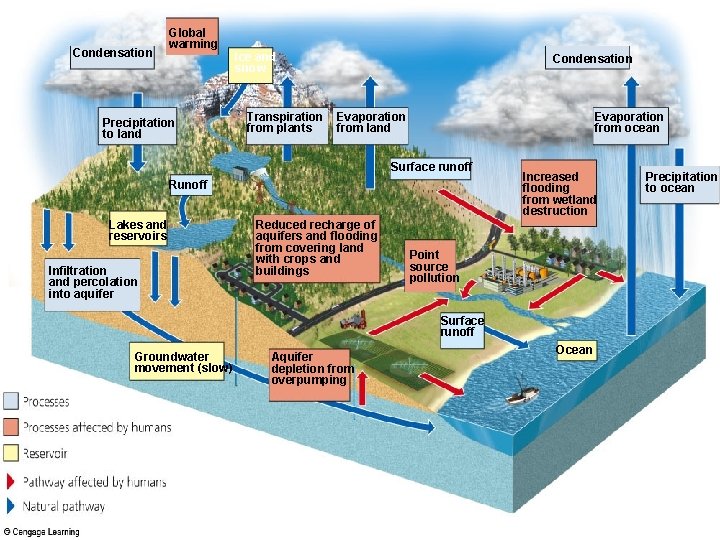
Condensation Global warming Precipitation to land Ice and snow Transpiration from plants Condensation Evaporation from land Evaporation from ocean Surface runoff Runoff Lakes and reservoirs Infiltration and percolation into aquifer Reduced recharge of aquifers and flooding from covering land with crops and buildings Increased flooding from wetland destruction Precipitation to ocean Point source pollution Surface runoff Groundwater movement (slow) Aquifer depletion from overpumping Ocean Fig. 3 -18, p. 654
Carbon Cycle Carbon dioxide Greenhouse gas; traps heat in the atmosphere. ○ Without it the Earth would be a frozen world. There is ~30% more carbon dioxide in the air today than there was 150 years ago ○ Humans burning more fuel Greenhouse gases are causing our planet to become warmer. 7
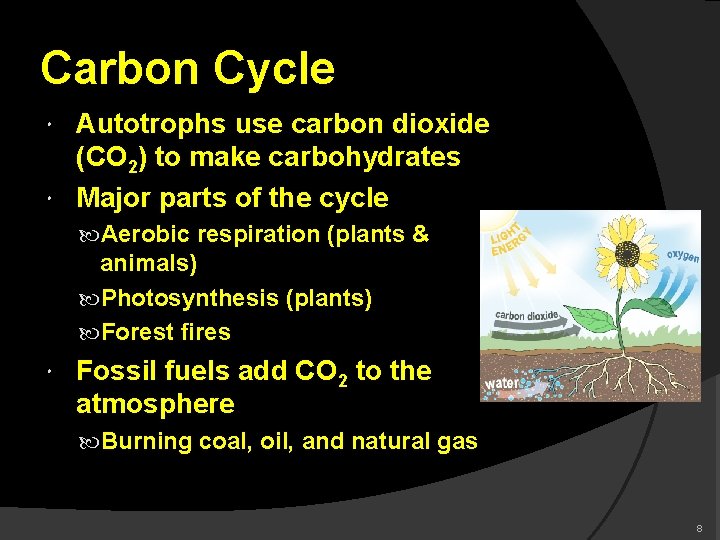
Carbon Cycle Autotrophs use carbon dioxide (CO 2) to make carbohydrates Major parts of the cycle Aerobic respiration (plants & animals) Photosynthesis (plants) Forest fires Fossil fuels add CO 2 to the atmosphere Burning coal, oil, and natural gas 8
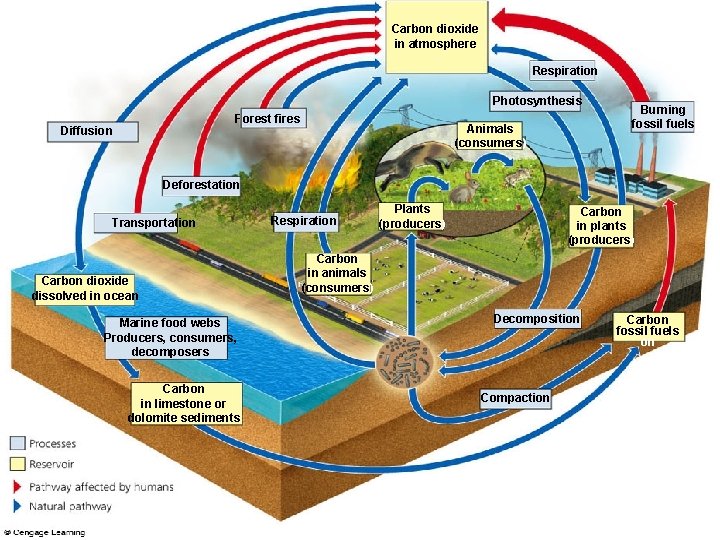
Carbon dioxide in atmosphere Respiration Photosynthesis Forest fires Diffusion Animals (consumers) Burning fossil fuels Deforestation Transportation Carbon dioxide dissolved in ocean Marine food webs Producers, consumers, decomposers Carbon in limestone or dolomite sediments Respiration Plants (producers) Carbon in plants (producers) Carbon in animals (consumers) Decomposition Carbon fossil fuels on Compaction 9
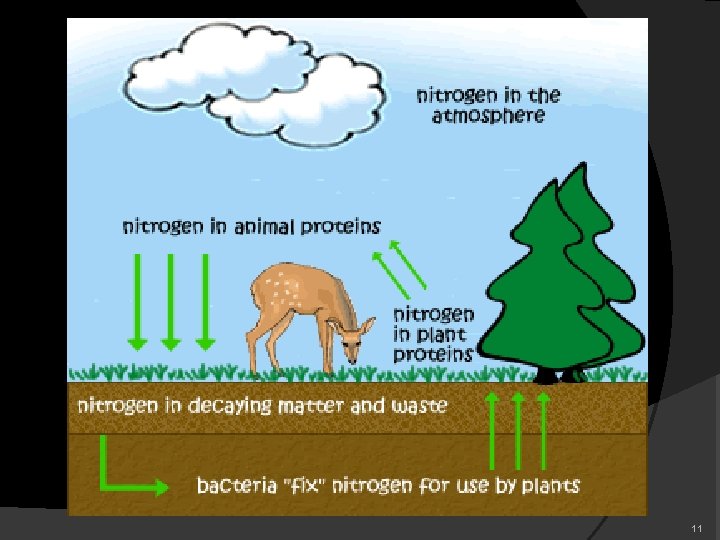
Nitrogen Cycle Nitrogen is needed to make proteins and nucleic acids (DNA) Nitrogen gas makes up ~78% Multicellular plants and animals cannot utilize atmospheric nitrogen ○ Needs to go through nitrogen fixation Nitrogen fixation Converting nitrogen gas to nitrate Nitrogen-fixing bacteria ○ Transforms nitrogen gas into usable form 10
11
Nitrogen Cycle Ammonification Decomposers breaking down dead organisms, urine and dung to release the nitrogen in the form of ammonium (NH 3) Nitrification Soil bacteria take the ammonium & oxidize (add oxygen) it into nitrites Plants use nitrites to form amino acids 12
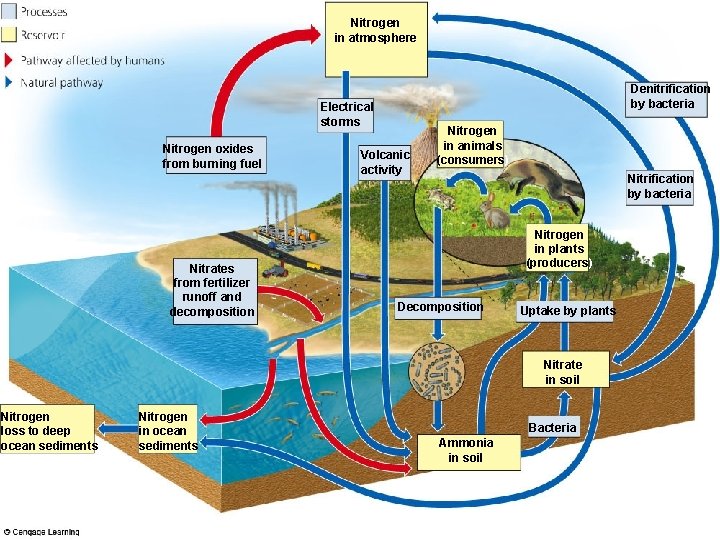
Nitrogen in atmosphere Denitrification by bacteria Electrical storms Nitrogen oxides from burning fuel Nitrates from fertilizer runoff and decomposition Volcanic activity Nitrogen in animals (consumers) Nitrification by bacteria Nitrogen in plants (producers) Decomposition Uptake by plants Nitrate in soil Nitrogen loss to deep ocean sediments Nitrogen in ocean sediments Bacteria Ammonia in soil Fig. 3 -20, p. 1357
Phosphorus Cycle Does not cycle through the atmosphere Obtained from terrestrial rock formations Limiting factor on land in freshwater ecosystems Biologically important for producers and consumers Phosphorus Cycle Movement of phosphorus from the environment to organisms and back to the environment 14
Phosphorus Cycle Phosphorus is essential Needed in animals to form bones, teeth, molecules such as DNA & RNA Plants get phosphorous from soil & water Animals get phosphorous from eating plants or animals 15
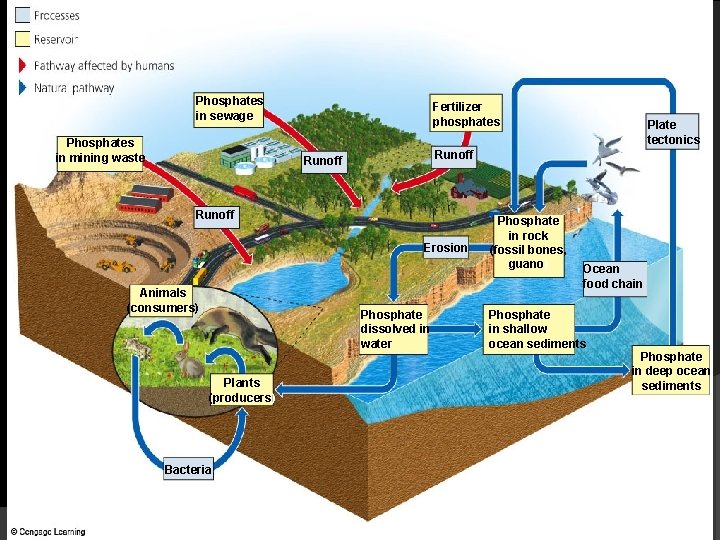
Phosphates in sewage Phosphates in mining waste Fertilizer phosphates Plate tectonics Runoff Sea birds Runoff Erosion Animals (consumers) Phosphate dissolved in water Plants (producers) Phosphate in rock (fossil bones, guano) Ocean food chain Phosphate in shallow ocean sediments Phosphate in deep ocean sediments Bacteria Fig. 3 -21, p. 1658

http: //www. drippytheraindrop. com/Dripp ys. World. Trial. Stories/To. Mountains. And. Ba ck/Entry. htm 17
- Slides: 17