
Ecosystem Modeling Tutorial An Overview of the NOAA


- Slides: 47
Ecosystem Modeling Tutorial An Overview of the NOAA Fisheries Ecosystem Modeling Effort Howard Townsend, Ph. D. Ecosystem Modeling Coordinator Howard. Townsend@noaa. gov NOAA General Modeling Meeting and Fair September 11, 2018
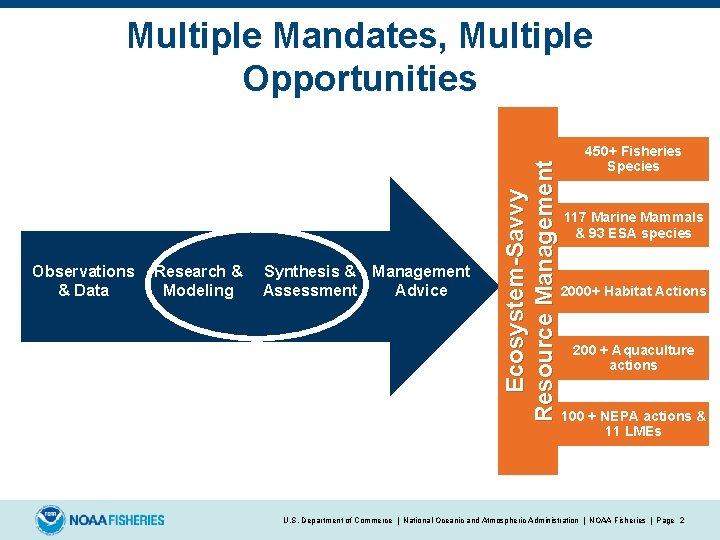
Observations & Data Research & Modeling Synthesis & Management Assessment Advice Ecosystem-Savvy Resource Management Multiple Mandates, Multiple Opportunities 450+ Fisheries Species 117 Marine Mammals & 93 ESA species 2000+ Habitat Actions 200 + Aquaculture actions 100 + NEPA actions & 11 LMEs U. S. Department of Commerce | National Oceanic and Atmospheric Administration | NOAA Fisheries | Page 2
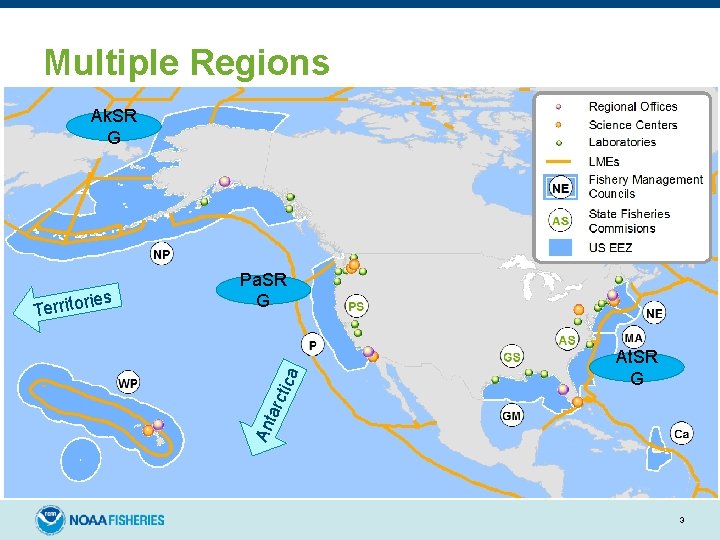
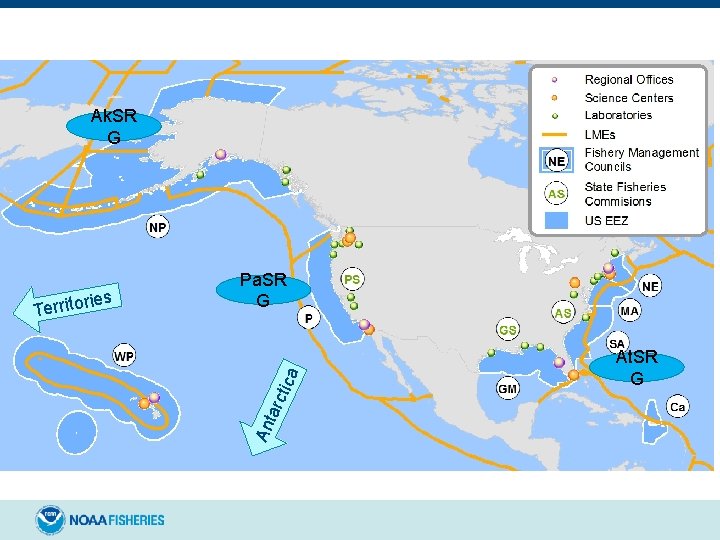
Multiple Regions Ak. SR G tica tarc At. SR G An ries Territo Pa. SR G 3
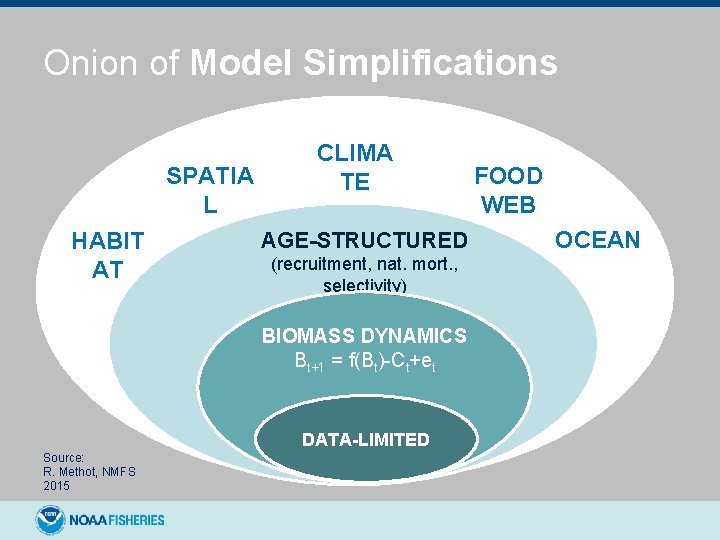
Onion of Model Simplifications SPATIA L HABIT AT CLIMA TE AGE-STRUCTURED (recruitment, nat. mort. , selectivity) BIOMASS DYNAMICS Bt+1 = f(Bt)-Ct+et DATA-LIMITED Source: R. Methot, NMFS 2015 FOOD WEB OCEAN
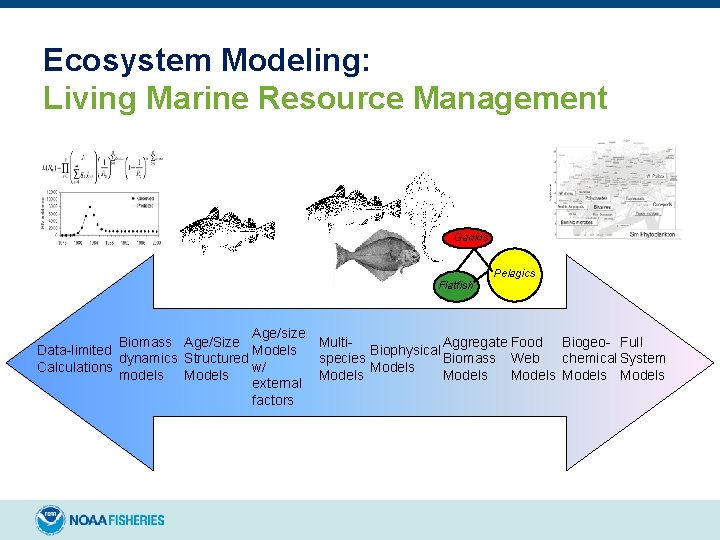
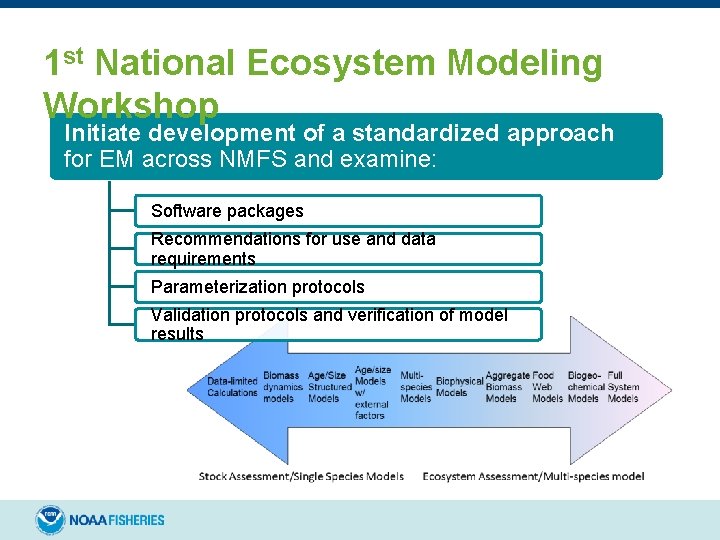
Ecosystem Modeling: Living Marine Resource Management Gadids Flatfish Pelagics Age/size Biomass Age/Size Multi. Aggregate Food Biogeo- Full Models Data-limited Biophysical dynamics Structured species Biomass Web chemical System w/ Calculations Models models Models Models external factors
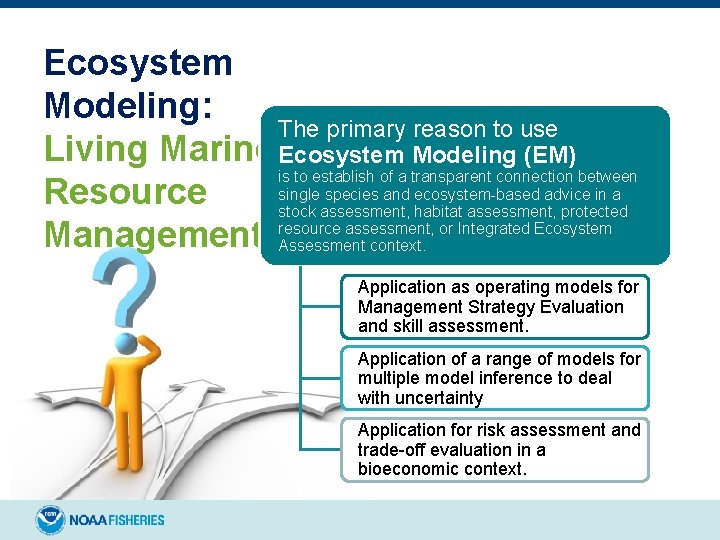
Ecosystem Modeling: The primary reason to use Living Marine Ecosystem Modeling (EM) is to establish of a transparent connection between single species and ecosystem-based advice in a Resource stock assessment, habitat assessment, protected Management resource assessment, or Integrated Ecosystem Assessment context. Application as operating models for Management Strategy Evaluation and skill assessment. Application of a range of models for multiple model inference to deal with uncertainty Application for risk assessment and trade-off evaluation in a bioeconomic context.
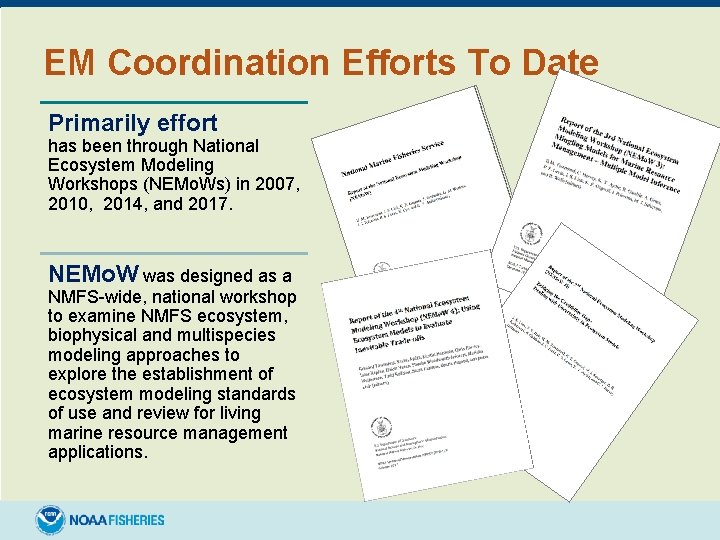
EM Coordination Efforts To Date Primarily effort has been through National Ecosystem Modeling Workshops (NEMo. Ws) in 2007, 2010, 2014, and 2017. NEMo. W was designed as a NMFS-wide, national workshop to examine NMFS ecosystem, biophysical and multispecies modeling approaches to explore the establishment of ecosystem modeling standards of use and review for living marine resource management applications.
1 st National Ecosystem Modeling Workshop Initiate development of a standardized approach for EM across NMFS and examine: Software packages Recommendations for use and data requirements Parameterization protocols Validation protocols and verification of model results
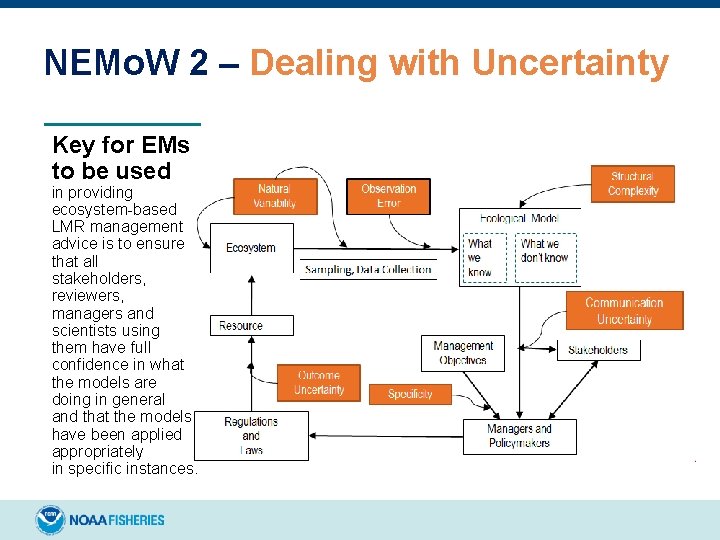
NEMo. W 2 – Dealing with Uncertainty Key for EMs to be used in providing ecosystem-based LMR management advice is to ensure that all stakeholders, reviewers, managers and scientists using them have full confidence in what the models are doing in general and that the models have been applied appropriately in specific instances.
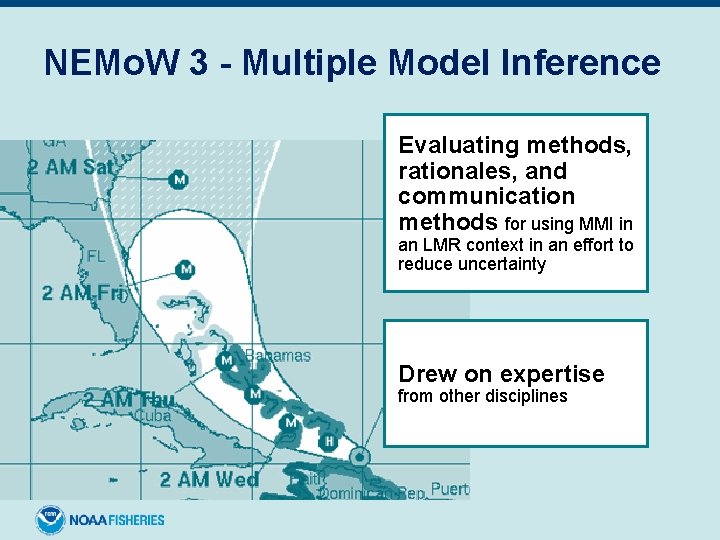
NEMo. W 3 - Multiple Model Inference Evaluating methods, rationales, and communication methods for using MMI in an LMR context in an effort to reduce uncertainty Drew on expertise from other disciplines
National Ecosystem Modeling Workshop 4 Evaluate best practices for using ecosystem models to address trade-offs inherent in ecosystem-based management of living marine resources Outline and review trade-offs being addressed Review common novel tools for modeling and communicating trade-offs Understand management implications for tradeoffs Summarize best practices for addressing tradeoffs using EM
Major Recommendations from NEMo. Ws. Formally support/expand dedicated EM efforts at Centers Adopt a National Standards of EM use Establish regular NEMo. Ws Identify and note sources of EM uncertainty as a must for EM use and review Adopt Multiple Model Inference (MMI) best practices Perform simulation studies to evaluate the skill of models to be used for MMI Engage with stakeholders early and often
Major Outcomes from NEMo. Ws Networking and swapping Vehicle to advance During NEMo. W At least 3 centers have had formal review of best practices, tools, approaches 1, 2 out of 7 Centers (and Habitat Conservation Office) had dedicated EM efforts/groups, there are now 4. 5(+) out of 7 such groups ecosystem modeling and ecosystem-oriented efforts of ecosystem models so that Councils can use the EMs
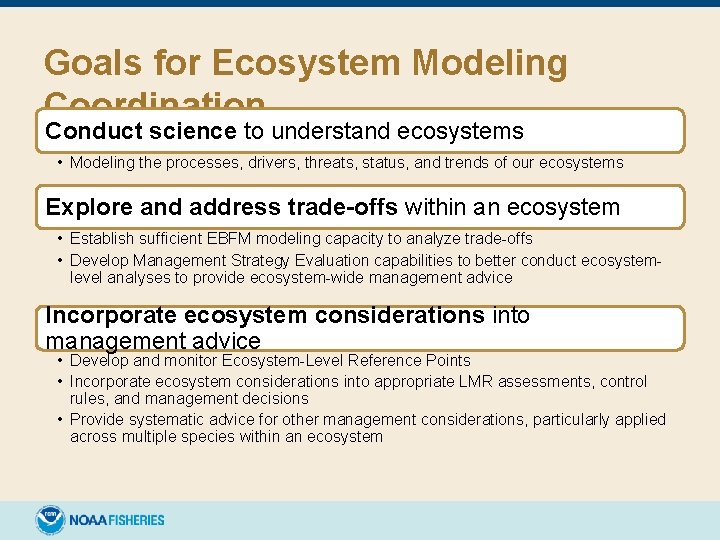
Goals for Ecosystem Modeling Coordination Conduct science to understand ecosystems • Modeling the processes, drivers, threats, status, and trends of our ecosystems Explore and address trade-offs within an ecosystem • Establish sufficient EBFM modeling capacity to analyze trade-offs • Develop Management Strategy Evaluation capabilities to better conduct ecosystemlevel analyses to provide ecosystem-wide management advice Incorporate ecosystem considerations into management advice • Develop and monitor Ecosystem-Level Reference Points • Incorporate ecosystem considerations into appropriate LMR assessments, control rules, and management decisions • Provide systematic advice for other management considerations, particularly applied across multiple species within an ecosystem
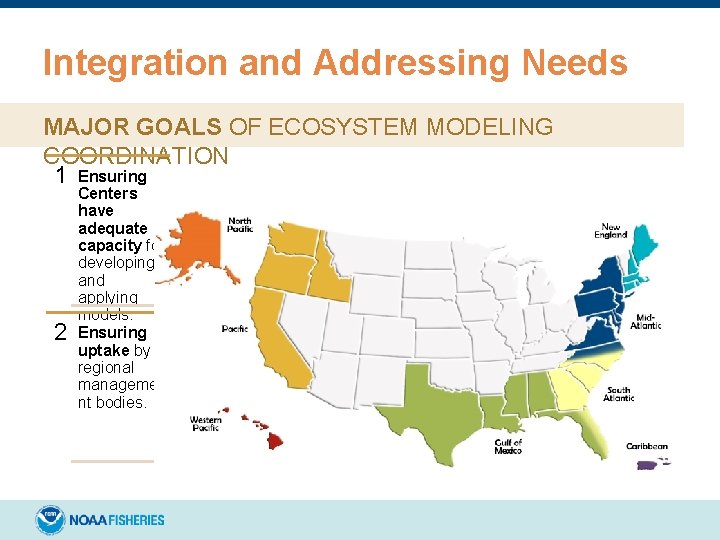
Integration and Addressing Needs MAJOR GOALS OF ECOSYSTEM MODELING COORDINATION 1 Ensuring 2 Centers have adequate capacity for developing and applying models. Ensuring uptake by regional manageme nt bodies.
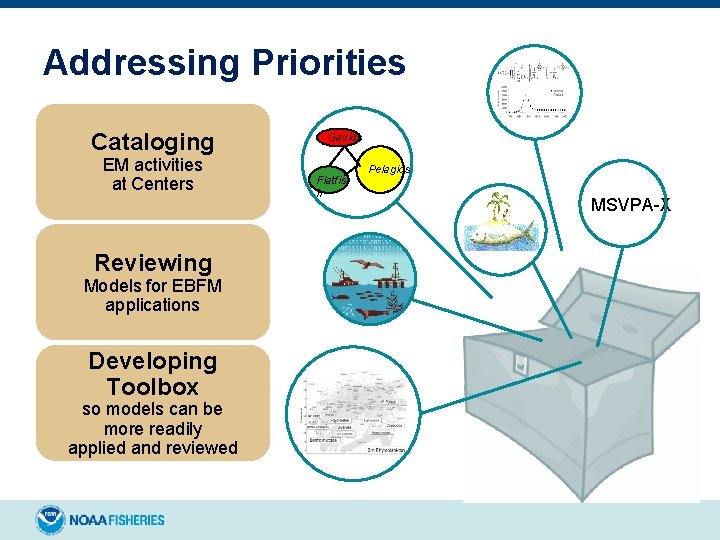
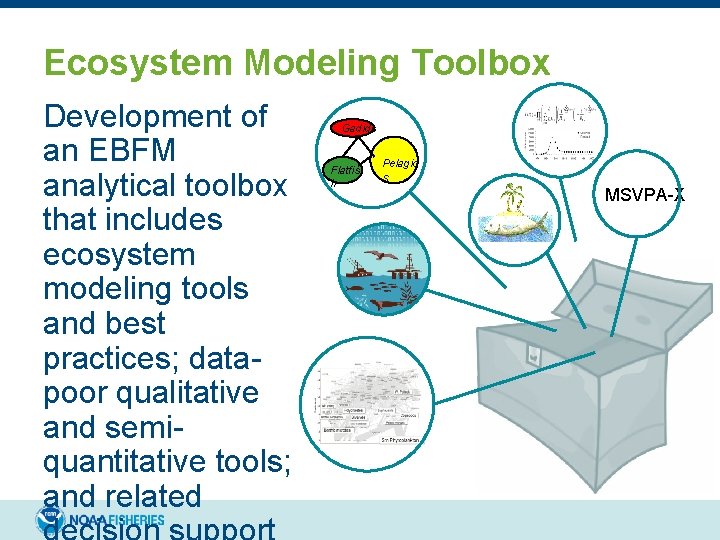
Addressing Priorities Cataloging EM activities at Centers Reviewing Models for EBFM applications Developing Toolbox so models can be more readily applied and reviewed Gadids Flatfis h Pelagics MSVPA-X
Ak. SR G tica tarc An ries Territo Pa. SR G At. SR G
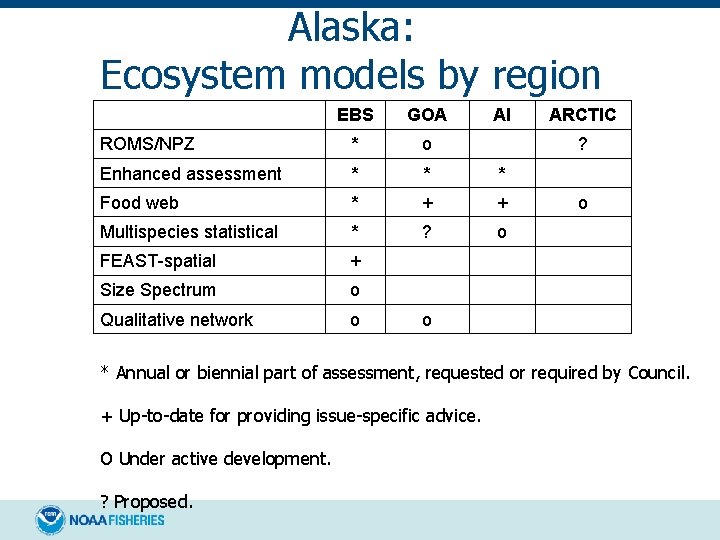
Alaska: Ecosystem models by region EBS GOA AI ROMS/NPZ * o Enhanced assessment * * * Food web * + + Multispecies statistical * ? o FEAST-spatial + Size Spectrum o Qualitative network o ARCTIC ? o o * Annual or biennial part of assessment, requested or required by Council. + Up-to-date for providing issue-specific advice. O Under active development. ? Proposed.
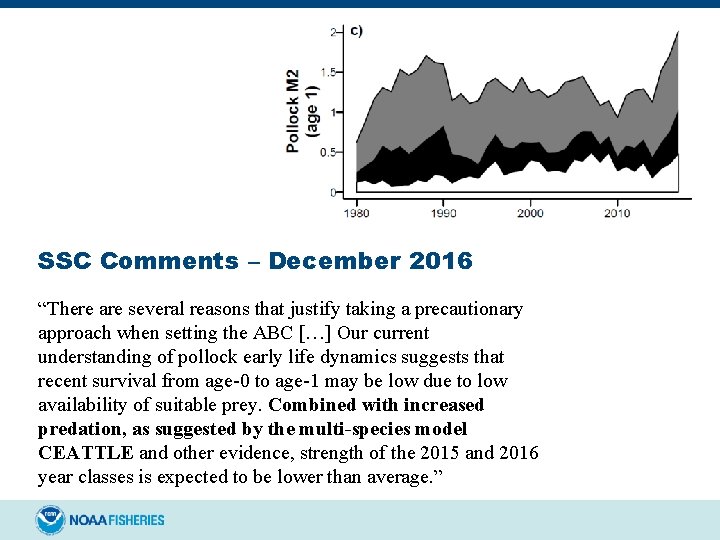
SSC Comments – December 2016 “There are several reasons that justify taking a precautionary approach when setting the ABC […] Our current understanding of pollock early life dynamics suggests that recent survival from age-0 to age-1 may be low due to low availability of suitable prey. Combined with increased predation, as suggested by the multi-species model CEATTLE and other evidence, strength of the 2015 and 2016 year classes is expected to be lower than average. ”
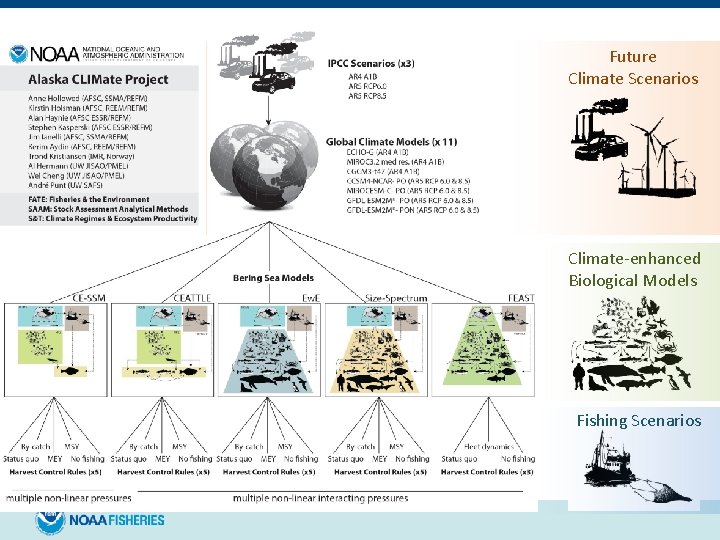
Future Climate Scenarios Climate-enhanced Biological Models Fishing Scenarios
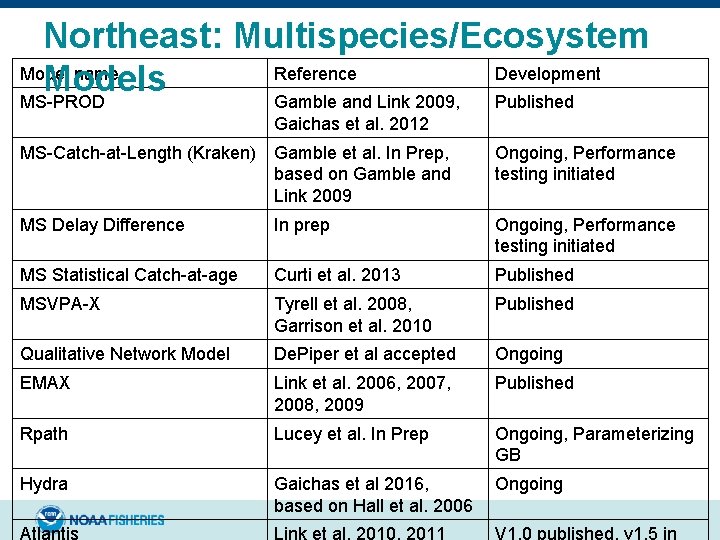
Northeast: Multispecies/Ecosystem Model name Reference Development Models MS-PROD Gamble and Link 2009, Published Gaichas et al. 2012 MS-Catch-at-Length (Kraken) Gamble et al. In Prep, based on Gamble and Link 2009 Ongoing, Performance testing initiated MS Delay Difference In prep Ongoing, Performance testing initiated MS Statistical Catch-at-age Curti et al. 2013 Published MSVPA-X Tyrell et al. 2008, Garrison et al. 2010 Published Qualitative Network Model De. Piper et al accepted Ongoing EMAX Link et al. 2006, 2007, 2008, 2009 Published Rpath Lucey et al. In Prep Ongoing, Parameterizing GB Hydra Gaichas et al 2016, based on Hall et al. 2006 Ongoing
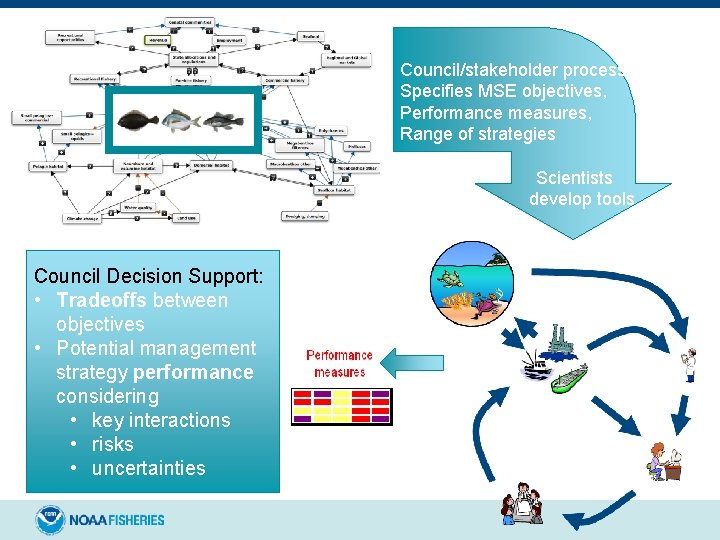
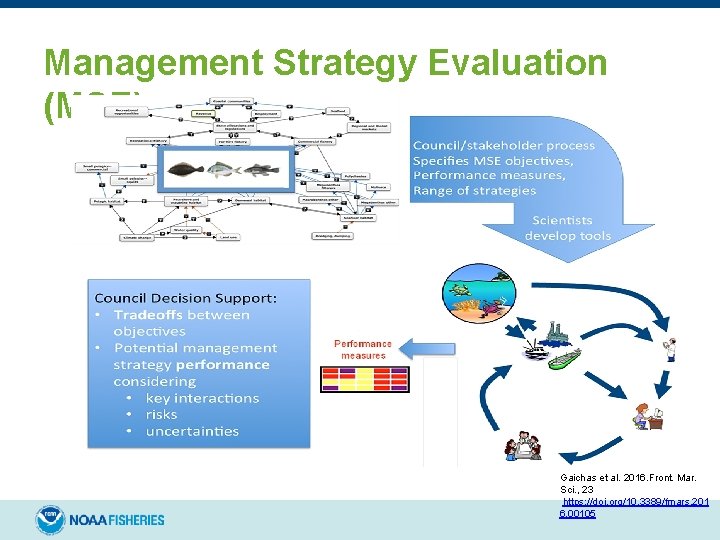
Council/stakeholder process Specifies MSE objectives, Performance measures, Range of strategies Scientists develop tools Council Decision Support: • Tradeoffs between objectives • Potential management strategy performance considering • key interactions • risks • uncertainties
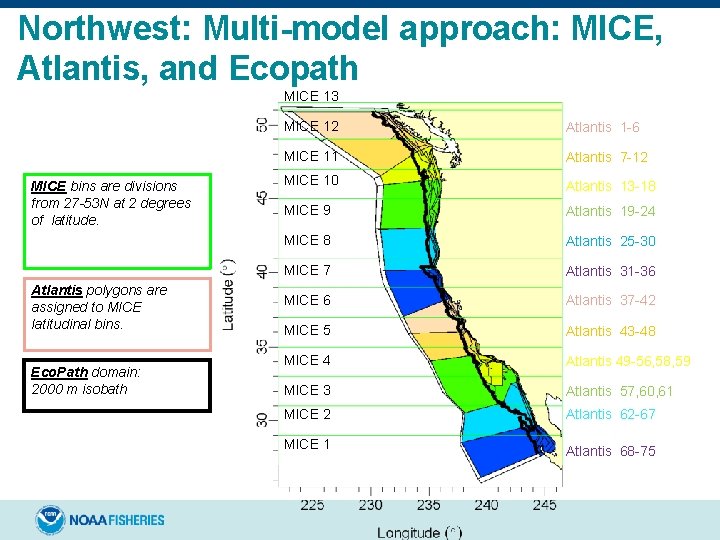
Northwest: A Multi-model approach: MICE, Multi-Model approach Atlantis, and Ecopath MICE 13 MICE bins are divisions from 27 -53 N at 2 degrees of latitude. Atlantis polygons are assigned to MICE latitudinal bins. Eco. Path domain: 2000 m isobath MICE 12 Atlantis 1 -6 MICE 11 Atlantis 7 -12 MICE 10 Atlantis 13 -18 MICE 9 Atlantis 19 -24 MICE 8 Atlantis 25 -30 MICE 7 Atlantis 31 -36 MICE 6 Atlantis 37 -42 MICE 5 Atlantis 43 -48 MICE 4 Atlantis 49 -56, 58, 59 MICE 3 Atlantis 57, 60, 61 MICE 2 Atlantis 62 -67 MICE 1 Atlantis 68 -75
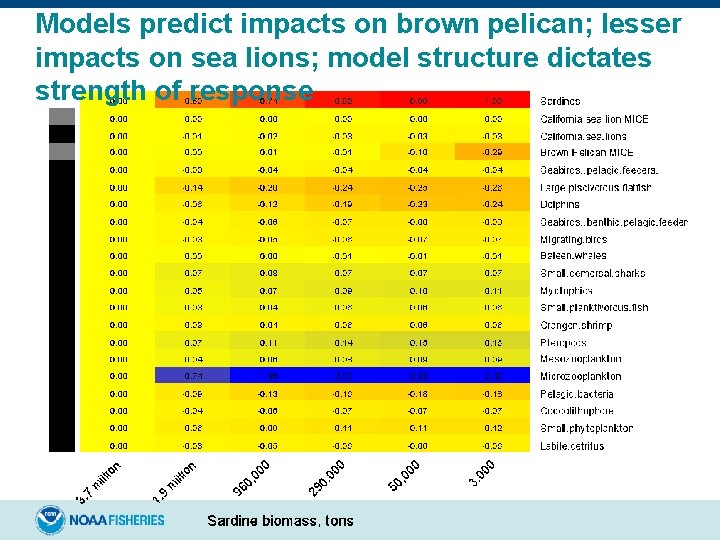
Models predict impacts on brown pelican; lesser A impacts on sea lions; model structure dictates strength of response
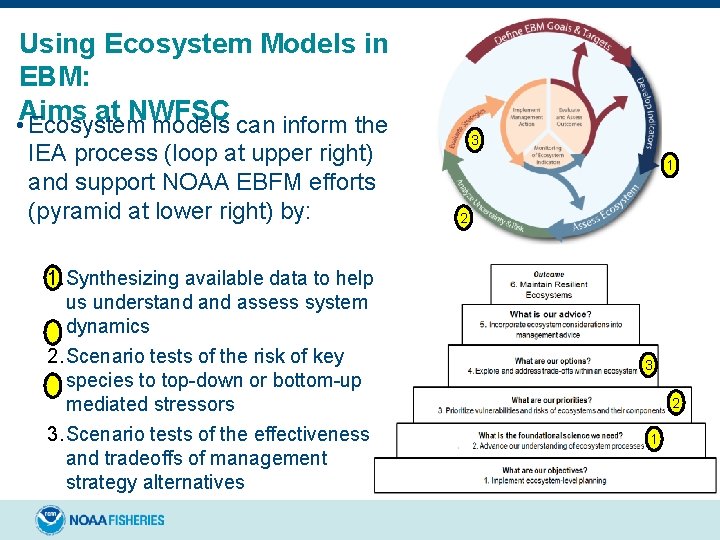
Using Ecosystem Models in EBM: Aims at NWFSC • Ecosystem models can inform the IEA process (loop at upper right) and support NOAA EBFM efforts (pyramid at lower right) by: 1. Synthesizing available data to help us understand assess system dynamics 2. Scenario tests of the risk of key species to top-down or bottom-up mediated stressors 3. Scenario tests of the effectiveness and tradeoffs of management strategy alternatives 3 1 2 3 2 1
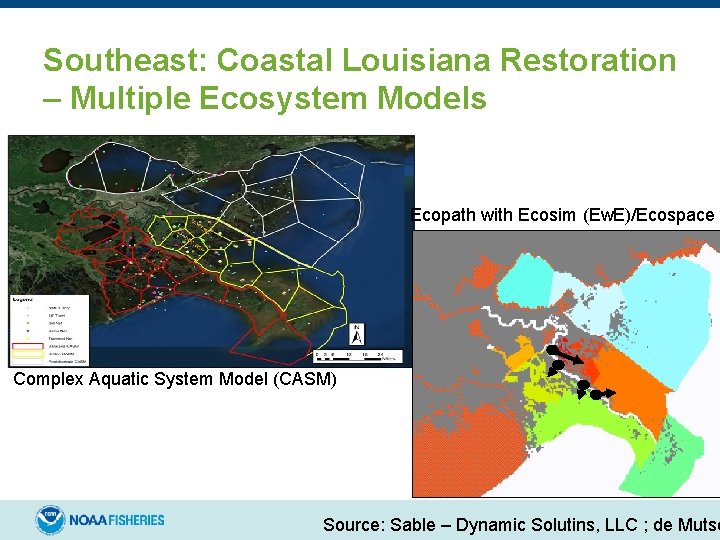
Southeast: Coastal Louisiana Restoration – Multiple Ecosystem Models Ecopath with Ecosim (Ew. E)/Ecospace Complex Aquatic System Model (CASM) Source: Sable – Dynamic Solutins, LLC ; de Mutse
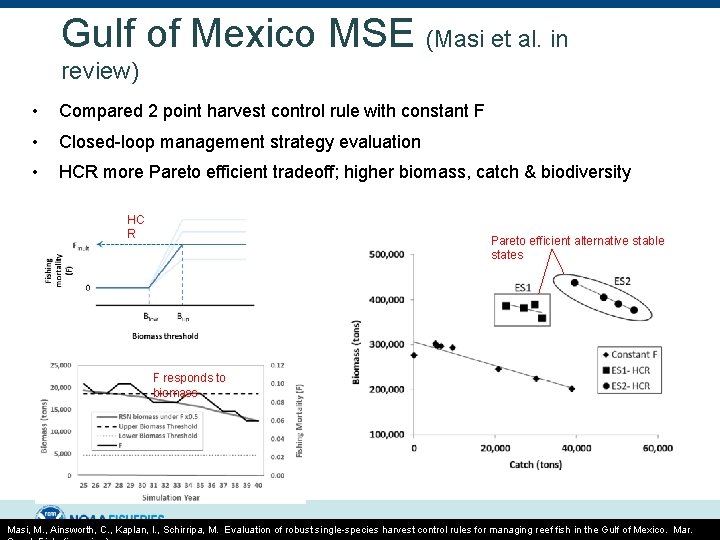
Gulf of Mexico MSE (Masi et al. in review) • Compared 2 point harvest control rule with constant F • Closed-loop management strategy evaluation • HCR more Pareto efficient tradeoff; higher biomass, catch & biodiversity HC R Pareto efficient alternative stable states F responds to biomass Masi, M. , Ainsworth, C. , Kaplan, I. , Schirripa, M. Evaluation of robust single-species harvest control rules for managing reef fish in the Gulf of Mexico. Mar.
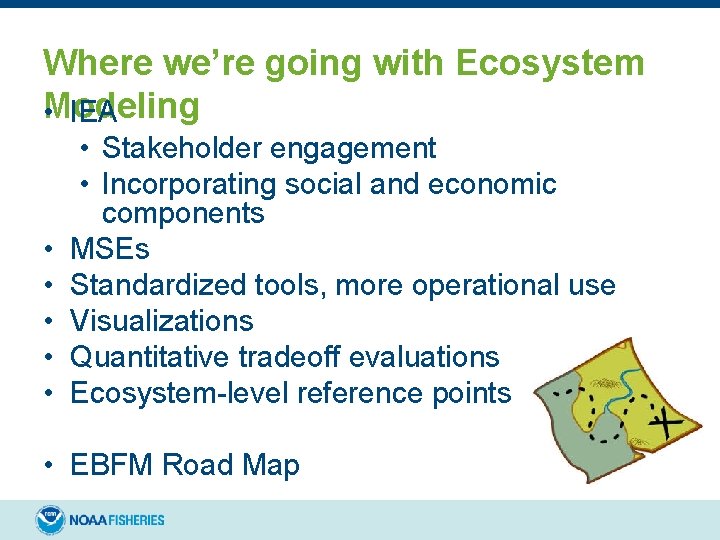
Where we’re going with Ecosystem Modeling • IEA • • • Stakeholder engagement • Incorporating social and economic components MSEs Standardized tools, more operational use Visualizations Quantitative tradeoff evaluations Ecosystem-level reference points • EBFM Road Map
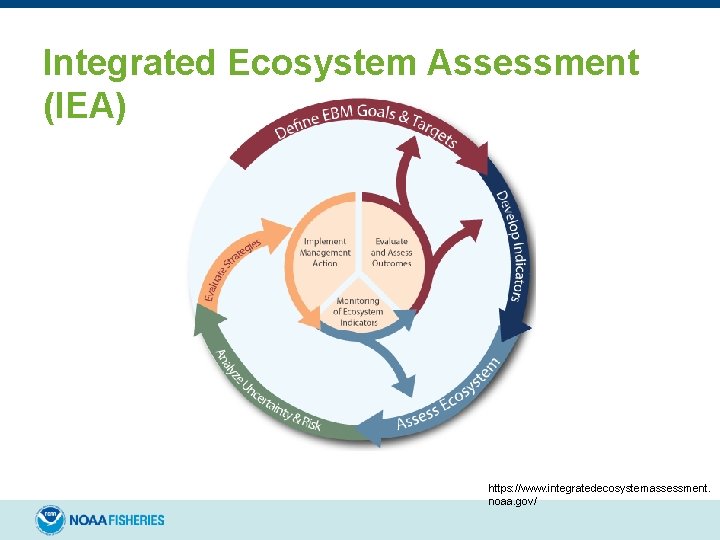
Integrated Ecosystem Assessment (IEA) https: //www. integratedecosystemassessment. noaa. gov/
Management Strategy Evaluation (MSE) Gaichas et al. 2016. Front. Mar. Sci. , 23 https: //doi. org/10. 3389/fmars. 201 6. 00105
Ecosystem Modeling Toolbox Development of an EBFM analytical toolbox that includes ecosystem modeling tools and best practices; datapoor qualitative and semiquantitative tools; and related Gadids Flatfis h Pelagic s MSVPA-X
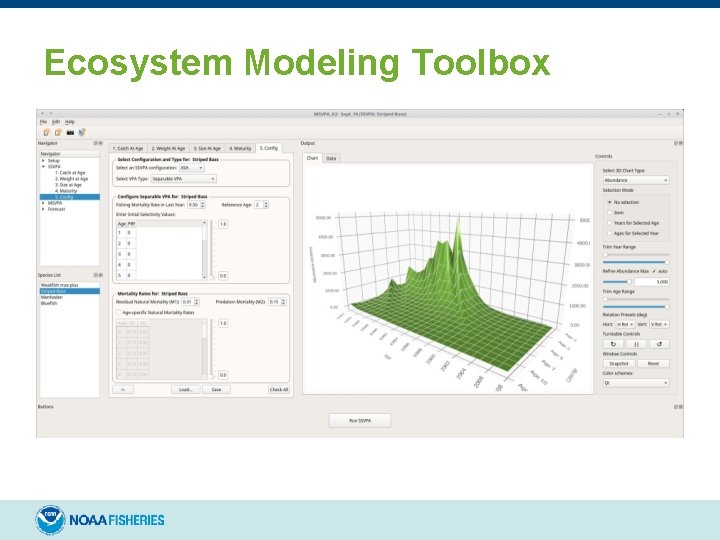
Ecosystem Modeling Toolbox
Visualization Tools
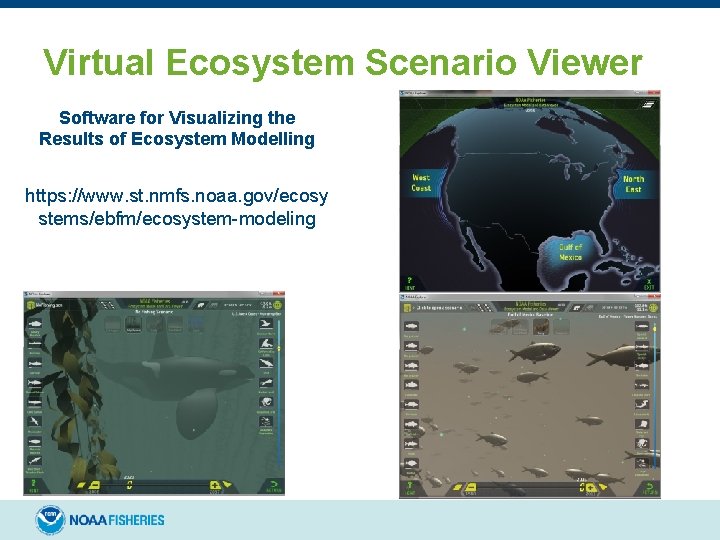
Virtual Ecosystem Scenario Viewer Software for Visualizing the Results of Ecosystem Modelling https: //www. st. nmfs. noaa. gov/ecosy stems/ebfm/ecosystem-modeling
The Need for Stakeholder Engagement “The considerable uncertainties in the predictions provided by ecosystem/multispecies models notwithstanding, decisions have to be made and actions implemented to ensure sustainable and optimal utilization of marine living resources. These decisions must be informed by the best available scientific advice and, in the context of EAF, this scientific advice must include ecosystem considerations. Ecosystem models, adhering as far as possible to the best practices described here, will frequently be the best sources of such information and can lead to advice that rests on explicit and principled arguments. In their absence, managers and decisionmakers will have no choice but to fall back on their own mental models which may frequently be subjective, untested and incomplete, a situation which clearly needs to be avoided. ” -UN FAO Report 2008. BEST PRACTICES IN ECOSYSTEM MODELLING FOR INFORMING AN ECOSYSTEM APPROACH TO FISHERIES
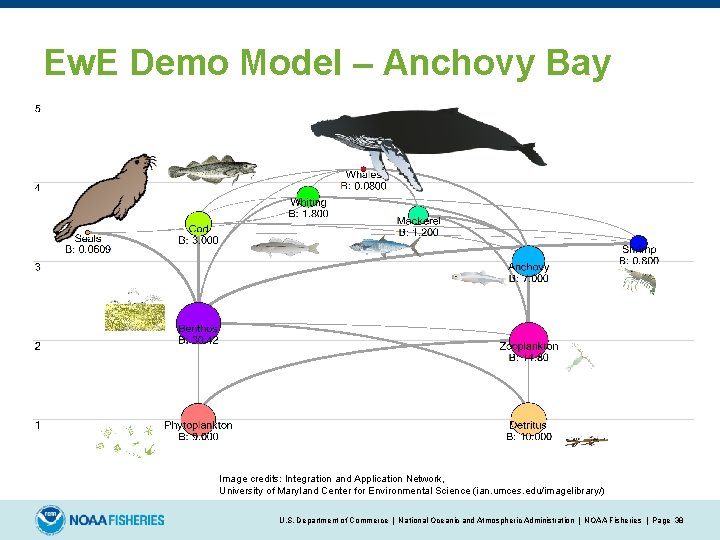
Tutorial Demos- Stakeholder Engagement • Ecopath with Ecosim • Mental Models 36
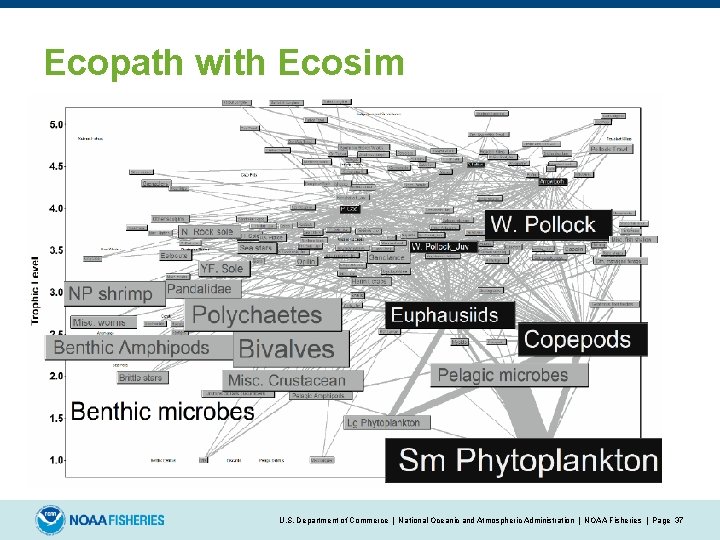
Ecopath with Ecosim U. S. Department of Commerce | National Oceanic and Atmospheric Administration | NOAA Fisheries | Page 37
Ew. E Demo Model – Anchovy Bay Image credits: Integration and Application Network, University of Maryland Center for Environmental Science (ian. umces. edu/imagelibrary/) U. S. Department of Commerce | National Oceanic and Atmospheric Administration | NOAA Fisheries | Page 38
Qualitative Network Model (Mental Model) Exercise
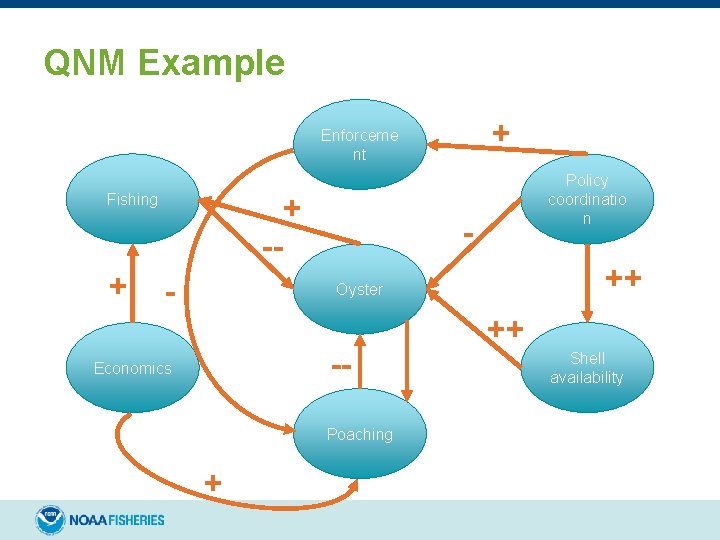
QNM Example + Enforceme nt + Fishing - -+ - Policy coordinatio n ++ Oyster -- Economics Poaching + ++ Shell availability
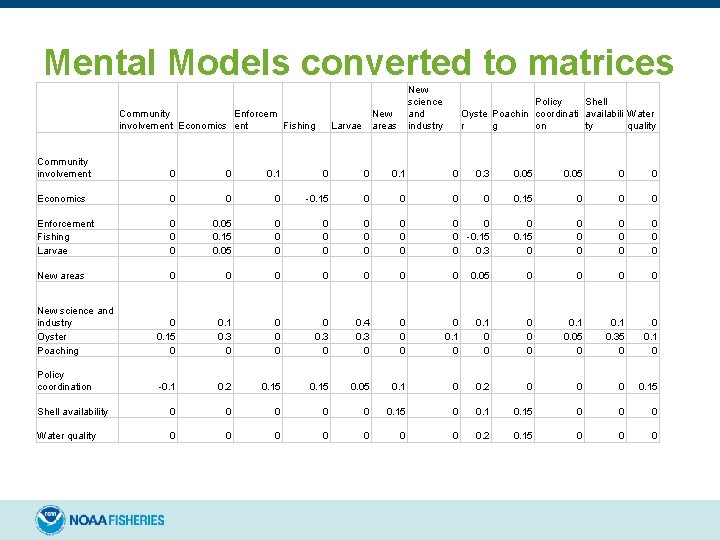
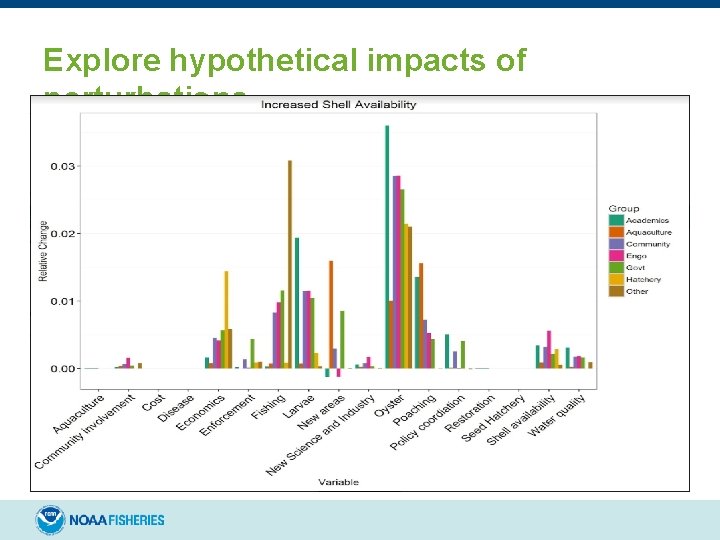
Mental Models converted to matrices Community Enforcem involvement Economics ent Fishing New science and industry New areas Larvae Policy Shell Oyste Poachin coordinati availabili Water r g on ty quality Community involvement 0 0 0. 1 0 0. 3 0. 05 0 0 Economics 0 0 0 -0. 15 0 0 0 Enforcement Fishing Larvae 0 0. 05 0. 15 0. 05 0 0 0 0 -0. 15 0 0. 3 0 0. 15 0 0 0 0 0 New areas 0 0 0 0. 05 0 0 New science and industry Oyster Poaching 0 0. 15 0 0. 1 0. 3 0 0. 4 0. 3 0 0 0. 1 0. 05 0 0. 1 0. 35 0 0 0. 1 0 Policy coordination -0. 1 0. 2 0. 15 0. 05 0. 1 0 0. 2 0 0. 15 Shell availability 0 0 0. 15 0 0 0 Water quality 0 0 0 0. 2 0. 15 0 0 0
Explore hypothetical impacts of perturbations
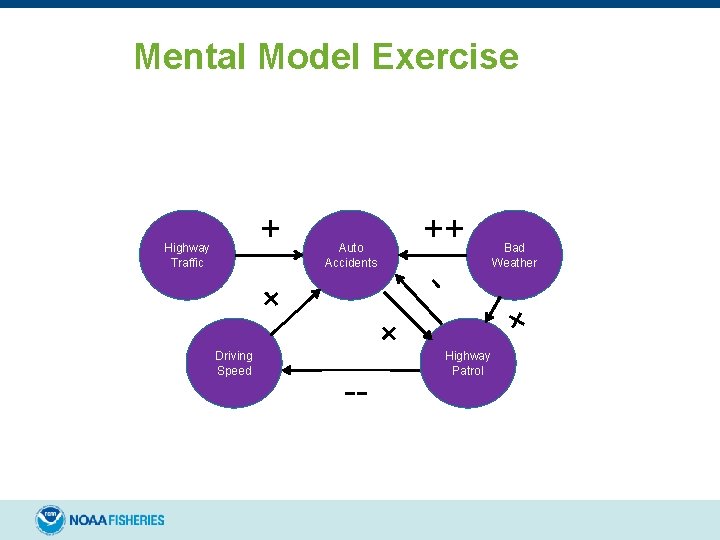
Mental Model Exercise + Highway Traffic Auto Accidents + + -- Driving Speed Bad Weather - + ++ Highway Patrol
Mental Modeler Demo • http: //www. mentalmodeler. org/ 44
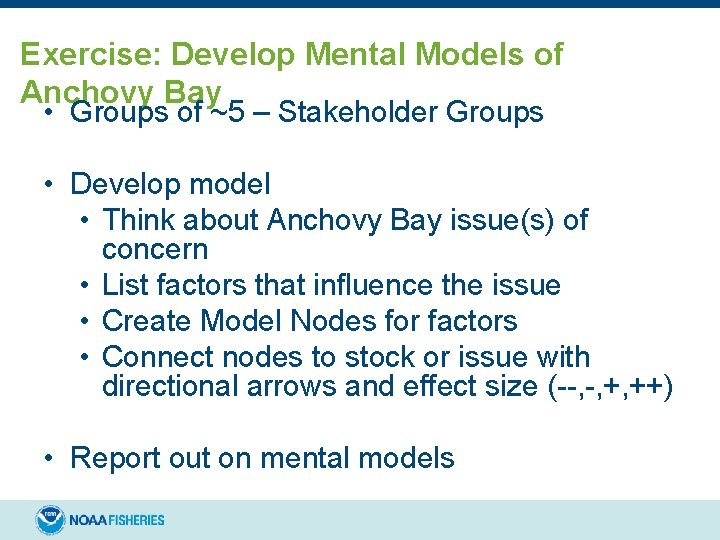
Exercise: Develop Mental Models of Anchovy Bay • Groups of ~5 – Stakeholder Groups • Develop model • Think about Anchovy Bay issue(s) of concern • List factors that influence the issue • Create Model Nodes for factors • Connect nodes to stock or issue with directional arrows and effect size (--, -, +, ++) • Report out on mental models
Extra Slides
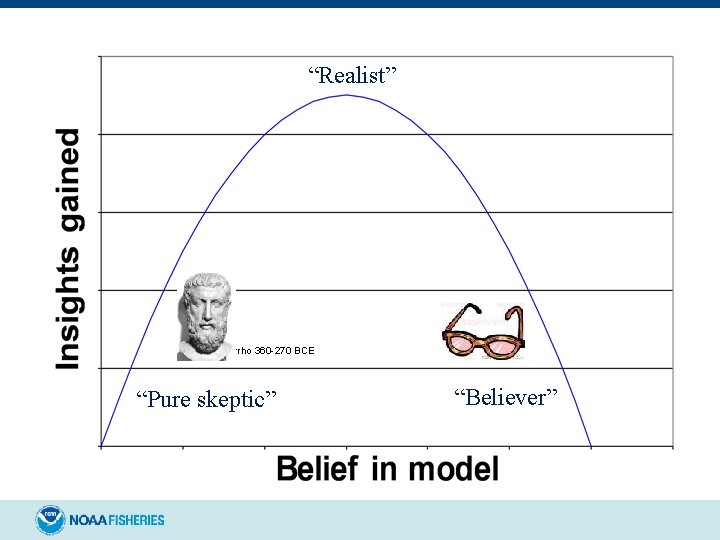
“Realist” Pyrrho 360 -270 BCE “Pure skeptic” “Believer”