
Ecosystem carbon storage capacity as affected by disturbance
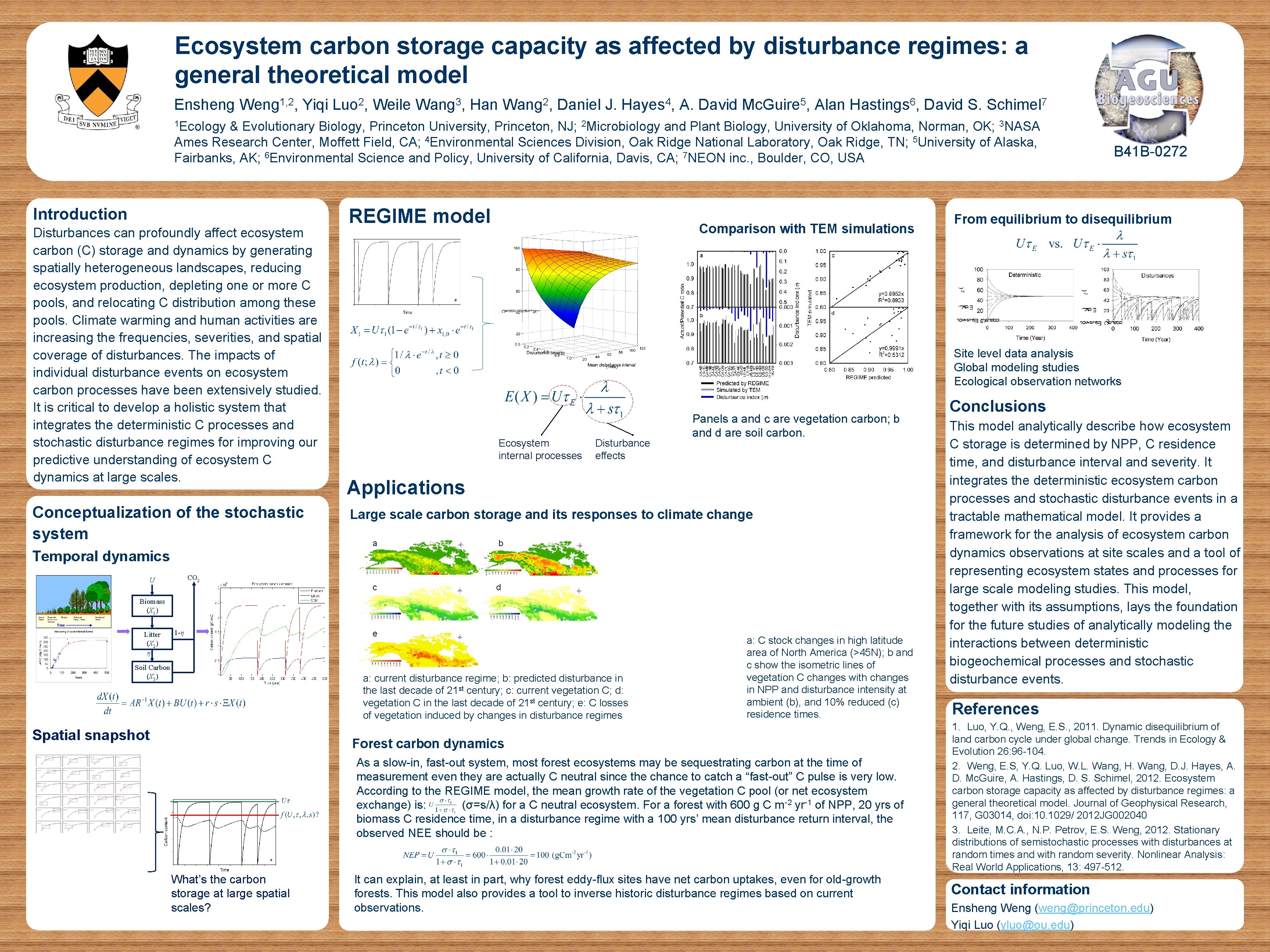
Ecosystem carbon storage capacity as affected by disturbance regimes: a general theoretical model Ensheng Weng 1, 2, Yiqi Luo 2, Weile Wang 3, Han Wang 2, Daniel J. Hayes 4, A. David Mc. Guire 5, Alan Hastings 6, David S. Schimel 7 1 Ecology & Evolutionary Biology, Princeton University, Princeton, NJ; 2 Microbiology and Plant Biology, University of Oklahoma, Norman, OK; 3 NASA Ames Research Center, Moffett Field, CA; 4 Environmental Sciences Division, Oak Ridge National Laboratory, Oak Ridge, TN; 5 University of Alaska, Fairbanks, AK; 6 Environmental Science and Policy, University of California, Davis, CA; 7 NEON inc. , Boulder, CO, USA Introduction Disturbances can profoundly affect ecosystem carbon (C) storage and dynamics by generating spatially heterogeneous landscapes, reducing ecosystem production, depleting one or more C pools, and relocating C distribution among these pools. Climate warming and human activities are increasing the frequencies, severities, and spatial coverage of disturbances. The impacts of individual disturbance events on ecosystem carbon processes have been extensively studied. It is critical to develop a holistic system that integrates the deterministic C processes and stochastic disturbance regimes for improving our predictive understanding of ecosystem C dynamics at large scales. Conceptualization of the stochastic system Temporal dynamics CO 2 U REGIME model Comparison with TEM simulations 1 -η Soil Carbon (X 3) Ecosystem internal processes Disturbance effects Panels a and c are vegetation carbon; b and d are soil carbon. Applications Large scale carbon storage and its responses to climate change aa b b cc d d ee a: current disturbance regime; b: predicted disturbance in the last decade of 21 st century; c: current vegetation C; d: vegetation C in the last decade of 21 st century; e: C losses of vegetation induced by changes in disturbance regimes Spatial snapshot a: C stock changes in high latitude area of North America (>45 N); b and c show the isometric lines of vegetation C changes with changes in NPP and disturbance intensity at ambient (b), and 10% reduced (c) residence times. Conclusions This model analytically describe how ecosystem C storage is determined by NPP, C residence time, and disturbance interval and severity. It integrates the deterministic ecosystem carbon processes and stochastic disturbance events in a tractable mathematical model. It provides a framework for the analysis of ecosystem carbon dynamics observations at site scales and a tool of representing ecosystem states and processes for large scale modeling studies. This model, together with its assumptions, lays the foundation for the future studies of analytically modeling the interactions between deterministic biogeochemical processes and stochastic disturbance events. References As a slow-in, fast-out system, most forest ecosystems may be sequestrating carbon at the time of measurement even they are actually C neutral since the chance to catch a “fast-out” C pulse is very low. According to the REGIME model, the mean growth rate of the vegetation C pool (or net ecosystem exchange) is: (σ=s/λ) for a C neutral ecosystem. For a forest with 600 g C m-2 yr-1 of NPP, 20 yrs of biomass C residence time, in a disturbance regime with a 100 yrs’ mean disturbance return interval, the observed NEE should be : 1. Luo, Y. Q. , Weng, E. S. , 2011. Dynamic disequilibrium of land carbon cycle under global change. Trends in Ecology & Evolution 26: 96 -104. 2. Weng, E. S, Y. Q. Luo, W. L. Wang, H. Wang, D. J. Hayes, A. D. Mc. Guire, A. Hastings, D. S. Schimel, 2012. Ecosystem carbon storage capacity as affected by disturbance regimes: a general theoretical model. Journal of Geophysical Research, 117, G 03014, doi: 10. 1029/ 2012 JG 002040 3. Leite, M. C. A. , N. P. Petrov, E. S. Weng, 2012. Stationary distributions of semistochastic processes with disturbances at random times and with random severity. Nonlinear Analysis: Real World Applications, 13: 497 -512. It can explain, at least in part, why forest eddy-flux sites have net carbon uptakes, even for old-growth forests. This model also provides a tool to inverse historic disturbance regimes based on current observations. Contact information Forest carbon dynamics What’s the carbon storage at large spatial scales? From equilibrium to disequilibrium Site level data analysis Global modeling studies Ecological observation networks Biomass (X 1) Litter (X 2) η B 41 B-0272 Ensheng Weng (weng@princeton. edu) Yiqi Luo (yluo@ou. edu)
- Slides: 1