
ECOSTRESSDerived IrrigatedNonIrrigated Vegetation Maps of Los Angeles CA
- Slides: 2
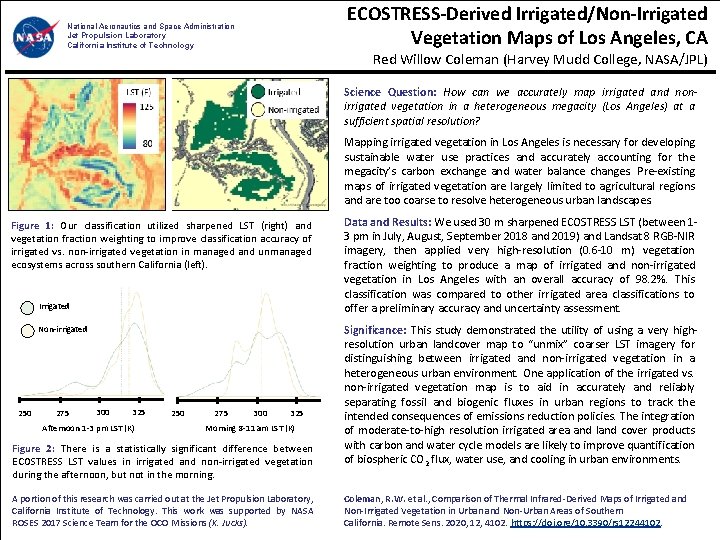
ECOSTRESS-Derived Irrigated/Non-Irrigated Vegetation Maps of Los Angeles, CA National Aeronautics and Space Administration Jet Propulsion Laboratory California Institute of Technology Red Willow Coleman (Harvey Mudd College, NASA/JPL) Science Question: How can we accurately map irrigated and nonirrigated vegetation in a heterogeneous megacity (Los Angeles) at a sufficient spatial resolution? Mapping irrigated vegetation in Los Angeles is necessary for developing sustainable water use practices and accurately accounting for the megacity’s carbon exchange and water balance changes. Pre-existing maps of irrigated vegetation are largely limited to agricultural regions and are too coarse to resolve heterogeneous urban landscapes. Figure 1: Our classification utilized sharpened LST (right) and vegetation fraction weighting to improve classification accuracy of irrigated vs. non-irrigated vegetation in managed and unmanaged ecosystems across southern California (left). Irrigated Non-irrigated 250 275 300 325 Afternoon 1 -3 pm LST (K) 250 275 300 325 Morning 8 -11 am LST (K) Figure 2: There is a statistically significant difference between ECOSTRESS LST values in irrigated and non-irrigated vegetation during the afternoon, but not in the morning. A portion of this research was carried out at the Jet Propulsion Laboratory, California Institute of Technology. This work was supported by NASA ROSES 2017 Science Team for the OCO Missions (K. Jucks). Data and Results: We used 30 m sharpened ECOSTRESS LST (between 13 pm in July, August, September 2018 and 2019) and Landsat 8 RGB-NIR imagery, then applied very high-resolution (0. 6 -10 m) vegetation fraction weighting to produce a map of irrigated and non-irrigated vegetation in Los Angeles with an overall accuracy of 98. 2%. This classification was compared to other irrigated area classifications to offer a preliminary accuracy and uncertainty assessment. Significance: This study demonstrated the utility of using a very highresolution urban landcover map to “unmix” coarser LST imagery for distinguishing between irrigated and non-irrigated vegetation in a heterogeneous urban environment. One application of the irrigated vs. non-irrigated vegetation map is to aid in accurately and reliably separating fossil and biogenic fluxes in urban regions to track the intended consequences of emissions reduction policies. The integration of moderate-to-high resolution irrigated area and land cover products with carbon and water cycle models are likely to improve quantification of biospheric CO 2 flux, water use, and cooling in urban environments. Coleman, R. W. et al. , Comparison of Thermal Infrared-Derived Maps of Irrigated and Non-Irrigated Vegetation in Urban and Non-Urban Areas of Southern California. Remote Sens. 2020, 12, 4102. https: //doi. org/10. 3390/rs 12244102.
National Aeronautics and Space Administration Jet Propulsion Laboratory California Institute of Technology Contact: Red Willow Coleman, N/A, Jet Propulsion Laboratory, Pasadena, CA 91109 red. willow. coleman@jpl. nasa. gov wcoleman@hmc. edu (after 12/18/2020) Citation: Coleman, R. W. ; Stavros, N. ; Hulley, G. ; Parazoo, N. Comparison of Thermal Infrared-Derived Maps of Irrigated and Non-Irrigated Vegetation in Urban and Non-Urban Areas of Southern California. Remote Sens. 2020, 12, 4102. https: //doi. org/10. 3390/rs 12244102. Data Sources: ECOSTRESS (NASA, available on NASA Earthdata Search) Sentinel-2 (ESA, available on Google Earth Engine) Landsat 8 (USGS, available on Google Earth Engine) NAIP (USDA, available on Google Earth Engine) Technical Description of Figures: Figure 1: Our classification utilized sharpened ECOSTRESS LST, Landsat 8 optical imagery, and vegetation fraction weighting to improve classification accuracy of irrigated vs. non-irrigated vegetation in managed and unmanaged ecosystems across southern California. The LST image shows that the irrigated golf course is much color than the surrounding non-irrigated vegetation. Vegetation fraction weighting enabled “unmixing” of potentially heterogeneous 30 m sharpened ECOSTRESS pixels by incorporating high-resolution landcover data across the study area. Figure 2: We wanted to determine the time of day during which there is a significant difference in LST between irrigated and non-irrigated vegetation and then train a supervised classifier using imagery from that time period. We determined that there is a statistically significant difference between ECOSTRESS LST values in irrigated and non-irrigated vegetation during the afternoon (1 -3 pm), but not in the morning (8 -11 am). Scientific significance, societal relevance, and relationships to future missions: This irrigated vs. non-irrigated vegetation classification map covers 17, 100 km 2 of urban and non-urban areas in the complex and heterogeneous Los Angeles megacity. We determined that training a random forest classifier with a combination of Landsat 8 optical imagery (30 m) and weighting sharpened ECOSTRESS LST (30 m) with a fractionally aggregated high-resolution urban vegetation map (0. 6– 10 m) produced a map of irrigated and nonirrigated vegetation cover in So. CAB with an overall accuracy of 98. 2%. This classification was developed for regional modeling of urban carbon and water cycling, which require a detailed understanding of both land use (i. e. , irrigation schemes) and land cover (i. e. , vegetation type) to accurately model the urban environment. In addition, the urban biospheric CO 2 flux model that utilizes this irrigated land use classification can be used to validate OCO-3 and other satellite measurements of CO 2.