
Ecosim Pro in CRG presentation of section activities
- Slides: 19
Ecosim. Pro in CRG: presentation of section activities Use of Ecosim. Pro in the ME section for thermal and hydraulic design and assessment of Ecosim. Pro as design tool A. Wanninger, A. Perin CERN, 12 th December 2019 Ecosim. Pro in CRG, Usage of Ecosim. Pro in ME, A. Wanninger, A. Perin, 12. 2019 1
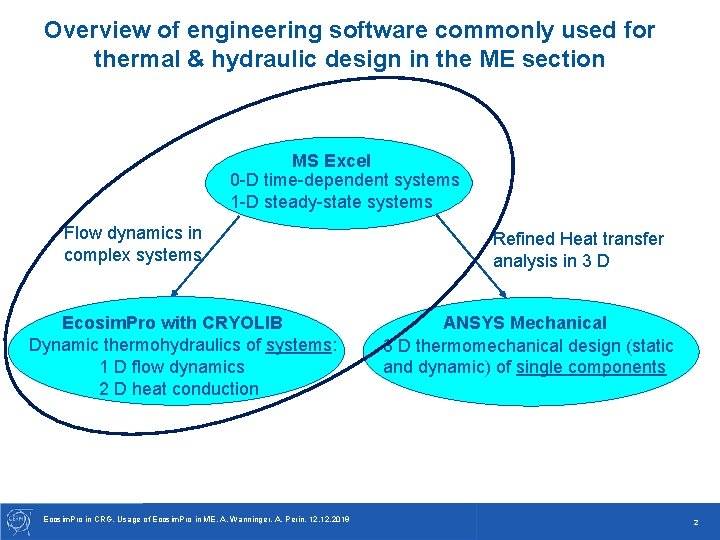
Overview of engineering software commonly used for thermal & hydraulic design in the ME section MS Excel 0 -D time-dependent systems 1 -D steady-state systems Flow dynamics in complex systems Ecosim. Pro with CRYOLIB Dynamic thermohydraulics of systems: 1 D flow dynamics 2 D heat conduction Ecosim. Pro in CRG, Usage of Ecosim. Pro in ME, A. Wanninger, A. Perin, 12. 2019 Refined Heat transfer analysis in 3 D ANSYS Mechanical 3 D thermomechanical design (static and dynamic) of single components 2
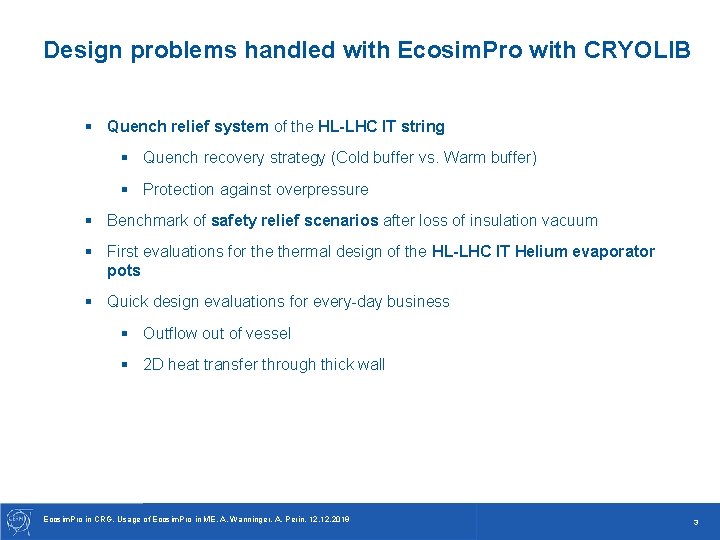
Design problems handled with Ecosim. Pro with CRYOLIB § Quench relief system of the HL-LHC IT string § Quench recovery strategy (Cold buffer vs. Warm buffer) § Protection against overpressure § Benchmark of safety relief scenarios after loss of insulation vacuum § First evaluations for thermal design of the HL-LHC IT Helium evaporator pots § Quick design evaluations for every-day business § Outflow out of vessel § 2 D heat transfer through thick wall Ecosim. Pro in CRG, Usage of Ecosim. Pro in ME, A. Wanninger, A. Perin, 12. 2019 3
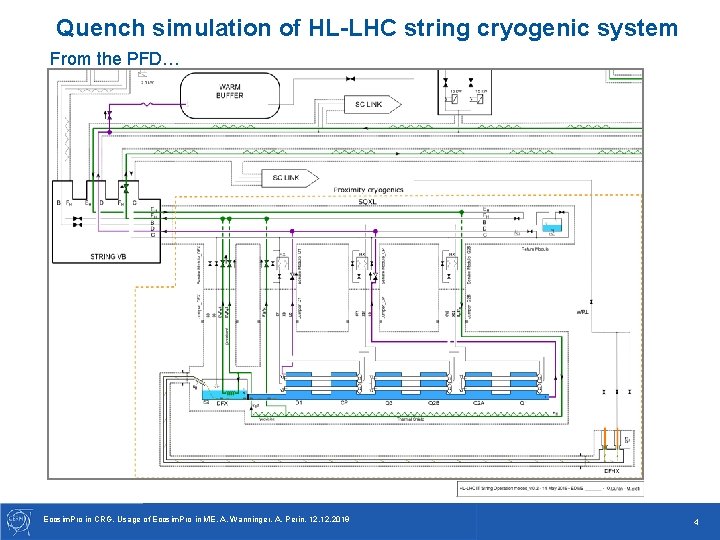
Quench simulation of HL-LHC string cryogenic system From the PFD… Ecosim. Pro in CRG, Usage of Ecosim. Pro in ME, A. Wanninger, A. Perin, 12. 2019 4
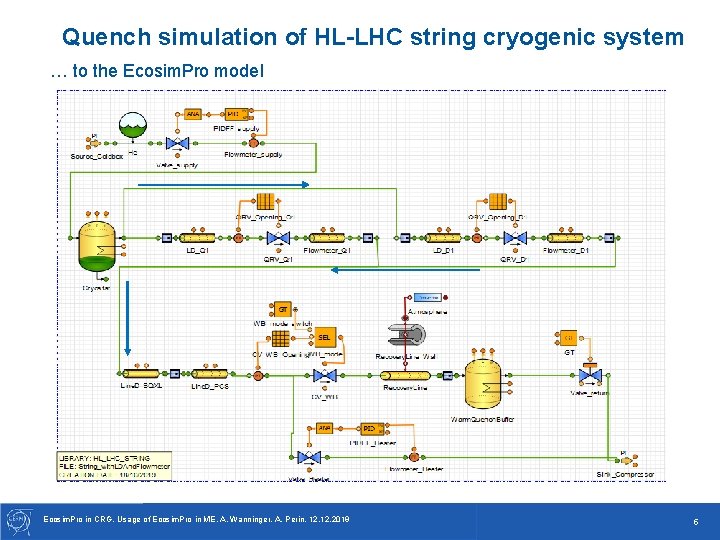
Quench simulation of HL-LHC string cryogenic system … to the Ecosim. Pro model Ecosim. Pro in CRG, Usage of Ecosim. Pro in ME, A. Wanninger, A. Perin, 12. 2019 5
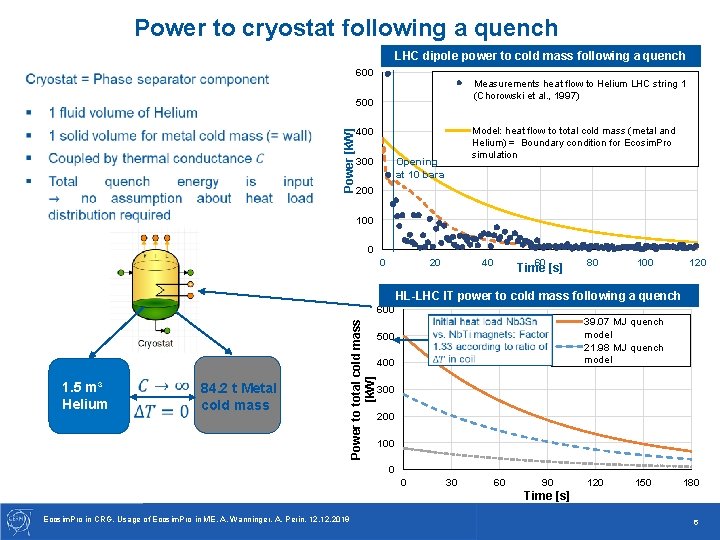
Power to cryostat following a quench LHC dipole power to cold mass following a quench 600 Measurements heat flow to Helium LHC string 1 (Chorowski et al. , 1997) Power [k. W] 500 Model: heat flow to total cold mass (metal and Helium) = Boundary condition for Ecosim. Pro simulation 400 300 Opening at 10 bara 200 100 0 0 20 40 60 Time [s] 80 100 120 HL-LHC IT power to cold mass following a quench 1. 5 m³ Helium 84. 2 t Metal cold mass Power to total cold mass [k. W] 600 39. 07 MJ quench model 21. 98 MJ quench model 500 400 300 200 100 0 0 30 60 90 120 150 180 Time [s] Ecosim. Pro in CRG, Usage of Ecosim. Pro in ME, A. Wanninger, A. Perin, 12. 2019 6
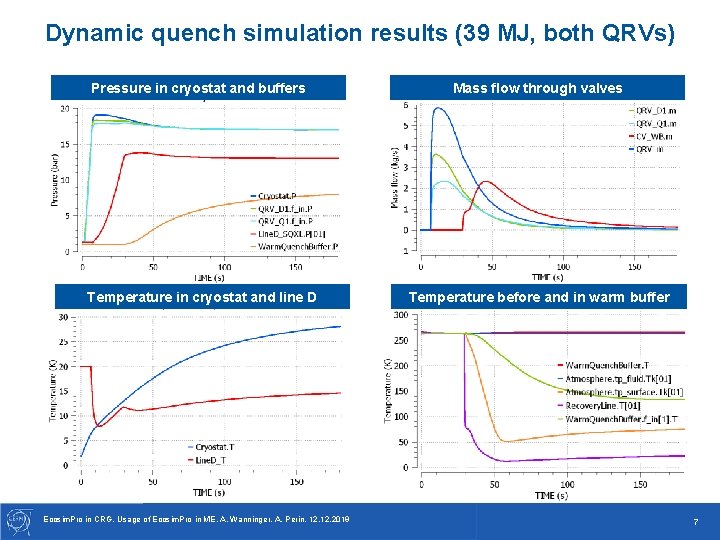
Dynamic quench simulation results (39 MJ, both QRVs) Pressure in cryostat and buffers Mass flow through valves Temperature in cryostat and line D Temperature before and in warm buffer Ecosim. Pro in CRG, Usage of Ecosim. Pro in ME, A. Wanninger, A. Perin, 12. 2019 7
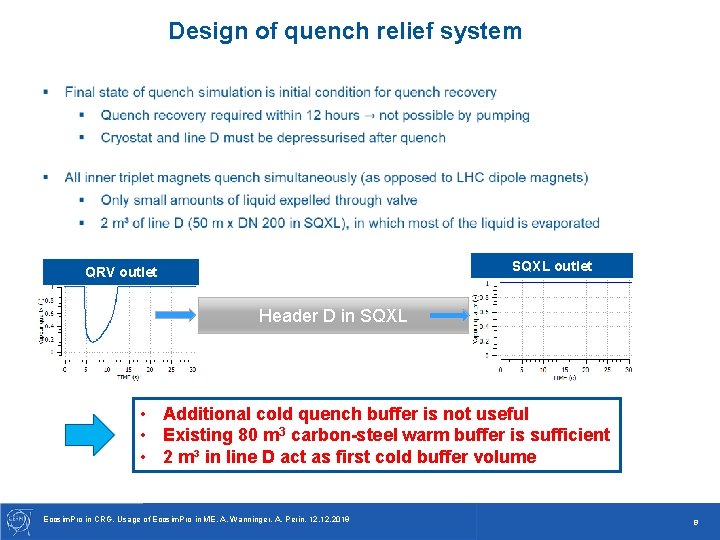
Design of quench relief system SQXL outlet QRV outlet Header D in SQXL • Additional cold quench buffer is not useful • Existing 80 m 3 carbon-steel warm buffer is sufficient • 2 m³ in line D act as first cold buffer volume Ecosim. Pro in CRG, Usage of Ecosim. Pro in ME, A. Wanninger, A. Perin, 12. 2019 8
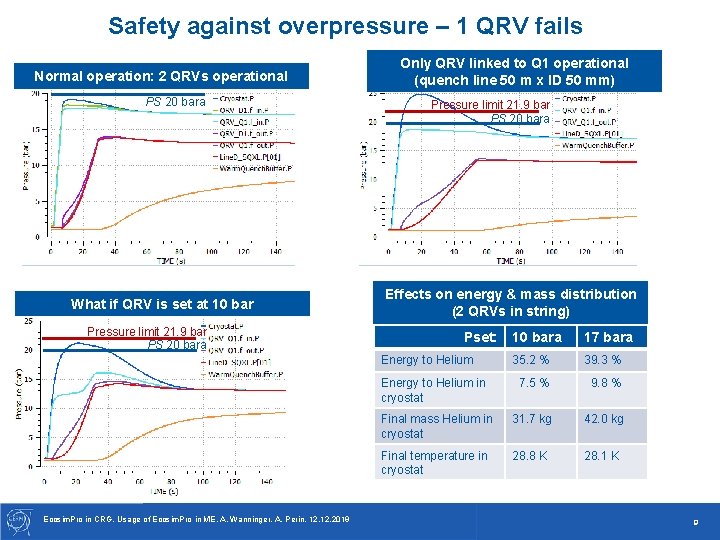
Safety against overpressure – 1 QRV fails Normal operation: 2 QRVs operational PS 20 bara What if QRV is set at 10 bar Pressure limit 21. 9 bar PS 20 bara , Ecosim. Pro in CRG, Usage of Ecosim. Pro in ME, A. Wanninger, A. Perin, 12. 2019 Only QRV linked to Q 1 operational (quench line 50 m x ID 50 mm) Pressure limit 21. 9 bar PS 20 bara , Effects on energy & mass distribution (2 QRVs in string) Pset: 10 bara 17 bara Energy to Helium 35. 2 % 39. 3 % Energy to Helium in cryostat 7. 5 % 9. 8 % Final mass Helium in cryostat 31. 7 kg 42. 0 kg Final temperature in cryostat 28. 8 K 28. 1 K 9
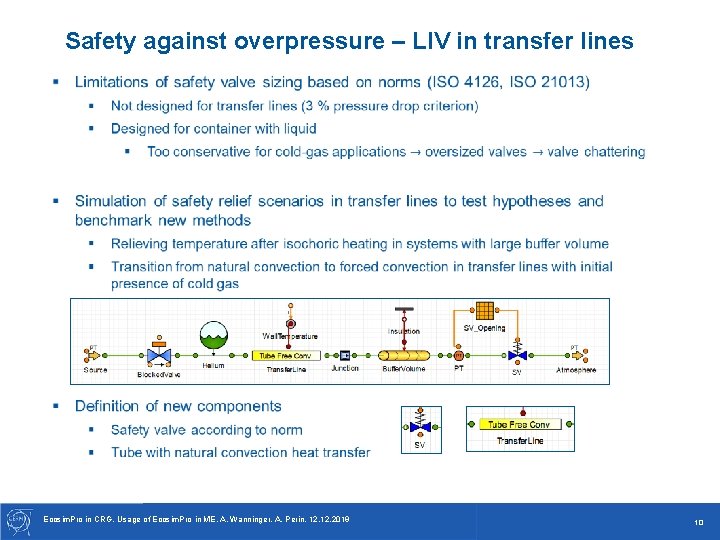
Safety against overpressure – LIV in transfer lines Ecosim. Pro in CRG, Usage of Ecosim. Pro in ME, A. Wanninger, A. Perin, 12. 2019 10
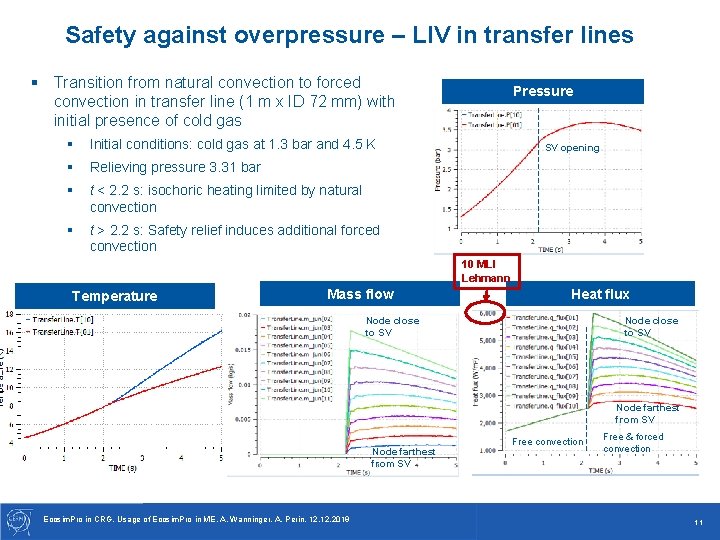
Safety against overpressure – LIV in transfer lines § Transition from natural convection to forced convection in transfer line (1 m x ID 72 mm) with initial presence of cold gas § Initial conditions: cold gas at 1. 3 bar and 4. 5 K § Relieving pressure 3. 31 bar § t < 2. 2 s: isochoric heating limited by natural convection § t > 2. 2 s: Safety relief induces additional forced convection Pressure SV opening 10 MLI Lehmann Temperature Mass flow Heat flux Node close to SV Node farthest from SV Ecosim. Pro in CRG, Usage of Ecosim. Pro in ME, A. Wanninger, A. Perin, 12. 2019 Free convection Free & forced convection 11
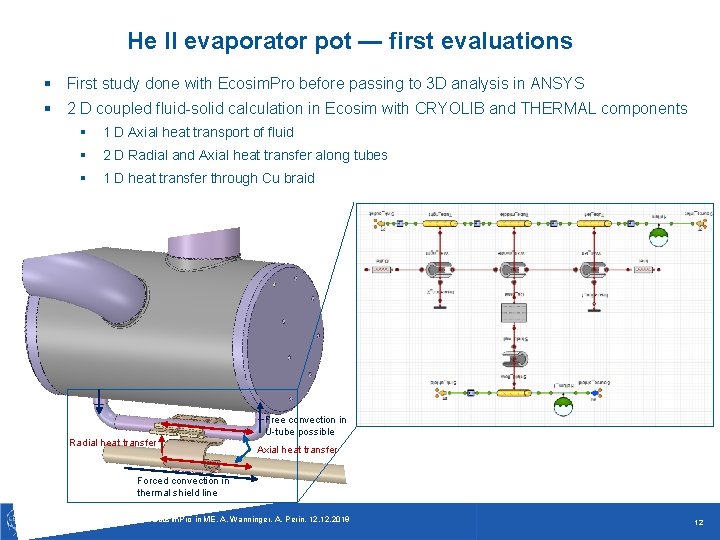
He II evaporator pot — first evaluations § First study done with Ecosim. Pro before passing to 3 D analysis in ANSYS § 2 D coupled fluid-solid calculation in Ecosim with CRYOLIB and THERMAL components § 1 D Axial heat transport of fluid § 2 D Radial and Axial heat transfer along tubes § 1 D heat transfer through Cu braid Radial heat transfer Free convection in U-tube possible Axial heat transfer Forced convection in thermal shield line Ecosim. Pro in CRG, Usage of Ecosim. Pro in ME, A. Wanninger, A. Perin, 12. 2019 12
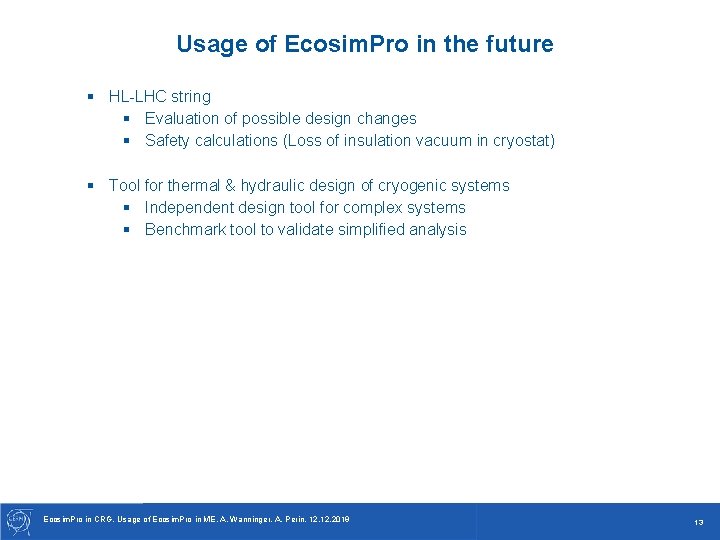
Usage of Ecosim. Pro in the future § HL-LHC string § Evaluation of possible design changes § Safety calculations (Loss of insulation vacuum in cryostat) § Tool for thermal & hydraulic design of cryogenic systems § Independent design tool for complex systems § Benchmark tool to validate simplified analysis Ecosim. Pro in CRG, Usage of Ecosim. Pro in ME, A. Wanninger, A. Perin, 12. 2019 13
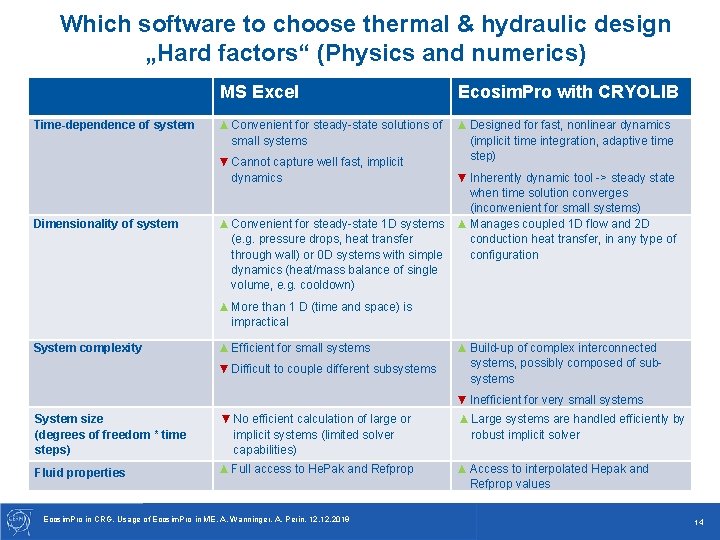
Which software to choose thermal & hydraulic design „Hard factors“ (Physics and numerics) MS Excel Time-dependence of system Ecosim. Pro with CRYOLIB ▲ Convenient for steady-state solutions of ▲ Designed for fast, nonlinear dynamics small systems (implicit time integration, adaptive time step) ▼ Cannot capture well fast, implicit ▼ Inherently dynamic tool -> steady state when time solution converges (inconvenient for small systems) ▲ Convenient for steady-state 1 D systems ▲ Manages coupled 1 D flow and 2 D (e. g. pressure drops, heat transfer conduction heat transfer, in any type of through wall) or 0 D systems with simple configuration dynamics (heat/mass balance of single volume, e. g. cooldown) dynamics Dimensionality of system ▲ More than 1 D (time and space) is impractical System complexity ▲ Efficient for small systems ▼ Difficult to couple different subsystems ▲ Build-up of complex interconnected systems, possibly composed of subsystems ▼ Inefficient for very small systems System size (degrees of freedom * time steps) ▼ No efficient calculation of large or implicit systems (limited solver capabilities) ▲ Large systems are handled efficiently by robust implicit solver Fluid properties ▲ Full access to He. Pak and Refprop ▲ Access to interpolated Hepak and Refprop values Ecosim. Pro in CRG, Usage of Ecosim. Pro in ME, A. Wanninger, A. Perin, 12. 2019 14
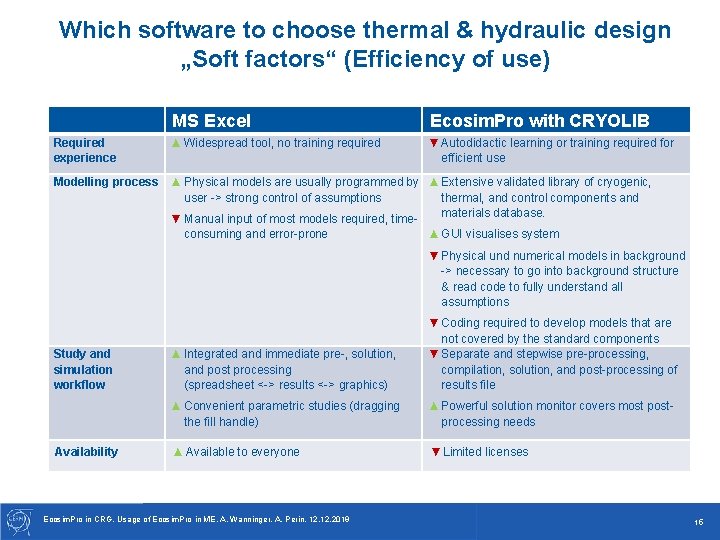
Which software to choose thermal & hydraulic design „Soft factors“ (Efficiency of use) Required experience MS Excel Ecosim. Pro with CRYOLIB ▲ Widespread tool, no training required ▼ Autodidactic learning or training required for efficient use Modelling process ▲ Physical models are usually programmed by ▲ Extensive validated library of cryogenic, user -> strong control of assumptions thermal, and control components and materials database. ▼ Manual input of most models required, timeconsuming and error-prone ▲ GUI visualises system ▼ Physical und numerical models in background -> necessary to go into background structure & read code to fully understand all assumptions Study and simulation workflow Availability ▲ Integrated and immediate pre-, solution, and post processing (spreadsheet <-> results <-> graphics) ▼ Coding required to develop models that are not covered by the standard components ▼ Separate and stepwise pre-processing, compilation, solution, and post-processing of results file ▲ Convenient parametric studies (dragging the fill handle) ▲ Powerful solution monitor covers most postprocessing needs ▲ Available to everyone ▼ Limited licenses Ecosim. Pro in CRG, Usage of Ecosim. Pro in ME, A. Wanninger, A. Perin, 12. 2019 15
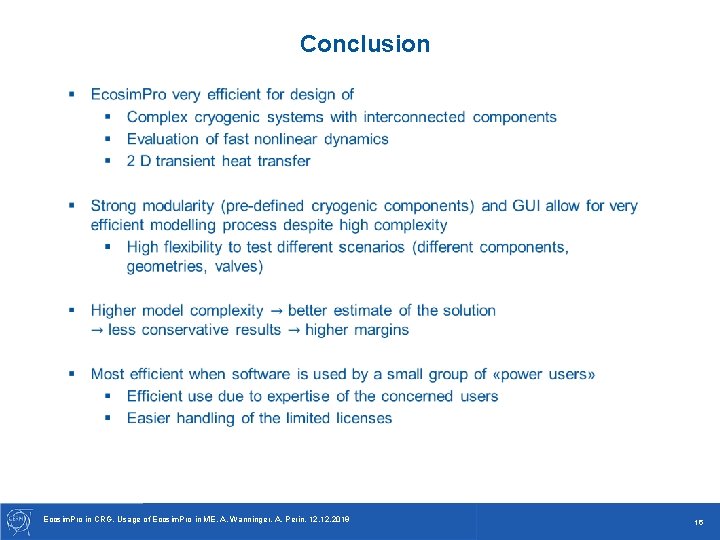
Conclusion Ecosim. Pro in CRG, Usage of Ecosim. Pro in ME, A. Wanninger, A. Perin, 12. 2019 16
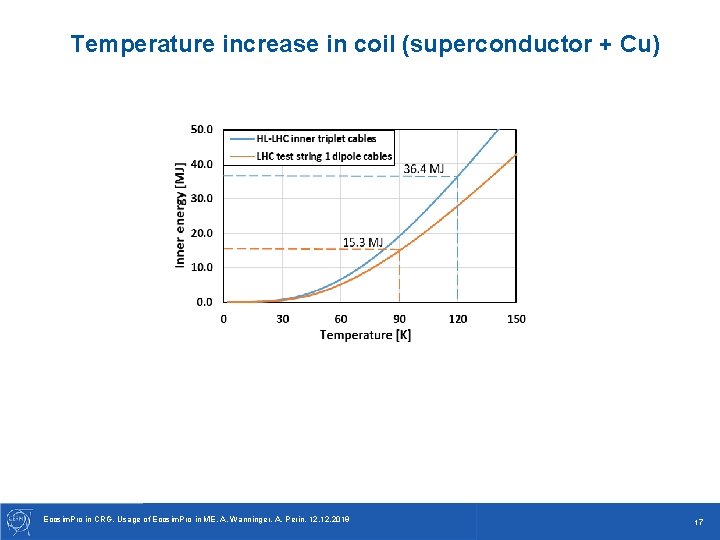
Temperature increase in coil (superconductor + Cu) Ecosim. Pro in CRG, Usage of Ecosim. Pro in ME, A. Wanninger, A. Perin, 12. 2019 17
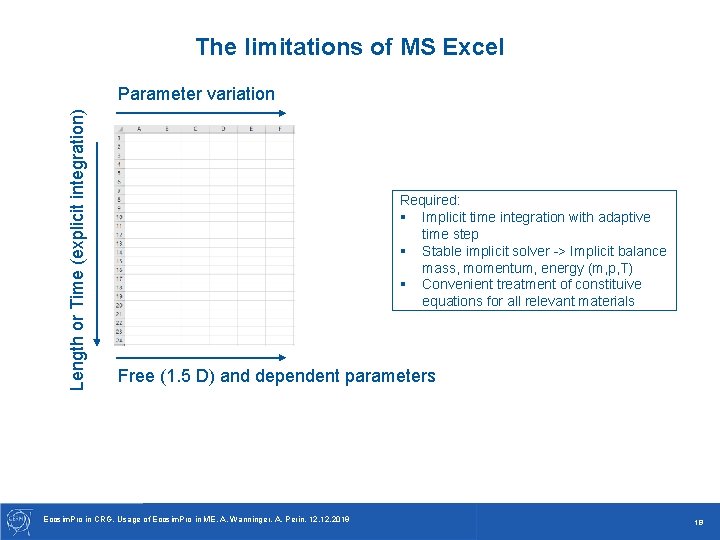
The limitations of MS Excel Length or Time (explicit integration) Parameter variation Required: § Implicit time integration with adaptive time step § Stable implicit solver -> Implicit balance mass, momentum, energy (m, p, T) § Convenient treatment of constituive equations for all relevant materials Free (1. 5 D) and dependent parameters Ecosim. Pro in CRG, Usage of Ecosim. Pro in ME, A. Wanninger, A. Perin, 12. 2019 18
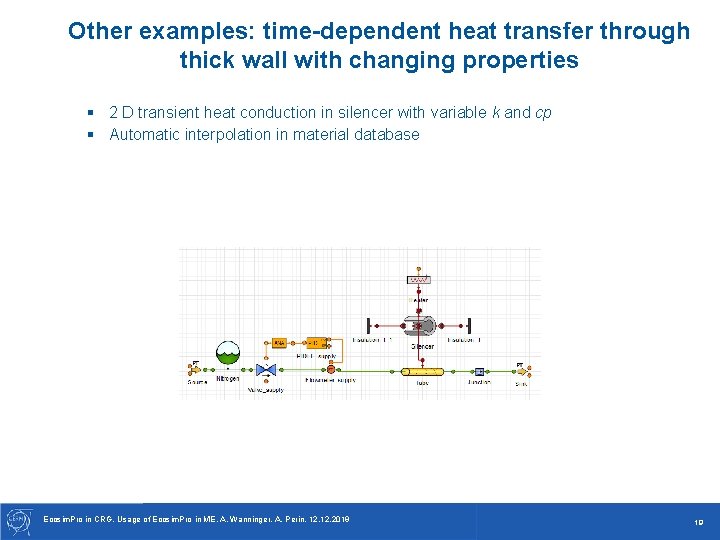
Other examples: time-dependent heat transfer through thick wall with changing properties § 2 D transient heat conduction in silencer with variable k and cp § Automatic interpolation in material database Ecosim. Pro in CRG, Usage of Ecosim. Pro in ME, A. Wanninger, A. Perin, 12. 2019 19