
ECONOMY The First Occupants and European Contact Circa


- Slides: 33
ECONOMY The First Occupants and European Contact Circa 1500
Introduction – First Occupants For thousands of years the first occupants of North America used the resources of their territory to ensure their subsistence (what they did to meet their basic needs and ensure their survival) They were not completely self-sufficient though and often relied on exchanges with each other in order to survive - trade
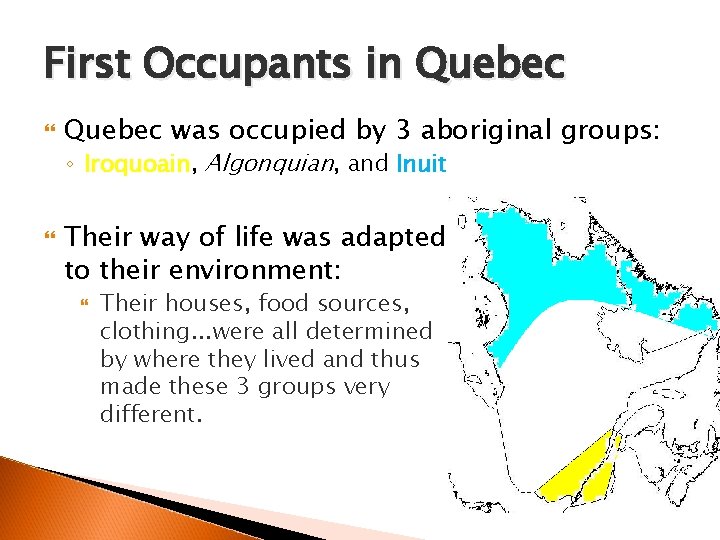
First Occupants in Quebec was occupied by 3 aboriginal groups: ◦ Iroquoain, Algonquian, and Inuit Their way of life was adapted to their environment: Their houses, food sources, clothing. . . were all determined by where they lived and thus made these 3 groups very different.
The Algonquians Settled in the subarctic climate zone (Canadian Shield) Their resources were obtained by hunting, fishing and gathering ◦ They ate caribou, moose, porcupine, hare, loons, geese. . . ◦ They also ate fish such as salmon and northern pike ◦ They used the fur from other animals such as beaver, fox, bear, muskrat, and wolf to make clothing Since the availability of these resources depended on the seasons, the Algonquians had to remain mobile: they were nomadic
The Iroquois Settled in the humid continental zone (Saint Lawrence River Valley) Though fishing, hunting and gathering were important, the mild climate and good soil made agriculture possible ◦ This lead them to remain in one place for longer periods of time (moved only when soil was depleted) ◦ Villages of longhouses developed as well as a more complex social structure ◦ Men spent most of their time hunting and women were responsible for agriculture, which gave them a more important role within the society Since the Iroquois lived in a climate that allowed for agriculture, they became sedentary farmers
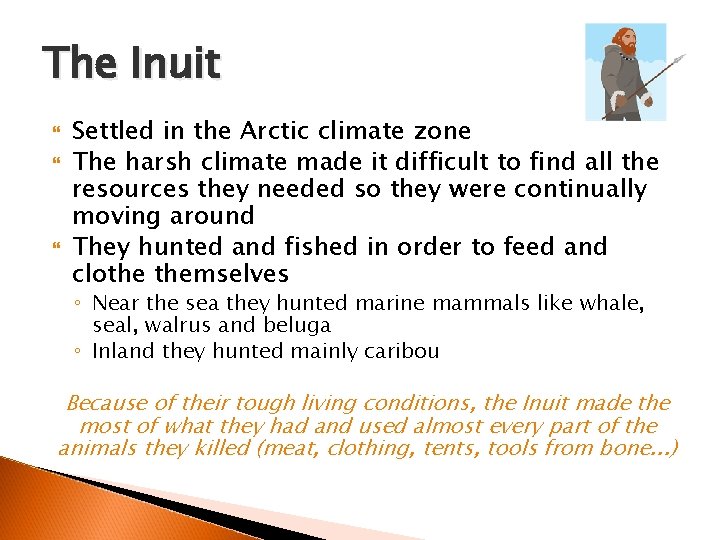
The Inuit Settled in the Arctic climate zone The harsh climate made it difficult to find all the resources they needed so they were continually moving around They hunted and fished in order to feed and clothe themselves ◦ Near the sea they hunted marine mammals like whale, seal, walrus and beluga ◦ Inland they hunted mainly caribou Because of their tough living conditions, the Inuit made the most of what they had and used almost every part of the animals they killed (meat, clothing, tents, tools from bone. . . )
Trade Networks Since the territories and ways of life differed so greatly between each group, they relied on trade with each other to obtain the resources they did not have in their region The used what was called the barter system: ◦ Iroquois traded their agricultural surplus to the Algonquians for caribou hides and meat Complex trade networks developed and some ran as far south as the Gulf of Mexico This system served to mutually satisfy the basic needs of all parties involved; they had no desire to make a profit. Their focus was on sharing what they had.
Early European Contact In the 15 th century, Europeans were seeking a route to Asia ◦ Christopher Columbus (Spain) arrived in N. A. in 1492 ◦ John Cabot (England) reached NFLD in 1497 These and other explorers realized that the waters off the coast of North America were filled of fish Since European demand for fish was very high, many came to take advantage of this resource
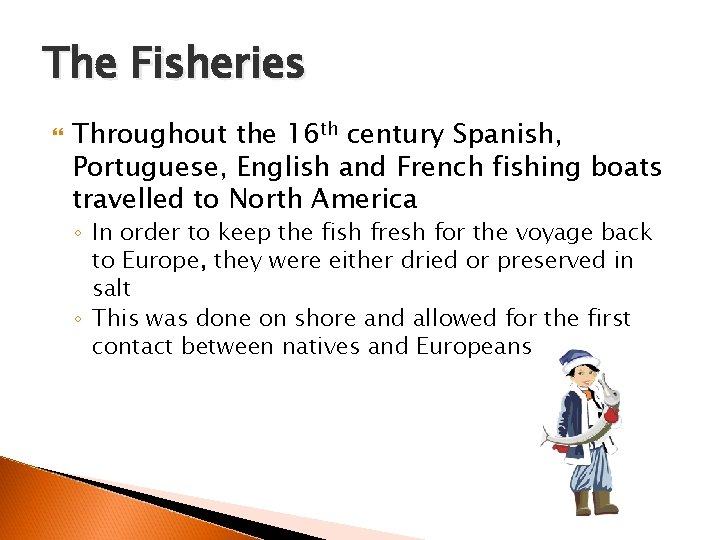
The Fisheries Throughout the 16 th century Spanish, Portuguese, English and French fishing boats travelled to North America ◦ In order to keep the fish fresh for the voyage back to Europe, they were either dried or preserved in salt ◦ This was done on shore and allowed for the first contact between natives and Europeans
Trade with Europens Increased contact between natives and Europeans created more trade networks European objects (metal tools, beads, mirrors, glass, jewellery, fabrics) were gradually introduced to natives and were of high value to them In exchange, Europeans got furs from the natives which could easily be sold for a large profit in Europe
Economic Potential North America’s economic potential fuelled the colonialist plans of the European countries (expansion and domination of more territory) Much capital (goods/money) was invested in sending ships to North America to take possession of the territories that the natives were already occupying ◦ Jacques Cartier (1534 -35, 1541) was sent to claim land for France and to find riches. ◦ He was not successful in finding riches, but did plant a cross at Gaspe claiming the territory for France
Economic Potential In the late 16 th century, the French realised that the beaver pelts fishers had been obtaining from natives had a much higher value in Europe ◦ They saw the fur trade as a new way to get rich The French state allowed merchants to invest money into developing a strong trading network and trade colony in North America: ◦ Competition began and monopolies were given to develop the fur trade ◦ First trading post at Tadoussac in 1600
Effects of Increased Contact with Europeans had severe consequences for aboriginal peoples: ◦ Trade favoured some native groups and not others which created conflicts ◦ Rivalries between native nations were intensified and wars broke out ◦ Natives contracted infectious diseases causing a sharp decrease in native population
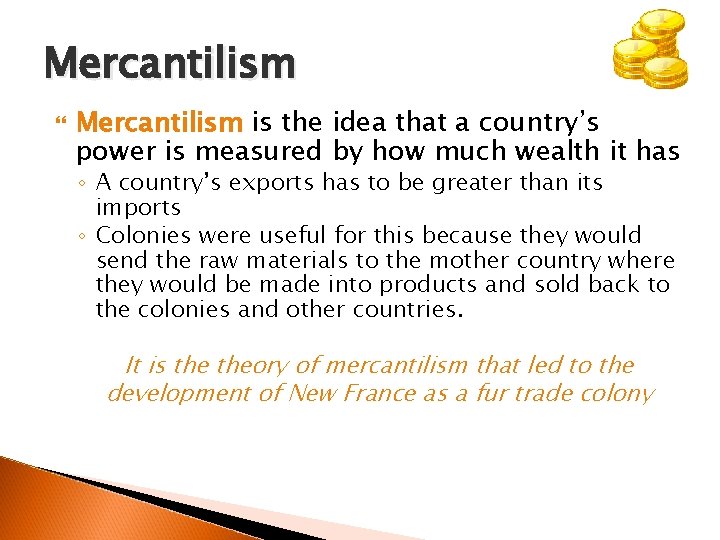
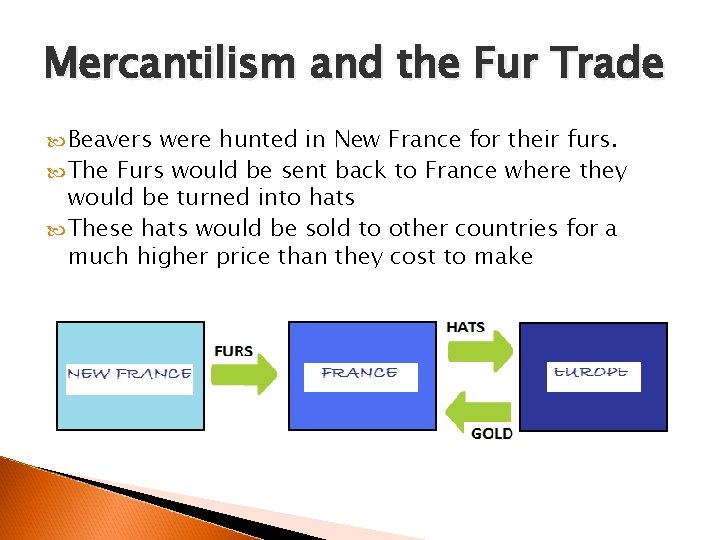
Mercantilism is the idea that a country’s power is measured by how much wealth it has ◦ A country’s exports has to be greater than its imports ◦ Colonies were useful for this because they would send the raw materials to the mother country where they would be made into products and sold back to the colonies and other countries. It is theory of mercantilism that led to the development of New France as a fur trade colony
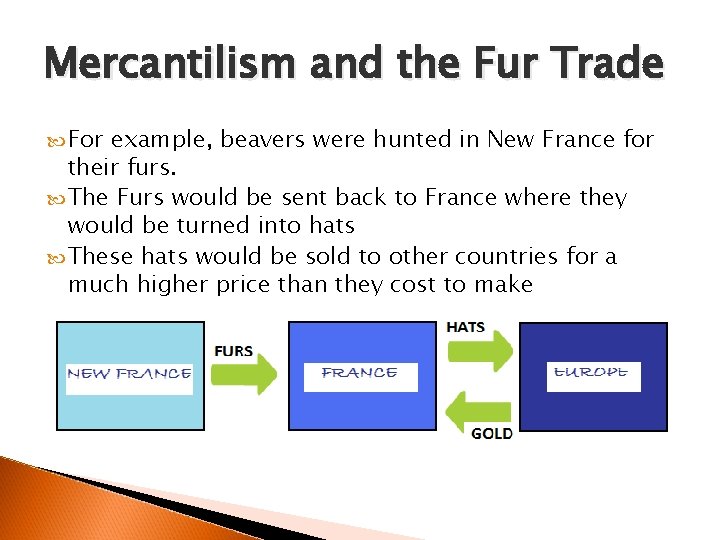
Mercantilism and the Fur Trade For example, beavers were hunted in New France for their furs. The Furs would be sent back to France where they would be turned into hats These hats would be sold to other countries for a much higher price than they cost to make
ECONOMY The French Regime 1608 - 1760
Development of a Colony French had taken possession of New France in 1534: ◦ Jacques Cartier plants a cross at Gaspe ◦ Colonization abandoned due to conflicts with Iroquois By the late 16 th century colonial interest resurfaced: ◦ The fur trade ◦ Alliances with aboriginal groups were created
Mercantilism European countries based the development of their economy on theory of Mercantilism: ◦ Theory that a nation’s power is based on its wealth ◦ European nations competed with each other to build empires that would make them more wealthy Best way to become more wealthy is to export more than you import ◦ Mother countries relied on their colonies for raw materials to turn into manufactured goods (ie: Beaver Hats)
Mercantilism and the Fur Trade Beavers were hunted in New France for their furs. The Furs would be sent back to France where they would be turned into hats These hats would be sold to other countries for a much higher price than they cost to make
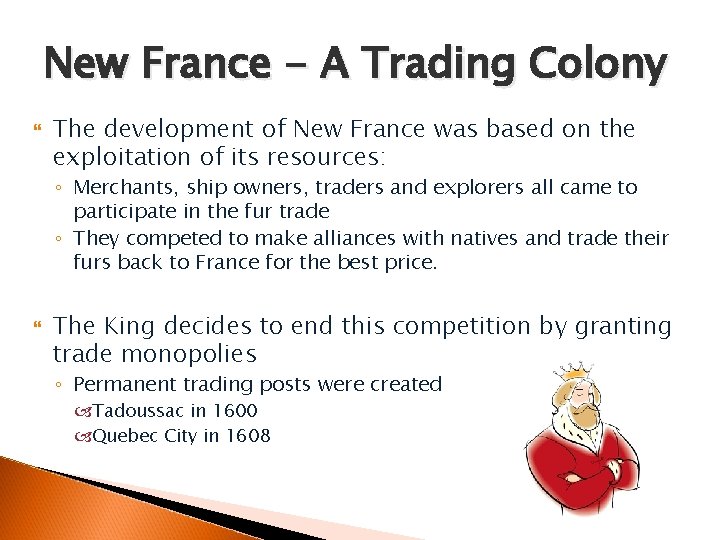
New France - A Trading Colony The development of New France was based on the exploitation of its resources: ◦ Merchants, ship owners, traders and explorers all came to participate in the fur trade ◦ They competed to make alliances with natives and trade their furs back to France for the best price. The King decides to end this competition by granting trade monopolies ◦ Permanent trading posts were created Tadoussac in 1600 Quebec City in 1608
Monopoly
Chartered Companies From 1601 -1627 chartered companies that were granted trade monopolies were responsible for governing the colony In exchange for the monopoly they were responsible for bringing immigrants to New France ◦ The Company of 100 Associates ◦ Did not honour its commitment In 1663, King Louis XIV dissolved the Company of 100 Associates and created Royal Government
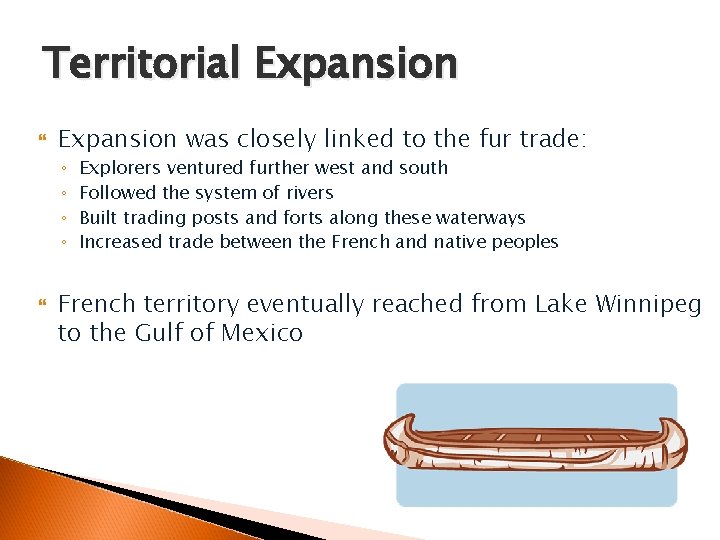
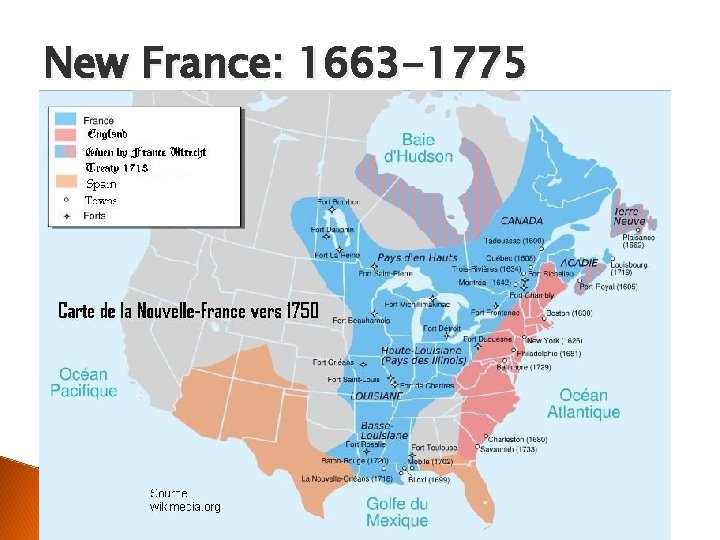
Territorial Expansion was closely linked to the fur trade: ◦ ◦ Explorers ventured further west and south Followed the system of rivers Built trading posts and forts along these waterways Increased trade between the French and native peoples French territory eventually reached from Lake Winnipeg to the Gulf of Mexico
New France: 1663 -1775
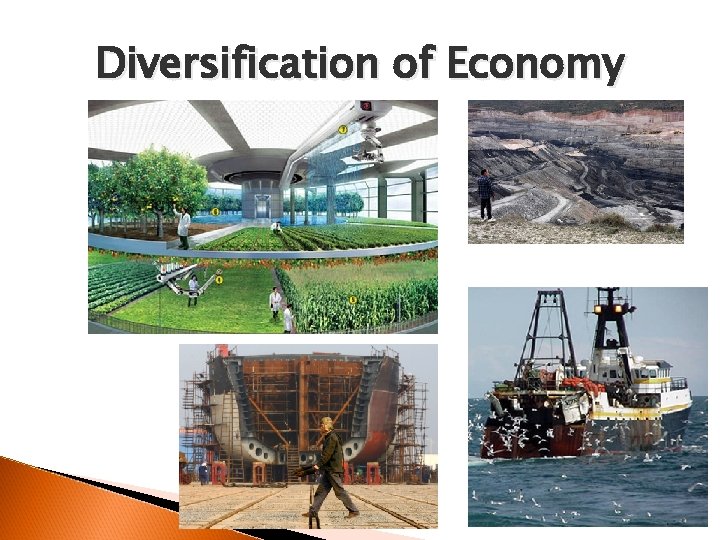
Diversification of Economy
Other Economic Activities: Fishing was also an important economic activity ◦ Main food source for colonizers ◦ Some fish was brought back to Europe (mainly Cod) ◦ Whale and seal oil was an important export
Other Economic Activities: Farming Agriculture was originally a subsistence activity in New France (population was too low) With the arrival of les Filles du Roi, les engages, and soldiers the population increased drastically, making agriculture an important economic activity
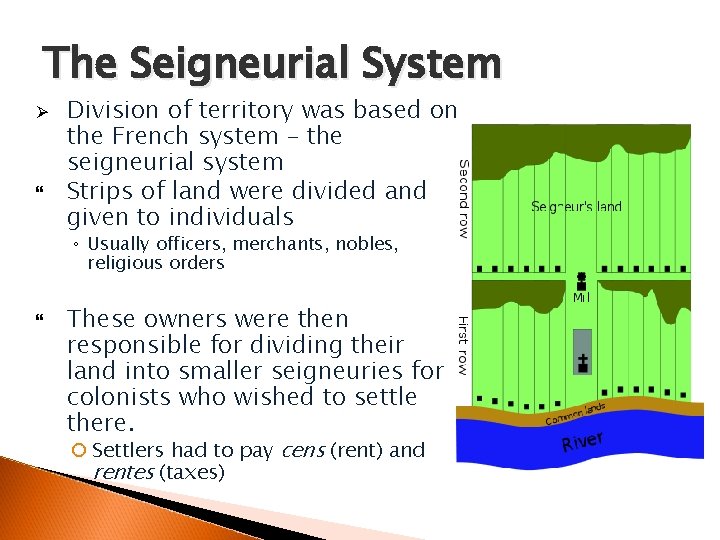
The Seigneurial System Ø Division of territory was based on the French system – the seigneurial system Strips of land were divided and given to individuals ◦ Usually officers, merchants, nobles, religious orders These owners were then responsible for dividing their land into smaller seigneuries for colonists who wished to settle there. Settlers had to pay cens (rent) and rentes (taxes)
Other Economic Activities: Farming Surplus was collected and sold by merchants to fishers, those living in cities, or other French colonies (Louisbourg, Antilles) Little of the surplus was sent back to France Agricultural products included: ◦ ◦ ◦ ◦ Wheat Oats Peas, beans Carrots Corn Onions Squash
Other Economic Activities: Iron Shipbuilding and ironworks industries were created to diversify the economy of New France: ◦ Shipyards were created to build ships for the French Navy Led to the creation of other industries related to shipbuilding (tar, rope, barrels. . . ) ◦ Ironworks industries were established in the Saint Maurice region Created parts for ships, wood stoves, cooking pots, ploughs. . . )
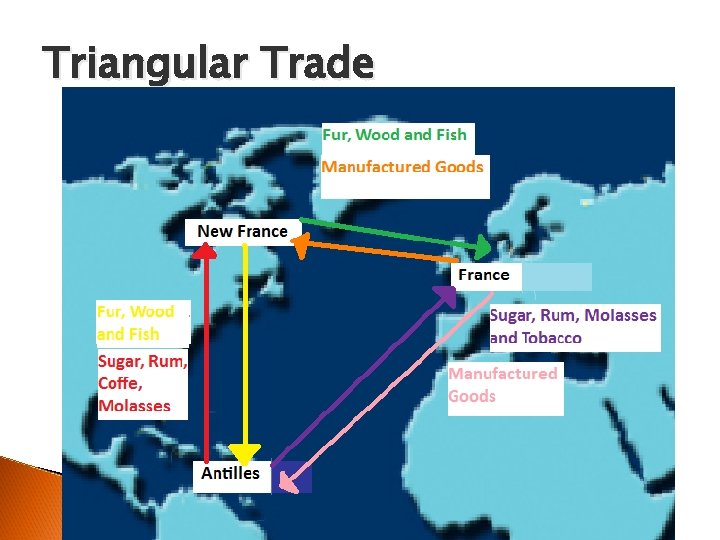
Triangular Trade According to the principles of mercantilism, colonies could not trade with other empires (New France could only trade with other French colonies) Merchants who organized trips between two colonies and the mother country created a triangular trade system.
Triangular Trade
The Conquest - 1760 Though New France was able to diversify its economy, the small population and European warfare, contributed to the defeat of the French by the British in 1760 The colony would now be under British Rule and become part of their trading system