
Economics Vocabulary Chapter 3 Section 1 Demand Quantity
Economics Vocabulary Chapter 3 Section 1 Demand Quantity Demanded Law of demand Purchasing power Income effect Substitution effect Diminishing marginal utility Demand schedule Demand curve
Economics Vocabulary Chapter 3 Section 1 Demand – the amount of a good or service that a consumer is willing and able to buy at various possible prices during a given time period Quantity Demanded – the amount a good or service that a consumer is willing and able to buy at each particular price during a given time period
Economics Vocabulary Chapter 3 Section 1 Law of demand – relationship between price and the quantity demanded • increase in price causes a decrease in demand • decrease in price causes an increase in demand
Economics Vocabulary Chapter 3 Section 1 Income effect – any increase or decrease in consumer’s purchasing power tends to decrease his or her demand Substitution effect – describes the tendency of consumers to substitute a similar, lower-priced product for another product that is relatively more expensive Diminishing marginal utility – utility of each unit consumed diminishes, or lessons with each additional unit
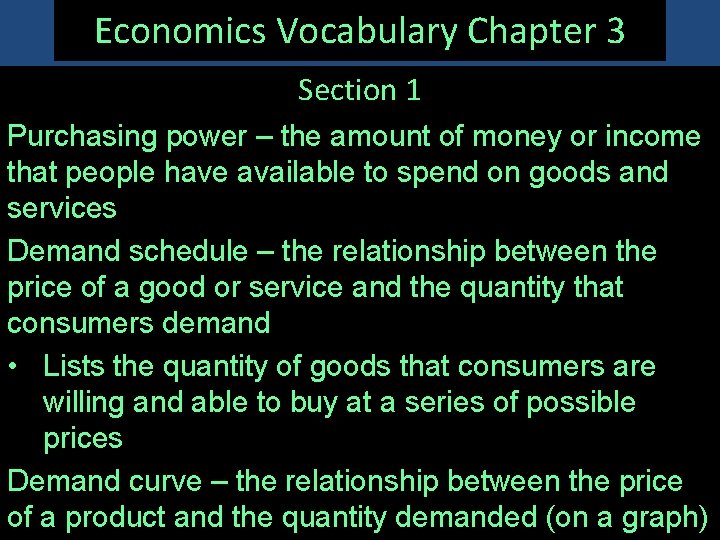
Economics Vocabulary Chapter 3 Section 1 Purchasing power – the amount of money or income that people have available to spend on goods and services Demand schedule – the relationship between the price of a good or service and the quantity that consumers demand • Lists the quantity of goods that consumers are willing and able to buy at a series of possible prices Demand curve – the relationship between the price of a product and the quantity demanded (on a graph)
Economics Vocabulary Chapter 3 Section 2 Determinants of demand Substitute goods Complementary goods
Economics Vocabulary Chapter 3 Section 2 Demand curve – shows the quantity of a good or service demanded at each price during a specific period of time determinants of demand – Substitute goods Complementary goods
Economics Vocabulary Chapter 3 Section 2 Group of factors that shifts demand • Consumer tastes and preferences • Market size • Income prices of related goods • Consumer expectations
Economics Vocabulary Chapter 3 Section 2 Shifts in Demand • Increase in demand price stays the same Quantity demanded increases (compared to the original quantity) • Decrease in demand price stays the same Quantity demanded decreases (compared to the original quantity)
Economics Vocabulary Chapter 3 Section 2 Substitute goods – good that can be used to replace the purchase of similar goods when prices rise Complementary goods – Goods that are commonly used with other goods
Economics Vocabulary Chapter 3 Section 2 Elasticity of Demand- the degrees to which changes in a good’s price affects the quantity demanded by consumers. 2 types • Elastic demand • Inelastic demand
Economics Vocabulary Chapter 3 Section 2 • • • Elastic demand The product is not a necessity There are readily available substitutes The product’s cost represents a large portion of consumer’s income
Economics Vocabulary Chapter 3 Section 2 Inelastic demand • The product is a necessity • There are few or no readily available substitutes • The product’s cost represents a small portion of consumer’s income
Economics Vocabulary Chapter 3 Section 3 3 characteristics that determines if a product is elastic or inelastic • Is the product a necessity? • Does the product have a number of available substitutes? • Does the product’s cost represent a small or large portion of consumers’ income
Economics Vocabulary Chapter 3 Section 3 Total-revenue – also known as total receipts – refers to the total income that a business receives from selling its products. Can businesses or manufacturers change the demand elasticity of their product to increase revenue? HOW?
Economics Chapter 3 -3 Section 2 Can a product be both elastic and inelastic at the same time? Give an example for yes or no
- Slides: 16