
ECONOMICS UNIT FOUR International Economics THURSDAY FEBRUARY TH
ECONOMICS UNIT FOUR International Economics
THURSDAY, FEBRUARY TH 28 Good morning/afternoon! As you enter, please: v Sit in your old assigned seat (still working on new seating…hopefully tomorrow!) v Front Table – pick up a Unit 4 Summary (if you don’t already have one) and a Expedition Econ to complete v Also, pick up a Financial Literacy Post-Test and complete it the best you can – I’ll collect them shortly!
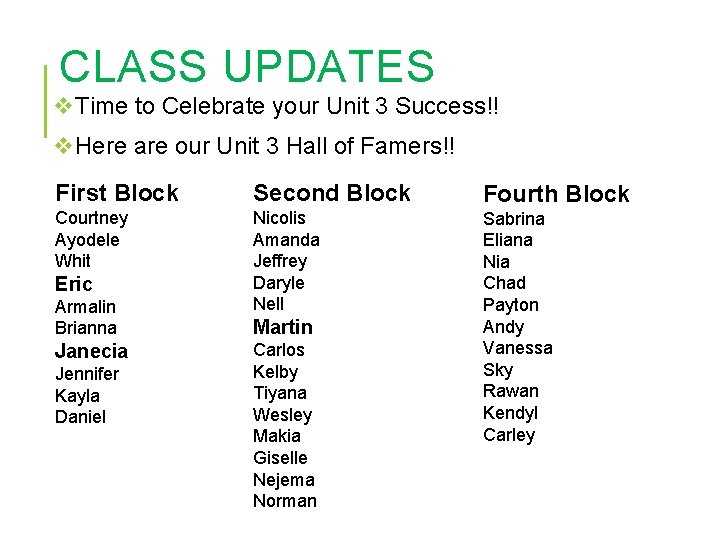
CLASS UPDATES v. Time to Celebrate your Unit 3 Success!! v. Here are our Unit 3 Hall of Famers!! First Block Second Block Fourth Block Courtney Ayodele Whit Nicolis Amanda Jeffrey Daryle Nell Sabrina Eliana Nia Chad Payton Andy Vanessa Sky Rawan Kendyl Carley Eric Armalin Brianna Janecia Jennifer Kayla Daniel Martin Carlos Kelby Tiyana Wesley Makia Giselle Nejema Norman
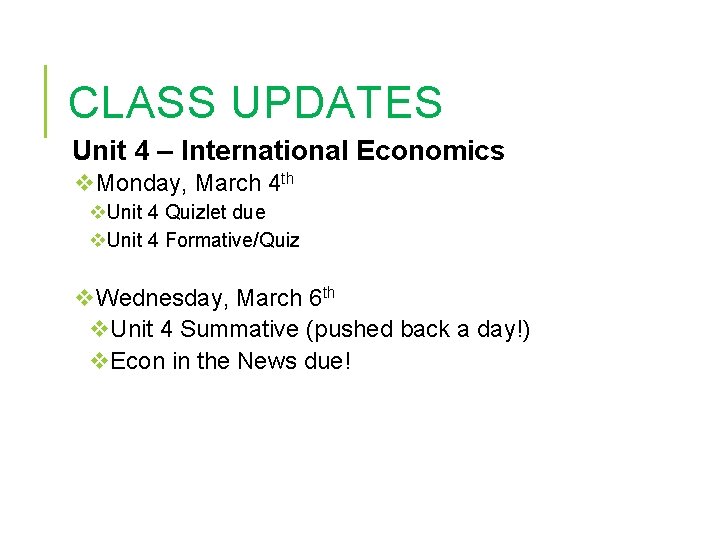
CLASS UPDATES Unit 4 – International Economics v. Monday, March 4 th v. Unit 4 Quizlet due v. Unit 4 Formative/Quiz v. Wednesday, March 6 th v. Unit 4 Summative (pushed back a day!) v. Econ in the News due!
CLASS UPDATES Unit 5 – Personal Finance – estimated timing v. Kick-off Thursday, March 7 th v. Wednesday, March 13 th – Formative & Quizlet due v. Friday, March 15 th – Unit 5 Summative Friday – March 15 th – Final due date for ANY make-up work! No Exceptions!

CLASS UPDATES Remaining Tutoring Opportunities v. Today! v. Mondays – March 4 th and 11 th v. Thursdays – March 7 th and 14 th Econ Review Sessions v. Wednesday, March 13 th (early release day) – 12: 303: 30 pm v. Saturday, March 16 th – 8: 30 – 12: 30 pm
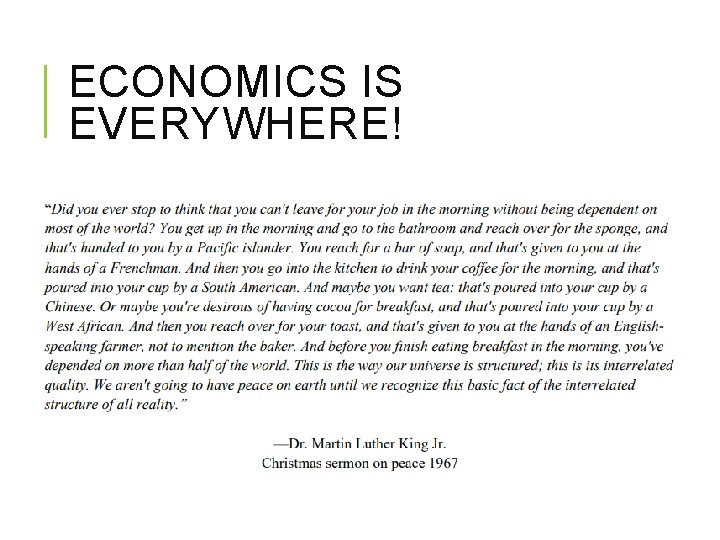
ECONOMICS IS EVERYWHERE!
ECON BIG IDEAS Voluntary Exchange Scarcity Opportunity Cost
UNIT FOUR – INTERNATIONAL ECONOMICS SSEIN 1 Explain why individuals, businesses, and governments trade goods and services. a. Define and distinguish between absolute advantage and comparative advantage. b. Explain that most trade takes place because of comparative advantage in the production of a good or service. c. Define balance of trade, trade surplus, and trade deficit
GETTING STARTED Global Trade Shift Happens – Original Did You Know 2018
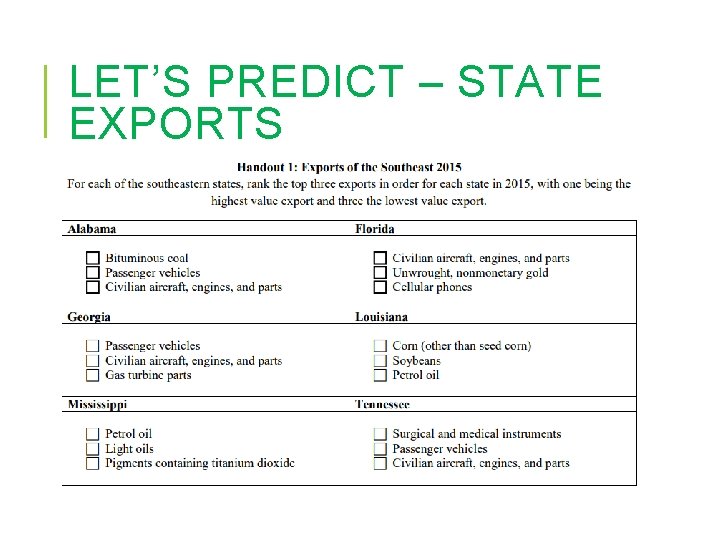
LET’S PREDICT – STATE EXPORTS
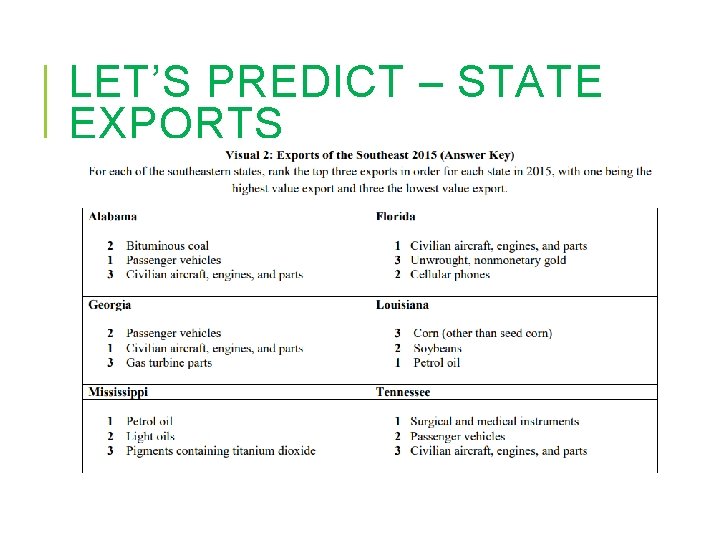
LET’S PREDICT – STATE EXPORTS
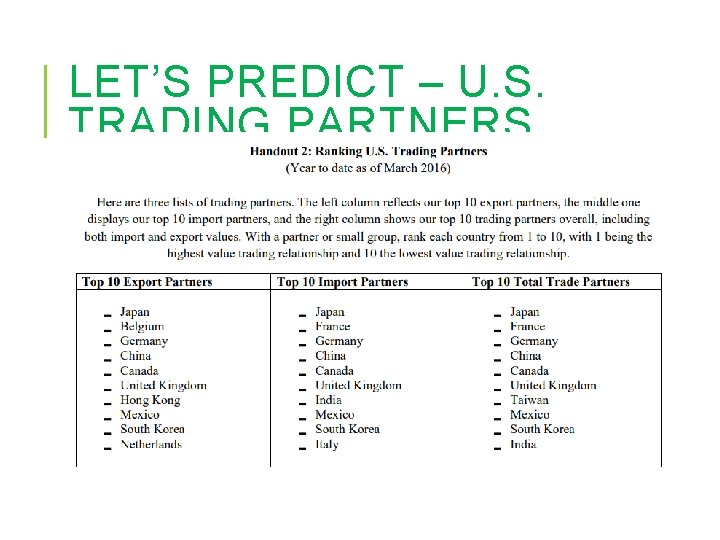
LET’S PREDICT – U. S. TRADING PARTNERS
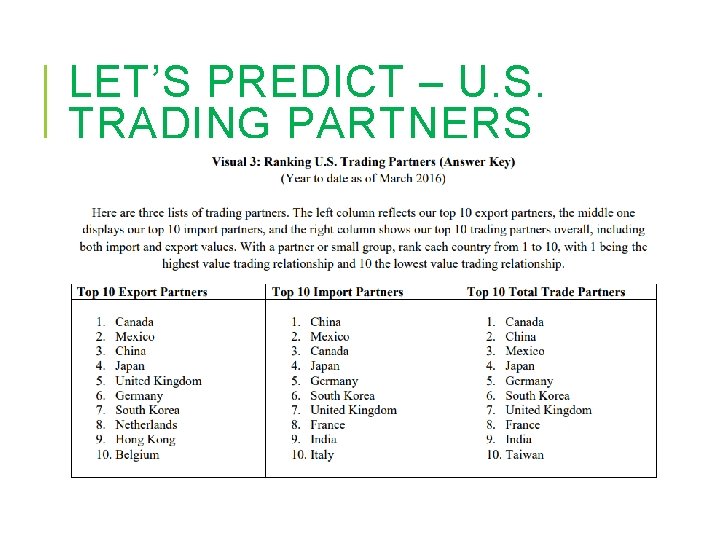
LET’S PREDICT – U. S. TRADING PARTNERS
Absolutely Comparative Advantage Unit 4
As a class, brainstorm possible answers to the question: Do yo u h ave an y l o ti o n ? Why do countries trade?
Countries trade because… • they cannot produce a product domestically. • to have a wider variety of goods available to consumers. • even if a they can produce a product, if another country specializes it that item, buying it from them may increase quality and decrease the price. • they wish to conserve limited resources. • other countries have an advantage. Specialize- a task assigned to one person or group that does it more efficiently
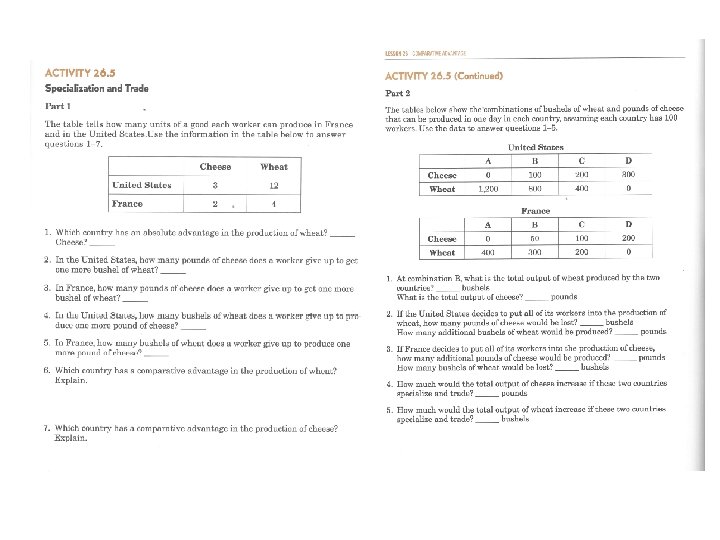
I can make m o r e th a n yo u can Type of Advantage There are 2 types of advantage. • Absolute Advantage • Comparative Advantage Anything you can do I can do better Advantage- a condition or circumstance that puts one in a favorable position
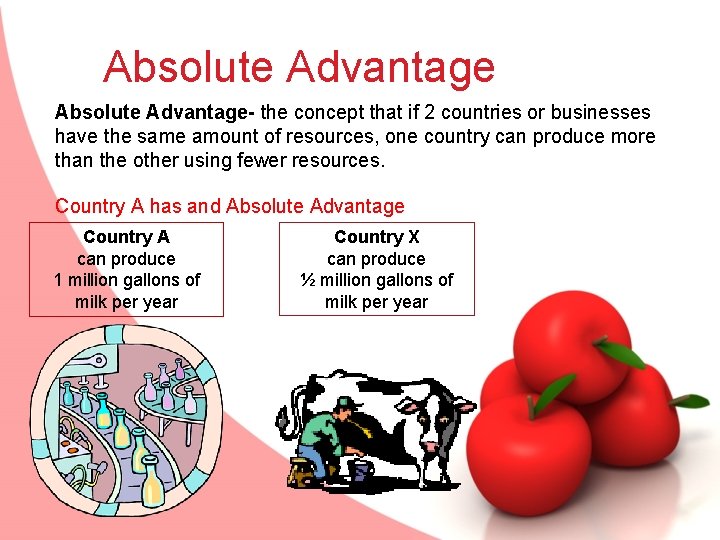
Absolute Advantage- the concept that if 2 countries or businesses have the same amount of resources, one country can produce more than the other using fewer resources. Country A has and Absolute Advantage Country A can produce 1 million gallons of milk per year Country X can produce ½ million gallons of milk per year
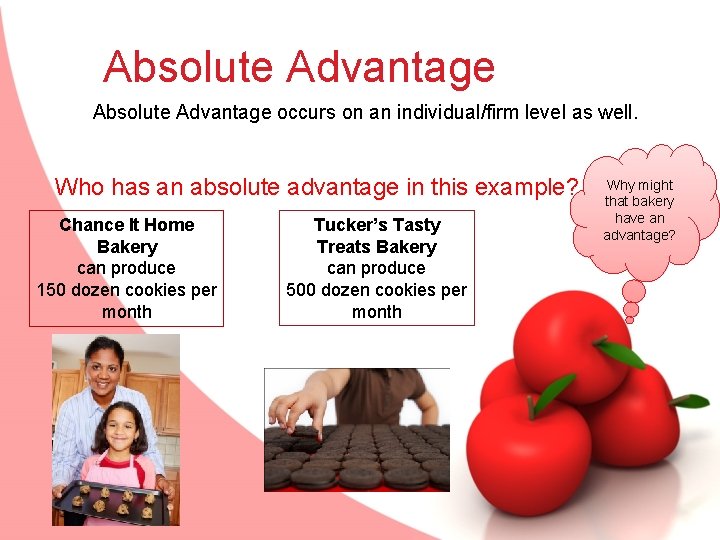
Absolute Advantage occurs on an individual/firm level as well. Who has an absolute advantage in this example? Chance It Home Bakery can produce 150 dozen cookies per month Tucker’s Tasty Treats Bakery can produce 500 dozen cookies per month Why might that bakery have an advantage?
Is Absolute Advantage Everything? Does this mean that Chance It Home Bakery should go out of business because they cannot make as many cookies as Tucker’s Tasty Treats? The answer is no. Absolutely advantage is not the best way to determine who should produce. Can you think of a reason or an example of why Chance It bakery should continue making cookies? L e t’ s co mp are co st
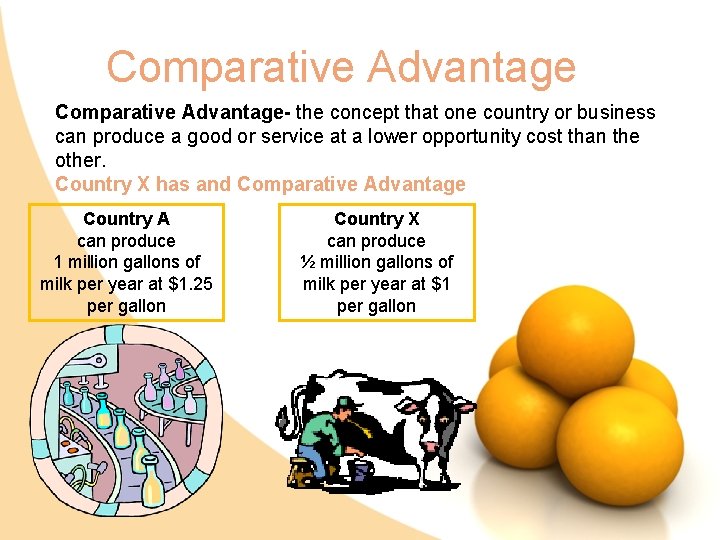
Comparative Advantage- the concept that one country or business can produce a good or service at a lower opportunity cost than the other. Country X has and Comparative Advantage Country A can produce 1 million gallons of milk per year at $1. 25 per gallon Country X can produce ½ million gallons of milk per year at $1 per gallon
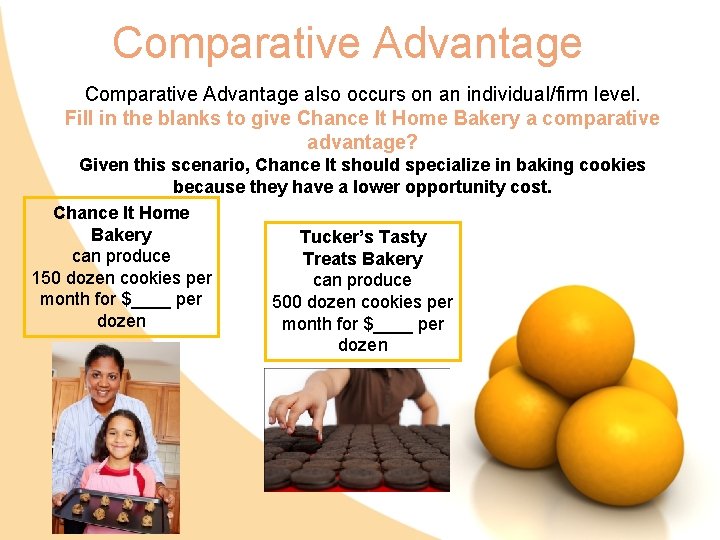
Comparative Advantage also occurs on an individual/firm level. Fill in the blanks to give Chance It Home Bakery a comparative advantage? Given this scenario, Chance It should specialize in baking cookies because they have a lower opportunity cost. Chance It Home Bakery Tucker’s Tasty can produce Treats Bakery 150 dozen cookies per can produce month for $____ per 500 dozen cookies per dozen month for $____ per dozen
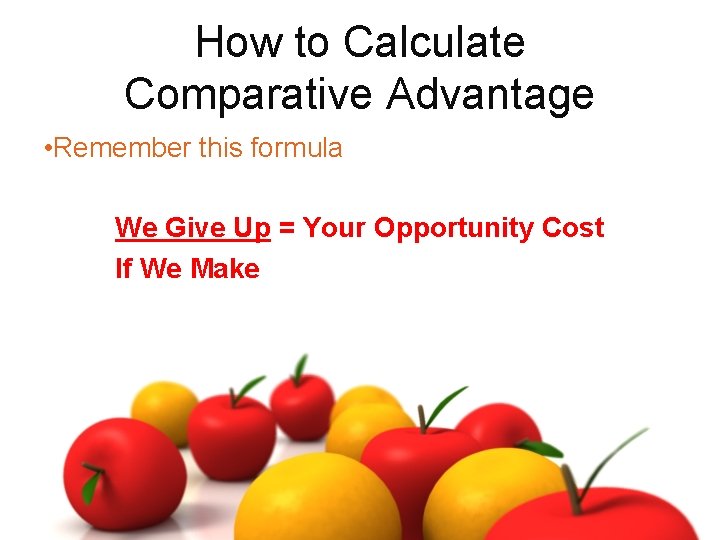
How to Calculate Comparative Advantage • Remember this formula We Give Up = Your Opportunity Cost If We Make
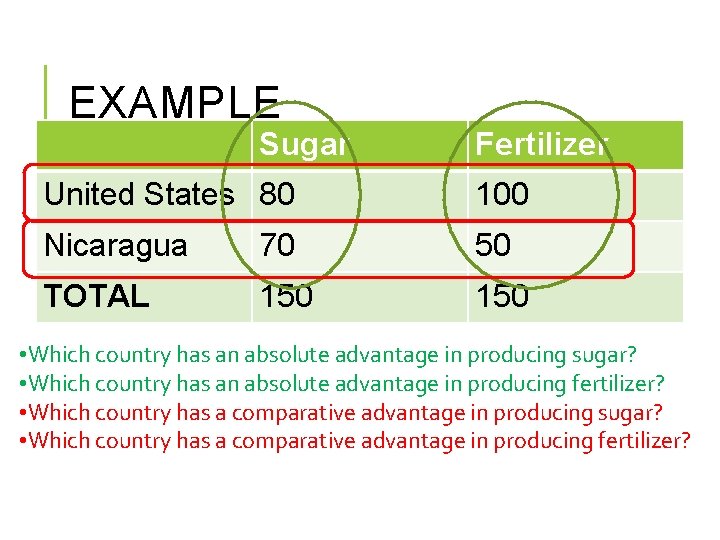
EXAMPLE Sugar Fertilizer United States 80 100 Nicaragua 70 50 TOTAL 150 • Which country has an absolute advantage in producing sugar? • Which country has an absolute advantage in producing fertilizer? • Which country has a comparative advantage in producing sugar? • Which country has a comparative advantage in producing fertilizer?
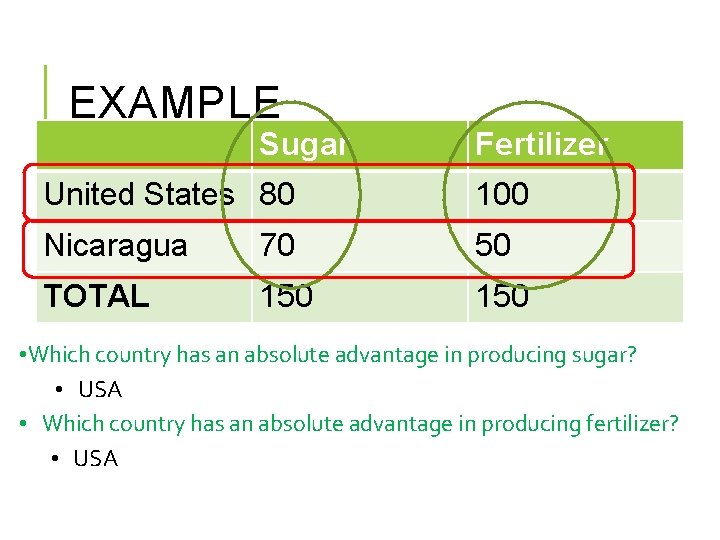
EXAMPLE Sugar Fertilizer United States 80 100 Nicaragua 70 50 TOTAL 150 • Which country has an absolute advantage in producing sugar? • USA • Which country has an absolute advantage in producing fertilizer? • USA
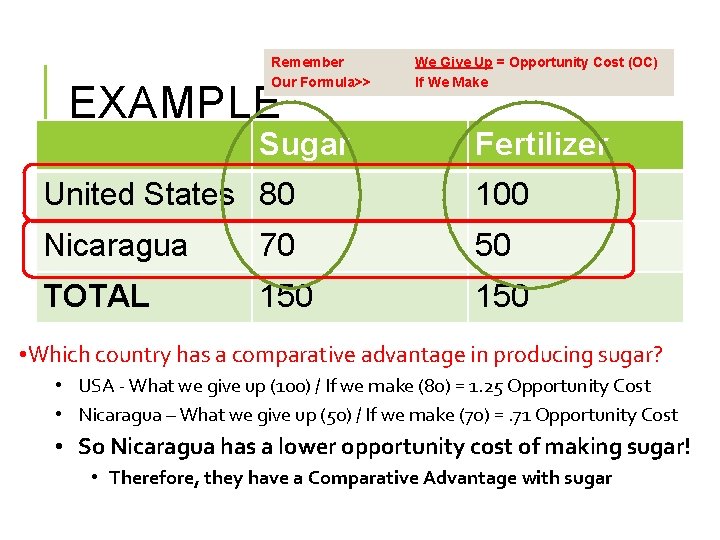
Remember Our Formula>> EXAMPLE Sugar We Give Up = Opportunity Cost (OC) If We Make Fertilizer United States 80 100 Nicaragua 70 50 TOTAL 150 • Which country has a comparative advantage in producing sugar? • USA - What we give up (100) / If we make (80) = 1. 25 Opportunity Cost • Nicaragua – What we give up (50) / If we make (70) =. 71 Opportunity Cost • So Nicaragua has a lower opportunity cost of making sugar! • Therefore, they have a Comparative Advantage with sugar
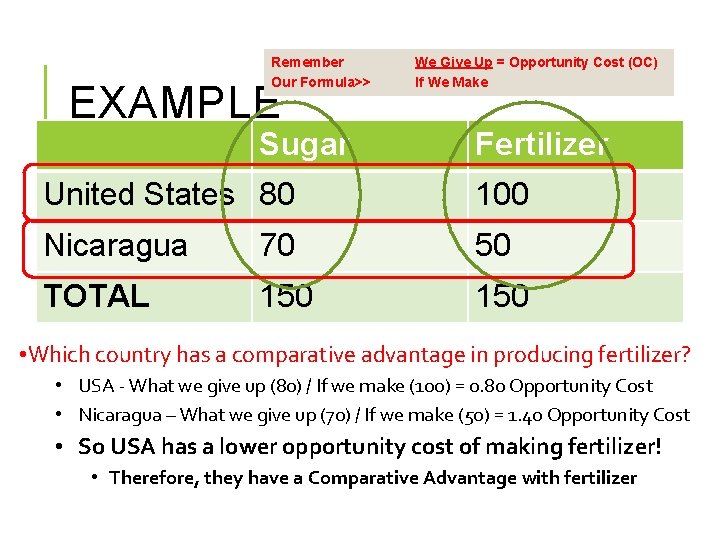
Remember Our Formula>> EXAMPLE Sugar We Give Up = Opportunity Cost (OC) If We Make Fertilizer United States 80 100 Nicaragua 70 50 TOTAL 150 • Which country has a comparative advantage in producing fertilizer? • USA - What we give up (80) / If we make (100) = 0. 80 Opportunity Cost • Nicaragua – What we give up (70) / If we make (50) = 1. 40 Opportunity Cost • So USA has a lower opportunity cost of making fertilizer! • Therefore, they have a Comparative Advantage with fertilizer
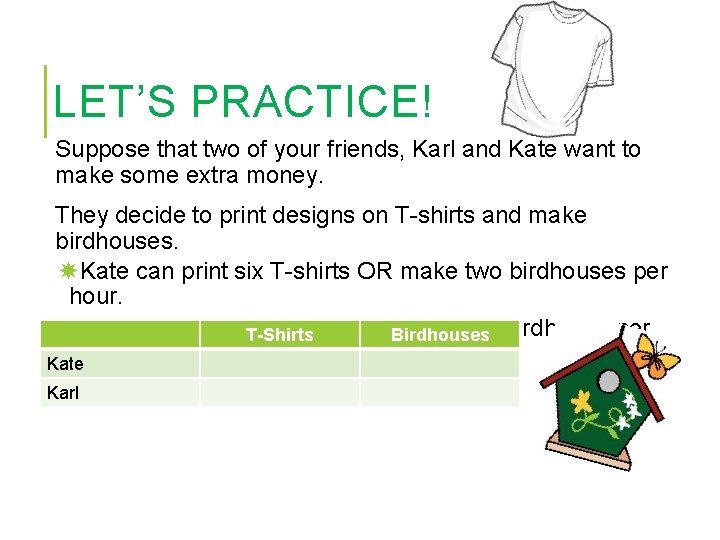
LET’S PRACTICE! Suppose that two of your friends, Karl and Kate want to make some extra money. They decide to print designs on T-shirts and make birdhouses. Kate can print six T-shirts OR make two birdhouses per hour. Karl can print one T-shirt OR Birdhouses make one birdhouse per T-Shirts hour. Kate Karl
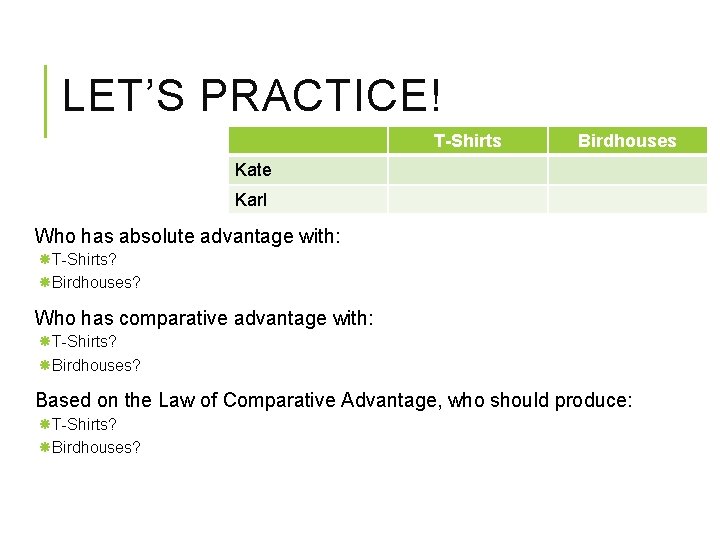
LET’S PRACTICE! T-Shirts Birdhouses Kate Karl Who has absolute advantage with: T-Shirts? Birdhouses? Who has comparative advantage with: T-Shirts? Birdhouses? Based on the Law of Comparative Advantage, who should produce: T-Shirts? Birdhouses?
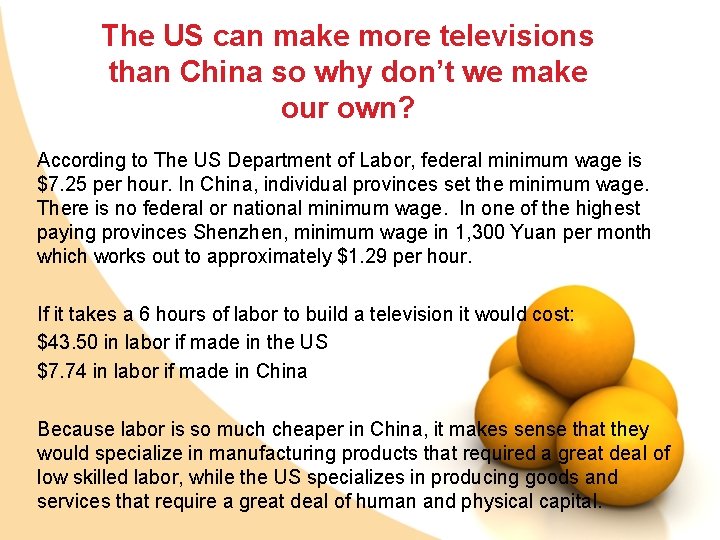
The US can make more televisions than China so why don’t we make our own? According to The US Department of Labor, federal minimum wage is $7. 25 per hour. In China, individual provinces set the minimum wage. There is no federal or national minimum wage. In one of the highest paying provinces Shenzhen, minimum wage in 1, 300 Yuan per month which works out to approximately $1. 29 per hour. If it takes a 6 hours of labor to build a television it would cost: $43. 50 in labor if made in the US $7. 74 in labor if made in China Because labor is so much cheaper in China, it makes sense that they would specialize in manufacturing products that required a great deal of low skilled labor, while the US specializes in producing goods and services that require a great deal of human and physical capital.
Friday, March 1 st • Good morning/afternoon! • As you come in, please: – Sit in your (possibly new) seat! – Front Table – Pick up a Day 2 Expedition Econ and complete it using your Unit 4 Info Summary!
Class Updates • Unit 4 – International Economics v. Monday, March 4 th v. Unit 4 Quizlet due v. Unit 4 Formative/Quiz v. Wednesday, March 6 th v. Unit 4 Summative (pushed back a day!) v. Econ in the News due!
Class Updates Unit 5 – Personal Finance – estimated timing v. Kick-off Thursday, March 7 th v. Wednesday, March 13 th – Formative & Quizlet due v. Friday, March 15 th – Unit 5 Summative Friday – March 15 th – Final due date for ANY make-up work! No Exceptions!

Class Updates Remaining Tutoring Opportunities v. Mondays – March 4 th and 11 th v. Thursdays – March 7 th and 14 th Econ Review Sessions v. Wednesday, March 13 th (early release day) – 12: 303: 30 pm v. Saturday, March 16 th – 8: 30 – 12: 30 pm
Strike a Balance D o e s th i s l eaf make me l o o k ta s ty ? When countries trade, it is important to keep a balance of goods exported and imported. The term balance of trade refers to the value of all goods and services exported minus the value of all goods and services imported. If a countries exports exceed its imports, then the country has a trade surplus. If the country imports more than it exports, then there is a trade deficit. Balance of Payments is how countries keep track of all monetary transactions in each sector(public and private) of the international market. It is the difference between the money a country pays out for imports and the money a country gets paid from other countries for exports.
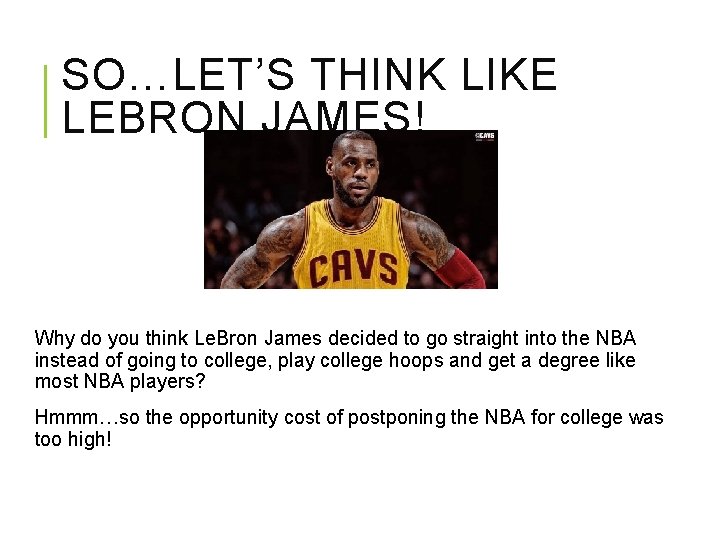
SO…LET’S THINK LIKE LEBRON JAMES! Why do you think Le. Bron James decided to go straight into the NBA instead of going to college, play college hoops and get a degree like most NBA players? Hmmm…so the opportunity cost of postponing the NBA for college was too high!

SO…SHOULD LEBRON MOW HIS OWN GRASS? Let’s assume that Le. Bron is a great basketball player and a great lawn mower. However, Le. Bron has a young neighbor named Scotty who is willing to mow his lawn. Le. Bron $10, 000 Choices: 1. Mow his lawn in two hours 2. Make a Nike commercial in two hours for So, the opportunity cost of mowing his own yard is $10, 000

SCOTTY…LEBRON’S NEIGHBOR Neighbor Scotty’s choices: 1. Mow Le. Bron’s yard in 4 hours 2. Work at Mc. Donalds for 4 hours and earn $8. 00/hour Scotty’s opportunity cost for mowing Le. Bron’s yard is $32.

SO WHO HAS THE ABSOLUTE ADVANTAGE? Le. Bron needs 2 hours to mow Scotty needs 4 hours His yard to mow Le. Bron’s yard Absolute Advantage – Le. Bron can do it in less time, so Le. Bron is better at mowing than Scotty.
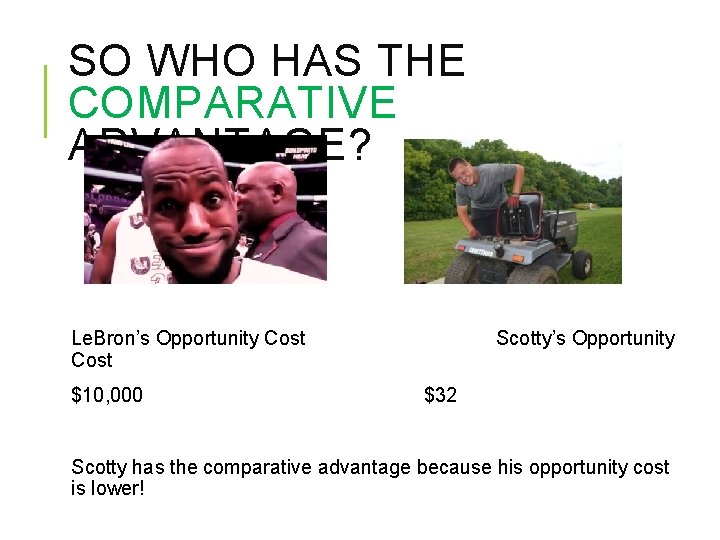
SO WHO HAS THE COMPARATIVE ADVANTAGE? Le. Bron’s Opportunity Cost $10, 000 Scotty’s Opportunity $32 Scotty has the comparative advantage because his opportunity cost is lower!
SO WOULD LEBRON BENEFIT FROM A TRADE? While Le. Bron is better at mowing than Scotty (absolute advantage), his opportunity cost is much higher so Scotty has the comparative advantage! Would Le. Bron benefit from a trade? Yes! As long as Le. Bron pays Scotty more than $32 to mow his yard then they both benefit from the trade.
SO EVERYONE BENEFITS! If we specialize at what we’re good at and trade with others for other things we want we all benefit. This is why: ØWe generally don’t grow our own food ØFactories often use assembly lines ØBasketball or football players often specialize in one position as apposed to playing all of them ØI teach economics and government and I DON’T teach chemistry or math! ØWhat examples can you think of?
SPECIALIZATION AND TRADE EVERYONE BENEFITS! We already know specialization and voluntary exchange allow all parties to benefit in an economy Well, the same works for regions and nations! When countries specialize in certain goods, they are able to make more of that good and then benefit from trading with others What a country produces depends on its resources – its natural resources such as land, water, metals and climate and its skilled and educated workers Increases the amount and variety of goods available to all nations; increases efficiency
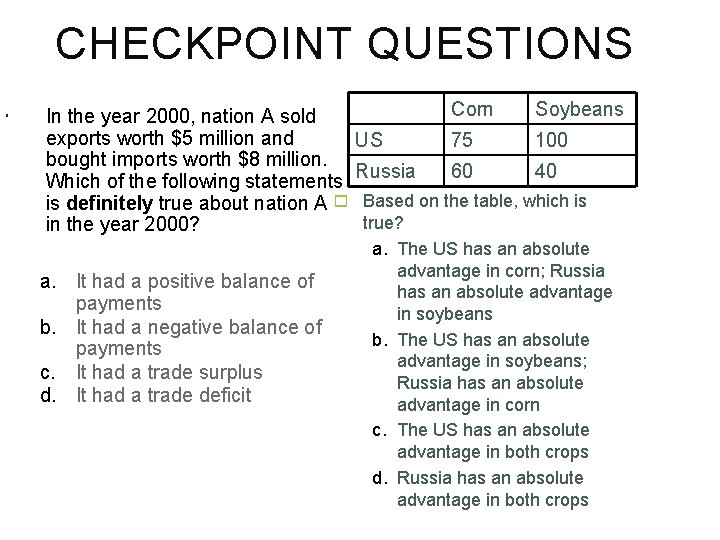
CHECKPOINT QUESTIONS In the year 2000, nation A sold exports worth $5 million and bought imports worth $8 million. Which of the following statements is definitely true about nation A o in the year 2000? a. It had a positive balance of payments b. It had a negative balance of payments c. It had a trade surplus d. It had a trade deficit Corn Soybeans US 75 100 Russia 60 40 Based on the table, which is true? a. The US has an absolute advantage in corn; Russia has an absolute advantage in soybeans b. The US has an absolute advantage in soybeans; Russia has an absolute advantage in corn c. The US has an absolute advantage in both crops d. Russia has an absolute advantage in both crops
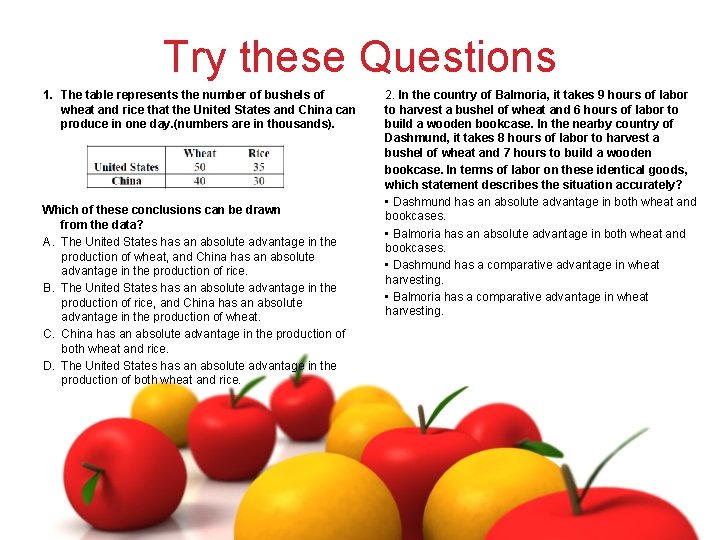
Try these Questions 1. The table represents the number of bushels of wheat and rice that the United States and China can produce in one day. (numbers are in thousands). Which of these conclusions can be drawn from the data? A. The United States has an absolute advantage in the production of wheat, and China has an absolute advantage in the production of rice. B. The United States has an absolute advantage in the production of rice, and China has an absolute advantage in the production of wheat. C. China has an absolute advantage in the production of both wheat and rice. D. The United States has an absolute advantage in the production of both wheat and rice. 2. In the country of Balmoria, it takes 9 hours of labor to harvest a bushel of wheat and 6 hours of labor to build a wooden bookcase. In the nearby country of Dashmund, it takes 8 hours of labor to harvest a bushel of wheat and 7 hours to build a wooden bookcase. In terms of labor on these identical goods, which statement describes the situation accurately? • Dashmund has an absolute advantage in both wheat and bookcases. • Balmoria has an absolute advantage in both wheat and bookcases. • Dashmund has a comparative advantage in wheat harvesting. • Balmoria has a comparative advantage in wheat harvesting.
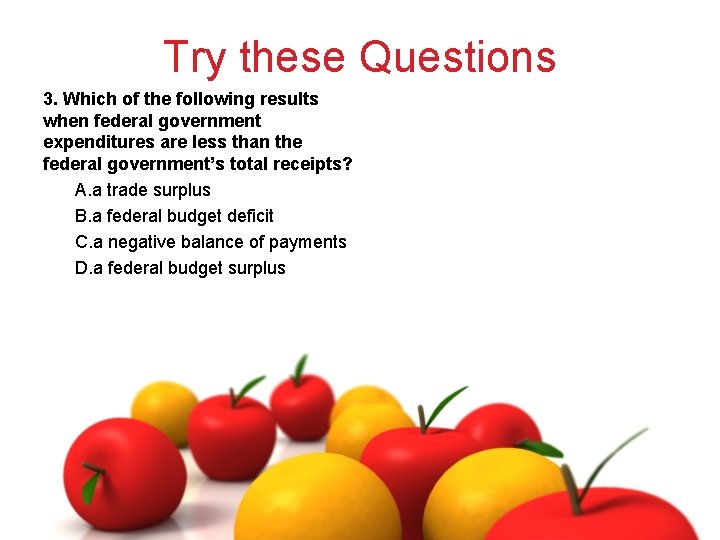
Try these Questions 3. Which of the following results when federal government expenditures are less than the federal government’s total receipts? A. a trade surplus B. a federal budget deficit C. a negative balance of payments D. a federal budget surplus
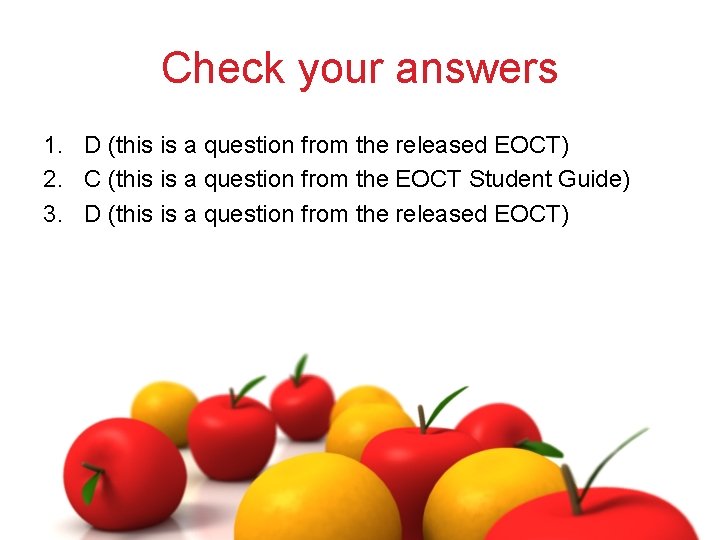
Check your answers 1. D (this is a question from the released EOCT) 2. C (this is a question from the EOCT Student Guide) 3. D (this is a question from the released EOCT)
Let’s Wrap It Up! • ACDC - Comparative Advantage

Let’s Wrap It Up! • Comparative Advantage Practice Sheet – Work with a partner to complete
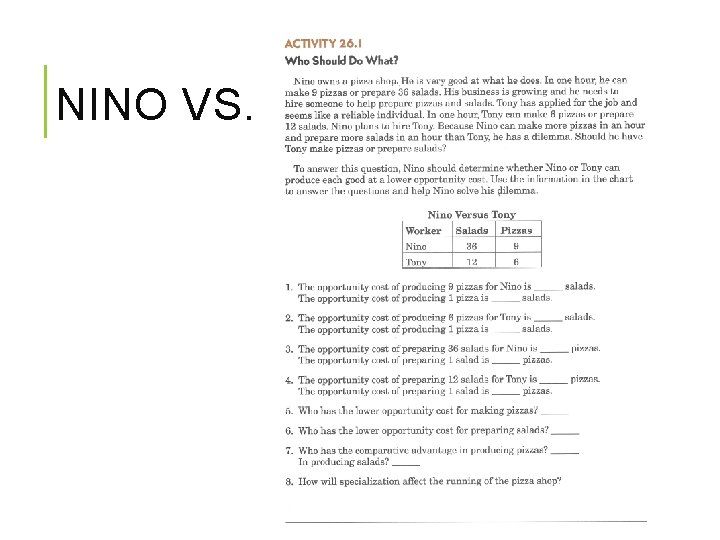
NINO VS. TONY
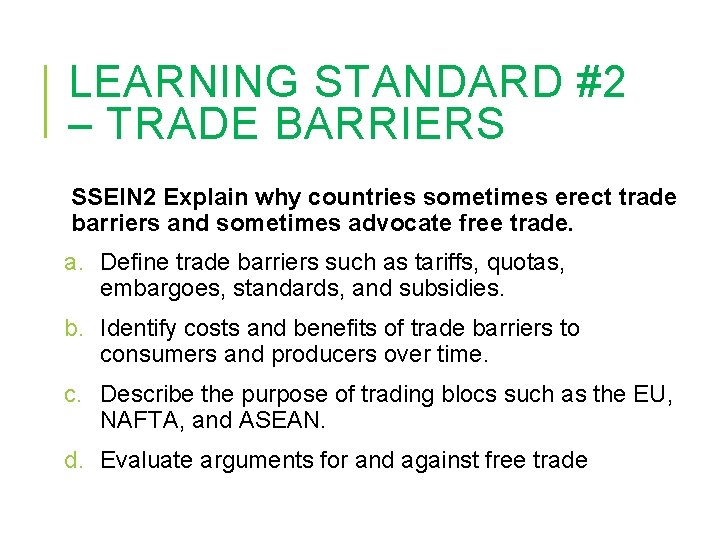
LEARNING STANDARD #2 – TRADE BARRIERS SSEIN 2 Explain why countries sometimes erect trade barriers and sometimes advocate free trade. a. Define trade barriers such as tariffs, quotas, embargoes, standards, and subsidies. b. Identify costs and benefits of trade barriers to consumers and producers over time. c. Describe the purpose of trading blocs such as the EU, NAFTA, and ASEAN. d. Evaluate arguments for and against free trade
TODAY’S LESSON PLAN We’ll study trade barriers today by: Completing our Expedition Econ (which is your Study Guide, too!) Trade Barriers Identification Activity Arguments For and Against Free Trade Guided Notes as homework (remember – if you made an ‘A’ on your Unit 3 test you don’t have to do this! But if you do, it counts as bonus points!)
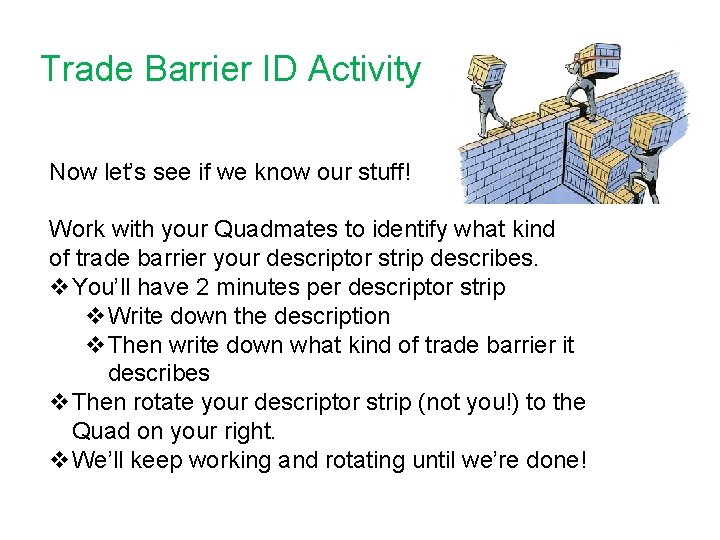
Trade Barrier ID Activity Now let’s see if we know our stuff! Work with your Quadmates to identify what kind of trade barrier your descriptor strip describes. v. You’ll have 2 minutes per descriptor strip v. Write down the description v. Then write down what kind of trade barrier it describes v. Then rotate your descriptor strip (not you!) to the Quad on your right. v. We’ll keep working and rotating until we’re done!
Arguments For and Against Free Trade Is it an argument • FOR 100% Free Trade/No Trade Barriers • Some Trade Barriers are Okay Work with your Quadmates to read, understand then sort each argument onto your T-Chart • https: //www. youtube. com/watch? v=5 ITyd 1 Pzek 0&vl=en • https: //www. washingtonpost. com/business/2018/10/01/us-canadamexico-just-reached-sweeping-new-nafta-deal-heres-whatsit/? noredirect=on&utm_term=. db 539 bbe 6 e 0 c


DAY #2 GUIDED NOTES START HERE!
LET’S REVIEW INTERNATIONAL TRADE When countries trade with other countries, each country gains a higher standard of living. A high degree of economic interdependence exists in the world No country is able to get everything it needs within its own borders. We live in a time in which most countries are moving toward open economies: High degrees of free trade with few trade barriers such as quotas and tariffs.
TRADE EFFICIENCY Absolute Advantage: one country can produce a product at lower cost or with higher labor productivity Comparative Advantage: One country can produce at a lower opportunity cost than another country
WHY NATIONS TRADE Comparative Advantage Uneven distribution of resources Everyone benefits https: //www. youtube. com/watch? v=tz. Xzk. As_ cf 0
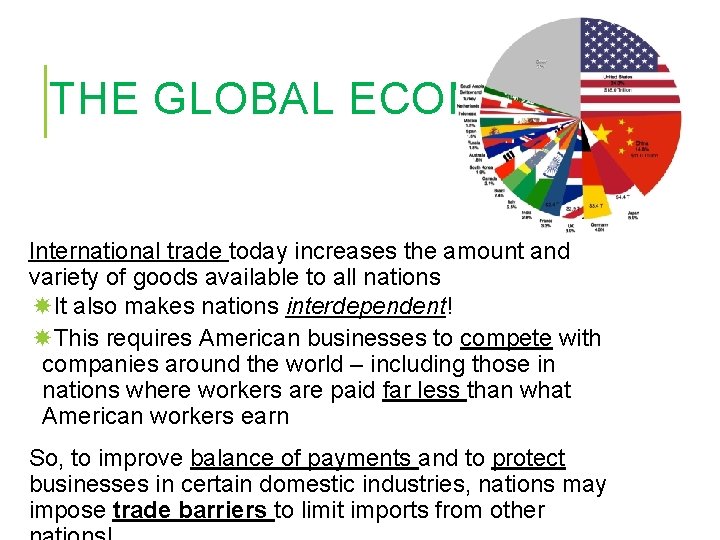
THE GLOBAL ECONOMY International trade today increases the amount and variety of goods available to all nations It also makes nations interdependent! This requires American businesses to compete with companies around the world – including those in nations where workers are paid far less than what American workers earn So, to improve balance of payments and to protect businesses in certain domestic industries, nations may impose trade barriers to limit imports from other
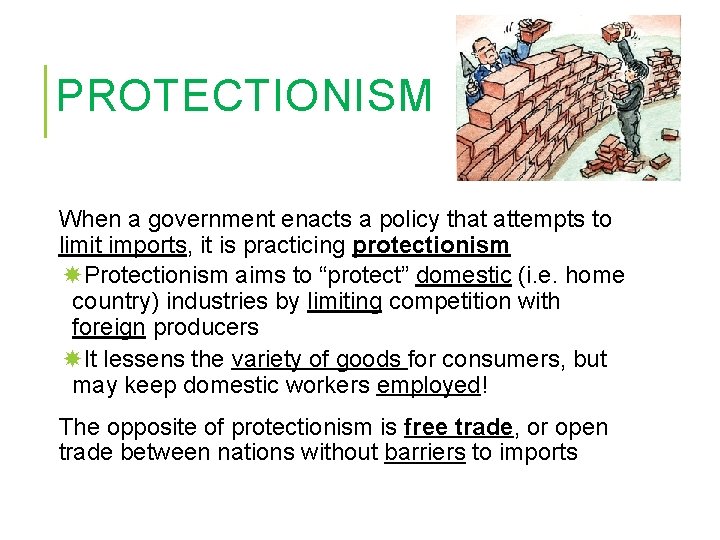
PROTECTIONISM When a government enacts a policy that attempts to limit imports, it is practicing protectionism Protectionism aims to “protect” domestic (i. e. home country) industries by limiting competition with foreign producers It lessens the variety of goods for consumers, but may keep domestic workers employed! The opposite of protectionism is free trade, or open trade between nations without barriers to imports
WHAT ARE TRADE BARRIERS? Attempts to limit imports into a country “Protectionism” is government policy
TYPES OF TRADE BARRIERS #1: Tariffs (tax on certain imports) These make imports more expensive to buy and earn revenue for the government Reduces demand foreign goods => helps nation’s own industries compete Increases govt. revenue => reduces a nation’s budget deficit
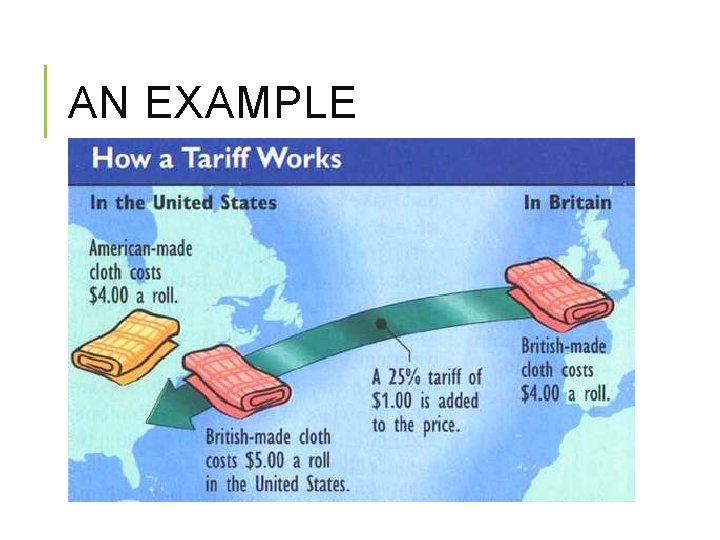
AN EXAMPLE
TYPES OF TRADE BARRIERS #2: Quotas (limit on the # of certain products that can be imported from another country) Example: U. S. forced a limit on the number of cars that could be imported from Japan
TYPES OF TRADE BARRIERS #3: Standards Rules about the quality of imports If imports don’t pass a nation’s standards, they will not be accepted Example: U. S. might ban the import of fruit that has been sprayed with certain pesticides
TYPES OF TRADE BARRIERS #4: Subsidies Direct financial aid to certain domestic industries Lower a firm’s production costs and allow domestic firms to compete with lower-cost imports
TYPES OF TRADE BARRIERS #5: Embargo Total ban on one or more products from a particular nation Often politically motivated => pressures other govts. to change behavior The most famous embargo is the 1970 s oil embargo imposed by OPEC against the US and other western nations The US also had an embargo against Cuba that was recently lifted. https: //study. com/academy/lesson/trade-barriersimpacts-on-prices-demand. html
ARGUMENTS FOR FREE TRADE §Improves economic efficiency §Offers consumers of all nations a wide variety of goods/services §Offers consumers the lowest possible prices
ARGUMENTS AGAINST FREE TRADE §Protection of national security §National security requires access to certain things (energy, military goods, etc. ) §Protection of “infant” industries §New industries with high potential that need help to get started §Protection of domestic jobs

IMPORTANT TRADE AGREEMENTS USA is member of World Trade Organization (WTO) Organization that seeks to reduce protectionism around the world.
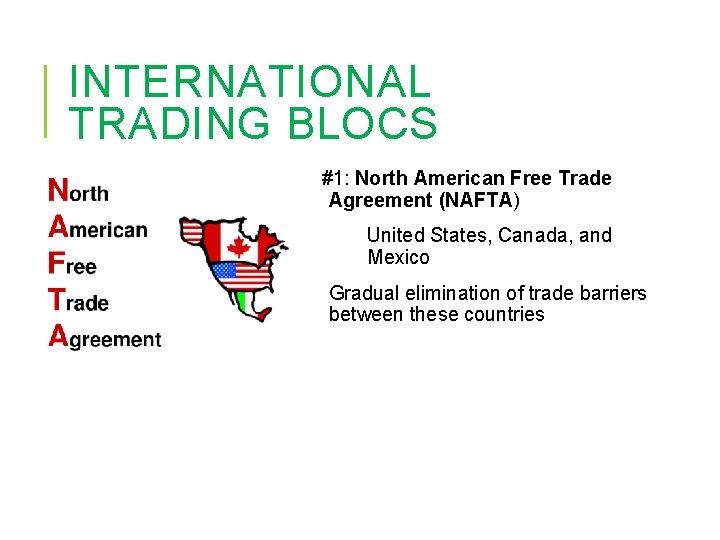
INTERNATIONAL TRADING BLOCS #1: North American Free Trade Agreement (NAFTA) United States, Canada, and Mexico Gradual elimination of trade barriers between these countries
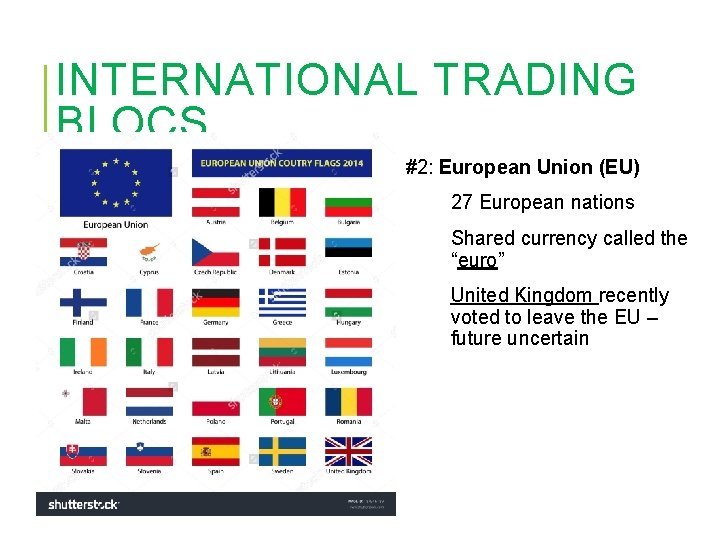
INTERNATIONAL TRADING BLOCS #2: European Union (EU) 27 European nations Shared currency called the “euro” United Kingdom recently voted to leave the EU – future uncertain
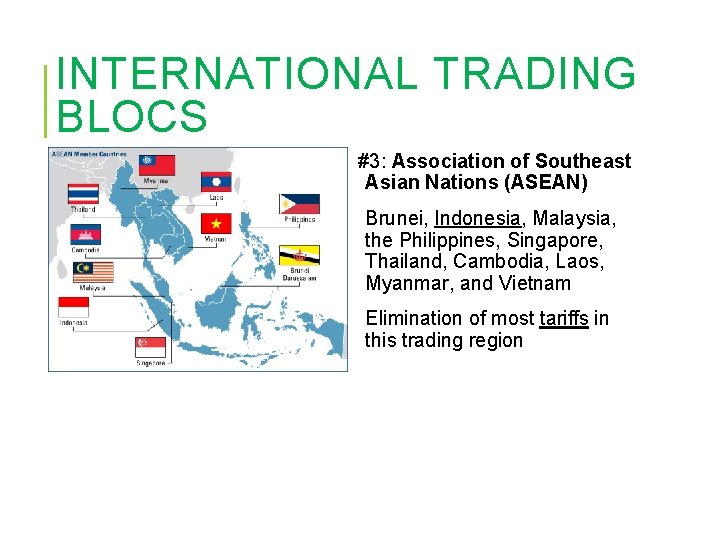
INTERNATIONAL TRADING BLOCS #3: Association of Southeast Asian Nations (ASEAN) Brunei, Indonesia, Malaysia, the Philippines, Singapore, Thailand, Cambodia, Laos, Myanmar, and Vietnam Elimination of most tariffs in this trading region
FOCUS #2 CHECK POINT A person who favors a protectionist trade policy would MOST likely: a. Call for an end to quotas b. Support a reduction in tariffs c. Call for supporting national security and American jobs d. Claim that trade restrictions result in fewer choices and higher prices o What is the most important purpose of NAFTA? a. To increase trade barriers between the US, Canada, and Mexico b. To reduce trade barriers between the US, Canada, and Mexico c. To help the Mexican economy with American and Canadian subsidies d. To compete with the nations of the European Union
MONDAY, MARCH 4 TH Good morning/afternoon! As you enter, please: Sit in your assigned seat Front table – pick up your Day 3 Expedition Econ and complete it using your Unit 4 Summary
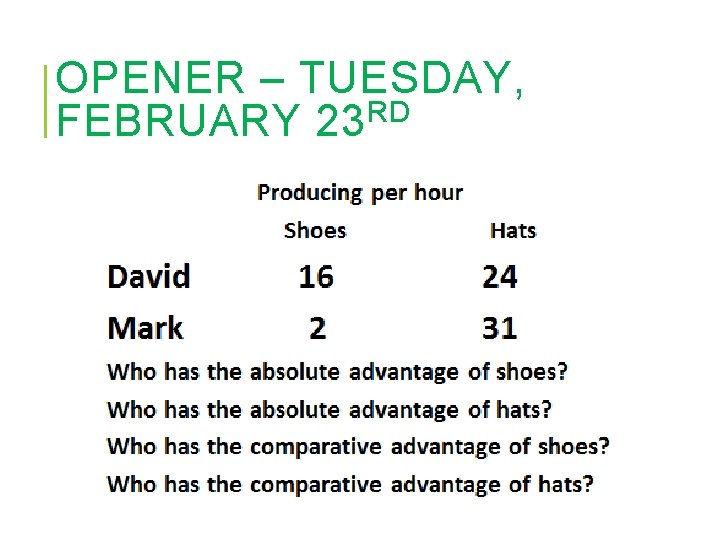
OPENER – TUESDAY, FEBRUARY 23 RD
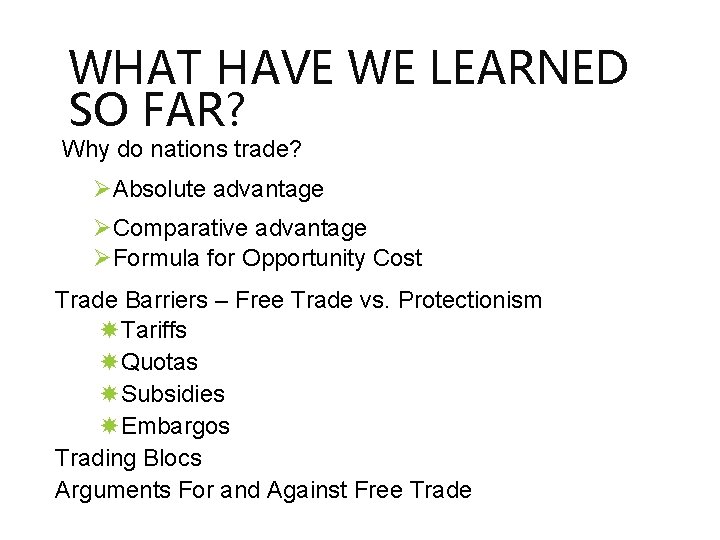
WHAT HAVE WE LEARNED SO FAR? Why do nations trade? ØAbsolute advantage ØComparative advantage ØFormula for Opportunity Cost Trade Barriers – Free Trade vs. Protectionism Tariffs Quotas Subsidies Embargos Trading Blocs Arguments For and Against Free Trade
Squeezing in a Quick Formative Let’s squeeze in a quick formative to see how we’re doing so far. Please turn off all electronics and clear your desk. We’ll complete it with a bubble sheet, followed by the i. Respond handhelds As always, until the last papers are turned in; v. No electronics v. No talking v. No squawking v. No walking v. No gawking
LEARNING STANDARD #3 – EXCHANGE RATES SSEIN 3 Explain how changes in exchange rates can have an impact on the purchasing power of groups in the United States and in other countries. a. Define exchange rate as the price of one nation’s currency in terms of another nation’s currency. b. Interpret changes in exchange rates, in regards to appreciation and depreciation of currency. c. Explain why some groups benefit and others lose when exchange rates change.
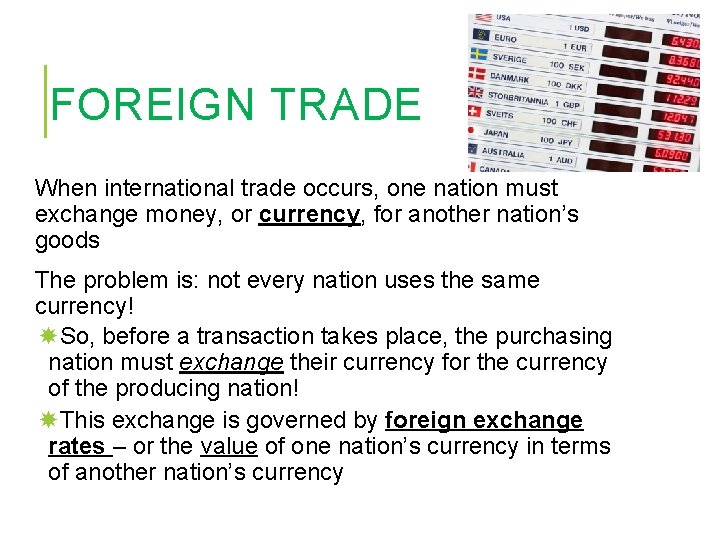
FOREIGN TRADE When international trade occurs, one nation must exchange money, or currency, for another nation’s goods The problem is: not every nation uses the same currency! So, before a transaction takes place, the purchasing nation must exchange their currency for the currency of the producing nation! This exchange is governed by foreign exchange rates – or the value of one nation’s currency in terms of another nation’s currency
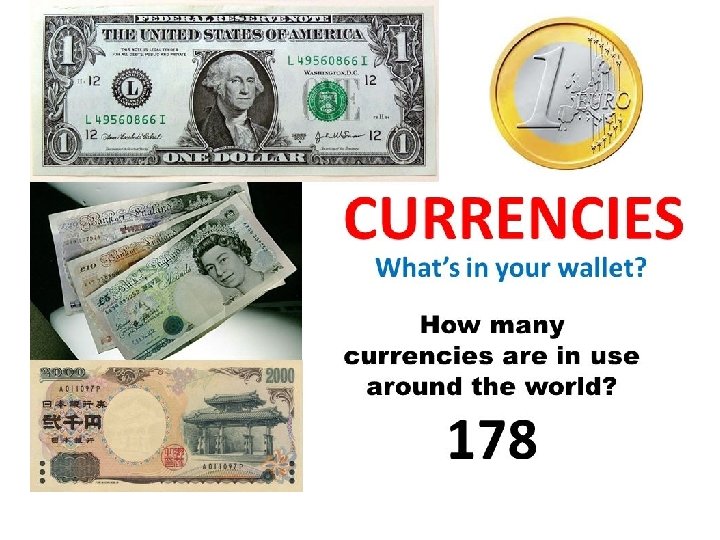
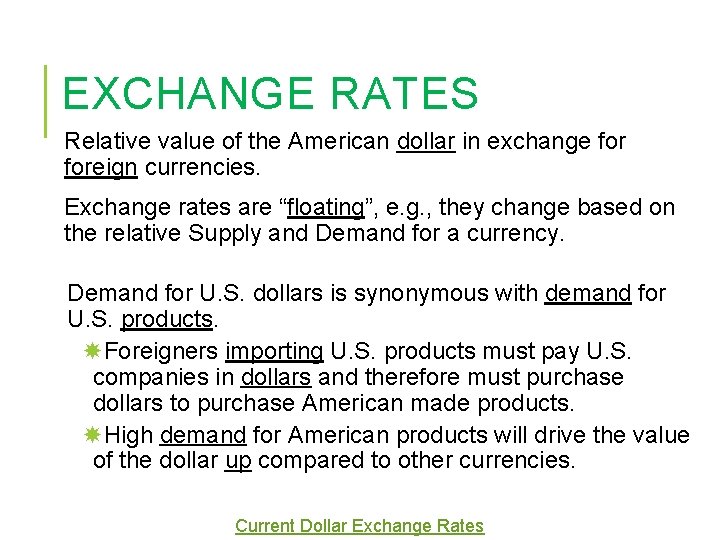
EXCHANGE RATES Relative value of the American dollar in exchange foreign currencies. Exchange rates are “floating”, e. g. , they change based on the relative Supply and Demand for a currency. Demand for U. S. dollars is synonymous with demand for U. S. products. Foreigners importing U. S. products must pay U. S. companies in dollars and therefore must purchase dollars to purchase American made products. High demand for American products will drive the value of the dollar up compared to other currencies. Current Dollar Exchange Rates
FOREIGN EXCHANGE MARKET Derived demand Currencies are bought and sold Largest financial market in the world Operates 24 hours a day
NOMINAL EXCHANGE RATES Rate at which the currency of one country can be exchanged for the currency of another country Depreciate = Weaken = Lose value Appreciate = Strengthen = Gain value
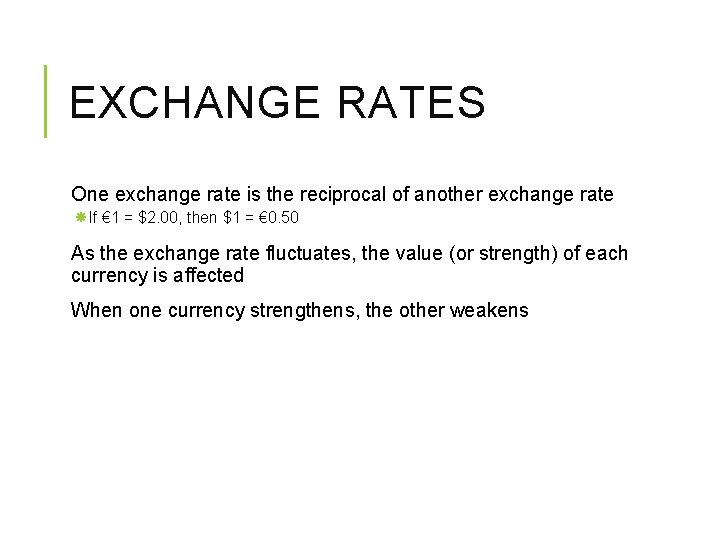
EXCHANGE RATES One exchange rate is the reciprocal of another exchange rate If € 1 = $2. 00, then $1 = € 0. 50 As the exchange rate fluctuates, the value (or strength) of each currency is affected When one currency strengthens, the other weakens
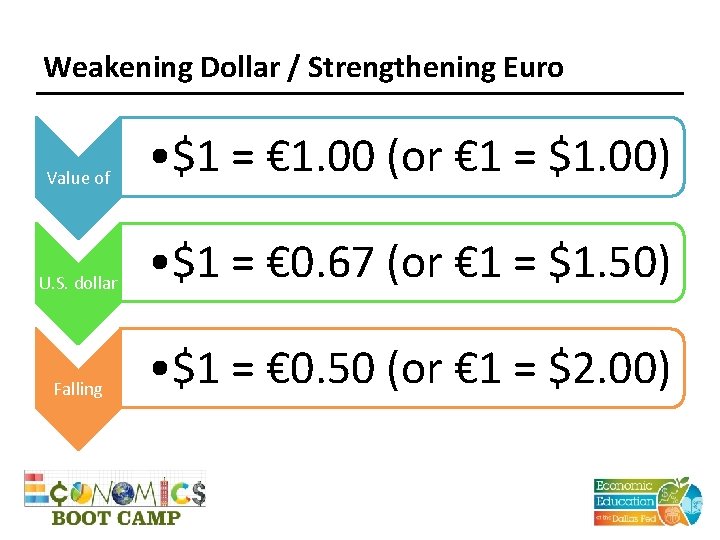
Weakening Dollar / Strengthening Euro Value of • $1 = € 1. 00 (or € 1 = $1. 00) U. S. dollar • $1 = € 0. 67 (or € 1 = $1. 50) Falling • $1 = € 0. 50 (or € 1 = $2. 00)
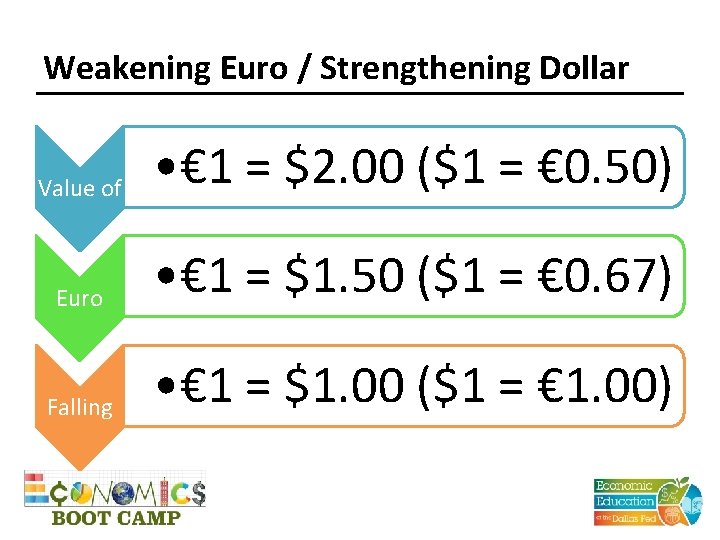
Weakening Euro / Strengthening Dollar Value of • € 1 = $2. 00 ($1 = € 0. 50) Euro • € 1 = $1. 50 ($1 = € 0. 67) Falling • € 1 = $1. 00 ($1 = € 1. 00)
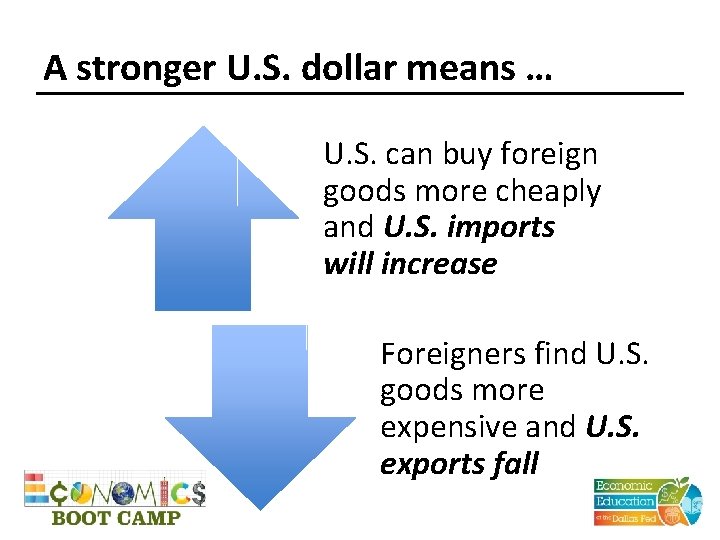
A stronger U. S. dollar means … U. S. can buy foreign goods more cheaply and U. S. imports will increase Foreigners find U. S. goods more expensive and U. S. exports fall
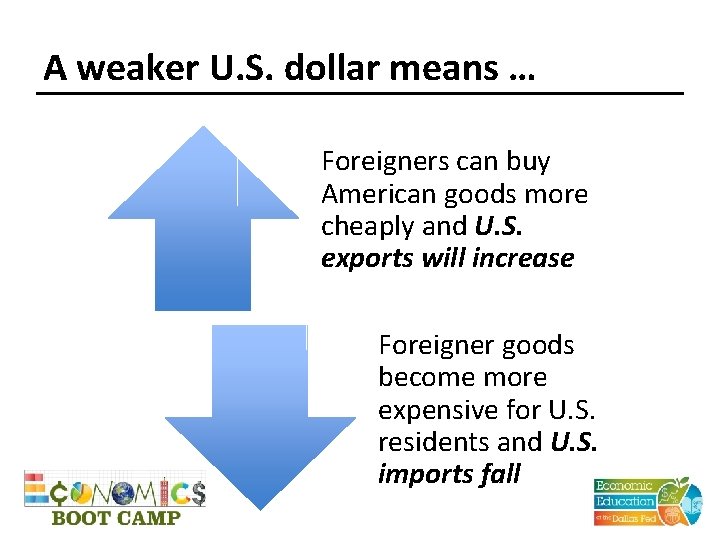
A weaker U. S. dollar means … Foreigners can buy American goods more cheaply and U. S. exports will increase Foreigner goods become more expensive for U. S. residents and U. S. imports fall
AN EXAMPLE
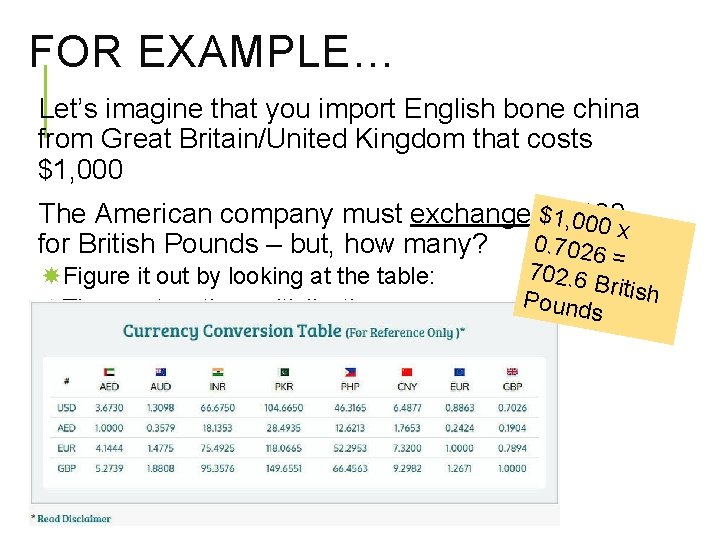
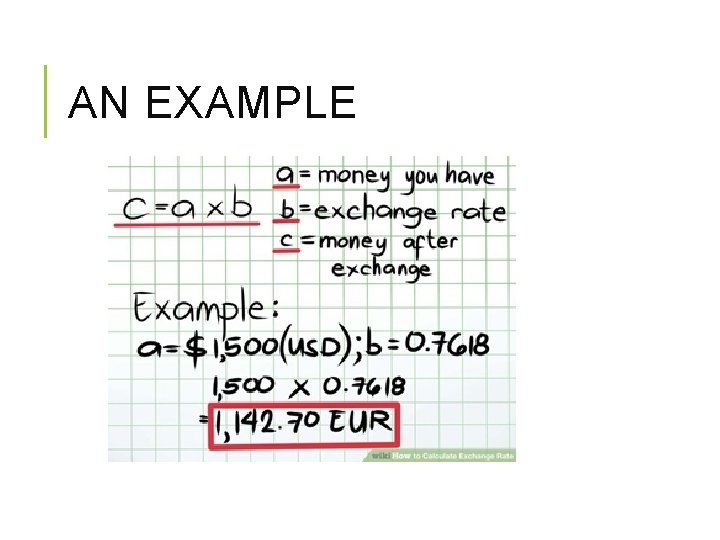
FOR EXAMPLE… Let’s imagine that you import English bone china from Great Britain/United Kingdom that costs $1, 000 The American company must exchange $$1, 000 x 0. 7026 for British Pounds – but, how many? = Figure it out by looking at the table: Then, set up the multiplication: $1 US = 113. 94 yen 702. 6 British Pound s
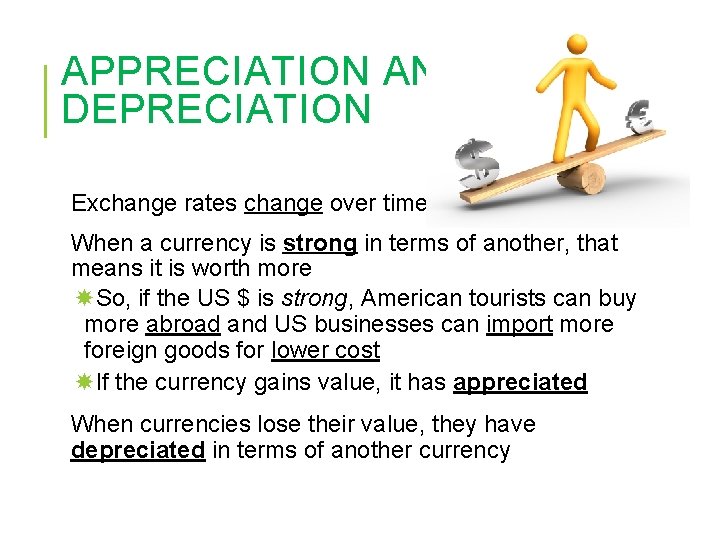
APPRECIATION AND DEPRECIATION Exchange rates change over time When a currency is strong in terms of another, that means it is worth more So, if the US $ is strong, American tourists can buy more abroad and US businesses can import more foreign goods for lower cost If the currency gains value, it has appreciated When currencies lose their value, they have depreciated in terms of another currency
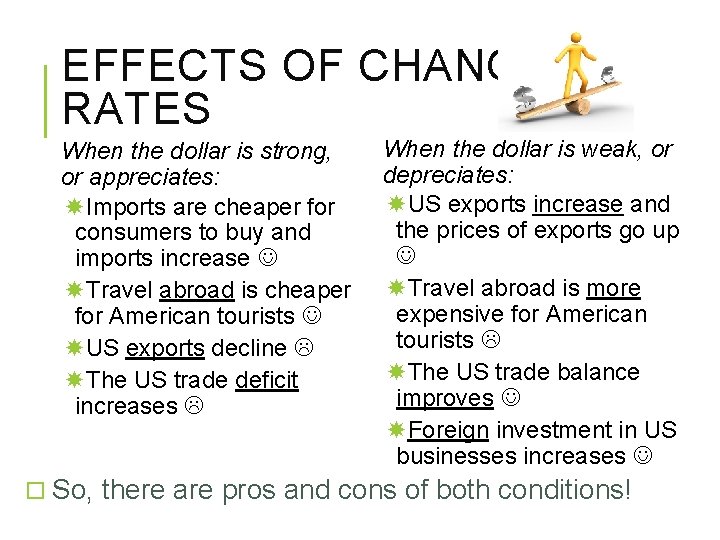
EFFECTS OF CHANGING RATES When the dollar is strong, or appreciates: Imports are cheaper for consumers to buy and imports increase Travel abroad is cheaper for American tourists US exports decline The US trade deficit increases When the dollar is weak, or depreciates: US exports increase and the prices of exports go up Travel abroad is more expensive for American tourists The US trade balance improves Foreign investment in US businesses increases o So, there are pros and cons of both conditions!
WEAK DOLLAR What is a ‘weak’ dollar? The value of the dollar falls compared to other currencies More U. S. dollars are needed to purchase foreign currencies The value of the dollar is depreciating Who is helped by a weak dollar? § U. S. Producers – because they’re competing with higher priced imported goods & services § Foreign Consumers – because they can buy U. S. goods & services at a lower price § U. S. Exporters – because American goods & services become less expensive foreign consumers
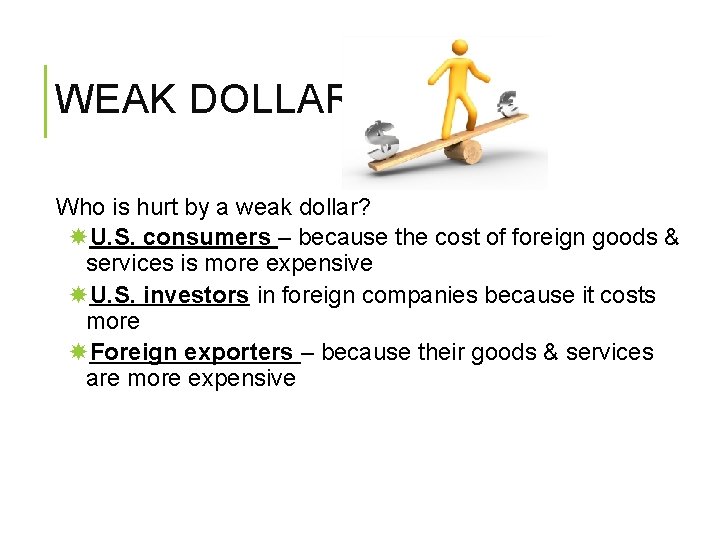
WEAK DOLLAR Who is hurt by a weak dollar? U. S. consumers – because the cost of foreign goods & services is more expensive U. S. investors in foreign companies because it costs more Foreign exporters – because their goods & services are more expensive
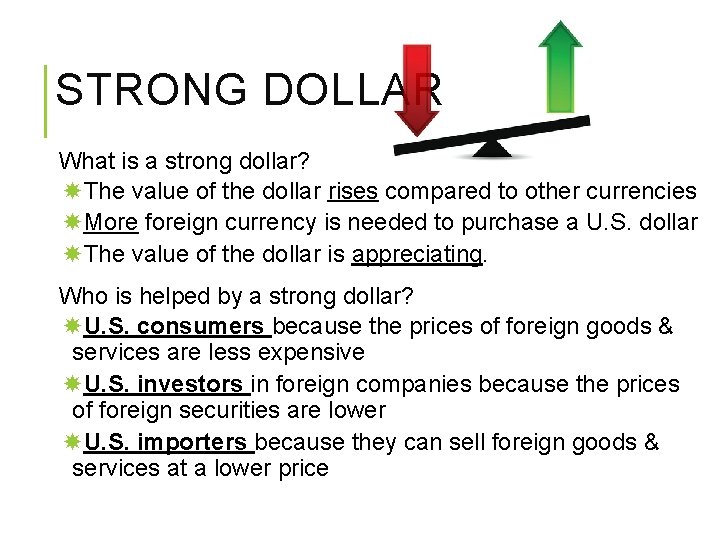
STRONG DOLLAR What is a strong dollar? The value of the dollar rises compared to other currencies More foreign currency is needed to purchase a U. S. dollar The value of the dollar is appreciating. Who is helped by a strong dollar? U. S. consumers because the prices of foreign goods & services are less expensive U. S. investors in foreign companies because the prices of foreign securities are lower U. S. importers because they can sell foreign goods & services at a lower price
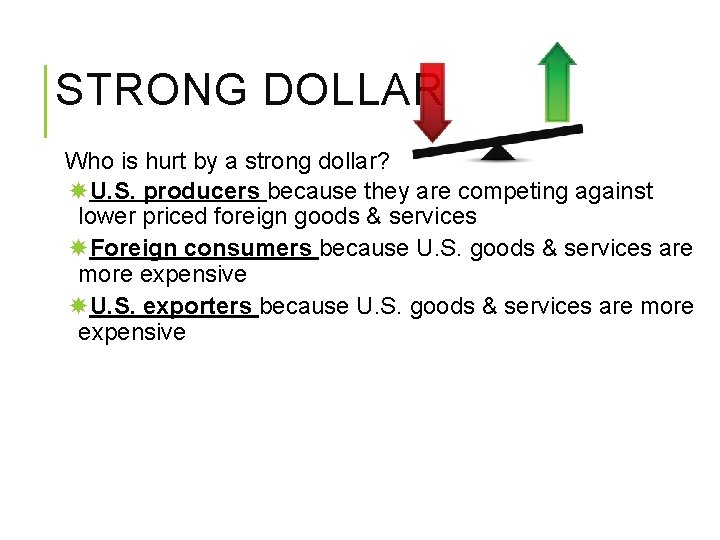
STRONG DOLLAR Who is hurt by a strong dollar? U. S. producers because they are competing against lower priced foreign goods & services Foreign consumers because U. S. goods & services are more expensive U. S. exporters because U. S. goods & services are more expensive
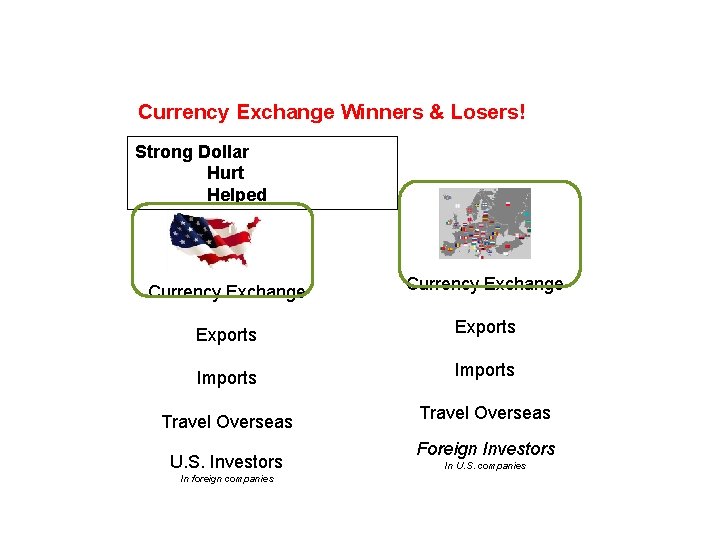
Currency Exchange Winners & Losers! Strong Dollar Hurt Helped Currency Exchange Exports Imports Travel Overseas U. S. Investors In foreign companies Foreign Investors In U. S. companies
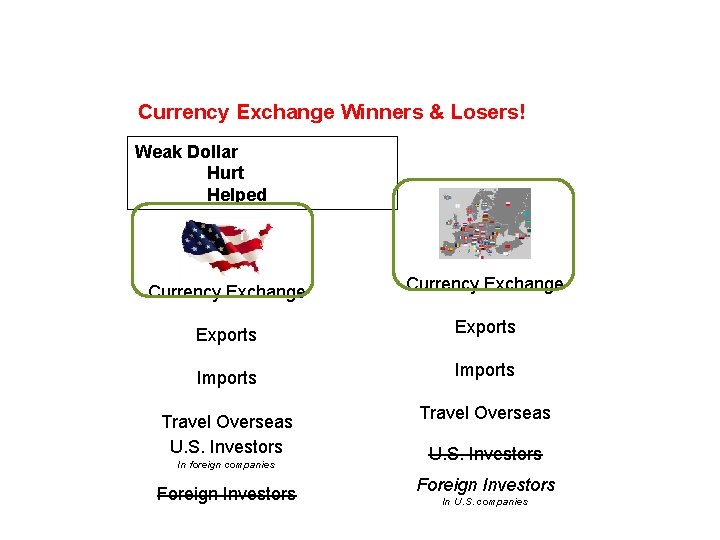
Currency Exchange Winners & Losers! Weak Dollar Hurt Helped Currency Exchange Exports Imports Travel Overseas U. S. Investors Travel Overseas In foreign companies Foreign Investors U. S. Investors Foreign Investors In U. S. companies
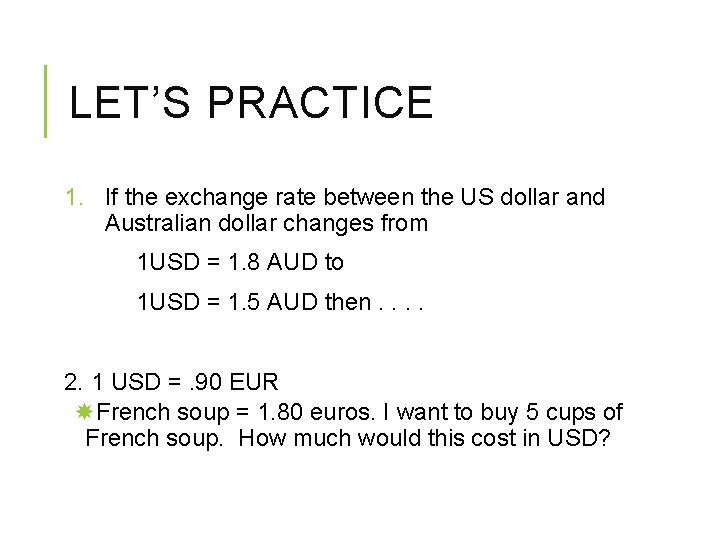
LET’S PRACTICE 1. If the exchange rate between the US dollar and Australian dollar changes from 1 USD = 1. 8 AUD to 1 USD = 1. 5 AUD then. . 2. 1 USD =. 90 EUR French soup = 1. 80 euros. I want to buy 5 cups of French soup. How much would this cost in USD?
IMPORTANCE OF EXCHANGE! Foreign Trade is extremely important – nations work together to produce and consume all types of goods and services And, exchange rates are very important to people involved in international trade, tourism, or investment industries So, changes in exchange rates are posted daily and experts are hired to predict and interpret these changes for the future!
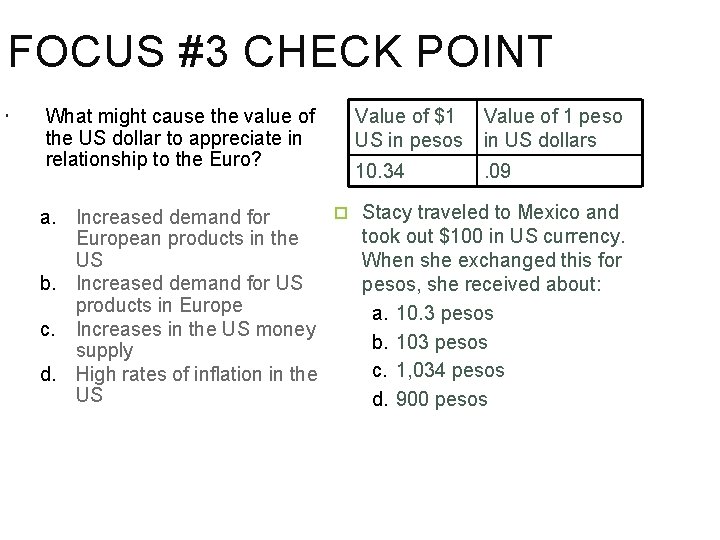
FOCUS #3 CHECK POINT What might cause the value of the US dollar to appreciate in relationship to the Euro? Value of $1 US in pesos Value of 1 peso in US dollars 10. 34 . 09 o Stacy traveled to Mexico and a. Increased demand for took out $100 in US currency. European products in the US When she exchanged this for b. Increased demand for US pesos, she received about: products in Europe a. 10. 3 pesos c. Increases in the US money b. 103 pesos supply c. 1, 034 pesos d. High rates of inflation in the US d. 900 pesos
TIME FOR A FAMILY VACATION! Let’s go on a family vacation by following the clues and seeing how much money we spend as we travel around the world. Goal – foreign currencies to U. S. dollars and add up how much we spend.
Thursday, October 5 th As you come in, leave your ‘stuff’ (bookbag, purse, electronics, basically everything!) at the front of the room and find your country! Country A Favio Angel Ma’Teka Omar Davion Country B Ke’Shaun Grace Tarndeep Brianna Edgar Alberto Country C Kristopher Tamia Jabari Dwight Pedro Elizabeth Country D Emmanuel Brooke Grant Jerome Jennifer Country E Alondra Jose Kodou Kahlial Destiny Trader - Zaionna Sit quietly (yes – it’s possible - ) and wait for further instructions!
Listen Up! Each of your groups is a team and represents a country. The objective for each country is to make as much money for itself as possible by using the materials in the bag you will be given. v. No other materials can be used You will use the materials to manufacture paper shapes. Your country will specialize in the shape on your poster. However, you can decide to also produce other shapes if you’d like.
Manufacturing Specifications All shapes must be cut with clean sharp edges using scissors and must be of the exact size and pattern as displayed on your poster/s. The shapes can then be sold to the trader in batches, who will check them for accuracy and exchange them for cash. v Inaccurate shapes will be rejected. v You can manufacture as many shapes as you like – the more you make, the richer your country will become!
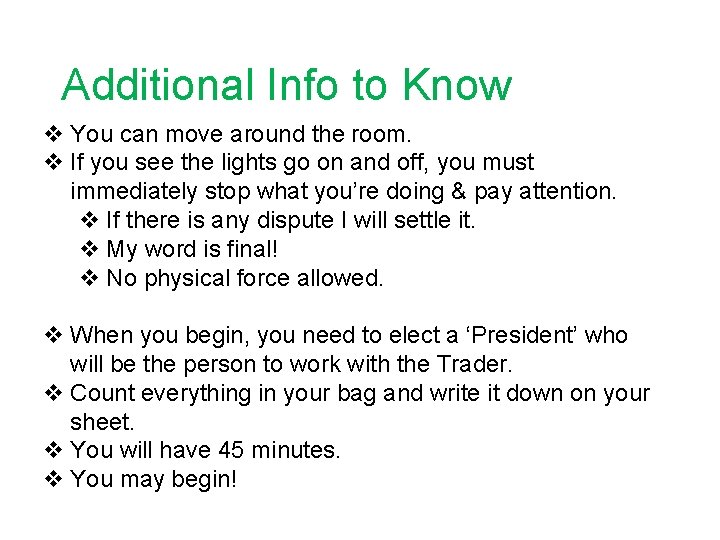
Additional Info to Know v You can move around the room. v If you see the lights go on and off, you must immediately stop what you’re doing & pay attention. v If there is any dispute I will settle it. v My word is final! v No physical force allowed. v When you begin, you need to elect a ‘President’ who will be the person to work with the Trader. v Count everything in your bag and write it down on your sheet. v You will have 45 minutes. v You may begin!
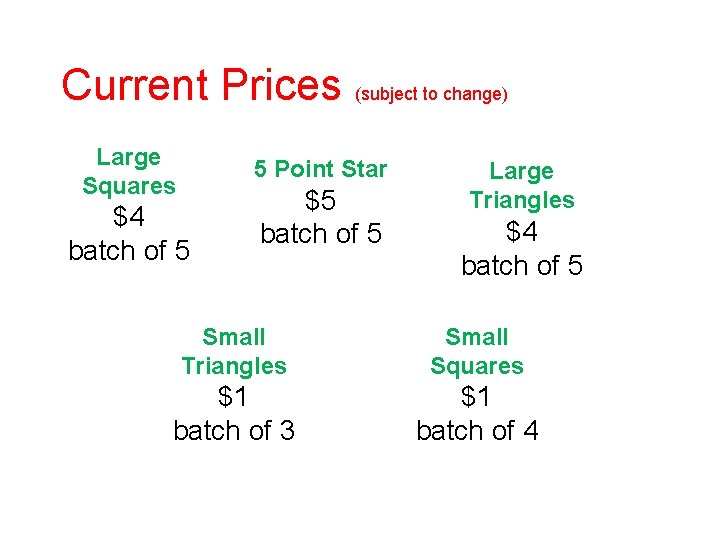
Current Prices (subject to change) Large Squares 5 Point Star $4 batch of 5 $5 batch of 5 Large Triangles $4 batch of 5 Small Triangles Small Squares $1 batch of 3 $1 batch of 4
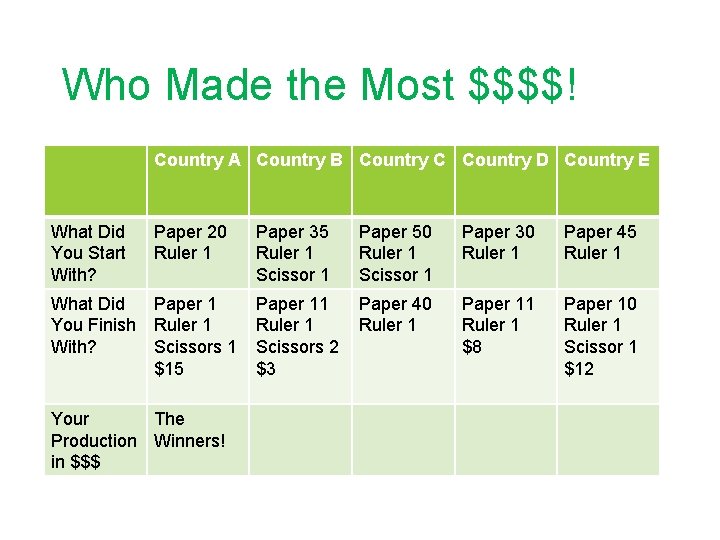
Who Made the Most $$$$! Country A Country B Country C Country D Country E What Did You Start With? Paper 20 Ruler 1 What Did Paper 1 You Finish Ruler 1 With? Scissors 1 $15 Your The Production Winners! in $$$ Paper 35 Ruler 1 Scissor 1 Paper 50 Ruler 1 Scissor 1 Paper 30 Ruler 1 Paper 45 Ruler 1 Paper 11 Ruler 1 Scissors 2 $3 Paper 40 Ruler 1 Paper 11 Ruler 1 $8 Paper 10 Ruler 1 Scissor 1 $12
FRIDAY, OCTOBER 6 TH Good Afternoon! As you come in, please: v. Please sit in your alphabetical seat v. Pull out your Unit 4 classwork and homework v. Staple a cover page on top and turn it in on the Front Table
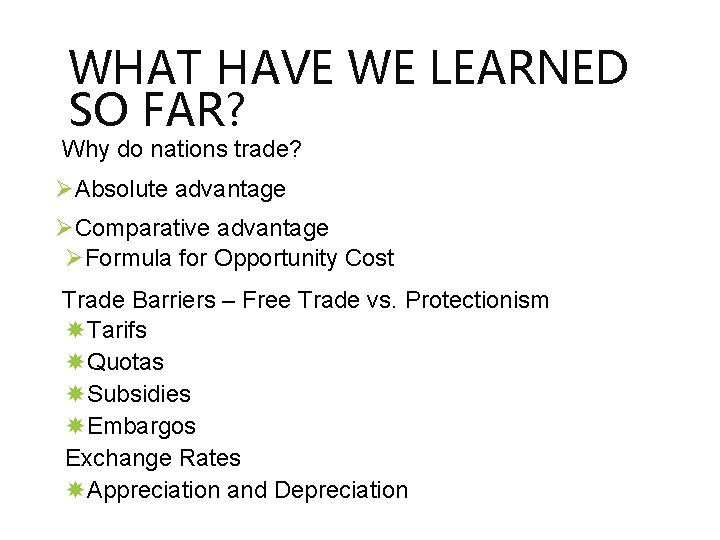
WHAT HAVE WE LEARNED SO FAR? Why do nations trade? ØAbsolute advantage ØComparative advantage ØFormula for Opportunity Cost Trade Barriers – Free Trade vs. Protectionism Tarifs Quotas Subsidies Embargos Exchange Rates Appreciation and Depreciation

Let’s Kahoot!
Time for Test Mode! Please: v. Power down all electronics & pack them away v. Put all your bookbags and purses at the front of the room v. All you need is a pencil v. When you get your bubble sheet, double-check that it’s yours
Test Mode! Just like usual, we’ll be taking the test with bubble sheets AND i. Respond hand-held clickers Remember – until the LAST paper is turned in: v No electronics v No talking v No squawking v No walking v No gawking!
Time for Test Mode! Please: v. Power down all electronics & pack them away v. Put all your bookbags and purses at the front of the room v. All you need is a pencil v. When you get your bubble sheet, double-check that it’s yours
During class today you have 35 minutes to: Hopefully finish your Unit 5 Study Guide Ask any questions Pull together/organize (possibly finish) your Unit 5 classwork and homework Complete additional practice work Review crossword puzzle Flash cards Time permitting, we can do a review game!

Please quickly and calmly turn in your Unit 4 classwork and homework papers. A gift for you – Keep your Unit 4 Study Guide and you can use it to help you with your test! Turn in your Unit 4 Study Guide with your test
Please: Turn your phone off or silent 2. Put it in your book bag/purse/Phone Hotel 3. Clear your desk off 4. Put your bookbag/purse at the front of the classroom 1.
Remember during ‘Test Mode’: 1. 2. 3. 4. 5. No talking No squawking (no noises or disruptions) No walking (raise your hand & I’ll come to you) No gawking (keep your eyes on your own paper) All electronics are gone/gone until the last test is turned in!!
In just a moment we’re heading down to the Betty Grey Computer Lab to give you some time to work on your project before the Fall Break (yeah!!) A little coaching: Catch up over Fall Break (after some sleep!) Add up all your expenses and make sure you’re not spending more than you’re making. You may need to figure out how to cut back in order to live within your disposable income. Add details and make it look neat and presentable to get the most points! Remember – extra forms are


Unit 5 Test Get our your phone and go to your web browser. Go to Kahoot. com and type in our game number Remember to login with your REAL name!
UNIT 5 TEST Remember! No talking No squawking (no disruptions) No gawking (eyes on your own paper) No walking (raise your hand & I’ll come to you) – until all tests are turned in. All multiple choice answers are to be bubbled in on your Zipgrade answer sheet. Remember to answer your Short Answer and Bonus question on the back side of your Zipgrade sheet!
- Slides: 126