
ECONOMICS UNIT FOUR International Economics ECONOMICS IS EVERYWHERE

- Slides: 22
ECONOMICS UNIT FOUR International Economics
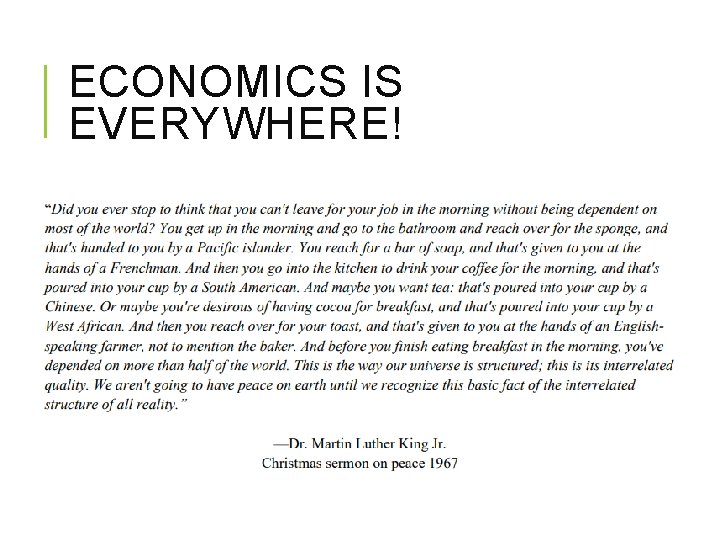
ECONOMICS IS EVERYWHERE!
ECON BIG IDEAS Voluntary Exchange Scarcity Opportunity Cost
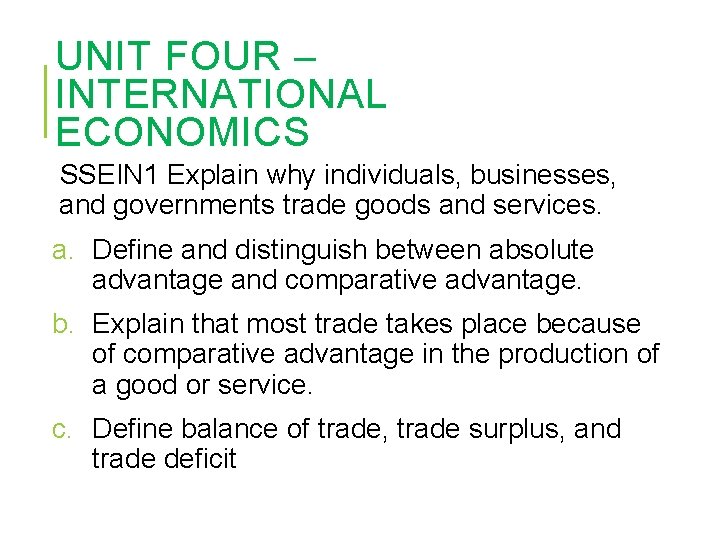
UNIT FOUR – INTERNATIONAL ECONOMICS SSEIN 1 Explain why individuals, businesses, and governments trade goods and services. a. Define and distinguish between absolute advantage and comparative advantage. b. Explain that most trade takes place because of comparative advantage in the production of a good or service. c. Define balance of trade, trade surplus, and trade deficit
GETTING STARTED Global Trade Shift Happens – Original Did You Know 2018
Absolutely Comparative Advantage Unit 4
As a class, brainstorm possible answers to the question: Do yo u h ave an y l o ti o n ? Why do countries trade?
Countries trade because… • they cannot produce a product domestically. • to have a wider variety of goods available to consumers. • even if a they can produce a product, if another country specializes it that item, buying it from them may increase quality and decrease the price. • they wish to conserve limited resources. • other countries have an advantage. Specialize- a task assigned to one person or group that does it more efficiently
I can make m o r e th a n yo u can Type of Advantage There are 2 types of advantage. • Absolute Advantage • Comparative Advantage Anything you can do I can do better Advantage- a condition or circumstance that puts one in a favorable position
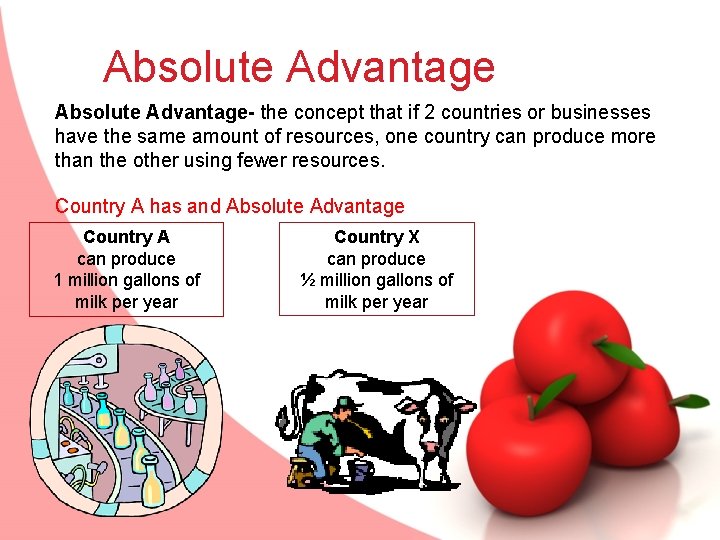
Absolute Advantage- the concept that if 2 countries or businesses have the same amount of resources, one country can produce more than the other using fewer resources. Country A has and Absolute Advantage Country A can produce 1 million gallons of milk per year Country X can produce ½ million gallons of milk per year
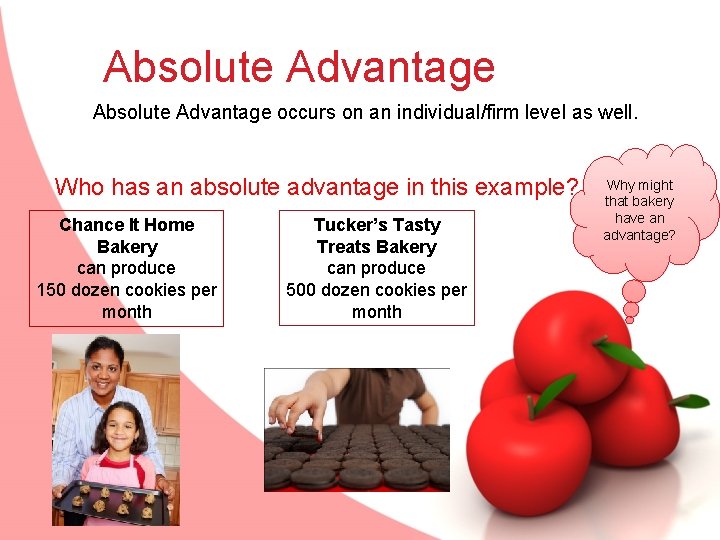
Absolute Advantage occurs on an individual/firm level as well. Who has an absolute advantage in this example? Chance It Home Bakery can produce 150 dozen cookies per month Tucker’s Tasty Treats Bakery can produce 500 dozen cookies per month Why might that bakery have an advantage?
Is Absolute Advantage Everything? Does this mean that Chance It Home Bakery should go out of business because they cannot make as many cookies as Tucker’s Tasty Treats? The answer is no. Absolutely advantage is not the best way to determine who should produce. Can you think of a reason or an example of why Chance It bakery should continue making cookies? L e t’ s co mp are co st
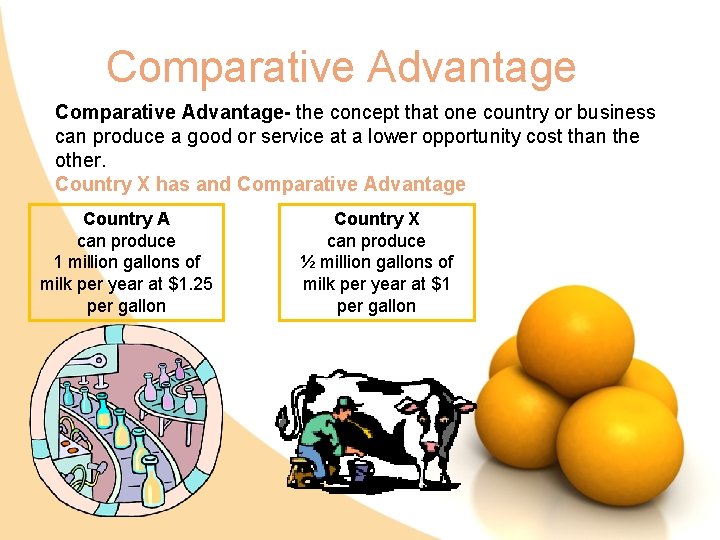
Comparative Advantage- the concept that one country or business can produce a good or service at a lower opportunity cost than the other. Country X has and Comparative Advantage Country A can produce 1 million gallons of milk per year at $1. 25 per gallon Country X can produce ½ million gallons of milk per year at $1 per gallon
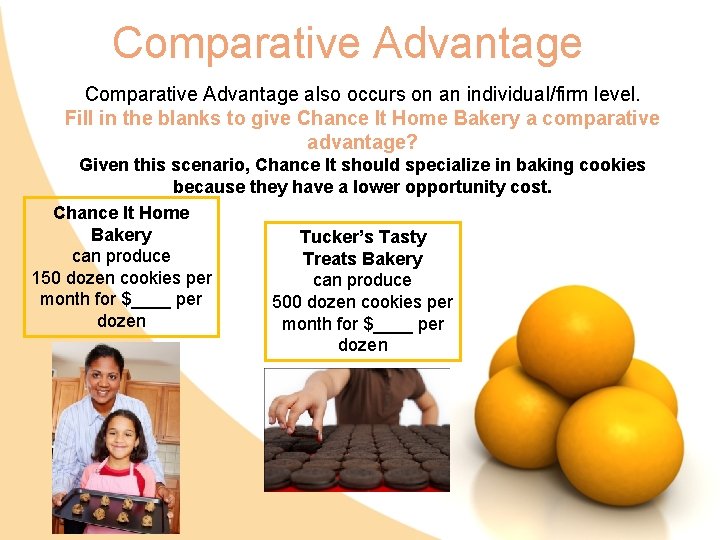
Comparative Advantage also occurs on an individual/firm level. Fill in the blanks to give Chance It Home Bakery a comparative advantage? Given this scenario, Chance It should specialize in baking cookies because they have a lower opportunity cost. Chance It Home Bakery Tucker’s Tasty can produce Treats Bakery 150 dozen cookies per can produce month for $____ per 500 dozen cookies per dozen month for $____ per dozen
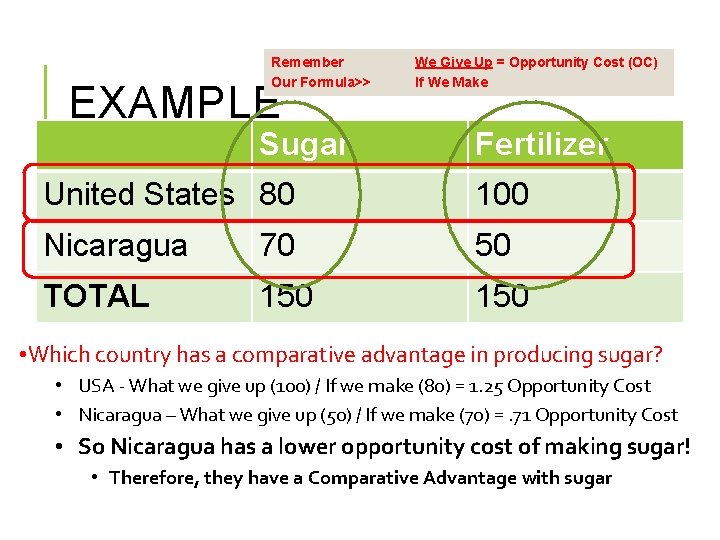
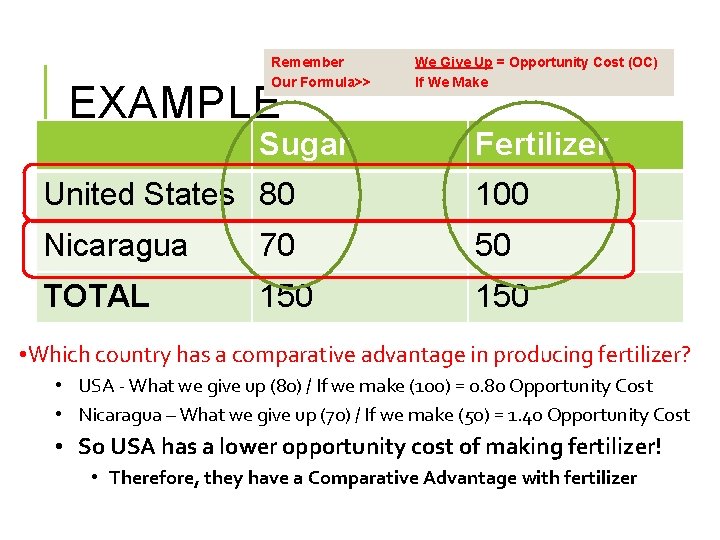
How to Calculate Comparative Advantage • Remember this formula We Give Up = Your Opportunity Cost If We Make
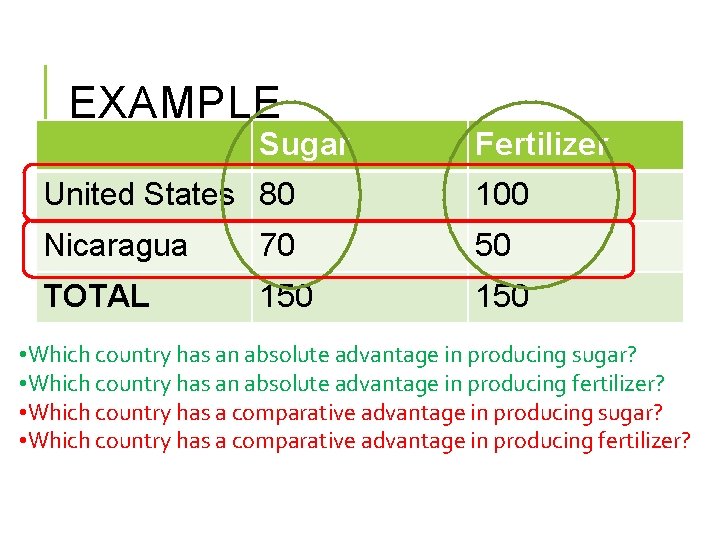
EXAMPLE Sugar Fertilizer United States 80 100 Nicaragua 70 50 TOTAL 150 • Which country has an absolute advantage in producing sugar? • Which country has an absolute advantage in producing fertilizer? • Which country has a comparative advantage in producing sugar? • Which country has a comparative advantage in producing fertilizer?
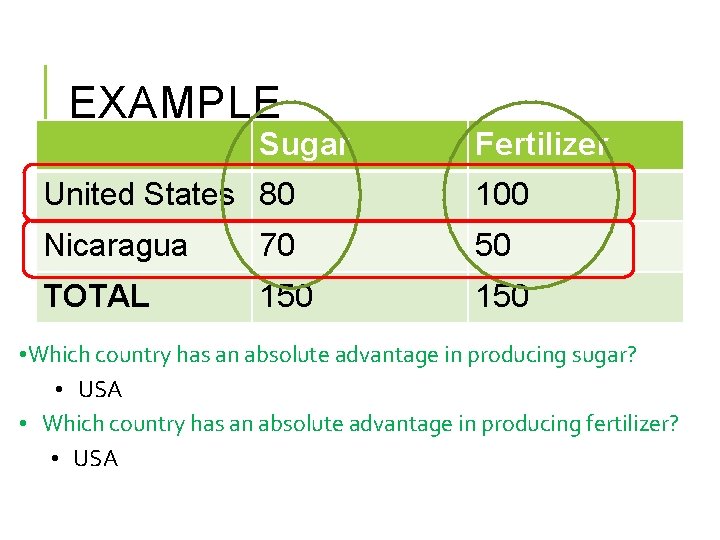
EXAMPLE Sugar Fertilizer United States 80 100 Nicaragua 70 50 TOTAL 150 • Which country has an absolute advantage in producing sugar? • USA • Which country has an absolute advantage in producing fertilizer? • USA
Remember Our Formula>> EXAMPLE Sugar We Give Up = Opportunity Cost (OC) If We Make Fertilizer United States 80 100 Nicaragua 70 50 TOTAL 150 • Which country has a comparative advantage in producing sugar? • USA - What we give up (100) / If we make (80) = 1. 25 Opportunity Cost • Nicaragua – What we give up (50) / If we make (70) =. 71 Opportunity Cost • So Nicaragua has a lower opportunity cost of making sugar! • Therefore, they have a Comparative Advantage with sugar
Remember Our Formula>> EXAMPLE Sugar We Give Up = Opportunity Cost (OC) If We Make Fertilizer United States 80 100 Nicaragua 70 50 TOTAL 150 • Which country has a comparative advantage in producing fertilizer? • USA - What we give up (80) / If we make (100) = 0. 80 Opportunity Cost • Nicaragua – What we give up (70) / If we make (50) = 1. 40 Opportunity Cost • So USA has a lower opportunity cost of making fertilizer! • Therefore, they have a Comparative Advantage with fertilizer
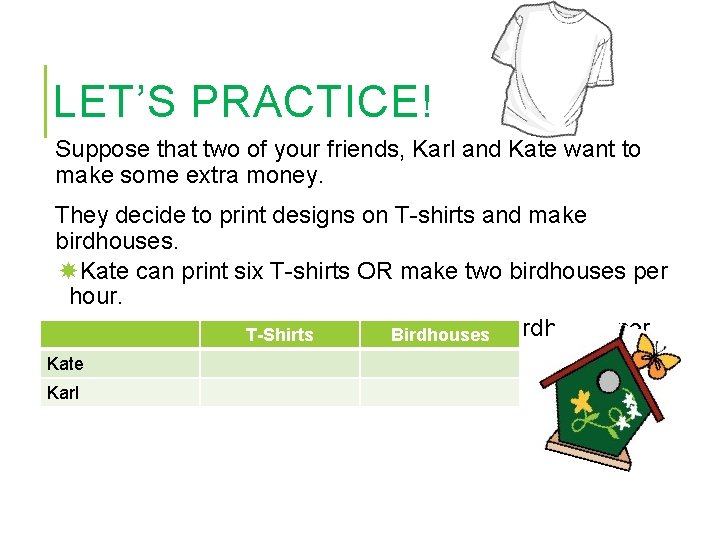
LET’S PRACTICE! Suppose that two of your friends, Karl and Kate want to make some extra money. They decide to print designs on T-shirts and make birdhouses. Kate can print six T-shirts OR make two birdhouses per hour. Karl can print one T-shirt OR Birdhouses make one birdhouse per T-Shirts hour. Kate Karl
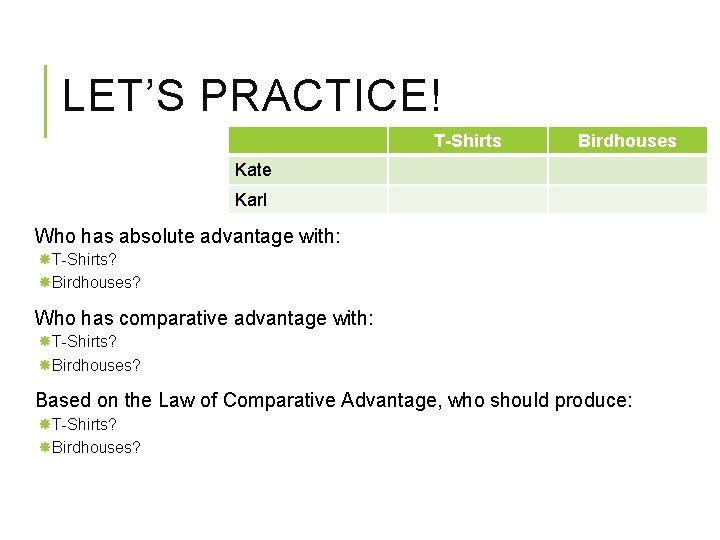
LET’S PRACTICE! T-Shirts Birdhouses Kate Karl Who has absolute advantage with: T-Shirts? Birdhouses? Who has comparative advantage with: T-Shirts? Birdhouses? Based on the Law of Comparative Advantage, who should produce: T-Shirts? Birdhouses?
The US can make more televisions than China so why don’t we make our own? According to The US Department of Labor, federal minimum wage is $7. 25 per hour. In China, individual provinces set the minimum wage. There is no federal or national minimum wage. In one of the highest paying provinces Shenzhen, minimum wage in 1, 300 Yuan per month which works out to approximately $1. 29 per hour. If it takes a 6 hours of labor to build a television it would cost: $43. 50 in labor if made in the US $7. 74 in labor if made in China Because labor is so much cheaper in China, it makes sense that they would specialize in manufacturing products that required a great deal of low skilled labor, while the US specializes in producing goods and services that require a great deal of human and physical capital.