
Economics of Technical Compatibility Standards Yale Braunstein Background
Economics of Technical Compatibility Standards Yale Braunstein
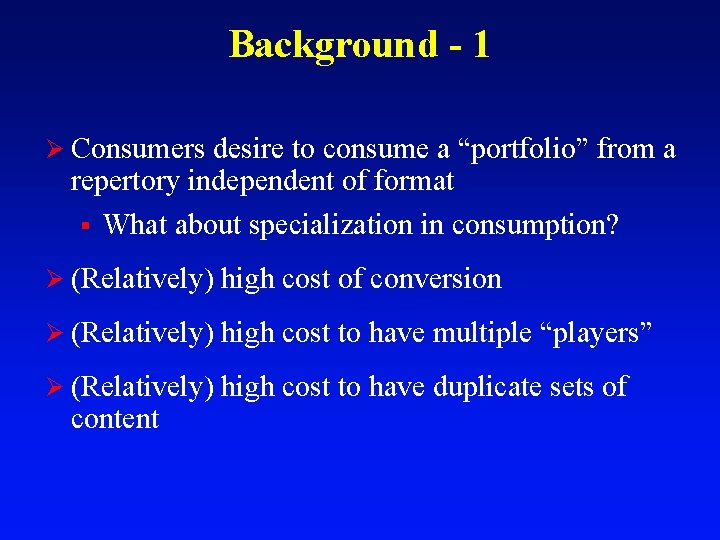
Background - 1 Ø Consumers desire to consume a “portfolio” from a repertory independent of format § What about specialization in consumption? Ø (Relatively) high cost of conversion Ø (Relatively) high cost to have multiple “players” Ø (Relatively) high cost to have duplicate sets of content
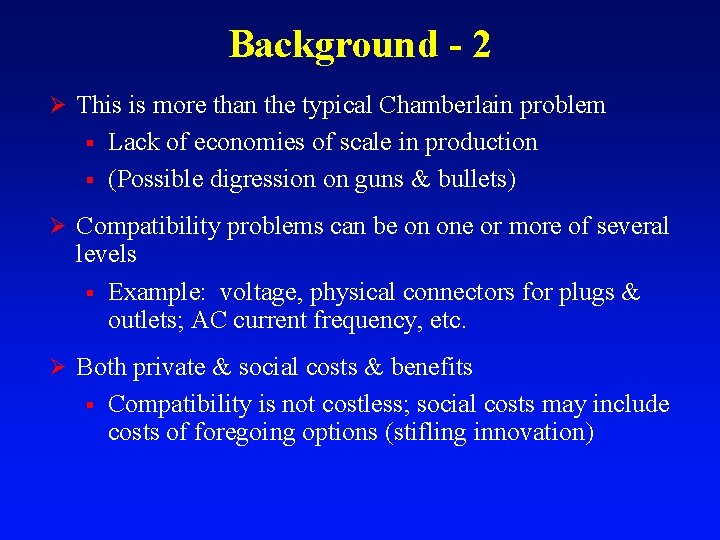
Background - 2 Ø This is more than the typical Chamberlain problem § § Lack of economies of scale in production (Possible digression on guns & bullets) Ø Compatibility problems can be on one or more of several levels § Example: voltage, physical connectors for plugs & outlets; AC current frequency, etc. Ø Both private & social costs & benefits § Compatibility is not costless; social costs may include costs of foregoing options (stifling innovation)
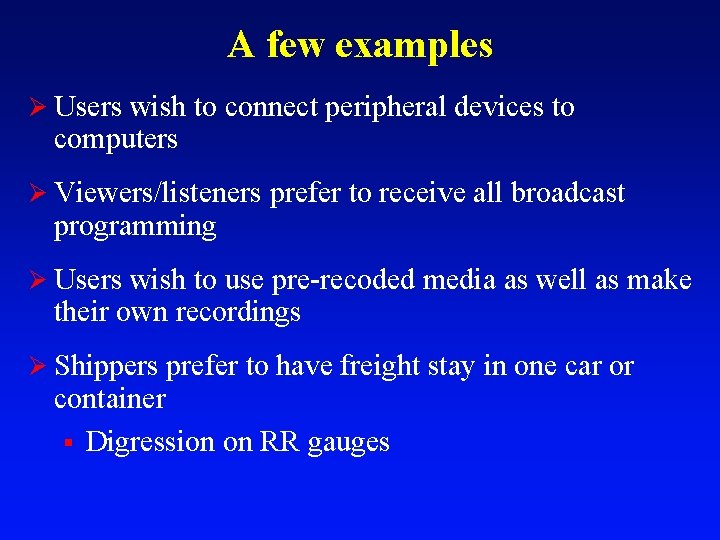
A few examples Ø Users wish to connect peripheral devices to computers Ø Viewers/listeners prefer to receive all broadcast programming Ø Users wish to use pre-recoded media as well as make their own recordings Ø Shippers prefer to have freight stay in one car or container § Digression on RR gauges
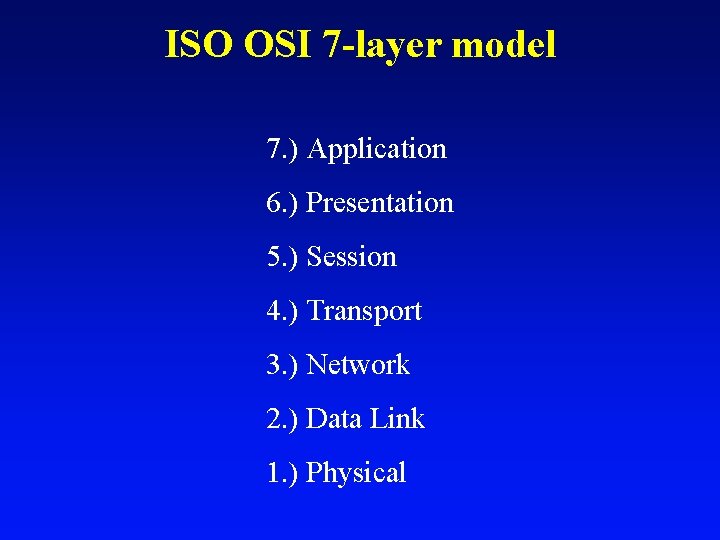
ISO OSI 7 -layer model 7. ) Application 6. ) Presentation 5. ) Session 4. ) Transport 3. ) Network 2. ) Data Link 1. ) Physical

Approaches to compatibility Ø National & international standards bodies § ITU, ETSI, ANSI, … Ø Directed vs. undirected § § National industrial policy Leave it to the market Compulsory licensing Require open standards Ø Ethernet as a case study
More on social gains & losses Ø Gains § Reduction in “translation” costs, duplicate equipment, duplicate repertories, etc. Ø Losses § § § Loss of technologies with unique properties or highly valued by a few Premature scrapping of no-longer compatible equipment Barriers to entry Ø Timing § § Premature decisions forcing compatibility may lead to “wrong” choices But, the longer you wait, the greater the “lost” investment
Positive models Ø Importance of “specialized” vs. “portfolio” consumers Ø Importance of “locus” of decision making § § § Equipment manufacturers Broadcasters Etc.
Antitrust & regulatory issues Ø Be suspicious of arrangements that are collusive or increase barriers to entry Ø Vertical integration may be socially useful Ø Regulate to avoid negative externatities
- Slides: 9